Adrian Peterson is the SOG Sports pick for the best NFL running back of the 2010s. LeSean McCoy produced the strongest full-decade volume, Marshawn Lynch became the heartbeat of a championship offense and Le’Veon Bell helped redefine how a three-down back could control a game. Peterson still takes the top spot because his 2012 MVP season reached a level no other runner matched during the decade.
This is an editorial ranking, not a rushing-yards leaderboard. It evaluates what each player did from the 2010 regular season through the 2019 season, with the greatest weight placed on peak value, sustained production, efficiency, receiving impact, awards, durability and postseason performance.
How We Ranked the Best Running Backs of the 2010s
Only performance inside the decade determines placement. Seasons before 2010 or after 2019 can provide career context, but they do not add ranking value. Chris Johnson’s 2,006-yard season in 2009, for example, is not part of his case here. The same rule limits late-decade stars such as Christian McCaffrey, Derrick Henry, Alvin Kamara, Saquon Barkley and Nick Chubb.
Peak performance mattered most. A back who delivered two or three truly game-changing seasons could rank above a steadier player whose production never threatened the same ceiling. Sustained excellence still mattered, especially when it survived changes in quarterbacks, coaches or blocking quality.
Rushing was the foundation, but this was also the decade in which receiving became essential to the position’s value. Bell, Matt Forte, McCaffrey, Kamara, Darren Sproles and Arian Foster gained ground because they could alter coverages and remain dangerous in any down-and-distance situation. Awards, playoff moments and team context separated otherwise close cases rather than replacing the regular-season résumé.
What the Decade Data Says
McCoy has the cleanest statistical argument for No. 1. He led all running backs during the 2010s with 10,434 rushing yards and 13,923 yards from scrimmage. Frank Gore finished second among backs with 11,851 scrimmage yards, followed by Forte at 11,353 and Peterson at 11,268. That gap is why McCoy ranks ahead of every back except Peterson.
Peterson’s advantage comes from the top of the résumé. He rushed for 2,097 yards and won league MVP in 2012, then captured another rushing title in 2015. He also led all players in the decade with 71 rushing touchdowns, narrowly ahead of McCoy’s 69 and Lynch’s 68. The volume belongs to McCoy; the most valuable peak and the slight rushing-touchdown edge belong to Peterson.
The NFL’s official 2010s All-Decade Team selected Peterson, McCoy, Lynch and Gore at running back. All four make this top eight, but this ranking also rewards the shorter, higher receiving peaks of Bell, Forte and Foster.
Best Running Backs of the 2010s: Nos. 30–21
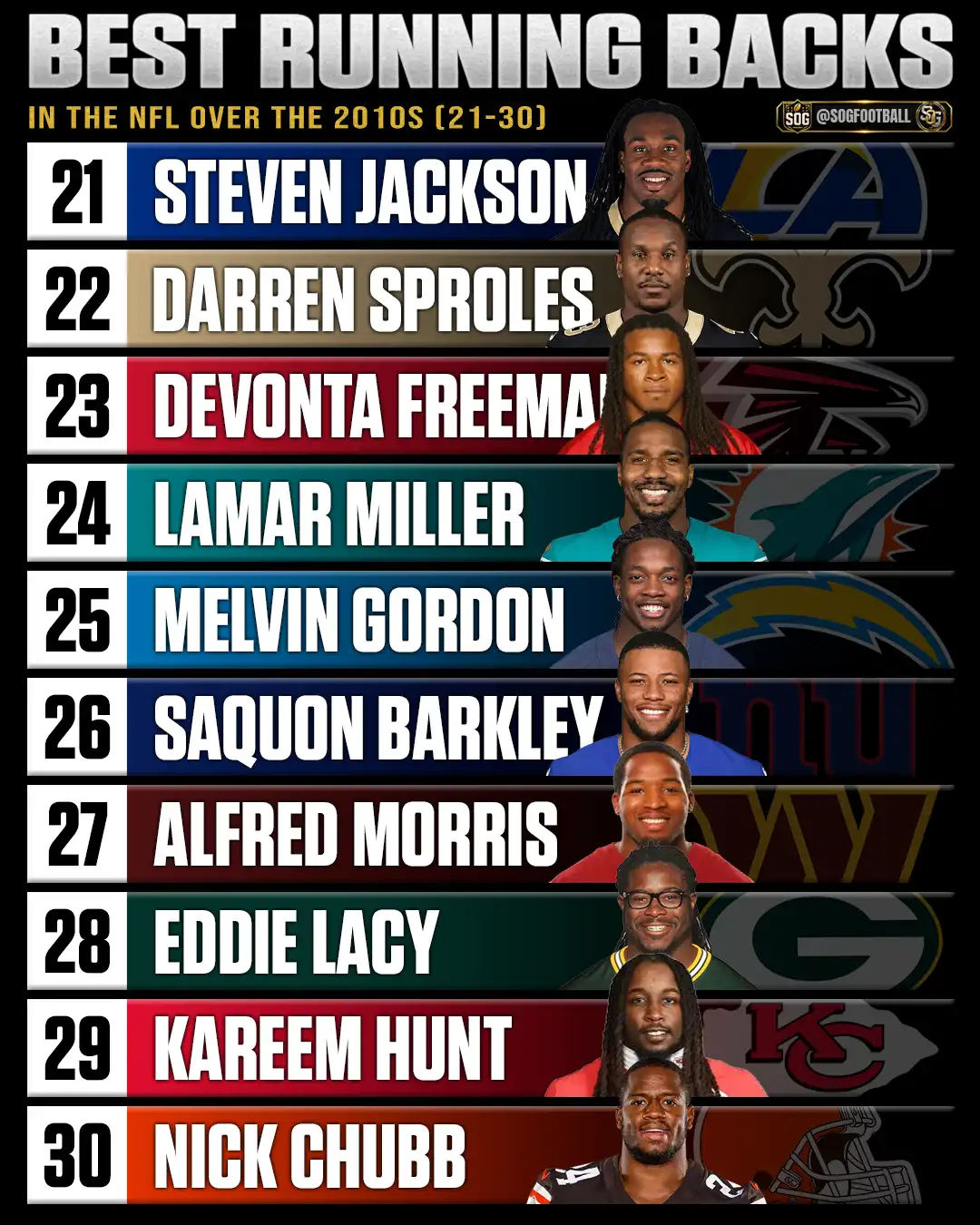
Running backs ranked 21 through 30 in the NFL over the 2010s, featuring Steven Jackson, Darren Sproles and Devonta Freeman.
30. Nick Chubb
Nick Chubb had only two seasons to build a 2010s résumé, but both revealed elite rushing quality. He nearly reached 1,000 yards as a 2018 rookie despite opening the season behind Carlos Hyde, then exploded for 1,494 rushing yards in 2019.
Chubb’s vision, balance and efficiency earn the final spot. The two-year sample prevents a higher placement, but few runners closed the decade looking more complete on the ground.
29. Kareem Hunt
Kareem Hunt led the NFL with 1,327 rushing yards as a 2017 rookie and added 455 receiving yards. His contact balance and receiving skill gave Kansas City a runner who could punish the light boxes created by Andy Reid’s passing game.
The short Chiefs run and the suspension that followed limit his decade case. At his best, however, Hunt delivered top-10 weekly value and could stay on the field in any game script.
28. Eddie Lacy
Eddie Lacy won Offensive Rookie of the Year in 2013 after rushing for 1,178 yards. He followed it with 1,139 rushing yards, 427 receiving yards and 13 total touchdowns in 2014.
The prime faded quickly, but Green Bay’s offense was more balanced when Lacy supplied power and finishing ability. Two high-level seasons are enough to keep him inside the top 30.
27. Alfred Morris
Alfred Morris produced one of the decade’s best rookie rushing seasons in 2012: 1,613 yards, 13 touchdowns and a central role in Washington’s zone-read offense with Robert Griffin III.
Morris offered little as a receiver, which matters in this era. His vision, patience and downhill consistency still made him one of football’s most productive pure runners from 2012 through 2014.
26. Saquon Barkley
Saquon Barkley entered the league near the decade’s end, but his 2018 rookie season was impossible to ignore. He generated 1,307 rushing yards, 721 receiving yards, 91 catches and 15 total touchdowns.
Few backs were more dangerous in space. The limited two-season window keeps Barkley in the 20s here; his work in the following decade is considered separately in the SOG Sports ranking of the best NFL running backs since 2020.
25. Melvin Gordon
Melvin Gordon recovered from a difficult rookie year to become one of the late 2010s’ better touchdown backs. From 2016 through 2018, he gave the Chargers rushing volume, goal-line production and enough receiving value to remain useful on passing downs.
His best all-around season came in 2018, when he totaled 885 rushing yards, 490 receiving yards and 14 touchdowns in only 12 games. Missed time and uneven efficiency keep him in the back third of the ranking.
24. Lamar Miller
Lamar Miller gave Miami and Houston seven seasons of credible starting-back value. His cleanest peak came with the Dolphins in 2014, when he rushed for 1,099 yards at 5.1 yards per carry.
Miller’s case is based on speed, consistency and versatility rather than awards. He created chunk plays without needing 25 touches and finished 13th among running backs in 2010s yards from scrimmage.
23. Devonta Freeman
Devonta Freeman’s best two-year run was outstanding. He produced 1,634 yards from scrimmage and 14 total touchdowns in 2015, then exceeded 1,500 scrimmage yards again for Atlanta’s 2016 Super Bowl team.
Freeman fit perfectly in a spread-out zone offense, where he could press the line, make a decisive cut and win underneath as a receiver. Injuries shortened the prime, but the 2015–2016 version was one of the league’s most complete backs.
22. Darren Sproles
Darren Sproles did not resemble a traditional feature back, but his receiving and return value stretched the position. His 2011 season with New Orleans was the clearest example: 1,313 yards from scrimmage, 86 catches and major special-teams impact in the same package.
Sproles was a specialist, not a gimmick. He forced linebackers and safeties to defend the entire field and remained useful deep into his 30s.
21. Steven Jackson
Steven Jackson’s greatest seasons came before the decade, but he opened the 2010s with three straight 1,000-yard rushing campaigns. He reached those totals while carrying a Rams offense that rarely created favorable boxes.
Jackson lacks the in-decade peak of the players above him. His ability to create difficult yardage and absorb work through 2012 gives him the stronger case than most other veterans whose primes crossed the decade line.
Best Running Backs of the 2010s: Nos. 20–11
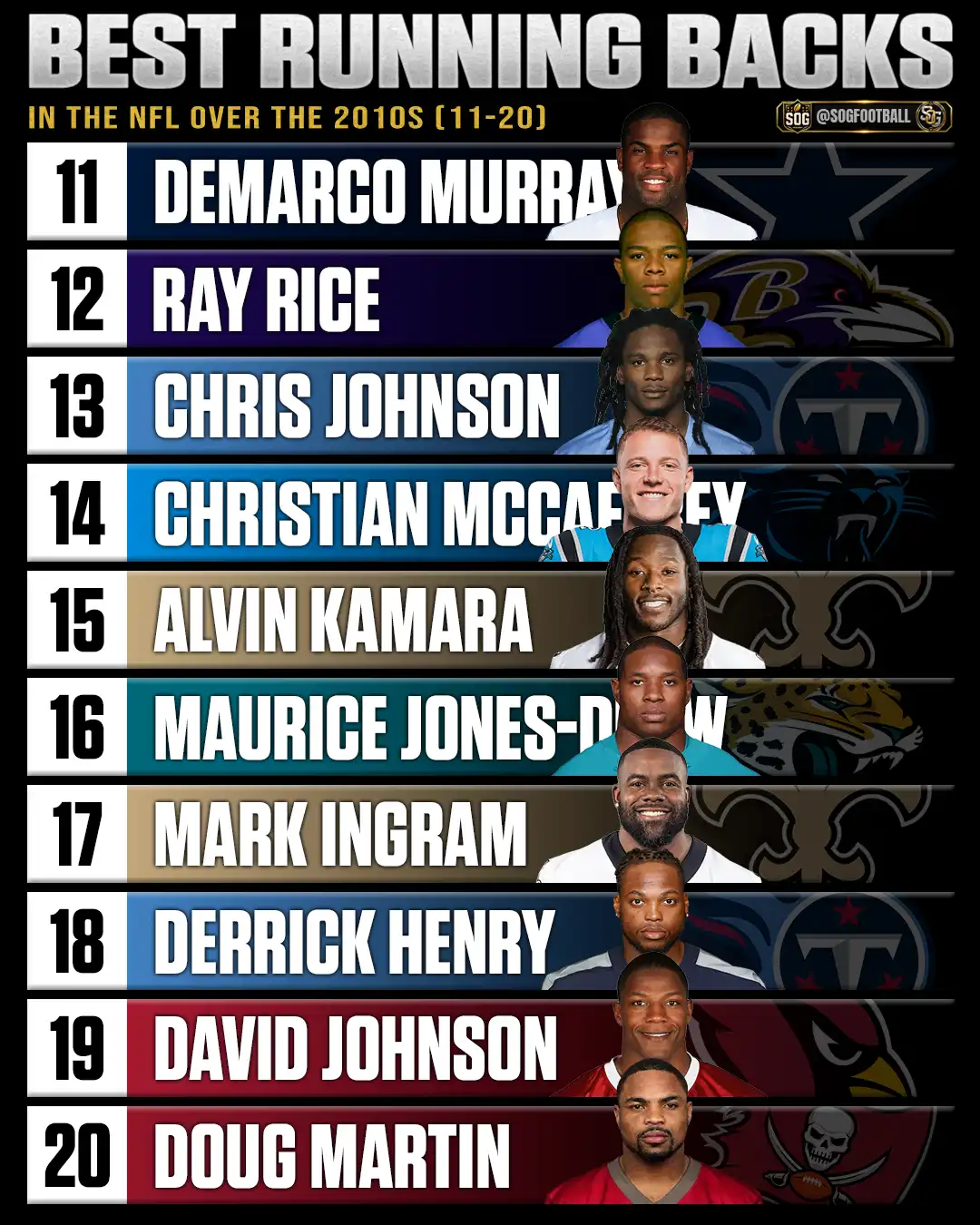
Running backs ranked 11 through 20 in the NFL over the 2010s, including DeMarco Murray, Ray Rice and Chris Johnson.
20. Doug Martin
Doug Martin built his ranking around two enormous seasons. As a 2012 rookie, he amassed 1,454 rushing yards, 472 receiving yards and 12 total touchdowns. He returned to that level in 2015 with 1,402 rushing yards at 4.9 yards per carry.
The seasons between and after those peaks were far less dependable. Martin’s best version was top-10 caliber, but he did not sustain it long enough to climb beyond No. 20.
19. David Johnson
David Johnson’s 2016 campaign was one of the decade’s greatest all-purpose seasons: 1,239 rushing yards, 879 receiving yards, 80 catches and 20 total touchdowns.
At his best, Johnson paired a wide receiver’s route value with feature-back volume and goal-line power. Injuries reduced the prime to a brief window, but the height of that one-season peak earns a top-20 position.
18. Derrick Henry
Derrick Henry’s decade ended just as he was becoming the league’s most imposing runner. He led the NFL with 1,540 rushing yards and 16 rushing touchdowns in 2019, then powered Tennessee through New England and Baltimore in the playoffs.
Early in his career, Henry shared work and did not yet have the volume that defined his 2020s. Only the 2010s count here, but his rushing title and postseason takeover comfortably place him in the top 20.
17. Mark Ingram
Mark Ingram supplied dependable production in two very different offenses, first within Sean Payton’s rotation in New Orleans and then as a tone-setter for Baltimore’s record-setting 2019 rushing attack.
His best Saints season came in 2017, when he rushed for 1,124 yards and 12 touchdowns while sharing the backfield with Alvin Kamara. Ingram’s case rests on efficient multi-year value rather than one overwhelming peak.
16. Maurice Jones-Drew
Maurice Jones-Drew’s prime crossed two decades, but his 2011 season belongs among the best performances on this list. He led the NFL with 1,606 rushing yards despite playing in an offense that gave defenses every reason to load the box.
That rushing title carries significant weight because of the conditions around it. His production declined quickly after 2011, which keeps a spectacular peak outside the top 15.
15. Alvin Kamara
Alvin Kamara entered the league in 2017 and immediately changed New Orleans’ spacing. As a rookie, he produced 728 rushing yards, 826 receiving yards and 13 total touchdowns on exceptional efficiency.
Kamara did not require feature-back carry totals to tilt games. His route running, tackle-breaking and red-zone utility made him one of the NFL’s hardest matchups from his first season.
14. Christian McCaffrey
Christian McCaffrey had only three seasons in the decade, but his 2019 performance forces him this high. He rushed for 1,387 yards, added 1,005 receiving yards, caught 116 passes and scored 19 total touchdowns.
Carolina did not merely throw him checkdowns; the Panthers built their offense through his ability to run between the tackles, separate from coverage and create after the catch. A longer 2010s sample would have made him a top-10 threat.
13. Chris Johnson
Chris Johnson’s famous 2,006-yard season came in 2009 and receives no ranking credit here. Even without it, he opened the decade with 1,364 rushing yards in 2010 and added 1,243 in 2012.
Johnson was no longer at his absolute peak, but his speed continued to dictate pursuit angles and punish a single missed fit. His strong early-decade volume keeps him near the top 12.
12. Ray Rice
Ray Rice was one of the league’s most complete backs from 2010 through 2012. His 2011 high point included 1,364 rushing yards, 704 receiving yards and 15 total touchdowns.
Rice had the contact balance to work between the tackles and the receiving skill to punish defenses underneath. His production collapsed in 2013, and his Ravens tenure ended before the 2014 season after his domestic-violence case and suspension. This placement evaluates the on-field résumé within the decade, where his three-year peak belongs just outside the top 10.
11. DeMarco Murray
DeMarco Murray narrowly misses the top 10 because his 2014 season was one of the decade’s defining workload performances. He rushed for 1,845 yards, added 416 receiving yards and won Offensive Player of the Year as Dallas finished 12–4.
Murray had other productive years, including a 1,287-yard rushing season with Tennessee in 2016, but he never sustained the Dallas peak. In a ranking based only on the best single season, he would place much higher.
Best Running Backs of the 2010s: Nos. 10–1

The top 10 running backs in the NFL over the 2010s, led by Adrian Peterson, LeSean McCoy and Marshawn Lynch.
10. Ezekiel Elliott
Ezekiel Elliott arrived with a throwback rookie season in 2016, leading the NFL with 1,631 rushing yards while scoring 16 total touchdowns. He gave Dallas a weekly identity immediately.
Elliott won another rushing title in 2018 with 1,434 yards and added 77 catches. His four-season sample is shorter than those of several backs below him, but two rushing crowns, durability and high-volume consistency earn the final top-10 spot.
9. Todd Gurley
Todd Gurley’s peak was brief and spectacular. In 2017, he generated 2,093 yards from scrimmage and 19 total touchdowns while winning Offensive Player of the Year. He followed with 1,831 scrimmage yards and 21 touchdowns in 2018.
Gurley was the ideal centerpiece for Sean McVay’s offense: dangerous against light boxes, decisive in outside zone and explosive after the catch. His knee issues and shorter prime prevent a higher rank, but few backs ever matched that two-year ceiling.
8. Jamaal Charles
Jamaal Charles combined feature-back production with extraordinary efficiency. He rushed for 1,467 yards at 6.4 yards per carry in 2010, then delivered the fullest version of his game in 2013: 1,287 rushing yards, 693 receiving yards and 19 total touchdowns.
Injuries cost Charles the longevity of the seven players above him. On a per-touch basis, though, no running back in the decade was more dangerous.
7. Frank Gore
Frank Gore’s case is built on consistency, toughness and productive longevity across systems. He ranked second among 2010s running backs with 11,851 yards from scrimmage and recorded five 1,000-yard rushing seasons during the decade.
Gore did not have the decade-defining peak of Peterson, Bell or Foster. His floor, availability and ability to remain a starting-caliber runner into his 30s were exceptional.
6. Arian Foster
Arian Foster seized the league in 2010, leading the NFL with 1,616 rushing yards while adding 604 receiving yards and 18 total touchdowns. He followed with two more seasons above 1,600 yards from scrimmage.
Foster’s patience and vision made Houston’s zone-running system look effortless, while his receiving skill kept the entire playbook open. Injuries shortened his prime, but from 2010 through 2012 he was one of football’s most valuable offensive players.
5. Matt Forte
Matt Forte played the modern version of the position before every offense demanded it. He handled volume carries, caught passes at a wide receiver’s rate and remained dependable enough in protection to stay on the field in any situation.
His 2014 season is the clearest proof: 1,038 rushing yards, 808 receiving yards and an NFL-record 102 catches by a running back at the time. Forte finished third among 2010s backs with 11,353 yards from scrimmage, giving him elite longevity as well as versatility.
4. Le’Veon Bell
Le’Veon Bell changed the tempo of NFL running. His hesitation was controlled rather than slow: he waited for blocks to declare, then accelerated through lanes other backs would have abandoned.
Bell produced 2,215 yards from scrimmage in 2014, including 854 receiving yards. He carried a huge workload again in 2017 and finished with 1,946 scrimmage yards. The 2018 holdout and short peak weaken his longevity case, but his best Steelers seasons were too complete to rank lower.
3. Marshawn Lynch
Marshawn Lynch gave Seattle exactly the running back its championship identity required. From 2011 through 2014, he rushed for more than 1,200 yards every season and scored 48 rushing touchdowns.
His statistical peak came in 2012 with 1,590 rushing yards, but his value extended into January. Lynch could turn a blocked-up play into punishment, close games against tired defenses and set the physical tone for two NFC championship teams.
2. LeSean McCoy
LeSean McCoy was the decade’s most creative open-field runner. He could stop, restart and cut across pursuit angles in ways that made defenders wrong even when they entered the correct gap.
His 2013 peak included 1,607 rushing yards, 2,146 yards from scrimmage and a rushing title. More importantly, McCoy sustained the production: he led every 2010s back in rushing yards and yards from scrimmage. His 20-touchdown 2011 season, receiving value and later success in Buffalo make him the closest challenger for No. 1.
1. Adrian Peterson
Adrian Peterson ranks first because his 2012 performance was the decade’s greatest running back season. Less than a year after major knee surgery, he rushed for 2,097 yards, carried Minnesota to the playoffs and became the first non-quarterback since 2006 to win league MVP.
Peterson was more than one historic year. He won another rushing title in 2015 with 1,485 yards and finished the decade with an NFL-best 71 rushing touchdowns. McCoy owns the stronger full-decade volume, Bell and Forte offered more receiving value, and Lynch built the greater postseason identity. Nobody, however, reached Peterson’s rushing peak.
Closest Calls and Toughest Cuts
Adrian Peterson vs. LeSean McCoy for No. 1
McCoy’s 13,923 yards from scrimmage give him the most complete decade-long case. Peterson wins a close decision because 2,097 rushing yards and an MVP represent the ranking’s best peak, while his 71 rushing touchdowns also led the decade. A list that values longevity above peak could reasonably reverse the top two.
Marshawn Lynch, Le’Veon Bell and Matt Forte at Nos. 3–5
These three cases measure different kinds of value. Lynch supplied four straight 1,200-yard rushing seasons and the strongest playoff identity. Bell had the best three-down peak, while Forte had the most sustained all-purpose production. Lynch’s combination of prime length, touchdowns and postseason importance gives him the narrow edge.
Todd Gurley vs. Ezekiel Elliott
Elliott won two rushing titles and had the stronger volume profile. Gurley ranks one spot higher because his 2017–2018 peak was more valuable on a per-season basis: 3,924 yards from scrimmage and 40 total touchdowns while driving one of the NFL’s best offenses.
The Late-Decade Stars
McCaffrey, Kamara, Henry, Barkley and Chubb would all rise on a ranking that extended into the 2020s. The decade boundary is intentionally strict. Their later production confirms how talented they were, but it cannot add value to a 2010–2019 list.
LeGarrette Blount, Jonathan Stewart and the Final Cut
LeGarrette Blount had the strongest touchdown case outside the top 30. He produced 6,760 yards from scrimmage and 58 total touchdowns during the decade, including an NFL-best 18 rushing scores in 2016. He also appeared on three Super Bowl champions. Limited receiving value and fewer seasons as a true every-down centerpiece leave him narrowly behind Chubb’s elite two-year rushing peak.
Jonathan Stewart compiled 6,475 scrimmage yards and 37 total touchdowns in the decade while supplying power and stability to Carolina. Ryan Mathews reached 6,632 scrimmage yards and 40 total touchdowns. Both had stronger longevity than some players near the cutoff, but neither delivered a peak as distinctive as Chubb, Hunt, Lacy or Morris.
Chris Ivory, Darren McFadden, Fred Jackson, C.J. Anderson, DeAngelo Williams, Latavius Murray and Ahmad Bradshaw completed the deepest group of candidates. The final ranking favored either an unmistakable peak season, several years of clear starting value or, in Sproles’ case, a specialized role that materially changed how defenses had to play.
Full Ranking Table
| Rank | Running Back | Primary 2010s Team |
|---|---|---|
| 1 | Adrian Peterson | Minnesota Vikings |
| 2 | LeSean McCoy | Philadelphia Eagles |
| 3 | Marshawn Lynch | Seattle Seahawks |
| 4 | Le’Veon Bell | Pittsburgh Steelers |
| 5 | Matt Forte | Chicago Bears |
| 6 | Arian Foster | Houston Texans |
| 7 | Frank Gore | San Francisco 49ers |
| 8 | Jamaal Charles | Kansas City Chiefs |
| 9 | Todd Gurley | Los Angeles Rams |
| 10 | Ezekiel Elliott | Dallas Cowboys |
| 11 | DeMarco Murray | Dallas Cowboys |
| 12 | Ray Rice | Baltimore Ravens |
| 13 | Chris Johnson | Tennessee Titans |
| 14 | Christian McCaffrey | Carolina Panthers |
| 15 | Alvin Kamara | New Orleans Saints |
| 16 | Maurice Jones-Drew | Jacksonville Jaguars |
| 17 | Mark Ingram | New Orleans Saints |
| 18 | Derrick Henry | Tennessee Titans |
| 19 | David Johnson | Arizona Cardinals |
| 20 | Doug Martin | Tampa Bay Buccaneers |
| 21 | Steven Jackson | St. Louis Rams |
| 22 | Darren Sproles | New Orleans Saints |
| 23 | Devonta Freeman | Atlanta Falcons |
| 24 | Lamar Miller | Miami Dolphins |
| 25 | Melvin Gordon | Los Angeles Chargers |
| 26 | Saquon Barkley | New York Giants |
| 27 | Alfred Morris | Washington Redskins |
| 28 | Eddie Lacy | Green Bay Packers |
| 29 | Kareem Hunt | Kansas City Chiefs |
| 30 | Nick Chubb | Cleveland Browns |
Conclusion
The 2010s carried the running back position from Peterson’s historic pure-rushing peak to the receiving-heavy versatility of Bell, Forte, Kamara and McCaffrey. McCoy assembled the decade’s best complete body of work, and Lynch gave its best teams a defining postseason runner.
Peterson remains No. 1 because the highest peak should decide a close race. His 2012 MVP season, second rushing title and decade-leading touchdown total give him just enough separation from McCoy.
More NFL Rankings
- Best Running Backs of All-Time
- Best Running Backs Every Year in NFL History
- Most Rushing Yards in NFL History
- Best Quarterbacks in the NFL Over the 2010s
- Best Wide Receivers in the NFL Over the 2010s
- Best Cornerbacks in the NFL Over the 2010s
You can also follow SOG Football on Instagram for more NFL rankings, debates and football history content.
