
Julio Jones ranks as the best NFL wide receiver in the NFL of the 2010s, narrowly beating Antonio Brown for the top spot. Jones led every wide receiver with 12,125 receiving yards from 2010 through 2019 and paired that volume with a complete outside-receiver skill set. Brown owns the strongest six-year statistical run, Calvin Johnson reached the decade’s most overwhelming peak, DeAndre Hopkins dominated through unstable quarterback play, and A.J. Green rounds out the top five.
This is a strict 1-through-30 ranking of performance during the 2010s, not a career list. The order rewards decade production, peak dominance, receiver talent, awards, role difficulty and postseason value. That balance explains why Johnson remains No. 3 despite retiring after 2015, while late arrivals such as Michael Thomas and Tyreek Hill land outside the top 10 despite extraordinary peaks.
For a year-by-year view of the position, compare this ranking with the best wide receiver from every NFL season. For the broader historical debate, see the best wide receivers of all time.
How We Ranked the Best Wide Receivers of the 2010s
The ranking uses a five-part framework. Decade production and consistency account for 40 percent; peak dominance and overall receiver ability account for 30 percent; awards and standing relative to the league account for 15 percent; postseason and other high-leverage performance account for 10 percent; and role difficulty, quarterback stability and offensive context account for 5 percent. The weights guide close comparisons rather than turning subjective football evaluation into false mathematical precision.
- Decade production and consistency (40%): receptions, receiving yards, touchdowns, availability and the number of seasons spent performing like a true top option.
- Peak dominance and receiver ability (30%): separation, releases, route running, hands, contested-catch skill, speed, yards after the catch and the ability to dictate coverage.
- Awards and league standing (15%): AP All-Pro selections, Pro Bowls, major awards and league-leading seasons.
- Postseason and high-leverage value (10%): playoff production, championship runs and performance in the biggest situations.
- Role and context (5%): alignment, target difficulty, quarterback play, offensive environment and how much attention the receiver drew from defenses.
Statistics do not decide the order by themselves. Larry Fitzgerald produced more catches than any wide receiver in the decade, while Jones led in yards and Brown led this group in receiving touchdowns. Johnson ranks above all three in peak yards per game. The point of the framework is to explain how those different cases are balanced.
Eligibility and Scope
The evaluation covers the 2010 through 2019 NFL seasons. The stat line under each player includes regular-season receiving production inside that window only. Postseasons are attached to the season that produced them, so the championship game played after the 2010 season counts, as does the one played after the 2019 season.
There is no rigid minimum number of games. A short, historic peak can beat a longer stretch of merely good production, but a limited sample creates a real penalty. Work completed before 2010 or after 2019 does not improve a player’s placement here, even when it strengthens his all-time résumé.
Best Wide Receivers of the 2010s: 1-10
1. Julio Jones
Julio Jones takes the top spot because nobody matched his blend of sustained yardage, physical talent and downfield pressure. He led all wide receivers in 2010s receiving yards despite not entering the league until 2011, and his 96.2 yards per game were the best in this field. At 6-foot-3 and roughly 220 pounds, he could defeat press coverage, separate on intermediate breaks, win over the top and turn routine completions into explosive gains.
The 2015 season captures his peak: 136 catches for 1,871 yards, then the second-highest yardage total in league history. He followed with 1,409 yards in 14 games in 2016 and made a spectacular sideline catch late in Super Bowl LI. His lower touchdown total gives Brown a legitimate counterargument, but Jones was the decade’s most reliable yardage engine and its most complete outside matchup.
2010s stats and accolades: 797 receptions, 12,125 receiving yards and 57 receiving touchdowns; two first-team All-Pro selections, seven Pro Bowls and two receiving-yardage titles.
2. Antonio Brown
Antonio Brown produced the best sustained statistical peak of the decade. From 2013 through 2018, he averaged more than 114 catches, 1,524 yards and 11 touchdowns per season. His releases, balance, route detail and late hands made him dangerous at every level even without the size normally associated with a dominant boundary target.
Brown’s 136-catch, 1,834-yard performance in 2015 nearly matched Jones at the top of the decade’s single-season leaderboard. He also led the league in catches in 2014, shared the receptions lead in 2015, won two yardage titles and led in receiving touchdowns in 2018. Jones gets the narrow edge for the complete physical profile and slightly stronger decade yardage case, but Brown at No. 1 would be entirely defensible.
2010s stats and accolades: 841 receptions, 11,263 receiving yards and 75 receiving touchdowns; four consecutive first-team All-Pro selections and seven Pro Bowls.
3. Calvin Johnson
Calvin Johnson played only six seasons in the decade, yet his peak was too extreme to place lower. His size-speed combination forced defenses to devote safety help before the snap, and even that often failed because he could win above, through or beyond double coverage. Among the 30 players here, his 95.0 receiving yards per game trail only Jones.
Johnson’s 2012 season remains the centerpiece of the case. He caught 122 passes for an NFL-record 1,964 yards, including eight consecutive 100-yard games. The shorter window costs him the top two spots, but three straight first-team All-Pro seasons and six consecutive Pro Bowls make this far more than a one-year peak.
2010s stats and accolades: 538 receptions, 8,548 receiving yards and 62 receiving touchdowns; three first-team All-Pro selections, six Pro Bowls and the single-season receiving-yardage record.
4. DeAndre Hopkins
DeAndre Hopkins built an elite decade case while catching passes from a rotating cast of quarterbacks. He did not need ideal ball placement or clean separation to take over a game. His hand strength, body control, boundary awareness and late adjustments made inaccurate throws playable and contested throws feel tilted in his favor.
The strongest stretch came from 2017 through 2019, when Hopkins earned three straight first-team All-Pro selections. His 2018 line of 115 catches, 1,572 yards and 11 touchdowns was his best statistical season, but the weekly dependability mattered just as much. He ranks fourth because he combined a top-tier peak with more full-decade value than the shorter cases below him.
2010s stats and accolades: 632 receptions, 8,602 receiving yards and 54 receiving touchdowns; three first-team All-Pro selections and four Pro Bowls.
5. A.J. Green
A.J. Green was one of the smoothest large receivers of his era. His long speed, body control and ability to disguise vertical routes gave him answers against press, off coverage and safety help. He immediately became a high-volume No. 1 target and made the Pro Bowl in each of his first seven seasons.
Green’s 2013 season produced career highs of 98 catches and 1,426 yards, plus 11 touchdowns. Injuries disrupted the back end of his decade and kept him from adding to a résumé that was already close to 9,000 yards. His peak was less overwhelming than Johnson’s and his top-end awards fall short of Hopkins, but the seven-year run of elite play secures fifth.
2010s stats and accolades: 602 receptions, 8,907 receiving yards and 63 receiving touchdowns; seven consecutive Pro Bowl selections.
6. Demaryius Thomas
Demaryius Thomas combined a power-forward frame with legitimate open-field acceleration. He could win isolation routes outside, turn a quick screen into a long gain and handle the target volume created by one of the decade’s most productive passing attacks. Four straight seasons above 1,300 receiving yards separate his case from most of the field.
His best season came in 2014, when he caught 111 passes for 1,619 yards and 11 touchdowns. Thomas also contributed to two championship-game appearances and finished the 2015 season as a Super Bowl champion. The quarterback environment helped his raw totals, but his yards-after-catch ability and performance after that offense changed proved he was not simply a product of it.
2010s stats and accolades: 724 receptions, 9,763 receiving yards and 63 receiving touchdowns; four Pro Bowls, two second-team All-Pro selections and one Super Bowl championship.
7. Larry Fitzgerald
Larry Fitzgerald entered the decade as an established star and then reinvented himself to remain one. As his vertical role declined, he moved inside, mastered leverage against zone coverage and became one of the league’s most reliable possession targets. No wide receiver caught more passes during the 2010s, and only Jones and Brown accumulated more receiving yards.
Fitzgerald’s 2015 revival produced 109 catches, 1,215 yards and nine touchdowns. He then delivered 176 yards and the decisive overtime setup in a memorable divisional-round performance. His lower efficiency and touchdown rate keep him behind the peak-heavy top six, but his adaptability, durability and 10,000-yard decade make seventh a strong floor.
2010s stats and accolades: 855 receptions, 10,016 receiving yards and 61 receiving touchdowns; seven Pro Bowls during the decade.
8. Brandon Marshall
Brandon Marshall was a volume receiver with the strength to dominate crowded areas of the field. He consistently won slants, digs and back-shoulder throws, and his catch-point power made him especially valuable when an offense needed a conversion rather than a perfect play design. His production traveled across several different systems and quarterback situations.
Marshall’s 2012 season was the high point: 118 receptions, 1,508 yards and 11 touchdowns. Three years later, he produced 1,502 yards and a career-best 14 touchdowns, proving the first peak was not tied to one setting. The lack of postseason opportunities hurts in the final comparison, but two separate 1,500-yard seasons and four Pro Bowls earn eighth.
2010s stats and accolades: 643 receptions, 8,332 receiving yards and 58 receiving touchdowns; four Pro Bowls and two 1,500-yard seasons.
9. Dez Bryant
Dez Bryant’s peak was shorter than the receivers immediately above him, but few players in the decade were more dangerous near the goal line. His strength, timing and concentration turned tightly covered fades and back-shoulder throws into high-percentage scoring chances. From 2012 through 2014, he scored 41 receiving touchdowns.
The 2014 season was his complete statement: 88 catches, 1,320 yards and a league-leading 16 receiving touchdowns. Injuries reduced his availability after that three-year surge, and his route-to-route consistency was not as polished as Brown’s or Hopkins’. The scoring dominance still gives Bryant a deserved top-10 placement.
2010s stats and accolades: 531 receptions, 7,459 receiving yards and 73 receiving touchdowns; one first-team All-Pro selection, three Pro Bowls and the 2014 receiving-touchdown title.
10. Mike Evans
Mike Evans entered the league in 2014 and immediately began one of the most consistent starts ever by a wide receiver. He cleared 1,000 yards in each of his first six seasons despite frequent changes in quarterback play and offensive structure. His catch radius, vertical tracking and ability to win through contact made him a stable answer when the rest of the passing game was not.
Evans peaked within this window at 1,524 yards in 2018 while averaging 17.7 yards per catch. He did not yet have the later championships or touchdown milestones that strengthen his all-time case, so only work completed by 2019 counts here. Six straight 1,000-yard seasons and nearly 81 yards per game are enough to close the top 10.
2010s stats and accolades: 462 receptions, 7,260 receiving yards and 48 receiving touchdowns; three Pro Bowls and six consecutive 1,000-yard seasons.
Best Wide Receivers of the 2010s: 11-20
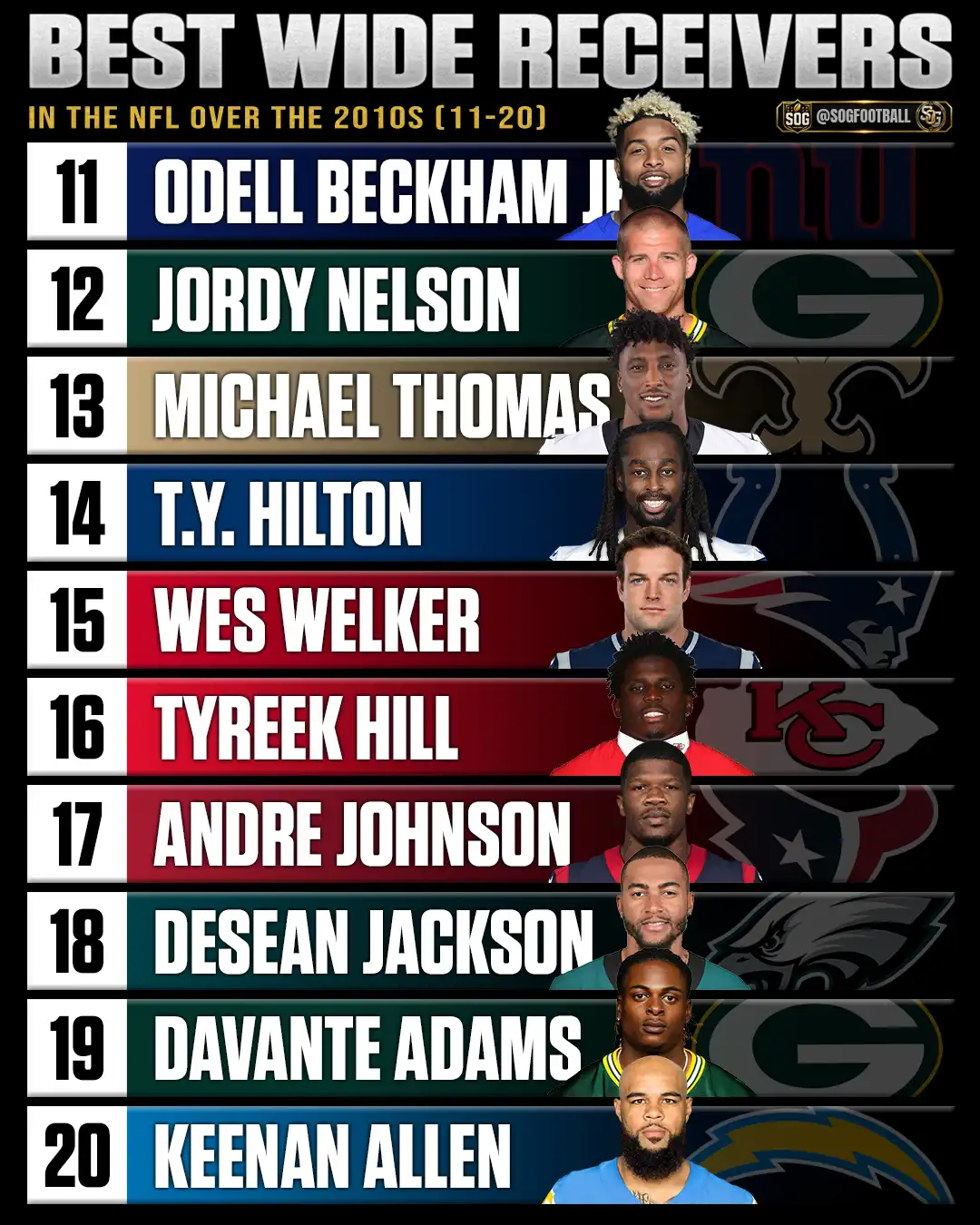
Best wide receivers in the NFL over the 2010s ranked 11 through 20: Odell Beckham Jr., Jordy Nelson, Michael Thomas, T.Y. Hilton, Wes Welker, Tyreek Hill, Andre Johnson, DeSean Jackson, Davante Adams and Keenan Allen.
11. Odell Beckham Jr.
Odell Beckham Jr. had one of the greatest three-year openings the position has seen. In only 43 games from 2014 through 2016, he produced 288 catches, 4,122 yards and 35 touchdowns. His acceleration out of breaks, one-handed catch ability and burst after the catch made every target a potential highlight.
The 2014 rookie season remains the sharpest snapshot: 91 catches, 1,305 yards and 12 touchdowns in only 12 games. Injuries interrupted the middle of the decade, and his production after the initial surge did not reach the same level. That availability gap keeps him just outside the top 10, while his 86.8 yards per game and explosive peak keep him ahead of the longer résumés below.
2010s stats and accolades: 464 receptions, 6,511 receiving yards and 48 receiving touchdowns; 2014 Offensive Rookie of the Year and three Pro Bowls.
12. Jordy Nelson
Jordy Nelson was more than a beneficiary of elite quarterback play. His vertical speed, sideline tracking and feel for scramble rules made him uniquely effective when a play extended, while his size gave him a real advantage on isolation routes. From 2011 through 2014, he averaged 15.8 yards per catch and scored 43 receiving touchdowns.
Nelson’s 2014 season delivered 98 receptions, 1,519 yards and 13 touchdowns. A torn ACL erased 2015, but he returned to lead the league with 14 receiving touchdowns in 2016 and won Comeback Player of the Year. He lands behind Beckham because the very top of his peak was slightly lower, but Nelson’s efficiency, scoring and championship contribution form a complete case.
2010s stats and accolades: 558 receptions, 7,901 receiving yards and 68 receiving touchdowns; one second-team All-Pro selection, 2016 Comeback Player of the Year and one Super Bowl championship.
13. Michael Thomas
Michael Thomas played only four seasons in the decade, but he packed an extraordinary amount of production into them. He used strength, pacing and precise leverage to dominate slants, in-breakers and option routes even when defenses knew the ball was coming quickly. His 7.5 receptions per game are the highest rate among the players on this list.
The 2019 season produced an NFL-record 149 catches, 1,725 yards, nine touchdowns and Offensive Player of the Year honors. He also earned first-team All-Pro recognition in both 2018 and 2019. The limited window prevents a top-10 placement, but his peak compares with any possession receiver of the era.
2010s stats and accolades: 470 receptions, 5,512 receiving yards and 32 receiving touchdowns; 2019 Offensive Player of the Year, two first-team All-Pro selections and the single-season receptions record.
14. T.Y. Hilton
T.Y. Hilton consistently threatened the deep middle and outside seams despite playing at a size disadvantage. His route tempo and ball tracking allowed him to create explosive plays without relying on contested catches. He topped 1,000 yards in five of six seasons from 2013 through 2018.
Hilton led the league with 1,448 receiving yards in 2016 and averaged 15.6 yards per catch across the decade. Quarterback injuries and changes affected the final years of his window, but he remained the passing game’s primary field-stretcher. His sustained yardage gives him the edge over several shorter or more role-specific cases below.
2010s stats and accolades: 552 receptions, 8,598 receiving yards and 45 receiving touchdowns; four Pro Bowls and the 2016 receiving-yardage title.
15. Wes Welker
Wes Welker helped redefine how much an offense could run through the slot. His option-route intelligence, short-area quickness and instant understanding with his quarterbacks made him a first-down machine. Although his best overall stretch began before 2010, his early-decade work remained elite.
Welker led the league with 122 receptions in 2011 while setting career highs with 1,569 yards and nine touchdowns. He followed with 118 catches in 2012, then scored a career-high 10 touchdowns in 2013. The shorter period of top-level work within this specific window keeps him in the middle of the ranking, but his influence and early-decade volume are undeniable.
2010s stats and accolades: 461 receptions, 5,115 receiving yards and 34 receiving touchdowns; three Pro Bowls during the decade and the 2011 receptions title.
16. Tyreek Hill
Tyreek Hill entered the league in 2016 and immediately changed the geometry of defensive coverage. His speed threatened both sidelines and the deep middle, but his value was not limited to go routes. He could win on crossers, create after short catches, carry the ball and alter field position as a returner.
Hill’s 2018 season produced 87 catches, 1,479 yards and 12 touchdowns at 17.0 yards per reception. He then helped finish the 2019 season with a championship, including a crucial 44-yard catch during the fourth-quarter comeback. Four seasons are not enough to challenge the decade-long producers, but few players created more tactical stress from the moment they arrived.
2010s stats and accolades: 281 receptions, 4,115 receiving yards and 32 receiving touchdowns; four Pro Bowls, first-team All-Pro recognition as a returner and flex player, and one Super Bowl championship.
17. Andre Johnson
Andre Johnson’s all-time case is larger than his 2010s placement because much of his prime came before the decade. He was still outstanding early in this window, combining boundary strength, intermediate precision and the toughness to work through physical coverage. Even with injuries limiting him in 2011, he produced more than 1,200 yards in three of the next four seasons.
His 2012 campaign delivered 112 catches and a career-high 1,598 yards, followed by 109 catches and 1,407 yards in 2013. Age reduced his explosiveness late in the decade, which creates the gap between his career reputation and this ranking. The two-year resurgence was still too productive to leave him outside the top 20.
2010s stats and accolades: 475 receptions, 6,237 receiving yards and 28 receiving touchdowns; one second-team All-Pro selection and three Pro Bowls during the decade.
18. DeSean Jackson
DeSean Jackson was the decade’s defining pure deep threat. His 17.6 yards per reception are the best among this top 30, and that number understates the space his speed created for teammates underneath. Safeties had to declare their intentions early because one false step could become a touchdown.
Jackson’s most complete season came in 2013, when he caught 82 passes for 1,332 yards and nine touchdowns. He cleared 1,000 yards with three different offenses during the decade, showing that the vertical production was portable rather than system-specific. A lower target volume and less week-to-week possession value keep him below the more complete No. 1 receivers, but his singular field-stretching effect earns 18th.
2010s stats and accolades: 474 receptions, 8,352 receiving yards and 44 receiving touchdowns; two Pro Bowls and a 17.6-yard receiving average.
19. Davante Adams
Davante Adams needed time to become an elite receiver, which matters in a decade-only evaluation. By the second half of the 2010s, however, his release package, footwork and red-zone craft were among the best in football. He could create clean throwing windows without elite long speed and repeatedly beat press coverage before the route had fully developed.
Adams’ 2018 season produced 111 receptions, 1,386 yards and 13 touchdowns in 15 games. He scored 40 receiving touchdowns from 2016 through 2019 and made three straight Pro Bowls to close the decade. Most of his all-time résumé was still ahead of him, so 19th reflects the work completed by the cutoff rather than what he later became.
2010s stats and accolades: 431 receptions, 5,194 receiving yards and 44 receiving touchdowns; three Pro Bowls and three double-digit touchdown seasons.
20. Keenan Allen
Keenan Allen won with technique, leverage and timing rather than track speed. His ability to change pace within a route and understand a defender’s blind spots made him one of the decade’s cleanest third-down separators. Injuries cost him most of 2015 and nearly all of 2016, interrupting what otherwise could have been a much higher-volume case.
Allen returned with 102 catches and 1,393 yards in 2017, earning Comeback Player of the Year, then followed with two more Pro Bowl seasons. He ended the decade with three consecutive years above 1,190 yards. The durability gap keeps him at 20, but his healthy play was consistently that of a top-level route runner.
2010s stats and accolades: 519 receptions, 6,405 receiving yards and 34 receiving touchdowns; 2017 Comeback Player of the Year and three Pro Bowls.
Best Wide Receivers of the 2010s: 21-30
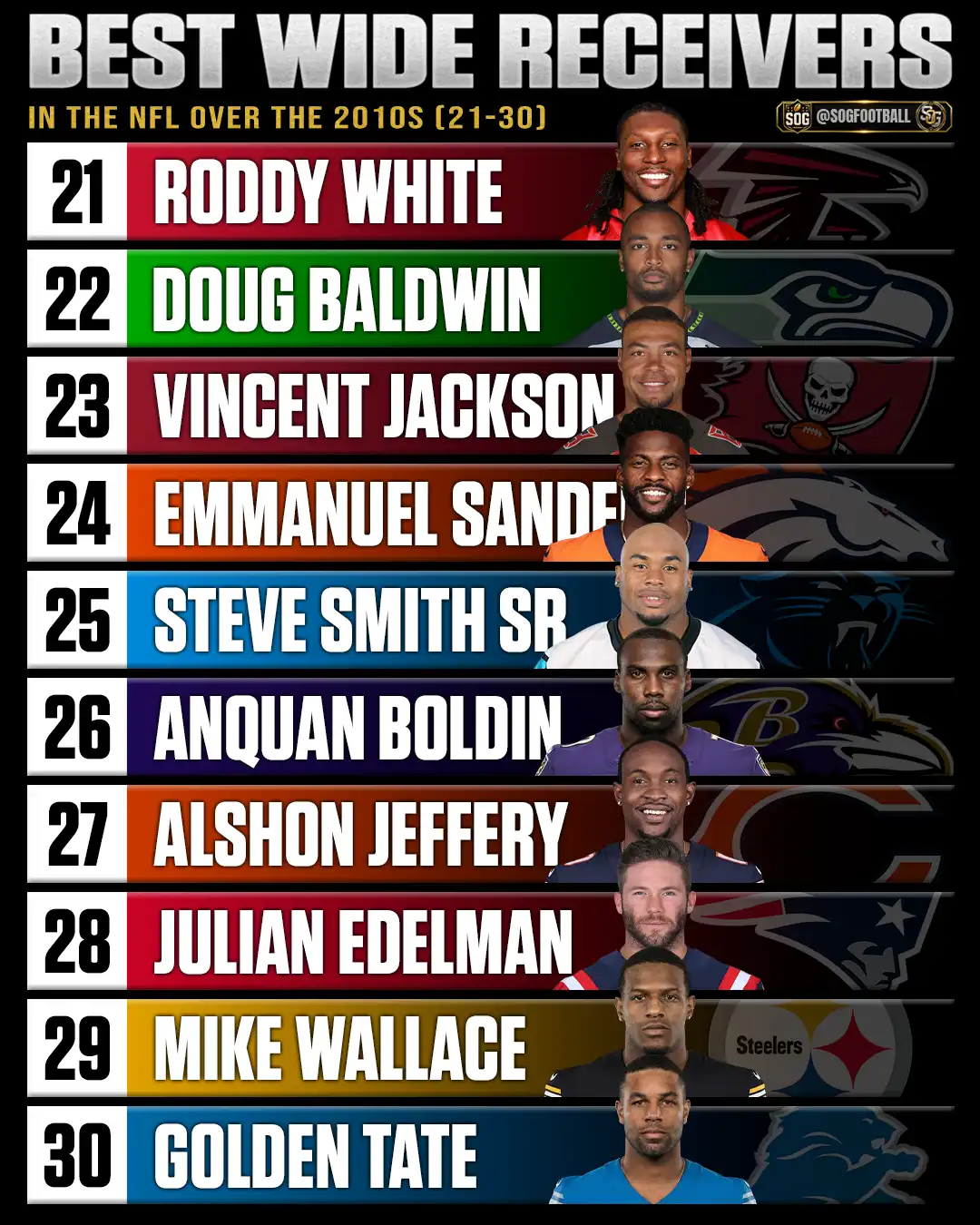
Best wide receivers in the NFL over the 2010s ranked 21 through 30: Roddy White, Doug Baldwin, Vincent Jackson, Emmanuel Sanders, Steve Smith Sr., Anquan Boldin, Alshon Jeffery, Julian Edelman, Mike Wallace and Golden Tate.
21. Roddy White
Roddy White carried his late-2000s prime into the first three seasons of the new decade. He was a physical route runner who handled heavy target volume and consistently gave his quarterback a dependable answer on intermediate routes. His production also helped bridge an offense from one established No. 1 receiver to another without immediately disappearing.
White led the league with 115 receptions in 2010 while adding 1,389 yards and 10 touchdowns. He followed with two more seasons above 1,290 yards before injuries and age accelerated the decline. The back half of the decade was empty, but three straight Pro Bowl seasons and a first-team All-Pro peak give him the first spot in this final group.
2010s stats and accolades: 493 receptions, 6,174 receiving yards and 36 receiving touchdowns; one first-team All-Pro selection, three Pro Bowls and the 2010 receptions title.
22. Doug Baldwin
Doug Baldwin’s raw volume understates his importance in a run-first offense. He was an expert at finding leverage from the slot, separating late and working with a quarterback who frequently extended plays. His efficiency and third-down reliability made him the passing game’s most trusted receiver during a championship window.
Baldwin tied for the league lead with 14 receiving touchdowns in 2015 despite catching only 78 passes. He followed with a career-high 1,128 yards in 2016 and 991 yards in 2017, earning Pro Bowl selections in both seasons. The smaller target load keeps him behind the major volume receivers, while his scoring peak and postseason value keep him above the remaining group.
2010s stats and accolades: 493 receptions, 6,563 receiving yards and 49 receiving touchdowns; two Pro Bowls, the shared 2015 receiving-touchdown title and one Super Bowl championship.
23. Vincent Jackson
Vincent Jackson was a prototype vertical boundary target. At 6-foot-5, he could play above defensive backs, but his value also came from speed that forced them to turn and run. He averaged at least 17.7 yards per catch in each season from 2010 through 2013.
Jackson’s 2012 season was his best of the decade: 72 catches, 1,384 yards and eight touchdowns at 19.2 yards per reception. He topped 1,000 yards three times in four seasons before injuries shortened the end of his career. The limited reception volume caps the ranking, but his downfield efficiency and two Pro Bowls justify 23rd.
2010s stats and accolades: 342 receptions, 5,680 receiving yards and 32 receiving touchdowns; two Pro Bowls and three 1,000-yard seasons.
24. Emmanuel Sanders
Emmanuel Sanders supplied reliable production across multiple roles and offensive environments. He could align outside or in the slot, separate on intermediate routes and win vertically without requiring the offense to feature him as its only target. That adaptability helped him remain useful through quarterback and scheme changes.
Sanders peaked in 2014 with 101 receptions, 1,404 yards and nine touchdowns. He also produced 83 catches for 1,112 yards in 2015 and then led his championship-winning team in postseason receiving yards. He never had the singular dominance of the top 20, but nearly 7,900 decade yards and a strong playoff résumé make him one of the safest selections in this range.
2010s stats and accolades: 601 receptions, 7,893 receiving yards and 42 receiving touchdowns; two Pro Bowls and one Super Bowl championship.
25. Steve Smith Sr.
Steve Smith Sr. was already 31 when the decade began, yet he still produced three 1,000-yard seasons and remained one of football’s fiercest competitors. His releases, contact balance and ability to play much larger than his frame kept him dangerous after his pure speed declined. The 2010s portion of his career is a longevity achievement rather than the source of his all-time greatness.
Smith’s 2011 season delivered 79 catches, 1,394 yards and seven touchdowns, earning Pro Bowl and second-team All-Pro recognition. He later posted 1,065 yards at age 35 and returned from a torn Achilles to contribute again at 37. The uneven opening and injury-shortened 2015 season keep him in the final tier, but the late-career quality earns 25th.
2010s stats and accolades: 457 receptions, 6,401 receiving yards and 31 receiving touchdowns; one second-team All-Pro selection and one Pro Bowl during the decade.
26. Anquan Boldin
Anquan Boldin was the decade’s model for winning without separation speed. He used strength, positioning and fearless work over the middle to turn covered throws into completions. His toughness was functional, not cosmetic: it let him stay on schedule in congested areas and become a trusted playoff target.
Boldin’s defining stretch came in the 2012 postseason, when he caught 22 passes for 380 yards and four touchdowns during a championship run. He then produced consecutive 1,000-yard seasons in 2013 and 2014 in a different offense. His regular-season peak falls below the names ahead of him, but his portable possession value and high-leverage production make 26th appropriate.
2010s stats and accolades: 490 receptions, 6,259 receiving yards and 38 receiving touchdowns; one Super Bowl championship and 380 receiving yards in the 2012 postseason.
27. Alshon Jeffery
Alshon Jeffery was at his best when he could use size, timing and catch radius downfield. He was not an effortless separator on every route, but he could erase tight coverage by locating the ball early and finishing through contact. His two-season peak from 2013 through 2014 produced 2,554 receiving yards.
The 2013 campaign was the high point at 89 catches, 1,421 yards and seven touchdowns. Later injuries reduced his regular-season consistency, yet he supplied 219 yards and three touchdowns during the 2017 postseason and scored in the championship game. That blend of peak yardage and playoff value puts him narrowly above Edelman.
2010s stats and accolades: 469 receptions, 6,671 receiving yards and 45 receiving touchdowns; one Pro Bowl and one Super Bowl championship.
28. Julian Edelman
Julian Edelman’s regular-season résumé is lighter than every receiver above him, so this placement requires a clear postseason argument. His short-area burst, option-route chemistry and toughness over the middle made him a dependable third-down target. Those qualities became more valuable when playoff games narrowed and the offense needed precise answers against pressure.
Edelman finished the decade with three championships and won Super Bowl LIII MVP after catching 10 passes for 141 yards. He also made one of the defining catches of the comeback in Super Bowl LI. The lack of Pro Bowls, All-Pro selections and regular-season dominance prevents him from climbing higher, but the postseason body of work is too substantial to omit.
2010s stats and accolades: 562 receptions, 6,148 receiving yards and 35 receiving touchdowns; three Super Bowl championships and Super Bowl LIII MVP.
29. Mike Wallace
Mike Wallace was one of the league’s premier vertical threats at the start of the decade. His acceleration forced cornerbacks to protect against the deep ball, and he could maintain separation once he stacked coverage. He was more productive across later stops than his early-peak reputation sometimes suggests, finishing the decade above 7,300 receiving yards.
Wallace’s 2010 season produced 1,257 yards and 10 touchdowns at 21.0 yards per catch. He followed with a career-high 72 receptions and 1,193 yards in 2011, earning his only Pro Bowl selection. He did not sustain top-tier No. 1 receiver play long enough to move higher, but the explosive peak and solid decade volume earn 29th.
2010s stats and accolades: 499 receptions, 7,316 receiving yards and 51 receiving touchdowns; one Pro Bowl and three 1,000-yard seasons.
30. Golden Tate
Golden Tate closes the ranking because his consistency and yards-after-catch value narrowly beat the strongest omissions. He was difficult to tackle in space, could play multiple alignments and handled high reception volume without fitting the traditional profile of a boundary No. 1. Only Fitzgerald, Brown, Jones and Thomas caught more passes among the wide receivers listed here.
Tate’s best season came in 2014, when he caught 99 passes for 1,331 yards and earned a Pro Bowl selection. He added three more 90-catch seasons before the decade ended and contributed to a championship earlier in the window. His lower scoring output and modest peak create the ceiling, but 660 catches and nearly 7,900 yards give him the final spot.
2010s stats and accolades: 660 receptions, 7,890 receiving yards and 44 receiving touchdowns; one Pro Bowl and one Super Bowl championship.
Biggest Debates and Toughest Calls
Why Julio Jones ranks ahead of Antonio Brown
Brown had more catches, more touchdowns and the decade’s strongest six-year production run. Jones counters with 862 more receiving yards in five fewer games, a 10.2-yard advantage in receiving yards per game and the broader size-speed profile. This ranking gives Jones the slightest edge because he paired league-leading decade volume with the ability to win every kind of outside matchup. The margin is small enough that a touchdowns-first or route-running-first evaluation could reverse it.
Why Calvin Johnson remains third with only six seasons
Johnson’s limited sample is already reflected in the placement. A pure peak list could put him first, while a strict cumulative list would drop him well below the top five. Three consecutive first-team All-Pro selections, 95.0 yards per game and the single-season receiving-yardage record are powerful enough to overcome the missing four seasons, but not enough to pass the two players who paired historic peaks with more decade value.
How shorter late-decade peaks were handled
Michael Thomas and Tyreek Hill were judged only on what they completed by the end of the 2019 season. Thomas owns the single-season receptions record, while Hill immediately changed coverage structure and helped complete a championship season. Their ability pushes them above many longer careers, but four seasons cannot match the accumulated value of the top 10 without an even larger gap in peak play.
Why Julian Edelman is not higher
Edelman’s playoff work is among the best in the group, but this remains a full-decade receiver ranking. He never made a Pro Bowl, never reached 1,200 receiving yards in a regular season and never scored more than seven receiving touchdowns in one. Postseason value gets him onto the list and above several stronger regular-season omissions; it does not erase the much larger weekly production gaps above No. 28.
Honorable Mentions
Pierre Garçon was the toughest omission. He accumulated 577 receptions and 7,066 receiving yards during the decade, including a league-leading 113 catches in 2013, but his scoring and peak dominance did not match Tate’s final case.
Michael Crabtree also had a strong volume argument with 589 catches, 6,874 yards and 52 touchdowns. His best full season did not reach the same level as Wallace’s or Jeffery’s, and he had fewer defining high-leverage moments than the postseason specialists who made the list.
Eric Decker, Randall Cobb, Jarvis Landry, Marques Colston and Amari Cooper all received consideration. Decker offered scoring and consistency, Cobb supplied versatility, Landry piled up late-decade receptions, Colston remained productive early, and Cooper produced four 1,000-yard seasons after entering in 2015. None had a complete enough blend of decade volume, peak and high-leverage value to displace the final five.
Full Top 30 Wide Receivers of the 2010s Ranking
The recap is intentionally limited to rank and player name for a clean mobile reference.
| Rank | Wide Receiver |
|---|---|
| 1 | Julio Jones |
| 2 | Antonio Brown |
| 3 | Calvin Johnson |
| 4 | DeAndre Hopkins |
| 5 | A.J. Green |
| 6 | Demaryius Thomas |
| 7 | Larry Fitzgerald |
| 8 | Brandon Marshall |
| 9 | Dez Bryant |
| 10 | Mike Evans |
| 11 | Odell Beckham Jr. |
| 12 | Jordy Nelson |
| 13 | Michael Thomas |
| 14 | T.Y. Hilton |
| 15 | Wes Welker |
| 16 | Tyreek Hill |
| 17 | Andre Johnson |
| 18 | DeSean Jackson |
| 19 | Davante Adams |
| 20 | Keenan Allen |
| 21 | Roddy White |
| 22 | Doug Baldwin |
| 23 | Vincent Jackson |
| 24 | Emmanuel Sanders |
| 25 | Steve Smith Sr. |
| 26 | Anquan Boldin |
| 27 | Alshon Jeffery |
| 28 | Julian Edelman |
| 29 | Mike Wallace |
| 30 | Golden Tate |
FAQ: Best Wide Receivers of the 2010s
Who was the best wide receiver of the 2010s?
Julio Jones ranks first because he led all wide receivers with 12,125 receiving yards during the decade, averaged 96.2 yards per game and combined that production with elite size, speed and route-running ability.
Who are the top five wide receivers of the 2010s?
The top five are Julio Jones, Antonio Brown, Calvin Johnson, DeAndre Hopkins and A.J. Green, in that order.
Who had the most receiving yards in the 2010s?
Julio Jones led all players with 12,125 regular-season receiving yards from 2010 through 2019. Antonio Brown ranked second with 11,263, and Larry Fitzgerald ranked third with 10,016.
Who had the best single receiving season of the decade?
Calvin Johnson’s 2012 season has the strongest yardage case because his 1,964 receiving yards remain the NFL record. Julio Jones and Antonio Brown both caught 136 passes and exceeded 1,830 yards in 2015, while Michael Thomas set the receptions record with 149 in 2019.
Why is Calvin Johnson third if he retired in 2016?
Johnson ranks third because his six seasons inside the window included three first-team All-Pro selections, six Pro Bowls and the greatest receiving-yardage season in league history. The short sample keeps him behind Jones and Brown, but the peak was too dominant to place lower.
Are postseason stats included in the decade totals?
No. The stat lines list regular-season receiving production only. Postseason performance affects the ranking separately, and each postseason is attached to its corresponding regular season.
Is this ranking based only on statistics?
No. Production carries the most weight, but the evaluation also includes peak ability, awards, postseason performance, role difficulty, quarterback context and the ways each receiver forced defenses to adjust.
Last reviewed: August 9, 2026.
Conclusion: Ranking the Best NFL Wide Receivers of the 2010s
Julio Jones finishes first because he combined the decade’s highest receiving-yardage total with the most complete physical profile. Antonio Brown’s route running and six-year production peak make the top decision extremely close, while Calvin Johnson remains third because the shorter résumé contains a level of dominance that cumulative totals cannot fully capture.
The rest of the ranking shows why the decade cannot be reduced to one statistic. Hopkins and Green paired elite talent with sustained No. 1 work. Fitzgerald aged into a different role without losing his value. Thomas and Hill compressed historic impact into four seasons. Boldin and Edelman gained ground through postseason performance, while deep threats such as Jackson and Wallace created value that reception totals alone miss.
Continue with the most receiving yards in NFL history, the career receiving-yards-per-game leaders and the best wide receivers in the NFL since 2020. For more football rankings, graphics and debates, follow @SOGFootball on Instagram.
