
Bijan Robinson leads this ranking of the best running backs every year NFL season, with Saquon Barkley, Christian McCaffrey, Barry Sanders, Walter Payton, Eric Dickerson and Gale Sayers among the other yearly selections. Robinson gets the 2025 spot because his league-leading 2,298 yards from scrimmage created the best all-purpose case in a season with several credible choices.
The list covers every completed season from 1966 through 2025. Rushing production remains central, but receiving value, touchdowns, efficiency, awards, workload, team impact, postseason play and era context can separate close seasons. Team names reflect the franchise identity used during the season being discussed.
This is a single-season timeline, not a career ranking. Readers comparing full résumés can use our best running backs of all-time ranking, while the best running backs in the NFL today covers the current position entering 2026.
How We Picked the Best Running Backs Every Year
The standard changes by era because the job has changed. A running back in the 1970s was usually judged by rushing volume, short-yardage toughness, MVP races and how much of the offense he carried. A modern back has to be judged more heavily by receiving value, yards from scrimmage, explosive plays, touchdown value and how many different ways he stresses a defense.
A player did not have to lead the league in every category to be the pick. Sometimes the answer is the rushing champion. Sometimes it is the touchdown leader. Sometimes it is the guy who made the entire offense work. The best running back every year is the player who had the best overall season at the position, not automatically the player with the cleanest stat line.
Team names are listed with the full franchise name from that specific season. That matters because franchises have moved or rebranded over time, and this list is meant to work as a historical year-by-year record.
Best Running Backs Each Year, 2025–1996
2025: Bijan Robinson, Atlanta Falcons
Bijan Robinson was the most complete running back in football in 2025. James Cook led the league with 1,621 rushing yards, while Jonathan Taylor led all players with 18 rushing touchdowns. Robinson’s advantage came from the full workload: he could carry Atlanta’s ground game, create explosive plays and function as a major receiving weapon without telegraphing the offense.
Atlanta’s official season review credits Robinson with 1,478 rushing yards, 79 receptions for 820 yards and 11 total touchdowns. His 2,298 yards from scrimmage led the NFL and set a Falcons single-season record. That all-purpose production separates him in a genuinely close three-player debate.
2024: Saquon Barkley, Philadelphia Eagles
Saquon Barkley’s first season with the Philadelphia Eagles produced one of the strongest modern rushing campaigns. He ran for 2,005 yards, scored 13 rushing touchdowns and won Offensive Player of the Year while sitting out the regular-season finale.
Barkley’s burst and finishing power were an ideal match for Philadelphia’s offensive line, but the season was bigger than the blocking advantage. His vision created clean decisions, his explosive runs punished small leverage errors and his postseason helped the Eagles finish as Super Bowl champions. His place among the highest single-season rushing totals in NFL history makes 2024 one of the easiest selections on the page.
2023: Christian McCaffrey, San Francisco 49ers
McCaffrey was the easiest running back pick of 2023. The San Francisco 49ers could use him as a traditional runner, a slot receiver, a motion piece or a red-zone matchup problem, and all of it worked. He finished with 2,023 scrimmage yards, 21 total touchdowns and Offensive Player of the Year honors. He changed what defenses had to worry about on almost every snap.
2022: Josh Jacobs, Las Vegas Raiders
Jacobs owned 2022 through volume, toughness and late-game punishment. He led the NFL with 1,653 rushing yards and 2,053 yards from scrimmage, giving the Las Vegas Raiders a true offensive identity in a season where they needed one badly. The workload remained productive because Jacobs ran with patience, finished runs, created yards after contact and made Las Vegas feel dangerous even when the passing game was uneven.
2021: Jonathan Taylor, Indianapolis Colts
Taylor’s 2021 season was his superstar arrival with the Indianapolis Colts. He led the league in rushing yards, rushing touchdowns, scrimmage yards and total touchdowns, which is about as complete as a traditional running back season gets. He had the long speed to turn a crease into a touchdown and the size to finish drives near the goal line. For a stretch that season, Indianapolis could hand him the ball and feel like the offense had a real chance no matter the defensive look.
2020: Derrick Henry, Tennessee Titans
Henry was the rare modern back who made defenses look old-school helpless. Everyone knew the Tennessee Titans wanted to hand him the ball, and it still did not matter. He rushed for 2,027 yards, became the eighth player in NFL history to reach 2,000 rushing yards in a season, and did it in an era built around passing. The numbers were ridiculous, but the weekly feeling was even better: by the fourth quarter, defenses looked tired of tackling him.
2019: Christian McCaffrey, Carolina Panthers
McCaffrey’s 2019 season went far beyond a running back having a good receiving year. He was basically the Carolina Panthers offense. He joined the 1,000 rushing yard and 1,000 receiving yard club, finished with 2,392 scrimmage yards and scored 19 total touchdowns. The Panthers could not function normally without him, and he still produced like an elite runner and an elite pass-catching weapon at the same time.
2018: Todd Gurley, Los Angeles Rams
Gurley was still the most dangerous touchdown back in football in 2018. He finished with 21 total touchdowns, and when the Los Angeles Rams offense was rolling, he made them feel almost automatic in the red zone. The system helped, but Gurley was central to the system’s success. His ability to run wide zone, catch passes and punish teams near the goal line made him the best back of that season.
2017: Todd Gurley, Los Angeles Rams
Gurley’s 2017 season was the full breakout. He looked faster, sharper and more comfortable in Sean McVay’s offense, and the Los Angeles Rams immediately became one of the NFL’s most explosive teams. Gurley finished with 2,093 yards from scrimmage and 19 total touchdowns, giving him the strongest all-around case at the position. He was a runner, receiver and touchdown finisher all in one.
2016: David Johnson, Arizona Cardinals
David Johnson’s peak did not last long, but 2016 with the Arizona Cardinals was special. He had 2,118 yards from scrimmage and 20 total touchdowns, giving Arizona legitimate receiver-level value out of the backfield while still handling feature-back work as a runner. Ezekiel Elliott had the cleaner rushing-title case behind Dallas’ dominant line. Johnson had the better all-purpose case, and that is enough to put him here.
2015: Adrian Peterson, Minnesota Vikings
Peterson was not supposed to still be this dangerous in 2015. He had already taken on years of heavy usage, injuries and defensive attention, yet he still led the league in rushing. The Minnesota Vikings built around his physical style, and Peterson gave them another vintage power-and-burst season. This was not his peak, but it was one more reminder that even late-prime Adrian Peterson could still own the position.
2014: DeMarco Murray, Dallas Cowboys
Murray’s 2014 season was built on patience, volume and the Dallas Cowboys’ dominant offensive line, but he deserves credit for how consistently he kept that machine moving. He rushed for 1,845 yards, led the league in scrimmage yards and gave Dallas a clear identity. Tony Romo had one of his most efficient seasons partly because Murray made the Cowboys so hard to defend on early downs.
2013: LeSean McCoy, Philadelphia Eagles
McCoy was electric in Chip Kelly’s Philadelphia Eagles offense. His cuts were violent, his acceleration was instant, and defenders rarely got a clean angle on him in space. He led the NFL in rushing yards and yards from scrimmage, which matched the eye test perfectly. Philadelphia played fast, forced defenses to spread out, and McCoy made people miss in space all season.
2012: Adrian Peterson, Minnesota Vikings
This is one of the wildest running back seasons ever. Coming off a major knee injury, Peterson returned and rushed for 2,097 yards, falling just nine yards short of Eric Dickerson’s single-season record. The Minnesota Vikings did not have a passing attack that scared defenses, which made the season even more ridiculous. Everyone knew Peterson was getting the ball, and he still kept ripping off huge runs.
2011: LeSean McCoy, Philadelphia Eagles
McCoy’s 2011 season showed why “Shady” was the perfect nickname. He was slippery in a way that made tackling angles feel useless. His touchdown production separated him from a crowded group of backs, and his ability to create something out of broken spacing made him one of the most frustrating players in the league to defend. The flash came with reliable production. He was the Philadelphia Eagles’ most reliable offensive weapon.
2010: Arian Foster, Houston Texans
Foster came out of nowhere and turned into one of the smoothest backs in football. He led the NFL in rushing yards, scrimmage yards and total touchdowns, which made the breakout impossible to ignore. His patience, vision and one-cut style fit the Houston Texans’ zone game perfectly. Add in his receiving value, and The surprise season became a full takeover.
2009: Chris Johnson, Tennessee Titans
Chris Johnson’s 2009 season with the Tennessee Titans was pure speed with historic production behind it. CJ2K rushed for 2,006 yards and set the NFL single-season record with 2,509 yards from scrimmage. He could turn a normal crease into a touchdown before the safety even had time to fix his angle. The rushing total was massive, but the scrimmage-yard record is what really pushes this season into legendary territory.
2008: Adrian Peterson, Minnesota Vikings
Peterson’s 2008 season was the early-prime version of everything that made him special. He led the NFL in rushing and constantly forced defenses to bring extra bodies into the box. Even without a perfect passing-game environment around him, the Minnesota Vikings back was the player opponents had to build their plan around. The violent running style, acceleration and home-run ability were all already there.
2007: LaDainian Tomlinson, San Diego Chargers
Tomlinson was still the best back in football in 2007. The previous year was his masterpiece, but he remained the complete package: runner, receiver, scorer and weekly defensive priority. The San Diego Chargers could use him in almost any situation and still feel like they had the matchup advantage. It was not quite 2006, but it was still LT sitting on top of the position.
2006: LaDainian Tomlinson, San Diego Chargers
This one does not need much debate. Tomlinson’s 2006 season ranks with the greatest rushing-touchdown seasons in NFL history: MVP, 1,815 rushing yards, 2,323 yards from scrimmage and an NFL-record 31 total touchdowns. He was unstoppable near the goal line, dangerous as a receiver and still capable of breaking a game open from anywhere. LT was the best running back that year and one of the best players in football, period.
2005: Shaun Alexander, Seattle Seahawks
Alexander’s 2005 season powered the Seattle Seahawks to the Super Bowl and earned him MVP honors. He rushed for 1,880 yards and scored 28 total touchdowns, thriving behind a great offensive line but also showing elite patience and goal-line feel. He was not the flashiest back on this list, but in 2005, nobody had a better running back season.
2004: Curtis Martin, New York Jets
Curtis Martin winning this spot deep into his career says a lot about how steady he was. He led the NFL in rushing at age 31, which is almost absurd for a running back. Martin was not built around highlight plays. He won with vision, durability, balance and trust. The New York Jets could keep feeding him the ball, and he kept giving them exactly what they needed.
2003: Jamal Lewis, Baltimore Ravens
Jamal Lewis was a nightmare in 2003. He rushed for 2,066 yards, including a then-record 295-yard game against the Cleveland Browns, and did it for a Baltimore Ravens team that was not exactly loaded with easy passing-game help. He had the size to run through defenders and enough speed to make huge gains once he hit the second level. This was a brutal, old-school rushing season.
2002: Priest Holmes, Kansas City Chiefs
Holmes had one of the great scoring peaks by any running back. The Kansas City Chiefs’ offensive line and system helped, but Holmes was the perfect back for it: patient, decisive, reliable as a receiver and deadly near the end zone. He led the league in scrimmage yards and touchdowns, giving him the best combination of volume, efficiency and scoring value that season.
2001: Marshall Faulk, St. Louis Rams
Faulk was the rare back who made a passing offense more dangerous just by existing. Defenses had to respect him as a runner, but his receiving ability was the real problem. The St. Louis Rams could split him out, motion him, punish linebackers and turn short throws into chunk plays. The Greatest Show on Turf does not look the same without him.
2000: Marshall Faulk, St. Louis Rams
Faulk’s 2000 season with the St. Louis Rams was peak all-purpose running back value before that phrase became common. He won MVP after piling up 2,189 yards from scrimmage and 26 total touchdowns in only 14 games. If a linebacker covered him, he was in trouble. If a safety came down, the Rams had answers over the top. Faulk made everything harder.
1999: Marshall Faulk, St. Louis Rams
Faulk’s first season with the St. Louis Rams changed the entire offense. St. Louis had speed everywhere, but Faulk gave the group its most flexible piece. He finished with 2,429 yards from scrimmage, won Offensive Player of the Year and helped turn the Rams into a Super Bowl champion. The fit was perfect from the start.
1998: Terrell Davis, Denver Broncos
Davis’ 1998 season was the perfect blend of production and winning. He rushed for 2,008 yards, scored 23 total touchdowns, won MVP and powered a Denver Broncos team that repeated as Super Bowl champions. Denver’s zone scheme was excellent, but Davis’ one-cut decisiveness and finishing power made him the clear best back in football.
1997: Barry Sanders, Detroit Lions
Sanders’ 1997 season is running back art. He rushed for 2,053 yards despite rarely having the luxury of easy, clean lanes. The cuts, balance, acceleration and improvisation were all ridiculous. Terrell Davis had a great argument because of the Denver Broncos’ team success, but Sanders’ individual season with the Detroit Lions was too special to pass up.
1996: Terrell Davis, Denver Broncos
Davis was already becoming the back who would define the Denver Broncos’ late-1990s championship run. His vision and one-cut burst fit the Broncos perfectly, and he brought more power than people sometimes remember. Before the MVP season and the 2,000-yard year, 1996 was the season Davis clearly became one of the NFL’s best backs.
Best Running Backs Each Year, 1995–1966
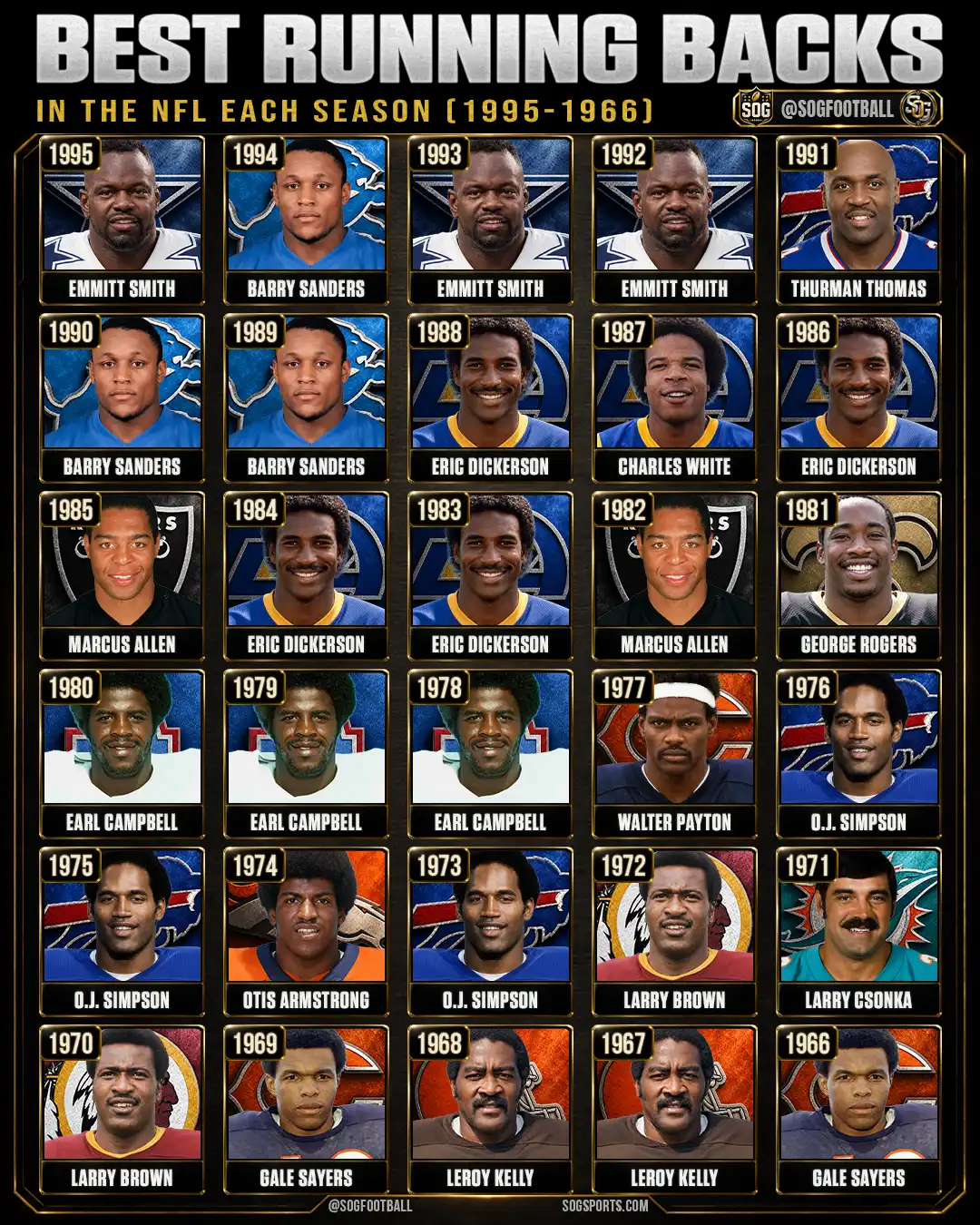
Ranking the best running back in the NFL each season from 1995 to 1966, featuring Emmitt Smith, Barry Sanders, Eric Dickerson, Walter Payton, O.J. Simpson, Earl Campbell, and more.
1995: Emmitt Smith, Dallas Cowboys
Emmitt Smith’s place atop Dallas Cowboys running back history was never clearer than in 1995. He won MVP, led the league in rushing touchdowns, scored 25 total touchdowns and finished the year with another Super Bowl. Dallas trusted him in every big moment, especially near the goal line, and he kept rewarding that trust. He was not the flashiest back in football, but he was the most dependable centerpiece on the league’s best team.
1994: Barry Sanders, Detroit Lions
Sanders in 1994 was almost impossible to square up. He rushed for 1,883 yards, won Offensive Player of the Year and created yards without needing perfect blocking. His style sometimes made the Detroit Lions offense look chaotic, but that chaos was also the point. Nobody else could create like him.
1993: Emmitt Smith, Dallas Cowboys
Smith’s 1993 season was about toughness and timing. His holdout ended, the Dallas Cowboys got their engine back, and the team returned to championship form. The shoulder-game performance against the New York Giants is one of those moments that still defines his career, but the full season was strong enough on its own. He led the league in rushing, won MVP and then helped Dallas repeat as Super Bowl champions.
1992: Emmitt Smith, Dallas Cowboys
In 1992, Smith became the engine of the Dallas Cowboys’ championship formula. He led the league in rushing and helped Dallas control games with balance, patience and short-yardage reliability. The Cowboys had stars everywhere, but Smith gave the offense its rhythm. This was the beginning of his strongest dynasty stretch.
1991: Thurman Thomas, Buffalo Bills
Thomas was the complete back the Buffalo Bills needed for the K-Gun offense. He could run, catch, block and stress defenses in space, which made him more than just a traditional ball-carrier. In 1991, he won MVP and Offensive Player of the Year while leading the NFL in yards from scrimmage. He was one of the best offensive players in football, not just one of the best running backs.
1990: Barry Sanders, Detroit Lions
Sanders’ 1990 season helped establish him as one of the most exciting players the league had ever seen. Every carry for the Detroit Lions felt like it could become a highlight. He did not need a perfect structure around him. Give him a crease, or even half a crease, and he could embarrass an entire defense.
1989: Barry Sanders, Detroit Lions
Sanders wasted no time becoming a superstar. As a rookie with the Detroit Lions, he already had the footwork, balance and burst that would define his entire career. Most rookie backs need time to adjust to NFL speed. Sanders looked like the league was trying to adjust to him.
1988: Eric Dickerson, Indianapolis Colts
Dickerson’s greatness traveled. Even after leaving the Los Angeles Rams, his stride, vision and workload ability kept him near the top of the position with the Indianapolis Colts. In 1988, he was still a high-volume rushing force and one of the few backs who could make an offense feel dangerous almost by himself.
1987: Charles White, Los Angeles Rams
White’s 1987 season was one of the more unusual entries on this list because it came in a shortened season. Still, he gave the Los Angeles Rams the best running back year of that specific season. He ran hard, handled the workload and took full advantage of his chance during a strange NFL year.
1986: Eric Dickerson, Los Angeles Rams
Dickerson’s 1986 season proved his record-setting peak was no one-year explosion. He remained the league’s most dangerous pure runner for the Los Angeles Rams, with the upright style, long speed and heavy workload that made him such a unique problem. When Dickerson got rolling, he looked like he was gliding away from people.
1985: Marcus Allen, Los Angeles Raiders
Allen’s 1985 season with the Los Angeles Raiders was complete in every way. He rushed for 1,759 yards, added major receiving value, scored 14 total touchdowns and won MVP. His smoothness sometimes made the game look easier than it was, but the production showed how valuable he really was. He could win with patience, receiving skill, scoring value and big-play timing.
1984: Eric Dickerson, Los Angeles Rams
Dickerson’s 1984 season still sits at the top of the single-season rushing record book. He rushed for 2,105 yards with the Los Angeles Rams, the most ever in one NFL season. His style was unlike almost anyone else: upright, fast, graceful and punishing through volume. It is one of the cleanest picks on the entire list.
1983: Eric Dickerson, Los Angeles Rams
Dickerson entered the NFL and immediately looked like a finished superstar. His rookie season with the Los Angeles Rams was immediately dominant. The Rams gave him the ball right away, and he instantly became one of the league’s most dangerous offensive players. By the end of 1983, he was already one of the faces of the position.
1982: Marcus Allen, Los Angeles Raiders
Allen’s rookie season with the Los Angeles Raiders came in a shortened year, but the all-purpose skill set was obvious right away. He had the patience of a veteran, the hands to matter in the passing game and the scoring value to separate himself. This was the first real sign of the Hall of Fame player he would become.
1981: George Rogers, New Orleans Saints
Rogers was a major force immediately. The New Orleans Saints gave him a huge workload, and he handled it like a true feature back. He led the league in rushing as a rookie and gave New Orleans a rushing identity. For a team that needed a centerpiece, Rogers became one right away.
1980: Earl Campbell, Houston Oilers
Campbell’s 1980 season was pure punishment. Defenders knew what was coming, the Houston Oilers knew what was coming, and it still worked. He led the NFL in rushing for the third straight year and remained the defining power back in football. His combination of strength, balance and intimidation made every Oilers game feel physical.
1979: Earl Campbell, Houston Oilers
Campbell in 1979 was the identity of the Houston Oilers. He carried the ball and set the tone for the entire team. His physical running style wore defenses down and made every game feel like a test of how much punishment the opponent could take. He won MVP and Offensive Player of the Year, giving him one of the strongest cases on the list.
1978: Earl Campbell, Houston Oilers
Campbell entered the league with force. Some rookies flash. Campbell immediately became one of the most physical runners in football. He led the NFL in rushing as a rookie and instantly gave the Houston Oilers a franchise-changing offensive identity. His 1978 season started one of the great power-back peaks in league history.
1977: Walter Payton, Chicago Bears
Walter Payton’s place in Chicago Bears history was secured long before his career ended, and 1977 showed why. He rushed for 1,852 yards, won MVP and carried a Chicago Bears offense that leaned on him heavily. The famous 275-yard game against the Minnesota Vikings was the signature moment, but the whole season was Sweetness at his absolute best: tough, creative, balanced and relentless.
1976: O.J. Simpson, Buffalo Bills
For this list, Simpson is being judged only by his on-field football seasons. His broader legacy is obviously far more complicated. On the field for the Buffalo Bills in 1976, he was still one of football’s most explosive runners. His speed, vision and open-field ability gave Buffalo a constant big-play threat.
1975: O.J. Simpson, Buffalo Bills
Simpson’s 1975 season was another reminder that his 1973 explosion was not random. He led the league in rushing again and remained one of the most dangerous runners in football. His burst could flip a game in one play, and the Buffalo Bills offense still ran through him.
1974: Otis Armstrong, Denver Broncos
Armstrong’s 1974 season gave the Denver Broncos one of the league’s best rushing threats. He led the NFL in rushing yards and yards per carry, which is a rare combination of volume and efficiency. It is not the most famous season on this list, but it holds up as the right kind of one-year peak.
1973: O.J. Simpson, Buffalo Bills
Simpson’s 1973 season is one of the most important rushing seasons in NFL history. He became the first player to rush for 2,000 yards, and he did it in a 14-game season with the Buffalo Bills. Purely on the field, this is one of the most dominant running back years ever. It is also one of the easiest yearly picks on the board.
1972: Larry Brown, Washington Redskins
Brown’s 1972 season with the Washington Redskins was tough, efficient and complete. He ran with power, contributed as a receiver and gave Washington the kind of offensive reliability that mattered in that era. His MVP season earns this spot because he did far more than compile carries. He was the center of a winning offense.
1971: Larry Csonka, Miami Dolphins
Csonka brought force to the Miami Dolphins backfield. He was not a flashy runner, but he fit perfectly with the Dolphins’ physical identity. His value came from tone-setting runs, short-yardage trust and the way Miami could impose its style on opponents. This is one of those picks where the stat sheet matters, but the team identity matters too.
1970: Larry Brown, Washington Redskins
Brown’s 1970 season with the Washington Redskins was the start of his strongest stretch. He ran with patience and toughness, caught passes when needed and gave Washington a back who could handle a real offensive burden. The peak came later, but this was already one of the best running back seasons in the league.
1969: Gale Sayers, Chicago Bears
Sayers was still magical in 1969. Injuries had already started to shape his career, but the talent was impossible to miss. His acceleration, vision and return-style running made him one of football’s most electric players whenever he had the ball for the Chicago Bears. Even when his body was not fully cooperating, the skill level jumped off the field.
1968: Leroy Kelly, Cleveland Browns
Kelly carried the Cleveland Browns’ rushing tradition forward after the Jim Brown era. That was not an easy shadow to live under, but Kelly built his own case with speed, production and scoring value. In 1968, he was one of the league’s best offensive weapons and one of the few backs who could define a game on his own.
1967: Leroy Kelly, Cleveland Browns
Kelly’s 1967 season was one of his best. He gave the Cleveland Browns a true offensive centerpiece and proved the franchise could still have an elite rushing attack after Jim Brown. His blend of rushing and touchdown production made him the clear pick.
1966: Gale Sayers, Chicago Bears
Sayers closes the list with one of the most exciting seasons from any back in NFL history. He did not need a huge number of touches to change a game. As a runner, receiver and return threat for the Chicago Bears, he brought a level of explosiveness that few players from any era could match. If this list is about who defined the position year by year, Sayers absolutely belongs at the starting point.
Closest Calls on the List
Some years were easy. Others needed more of a debate. These are the seasons where another back had a real argument.
2025: Bijan Robinson, Atlanta Falcons vs. Jonathan Taylor, Indianapolis Colts vs. James Cook, Buffalo Bills
Bijan gets the nod for total all-around value, but this was not a runaway. Taylor led the NFL with 18 rushing touchdowns, while Cook won the rushing title with 1,621 yards. Robinson’s league-high 2,298 scrimmage yards and first-team All-Pro selection separate him in this ranking.
2022: Josh Jacobs, Las Vegas Raiders vs. Christian McCaffrey, San Francisco 49ers
McCaffrey’s value after joining the San Francisco 49ers was obvious, but Jacobs had the better full-season running back case with the Las Vegas Raiders. His workload, rushing title and week-to-week physical impact gave him the edge.
2018: Todd Gurley, Los Angeles Rams vs. Saquon Barkley, New York Giants
Saquon was spectacular as a rookie, especially given the New York Giants’ situation. Gurley gets the pick because his touchdown value and role in a dominant Los Angeles Rams offense made him the more impactful back that season.
2016: David Johnson, Arizona Cardinals vs. Ezekiel Elliott, Dallas Cowboys
Elliott had the clean rushing-title argument behind the Dallas Cowboys’ dominant line. Johnson had the better all-purpose argument with the Arizona Cardinals. Because this list values receiving impact and total offensive usage, Johnson gets the edge.
2004: Curtis Martin, New York Jets vs. Shaun Alexander, Seattle Seahawks
Alexander had the touchdown case with the Seattle Seahawks, but Martin’s rushing title and veteran consistency with the New York Jets push him slightly ahead. It is one of the quieter debates on the list, but it is closer than people remember.
1997: Barry Sanders, Detroit Lions vs. Terrell Davis, Denver Broncos
Davis had the team-success argument and was brilliant for the Denver Broncos. Sanders had the individual masterpiece with the Detroit Lions. When a back rushes for 2,000 yards while creating so much on his own, that is hard to beat.
1971: Larry Csonka, Miami Dolphins vs. Larry Brown, Washington Redskins
Csonka gets the pick because of his role in the Miami Dolphins’ physical identity, but Larry Brown was right there for Washington. This is a good example of a season where style, team context and era matter as much as raw numbers.
Full Year-by-Year Table: Best Running Back Every Year in NFL History
Use the table below as a quick reference for every selection from 2025 through 1966.
| Year | Best Running Back | Full Team Name |
|---|---|---|
| 2025 | Bijan Robinson | Atlanta Falcons |
| 2024 | Saquon Barkley | Philadelphia Eagles |
| 2023 | Christian McCaffrey | San Francisco 49ers |
| 2022 | Josh Jacobs | Las Vegas Raiders |
| 2021 | Jonathan Taylor | Indianapolis Colts |
| 2020 | Derrick Henry | Tennessee Titans |
| 2019 | Christian McCaffrey | Carolina Panthers |
| 2018 | Todd Gurley | Los Angeles Rams |
| 2017 | Todd Gurley | Los Angeles Rams |
| 2016 | David Johnson | Arizona Cardinals |
| 2015 | Adrian Peterson | Minnesota Vikings |
| 2014 | DeMarco Murray | Dallas Cowboys |
| 2013 | LeSean McCoy | Philadelphia Eagles |
| 2012 | Adrian Peterson | Minnesota Vikings |
| 2011 | LeSean McCoy | Philadelphia Eagles |
| 2010 | Arian Foster | Houston Texans |
| 2009 | Chris Johnson | Tennessee Titans |
| 2008 | Adrian Peterson | Minnesota Vikings |
| 2007 | LaDainian Tomlinson | San Diego Chargers |
| 2006 | LaDainian Tomlinson | San Diego Chargers |
| 2005 | Shaun Alexander | Seattle Seahawks |
| 2004 | Curtis Martin | New York Jets |
| 2003 | Jamal Lewis | Baltimore Ravens |
| 2002 | Priest Holmes | Kansas City Chiefs |
| 2001 | Marshall Faulk | St. Louis Rams |
| 2000 | Marshall Faulk | St. Louis Rams |
| 1999 | Marshall Faulk | St. Louis Rams |
| 1998 | Terrell Davis | Denver Broncos |
| 1997 | Barry Sanders | Detroit Lions |
| 1996 | Terrell Davis | Denver Broncos |
| 1995 | Emmitt Smith | Dallas Cowboys |
| 1994 | Barry Sanders | Detroit Lions |
| 1993 | Emmitt Smith | Dallas Cowboys |
| 1992 | Emmitt Smith | Dallas Cowboys |
| 1991 | Thurman Thomas | Buffalo Bills |
| 1990 | Barry Sanders | Detroit Lions |
| 1989 | Barry Sanders | Detroit Lions |
| 1988 | Eric Dickerson | Indianapolis Colts |
| 1987 | Charles White | Los Angeles Rams |
| 1986 | Eric Dickerson | Los Angeles Rams |
| 1985 | Marcus Allen | Los Angeles Raiders |
| 1984 | Eric Dickerson | Los Angeles Rams |
| 1983 | Eric Dickerson | Los Angeles Rams |
| 1982 | Marcus Allen | Los Angeles Raiders |
| 1981 | George Rogers | New Orleans Saints |
| 1980 | Earl Campbell | Houston Oilers |
| 1979 | Earl Campbell | Houston Oilers |
| 1978 | Earl Campbell | Houston Oilers |
| 1977 | Walter Payton | Chicago Bears |
| 1976 | O.J. Simpson | Buffalo Bills |
| 1975 | O.J. Simpson | Buffalo Bills |
| 1974 | Otis Armstrong | Denver Broncos |
| 1973 | O.J. Simpson | Buffalo Bills |
| 1972 | Larry Brown | Washington Redskins |
| 1971 | Larry Csonka | Miami Dolphins |
| 1970 | Larry Brown | Washington Redskins |
| 1969 | Gale Sayers | Chicago Bears |
| 1968 | Leroy Kelly | Cleveland Browns |
| 1967 | Leroy Kelly | Cleveland Browns |
| 1966 | Gale Sayers | Chicago Bears |
FAQ: Best Running Back Every Year in NFL History
Who was the best running back in 2025?
Bijan Robinson of the Atlanta Falcons gets the 2025 spot because he had the best all-around case. James Cook led the league with 1,621 rushing yards and Jonathan Taylor led with 18 rushing touchdowns, but Robinson’s 2,298 scrimmage yards and receiving value gave him the edge.
Who was the best running back in 2024?
Saquon Barkley is the 2024 pick after a dominant first season with the Philadelphia Eagles. His move to Philadelphia unlocked one of the best rushing seasons of the modern era.
Who appears the most on this list?
Barry Sanders and Eric Dickerson lead the list with four selections each. Marshall Faulk, Emmitt Smith, Earl Campbell, Adrian Peterson and O.J. Simpson each appear three times.
What is this running back ranking based on?
The ranking is based on yearly dominance at running back. Rushing yards matter, but so do scrimmage yards, touchdowns, receiving value, awards, team impact, era context and how clearly a player separated from the rest of the position.
Who was the best running back in 2012?
Adrian Peterson of the Minnesota Vikings is the easy 2012 pick. He came off a major knee injury and nearly broke Eric Dickerson’s single-season rushing record, which makes it one of the greatest running back seasons ever.
Who was the best running back in 2006?
LaDainian Tomlinson of the San Diego Chargers was the best running back in 2006. His MVP season and record-setting touchdown production make it one of the cleanest picks on the entire list.
Who was the best running back in 1997?
Barry Sanders gets the 1997 spot after his legendary 2,000-yard rushing season with the Detroit Lions. Terrell Davis had a real case with the Denver Broncos, but Sanders’ individual season was too special.
Who was the best running back in 1984?
Eric Dickerson of the Los Angeles Rams was the best running back in 1984 after setting the NFL single-season rushing yards record. It remains one of the most iconic rushing seasons in league history.
Who was the best running back in 1977?
Walter Payton of the Chicago Bears was the best running back in 1977. That MVP season showed the full Sweetness package: rushing volume, toughness, balance, receiving value and effort on every snap.
Who was the best running back in 1966?
Gale Sayers gets the 1966 spot because of his explosive rushing, receiving and return value for the Chicago Bears. Few players in NFL history have ever been more dangerous with the ball in their hands.
More NFL Running Back Rankings and Records
Career volume is covered in the NFL career rushing-yard leaders and the career rushing-touchdown leaders.
The broader offense series also includes the best quarterbacks of all-time.
Browse the SOG Sports NFL hub for more football history. For daily graphics and debates, follow @sogfootball on Instagram.
What the Year-by-Year Running Back List Shows
The yearly winners trace the position’s changing job description. Walter Payton and Earl Campbell carried enormous rushing burdens. Marshall Faulk and LaDainian Tomlinson proved receiving production could coexist with feature-back volume. Christian McCaffrey and Bijan Robinson pushed the all-purpose model even further.
Barry Sanders and Eric Dickerson lead the page with four selections apiece, but different seasons reward different forms of value. A rushing title can decide one year, while touchdown dominance, receiving work or postseason impact breaks the tie in another. From Gale Sayers in 1966 to Robinson in 2025, every choice identifies the back who most convincingly owned that season.
