Jerry Rice is the SOG Sports pick as the best NFL player to never win the AP NFL Most Valuable Player award. Rice did almost everything else a player can do: he rewrote the receiving record book, won three Super Bowls and produced one of the greatest seasons ever by a non-quarterback. He still never received the league’s most famous regular-season award.
This is not simply a list of the best careers without an MVP trophy. Peak dominance, longevity, positional separation, postseason value, era and the strength of each player’s best MVP case all matter. The result naturally favors several defenders, linemen and pass catchers whose positions have historically made winning AP MVP nearly impossible.
Table of Contents
- How We Ranked the Players
- Award Scope and Eligibility
- Toughest Omissions
- Best NFL Players to Never Win MVP: 1-10
- Best NFL Players to Never Win MVP: 11-20
- Best NFL Players to Never Win MVP: 21-30
- Biggest Ranking Debates
- Complete Ranking Table
- FAQ
- Conclusion
- Related Articles
How We Ranked the Players
This is a subjective SOG Sports ranking, not an official NFL list. The order weighs each player’s peak, sustained excellence, dominance relative to his position, postseason impact, awards, era and overall football value. An elite five-year peak can beat a longer but less overwhelming career, but longevity still matters when two players reached a similar ceiling.
The award’s quarterback bias is part of the discussion, not a reason to inflate every non-quarterback. Quarterbacks control more of an offense than any other position, but receivers, offensive linemen and defenders need historically unusual seasons even to enter the MVP race. That gap between on-field value and award access is why this ranking includes so many players from positions the voters rarely recognize.
For broader positional context, see the SOG Sports rankings of the best wide receivers of all time, best defensive players in NFL history, best pass rushers in NFL history and best quarterbacks of all time.
Award Scope and Eligibility
This article uses only the Associated Press NFL MVP award and covers completed seasons through 2025. Super Bowl MVP, AP Offensive Player of the Year, AP Defensive Player of the Year and other honors do not disqualify a player. Matthew Stafford won the 2025 AP NFL MVP, so he is not eligible.
The AP award began in 1957. To avoid penalizing stars who completed their careers before the award existed, a player must have appeared in at least one NFL regular season from 1957 onward. That makes Dick “Night Train” Lane eligible but leaves pre-1957-only legends outside the pool. Players active in 2026 can move off this list if they win the award later, so this is a snapshot rather than a permanent ruling.
Lawrence Taylor and Alan Page are absent for the opposite reason: both defensive legends won AP NFL MVP. Their wins show that a defender can break through, but they also underline how extraordinary a defensive season must be to beat the league’s best quarterbacks.
Toughest Omissions
Several Hall of Fame-level players narrowly missed the top 30. Junior Seau, Champ Bailey, Walter Jones, Bruce Matthews, Calvin Johnson, Larry Fitzgerald, Steve Largent, Michael Strahan, Derrick Brooks, Derrick Thomas and Antonio Gates all had credible cases. Luke Kuechly also deserved consideration because his short peak included Defensive Rookie of the Year, Defensive Player of the Year and five first-team All-Pro selections.
The final cuts came down to separation. The offensive linemen who made the list had stronger claims as the defining player at their position. The selected receivers either created more overwhelming peaks or larger career gaps. At linebacker and defensive back, the players inside the top 30 combined individual dominance with a deeper postseason, longevity or playmaking case.
Best NFL Players to Never Win MVP: 1-10
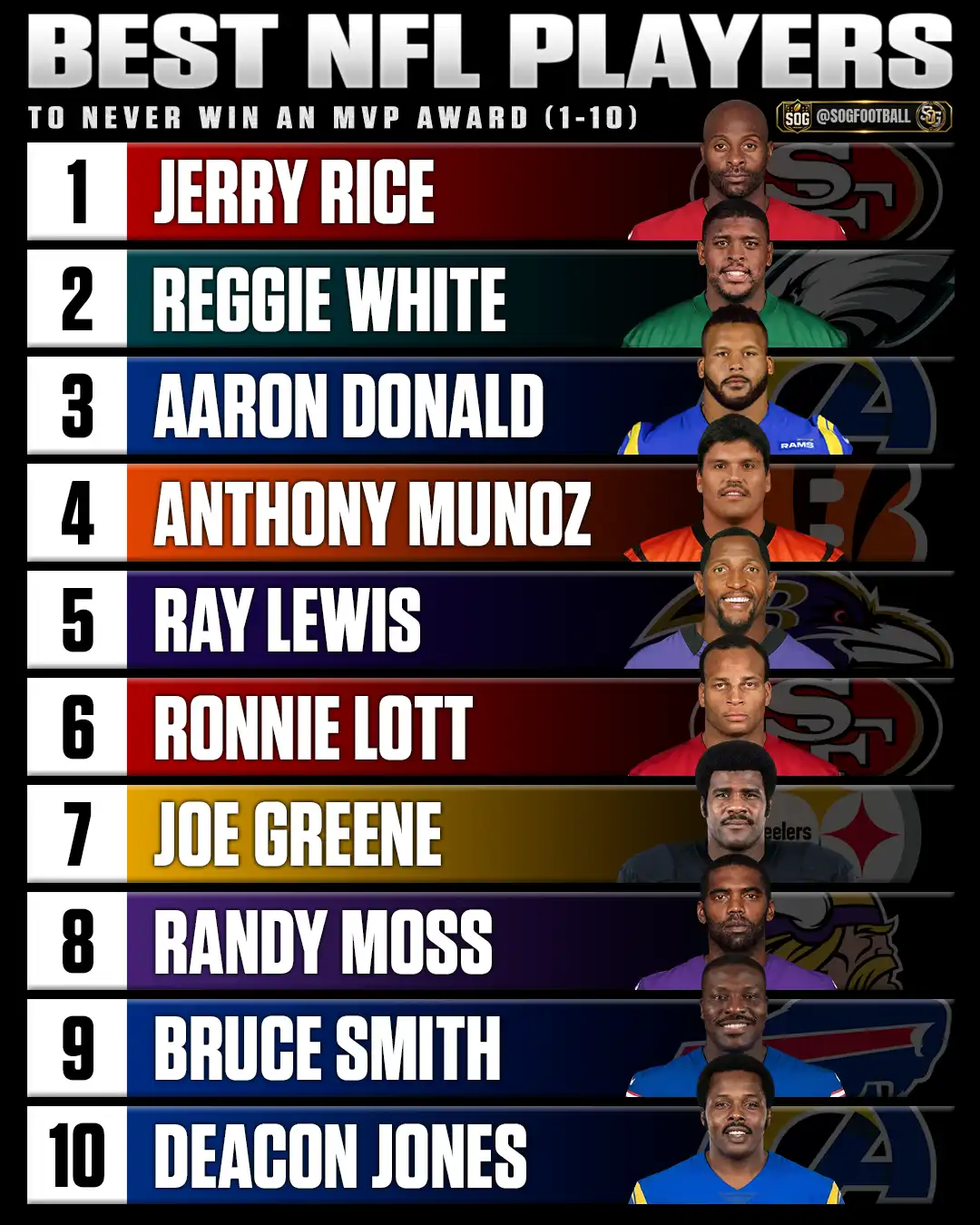
Ranks 1-10 of the best NFL players to never win an MVP Award, led by Jerry Rice, Reggie White and Aaron Donald.
1. Jerry Rice
Rice is the easy starting point. He owns NFL career records for receptions (1,549), receiving yards (22,895), receiving touchdowns (197) and total touchdowns (208). He posted 14 1,000-yard seasons, earned 11 consecutive first-team All-Pro selections and was selected to 13 Pro Bowls. His three Super Bowl rings and Super Bowl XXIII MVP strengthen a case that already stands on regular-season dominance.
His greatest MVP argument came in the strike-shortened 1987 season, when he caught 22 touchdown passes in only 12 games and finished second in the AP vote. That touchdown record lasted two decades despite the shorter schedule. Rice later set the single-season receiving record with 1,848 yards in 1995. No other eligible player combined that kind of peak with such an enormous career lead at his position.
2. Reggie White
White finished with 198 official sacks, second only to Bruce Smith, and reached 13 consecutive Pro Bowls. He earned 10 first-team All-Pro selections and recorded at least 10 sacks in 12 seasons. In 1987, he produced 21 sacks in only 12 games, a pace that illustrates how quickly he could wreck an offense.
The “Minister of Defense” was more than an edge speed rusher. His power collapsed the pocket, his technique defeated double-teams and his presence altered protection plans. He added three sacks in Green Bay’s Super Bowl XXXI victory. White has the best No. 1 argument among the defenders, but Rice’s historic positional separation gives the receiver the narrow edge.
3. Aaron Donald
Donald won three AP Defensive Player of the Year awards and earned eight first-team All-Pro selections in his first 10 seasons. His 20.5 sacks in 2018 came from defensive tackle, where interior traffic and constant double-teams make that total especially difficult. He reached 111 career sacks before his initial retirement and returned to the Rams in 2026.
His value began before the quarterback went down. Donald destroyed the depth of the pocket, erased running lanes and forced offenses to slide protection toward the middle. That disruption helped create one-on-one chances for teammates. Few interior defenders have ever produced an MVP-level peak, and Donald sustained his longer than almost anyone.
4. Anthony Muñoz
Muñoz made 11 consecutive Pro Bowls and received 11 straight All-Pro selections, including nine first-team honors. He was named the league’s Offensive Lineman of the Year three times and helped Cincinnati reach two Super Bowls. For more than a decade, he set the standard at left tackle.
There is no clean box score for eliminating an elite edge rusher, which is why offensive tackles do not build conventional MVP campaigns. Muñoz combined balance, strength, footwork and movement ability in the run game. His placement at No. 4 recognizes that protecting the quarterback’s blind side can be franchise-defining even when the player doing it never touches the ball.
5. Ray Lewis
Lewis was selected to 12 Pro Bowls, earned eight first-team All-Pro honors and won two Defensive Player of the Year awards. He also finished with 41.5 sacks and 31 interceptions, numbers that capture only part of his range. His résumé includes two Super Bowl championships and a Super Bowl XXXV MVP.
Baltimore built its defensive identity around Lewis’ diagnosis, communication and ability to finish plays from sideline to sideline. He could fit the run, carry routes and organize everyone around him. An off-ball linebacker has an extremely narrow MVP path, but Lewis controlled games in ways normally associated with more statistically celebrated positions.
6. Ronnie Lott
Lott collected 63 interceptions, 10 Pro Bowl selections and eight first-team All-Pro honors while winning four Super Bowls. He also intercepted nine passes in the postseason. His career moved from cornerback to safety without reducing his influence, a testament to his intelligence and complete skill set.
The famous hits are only one part of the case. Lott could cover, tackle in space, support the run and organize the secondary. He was the rare defensive back who could change both an opponent’s route choices and its willingness to attack the middle. That versatility gives him the strongest safety résumé on this list.
7. Joe Greene
Greene earned 10 Pro Bowl selections, five first-team All-Pro honors and two Defensive Player of the Year awards. He was the foundational player of Pittsburgh’s Steel Curtain defense and won four Super Bowls. In 1972, he recorded 11 sacks before sacks were an official individual statistic.
Greene’s impact was structural. His quickness and power from defensive tackle broke blocking schemes, disrupted the run and created opportunities for the linebackers behind him. Pittsburgh’s dynasty had stars at every level, but Greene was the piece that changed the franchise’s identity and made everything else fit.
8. Randy Moss
Moss caught 982 passes for 15,292 yards and 156 touchdowns. He posted 10 1,000-yard seasons and earned four first-team All-Pro selections. His 23 touchdown catches for New England in 2007 remain the single-season NFL record and made him the defining vertical threat on the first 16-0 regular-season team.
His numbers do not fully capture the defensive stress. Moss forced safeties to align deeper, created space underneath and could turn a routine snap into a touchdown from anywhere. Rice owns the stronger total career, but Moss may have produced the most frightening single-season receiver peak the league has seen.
9. Bruce Smith
Smith holds the official NFL career record with 200 sacks. He earned nine first-team All-Pro selections, reached 11 Pro Bowls and won two Defensive Player of the Year awards. He also recorded at least 10 sacks in 13 seasons, the kind of longevity almost no pass rusher has matched.
Buffalo reached four consecutive Super Bowls with Smith as the defense’s premier front-line problem. He could rush with speed, win with power and remain effective against the run. Reggie White’s peak and all-around dominance place him higher, but Smith’s combination of production and durability makes him an unquestioned top-10 choice.
10. Deacon Jones
Jones earned eight Pro Bowl selections, five first-team All-Pro honors and back-to-back Defensive Player of the Year awards in 1967 and 1968. Because sacks did not become an official individual statistic until 1982, the standard career totals cannot properly describe his production.
Film, contemporary accounts and his awards establish the larger point: Jones was one of the league’s defining edge defenders. His speed around the corner and violent hand use helped shape modern pass rushing. The uncertainty created by incomplete historical statistics keeps him behind Smith, but his peak and influence close the top 10.
Best NFL Players to Never Win MVP: 11-20
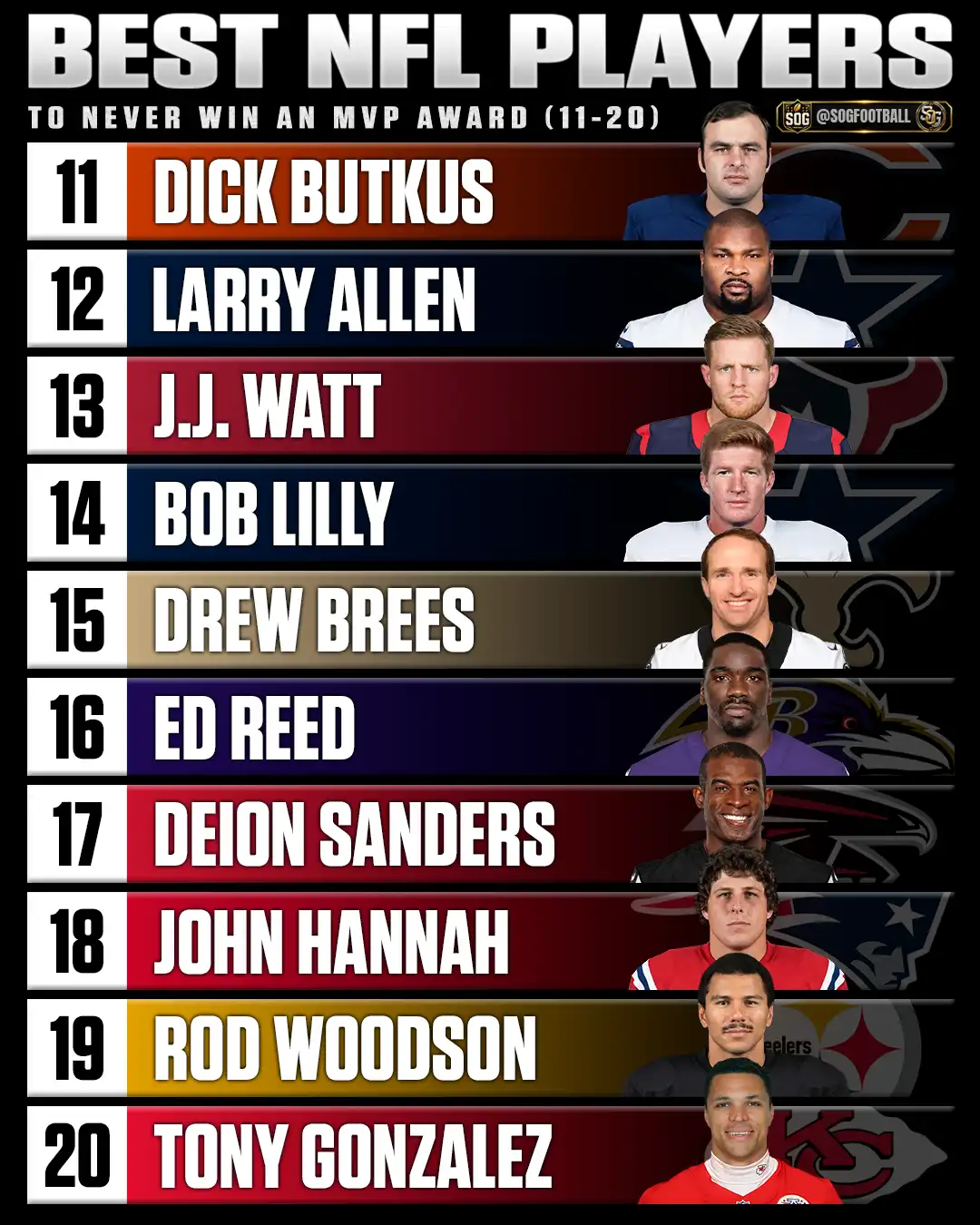
Ranks 11-20 of the best NFL players to never win an MVP Award, featuring Dick Butkus, Larry Allen, J.J. Watt and Drew Brees.
11. Dick Butkus
Butkus packed six first-team All-Pro selections and eight consecutive Pro Bowls into a nine-season career. He intercepted 22 passes and recovered 27 fumbles, remarkable playmaking totals for a middle linebacker in his era. He was not merely an intimidating hitter; his anticipation consistently put him at the ball.
Team success limited his national award narrative because Chicago never reached the playoffs during his career. The short career also keeps him just outside the top 10. At his best, however, Butkus represented everything an offense feared in the middle of the field.
12. Larry Allen
Allen made 11 Pro Bowls and earned six first-team All-Pro selections, including a seven-year stretch in which he was an All-Pro every season. He started at guard and tackle, won Super Bowl XXX with Dallas and combined rare athletic movement with legendary power.
A dominant guard can transform both the running game and the shape of the pocket without producing a statistic that appears in an MVP graphic. Allen routinely displaced defensive linemen and was athletic enough to block in space. Only Muñoz ranks higher among the four offensive linemen on this list.
13. J.J. Watt
Watt won three Defensive Player of the Year awards and retired with 114.5 sacks. He produced 20.5-sack seasons in both 2012 and 2014, making him the first player since official sacks began to post two seasons with at least 20. His 2014 campaign also included dominant run defense, pass deflections and offensive touchdowns.
That 2014 season made Watt the AP MVP runner-up, an extraordinary result for a defensive lineman. His best stretch belongs with any defender in league history. Donald ranks higher because his interior peak lasted longer with fewer interruptions, while injuries reduced Watt’s volume during the second half of his career.
14. Bob Lilly
Lilly made 11 Pro Bowls, earned eight first-team All-Pro selections and missed only one game in 14 seasons. He played 196 consecutive regular-season games and helped Dallas win Super Bowl VI. As the Cowboys’ first draft pick and first Hall of Famer, he became the original standard for the franchise’s defense.
His quickness at defensive tackle let him penetrate rather than simply occupy blockers. That distinction matters because interior pressure can ruin a play before it develops. Lilly’s consistency and durability give him the edge over several more statistically visible defenders who missed the top 30.
15. Drew Brees
Brees retired with 80,358 passing yards and 571 touchdown passes. He led the NFL in passing yards seven times, produced five 5,000-yard seasons, made 13 Pro Bowls and won two Offensive Player of the Year awards. He also led New Orleans to its first championship and won Super Bowl XLIV MVP.
His absence from the MVP winners list is largely about timing. Brees delivered award-caliber seasons in an era that also featured Peyton Manning, Tom Brady and Aaron Rodgers at their peaks. He is the highest-ranked quarterback here because his sustained statistical excellence and transformative effect on the Saints outweigh every other eligible passer’s case.
16. Ed Reed
Reed intercepted 64 passes and returned them for an NFL-record 1,590 yards. His seven interception-return touchdowns, nine Pro Bowls, six first-team All-Pro selections and 2004 Defensive Player of the Year award reflect an unmatched ability to turn coverage into offense. He also won a Super Bowl with Baltimore.
Quarterbacks had to locate Reed before every snap because his range could erase throws that looked open. He studied tendencies, disguised coverages and attacked the ball after the catch point. Lott’s broader physical influence earns the higher safety ranking, but Reed was the more dangerous pure takeaway creator.
17. Deion Sanders
Sanders recorded 53 interceptions, scored 22 total touchdowns and won two Super Bowls. He was an eight-time Pro Bowler, nine-time first-team All-Pro and the 1994 Defensive Player of the Year. His value extended to punt returns and occasional offensive snaps.
Elite cornerback play can disappear from a box score because quarterbacks simply stop throwing in that direction. Sanders turned that silence into an advantage by removing routes and shrinking the usable field. His tackling was not as complete as Lott’s, but few players ever changed an opponent’s passing plan more dramatically.
18. John Hannah
Hannah earned 10 straight All-Pro selections, made nine Pro Bowls and was named the NFL Players Association’s Offensive Lineman of the Year four consecutive times. He played 183 games over 13 seasons and became the standard by which guards were judged.
His leverage, balance and ability to pull made him equally valuable in tight spaces and in the open field. New England did not have the championship résumé of several teams represented above him, but Hannah’s individual dominance was never in question. The lack of a realistic award path for guards is exactly why this list needs positional context.
19. Rod Woodson
Woodson intercepted 71 passes, scored an NFL-record 12 interception-return touchdowns and reached 11 Pro Bowls. He won Defensive Player of the Year in 1993 and finished with 17 total touchdowns across defense and special teams. His 17-season career included elite years at cornerback and a successful transition to safety.
That adaptability separates him from more specialized defensive backs. Woodson could cover outside, blitz, return kicks and later patrol the deep middle. He sits behind Sanders because Sanders produced the higher shutdown-corner peak, but Woodson built the deeper all-phase career.
20. Tony Gonzalez
Gonzalez caught 1,325 passes for 15,127 yards and 111 touchdowns. He made 14 Pro Bowls, earned seven first-team All-Pro selections and missed only one game in 17 seasons. At retirement, his receiving volume belonged not merely among tight ends but among the most productive pass catchers ever.
His consistency helped redefine what an offense could expect from the position. Gonzalez worked the middle, won contested catches and remained productive across different quarterbacks and schemes. Gronkowski had the more overpowering peak, but Gonzalez’s historic durability and career volume earn the higher overall ranking.
Best NFL Players to Never Win MVP: 21-30
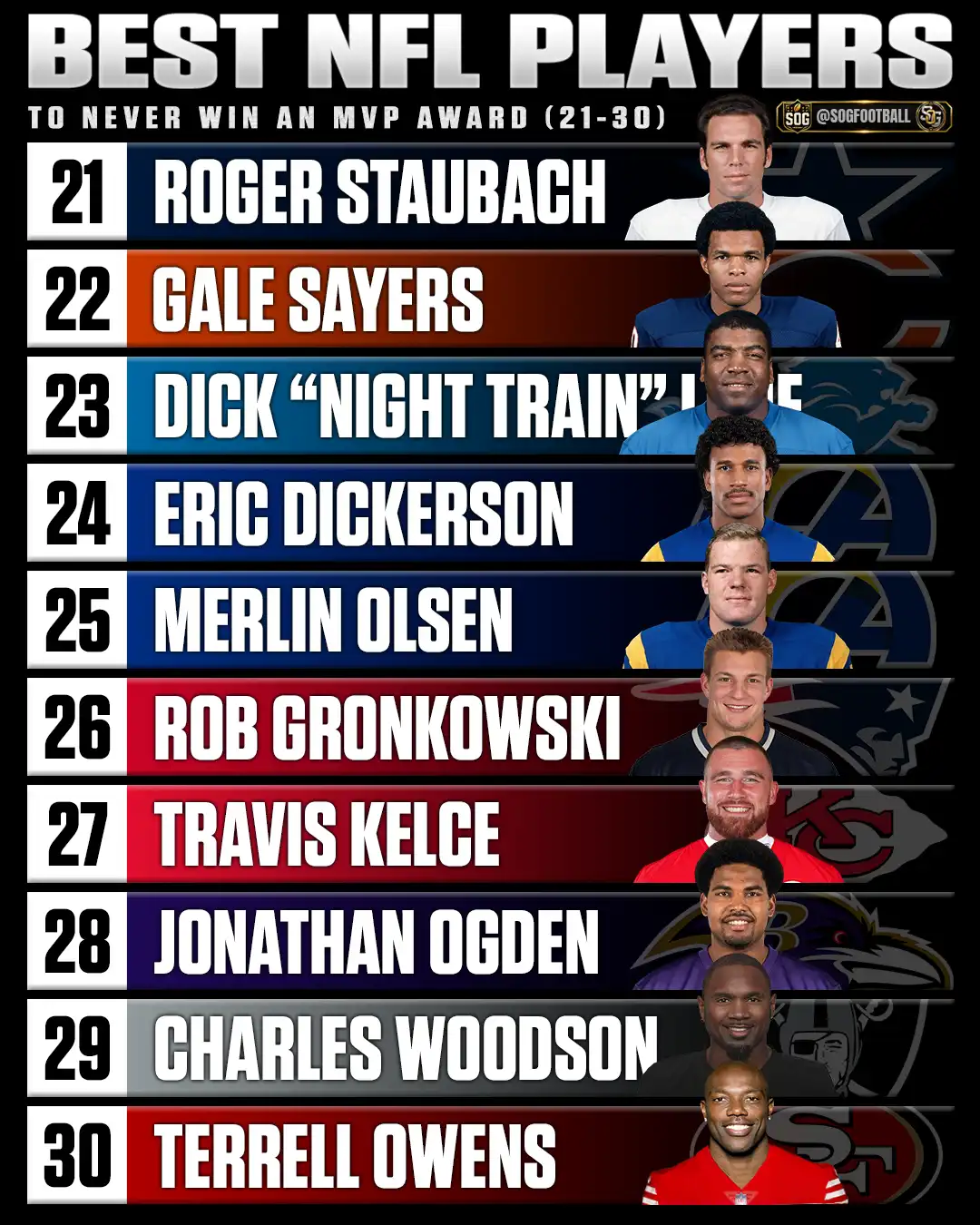
Ranks 21-30 of the best NFL players to never win an MVP Award, featuring Roger Staubach, Gale Sayers, Eric Dickerson and Rob Gronkowski.
21. Roger Staubach
Staubach threw for 22,700 yards and 153 touchdowns while adding 2,264 rushing yards and 20 scores. He led the league in passer rating four times, reached six Pro Bowls and won two Super Bowls, including a Super Bowl VI MVP performance.
His late NFL start after fulfilling a Navy commitment limited his career totals, but his efficiency, mobility and postseason command were elite. Staubach had the position most likely to win MVP, yet his best statistical seasons did not produce the volume of later eras. Brees’ much longer run of top-tier production creates the gap between the two quarterbacks.
22. Gale Sayers
Sayers scored 22 touchdowns as a rookie and finished his seven-season career with 4,956 rushing yards and 9,435 combined net yards. He earned five first-team All-Pro selections and averaged 30.6 yards per kickoff return. His open-field acceleration made routine touches feel dangerous.
Injuries are the only reason he is not much higher. Sayers produced a breathtaking peak as a runner, receiver and returner, but he played only 68 regular-season games. This ranking gives that peak substantial weight without treating a shortened career as equal to a decade of dominance.
23. Dick “Night Train” Lane
Lane intercepted 68 passes and made seven Pro Bowls with six first-team All-Pro selections. His 14 interceptions as a rookie in 1952 remain the single-season record even though the schedule was only 12 games. He continued playing through 1965, which makes him eligible under this article’s post-1957 award scope.
Lane combined ball production with a famously physical style at cornerback. The rules and passing environment were radically different, so direct comparison requires care. Even with that adjustment, his record-setting turnover production and sustained recognition make him impossible to exclude.
24. Eric Dickerson
Dickerson rushed for 13,259 yards and earned five first-team All-Pro selections across six Pro Bowl seasons. His 2,105 rushing yards in 1984 remain the single-season NFL record. He also became the fastest player at the time to reach 10,000 rushing yards, doing it in 91 games.
His upright style and long stride made him unusually explosive for a high-volume runner. Dickerson won major offensive awards but never AP MVP, even when his production was historic. His peak belongs higher than this ranking might suggest, while the careers above him generally offer either greater longevity or more extreme positional separation.
25. Merlin Olsen
Olsen reached the Pro Bowl in each of his first 14 seasons and received 10 first- or second-team All-Pro selections. He played 208 games across 15 years with the Rams and was the consistent interior anchor of the Fearsome Foursome defensive line.
His greatness was built on repetition rather than one headline season. Olsen controlled blockers, defended the run and supplied interior pressure year after year. That exceptional floor places him ahead of several players with flashier statistical peaks but less sustained positional dominance.
26. Rob Gronkowski
Gronkowski caught 621 passes for 9,286 yards and 92 touchdowns in only 143 regular-season games. He earned four first-team All-Pro selections, made five Pro Bowls and won four Super Bowls. His 2011 season produced 1,327 yards and a then-record 17 receiving touchdowns by a tight end.
At his best, Gronkowski was both an elite receiving weapon and a forceful in-line blocker. That two-way impact gives him the highest tight end peak on this list. Injuries and a shorter career keep him behind Gonzalez, whose availability and volume remained extraordinary for nearly two decades.
27. Travis Kelce
Through the completed 2025 season, Kelce had 1,080 receptions, 13,002 receiving yards and 82 receiving touchdowns. He had already earned four first-team All-Pro selections, made 11 Pro Bowls and won three Super Bowls. His postseason receiving production also set the tight end standard.
Kelce became the coverage-solving centerpiece of Kansas City’s offense, especially on option routes and high-leverage downs. Playing beside an MVP quarterback made an individual campaign even harder because Patrick Mahomes naturally received more credit for the same passing attack. Kelce remains active in 2026, so he could still leave this list by winning the award.
28. Jonathan Ogden
Ogden made 11 consecutive Pro Bowls and earned six first-team All-Pro selections in 12 seasons. He won Super Bowl XXXV and later blocked for Jamal Lewis during a 2,066-yard rushing season. At 6-foot-9, he paired extraordinary size with light feet and technical control.
Baltimore could build its protection and running game around the confidence that Ogden would handle the left edge. He ranks below Muñoz because Muñoz accumulated a longer run of first-team All-Pro dominance, but Ogden’s peak belongs in the same all-time tackle conversation.
29. Charles Woodson
Woodson played 18 seasons, intercepted 65 passes and recorded 20 sacks. He reached nine Pro Bowls, earned three first-team All-Pro selections and tied the career record with 13 defensive touchdowns. His 2009 season brought a Defensive Player of the Year award, and he later won a Super Bowl with Green Bay.
He could play outside corner, cover the slot, blitz and transition to safety late in his career. That versatility made him useful in virtually every game situation. Woodson’s best seasons came after his early Oakland peak, giving his career an unusual second act and a deserved place among the top 30.
30. Terrell Owens
Owens caught 1,078 passes for 15,934 yards and 153 touchdowns. He earned five first-team All-Pro selections and made six Pro Bowls. In Super Bowl XXXIX, he returned from a serious leg injury to catch nine passes for 122 yards, one of the toughest championship performances by a receiver.
His size, speed and yards-after-catch power produced dominant seasons in San Francisco, Philadelphia and Dallas. Owens falls behind Rice and Moss because those two created even larger peaks and cleaner all-time cases, not because his résumé is marginal. He is the final selection on an extremely crowded list.
Biggest Ranking Debates
Jerry Rice vs. Reggie White
White affected more snaps and could destroy an offense without help, which gives him a reasonable No. 1 argument. Rice gets the spot because his separation from every other receiver is greater. He owns the central career records, sustained an elite peak for more than a decade and delivered in championship games.
Why So Many Defenders Rank Near the Top
Seven of the first 10 players are defenders. That is not an attempt to dismiss quarterback value. It reflects the specific premise: the greatest players who never won an award overwhelmingly controlled by quarterbacks. Reggie White, Aaron Donald and Ray Lewis reached best-player-in-football territory without receiving the statistical platform quarterbacks enjoy.
The Offensive Line Problem
Muñoz, Allen, Hannah and Ogden collectively earned 30 first-team All-Pro selections, yet none had a practical MVP route. Their best work prevented negative plays and created opportunities for teammates, so it showed up in someone else’s statistics. Any ranking based only on conventional production would badly underrate them.
The Receiver and Tight End Problem
Rice, Moss and Owens needed quarterbacks to deliver the ball, while Gonzalez, Gronkowski and Kelce were also judged through a positional label that historically reduced their award ceiling. Their value included coverage gravity, blocking and space created for teammates. Those effects are real even when the quarterback receives most of the credit.
Peak vs. Longevity
Gale Sayers and J.J. Watt are the clearest peak cases, while Bruce Smith, Tony Gonzalez and Merlin Olsen represent longevity. The ranking generally breaks ties in favor of sustained dominance, but a genuinely historic peak can overcome fewer elite seasons. That balance keeps Sayers in the top 25 without placing his 68-game career above players who dominated for a decade.
Complete Ranking Table
| Rank | Player | Primary Team | Position |
|---|---|---|---|
| 1 | Jerry Rice | San Francisco 49ers | Wide Receiver |
| 2 | Reggie White | Philadelphia Eagles | Defensive End |
| 3 | Aaron Donald | Los Angeles Rams | Defensive Tackle |
| 4 | Anthony Muñoz | Cincinnati Bengals | Offensive Tackle |
| 5 | Ray Lewis | Baltimore Ravens | Linebacker |
| 6 | Ronnie Lott | San Francisco 49ers | Safety |
| 7 | Joe Greene | Pittsburgh Steelers | Defensive Tackle |
| 8 | Randy Moss | Minnesota Vikings | Wide Receiver |
| 9 | Bruce Smith | Buffalo Bills | Defensive End |
| 10 | Deacon Jones | Los Angeles Rams | Defensive End |
| 11 | Dick Butkus | Chicago Bears | Linebacker |
| 12 | Larry Allen | Dallas Cowboys | Guard |
| 13 | J.J. Watt | Houston Texans | Defensive End |
| 14 | Bob Lilly | Dallas Cowboys | Defensive Tackle |
| 15 | Drew Brees | New Orleans Saints | Quarterback |
| 16 | Ed Reed | Baltimore Ravens | Safety |
| 17 | Deion Sanders | Atlanta Falcons | Cornerback |
| 18 | John Hannah | New England Patriots | Guard |
| 19 | Rod Woodson | Pittsburgh Steelers | Defensive Back |
| 20 | Tony Gonzalez | Kansas City Chiefs | Tight End |
| 21 | Roger Staubach | Dallas Cowboys | Quarterback |
| 22 | Gale Sayers | Chicago Bears | Running Back |
| 23 | Dick “Night Train” Lane | Detroit Lions | Cornerback |
| 24 | Eric Dickerson | Los Angeles Rams | Running Back |
| 25 | Merlin Olsen | Los Angeles Rams | Defensive Tackle |
| 26 | Rob Gronkowski | New England Patriots | Tight End |
| 27 | Travis Kelce | Kansas City Chiefs | Tight End |
| 28 | Jonathan Ogden | Baltimore Ravens | Offensive Tackle |
| 29 | Charles Woodson | Oakland Raiders | Defensive Back |
| 30 | Terrell Owens | San Francisco 49ers | Wide Receiver |
FAQ
Did Jerry Rice ever win AP NFL MVP?
No. Rice finished second in the 1987 AP MVP vote after catching 22 touchdown passes in 12 games, but John Elway won the award. Rice did win two Offensive Player of the Year awards and Super Bowl XXIII MVP.
Who is the best defensive player to never win AP NFL MVP?
Reggie White is the highest-ranked defender on this list, followed by Aaron Donald. White combined 198 sacks with 10 first-team All-Pro selections, while Donald won three Defensive Player of the Year awards from defensive tackle.
Who is the best quarterback to never win AP NFL MVP?
Drew Brees ranks first among eligible quarterbacks. He retired with 80,358 passing yards, 571 touchdown passes and five 5,000-yard seasons but never won AP MVP.
Can an active player leave this list?
Yes. The ranking covers completed seasons through 2025. Any active player on the list would become ineligible if he wins AP NFL MVP in a later season.
Conclusion
Rice leads because no eligible player matches his combination of peak, career records, positional separation and postseason production. White, Donald, Muñoz and Lewis complete a top five that also captures the central weakness of MVP voting: a player can dominate football without playing the position that controls the ballot.
The trophy remains meaningful, but it is not a complete history of the league’s greatest players. This ranking recognizes the legends whose value was bigger than their access to one quarterback-dominated award.
Related Articles
- Best Defensive Players in NFL History
- Best Wide Receivers of All Time
- Best Pass Rushers in NFL History
- Best Offensive Linemen of All Time
- Best Tight Ends of All Time
- Best Quarterbacks of All Time
Follow @SOGFootball on Instagram for more NFL rankings, predictions and weekly performance breakdowns.
