Tom Brady was the best NFL quarterback of the 2010s, followed by Aaron Rodgers, Drew Brees, Russell Wilson and Peyton Manning. Brady did not lead the decade in passing yards or produce its most efficient individual season, but nobody matched his combination of sustained elite play, five Super Bowl appearances and three championships across the 2010 through 2019 seasons.
This is a ranking of what each quarterback accomplished within the decade, not a comparison of full careers. Total regular-season and playoff performance carries the most weight, but talent and peak play are deliberately important enough to reward shorter, extraordinary runs from quarterbacks such as Manning, Patrick Mahomes and Lamar Jackson.
How We Ranked the Best Quarterbacks in the NFL of the 2010s
The formula is built specifically for a decade ranking. It does not simply sort passing totals, count rings or ask which quarterback had the best full career. The final order uses three weighted categories:
- 40% total performance during the decade: Regular-season production, efficiency, consistency, durability, playoff performance and team results from the 2010 through 2019 seasons.
- 30% overall quarterback talent: Accuracy, arm strength, processing, pocket movement, mobility, creation outside structure and the ability to elevate an offense.
- 30% peak performance: The player’s best regular season, postseason or multi-year stretch within the decade.
That balance explains the shape of the list. Brady’s complete decade beats Rodgers’ superior efficiency peak and Brees’ greater passing volume. Manning and Mahomes rank aggressively because their best work was historically great, while quarterbacks with longer but lower-ceiling runs do not automatically move ahead of them. For a ranking based on complete careers rather than one decade, see the best quarterbacks of all time.
Eligibility and Decade Scope
Only performance from the 2010 through 2019 NFL seasons is considered. The postseason is attached to the season that produced it, not the calendar year in which the playoff game happened. Therefore, Green Bay’s championship after the 2010 season and Kansas City’s championship after the 2019 season count, while New Orleans’ title following the 2009 season does not.
There is no minimum number of starts. A short sample can earn a high position only if the peak and impact are exceptional enough to overcome the longevity gap. Regular-season statistics below cover the 2010-2019 seasons only. Rushing production is added when it materially changes a quarterback’s value.
Best Quarterbacks of the 2010s: 1-10

The 10 best NFL quarterbacks of the 2010s, led by Tom Brady, Aaron Rodgers and Drew Brees.
1. Tom Brady
2010s Stats & Accolades: 43,727 passing yards, 316 passing touchdowns and 80 interceptions; 2 AP MVP awards; 3 Super Bowl wins; 2 Super Bowl MVP awards.
Brady owns the decade because his case remains elite no matter which part of the résumé receives the most weight. He was fourth in passing yards from 2010 through 2019, threw more than 300 touchdown passes and posted one of the lowest interception rates among the decade’s major volume passers. His 2010 MVP season, with 36 touchdowns and four interceptions, was one of the cleanest quarterback seasons ever.
The separator is January. Brady reached five Super Bowls tied to 2010s seasons and won three of them, including the comeback from 28-3 against Atlanta. The supporting cast changed, the offense changed and Brady aged from 33 to 42, yet New England’s championship standard never moved. Rodgers reached a higher efficiency peak and Brees generated more volume, but Brady delivered the strongest total decade.
2. Aaron Rodgers
2010s Stats & Accolades: 38,145 passing yards, 305 passing touchdowns and 63 interceptions; 2 AP MVP awards; 1 Super Bowl win; 1 Super Bowl MVP award.
Rodgers had the best blend of arm talent, movement and ball security in the decade. His 2011 MVP season remains the peak: 4,643 yards, 45 touchdowns, six interceptions and a 122.5 passer rating. Defenses knew he wanted explosive plays, yet he almost never gave them the turnover needed to punish that aggression.
He also opened the decade by winning the Super Bowl and its MVP award after the 2010 season. Injuries cost him meaningful time in 2013 and 2017, and Green Bay never returned to the Super Bowl, which creates the gap behind Brady. On pure quarterback play, however, nobody from the decade made difficult throws look safer.
3. Drew Brees
2010s Stats & Accolades: A decade-leading 46,770 passing yards, 345 passing touchdowns and 127 interceptions; 4 seasons with at least 5,000 passing yards.
Brees was the passing-volume king of the 2010s. He led every quarterback in yards during the decade, finished first in completions and produced four of his five career 5,000-yard seasons. The 2011 campaign was the masterpiece: 5,476 yards, 46 touchdowns and a 71.2% completion rate.
His precision was not empty box-score production. New Orleans built an entire offensive identity around his anticipation, pocket movement and ability to find throwing lanes despite his height. The championship following the 2009 season falls outside this ranking’s scope, and the Saints endured three straight 7-9 seasons in the middle of the decade. Even so, Brees’ relentless elite output makes the top three clear.
4. Russell Wilson
2010s Stats & Accolades: 29,734 passing yards, 227 passing touchdowns and 68 interceptions; 3,993 rushing yards; 1 Super Bowl win and 2 NFC championships.
Wilson entered the league in 2012 and immediately gave Seattle efficient passing, movement and late-game creation. He was not asked to carry the same weekly passing volume as Brees or Matt Ryan, but he consistently turned broken plays into explosives without becoming reckless. His deep-ball touch was among the best in football, and his rushing value forced defenses to account for every edge.
Seattle’s defense and running game were major parts of the championship formula, but Wilson was not a passenger. He won a Super Bowl, returned the next season and later developed into a higher-volume passer as the roster changed. Eight strong seasons, rare durability and a 101.2 decade passer rating give him the edge over Manning’s shorter run.
5. Peyton Manning
2010s Stats & Accolades: 21,812 passing yards, 173 passing touchdowns and 70 interceptions; 1 AP MVP award; 2 Super Bowl appearances and 1 win.
Manning played only five seasons in the decade and missed 2011 after neck surgery, but his peak is too large to treat like an ordinary short sample. In 2013, he set single-season records with 5,477 passing yards and 55 touchdown passes. That season still leads the most passing yards in a single NFL season list.
His Denver run produced four straight division titles, two Super Bowl appearances and a championship after the 2015 season. By that final playoff run, the defense carried more of the burden and Manning’s arm had declined sharply. The ranking is not pretending otherwise. It is rewarding an all-time three-year peak from 2012 through 2014, plus enough postseason success to close the decade portion of his career.
6. Matt Ryan
2010s Stats & Accolades: 44,830 passing yards, 283 passing touchdowns and 122 interceptions; 2016 AP MVP and first-team All-Pro; 1 NFC championship.
Ryan quietly finished second in decade passing yards, started 159 of 160 possible games and supplied high-level quarterback play through several versions of Atlanta’s offense. His 2016 MVP season was the payoff: 4,944 yards, 38 touchdowns, seven interceptions and a 117.1 passer rating.
The Super Bowl collapse will always dominate the public memory, but reducing Ryan’s decade to 28-3 misses how well he played during that postseason. He produced a 135.3 passer rating across three playoff games and gave Atlanta a championship-level passing offense. Ryan did not have Mahomes’ raw peak talent, but eight more seasons of strong decade production are enough to keep him one spot ahead.
7. Patrick Mahomes
2010s Stats & Accolades: 9,412 passing yards, 76 passing touchdowns and 18 interceptions; 2018 AP MVP and first-team All-Pro; 1 Super Bowl win and 1 Super Bowl MVP award.
Mahomes made only 31 regular-season appearances during the decade, including one start in 2017. That would normally kill a top-10 case. His first two full seasons were so overwhelming that normal rules do not quite work: a 5,097-yard, 50-touchdown MVP debut as the starter, followed by a championship run tied to the 2019 season.
The arm angles and off-platform throws changed what fans expected an NFL quarterback to attempt, but the substance underneath the highlights mattered more. Mahomes attacked every level, handled pressure and became even more dangerous when structure disappeared. Ryan wins the longevity comparison. Mahomes wins talent and peak by enough to finish immediately behind him.
8. Ben Roethlisberger
2010s Stats & Accolades: 37,243 passing yards, 236 passing touchdowns and 110 interceptions; 1 AFC championship; a league-leading 5,129 passing yards in 2018.
Roethlisberger’s decade covered two different offensive identities. Early on, Pittsburgh still leaned on his size, deep arm and ability to survive chaotic pockets. Later, the offense opened up around Antonio Brown and Le’Veon Bell, allowing Roethlisberger to become one of the league’s highest-volume passers.
He reached the Super Bowl after the 2010 season, threw for 4,952 yards in 2014 and led the league with 5,129 yards in 2018. The lack of an MVP-level season or another Super Bowl run keeps him below Mahomes. Still, the combination of volume, explosive passing and play extension makes No. 8 a stronger fit than the more specialized cases below him.
9. Cam Newton
2010s Stats & Accolades: 29,041 passing yards, 182 passing touchdowns and 108 interceptions; 4,806 rushing yards and 58 rushing touchdowns; 2015 AP MVP; 2011 Offensive Rookie of the Year.
Newton was the decade’s most physically imposing quarterback. His passing could run hot and cold, but no other player created the same short-yardage and red-zone advantage. Defenses had to treat the quarterback as a power runner while still respecting an arm capable of attacking outside the numbers.
The 2015 season carries the case. Newton produced 45 combined passing and rushing touchdowns, led Carolina to a 15-1 record and won MVP before reaching the Super Bowl. Injuries and declining accuracy shortened the elite portion of his decade, but the formula gives 60% of its weight to talent and peak. That is exactly why Newton belongs in the top 10.
10. Philip Rivers
2010s Stats & Accolades: 44,320 passing yards, 291 passing touchdowns and 153 interceptions; 2013 AP Comeback Player of the Year; 4,710 passing yards in 2010.
Rivers started all 160 regular-season games in the decade and finished third in passing yards. The release was unconventional, but the anticipation, toughness and willingness to challenge tight windows were real. He led the league in passing yards in 2010 and completed a career-best 69.5% of his throws during his 2013 resurgence.
The ceiling is limited by the missing playoff breakthrough. Rivers won only two postseason games tied to 2010s seasons and never reached a conference championship game during the decade. He still beats the quarterbacks below him through ten years of durable, high-end passing with very few stretches of replacement-level play.
Best Quarterbacks of the 2010s: 11-20
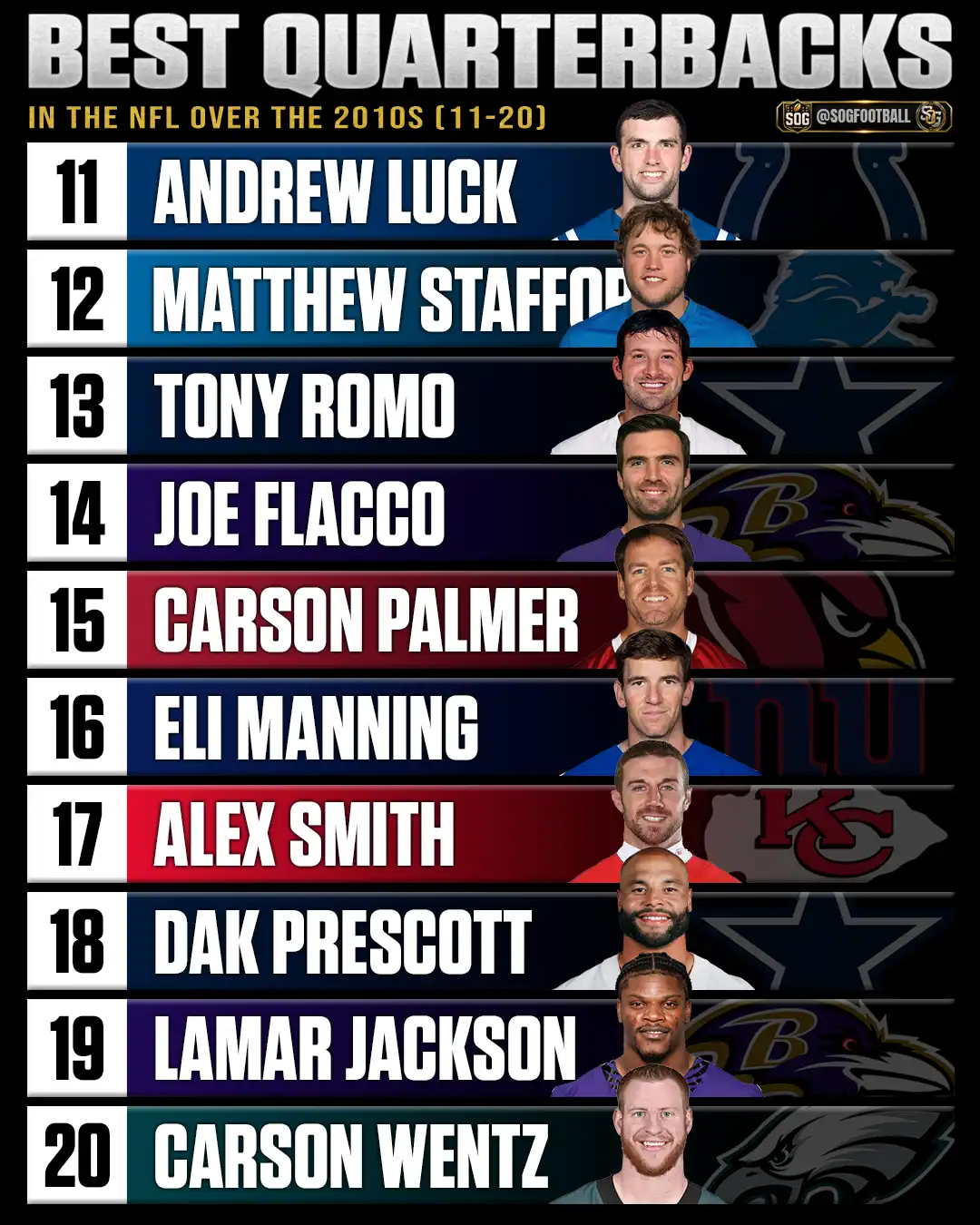
Quarterbacks ranked 11 through 20 for the 2010s, from Andrew Luck through Carson Wentz.
11. Andrew Luck
2010s Stats & Accolades: 23,671 passing yards, 171 passing touchdowns and 83 interceptions; 4 Pro Bowl selections; 2018 AP Comeback Player of the Year; 1 AFC Championship Game appearance.
Luck inherited a 2-14 team and immediately produced three straight 11-win seasons. He could attack vertically, create as a runner and absorb pressure behind offensive lines that too often asked him to be indestructible. His 2014 season delivered 4,761 yards and a league-leading 40 touchdown passes, followed by a run to the AFC Championship Game.
Injuries erased all of 2017 and helped push him into retirement before age 30. That prevents a top-10 decade résumé, but his best seasons were comfortably at that level. No quarterback outside the top 10 combined talent, peak and immediate franchise-changing impact more convincingly.
12. Matthew Stafford
2010s Stats & Accolades: 38,758 passing yards, 243 passing touchdowns and 114 interceptions; 2011 AP Comeback Player of the Year; 5,038 yards and 41 touchdowns in 2011.
Stafford’s best decade work happened before the championship that later changed his national reputation. In Detroit, he was regularly asked to rescue bad down-and-distance situations with arm strength, toughness and throws that only a small group of quarterbacks could attempt.
The 2011 breakout proved the ceiling, while three more 4,000-yard seasons from 2015 through 2017 showed he could sustain heavy offensive responsibility. Zero playoff wins during the decade matter and keep him behind Luck. The arm talent and nearly 39,000 passing yards keep him ahead of quarterbacks with cleaner team résumés but smaller weekly burdens.
13. Tony Romo
2010s Stats & Accolades: 19,138 passing yards, 141 passing touchdowns and 62 interceptions; 2014 second-team All-Pro; league-best 113.2 passer rating in 2014.
Romo’s decade sample is shorter than Stafford’s because injuries repeatedly interrupted the second half of his career. When healthy, he remained one of the league’s smartest and most creative passers. He manipulated coverage before the snap, escaped pressure without abandoning the play and consistently produced above-average efficiency.
His 2014 season deserves more respect than it receives: 34 touchdowns, nine interceptions, a 69.9% completion rate and a league-leading 113.2 rating. Limited availability and only one playoff win during the decade hold him at No. 13. Quality of play is why he remains this high despite the lighter volume.
14. Joe Flacco
2010s Stats & Accolades: 33,483 passing yards, 183 passing touchdowns and 117 interceptions; 1 Super Bowl win; 1 Super Bowl MVP award; 11 touchdowns and 0 interceptions in the 2012 postseason.
Flacco never sustained elite regular-season play, and his 84.0 passer rating for the decade shows the gap between him and the names directly above. He also produced one of the greatest playoff runs the position has seen. Over four games after the 2012 season, he beat Andrew Luck, Peyton Manning, Tom Brady and San Francisco while matching the postseason record with 11 touchdown passes and no interceptions.
That run is not enough to erase every ordinary regular season, but a formula with 30% devoted to peak performance cannot treat it like a footnote. Flacco’s durability, strong deep arm and championship peak give him the edge over Palmer and Eli Manning in the middle of the ranking.
15. Carson Palmer
2010s Stats & Accolades: 27,523 passing yards, 166 passing touchdowns and 107 interceptions; 2015 second-team All-Pro; 4,671 yards and 35 touchdowns in 2015.
Palmer’s decade looked finished before Arizona revived it. In Bruce Arians’ vertical offense, he attacked downfield with confidence and produced the best season of his career at age 36. The 2015 Cardinals went 13-3, reached the NFC Championship Game and finished with one of football’s most explosive passing attacks.
That peak was better than Eli Manning’s week-to-week play, but Palmer lacks Manning’s championship finish. Injuries also removed nearly all of 2014 and much of 2017. No. 15 reflects a top-five-calibre individual season surrounded by enough strong passing to matter, but not enough availability or postseason success to move higher.
16. Eli Manning
2010s Stats & Accolades: 38,379 passing yards, 241 passing touchdowns and 156 interceptions; 1 Super Bowl win and 1 Super Bowl MVP award; 4,933 yards in 2011.
Manning’s 2011 season is the entire argument in miniature. He set a career high in passing yards, delivered five fourth-quarter comebacks and six game-winning drives in the regular season, then completed another championship run through Green Bay, San Francisco and New England. The throw to Mario Manningham remains one of the defining quarterback plays of the decade.
The rest of the résumé is far less clean. Manning led the league in interceptions twice during the decade and produced only one winning season after 2012. One elite championship year keeps him firmly in the top 20. The long stretches of below-average efficiency keep him behind Palmer and Flacco.
17. Alex Smith
2010s Stats & Accolades: 27,039 passing yards, 156 passing touchdowns and 58 interceptions; 3 Pro Bowl selections; league-leading 104.7 passer rating in 2017.
Smith transformed from a former No. 1 pick fighting to keep his job into one of the decade’s steadiest winning quarterbacks. He protected the football, used his mobility intelligently and helped stabilize two franchises. The conservative label was often fair, but it sometimes obscured how well he handled pressure and situational football.
His 2017 season showed a more aggressive version: 4,042 yards, 26 touchdowns, five interceptions and the league’s best passer rating. Smith never produced a conference-title run as the starter, and his controlled style could leave explosive plays unused. His decade-long consistency still gives him a more complete case than the younger quarterbacks immediately below.
18. Dak Prescott
2010s Stats & Accolades: 15,778 passing yards, 97 passing touchdowns and 36 interceptions; 1,221 rushing yards and 21 rushing touchdowns; 2016 Offensive Rookie of the Year.
Prescott entered the league in 2016 as a fourth-round rookie and immediately played with veteran-level control. His first season produced 23 passing touchdowns, four interceptions and a 104.9 rating. By 2019, he had expanded into a 4,902-yard passer without losing the mobility and short-yardage value that made him difficult to defend.
Four seasons cannot match Smith’s decade-long volume, and Prescott won only one playoff game tied to the period. He still places above Jackson and Wentz because he supplied four complete seasons of above-average play, missed no starts and showed both a high floor and a growing ceiling.
19. Lamar Jackson
2010s Stats & Accolades: 4,328 passing yards, 42 passing touchdowns and 9 interceptions; 1,901 rushing yards and 12 rushing touchdowns; 2019 AP MVP and first-team All-Pro.
Jackson had only one full starting season in the decade. It was one of the most transformative seasons by any quarterback on this list. In 2019, he led the NFL with 36 touchdown passes, broke the single-season quarterback rushing record with 1,206 yards and became the second unanimous MVP in league history.
Baltimore did not merely add quarterback runs to a normal offense. Jackson changed the numbers every defense had to commit to the box, creating space before the ball was snapped. His playoff loss and tiny sample make No. 19 appropriate for a decade ranking, but his peak already established him among the best running quarterbacks in NFL history.
20. Carson Wentz
2010s Stats & Accolades: 14,191 passing yards, 97 passing touchdowns and 35 interceptions; 2017 second-team All-Pro; 33 touchdowns in 13 games in 2017.
Wentz was playing at an MVP level in 2017 before a torn ACL ended his season. He combined size, mobility, third-down aggression and red-zone creativity while helping Philadelphia build the conference’s best record. That peak matters, but Nick Foles completed the playoff run and deserves the postseason credit.
Wentz returned with efficient numbers in 2018 and became the first Eagles quarterback to pass for 4,000 yards in 2019, despite a depleted receiving group. Injuries and uneven late-game decisions made the overall sample less stable than Prescott’s. His 2017 level keeps him above the final ten.
Best Quarterbacks of the 2010s: 21-30
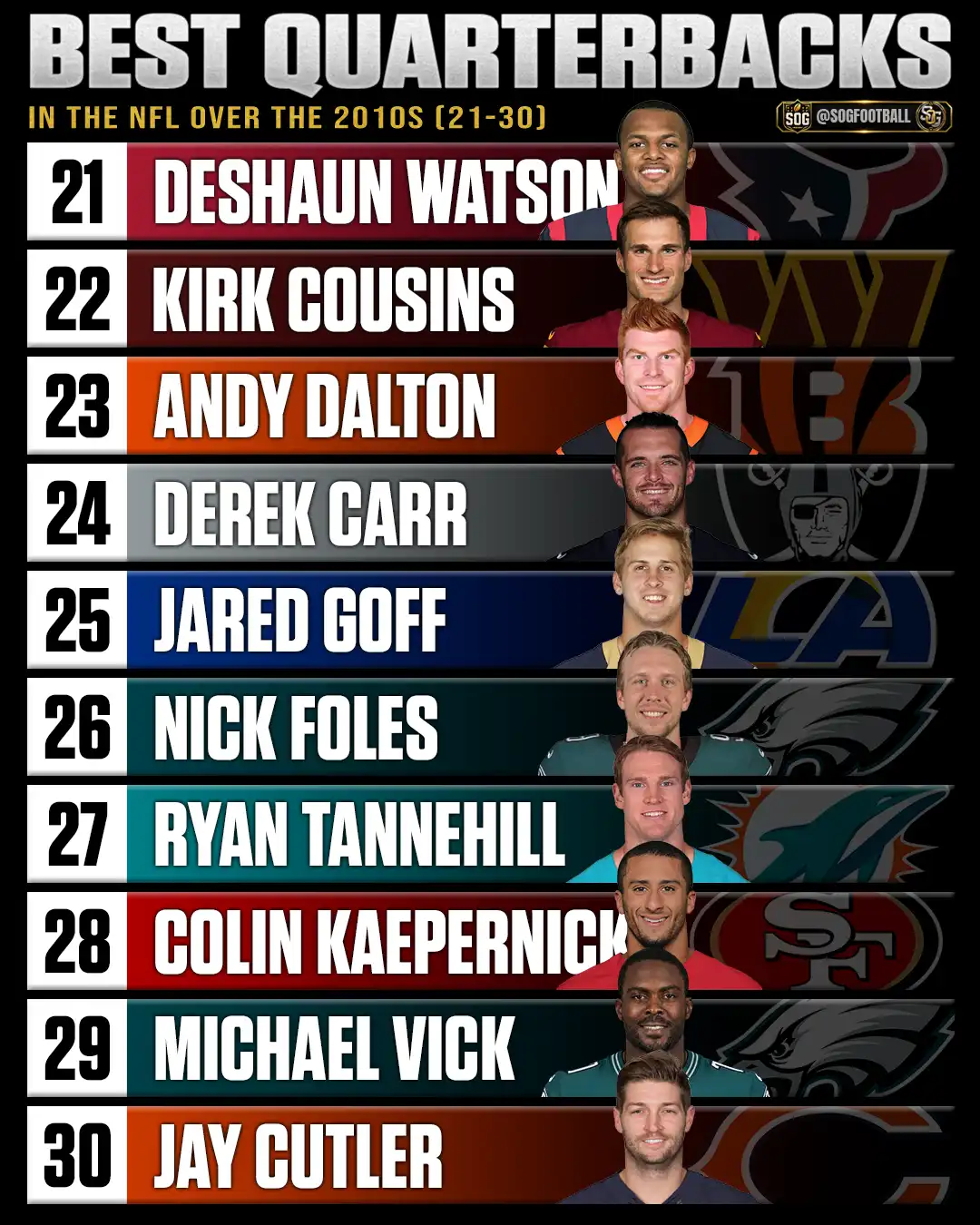
Quarterbacks ranked 21 through 30 for the 2010s, from Deshaun Watson through Jay Cutler.
21. Deshaun Watson
2010s Stats & Accolades: 9,716 passing yards, 71 passing touchdowns and 29 interceptions; 1,233 rushing yards and 14 rushing touchdowns; 2 Pro Bowl selections.
Watson’s placement is based only on his on-field performance from 2017 through 2019. During that span, he posted a 101.0 passer rating, created explosives outside structure and supplied meaningful rushing production. He also led Houston to consecutive division titles and a playoff win tied to the 2019 season.
The 38-game sample is the obvious limitation. Watson took too many sacks, and his best statistical season arrived in 2020, outside the window. The talent and immediate production are enough for No. 21, but not enough to jump quarterbacks who delivered either a longer run or a more significant peak within the decade.
22. Kirk Cousins
2010s Stats & Accolades: 24,107 passing yards, 155 passing touchdowns and 71 interceptions; a 96.8 passer rating; 4 seasons with at least 4,000 passing yards.
Cousins became one of the decade’s most reliable statistical producers after taking over as a full-time starter in 2015. His accuracy off play action and willingness to attack intermediate windows supported strong passing offenses in both Washington and Minnesota.
The criticism was not invented. Cousins often looked less comfortable when protection broke down, and his teams did not consistently convert good regular seasons into January success. The road playoff win following the 2019 season helped the case. His volume and efficiency beat Dalton’s, while the lack of a truly elite season prevents a top-20 spot.
23. Andy Dalton
2010s Stats & Accolades: 31,594 passing yards, 204 passing touchdowns and 118 interceptions; 3 Pro Bowl selections; 5 consecutive playoff appearances from 2011 through 2015.
Dalton gave Cincinnati stability almost immediately, and five straight playoff berths should not be dismissed just because none produced a win. He was accurate enough to keep the offense on schedule, handled the quick game well and reached a genuine high point in 2015.
That season ended early because of a thumb injury after Dalton posted 25 touchdowns, seven interceptions and a 106.3 passer rating. The absence of a playoff win and the lower ceiling in obvious passing situations keep him behind Cousins. More than 31,000 yards and 200 touchdowns make him too productive to slide much further.
24. Derek Carr
2010s Stats & Accolades: 22,793 passing yards, 143 passing touchdowns and 62 interceptions; 3 Pro Bowl selections; 28 touchdowns and 6 interceptions in 2016.
Carr’s 2016 season briefly changed the direction of the Raiders. His quick release, deep accuracy and late-game confidence helped produce 12 wins before a broken leg ended his season and removed him from the playoffs. He finished third in MVP voting.
The organization around him rarely stayed stable for long, but Carr was not blameless for the inconsistency that followed. His efficiency fell sharply in 2017 before recovering, and he never made a postseason start in the decade. The 2016 peak plus six seasons of competent starting play earns No. 24.
25. Jared Goff
2010s Stats & Accolades: 14,219 passing yards, 87 passing touchdowns and 42 interceptions; 2 Pro Bowl selections; 1 NFC championship.
Goff looked overwhelmed as a rookie, then became the point guard of one of football’s best-designed offenses. From 2017 through 2018, he threw for 8,492 yards and 60 touchdowns while Los Angeles won consecutive division titles and reached the Super Bowl.
Sean McVay’s structure and a loaded supporting cast made the job easier, but Goff still had to execute the throws. His 413-yard, four-touchdown duel against Patrick Mahomes in 2018 showed the high end. The offense’s decline in 2019 exposed limitations against pressure and post-snap disguise, which keeps him below Carr despite the stronger playoff résumé.
26. Nick Foles
2010s Stats & Accolades: 11,901 passing yards, 71 passing touchdowns and 35 interceptions; 2013 Pro Bowl selection; 1 Super Bowl win and 1 Super Bowl MVP award.
Foles produced two peaks that would sound fictional if they belonged to different players. In 2013, he threw 27 touchdowns against two interceptions and posted a 119.2 passer rating. Four years later, he took over for an injured Wentz and outplayed Tom Brady in the Super Bowl.
The rest of the decade was unstable. Foles struggled as a full-time starter in St. Louis, spent 2016 as a backup and could not hold a starting job after the championship run. The thin week-to-week résumé prevents a higher ranking. A historic efficiency season and a Super Bowl MVP make exclusion impossible.
27. Ryan Tannehill
2010s Stats & Accolades: 23,176 passing yards, 145 passing touchdowns and 81 interceptions; 2019 AP Comeback Player of the Year; league-leading 117.5 passer rating in 2019.
For most of the decade, Tannehill was a capable but limited starter in Miami. He could throw on the move and attack intermediate space, yet poor protection, injuries and uneven pocket feel prevented a true breakout.
Then Tennessee changed the ending. After taking over in 2019, Tannehill averaged 9.6 yards per attempt, threw 22 touchdowns in 12 games and led the league in passer rating. Derrick Henry drove the playoff offense, but Tannehill’s regular-season efficiency helped make that run possible. The late peak lifts him over Kaepernick, Vick and Cutler.
28. Colin Kaepernick
2010s Stats & Accolades: 12,271 passing yards, 72 passing touchdowns and 30 interceptions; 2,300 rushing yards and 13 rushing touchdowns; 1 NFC championship.
Kaepernick had the shortest conventional prime among the final three, but his peak created the greatest postseason impact. He took over during the 2012 season, added a devastating zone-read element and helped San Francisco reach the Super Bowl. His 181 rushing yards against Green Bay remain the signature performance.
The 49ers returned to the NFC Championship Game the next season, but the offensive structure and roster deteriorated quickly after that. Kaepernick never developed the consistent touch and progression speed needed to offset those changes. The brief conference-title peak earns a place; the limited sustained passing keeps him at No. 28.
29. Michael Vick
2010s Stats & Accolades: 10,873 passing yards, 61 passing touchdowns and 36 interceptions; 2,155 rushing yards and 13 rushing touchdowns; 2010 AP Comeback Player of the Year.
Vick’s 2010 comeback season was one of the decade’s most electric quarterback peaks. He threw for 3,018 yards, ran for 676 more and produced 30 combined touchdowns in only 12 games. His six-touchdown performance in Washington showed a version of Vick who had paired improved passing discipline with the same rare athleticism.
That level did not last. Injuries, turnovers and declining explosiveness prevented another complete season, and he became a part-time starter by 2013. Vick ranks above Cutler because his best season was substantially better and his rushing threat changed defensive structure in a way Cutler never could.
30. Jay Cutler
2010s Stats & Accolades: 22,443 passing yards, 146 passing touchdowns and 97 interceptions; 1 NFC Championship Game appearance; a career-high 28 touchdown passes in 2014.
Cutler closes the list because the tools and the starting longevity were both legitimate. His arm could threaten any part of the field, and he played well enough in 2010 to help Chicago reach the NFC Championship Game. At his best, he punished single-high coverage and created throws after the pocket moved.
The frustration was consistency. Cutler never made a Pro Bowl during the decade, finished with a passer rating above 90 only twice and too often trusted his arm after the play had already turned against him. Ryan Fitzpatrick has the stronger volume argument for the final spot, but Cutler’s talent, multi-year starting run and higher team peak win the narrow decision.
Biggest Debates and Toughest Calls
Why Brady Ranks Ahead of Rodgers and Brees
Rodgers had the decade’s best efficiency peak, while Brees led it in passing yards and touchdowns. Brady’s case is more complete. He still finished fourth in passing yards, won two MVPs and threw 316 touchdowns, then added five Super Bowl appearances and three wins. The playoff gap is too large for the modest regular-season statistical gap to overcome.
Why Manning and Mahomes Rank So High With Shorter Samples
Peak performance and talent account for 60% of the formula. Manning supplied the most productive passing season in NFL history and a three-year stretch of overwhelming regular-season control. Mahomes won MVP in his first full season as a starter and a championship in his second. Their lack of decade-long volume matters, which is why neither reaches the top four, but the formula is designed not to reward longevity for its own sake.
How Much One Playoff Run Should Matter
Flacco, Eli Manning, Foles and Kaepernick all rise because of postseason performance. They are not ranked as if one January erased every weaker regular season. Flacco and Manning remain outside the top 10, while Foles and Kaepernick sit in the final five. Their playoff peaks separate them from statistically comparable quarterbacks who never reached that level under the greatest pressure.
The Toughest Omissions
Ryan Fitzpatrick is the hardest cut. He threw for 28,782 yards during the decade, more than several players on the list, but never made the playoffs and did not produce a peak comparable to Cutler’s conference-title season or Vick’s 2010 breakout. Matt Schaub, Robert Griffin III, Jameis Winston, Sam Bradford and Jimmy Garoppolo also had reasonable arguments. Each fell short because of some combination of limited healthy seasons, inconsistency, a smaller peak or insufficient decade-long work.
Full Top 30 Quarterbacks of the 2010s Ranking
| Rank | Quarterback |
|---|---|
| 1 | Tom Brady |
| 2 | Aaron Rodgers |
| 3 | Drew Brees |
| 4 | Russell Wilson |
| 5 | Peyton Manning |
| 6 | Matt Ryan |
| 7 | Patrick Mahomes |
| 8 | Ben Roethlisberger |
| 9 | Cam Newton |
| 10 | Philip Rivers |
| 11 | Andrew Luck |
| 12 | Matthew Stafford |
| 13 | Tony Romo |
| 14 | Joe Flacco |
| 15 | Carson Palmer |
| 16 | Eli Manning |
| 17 | Alex Smith |
| 18 | Dak Prescott |
| 19 | Lamar Jackson |
| 20 | Carson Wentz |
| 21 | Deshaun Watson |
| 22 | Kirk Cousins |
| 23 | Andy Dalton |
| 24 | Derek Carr |
| 25 | Jared Goff |
| 26 | Nick Foles |
| 27 | Ryan Tannehill |
| 28 | Colin Kaepernick |
| 29 | Michael Vick |
| 30 | Jay Cutler |
FAQ: Best NFL Quarterbacks of the 2010s
Who was the best NFL quarterback of the 2010s?
Tom Brady was the best quarterback of the 2010s. He combined 43,727 passing yards and two MVP awards with five Super Bowl appearances and three championships tied to seasons within the decade.
Who were the top five quarterbacks of the 2010s?
The top five were Tom Brady, Aaron Rodgers, Drew Brees, Russell Wilson and Peyton Manning. Brady had the best total decade, Rodgers the greatest efficiency peak, Brees the most passing production, Wilson the strongest combination of longevity and dual-threat winning, and Manning the biggest short-sample passing peak.
Why is Patrick Mahomes ranked seventh?
Mahomes played only two full seasons as a starter in the decade, which prevents a top-five placement. Those seasons included a 50-touchdown MVP campaign and a Super Bowl MVP run, giving him enough peak value and talent to rank seventh despite the limited volume.
Does the postseason following the 2019 season count?
Yes. Playoff games are assigned to the NFL season that produced them. Kansas City’s Super Bowl win in February 2020 counts as part of the 2019 season, while New Orleans’ February 2010 Super Bowl win belongs to the 2009 season and falls outside this ranking.
Is the ranking based only on statistics and championships?
No. Total regular-season and playoff performance accounts for 40% of the ranking, overall talent accounts for 30%, and peak regular-season or postseason play accounts for 30%. Championships matter, but they do not replace individual quarterback evaluation.
Why is Lamar Jackson only ranked 19th?
Jackson’s 2019 MVP season was one of the decade’s greatest peaks, but he had only one full starting season within the ranking window. No. 19 rewards the historic peak without treating one season as equal to a decade of elite production.
Who was the toughest quarterback to leave out?
Ryan Fitzpatrick was the closest omission. He ranked highly in decade passing volume, but he never reached the playoffs and lacked the individual peak or team success of the quarterbacks who claimed the final positions.
Conclusion
Tom Brady takes the top spot because the 2010s demanded more than one type of greatness. Rodgers had the cleaner efficiency peak. Brees produced more passing yards. Manning and Mahomes delivered shorter stretches that reached a historic level. Brady countered with elite regular-season production, two MVPs and a postseason résumé nobody else approached.
The deeper ranking shows why a decade list cannot be reduced to career totals. Luck and Romo were better than their availability allowed them to prove. Flacco, Manning and Foles produced championship runs that changed their placement. Newton and Jackson expanded the position with rushing value, while Rivers, Stafford, Cousins and Dalton accumulated production without the same postseason finish.
The final order is meant to balance all of it: what each quarterback produced, how talented he was, how high his best level climbed and whether that level held up when the games mattered most.
More NFL Quarterback Rankings
Continue with the best NFL quarterback from every season, the best quarterbacks since 2020 and the full SOG Sports NFL rankings hub.
For more football rankings, graphics and debates, follow @SOGFootball on Instagram.
