The Jacksonville Jaguars rank No. 1 in SOG Sports’ 2026 power ranking of the best wide receiver trios in the NFL today. Parker Washington, Brian Thomas Jr. and Jakobi Meyers give Jacksonville the best blend of current production, lead-receiver upside and proven route-running.
This is not simply a ranking of each team’s WR1. The second and third receivers carry real weight, which produces a different order from our best wide receiver duos in the NFL ranking. For individual player comparisons, see our best wide receivers in the NFL today.
Table of Contents
- How We Ranked the Best Wide Receiver Trios
- How Injuries, Roles and Depth Charts Affect the Rankings
- Best WR Trios in the NFL: 1-10
- Best WR Trios in the NFL: 11-20
- Best WR Trios in the NFL: 21-32
- Biggest Takeaways
- Complete WR Trio Power Rankings
- FAQ
- Conclusion
- Related Articles
How We Ranked the Best Wide Receiver Trios
This is a subjective power ranking for the 2026 NFL season. We evaluated each team’s three best wide receivers right now using 2026 production through Week 2, current offensive role, availability, proven ability, WR1 ceiling, WR2 reliability, third-receiver value, separation, route versatility, explosive-play ability and the way the three skill sets fit together.
The third receiver is the defining part of this exercise. A team with two stars and a major drop-off at WR3 can finish behind a room with slightly less top-end talent but three credible threats. Tight ends and running backs are excluded. Quarterback play and scheme provide context, but the ranking is designed to evaluate the receivers rather than the entire passing offense.
How Injuries, Roles and Depth Charts Affect the Rankings
The ranking reflects rosters, roles and availability through September 21, 2026. It identifies the three receivers offering the most value to each team’s passing game now, not necessarily the three biggest names or the first three players listed on an unofficial depth chart. Early-season production does not erase a strong career record, but a receiver who is healthy, earning meaningful work and producing cannot be left out solely because a teammate entered the year with more hype.
Short-term injuries reduce certainty without erasing a player’s ability. Injured-reserve absences matter more because they change the active trio for multiple weeks. The order will naturally move as players return, young receivers earn larger roles and teams reveal how often they use three-receiver personnel.
Best WR Trios in the NFL: 1-10
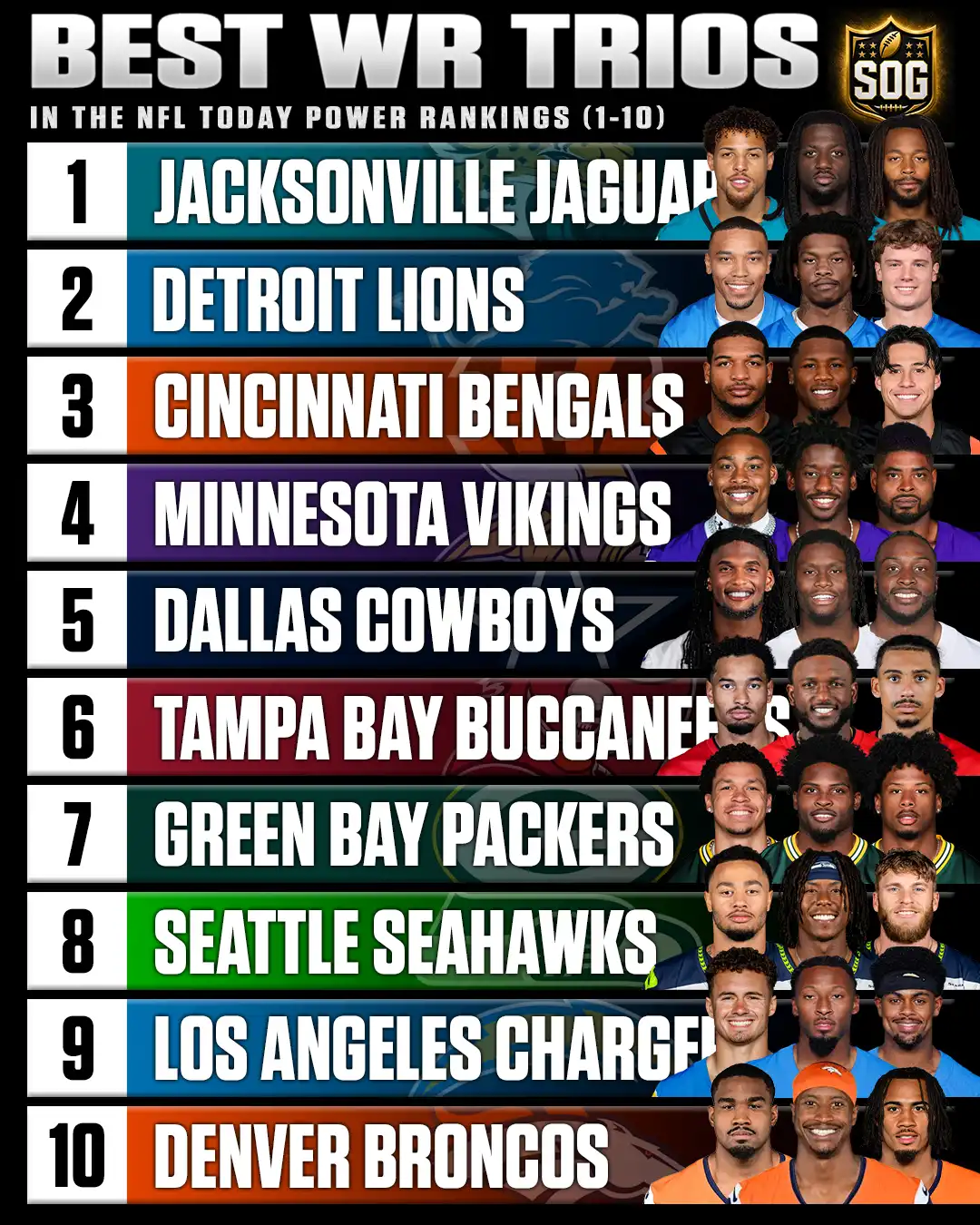
The top 10 NFL wide receiver trios, led by the Jacksonville Jaguars, Detroit Lions and Cincinnati Bengals.
1. Jacksonville Jaguars: Parker Washington, Brian Thomas Jr. and Jakobi Meyers
Parker Washington has earned top billing in Jacksonville’s current trio. Through two games, he leads the Jaguars with 12 receptions, 181 receiving yards and a touchdown. His quickness, route pacing and ability to create from the slot have made him the offense’s most productive wide receiver, not merely a depth option behind bigger names.
Brian Thomas Jr. remains the boundary accelerator with the size and speed to command deep help, while Jakobi Meyers supplies dependable timing, leverage awareness and chain-moving routes. Thomas has 80 receiving yards through Week 2, and Meyers has 68 yards and a touchdown. Travis Hunter remains an important two-way player, but one catch for eight yards does not place him ahead of Washington, Thomas or Meyers in the Jaguars’ current wide receiver hierarchy.
2. Detroit Lions: Amon-Ra St. Brown, Jameson Williams and Isaac TeSlaa
Amon-Ra St. Brown gives Detroit a reliable answer against zone coverage and a precise target in traffic. Jameson Williams changes the geometry of the defense with vertical speed, while Isaac TeSlaa adds size and a true outside frame. Their roles are cleanly separated, which lets Detroit threaten the short, intermediate and deep areas from the same personnel group.
The Lions narrowly miss No. 1 because TeSlaa has a shorter record of high-volume NFL production than Jacksonville’s complementary options. Even so, St. Brown’s consistency and Williams’ explosive ceiling make this one of the hardest trios to defend without two-high safety help.
3. Cincinnati Bengals: Ja’Marr Chase, Tee Higgins and Andrei Iosivas
Cincinnati may have the best first two receivers on the list. Ja’Marr Chase can win through release quickness, strength, speed and after-the-catch creation. Tee Higgins is a legitimate featured receiver in his own right, particularly on the boundary and at the catch point. Andrei Iosivas completes the trio with size, vertical ability and experience in the Bengals’ route structure.
The Bengals rank third only because this format places unusual emphasis on the final spot. In a two-receiver comparison, Chase and Higgins can lead the league. In a trio comparison, Jacksonville and Detroit gain ground through the total value and versatility of all three players.
4. Minnesota Vikings: Justin Jefferson, Jordan Addison and Jauan Jennings
Justin Jefferson remains the standard-setting player in this group, capable of dictating coverage before the snap and still winning when opponents tilt help toward him. Jordan Addison brings quick separation and vertical route skill. Jauan Jennings gives Minnesota a physical, reliable third option who can work through contact and convert contested downs.
The Vikings have elite route-running quality across the top two and a complementary possession target at WR3. Current availability creates slightly more uncertainty than the top three rooms, but a healthy Jefferson-Addison-Jennings trio belongs firmly in the league’s top tier.
5. Dallas Cowboys: CeeDee Lamb, George Pickens and Ryan Flournoy
CeeDee Lamb is a formation-versatile volume receiver who can separate outside or punish mismatches from the slot. George Pickens provides the size, body control and downfield aggression to win against isolated coverage. Ryan Flournoy rounds out the group as the current slot option and gives Dallas a more physical third receiver than its overall profile sometimes suggests.
Lamb and Pickens give the Cowboys top-three upside, but this ranking asks for proven value across all three spots. Flournoy’s development is the swing factor. If he turns his opportunity into consistent third-down and intermediate production, Dallas can challenge the rooms above it.
6. Tampa Bay Buccaneers: Emeka Egbuka, Chris Godwin Jr. and Ted Hurst III
Tampa Bay’s strength is balance. Emeka Egbuka can win from multiple alignments and handle a broad route tree. Chris Godwin Jr. remains an intelligent inside-outside target who finds space and finishes through contact. Ted Hurst III has earned the third spot with five receptions for 63 yards through Week 2, giving the Buccaneers another active receiver who can separate and contribute now.
The Buccaneers do not have to force every key target through one player. Their top three can trade alignments, which makes coverage declarations more difficult and protects the offense from becoming predictable. The absence of a clear weak link keeps Tampa Bay securely inside the top 10.
7. Green Bay Packers: Christian Watson, Jayden Reed and Matthew Golden
Christian Watson’s size-speed combination forces defenses to respect the boundary and deep middle. Jayden Reed can work from the slot, carry motion and create with the ball. Matthew Golden supplies another explosive outside option with the route quickness to attack intermediate windows. On skill set alone, Green Bay can make a case for the top five.
Availability is the tiebreaker. Reed’s current absence reduces the immediate strength of the trio, and Green Bay has often distributed work across a larger rotation. The ceiling remains excellent, but the Packers need their preferred three healthy and consistently involved to rise.
8. Seattle Seahawks: Jaxon Smith-Njigba, Rashid Shaheed and Cooper Kupp
Jaxon Smith-Njigba provides detailed route-running and the ability to command targets at every level. Rashid Shaheed stretches coverage horizontally and vertically with game-changing speed. Cooper Kupp adds veteran feel for leverage, option routes and working through condensed formations. Few trios have a cleaner division of responsibilities.
Seattle’s question is sustained peak production across the entire room, not fit. Smith-Njigba is the featured creator, Shaheed supplies explosive stress and Kupp gives the quarterback a coverage-savvy outlet. That combination makes the Seahawks especially dangerous against defenses that rely on one preferred coverage family.
9. Los Angeles Chargers: Ladd McConkey, Quentin Johnston and Tre’ Harris
Ladd McConkey is the engine because of his release package, change of direction and ability to uncover quickly. Quentin Johnston adds size and vertical speed, while Tre’ Harris brings another physical outside profile. The Chargers can pair McConkey’s precision with two bigger receivers who threaten cornerbacks down the field.
The ranking depends heavily on McConkey’s health and Johnston’s consistency. Harris gives Los Angeles a strong third option, but the room is most effective when McConkey controls high-value downs and the outside receivers punish defenses for squeezing the middle.
10. Denver Broncos: Jaylen Waddle, Courtland Sutton and Pat Bryant
Jaylen Waddle gives Denver sudden speed and separation, Courtland Sutton provides a large catch radius on the boundary, and Pat Bryant has moved into the preferred third-receiver role. Bryant has four catches for 42 yards through Week 2 and is currently ahead of Marvin Mims Jr. in both availability and offensive involvement.
The trio fits naturally: Waddle can stress space, Sutton can win isolated and Bryant can work as a physical complementary target. Denver stays at No. 10 because the target hierarchy behind Waddle is still developing, but the current top three are clearer than the preseason depth-chart projection suggested.
Best WR Trios in the NFL: 11-20
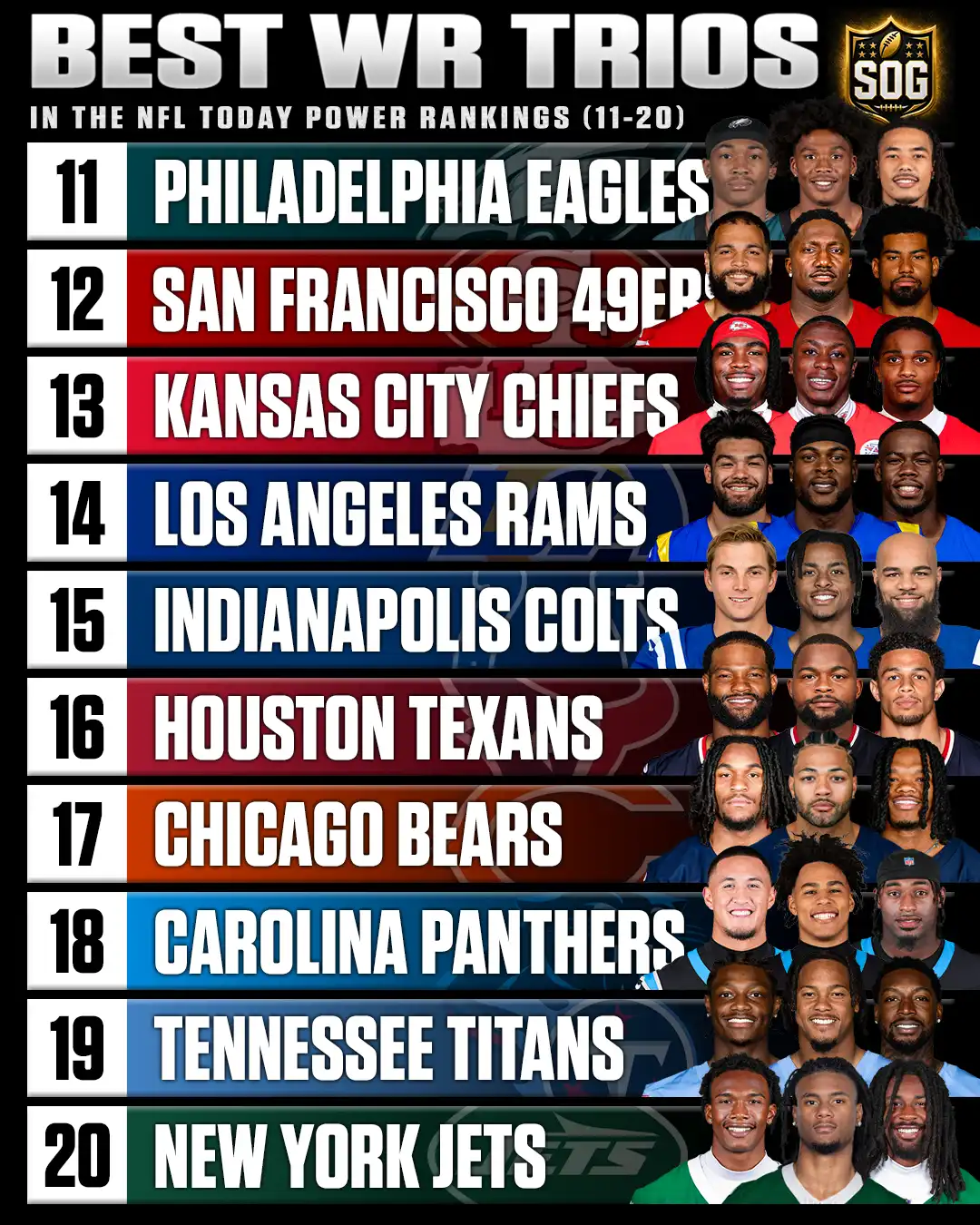
WR trio rankings 11 through 20, featuring the Eagles, 49ers, Chiefs, Rams and other notable receiving groups.
11. Philadelphia Eagles: DeVonta Smith, Dontayvion Wicks and Darius Cooper
DeVonta Smith is the clear headliner, combining efficient releases, body control and route pacing. Dontayvion Wicks offers size and useful alignment flexibility, while Darius Cooper has made the stronger immediate case for the third spot. Cooper has already produced a touchdown and 26 yards on two receptions, giving Philadelphia more impact than Makai Lemon’s four catches for nine yards.
Philadelphia sits just outside the top 10 because the secondary pieces are still establishing their roles in a reshaped receiver room. Smith has 13 catches for 170 yards and a touchdown, while Wicks has added 147 yards and a score. If Cooper’s early efficiency grows into steadier volume, the Eagles can move higher.
12. San Francisco 49ers: Mike Evans, Deebo Samuel Sr. and Demarcus Robinson
Mike Evans gives San Francisco a premier boundary target and red-zone presence. Deebo Samuel Sr. remains a unique motion and after-the-catch weapon, while Demarcus Robinson provides another experienced vertical option. The room is older than most groups above it, but its collective understanding of leverage and coverage is difficult to replicate.
Age and current availability limit the ranking more than raw talent. Robinson’s status affects the immediate depth, and the 49ers must manage three veteran workloads. When intact, the trio offers size, physicality and schematic flexibility that can still overwhelm younger secondaries.
13. Kansas City Chiefs: Rashee Rice, Xavier Worthy and Tyquan Thornton
Rashee Rice is the underneath and intermediate creator, especially when he can catch the ball in stride. Xavier Worthy’s speed changes safety depth and creates room for everyone else. Tyquan Thornton adds yet another vertical threat, making Kansas City capable of putting extreme speed on the field without sacrificing Rice’s more physical presence.
Patrick Mahomes improves the environment, but this ranking separates quarterback quality from receiver quality wherever possible. Kansas City can climb if Thornton converts his role into consistent production and Worthy becomes more than a coverage-clearing threat.
14. Los Angeles Rams: Puka Nacua, Davante Adams and Jordan Whittington
Puka Nacua and Davante Adams give the Rams a high-level pairing. Nacua creates through strength, timing and yards after the catch, while Adams remains a master of releases and route pacing. Jordan Whittington adds physical slot work and can execute the blocking and spacing details required in Sean McVay’s offense.
The Rams would rank much higher in a duo exercise. They land at No. 14 because the gap between the stars and the third spot is larger than it is for the teams above them, and current availability adds another layer of uncertainty. Healthy, this remains one of the league’s most dangerous passing-game cores.
15. Indianapolis Colts: Alec Pierce, Josh Downs and Keenan Allen
Alec Pierce stretches the field and wins on the boundary, Josh Downs separates quickly underneath and Keenan Allen supplies veteran route craft. Their skills overlap very little, which gives Indianapolis clear answers against different coverages and defensive personnel packages.
The concern is top-end ceiling rather than fit. Allen’s age and Pierce’s current availability create some volatility, while Downs may be the player most capable of driving consistent volume. As a complete trio, Indianapolis is balanced enough to stay in the top half of the league.
16. Houston Texans: Nico Collins, Kayshon Boutte and Xavier Hutchinson
Nico Collins is a true lead receiver with size, speed and the ability to win through contact. Kayshon Boutte gives Houston a more experienced secondary route-runner, while Xavier Hutchinson provides size and continuity in the system. The structure is functional, but much of the room’s ceiling depends on Collins being available and commanding coverage.
Houston’s ranking also reflects the loss of some anticipated depth before the trio could fully take shape. Boutte and Hutchinson do not need to become stars, but they must create dependable answers when opponents bracket Collins or force the Texans to win on the opposite side.
17. Chicago Bears: Rome Odunze, Luther Burden III and Kalif Raymond
Rome Odunze gives Chicago a large, polished outside target with room to become a true focal point. Luther Burden III adds tackle-breaking ability and can be moved to manufacture touches. Kalif Raymond contributes veteran speed, motion value and special-teams utility while serving as a complementary slot option.
The Bears have more upside than several teams immediately above them, but their ranking remains projection-heavy. If Odunze becomes a dominant target and Burden develops into a consistent separator, this room could move into the top 10 quickly.
18. Carolina Panthers: Tetairoa McMillan, Xavier Legette and Jalen Coker
Tetairoa McMillan is the centerpiece, using size, ball skills and route pacing to win outside. Xavier Legette adds another powerful athletic profile, while Jalen Coker offers a steadier underneath and intermediate presence. Carolina can put three young receivers on the field without repeating exactly the same role.
The physical tools are impressive, but the trio still needs more consistent separation and week-to-week production. McMillan’s ascent gives Carolina a strong foundation. The ranking will rise if Legette and Coker make defenses pay for directing coverage toward him.
19. Tennessee Titans: Calvin Ridley, Wan’Dale Robinson and Carnell Tate
Calvin Ridley remains Tennessee’s experienced outside route-runner. Wan’Dale Robinson supplies quickness, slot separation and a short-area answer, while Carnell Tate gives the Titans a young boundary option with size and developmental upside. The trio offers a sensible blend of experience and youth.
Tennessee lands in the middle tier because the room still needs a consistently dominant target. Ridley can lead the group, but Tate’s development is what could change its ceiling. If he becomes a reliable outside winner, Robinson’s complementary role becomes more valuable.
20. New York Jets: Garrett Wilson, Adonai Mitchell and Isaiah Williams
Garrett Wilson is the clear star and can create separation at every level. Adonai Mitchell offers length and downfield ability, while Isaiah Williams gives the Jets a quick, versatile third option. The group has the necessary role diversity, but the gap between Wilson and the supporting receivers remains substantial.
The Jets can rise if Mitchell turns traits into consistent production and Williams secures a dependable package. Until then, opponents can devote extra coverage to Wilson without facing the same proven punishment that the stronger trios provide.
Best WR Trios in the NFL: 21-32
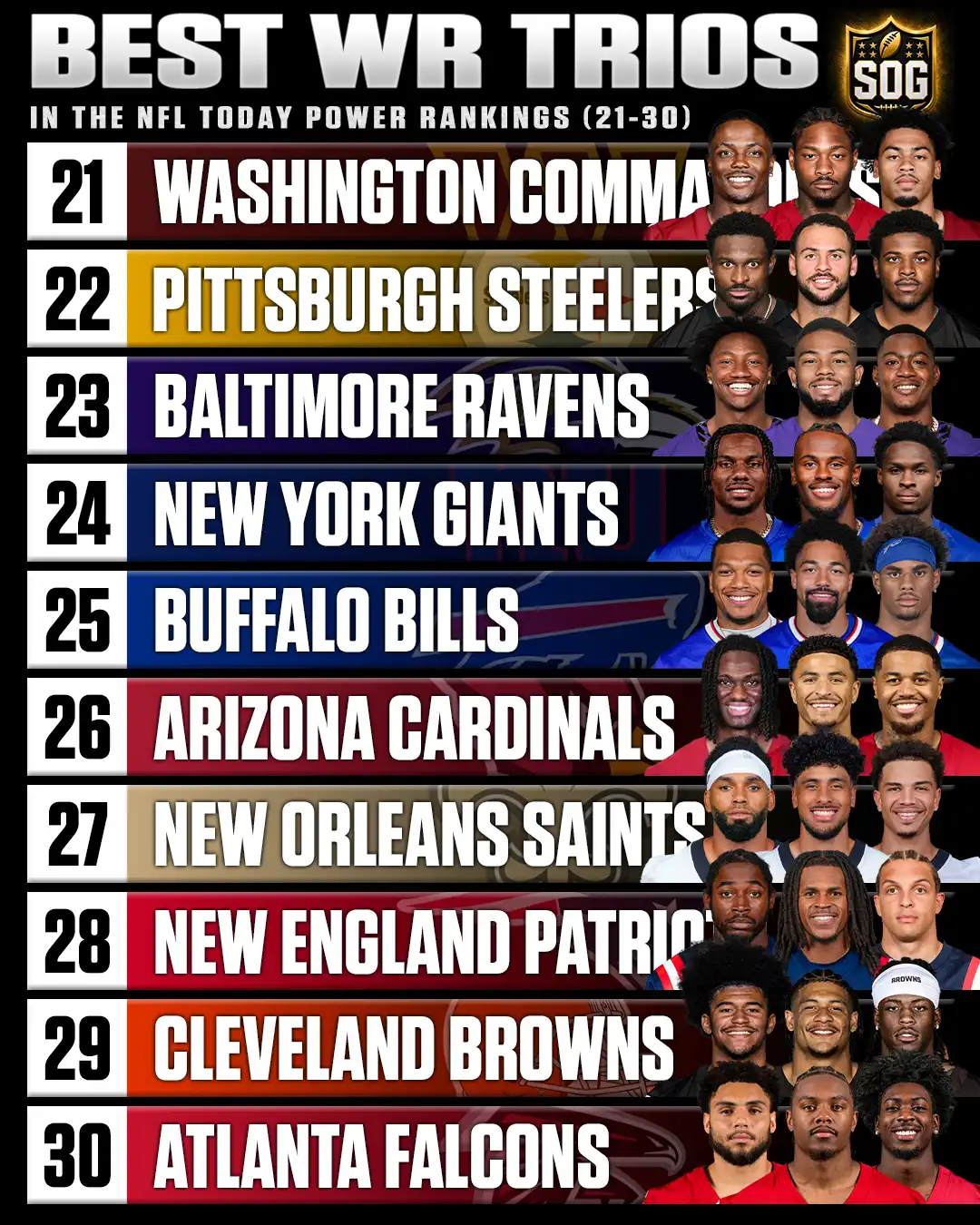
WR trio rankings 21 through 30, featuring the Commanders, Steelers, Ravens, Giants and Bills.
21. Washington Commanders: Terry McLaurin, Stefon Diggs and Antonio Williams
Terry McLaurin and Stefon Diggs give Washington two accomplished route-runners who understand how to create space without ideal leverage. Antonio Williams has earned the third spot with seven receptions for 88 yards and a touchdown through Week 2, outproducing the other candidates for Washington’s final place.
The ranking accounts for age, durability and the amount of explosiveness the veterans can sustain across a full season. Diggs has already scored three touchdowns, and Williams’ immediate emergence gives the Commanders a more credible third threat than their preseason projection suggested. More consistent volume for McLaurin would move the trio upward.
22. Pittsburgh Steelers: DK Metcalf, Michael Pittman Jr. and Roman Wilson
DK Metcalf and Michael Pittman Jr. form one of the league’s most physical pairings. Metcalf brings rare long speed for his size, while Pittman wins through strength, positioning and reliable intermediate work. Roman Wilson adds a quicker movement profile and can operate in space.
Pittsburgh’s top two are strong enough for a higher rank, but current availability and third-receiver production keep the room in this tier. Wilson has to become a consistent coverage answer rather than a complementary piece for the trio to match the reputation of its headliners.
23. Baltimore Ravens: Zay Flowers, Rashod Bateman and Chris Moore
Zay Flowers supplies quickness, horizontal stress and open-field creation. Rashod Bateman is the more traditional intermediate and vertical route-runner, while Chris Moore has provided the best current production from Baltimore’s remaining outside options. Moore has 59 yards on two receptions, compared with minimal offensive involvement for Devontez Walker.
Availability and consistency explain the ranking. Flowers has 150 yards and a touchdown through Week 2, while Bateman has 88 yards and a score. Moore’s explosive start earns him the current third spot, but Baltimore needs more week-to-week volume from the supporting receivers to climb.
24. New York Giants: Malik Nabers, Darnell Mooney and Malachi Fields
Malik Nabers gives New York a genuine featured receiver with the explosiveness to win before or after the catch. Darnell Mooney adds vertical speed and veteran route experience. Malachi Fields brings size and another outside target who can develop alongside Nabers.
The Giants have a higher WR1 ceiling than most teams in this tier. They remain at No. 24 because Mooney and Fields need to deliver more consistent secondary production. If defenses cannot safely roll coverage toward Nabers, the room’s ranking will improve quickly.
25. Buffalo Bills: DJ Moore, Khalil Shakir and Keon Coleman
DJ Moore provides proven creation ability, Khalil Shakir is a dependable middle-of-the-field target and Keon Coleman adds size at the catch point. Buffalo’s three receivers complement each other better than the ranking may initially suggest, especially when Moore and Shakir can trade inside-outside responsibilities.
The Bills sit this low because the trio has not yet established the same collective ceiling as the rooms above it, and current availability must be considered. Coleman remains the swing player. A major step forward from him would turn Buffalo into a much more difficult coverage assignment.
26. Arizona Cardinals: Marvin Harrison Jr., Michael Wilson and Kendrick Bourne
Marvin Harrison Jr. gives Arizona the high-end ceiling, Michael Wilson provides size and boundary reliability, and Kendrick Bourne supplies veteran flexibility from the slot. The roles make sense, but the offense still needs Harrison to become the week-to-week takeover target his talent suggests.
Wilson and Bourne are credible complementary receivers, yet neither consistently forces coverage away from Harrison. Arizona can move into the middle tier if the supporting pair wins favorable matchups when defenses shade a safety toward the No. 1 option.
27. New Orleans Saints: Chris Olave, Devaughn Vele and Bryce Lance
Chris Olave remains the centerpiece with polished routes and vertical separation. Devaughn Vele adds size and a possession profile, while Bryce Lance has earned the third spot with four catches for 50 yards through Week 2. Lance’s actual receiving involvement places him ahead of Barion Brown in the Saints’ current hierarchy.
Olave has opened the season with 18 receptions for 268 yards and a touchdown, and Vele has supplied 12 catches for 133 yards and a score. That is stronger top-two production than the No. 27 ranking suggests, but Lance still needs to turn his early role into sustained volume before New Orleans can climb.
28. New England Patriots: Romeo Doubs, DeMario Douglas and Mack Hollins
Romeo Doubs gives New England a steady outside target, DeMario Douglas provides slot quickness and Mack Hollins adds size, blocking value and experience. The active trio has functional role balance, but it lacks the commanding top-end presence that A.J. Brown would normally provide.
Brown’s injured-reserve absence is the main reason New England falls to No. 28. The ranking can change significantly when he returns. For now, the Patriots must create production collectively rather than building the passing game around one receiver who dictates coverage.
29. Cleveland Browns: Jerry Jeudy, Denzel Boston and KC Concepcion Jr.
Jerry Jeudy is the established route-runner and the receiver most capable of driving consistent volume. Denzel Boston brings a large outside frame, while KC Concepcion Jr. offers movement skills and versatility. Cleveland’s young supporting cast gives the room developmental upside.
The Browns rank near the bottom because two-thirds of the trio has little proven NFL production. Boston and Concepcion do not need to become stars immediately, but Cleveland needs one of them to establish a dependable secondary role so defenses cannot focus exclusively on Jeudy.
30. Atlanta Falcons: Drake London, Jahan Dotson and Olamide Zaccheaus
Drake London gives Atlanta a strong foundation through size, body control and improving route detail. Jahan Dotson can separate and work vertically, while Olamide Zaccheaus offers experience from multiple alignments. The trio is more functional than its rank, but London carries a disproportionate share of the ceiling.
Atlanta needs Dotson to become a consistent second threat. Zaccheaus can fill useful assignments, but the room will remain in the bottom tier until the Falcons can punish opponents for bracketing London on key passing downs.
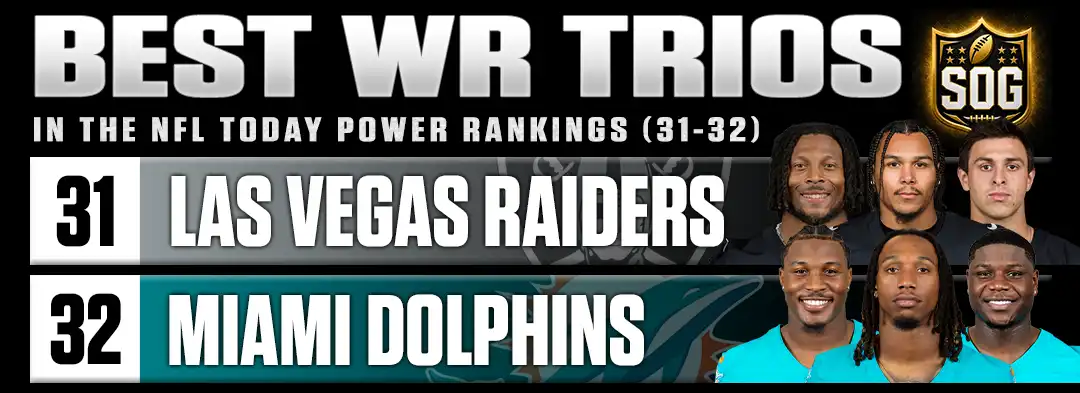
The Las Vegas Raiders and Miami Dolphins round out the WR trio power rankings at Nos. 31 and 32.
31. Las Vegas Raiders: Jalen Nailor, Tre Tucker and Jack Bech
Jalen Nailor and Tre Tucker give Las Vegas speed, while Jack Bech adds size, toughness and developmental upside. The group can stretch a defense and has room to outperform expectations, but it lacks the established featured target found in almost every higher-ranked room.
The Raiders need one receiver to become the clear first read on important downs. Tucker’s explosive ability gives him a path, Nailor can win vertically and Bech can grow into a physical possession role. Until that hierarchy forms, the group remains difficult to project.
32. Miami Dolphins: Chris Bell, Caleb Douglas and Malik Washington
Miami’s current trio is young and largely unproven. Chris Bell offers size, Caleb Douglas brings another outside frame and Malik Washington provides quickness and after-the-catch potential. There are useful traits, but the group has the smallest body of established NFL receiving production in the league.
No. 32 is a statement about current certainty rather than long-term potential. Washington can become a reliable slot creator, while Bell and Douglas have opportunities to claim larger roles. Miami will rise if one of them proves capable of consistently drawing defensive attention.
Biggest Takeaways From the Rankings
The Third Receiver Changes the Order
Cincinnati and Dallas show why a trio ranking is different from a duo ranking. Both have elite first and second options, but Jacksonville and Detroit gain ground because their third receivers add more to the complete matchup. A credible WR3 prevents opponents from concentrating every coverage resource on the top two targets.
Complementary Roles Matter
The best rooms do not feature three receivers trying to win in the same way. Detroit can pair St. Brown’s interior precision with Williams’ speed and TeSlaa’s size. Seattle combines Smith-Njigba’s route detail, Shaheed’s deep threat and Kupp’s veteran feel for space. A defense that solves one matchup still has to answer two different problems.
A Great Duo Does Not Guarantee a Great Trio
The Rams, Steelers and Commanders all have recognizable top-end talent, but the exercise measures the full three-player group. Teams rise when the third option can stay on the field, separate against a starting defensive back and produce when coverage shifts toward the stars.
Availability Can Move the Rankings Quickly
New England is the clearest example because A.J. Brown’s injured-reserve absence changes the identity of the active room. Green Bay, Minnesota, Pittsburgh, Baltimore and other teams also carry short-term availability questions. These rankings evaluate the NFL today, so an active trio can rank differently from its fully healthy ceiling.
Quarterback Context Helps, but Does Not Decide the List
Kansas City benefits from Patrick Mahomes, Buffalo from Josh Allen and Cincinnati from Joe Burrow, but the order does not simply mirror the league’s quarterback hierarchy. The goal is to isolate receiver quality and fit. For the larger offensive picture, see the SOG Sports NFL offense power rankings and best quarterbacks in the NFL today.
Complete WR Trio Power Rankings
| Rank | Team | WR Trio |
|---|---|---|
| 1 | Jacksonville Jaguars | Parker Washington, Brian Thomas Jr., Jakobi Meyers |
| 2 | Detroit Lions | Amon-Ra St. Brown, Jameson Williams, Isaac TeSlaa |
| 3 | Cincinnati Bengals | Ja’Marr Chase, Tee Higgins, Andrei Iosivas |
| 4 | Minnesota Vikings | Justin Jefferson, Jordan Addison, Jauan Jennings |
| 5 | Dallas Cowboys | CeeDee Lamb, George Pickens, Ryan Flournoy |
| 6 | Tampa Bay Buccaneers | Emeka Egbuka, Chris Godwin Jr., Ted Hurst III |
| 7 | Green Bay Packers | Christian Watson, Jayden Reed, Matthew Golden |
| 8 | Seattle Seahawks | Jaxon Smith-Njigba, Rashid Shaheed, Cooper Kupp |
| 9 | Los Angeles Chargers | Ladd McConkey, Quentin Johnston, Tre’ Harris |
| 10 | Denver Broncos | Jaylen Waddle, Courtland Sutton, Pat Bryant |
| 11 | Philadelphia Eagles | DeVonta Smith, Dontayvion Wicks, Darius Cooper |
| 12 | San Francisco 49ers | Mike Evans, Deebo Samuel Sr., Demarcus Robinson |
| 13 | Kansas City Chiefs | Rashee Rice, Xavier Worthy, Tyquan Thornton |
| 14 | Los Angeles Rams | Puka Nacua, Davante Adams, Jordan Whittington |
| 15 | Indianapolis Colts | Alec Pierce, Josh Downs, Keenan Allen |
| 16 | Houston Texans | Nico Collins, Kayshon Boutte, Xavier Hutchinson |
| 17 | Chicago Bears | Rome Odunze, Luther Burden III, Kalif Raymond |
| 18 | Carolina Panthers | Tetairoa McMillan, Xavier Legette, Jalen Coker |
| 19 | Tennessee Titans | Calvin Ridley, Wan’Dale Robinson, Carnell Tate |
| 20 | New York Jets | Garrett Wilson, Adonai Mitchell, Isaiah Williams |
| 21 | Washington Commanders | Terry McLaurin, Stefon Diggs, Antonio Williams |
| 22 | Pittsburgh Steelers | DK Metcalf, Michael Pittman Jr., Roman Wilson |
| 23 | Baltimore Ravens | Zay Flowers, Rashod Bateman, Chris Moore |
| 24 | New York Giants | Malik Nabers, Darnell Mooney, Malachi Fields |
| 25 | Buffalo Bills | DJ Moore, Khalil Shakir, Keon Coleman |
| 26 | Arizona Cardinals | Marvin Harrison Jr., Michael Wilson, Kendrick Bourne |
| 27 | New Orleans Saints | Chris Olave, Devaughn Vele, Bryce Lance |
| 28 | New England Patriots | Romeo Doubs, DeMario Douglas, Mack Hollins |
| 29 | Cleveland Browns | Jerry Jeudy, Denzel Boston, KC Concepcion Jr. |
| 30 | Atlanta Falcons | Drake London, Jahan Dotson, Olamide Zaccheaus |
| 31 | Las Vegas Raiders | Jalen Nailor, Tre Tucker, Jack Bech |
| 32 | Miami Dolphins | Chris Bell, Caleb Douglas, Malik Washington |
FAQ
Who has the best wide receiver trio in the NFL?
The Jacksonville Jaguars rank No. 1 with Parker Washington, Brian Thomas Jr. and Jakobi Meyers. Washington’s current WR1-level production, Thomas’ boundary ceiling and Meyers’ route-running reliability give Jacksonville the edge.
What counts as a wide receiver trio?
A trio means the three wide receivers most important to a team’s current passing-game outlook. A player does not have to carry a first-string label on an unofficial depth chart if his offensive role is clearly significant.
Are tight ends included?
No. Tight ends and running backs are excluded, even when one is among a team’s leading targets. This ranking evaluates wide receivers only.
Are these fantasy football rankings?
No. These are real-football receiver-room rankings. Separation, route diversity, coverage stress, third-receiver quality and overall fit matter more than projected fantasy volume.
Are these each team’s three official starters?
Not always. Depth-chart labels vary by formation and can lag behind actual usage. The list identifies the three receivers who matter most to the current offense, which is why an important rotational player can be included over a nominal starter.
Can the rankings change during the season?
Yes. Injuries, trades, breakouts and role changes can materially alter a receiver room. The order should evolve as the 2026 season provides more information.
Conclusion
Jacksonville leads the 2026 ranking because Washington, Thomas and Meyers provide the best combination of current production, ceiling, complementary roles and quality across all three spots. Detroit, Cincinnati, Minnesota and Dallas complete a top five separated by narrow margins.
The central lesson is that a great receiving trio requires more than one superstar. The highest-ranked teams can threaten a defense with every wide receiver on the field, making it much harder to tilt coverage toward one player without creating a favorable matchup elsewhere.
Related Articles
- Best Wide Receiver Duos in the NFL Today
- Best Wide Receivers in the NFL Today
- NFL Offense Power Rankings
- Best Quarterbacks in the NFL Today
Follow @SOGFootball on Instagram for more NFL rankings, predictions and weekly performance breakdowns.
