
Richard Sherman is the best cornerback of the 2010s, with Darrelle Revis and Patrick Peterson completing the top three. Sherman pairs the decade’s strongest body of work with a championship peak: 35 regular-season interceptions from 2011 through 2019, three first-team All-Pro selections and a central role on the era’s defining secondary.
This ranking evaluates only the 2010 through 2019 NFL seasons. Earlier and later work does not count, while playoff games connected to those seasons are considered separately. That distinction matters for legends such as Revis and Champ Bailey, whose full-career standing is higher than the portion of their careers that falls inside this window, and for late arrivals such as Jalen Ramsey, Tre’Davious White and Marshon Lattimore.
The final order balances peak coverage, sustained excellence, All-Pro recognition, ball production, assignment difficulty, versatility and postseason value. Interceptions help tell the story, but a shutdown corner can control a game precisely because quarterbacks stop testing him.
How We Ranked the Best Cornerbacks of the 2010s
Cornerback is one of football’s hardest positions to compare across players and schemes. A zone defender can create takeaways by reading the quarterback, a press-man specialist can erase the opponent’s best receiver, and a slot corner can solve the most complicated route combinations on the field. Each job creates value differently, so this ranking does not treat one coverage style as the only path to greatness.
- Peak coverage: How difficult was the corner to beat at his best?
- 2010s longevity: How many high-level seasons did he produce inside the decade?
- Honors: All-Pro selections, Pro Bowls and major awards earned for 2010s seasons.
- Ball production: Interceptions, pass breakups, forced fumbles and scoring plays.
- Assignment value: Shadow coverage, outside and slot flexibility, and the difficulty of the player’s regular responsibilities.
- Postseason impact: Performance on championship defenses and in high-leverage playoff games.
- Context: Scheme, surrounding talent, opponent avoidance and the difference between a brilliant peak and a complete decade.
The ranking rewards what happened on the field rather than what might have happened with better health or a longer prime. It also separates coverage value from fame: a memorable interception can strengthen a résumé, but one play cannot replace several seasons of elite cornerback work.
Eligibility and Decade Scope
Any player who appeared at cornerback during the 2010–2019 regular seasons was eligible. The ranking counts only performance within those seasons, and the postseason attached to each season is included when evaluating playoff impact. Super Bowl XLIX, for example, belongs to the 2014 season even though the game was played in February 2015.
Hybrid defensive backs were judged by their cornerback work. That keeps the list focused and explains why versatile stars who were primarily safeties are not included. Regular-season interception totals in the player capsules also stop after 2019; they are not full-career totals unless the player’s career ended during the decade.
Best Cornerbacks of the 2010s: 1–10
1. Richard Sherman
2010s stats and accolades: 35 interceptions; three first-team All-Pro selections; two second-team All-Pro selections; five Pro Bowls; 2013 NFL interceptions leader; Super Bowl XLVIII champion.
Sherman owns the best combination of peak, production and longevity inside the decade. His length and route recognition were ideal for Seattle’s coverage structure, but calling him a system product misses the skill that made the system so difficult to attack. He disguised his intentions, squeezed throwing windows near the boundary and converted poor decisions into turnovers at a rate no other corner matched across the 2010s.
His eight-interception 2013 season led the league and ended with Seattle overwhelming Denver in Super Bowl XLVIII. Sherman then remained an elite starter through major scheme and injury changes, earning second-team All-Pro honors with San Francisco in 2019. Revis reached a slightly higher pure shutdown peak, but Sherman delivered more elite seasons within the actual decade.
2. Darrelle Revis
2010s stats and accolades: 15 interceptions; three first-team All-Pro selections; five Pro Bowls; Super Bowl XLIX champion; NFL 2010s All-Decade Team.
Revis was the decade’s most trusted true shadow corner at his best. The Jets could assign him to a top receiver, tilt the rest of the coverage elsewhere and play defense with an advantage that does not appear in an interception total. His 2010 and 2011 seasons extended the Revis Island standard into this ranking window, and his 2014 work gave New England a championship-caliber No. 1 corner.
The only reason he does not rank first is scope. His legendary 2009 season falls outside the exercise, a torn ACL erased most of 2012, and his decline arrived before the decade ended. Within a single matchup, peak Revis is still the corner many coaches would choose first; across all ten seasons, Sherman has the stronger case.
3. Patrick Peterson
2010s stats and accolades: 25 interceptions; three first-team All-Pro selections; eight consecutive Pro Bowls from 2011 through 2018; NFL 2010s All-Decade Team.
Peterson brought rare size, speed and recovery ability to a role built around difficult outside assignments. Arizona regularly trusted him in man coverage against premier receivers, and his athletic margin allowed him to survive situations that would expose less gifted corners. Eight straight Pro Bowls show how long he remained central to the position’s national conversation.
His first first-team All-Pro selection in 2011 was driven heavily by historic punt-return value, while his later honors reflected his development into a more polished cover corner. That distinction keeps the evaluation honest without weakening his case. Few players combined matchup responsibility, durability and top-end athleticism for as much of the decade.
4. Chris Harris Jr.
2010s stats and accolades: 20 interceptions; one first-team All-Pro selection; two second-team All-Pro selections; four Pro Bowls; Super Bowl 50 champion; NFL 2010s All-Decade Team.
Harris is the decade’s best example of why cornerback value cannot be measured by boundary assignments alone. He could cover outside, move into the slot, anticipate option routes, tackle in space and blitz without forcing Denver to change personnel. That flexibility was foundational to the No Fly Zone rather than secondary to its success.
He earned All-Pro recognition in three consecutive seasons from 2014 through 2016 and helped anchor the defense that won Super Bowl 50. His technique remained remarkably stable against different receiver types, and his 20 interceptions included four returned for touchdowns. Harris did not receive the same early-career hype as the first-round stars around him, but his decade résumé is deeper than most of theirs.
5. Stephon Gilmore
2010s stats and accolades: 24 interceptions; 2019 Defensive Player of the Year; two first-team All-Pro selections; three Pro Bowls; 2019 co-leader in interceptions; Super Bowl LIII champion.
Gilmore closed the decade with its most decorated two-year cornerback peak. After years of strong, sometimes uneven work in Buffalo, he became the matchup eraser at the center of New England’s man-heavy defense. His patient feet and ability to play through a receiver’s hands made him exceptionally reliable against elite targets.
He intercepted two passes during the 2018 postseason run to a championship, then followed with six interceptions, 20 passes defended and two pick-sixes in 2019. That season made him the first cornerback since Charles Woodson to win Defensive Player of the Year. A longer stretch at that level would push him into the top three, but the peak is strong enough for fifth.
6. Aqib Talib
2010s stats and accolades: 26 interceptions; 10 interception-return touchdowns; one first-team All-Pro selection; one second-team All-Pro selection; five consecutive Pro Bowls; Super Bowl 50 champion.
Talib combined press-man physicality with some of the most dangerous return ability ever seen at the position. Quarterbacks did not merely risk losing possession when they challenged him; they risked giving up six points. His 10 pick-sixes during the decade capture the game-changing edge he brought to Tampa Bay, New England, Denver and Los Angeles.
His most complete stretch came in Denver, where his size and aggression complemented Harris’ inside-out versatility. Talib earned first-team All-Pro honors in 2016 and made five straight Pro Bowls from 2013 through 2017. Penalties and volatility were part of the package, but so were championship coverage and rare scoring production.
7. Casey Hayward
2010s stats and accolades: 22 interceptions; two second-team All-Pro selections; two Pro Bowls; 2016 NFL interceptions leader.
Hayward was one of the decade’s sharpest route readers. He produced six interceptions as a rookie, successfully handled slot and outside work, and then reached another level after moving to the Chargers. His anticipation let him close throwing windows without relying on gambling for every takeaway.
The 2016 season is the centerpiece: seven interceptions, 20 passes defended and the first of consecutive second-team All-Pro selections. Hayward did not have the same championship platform as the names above him, but his best tape and ball production belong in the elite tier. He was a technician whose value held across different roles and defensive systems.
8. Brent Grimes
2010s stats and accolades: 26 interceptions; one second-team All-Pro selection; four Pro Bowls; 118 regular-season starts.
Grimes repeatedly overcame the size assumptions attached to a 5-foot-10 corner. His vertical explosion, timing and body control allowed him to win contested catches against much larger receivers, while his change of direction made him dangerous underneath. From 2010 through 2017, he recorded at least three interceptions in six different seasons.
He made the Pro Bowl in 2010 and in three straight seasons from 2013 through 2015, earning second-team All-Pro honors in 2014. Grimes also remained a full-time outside starter well into his thirties. The longevity, ball production and spectacular catch-point play make his top-10 placement more substantial than an “underrated” label suggests.
9. Joe Haden
2010s stats and accolades: 27 interceptions; one second-team All-Pro selection; three Pro Bowls; 123 regular-season starts.
Haden became a No. 1 corner immediately, intercepting six passes as a rookie in 2010. His best Cleveland seasons demanded difficult weekly assignments without the protection of a dominant team around him, and his balance, competitiveness and ball skills kept him effective against a wide range of receivers.
He earned consecutive Pro Bowl selections in 2013 and 2014, then returned to the Pro Bowl in 2019 after re-establishing himself in Pittsburgh. Injuries interrupted the middle of his prime, but he finished the decade with five interceptions and 17 passes defended in 2019. Haden’s résumé combines early production, a genuine peak and late-career adaptability.
10. Jalen Ramsey
2010s stats and accolades: 10 interceptions; one first-team All-Pro selection; three Pro Bowls; 2016 PFWA All-Rookie Team.
Ramsey played only four seasons in the decade, yet he established an elite peak quickly enough to make the top 10. His blend of length, speed, contact balance and competitive confidence made him the prototype for a modern matchup corner. He could press outside, travel with a featured receiver and bring a safety’s physical presence against the run.
In 2017, Ramsey earned first-team All-Pro honors and helped Jacksonville reach the AFC Championship Game behind one of the league’s best defenses. The shorter sample is the entire reason he does not rank higher. His later accomplishments confirm the talent, but only what he did through 2019 counts here.
Best Cornerbacks of the 2010s: 11–20
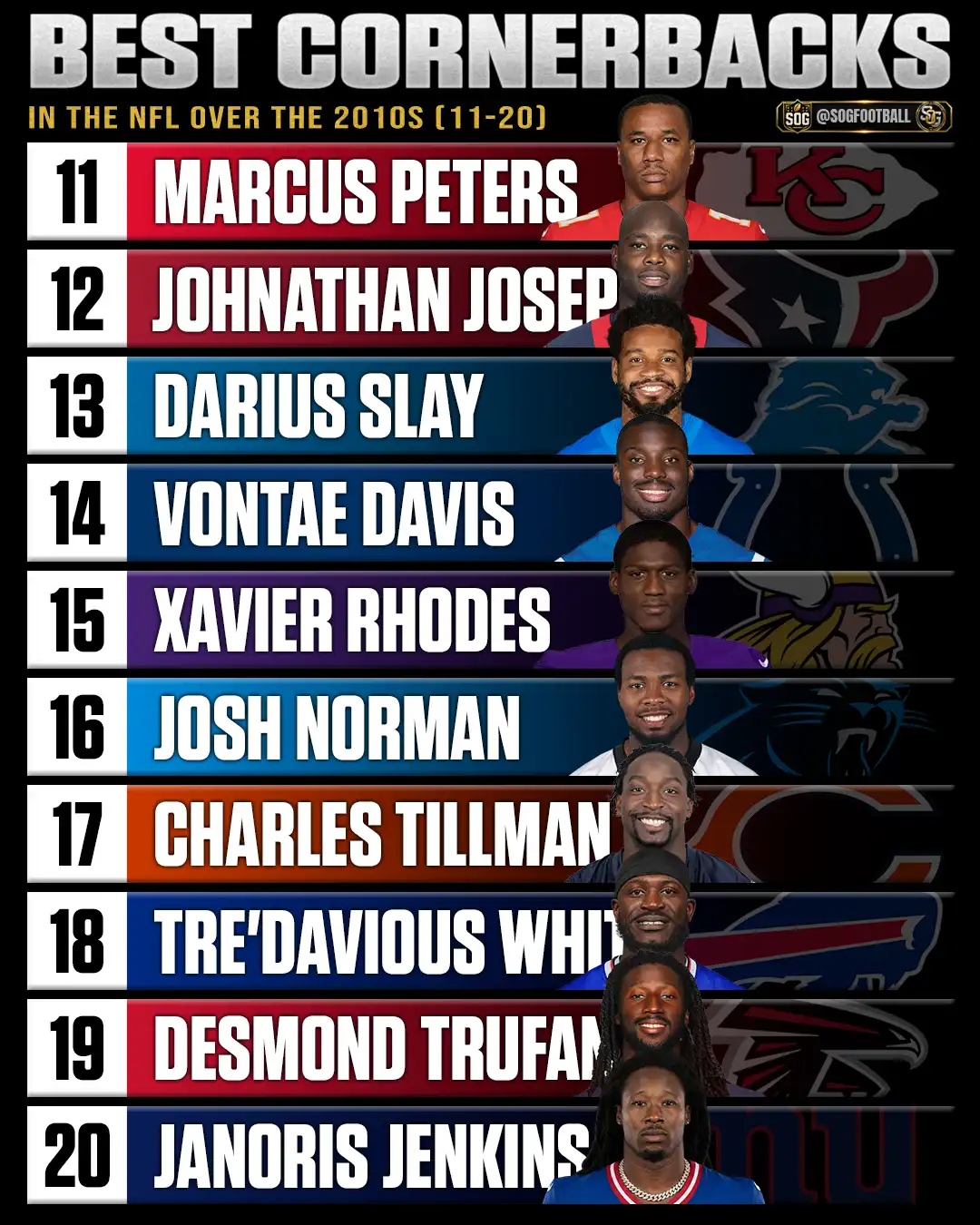
Best cornerbacks of the 2010s ranked 11–20: Marcus Peters, Johnathan Joseph, Darius Slay, Vontae Davis, Xavier Rhodes, Josh Norman, Charles Tillman, Tre’Davious White, Desmond Trufant and Janoris Jenkins.
11. Marcus Peters
2010s stats and accolades: 27 interceptions; 2015 Defensive Rookie of the Year; one second-team All-Pro selection; three Pro Bowls; six interception-return touchdowns.
Peters was the decade’s most productive pure ballhawk from the moment he entered the league. He intercepted eight passes and scored twice as a rookie, then reached 27 interceptions in only five seasons by reading route combinations and attacking quarterbacks who believed they had leverage. That aggression could concede a completion when his anticipation was wrong, which separates his style from a shutdown specialist such as Revis. The trade-off was historic playmaking: no corner on the list reached Peters’ 2010s interception total in fewer seasons.
12. Johnathan Joseph
2010s stats and accolades: 20 interceptions; one second-team All-Pro selection; two Pro Bowls; 140 regular-season starts.
Joseph supplied something every defense wants and few corners sustain: dependable outside coverage for almost the entire decade. His best season came in 2011, when he earned second-team All-Pro honors and helped transform Houston’s defense, but his value extended well beyond one peak. He stayed technically sound, played the ball without abandoning his assignment and remained a trusted starter through 2019. The lack of a loud signature season understates how difficult it was to maintain that level for so long.
13. Darius Slay
2010s stats and accolades: 19 interceptions; one first-team All-Pro selection; three consecutive Pro Bowls; 2017 NFL interceptions leader.
Slay developed from a toolsy prospect into one of the league’s premier travelling corners. His recovery speed allowed him to challenge releases aggressively, while improved route recognition turned that athleticism into more consistent production. In 2017, he led the NFL with eight interceptions, defended 26 passes and earned first-team All-Pro honors. Three straight Pro Bowls to close the decade give him both a meaningful peak and a strong multi-year run.
14. Vontae Davis
2010s stats and accolades: 18 interceptions; two Pro Bowls; 87 passes defended from 2010 through 2018.
Davis peaked as a physical man-cover corner who could disrupt releases and finish at the catch point. His 2014 season was the clearest expression of that ability: four interceptions, 19 passes defended and a central role in a run to the AFC Championship Game. He followed with another four-interception Pro Bowl season in 2015. The ending of his career was unusual, but it should not obscure a prime in which he consistently handled top outside assignments.
15. Xavier Rhodes
2010s stats and accolades: 10 interceptions; one first-team All-Pro selection; three Pro Bowls; 97 regular-season starts.
Rhodes was built to frustrate large boundary receivers. At his best, his length and strength disrupted releases before he used controlled positioning downfield to narrow the target window. He posted five interceptions in 2016, then earned first-team All-Pro honors in 2017 as Minnesota finished with the league’s top scoring and total defense. His performance fell off late in the decade, but the 2016–2017 peak was strong enough to hold a place in the top half.
16. Josh Norman
2010s stats and accolades: 14 interceptions; one first-team All-Pro selection; one Pro Bowl; 12 forced fumbles.
Norman’s ranking rests on a shorter peak than most players around him, but his 2015 season was too influential to discount. He intercepted four passes, returned two for touchdowns and became the coverage star of a 15–1 defense that reached Super Bowl 50. His length, zone vision and willingness to bait throws were perfectly synchronized that year. Later seasons were less consistent, yet his decade also included meaningful turnover production and several solid starting campaigns.
17. Charles Tillman
2010s stats and accolades: 16 interceptions; 22 forced fumbles; one first-team All-Pro selection; two Pro Bowls; five interception-return touchdowns.
Tillman offered a form of cornerback value that no one else on the list could duplicate. The Peanut Punch turned routine completions and open-field tackles into turnover opportunities, culminating in an extraordinary 10 forced fumbles in 2012. He also intercepted three passes and returned all three for touchdowns that season while earning first-team All-Pro honors. His best overall years straddled two decades, but his 2010s production alone remains exceptional.
18. Tre’Davious White
2010s stats and accolades: 12 interceptions in three seasons; one first-team All-Pro selection; one Pro Bowl; 2019 co-leader in interceptions.
White needed only three seasons to build a top-20 case. He started every game as a rookie and immediately combined patient footwork with advanced route awareness, then reached the elite tier in 2019. That year he tied for the NFL lead with six interceptions, defended 17 passes and did not allow a receiving touchdown. The sample is short, but unlike a projection, the ranking is supported by a completed first-team All-Pro season inside the decade.
19. Desmond Trufant
2010s stats and accolades: 13 interceptions; one Pro Bowl; 79 passes defended; 97 regular-season starts.
Trufant was a smoother cover player than his interception total suggests. He defended 33 passes across his first two seasons and made the Pro Bowl in 2015, using speed and disciplined leverage to survive demanding outside assignments. Injuries cost him much of the 2016 Super Bowl run and shortened his 2019 season, limiting the résumé that might have placed him higher. At his healthy peak, however, he was a reliable No. 1 corner.
20. Janoris Jenkins
2010s stats and accolades: 23 interceptions; seven interception-return touchdowns; one second-team All-Pro selection; one Pro Bowl; 111 regular-season starts.
Jenkins played cornerback with calculated aggression. He attacked routes, challenged the catch point and turned seven of his 23 decade interceptions into touchdowns, but that same approach occasionally exposed him to vertical plays. His most balanced season came in 2016, when he defended 18 passes, made his first Pro Bowl and earned second-team All-Pro honors for a resurgent Giants defense. The risk keeps him below the steadier names ahead; the playmaking keeps him comfortably in the top 20.
Best Cornerbacks of the 2010s: 21–30
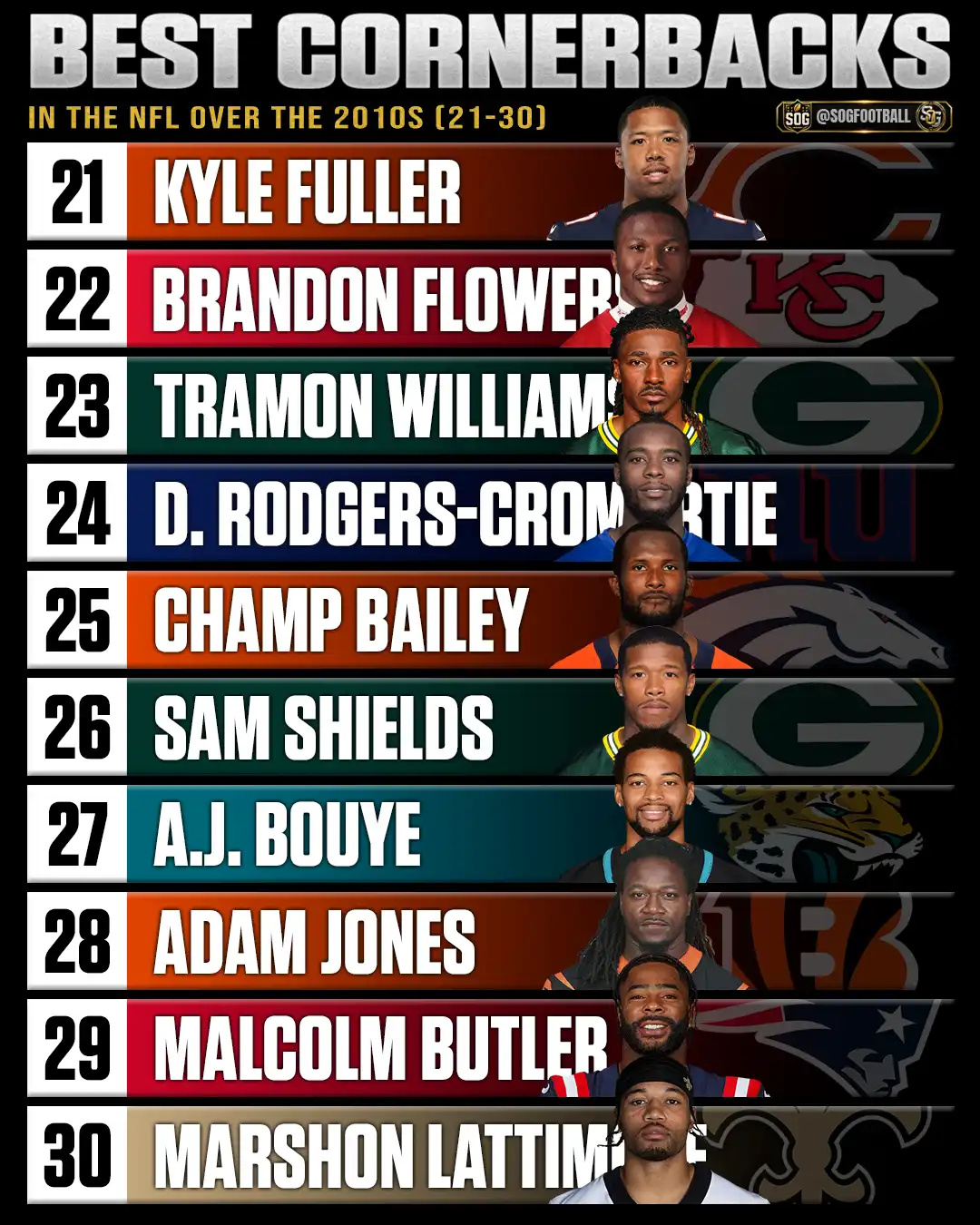
Best cornerbacks of the 2010s ranked 21–30: Kyle Fuller, Brandon Flowers, Tramon Williams, Dominique Rodgers-Cromartie, Champ Bailey, Sam Shields, A.J. Bouye, Adam Jones, Malcolm Butler and Marshon Lattimore.
21. Kyle Fuller
2010s stats and accolades: 18 interceptions; one first-team All-Pro selection; two Pro Bowls; 2018 co-leader in interceptions.
Fuller’s 2018 breakthrough gives him one of the strongest peak seasons in this range. He tied for the league lead with seven interceptions, defended 21 passes and earned first-team All-Pro honors as Chicago’s defense powered a division title. He followed with another Pro Bowl season in 2019, showing that the peak was not isolated. Missing all of 2016 and producing a shorter prime than the top-20 corners are the main limits on his case.
22. Brandon Flowers
2010s stats and accolades: 14 interceptions; one Pro Bowl; 73 passes defended from 2010 through 2016.
Flowers won with anticipation, toughness and efficient footwork rather than ideal size or rare long speed. He opened the decade with five productive seasons, including four interceptions in 2011 and his lone Pro Bowl selection for the 2013 campaign. His decline came quickly after 2014, so the complete body of work is not as deep as the names above him. At his best, though, he was a technically dependable outside corner who played larger than his frame.
23. Tramon Williams
2010s stats and accolades: 24 regular-season interceptions; one Pro Bowl; three interceptions during the 2010 postseason; Super Bowl XLV champion.
Williams started the decade with the best season of his career at exactly the right time. He intercepted six passes in the 2010 regular season, then added three more during Green Bay’s championship run, including a 70-yard pick-six before halftime in the divisional round. He continued to start across multiple systems and roles through 2019, eventually shifting inside late in his career. The combination of postseason leverage, longevity and ball production earns him a firm top-25 spot.
24. Dominique Rodgers-Cromartie
2010s stats and accolades: 20 interceptions; one second-team All-Pro selection; one Pro Bowl; four interception-return touchdowns.
Rodgers-Cromartie possessed the length and straight-line speed to stay attached to vertical routes that stressed most corners. His decade included strong work across several defensive systems, a Super Bowl appearance after the 2013 season and a Pro Bowl selection in 2015. He peaked again in 2016 with six interceptions, 21 passes defended and second-team All-Pro honors. Uneven year-to-year play lowers his ranking, but his best seasons featured uncommon range and playmaking.
25. Champ Bailey
2010s stats and accolades: Six interceptions; three Pro Bowls; one second-team All-Pro selection; 46 regular-season starts.
Bailey would sit near the top of an all-time cornerback ranking, but this exercise begins in his age-32 season. Even within that narrow window, he remained an elite technician: he reached three straight Pro Bowls from 2010 through 2012 and earned second-team All-Pro honors in 2012. Injuries limited him to five regular-season games in 2013, although he returned during Denver’s run to Super Bowl XLVIII. No credit from his historic 2000s prime is carried into this placement.
26. Sam Shields
2010s stats and accolades: 19 regular-season interceptions; one Pro Bowl; five postseason interceptions; Super Bowl XLV champion.
Shields converted elite speed into immediate value after entering the league undrafted. In the 2010 NFC Championship Game, he intercepted two passes, added a sack and forced a fumble, helping Green Bay advance to the Super Bowl. He later developed into a full-time outside starter and made the Pro Bowl for the 2014 season. Concussion problems interrupted his prime, but his recovery ability and verified postseason production make the decade résumé meaningful.
27. A.J. Bouye
2010s stats and accolades: 14 interceptions; one second-team All-Pro selection; one Pro Bowl; seven passes defended in six postseason games.
Bouye’s case is built around a superb two-season peak. He emerged as a high-end starter in 2016, then intercepted six passes and defended 18 in 2017 while forming half of an elite cornerback tandem in Jacksonville. That season ended with Pro Bowl and second-team All-Pro recognition plus a trip to the AFC Championship Game. He did not sustain that exact level long enough to climb higher, but the peak was complete rather than speculative.
28. Adam Jones
2010s stats and accolades: 13 interceptions; one Pro Bowl; 2014 first-team All-Pro as a return specialist; 70 games started.
Jones revived his career by becoming a reliable defensive starter and a dangerous returner in Cincinnati. From 2013 through 2015, he recorded nine interceptions while contributing significant value on special teams, earning first-team All-Pro recognition as a return specialist in 2014 and a Pro Bowl selection after the following season. His coverage peak was not as high as the pure cornerbacks above him, but his versatility and sustained comeback deserve recognition.
29. Malcolm Butler
2010s stats and accolades: 13 regular-season interceptions; one second-team All-Pro selection; one Pro Bowl; two Super Bowl championships.
Butler’s goal-line interception in Super Bowl XLIX is the decade’s most consequential cornerback play, but his ranking is not based on that snap alone. He became a full-time starter in 2015, reached the Pro Bowl, and followed with four interceptions, 17 passes defended and second-team All-Pro honors in 2016. His performance grew less consistent later in the decade, and an injury ended his 2019 season early. The complete résumé still includes a legitimate prime and championship-defining value.
30. Marshon Lattimore
2010s stats and accolades: Eight interceptions in three seasons; 2017 Defensive Rookie of the Year; two Pro Bowls; 44 passes defended.
Lattimore closes the list because his immediate impact outweighed a short sample. He intercepted five passes, defended 18 and won Defensive Rookie of the Year in 2017, giving New Orleans the top outside corner its improved defense needed. He added a second Pro Bowl selection in 2019 and helped the Saints reach the playoffs in all three of his decade seasons. Later work cannot raise this ranking, but the first three years were already enough to earn the final spot.
Biggest Ranking Debates
Richard Sherman vs. Darrelle Revis at No. 1
The answer changes with the question. If the choice is one corner at his absolute best for one matchup, Revis has the stronger shutdown argument. If the question is who produced the best complete 2010s résumé, Sherman has the edge: more interceptions inside the decade, more elite seasons spread across the window and a longer connection to championship-level play.
Full-decade value vs. a shorter elite peak
Ramsey, White and Lattimore entered the NFL late enough that they could not match the longevity of Joseph, Haden or Grimes. Their placements reward what they actually accomplished—including All-Pro seasons and major awards—without projecting later success backward. The same logic works in reverse for Bailey: his legendary pre-2010 career does not inflate four eligible seasons.
Shutdown coverage vs. takeaway production
Peters and Jenkins created turnovers more frequently than several players ranked ahead of them, but their aggressive styles also introduced more variance. Revis and Peterson were often asked to remove a receiver from the game plan, a responsibility that can suppress opportunities for interceptions. The ranking values both paths while giving coverage consistency the deciding weight when the overall résumés are close.
Why Chris Harris Jr. belongs in the top five
Slot coverage became more valuable as three-receiver formations and option routes spread across the league. Harris could handle that work without being limited to it; he also played outside, tackled and blitzed. His fourth-place ranking reflects the difficulty and flexibility of his assignments, not a bonus for being labelled underrated.
Toughest Cuts
Antonio Cromartie, Lardarius Webb, Jimmy Smith, Trumaine Johnson and Xavien Howard were among the closest omissions. Cromartie supplied early-decade man-coverage value, Webb and Smith played important roles on strong Baltimore defenses, Johnson combined size with scoring production, and Howard tied for the league lead with seven interceptions in 2018. Each had a credible case, but the selected top 30 offered a stronger combination of peak, longevity and decade-specific recognition.
Nnamdi Asomugha and Asante Samuel also deserve mention, but most of their best work came before 2010. Tyrann Mathieu was one of the decade’s most valuable defensive backs, although his hybrid slot-and-safety role places him outside a list focused on players whose primary identity was cornerback.
Complete Top 30 Cornerbacks of the 2010s
This table preserves the full ranking in a compact format. Player names are listed without team labels because several corners built their 2010s résumés across multiple franchises.
| Rank | Cornerback |
|---|---|
| 1 | Richard Sherman |
| 2 | Darrelle Revis |
| 3 | Patrick Peterson |
| 4 | Chris Harris Jr. |
| 5 | Stephon Gilmore |
| 6 | Aqib Talib |
| 7 | Casey Hayward |
| 8 | Brent Grimes |
| 9 | Joe Haden |
| 10 | Jalen Ramsey |
| 11 | Marcus Peters |
| 12 | Johnathan Joseph |
| 13 | Darius Slay |
| 14 | Vontae Davis |
| 15 | Xavier Rhodes |
| 16 | Josh Norman |
| 17 | Charles Tillman |
| 18 | Tre’Davious White |
| 19 | Desmond Trufant |
| 20 | Janoris Jenkins |
| 21 | Kyle Fuller |
| 22 | Brandon Flowers |
| 23 | Tramon Williams |
| 24 | Dominique Rodgers-Cromartie |
| 25 | Champ Bailey |
| 26 | Sam Shields |
| 27 | A.J. Bouye |
| 28 | Adam Jones |
| 29 | Malcolm Butler |
| 30 | Marshon Lattimore |
Frequently Asked Questions
Who was the best cornerback of the 2010s?
Richard Sherman ranks first because he combined the decade’s strongest sustained résumé with 35 interceptions, three first-team All-Pro selections and a championship peak on Seattle’s Legion of Boom defense.
Who are the top five cornerbacks of the 2010s?
The top five are Richard Sherman, Darrelle Revis, Patrick Peterson, Chris Harris Jr. and Stephon Gilmore. Together, they represent the decade’s leading mix of shutdown coverage, sustained excellence, versatility and peak recognition.
Why is Richard Sherman ranked ahead of Darrelle Revis?
Sherman had the stronger body of work across the full 2010s. Revis still has a compelling argument as the better pure shadow corner at his peak, but part of his best football occurred before 2010 and his eligible prime was shorter.
Who had the best cornerback season of the 2010s?
Stephon Gilmore’s 2019 Defensive Player of the Year season has the strongest award-based case. Sherman in 2013, Josh Norman in 2015, Chris Harris Jr. in 2016 and Jalen Ramsey in 2017 also produced defining peaks.
Who recorded the most interceptions among these cornerbacks during the decade?
Richard Sherman led the ranked players with 35 regular-season interceptions from 2011 through 2019. Marcus Peters reached 27 in only five seasons, making him the most prolific ballhawk relative to the length of his sample.
Why is Jalen Ramsey only ranked 10th?
Ramsey entered the NFL in 2016, leaving him only four eligible seasons. His first-team All-Pro peak belongs in the top 10, but the players above him combined elite play with longer 2010s résumés.
Does this ranking include playoff games?
Yes. Regular-season performance forms the statistical baseline, while playoff impact from the postseasons attached to the 2010 through 2019 seasons is considered separately.
Is the ranking based only on interceptions?
No. The evaluation also weighs coverage difficulty, opponent avoidance, All-Pro recognition, versatility, consistency and postseason impact. Interceptions are valuable, but they do not measure every way a corner can control a passing game.
More Cornerback Rankings
Compare this decade with our best cornerbacks of all time and best cornerback seasons in NFL history. You can also track how the position changed through the best cornerbacks from every NFL season.
For the modern era, see the best cornerbacks since 2020 and our ranking of the best cornerbacks in the NFL today. For more football rankings, graphics and debates, follow @SOGFootball on Instagram.
Final Verdict
Sherman’s complete decade earns the top spot. Revis supplied the most convincing shutdown peak, Peterson paired elite assignments with extraordinary longevity, Harris redefined the value of inside-out versatility, and Gilmore finished the era with its highest individual defensive honor.
The rest of the ranking shows why cornerback comparisons require more than one statistic. Talib and Jenkins turned interceptions into points, Peters hunted takeaways, Harris solved the slot, Tillman forced fumbles, and Ramsey reached an All-Pro level before he had enough seasons to build a decade-long total. Different styles created different forms of value, but the 30 players above produced the strongest cornerback résumés from 2010 through 2019.
Last reviewed: August 9, 2026.
