The Houston Texans have the best edge rusher duo in the NFL entering the 2026 season. Will Anderson Jr. and Danielle Hunter take the No. 1 spot because both can dictate protection, defend the run and finish pressures without Houston needing to hide a weak side of the formation.
Myles Garrett and Byron Young give the Los Angeles Rams the most frightening individual headliner, while T.J. Watt and Alex Highsmith remain the safest proven partnership. Brian Burns and Abdul Carter are close behind with a combination of established production and breakout potential. This SOG Sports power ranking evaluates the best two edge defenders on all 32 teams, not the overall depth of each defensive front.
The rankings reflect current rosters and reported availability entering Week 1 of the 2026 NFL season. They are a full-season projection rather than a list based only on who can play on opening weekend.
Table of Contents
- Best edge rusher duos: Nos. 21-32
- Biggest takeaways from the rankings
- Complete edge rusher duo rankings
- Final verdict
How We Ranked the Best Edge Rusher Duos
This is a subjective 2026 NFL power ranking, not a sack leaderboard. Recent production matters, but sacks alone can miss how frequently a player forces hurried throws, draws chips, compresses the pocket or closes the edge against the run. The order weighs current ability, projected 2026 role, pass-rush ceiling, run defense, durability, scheme fit, age and the quality of both members of the pairing.
The second edge rusher carries real weight. One superstar can make a front dangerous, but a credible partner prevents an offense from sliding protection in the same direction all afternoon. That is the main reason Houston ranks ahead of Los Angeles. Garrett is the best individual player in either pairing, but Anderson and Hunter form the stronger two-man unit.
The evaluation is limited to two edge defenders per team. Interior rushers can create easier opportunities for the duo, and several defenses have excellent three- or four-man rotations, but those players do not directly change the selected pairing. That distinction matters for teams such as Kansas City, Philadelphia, Seattle and Buffalo, whose total pass-rush plans are deeper than their two-player placement may suggest.
This list also differs from the SOG Sports ranking of the best individual edge rushers in the NFL today. An individual star can rank near the top at his position while his team lands lower here because the opposite edge remains unproven, injured or better suited to a rotational role.
How Injuries and Availability Affect the Rankings
Players on the physically unable to perform list remain eligible when they are expected to return before midseason. That keeps Micah Parsons and Mykel Williams in the full-season ranking, even though neither will be available for the first four games. Their team sections explain how much the missed time affects the placement.
Jonathon Cooper is a different case. He begins the season on the Commissioner’s Exempt List and is not permitted to practice or play while he remains there. Denver’s No. 6 ranking assumes Cooper returns during the season and resumes his starting role. If he does not, the active pairing becomes Nik Bonitto and Jonah Elliss, and the Broncos would fall several places.
Season-ending injuries are not treated the same way. Jalon Walker is on Atlanta’s reserve/injured list, so the Falcons are evaluated with Za’Darius Smith and Samson Ebukam. Carolina also lost Nic Scourton for the season, leaving Jaelan Phillips and Patrick Jones II as its featured duo. These are rankings of the projected 2026 pairings, not the two biggest names each team had at some point during the offseason.
Best Edge Rusher Duos in the NFL Today: 1-10

Ranks 1-10 of the best edge rusher duos in the NFL today power rankings.
1. Will Anderson Jr. and Danielle Hunter, Houston Texans
Houston gets the top spot because there is no obvious side for an offense to target. Anderson brings explosive acceleration, converts speed into power and has already become a complete every-down defender. Hunter remains one of the league’s most polished finishers, with the length and timing to win even when a tackle knows where he is coming from. Both earned Associated Press All-Pro honors for their work in 2025, with Anderson on the first team and Hunter on the second.
The separation from the Rams is balance. Garrett may command more attention than either Texan by himself, but Houston can leave Anderson and Hunter on opposite edges and force both tackles to survive. That reduces the need for constant blitzing and lets the coverage dictate more of the call. There is no projection required from the second member of this duo, which gives the Texans the highest floor on the list.
2. Myles Garrett and Byron Young, Los Angeles Rams
No pairing has a more destructive No. 1 rusher. Garrett changes protection before the ball is snapped because offenses must locate him, slide help toward him and avoid leaving slow-developing concepts exposed. The Rams can move him across the front instead of allowing an offense to solve the matchup with one chip or one favorable tackle.
Young is not merely riding Garrett’s reputation. He produced a career-high 12 sacks and 29 quarterback hits in 2025, started all 17 games and earned his first Pro Bowl selection. His speed becomes even harder to handle when the protection turns toward Garrett. Los Angeles ranks second only because Houston has two players who have already shown top-level, every-down consistency. If Young’s managed knee issue does not limit him and he repeats last season, the Rams can finish No. 1.
3. T.J. Watt and Alex Highsmith, Pittsburgh Steelers
Watt and Highsmith are the standard for a proven partnership. Watt wins games with sacks, forced fumbles, tipped passes and late-down finishes. Highsmith is strong enough to set the edge and skilled enough as a rusher that an offense cannot devote its entire plan to Watt. He enters 2026 with 45 career sacks and 10 forced fumbles, production that would make him the lead threat on several teams.
Pittsburgh also has Nick Herbig and Jack Sawyer available to keep the starters fresh, but the ranking is built on the two veterans. They sit behind Houston and Los Angeles because Watt is entering a later stage of his career and the two duos above offer a little more current explosiveness. The Steelers remain the easiest top-three choice to trust because there is almost no uncertainty about how the two players complement each other.
4. Brian Burns and Abdul Carter, New York Giants
Burns supplies the proven production after recording 16.5 sacks in 2025, the second-highest total in the league. His first step and closing speed force tackles to protect their outside shoulder, while his ability to change the rush path keeps him from becoming a one-move player. New York can build its passing-down plan around him without making every pressure look identical.
Carter is the reason the Giants rank above several established pairings. His rookie line of four sacks understates how quickly he developed, with 3.5 coming over the final five games. He can rush outside, loop through the interior or become the moving piece in a simulated pressure. Kayvon Thibodeaux gives New York excellent third-rusher depth, but Burns and Carter have the highest two-man ceiling. They rank fourth because Carter still has to turn a strong finish into full-season consistency.
5. Khalil Mack and Tuli Tuipulotu, Los Angeles Chargers
Mack remains valuable because his game is not built only on pure speed. He can collapse the edge with power, defeat tight ends in the run game and punish protections that treat him like a situational veteran. His 113 career sacks give the Chargers a closer who understands how to attack different sets and protection rules.
Tuipulotu makes this a top-five duo rather than a reputation-based ranking. He can play with his hand down, reduce inside and handle more early-down work than a pure speed rusher. That flexibility lets Los Angeles put Mack in the most favorable matchup instead of asking the veteran to solve every down. Akheem Mesidor adds another dangerous piece to the rotation, but the established partnership of Mack and Tuipulotu earns the fifth spot.
6. Nik Bonitto and Jonathon Cooper, Denver Broncos
At full strength, Bonitto and Cooper form one of the league’s best speed-and-strength combinations. Bonitto is the more explosive pass rusher and the player most likely to wreck a third down. Cooper is sturdier against the run, has posted at least eight sacks in each of the past three seasons and prevents offenses from treating the opposite edge as a safe release point.
The No. 6 placement is conditional. Cooper is on the Commissioner’s Exempt List and cannot currently practice or play, with no guaranteed return date. Jonah Elliss is the likely active starter opposite Bonitto in the meantime. Denver’s interior pressure and overall depth can keep the front effective, but the listed duo only belongs this high if Cooper returns for a meaningful portion of the season. No team in the top 10 has a larger availability caveat.
7. Josh Hines-Allen and Travon Walker, Jacksonville Jaguars
Jacksonville has two long, powerful former top-seven picks who can win without being schemed free. Hines-Allen is the more refined rusher and became the franchise’s career sack leader in 2025. Walker is heavier and more capable of playing through contact, which gives the Jaguars a strong run-defense floor on the opposite side.
Walker’s 2025 season was interrupted by wrist and knee injuries, and his sack total fell to 3.5 after consecutive double-digit seasons. That decline keeps Jacksonville outside the top five even though the physical ceiling is obvious. If Walker returns to his 2023 and 2024 form, the duo is balanced enough to rise. The four-year extension he signed in the offseason also confirms that the Jaguars still view the pairing as a long-term foundation.
8. Aidan Hutchinson and D.J. Wonnum, Detroit Lions
Hutchinson is the engine of Detroit’s front. He combines power, active hands and relentless pursuit, producing pressure without needing the defense to protect him from the run. The Lions entered the offseason with no major concern about his recovery, which restores a genuine game-plan changer to the edge.
Wonnum gives Detroit the credible second option it needed. He has produced two eight-sack seasons and is strong enough to play the base end role while Hutchinson moves around on passing downs. Second-round pick Derrick Moore adds developmental upside behind them. This duo ranks eighth because Wonnum has not been as consistent as the second rushers above him, but the fit is clean and Hutchinson gives the pairing top-five upside.
9. Maxx Crosby and Kwity Paye, Las Vegas Raiders
Crosby remains one of football’s most demanding individual assignments. He led Las Vegas with 10 sacks for a fifth straight season in 2025 and finished with 28 tackles for loss. His value comes from the volume as much as the splash plays. He pressures quarterbacks, chases runs from the back side and rarely gives an offense a down on which it can ignore him.
Paye is a better complement than his raw sack totals suggest because he can play with strength, hold up on early downs and reduce the physical burden on Crosby. Malcolm Koonce adds another possible pressure source, but Paye enters the season as the steadier two-way partner. The Raiders land ninth because this is still driven heavily by Crosby. To move higher, Paye must make protections pay for leaning toward No. 98.
10. Micah Parsons and Lukas Van Ness, Green Bay Packers
Green Bay would rank higher on pure peak ability. Parsons recorded 12.5 sacks and earned another All-Pro selection in 2025 despite missing the final three-plus regular-season games. He can rush from either edge or reduce inside, making it difficult for an offense to declare its protection before the snap.
The uncertainty comes from both availability and the second spot. Parsons will begin the season on PUP and miss at least four games while recovering from his knee injury. Van Ness is healthy after a foot injury disrupted his 2025 season, but he enters Year 4 with 10.5 career sacks including the postseason and still has to prove he can provide reliable pressure across a full schedule. The Packers have a top-three ceiling after Parsons returns, but No. 10 is the appropriate starting point for the complete 2026 outlook.
Best Edge Rusher Duos in the NFL Today: 11-20
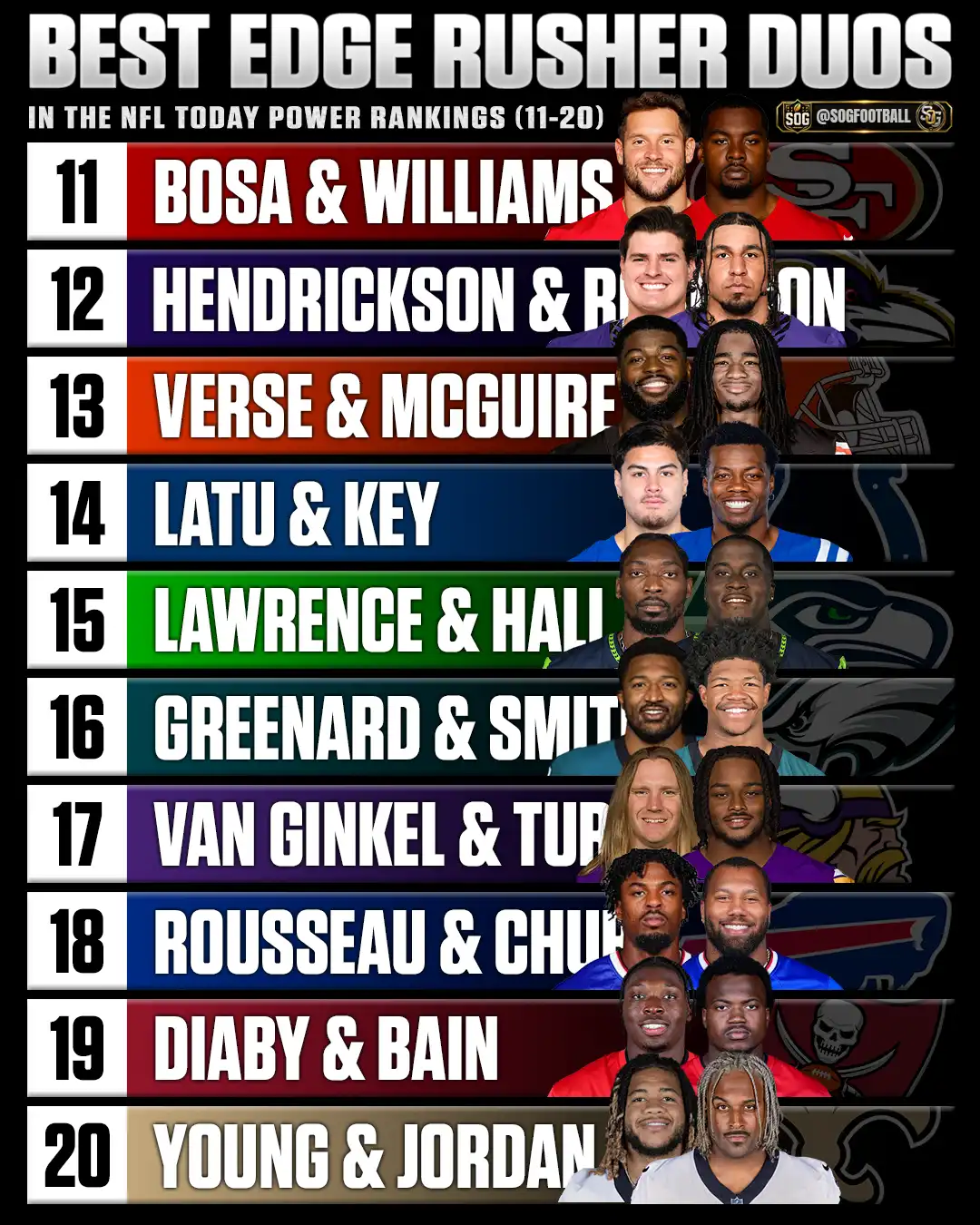
Ranks 11-20 of the best edge rusher duos in the NFL today power rankings.
11. Nick Bosa and Mykel Williams, San Francisco 49ers
Bosa gives San Francisco a top-tier anchor who can win with speed, leverage or power and forces an offense to account for him on every passing down. A healthy Bosa can carry a rush while the rest of the front develops. His return to practice before Week 1 is encouraging after the 49ers managed his workload through camp.
Williams is the reason this pairing sits outside the top 10. The former No. 11 pick will begin the season on reserve/PUP while recovering from an ACL injury that also involved cartilage damage. His size and inside-outside versatility are ideal next to Bosa, but the partnership has not yet had a chance to establish itself over a full season. If Williams returns near full strength in October, San Francisco can rise quickly. Until then, this ranking is based more on projected fit than available snaps.
12. Trey Hendrickson and Tavius Robinson, Baltimore Ravens
Hendrickson gives Baltimore the proven finisher it lacked. He attacks tackles with a developed rush plan rather than relying on one physical trait, and his presence should create cleaner opportunities for the Ravens’ interior pressure packages. Offenses cannot treat him like a decoy while focusing on simulated blitzes elsewhere.
Robinson is a complementary choice rather than the clear second-best pure pass rusher on every down. His length and strength help Baltimore set the edge, while Mike Green can take a larger pass-rush role in obvious situations. That rotation improves the defense but limits the ceiling of the specific Hendrickson-Robinson pairing. The Ravens rank 12th because the lead rusher is proven and the overall fit is sound, even if the second half is role-dependent.
13. Jared Verse and Isaiah McGuire, Cleveland Browns
Verse becomes the face of Cleveland’s new edge group after arriving in the Garrett trade. His power, urgency and ability to play through contact make him more than a designated third-down rusher. He can set a physical tone while still creating the negative plays expected from a lead edge defender.
McGuire gives the Browns a useful young complement, but he has not established the same weekly pressure floor as the second rushers in the top 12. Cleveland can also rotate Alex Wright and Derek Barnett, so the defense does not need McGuire to play every passing snap. This pairing has room to climb because Verse can become a top-10 individual player at the position. It starts 13th because the opposite edge remains less settled.
14. Laiatu Latu and Arden Key, Indianapolis Colts
Latu has the technical variety to become the best player in this duo. He can threaten outside, counter inside and win before a blocker has time to settle. Indianapolis needs him to convert more of those favorable rushes into finished sacks and forced mistakes, but his trajectory gives the pairing genuine upside.
Key is a sensible veteran partner who has produced in several fronts and can align wider or reduce inside on passing downs. He is most effective when the defense can manage his snap distribution rather than ask him to anchor every early down. The Colts rank just behind Cleveland because Verse is the more established lead threat, but Latu and Key may offer the cleaner two-man pass-rush plan.
15. DeMarcus Lawrence and Derick Hall, Seattle Seahawks
Lawrence is 34, but he still gives Seattle dependable run defense, powerful hands and the ability to collapse the pocket without winning cleanly around the corner. He plays with the awareness to keep the defense structurally sound, which matters in a front that asks its edge players to do more than chase sacks.
Hall brings the younger athletic element and signed a three-year extension after establishing himself in Seattle’s rotation. The Seahawks also carry Uchenna Nwosu and Dante Fowler Jr., so Lawrence and Hall will not have to absorb every high-leverage snap. That depth helps the defense, although it makes this ranking less about overwhelming production from the listed duo. Seattle lands 15th with a strong floor and a lower individual pass-rush ceiling than the teams above it.
16. Jonathan Greenard and Nolan Smith Jr., Philadelphia Eagles
Greenard is the sturdier half of the pairing. He can rush with power, play through tackles and stay useful on early downs. Smith adds the burst and pursuit speed that can turn a protection mistake into a drive-ending play. Their contrasting styles give Philadelphia more answers than a pair of similarly built speed rushers would.
The Eagles’ total edge room is deeper than No. 16 suggests. Arnold Ebiketie, A.J. Epenesa and Jalyx Hunt allow the defense to rotate without a dramatic drop in fresh legs. The listed duo sits in the middle because Smith still needs to become a steadier down-to-down producer. If he does, Greenard’s reliability makes Philadelphia a clear top-12 candidate.
17. Andrew Van Ginkel and Dallas Turner, Minnesota Vikings
Van Ginkel’s value is tied to how many different problems he can solve. He can rush, drop underneath a passing lane, attack inside or disguise which defender is actually coming. That flexibility gives Minnesota’s pressure packages more credibility before the ball is snapped.
Turner supplies the higher long-term pass-rush ceiling. His speed and range are ideal for a defense that manufactures hesitation, but the Vikings need more consistent finishing from him before this becomes a top-half lock. Kyle Van Noy adds experience to the room and can reduce the pressure on both starters. Minnesota ranks 17th because the schematic value is already present, while Turner’s full breakout remains a projection.
18. Greg Rousseau and Bradley Chubb, Buffalo Bills
Rousseau gives Buffalo length, strong run defense and a reliable base from which to build the rush. He may not win every snap with pure speed, but his ability to compress the pocket and disrupt throwing lanes makes him useful even when he does not record the sack.
Chubb is the swing player. He owns a 48-sack career résumé and made Buffalo’s initial 53-man roster, but his recent seasons have been shaped by injuries. If he stays available and recovers his burst, this duo is too low. If his workload must be managed, the Bills will lean more heavily on Mike Danna, Michael Hoecht, Javon Solomon and rookie TJ Parker. The range of possible outcomes is why Buffalo starts at No. 18.
19. YaYa Diaby and Rueben Bain Jr., Tampa Bay Buccaneers
Diaby led Tampa Bay with seven sacks in 2025, but his pressure volume was more encouraging than that total. He can win through power, chase plays across the formation and handle a significant early-down role. The next step is turning more disruption into finished quarterback takedowns.
Bain, the No. 15 pick in the 2026 draft, gives the Buccaneers the type of second threat they have been missing. His college production included 33.5 tackles for loss and 20.5 sacks, and his mix of leverage and power should translate to both run and pass situations. Al-Quadin Muhammad strengthens the broader rotation. Tampa Bay ranks 19th because Bain has not played an NFL snap, but this is one of the most obvious risers if the rookie adjusts quickly.
20. Chase Young and Cameron Jordan, New Orleans Saints
Young is now the player New Orleans needs to lead the pass rush. His size and acceleration still create difficult one-on-one assignments, but the Saints need consistent finishing rather than isolated flashes. A full season of dependable pressure would stabilize a front that can no longer be built around Jordan’s prime.
Jordan returns for Year 16 at age 37. His technique, strength and recognition still make him useful, particularly against the run and in selected matchups. The concern is whether he can provide enough pass-rush juice across a full schedule to punish protections that turn toward Young. New Orleans lands 20th because the pair has a credible floor, but age and recent consistency limit the ceiling.
Best Edge Rusher Duos in the NFL Today: 21-32
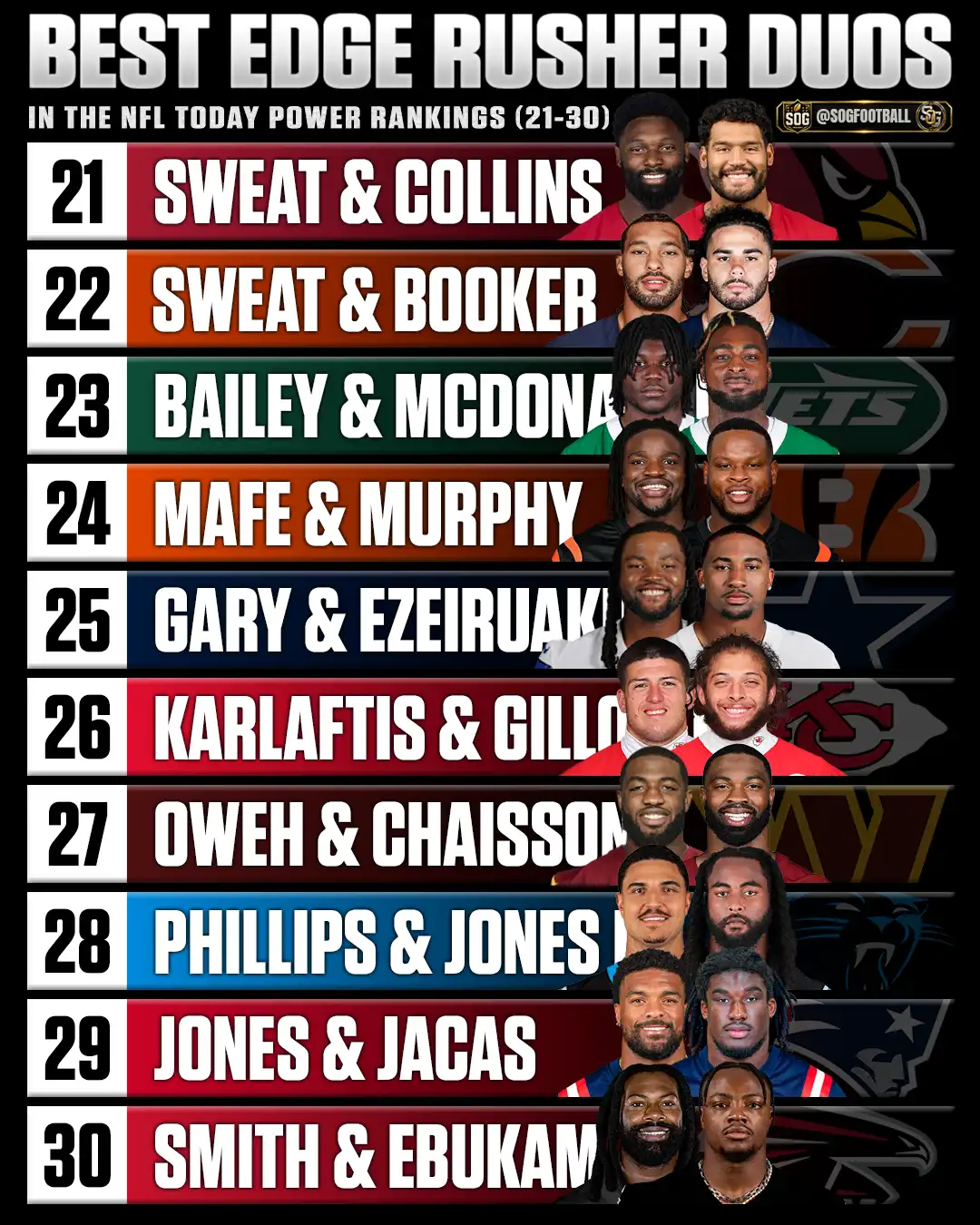
Ranks 21-30 of the best edge rusher duos in the NFL today power rankings.
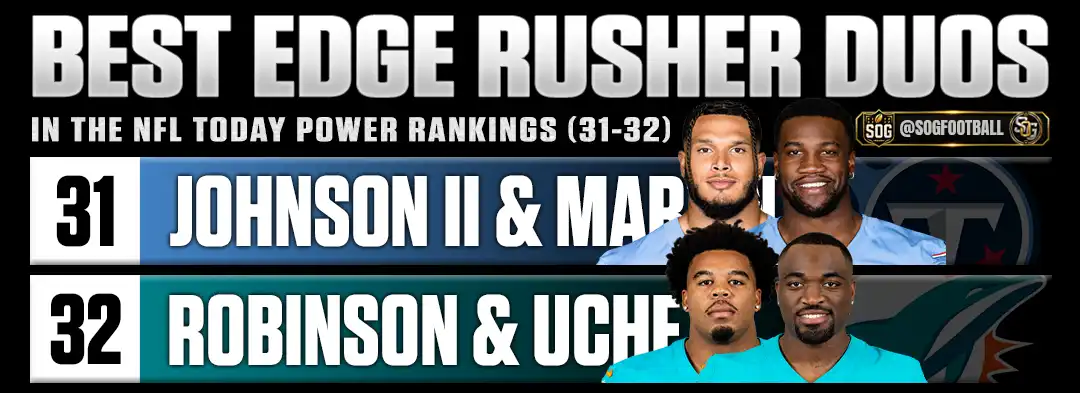
Ranks 31-32 of the best edge rusher duos in the NFL today power rankings.
21. Josh Sweat and Zaven Collins, Arizona Cardinals
Sweat is the clear lead rusher after setting a career high with 12 sacks in 2025. He has enough length and burst to win outside, but his effectiveness is highest when Arizona can keep him fresh and create favorable passing situations. He gives the Cardinals a proven player who belongs higher than the team’s overall placement.
Collins is a versatile edge-setting linebacker rather than a consistently dangerous pure pass rusher. He can play in space, handle run responsibilities and give the defense flexibility, but Arizona needs more pressure from the second side. That imbalance keeps the pair at No. 21. A larger pass-rush contribution from Collins would move the Cardinals into the top 16 because Sweat has already done his part.
22. Montez Sweat and Austin Booker, Chicago Bears
Montez Sweat reached 50 career sacks during the 2025 season and remains the Bears’ most dependable edge threat. His length and power allow him to affect both the run and the pass, while his presence gives Chicago a player protections must identify on every long-yardage snap.
Booker showed enough progress to finish among Chicago’s top three sack producers in 2025, but he still has to establish an every-week pressure floor. Dayo Odeyingbo provides another substantial edge body and could claim a larger share of the snaps. The selected duo ranks 22nd because the second side is still developing. If Booker takes a real third-year leap, the Bears have a straightforward path into the top half.
23. David Bailey and Will McDonald IV, New York Jets
The Jets may be the lowest-ranked duo with a realistic top-12 ceiling. McDonald recorded 10.5 sacks in 2024 and eight in 2025, leading New York in sacks both years. His first-step speed is already proven, although the Jets need him to remain sturdier when offenses run at his side.
Bailey arrives as the No. 2 overall pick after producing 14.5 sacks in his final college season at Texas Tech. His acceleration and disruptive upside give New York a potential lead rusher, not merely a rotational rookie. The pair starts at No. 23 because Bailey has yet to face NFL tackles and McDonald finished 2025 on injured reserve. If both stay healthy, this ranking could look conservative by October.
24. Boye Mafe and Myles Murphy, Cincinnati Bengals
Mafe gives Cincinnati a new edge presence with enough burst and power to play a major role immediately. The Bengals need him to become their most consistent outside pressure source rather than another member of a broad rotation.
Murphy is coming off his best professional season, leading Cincinnati with 5.5 sacks and making 10 starts in 2025. That was progress, but it was not yet the high-end production expected from a former first-round pick. The pair sits 24th because both players still need to prove they can win as featured rushers at the same time. A strong interior led by Dexter Lawrence and Jonathan Allen should give them cleaner opportunities than the ranking alone suggests.
25. Rashan Gary and Donovan Ezeiruaku, Dallas Cowboys
Gary brings the established power rusher Dallas needed after rebuilding the edge room. He can move blockers backward, defend the run and create pressure without requiring a wide alignment on every passing down. His arrival raises the floor immediately.
Ezeiruaku played 569 snaps as a rookie and enters 2026 with a clear opportunity to grow into a larger role. Dallas also added rookie Malachi Lawrence and veteran Von Miller, creating a deeper competition than the two-player ranking shows. The Cowboys land 25th because Gary is new to the defense and Ezeiruaku has not yet demonstrated high-end production. The supporting rotation gives this group more upside than most teams in the bottom eight.
26. George Karlaftis and Ashton Gillotte, Kansas City Chiefs
Karlaftis gives Kansas City a reliable, physical edge who plays with consistent effort and benefits from the attention Chris Jones draws inside. He may not force an offense to redesign the entire protection, but he converts enough opportunities to remain a dependable starter.
Gillotte opens the year opposite him on the Chiefs’ depth chart after earning a larger role. His development is the variable that decides whether this duo belongs higher. Kansas City can also use Felix Anudike-Uzomah and R Mason Thomas in the rotation, while Jones makes every outside rusher more dangerous. The specific pair ranks 26th because the second edge remains unproven, even though the complete Chiefs pass rush should outperform that number.
27. Odafe Oweh and K’Lavon Chaisson, Washington Commanders
Washington invested in Oweh because his speed and athletic profile fit an attacking front. He is dealing with a calf strain entering the season, but he remains on the active roster and is expected to be a central piece once ready. The challenge has always been converting his physical tools into steady finishing production.
Chaisson recorded 7.5 sacks in 2025 and brings similar explosiveness to the opposite side. The Commanders can also create pressure with Charles Omenihu from heavier alignments. Oweh and Chaisson rank 27th because both have had uneven stretches and are joining a new defensive structure together. The raw athletic ceiling is much higher than this placement, but Washington needs proof that the pressure will arrive every week.
28. Jaelan Phillips and Patrick Jones II, Carolina Panthers
Phillips is the strongest individual player in the bottom five and gives Carolina a legitimate top-20 edge rusher when healthy. He has the length and movement skill to win in several ways, and the Panthers can move him around rather than letting protection settle on one matchup.
Availability lowers the pairing. Phillips has missed substantial time in recent seasons, Jones is returning after his own injury-shortened 2025 campaign, and Nic Scourton suffered a season-ending knee injury on the first day of camp. Princely Umanmielen adds useful young depth, but the listed duo carries too much health uncertainty to rank higher. If Phillips and Jones stay on the field, No. 28 will undersell their ability.
29. Dre’Mont Jones and Gabe Jacas, New England Patriots
Jones gives New England a veteran who can play the edge on early downs and reduce inside in passing situations. That flexibility is valuable while Harold Landry III begins the season unavailable. Jones is not a high-volume sack star, but he provides the steadier half of an otherwise unsettled pairing.
Jacas, the No. 55 pick in the 2026 draft, made the roster after an uneven preseason and is being asked to contribute sooner because of Landry’s absence. His power and length offer developmental upside, but New England cannot assume immediate impact from a rookie second-rounder. The Patriots rank 29th because the second side is a projection and the expected lead rusher is not currently part of the pairing.
30. Za’Darius Smith and Samson Ebukam, Atlanta Falcons
Atlanta’s intended young edge group changed before the season. Jalon Walker is on reserve/injured, while James Pearce Jr. begins the year suspended. That leaves Smith and Ebukam as the two most experienced active options.
Both veterans understand how to attack protections and can still contribute in a rotation, but age and recent availability make it difficult to project a high snap ceiling. Smith is 33 and joined the roster late in August, while Ebukam is entering his 10th season. The Falcons rank 30th because the pairing looks like a short-term solution rather than the front’s long-term plan. A healthy return from the younger players would change the calculation later, but not the opening 2026 outlook.
31. Jermaine Johnson II and Jacob Martin, Tennessee Titans
Johnson is the upside play for Tennessee. He has the size and movement ability to become a complete edge defender, but injuries have interrupted the momentum he built earlier in his career. The Titans need him to stay available and become the clear lead pressure source.
Martin is an experienced rotational rusher with 26.5 career sacks and 56 quarterback hits across 119 games entering 2026. He can provide useful snaps, but his career role has generally been complementary rather than foundational. Tennessee’s interior group, led by Jeffery Simmons, John Franklin-Myers and several veteran tackles, can create opportunities for the edges. The duo still ranks 31st because neither player enters the season with a dependable recent record as a high-volume finisher.
32. Chop Robinson and Josh Uche, Miami Dolphins
Robinson has the burst and bend to become much better than the bottom ranking suggests. He produced six sacks as a rookie but slipped to four sacks and seven quarterback hits in 2025. Miami needs a third-year jump that turns athletic flashes into consistent disruption.
Uche is a speed-based rusher who can be useful in favorable passing situations, but he has not established himself as a complete every-down edge. The Dolphins’ official depth chart lists Robinson and Uche as the starters, with a broader rotation behind them. This pair ranks last because both players are currently better bets as specialized rushers than as two-sided anchors. Robinson’s development is the clearest route out of No. 32.
Biggest Takeaways From the Edge Rusher Duo Rankings
Balance Beats One Superstar at the Top
Houston ranks first even though Garrett is the best individual edge defender in the top two pairings. Anderson and Hunter can each punish isolated blocking, and neither needs the other to create his matchup. That balance makes the Texans less vulnerable to a protection plan built around one superstar.
The same principle separates Pittsburgh from several teams below it. Highsmith has produced enough on his own that offenses cannot spend every snap leaning toward Watt. Duos begin to fall when the second player is valuable against the run but has not shown he can consistently win passing downs.
Availability Creates the Widest Ranking Range
Denver, Green Bay, San Francisco and Buffalo have some of the largest differences between their ceiling and current certainty. Cooper’s exempt status is indefinite, Parsons and Williams must miss at least four games, and Chubb’s recent injury history makes Buffalo difficult to project. All four duos can outperform their ranking when complete, but none should be evaluated as though availability were guaranteed.
This is also why active-roster context matters more than name recognition. Atlanta cannot be ranked with Walker, and Carolina cannot use Scourton in its projected duo. A current power ranking should reflect who can plausibly contribute during the season being evaluated.
The Fastest Risers Are Built Around Young Second Rushers
The Giants, Buccaneers and Jets can climb because their second rushers have not established a hard ceiling. Carter finished his rookie year strongly, Bain enters the league with a three-down profile and Bailey was the second overall pick. A single breakout would change how opponents are allowed to protect against Burns, Diaby and McDonald.
The risk works in the opposite direction for teams relying on projection. If Van Ness, Williams, Jacas or Ezeiruaku does not take a step, the lead player will continue to see tilted protection. The best duos are not simply collections of draft pedigree. Both members must make the offense pay for its blocking decisions.
Two-Player Rankings Do Not Tell the Entire Pass-Rush Story
Kansas City is the clearest example. Karlaftis and Gillotte rank 26th as a duo, but Chris Jones can create more favorable edge opportunities than many teams receive from their interior. Philadelphia, Seattle and Buffalo also have deeper rotations that should outperform the rank of the selected two players.
The opposite can happen when a duo lacks support inside. Edge players are most dangerous when offenses face third-and-long and cannot step comfortably into the pocket. A team can own two talented outside rushers and still struggle if it cannot stop the run or create interior compression.
Recent Production Still Needs Context
Sack totals are an important result, but they do not identify how the pressure was created. Some players finish opportunities generated by scheme or interior teammates. Others draw the help that creates sacks for everyone else. The ranking rewards players who can generate their own wins and remain useful when an offense runs directly at them.
For a longer view of how today’s stars compare across the decade, see the best NFL edge rushers since 2020. The broader historical standard is covered in the ranking of the best edge rushers of all time.
Full Ranking Table: Best Edge Rusher Duos in the NFL Today
| Rank | Duo | Team |
|---|---|---|
| 1 | Will Anderson Jr. and Danielle Hunter | Houston Texans |
| 2 | Myles Garrett and Byron Young | Los Angeles Rams |
| 3 | T.J. Watt and Alex Highsmith | Pittsburgh Steelers |
| 4 | Brian Burns and Abdul Carter | New York Giants |
| 5 | Khalil Mack and Tuli Tuipulotu | Los Angeles Chargers |
| 6 | Nik Bonitto and Jonathon Cooper | Denver Broncos |
| 7 | Josh Hines-Allen and Travon Walker | Jacksonville Jaguars |
| 8 | Aidan Hutchinson and D.J. Wonnum | Detroit Lions |
| 9 | Maxx Crosby and Kwity Paye | Las Vegas Raiders |
| 10 | Micah Parsons and Lukas Van Ness | Green Bay Packers |
| 11 | Nick Bosa and Mykel Williams | San Francisco 49ers |
| 12 | Trey Hendrickson and Tavius Robinson | Baltimore Ravens |
| 13 | Jared Verse and Isaiah McGuire | Cleveland Browns |
| 14 | Laiatu Latu and Arden Key | Indianapolis Colts |
| 15 | DeMarcus Lawrence and Derick Hall | Seattle Seahawks |
| 16 | Jonathan Greenard and Nolan Smith Jr. | Philadelphia Eagles |
| 17 | Andrew Van Ginkel and Dallas Turner | Minnesota Vikings |
| 18 | Greg Rousseau and Bradley Chubb | Buffalo Bills |
| 19 | YaYa Diaby and Rueben Bain Jr. | Tampa Bay Buccaneers |
| 20 | Chase Young and Cameron Jordan | New Orleans Saints |
| 21 | Josh Sweat and Zaven Collins | Arizona Cardinals |
| 22 | Montez Sweat and Austin Booker | Chicago Bears |
| 23 | David Bailey and Will McDonald IV | New York Jets |
| 24 | Boye Mafe and Myles Murphy | Cincinnati Bengals |
| 25 | Rashan Gary and Donovan Ezeiruaku | Dallas Cowboys |
| 26 | George Karlaftis and Ashton Gillotte | Kansas City Chiefs |
| 27 | Odafe Oweh and K’Lavon Chaisson | Washington Commanders |
| 28 | Jaelan Phillips and Patrick Jones II | Carolina Panthers |
| 29 | Dre’Mont Jones and Gabe Jacas | New England Patriots |
| 30 | Za’Darius Smith and Samson Ebukam | Atlanta Falcons |
| 31 | Jermaine Johnson II and Jacob Martin | Tennessee Titans |
| 32 | Chop Robinson and Josh Uche | Miami Dolphins |
Who Has the Best Edge Rusher Duo in the NFL?
Will Anderson Jr. and Danielle Hunter give the Houston Texans the best edge rusher duo entering the 2026 NFL season. Garrett and Young have the most imposing individual centerpiece, while Watt and Highsmith offer the longest proven partnership near the top. Houston wins the comparison because both Texans can control a matchup without requiring the defense to protect the other side.
The middle of the ranking is far less settled. Returns from injury, early-season absences and breakouts from Carter, Bain, Bailey, Van Ness and Williams can move several teams by October. The most important test will not be which duo produces the first big sack total. It will be which pairing forces offenses to change protection on both edges for an entire season.
For more year-by-year defensive context, see the best defensive players from every NFL season since 1967.
Follow @SOGFootball on Instagram for more NFL rankings, predictions and season previews.
