The Philadelphia Eagles have the best cornerback duo in the NFL entering the 2026 season. Quinyon Mitchell and Cooper DeJean take the No. 1 spot because both earned first-team All-Pro honors in 2025, they solve different coverage problems and neither has to be protected by the structure around him.
Derek Stingley Jr. and Kamari Lassiter give the Houston Texans the closest challenge. Christian Gonzalez and Carlton Davis III place third for the New England Patriots, while the Indianapolis Colts and Denver Broncos round out the top five. This SOG Sports power ranking evaluates the two most valuable cornerbacks on all 32 teams, including a starting nickel when that player is clearly one of the defense’s best two corners.
The order is a full-season projection entering Week 1 of the 2026 NFL season. It weighs recent coverage performance, the ability to handle different receiver types, ball production, tackling, durability, role clarity and the strength of the second player in each pairing. It is not a ranking of entire secondaries or a list based only on the opening depth chart.
Table of Contents
- How the cornerback duos were ranked
- Injury, role and depth-chart rules
- Best cornerback duos: Nos. 1-10
- Best cornerback duos: Nos. 11-20
- Best cornerback duos: Nos. 21-32
- Biggest takeaways from the rankings
- Complete cornerback duo rankings
- Final verdict
How We Ranked the Best Cornerback Duos
This is a subjective power ranking, not an interception leaderboard. Cornerback play is shaped by assignment difficulty, coverage call, pass rush and the quality of the safeties behind the play. The best corners can discourage targets, survive without constant bracket help and let a coordinator pressure the quarterback without conceding an easy matchup elsewhere.
The second corner carries real weight. A superstar can erase one receiver, but an offense will move its best target, use bunch formations or isolate the weaker defender if the opposite side cannot hold up. That is why the list does not simply mirror the SOG Sports ranking of the best individual cornerbacks in the NFL today. Patrick Surtain II may have the strongest individual case, but Philadelphia and Houston place higher because their pairings are harder to attack as complete units.
Nickel corners are eligible because defending the slot is a starting job in the modern NFL. Cooper DeJean, Ja’Quan McMillian, Javon Bullard, Mike Sainristil and Chris Johnson all qualify through that role. The evaluation still focuses on cornerback value, so a safety who occasionally covers the slot does not automatically count as one half of a duo.
The order weighs 2025 performance most heavily, then adjusts for career level, age, injuries, projected 2026 usage and scheme fit. A young player can rise on a convincing projection, but draft position alone is not treated like proven NFL coverage. Likewise, a veteran with a strong résumé can fall if recent availability or role certainty has changed.
How Injuries, Roles and Depth Charts Affect the Rankings
These are full-season rankings rather than a list limited to opening-day availability. A player with a manageable camp injury remains eligible when he is on the active roster and expected to contribute early. Recent injuries still lower the floor for pairings such as Baltimore, Buffalo, Jacksonville and Dallas because a cornerback duo is only valuable when both members can stay in the weekly plan.
Current roster status takes priority over name recognition. Terrion Arnold is no longer with Detroit, which leaves D.J. Reed and Rock Ya-Sin as the Lions pairing. Trey Amos begins the season on Washington’s reserve/injured list, so Rasul Douglas and Mike Sainristil represent the Commanders here. Kansas City is evaluated with L’Jarius Sneed and rookie Mansoor Delane after its cornerback room changed substantially during the offseason.
Role labels also require context. Some teams list two boundary corners and a nickel, while others use three defensive backs interchangeably. The selected pair represents the two corners expected to provide the most 2026 value, not necessarily the first two names printed under the same position heading.
Best Cornerback Duos in the NFL Today: 1-10

Ranks 1-10 of the best cornerback duos in the NFL today power rankings.
1. Quinyon Mitchell and Cooper DeJean, Philadelphia Eagles
Philadelphia is the only team pairing two 2025 first-team All-Pro cornerbacks. Mitchell led NFL corners with a 42.4 percent opponent catch rate, giving the Eagles a true outside defender who can crowd releases, stay connected vertically and finish at the catch point. He does not need a favorable matchup or a protected zone to look like a No. 1 corner.
DeJean changes the geometry of the defense from the slot. He did not allow a passing touchdown in nickel coverage last season, tackles like a safety and can blitz without making the coverage behind him obvious. Riq Woolen strengthens the outside depth, but the ranking belongs to Mitchell and DeJean because they let Philadelphia match almost any three-receiver formation without substituting or revealing the call. No other duo combines recent performance, youth and complementary roles as cleanly.
2. Derek Stingley Jr. and Kamari Lassiter, Houston Texans
Stingley gives Houston the most natural shutdown corner in the top two pairings. His movement skills allow him to mirror a receiver without opening early, and his recovery speed protects him when a route initially creates separation. He also turns late or inaccurate throws into takeaway opportunities, which makes quarterbacks pay for testing tight coverage.
Lassiter makes the Texans a complete duo rather than a one-star secondary. He is comfortable playing with physical leverage, can move between the perimeter and slot and rarely gives an offense a soft target simply because Stingley is handling the lead assignment. Philadelphia gets the edge because both Eagles are coming off first-team All-Pro seasons and DeJean offers a little more role variety. Houston has the clearest path to No. 1 if Lassiter takes another step.
3. Christian Gonzalez and Carlton Davis III, New England Patriots
Gonzalez has the size and fluidity to travel with bigger outside receivers without forcing New England to abandon its preferred coverage. He started 16 games in 2025 and finished with 11 passes defensed, two interceptions and a fumble recovery returned for a touchdown. Those numbers support what the assignment profile already shows: he is a legitimate top corner, not merely a promising young player.
Davis provides the experienced, physical complement. He started all 17 regular-season games last year, added 10 passes defensed and then intercepted two passes during New England’s postseason run. Marcus Jones gives the Patriots a strong nickel option, but Gonzalez and Davis are the two who let the defense challenge receivers outside. The duo ranks third because it combines star-level upside with one of the most dependable second corners on the list.
4. Sauce Gardner and Charvarius Ward, Indianapolis Colts
Indianapolis can put unusual length on both boundaries. Gardner uses patient feet and recovery speed to close the sideline without panicking at the line of scrimmage. His presence changes where a quarterback wants to start the progression, especially when the Colts can create pressure without sacrificing coverage help.
Ward returned for 2026 after a difficult season that included repeated concussion evaluations and time on injured reserve. When healthy, he remains a proven press corner with the speed to carry vertical routes and the strength to disrupt timing. The Colts rank fourth because the ceiling is close to the top three, but the pairing has less continuity and more recent availability risk. A healthy full season would make this placement look conservative.
5. Patrick Surtain II and Ja’Quan McMillian, Denver Broncos
Surtain has the best individual cornerback argument in the league. He can play press or off coverage, recognizes route combinations early and wastes very little movement when transitioning out of his pedal. Denver can leave him on a difficult outside assignment and devote more of the coverage plan to the rest of the field.
McMillian earns the second spot through his nickel value. He plays through traffic, supports the run and has enough short-area quickness to handle option routes from the slot. Riley Moss remains an important outside starter, which gives Denver more total cornerback depth than a two-player ranking can show. The Broncos place fifth because McMillian is not the same individual coverage threat as the second players above him, but his fit beside Surtain is difficult to exploit.
6. Joey Porter Jr. and Jamel Dean, Pittsburgh Steelers
Porter and Dean give Pittsburgh two long outside corners built to challenge releases and make throwing lanes uncomfortable. Porter can use his reach to disrupt timing before the route develops, while Dean has the speed to stay attached when a receiver tries to win vertically. Their physical style fits a defense that wants its pass rush to gain an extra beat.
Dean arrived after allowing only one touchdown over the previous two seasons, giving Pittsburgh a steadier opposite boundary than it carried into 2025. Jalen Ramsey is listed as the nickel and may be the secondary’s most flexible piece, but Porter and Dean remain the dedicated outside pairing. They rank sixth because both have the traits to squeeze a passing game, although Porter must reduce penalties and Dean must stay available for the duo to reach its top-five ceiling.
7. Jaycee Horn and Mike Jackson, Carolina Panthers
Horn is now an established lead corner rather than an upside projection. He earned a second consecutive Pro Bowl selection after recording a career-high five interceptions in 2025, and offenses regularly chose to work away from his side. His ability to play outside or move into a hybrid slot role gives Carolina options against teams that motion their top receiver.
Jackson handled the extra traffic and still finished tied for the league lead with 17 passes defensed. Horn and Jackson placed sixth and seventh in the 2025 All-Pro cornerback voting, the highest-ranked pair of teammates outside the actual All-Pro selections. Carolina sits seventh because the duo does not offer the same recent peak as the top six, but it is deeper and more proven than Horn’s individual reputation alone suggests.
8. Trent McDuffie and Jaylen Watson, Los Angeles Rams
The Rams rebuilt their cornerback room by reuniting two players who already understand how to work together. McDuffie can play outside, slide into the slot, pressure the quarterback and tackle well enough that offenses cannot remove him with formation. His value comes from solving the offense’s most complicated matchup rather than staying on one side.
Watson supplies the longer perimeter profile. He is comfortable challenging bigger receivers and gives the Rams a boundary answer while McDuffie moves around. Their shared Kansas City background should shorten the communication adjustment, even in a different system. Los Angeles ranks eighth because McDuffie is returning from a late-2025 knee injury and the entire pairing is new to the Rams, but the schematic fit and prior chemistry give it top-five upside.
9. Denzel Ward and Tyson Campbell, Cleveland Browns
Ward remains Cleveland’s most trusted cover defender. His acceleration and mirror ability allow him to stay attached to receivers who win with quick separation, while his recovery speed gives him a chance to close even when the route initially creates space. He can handle a lead assignment without forcing the Browns to declare the coverage before the snap.
Campbell adds the bigger outside frame. Cleveland acquired him to give the defense another corner who can live on the perimeter, and the pairing enters 2026 as the clear foundation of the room. Both players have dealt with injuries, which prevents the Browns from moving higher. The talent belongs closer to the top five, but the ninth spot reflects how rarely a duo can control a season if one side is constantly changing.
10. Marlon Humphrey and Nate Wiggins, Baltimore Ravens
Humphrey remains one of the league’s most versatile veteran corners. He can play outside, work over the slot, blitz and support the run without becoming a liability against motion. That flexibility helps Baltimore disguise pressure and change the coverage picture after the quarterback has started the cadence.
Wiggins provides the recovery speed and vertical range that balance Humphrey’s physical game. Both missed practice time during camp, but each returned before the season and remains on the active roster. Chidobe Awuzie gives Baltimore a legitimate third starter, yet Wiggins owns the higher ceiling. The Ravens close the top 10 because the skill sets fit, while recent health and the need for Wiggins to produce consistently over a full year keep them behind Cleveland.
Best Cornerback Duos in the NFL Today: 11-20
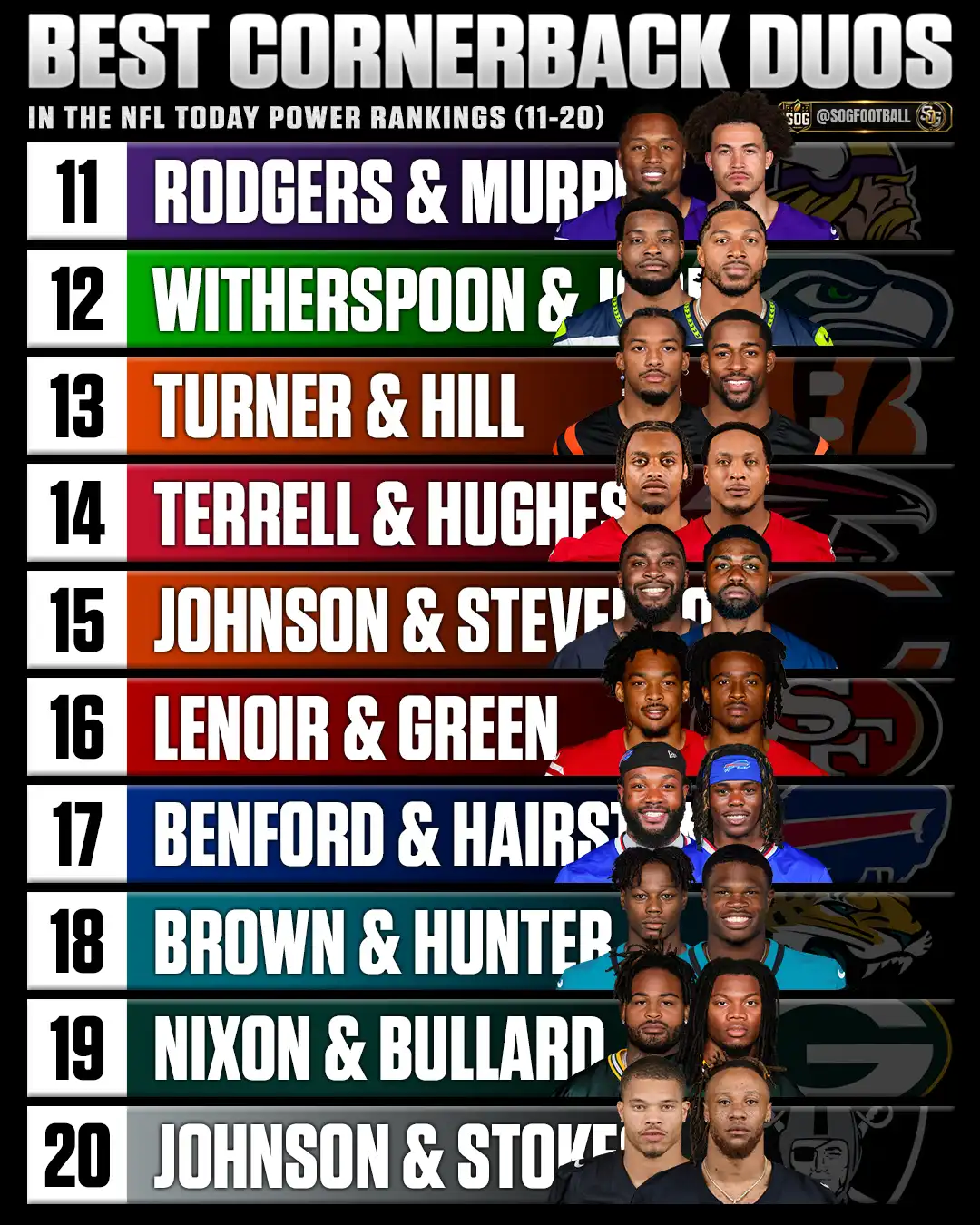
Ranks 11-20 of the best cornerback duos in the NFL today power rankings.
11. Isaiah Rodgers and Byron Murphy Jr., Minnesota Vikings
Minnesota’s duo fits a defense that wins by creating uncertainty. Rodgers has the speed to recover outside and the ball skills to punish throws that arrive late. Murphy can play on the boundary or inside, communicate through motion and take on the matchup that best fits the coverage call.
The Vikings confirmed both as their starting corners on the initial 2026 depth chart, and their familiarity removes much of the transition risk found in nearby pairings. Neither carries the pure shutdown profile of Stingley, Gonzalez or Surtain, which keeps Minnesota out of the top 10. The value is in having two adaptable veterans who allow the pressure package to change without exposing an obvious target.
12. Devon Witherspoon and Josh Jobe, Seattle Seahawks
Witherspoon drives Seattle’s placement. He brings explosive short-area movement, can play from the slot or outside and attacks screens and runs with the urgency of a much bigger defender. The Seahawks reinforced his status with a new contract extension before the season, making him the long-term center of the secondary.
Jobe is the steadier boundary complement. He plays with enough physicality to contest releases and finished the summer as one of Seattle’s two clear starting corners. The concern is not whether Witherspoon can affect games; it is whether the opposite side can hold up when offenses deliberately move away from him. Seattle ranks 12th because Jobe provides a workable answer, but not yet a proven high-end one.
13. DJ Turner II and Dax Hill, Cincinnati Bengals
Turner broke out in 2025 with 18 passes defensed, tied for third in the NFL and the most by a Bengals player since 2009. His speed allows him to stay in phase against vertical routes, while improved ball production made that coverage more valuable. He now enters 2026 as the clear lead corner in Cincinnati’s room.
Hill has settled at corner after beginning his career at safety. That background helps him recognize route combinations and gives the Bengals flexibility to change assignments without substituting. Cincinnati ranks 13th because both players are coming off progress rather than multiple seasons of top-level cornerback play. If Hill becomes more consistent at the catch point, the duo has the speed and versatility to move into the top 10.
14. A.J. Terrell and Mike Hughes, Atlanta Falcons
Terrell gives Atlanta a dependable outside anchor. His length and route recognition allow him to handle difficult assignments without forcing the safeties to lean toward him on every snap. That matters for a Falcons defense that wants to create pressure while preserving disguise on the back end.
Hughes started 12 games in 2025 and finished with seven passes defensed, 51 tackles and an interception. He returns as the starter opposite Terrell, with Avieon Terrell and C.J. Henderson adding competition behind the pair. The Falcons rank 14th because the top corner is proven and the second is functional, but Hughes does not consistently change the throwing decision the way the better No. 2 corners above him do.
15. Jaylon Johnson and Tyrique Stevenson, Chicago Bears
Johnson remains the foundation of Chicago’s outside coverage. His combination of size, patience and route recognition gives the Bears a corner who can handle lead assignments when healthy. The concern comes from a 2025 groin injury that cost him nine games, making availability a meaningful part of the projection.
Stevenson returned 10 pass breakups, an interception and two forced fumbles in 13 games last season. He plays aggressively at the line and at the catch point, but that same approach can create volatility when his leverage or eyes are late. Chicago ranks 15th because the best version of the duo belongs higher. The middle placement accounts for Johnson’s recent missed time and the week-to-week discipline still required from Stevenson.
16. Deommodore Lenoir and Renardo Green, San Francisco 49ers
Lenoir gives San Francisco an experienced corner who can move between the perimeter and slot without changing the entire coverage call. He is willing to tackle, competes through the route and can handle the communication demands created by shifts and motion.
Green starts on the opposite boundary and supplies a cleaner outside profile. The 49ers also have Upton Stout at nickel and Jack Jones behind Green, giving the defense more flexibility than this two-player ranking suggests. San Francisco lands 16th because the pairing is balanced and role-sound, but neither player has yet forced opponents to treat one side of the formation as completely unavailable.
17. Christian Benford and Maxwell Hairston, Buffalo Bills
Benford is the reliable half of Buffalo’s pairing. He plays with controlled leverage, understands when safety help changes his responsibility and has grown from a sixth-round pick into the veteran anchor of a young boundary group. The Bills can trust him to make the correct decision without chasing a highlight on every target.
Hairston carries the higher variance after recovering from the injury that interrupted his rookie season. His speed gives Buffalo an answer against vertical receivers, and the team kept him in a starting role entering 2026. Rookie Davison Igbinosun is the main depth option behind a thin pure-boundary group. The Bills rank 17th because Benford provides a strong floor, while Hairston’s availability and larger workload still require projection.
18. Montaric Brown and Travis Hunter, Jacksonville Jaguars
Brown became Jacksonville’s most stable corner in an injury-heavy 2025 season, starting 12 games before re-signing in March. He is physical enough to challenge routes outside and gives the Jaguars a dependable defensive-only presence while the rest of the cornerback room shifts around him.
Hunter is the ceiling. His movement skills, ball tracking and ability to transition from receiver to corner remain unusual, but his rookie year ended with an injury and his two-way workload must be managed. Jacksonville listed him as a starting corner again after his summer return. The Jaguars rank 18th because the best version of Hunter could make this pairing far better, while the current projection still has to account for health, snap allocation and the difficulty of mastering two NFL roles.
19. Keisean Nixon and Javon Bullard, Green Bay Packers
Nixon is Green Bay’s top outside corner entering 2026. He brings recovery speed, tackling toughness and enough experience in multiple alignments to handle changing assignments. A minor hamstring concern early in camp proved precautionary, allowing him to return well before the regular season.
Bullard is entrenched as the starting nickel after seven starts and 79 tackles in 2025. He is assignment-sound and aggressive against the run, although the Packers need more passes defensed and takeaways from the slot. Carrington Valentine and Benjamin St-Juste remain part of the boundary plan. Green Bay ranks 19th because the selected duo offers useful inside-outside balance, but neither has established the target-suppressing ceiling of the lead corners above.
20. Taron Johnson and Eric Stokes, Las Vegas Raiders
Johnson gives Las Vegas a proven nickel defender with a 2023 second-team All-Pro selection on his résumé. He can trigger downhill, cover option routes and blitz from the slot, bringing a level of experience the Raiders lacked inside. His missed-tackle rate has also remained low for a player asked to operate in traffic.
Stokes supplies the outside speed and enters the season atop one boundary position. The Raiders also drafted Jermod McCoy and added Darien Porter, so the perimeter roles may evolve around the veteran. This duo ranks 20th because Johnson’s role is clear while Stokes has not matched the consistency of his rookie year. Las Vegas has a functional inside-out pairing, but too much uncertainty outside to climb higher.
Best Cornerback Duos in the NFL Today: 21-32
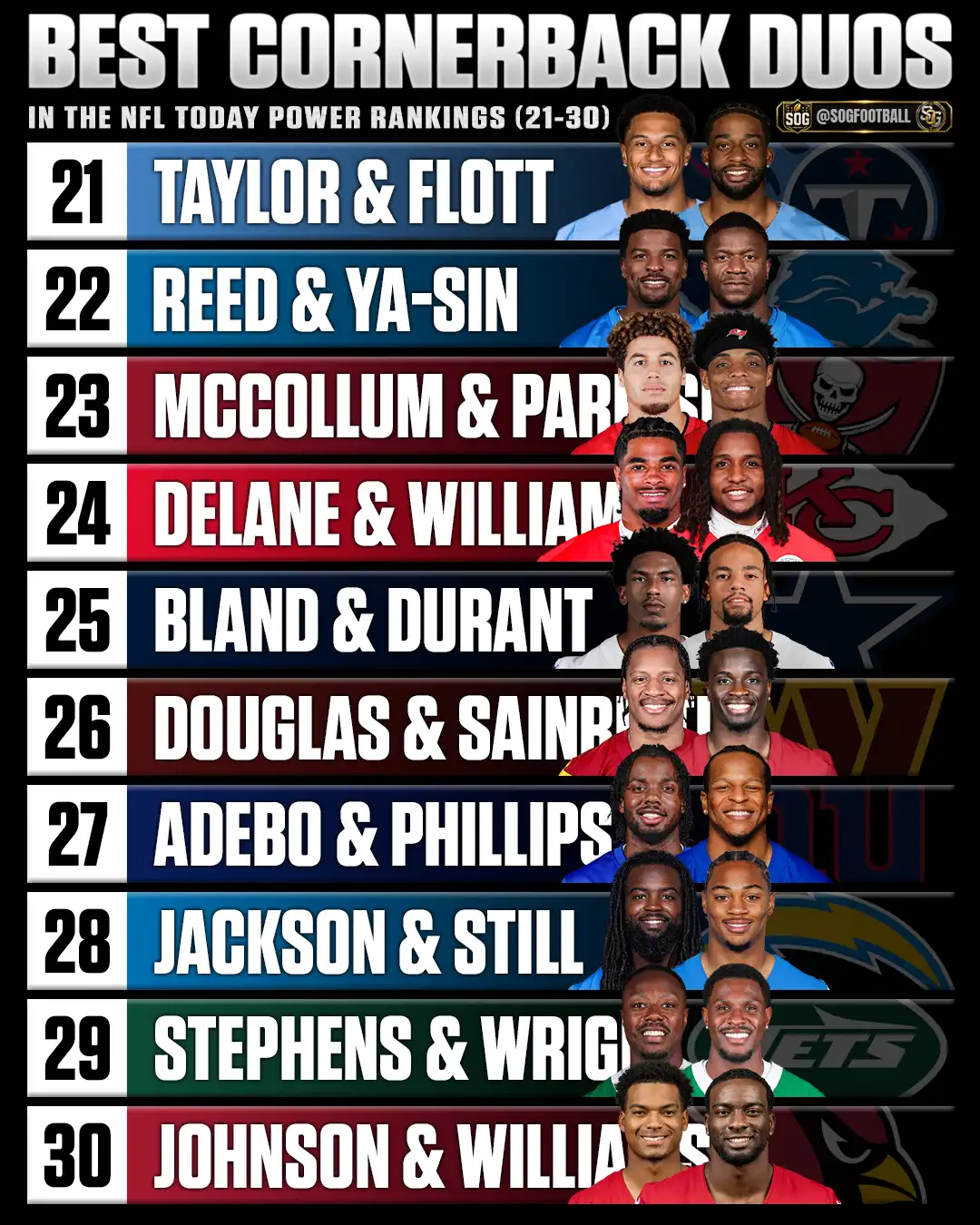
Ranks 21-30 of the best cornerback duos in the NFL today power rankings.
21. Alontae Taylor and Cor’Dale Flott, Tennessee Titans
Tennessee rebuilt its starting cornerback group with two free-agent additions. Taylor brings 53 career starts from New Orleans and has experience both outside and in the slot. He is at his best when allowed to play aggressively, tackle and use his size against physical receivers.
Flott offers similar alignment flexibility and has 25 career passes defensed entering the season. The Titans list both as outside starters, with Marcus Harris at nickel and Joshua Williams among the depth options. The pair ranks 21st because the roles are legitimate but the partnership is entirely new. A fast adjustment to Robert Saleh’s coverage system could push Tennessee into the top half.
22. D.J. Reed and Rock Ya-Sin, Detroit Lions
Reed remains Detroit’s best pure cover corner after limiting opponents to a 57.1 percent completion rate and a 72.8 passer rating when targeted in 2025. He also recorded two interceptions and seven passes defensed despite missing six games with a hamstring injury. His technique and competitiveness give the Lions a stable starting point.
Ya-Sin is the more physical second option. He allowed a 51.9 percent completion rate and only one touchdown last season while playing 611 defensive snaps, then re-signed for a chance to earn a larger role. Roger McCreary and Ennis Rakestraw Jr. add competition, but Reed and Ya-Sin carry the strongest current combination of experience and 2025 results. Detroit ranks 22nd because the duo lacks elite ball production and Reed’s availability remains important.
23. Zyon McCollum and Jacob Parrish, Tampa Bay Buccaneers
McCollum gives Tampa Bay length and recovery ability on one boundary. He has grown into a full-time role because he can challenge bigger receivers without giving away the vertical route, and his athletic range lets the Buccaneers vary their zone landmarks.
Parrish moves outside in 2026 after playing 746 snaps as the primary nickel during his rookie season. He finished that year with two interceptions, seven passes defensed, two sacks and seven tackles for loss, showing that he can affect more than the target directly in front of him. The transition creates uncertainty, but it also raises the ceiling. Tampa Bay sits 23rd because Parrish must prove that his quickness and route recognition translate against boundary assignments every week.
24. L’Jarius Sneed and Mansoor Delane, Kansas City Chiefs
Kansas City has a completely different cornerback structure after McDuffie and Watson left for Los Angeles. Sneed returns as the experienced outside defender. His length, press ability and willingness to tackle fit a defense that asks its corners to survive man coverage while pressure develops.
Delane was selected sixth overall to become the long-term answer. The rookie brings fluid movement, ball production and enough physicality to compete for a major role immediately, although the initial depth chart places Nohl Williams ahead of him on one boundary. The Chiefs rank 24th because Sneed is returning from uneven, injury-affected seasons and Delane has not taken an NFL regular-season snap. The talent is considerably better than the ranking if both settle quickly.
25. DaRon Bland and Cobie Durant, Dallas Cowboys
Bland remains the lead corner because his takeaway instincts can change a game instantly. His 2023 record-setting interception-return season showed the ceiling, but a recurring foot problem has limited him to 19 of a possible 34 regular-season games over the past two years. Dallas needs him healthy enough to win ordinary coverage snaps, not only create splash plays.
Durant arrives with experience inside and outside and seven career interceptions, including three during the 2025 postseason. Shavon Revel Jr. could still claim the opposite boundary job, while Durant also has a path to nickel snaps. The Cowboys rank 25th because the individual upside is clear but the exact deployment and Bland’s durability are not. This pairing can rise quickly if Dallas gets stable outside coverage from both spots.
26. Rasul Douglas and Mike Sainristil, Washington Commanders
Sainristil is the long-term piece and returns to his natural slot role. His quickness, intelligence and tackling allow Washington to match motion without losing structure underneath. He is also comfortable attacking the ball when a quarterback is late to recognize the coverage rotation.
Douglas brings the size Washington wanted on the perimeter after joining during the summer. He has a long record of punishing late throws, though he begins behind Trey Amos on the listed depth chart. Amos is on reserve/injured to open the season, making Douglas a more immediate part of the outside plan. The Commanders rank 26th because Sainristil is dependable inside, while the boundary assignments around him are still being sorted among Douglas and Amik Robertson.
27. Paulson Adebo and Dru Phillips, New York Giants
Adebo gives New York a physical outside corner with 63 starts, 51 passes defensed and 11 interceptions through five NFL seasons. He is comfortable challenging releases and has enough ball production to punish quarterbacks who assume tight coverage will not become a turnover.
Phillips brings the nickel value. He tackles, plays through traffic and was one of the league’s better first-year slot defenders before continuing to grow in 2025. Greg Newsome II is listed as the other outside starter, but Phillips remains one of the Giants’ two most valuable coverage pieces because of what he solves inside. New York ranks 27th because Adebo’s health and the secondary’s changing roles create more uncertainty than the individual talent suggests.
28. Donte Jackson and Tarheeb Still, Los Angeles Chargers
Jackson gives the Chargers veteran speed on the outside. He has seen nearly every route combination an offense can present and can still carry receivers vertically when the pass rush forces the ball out on time. His experience matters in a room with several young or role-specific options.
Still is the more interesting long-term piece. He can play outside or slide into the slot, has natural ball skills and enters 2026 as a full starter. Cam Hart and Deane Leonard provide depth behind the pair. Los Angeles ranks 28th because Jackson’s coverage has been volatile and Still must prove that his early playmaking translates into a steady weekly floor. The range of outcomes is wider than the number suggests.
29. Brandon Stephens and Nahshon Wright, New York Jets
Stephens brings the heavier snap history and starts on one boundary. He is physical enough to contest routes and has experience playing both safety and corner, but his best work comes when he can stay connected to the receiver rather than carrying too much zone responsibility.
Wright arrives after a breakout 2025 season in Chicago that produced five interceptions, two forced fumbles, three recoveries and a Pro Bowl selection. He shares the other starting line with Azareye’h Thomas on the Jets depth chart, while Jarvis Brownlee Jr. handles the nickel. The duo remains 29th because both veterans have had uneven coverage stretches and the entire Jets secondary is adjusting after major personnel changes. Wright’s takeaway production gives the pairing a real path to outperform the ranking.
30. Will Johnson and Garrett Williams, Arizona Cardinals
Johnson owns the highest coverage ceiling in Arizona’s room. His size, route recognition and ball skills give him the profile to handle lead outside assignments, but injuries have interrupted his development and kept the Cardinals from treating that upside as settled production.
Williams works from the slot and gives Arizona a quick, competitive defender underneath. Denzel Burke and Max Melton handle significant boundary roles, so this pairing reflects the two best individual corners rather than the two outside starters. The Cardinals rank 30th because Johnson’s availability remains central and the group has not established consistent high-end coverage. A healthy season from him would create one of the largest possible jumps in the bottom 10.
31. Kool-Aid McKinstry and Quincy Riley, New Orleans Saints
McKinstry is the established half after taking on a larger role and producing timely ball plays in 2025. His technique and patience allow him to stay square longer than many young corners, and he has the competitive temperament to handle repeated outside targets.
Riley started opposite him during stretches of his rookie season and remains atop the 2026 depth chart. Martin Emerson Jr. and waiver addition Decamerion Richardson add competition, but Riley has the clearest current path to the second starting job. New Orleans ranks 31st because the duo is young, the second side remains unsettled and neither player has yet produced a full season as a high-end No. 1 corner. The foundation is more credible than the ranking may imply.
32. Chris Johnson and JuJu Brents, Miami Dolphins
Johnson opens as Miami’s starting nickel and gives the rebuilding room much-needed speed and short-area movement. His role places him in the middle of route combinations, where communication and tackling will matter as much as pure man coverage.
Brents brings the length to handle an outside position, but injuries have prevented him from establishing a dependable NFL workload. Jason Marshall Jr. starts on the other boundary, while Ethan Bonner backs up Brents. Miami ranks last because every major role in the room carries projection or durability risk. Johnson’s development is encouraging, but the Dolphins need two corners to prove they can survive a full season before the pairing can move out of No. 32.
Biggest Takeaways From the Cornerback Duo Rankings
Slot Corners Change the Equation
Philadelphia ranks first in part because DeJean’s nickel work is not treated as secondary to outside coverage. Offenses use their best receivers in the slot, condense formations and force defenders to navigate traffic. A high-level nickel can affect more routes, run fits and pressure calls than a boundary corner who sees only a few targets.
The same logic helps Denver, Green Bay, Washington and Miami select their top two. McMillian, Bullard, Sainristil and Johnson are not backups simply because a traditional depth chart lists two outside corners first. Their role is central to how the defense handles modern personnel.
The Second Corner Sets the Duo’s Ceiling
Surtain, Stingley, Gardner, Gonzalez and Horn can all tilt coverage by themselves. Their teams separate in this ranking through the confidence level on the other side. Lassiter and Davis can punish an offense for avoiding the star, while less proven second corners allow the quarterback to redirect the matchup.
That is also why one strong season from Wiggins, Hairston, Parrish or Hunter could move a team several places. The lead corner already gives the defense a credible starting point. The ranking changes when the second player stops being the place an offense wants to attack.
Continuity and Upside Pull in Opposite Directions
Young pairings can rise faster, but established communication has real value at cornerback. Mitchell and DeJean already understand how their responsibilities connect. McDuffie and Watson bring prior experience together even though both are new to the Rams. By contrast, the Colts, Titans, Chiefs and Jets are asking new combinations to establish trust quickly.
A corner can execute his own assignment and still lose the play if the handoff through motion is wrong. That is why the ranking does not automatically push every talented new pairing toward the top. Chemistry must become visible in real coverage before projected upside turns into a dependable floor.
Availability Creates the Largest Swings
Cleveland, Baltimore, Buffalo, Jacksonville, Dallas and Arizona all carry wider ranges because recent injuries affect at least one half of the duo. Corner is especially difficult to stabilize through rotation. A pass rusher can play limited snaps while a teammate handles early downs, but a corner who leaves the lineup changes communication, matchup rules and safety help across the entire coverage.
The best version of Hunter, Bland or Will Johnson would make the corresponding ranking look too low. The current order requires more than peak talent. It asks whether both players can remain available long enough to function as an actual pairing.
Raw Production Still Needs Scheme Context
Interceptions and passes defensed matter, but neither statistic fully identifies the quality of a coverage season. A corner may see fewer targets because the offense respects him, while an aggressive zone can create more chances to read the quarterback. The rankings reward ball production without allowing it to replace assignment difficulty, target suppression or tackling.
For a broader comparison, the SOG Sports rankings of the best NFL cornerbacks since 2020 and the best cornerbacks of the 2010s show how role, scheme and supporting talent can change the way a corner’s peak is remembered.
Full Ranking Table: Best Cornerback Duos in the NFL Today
| Rank | Duo | Team |
|---|---|---|
| 1 | Quinyon Mitchell and Cooper DeJean | Philadelphia Eagles |
| 2 | Derek Stingley Jr. and Kamari Lassiter | Houston Texans |
| 3 | Christian Gonzalez and Carlton Davis III | New England Patriots |
| 4 | Sauce Gardner and Charvarius Ward | Indianapolis Colts |
| 5 | Patrick Surtain II and Ja’Quan McMillian | Denver Broncos |
| 6 | Joey Porter Jr. and Jamel Dean | Pittsburgh Steelers |
| 7 | Jaycee Horn and Mike Jackson | Carolina Panthers |
| 8 | Trent McDuffie and Jaylen Watson | Los Angeles Rams |
| 9 | Denzel Ward and Tyson Campbell | Cleveland Browns |
| 10 | Marlon Humphrey and Nate Wiggins | Baltimore Ravens |
| 11 | Isaiah Rodgers and Byron Murphy Jr. | Minnesota Vikings |
| 12 | Devon Witherspoon and Josh Jobe | Seattle Seahawks |
| 13 | DJ Turner II and Dax Hill | Cincinnati Bengals |
| 14 | A.J. Terrell and Mike Hughes | Atlanta Falcons |
| 15 | Jaylon Johnson and Tyrique Stevenson | Chicago Bears |
| 16 | Deommodore Lenoir and Renardo Green | San Francisco 49ers |
| 17 | Christian Benford and Maxwell Hairston | Buffalo Bills |
| 18 | Montaric Brown and Travis Hunter | Jacksonville Jaguars |
| 19 | Keisean Nixon and Javon Bullard | Green Bay Packers |
| 20 | Taron Johnson and Eric Stokes | Las Vegas Raiders |
| 21 | Alontae Taylor and Cor’Dale Flott | Tennessee Titans |
| 22 | D.J. Reed and Rock Ya-Sin | Detroit Lions |
| 23 | Zyon McCollum and Jacob Parrish | Tampa Bay Buccaneers |
| 24 | L’Jarius Sneed and Mansoor Delane | Kansas City Chiefs |
| 25 | DaRon Bland and Cobie Durant | Dallas Cowboys |
| 26 | Rasul Douglas and Mike Sainristil | Washington Commanders |
| 27 | Paulson Adebo and Dru Phillips | New York Giants |
| 28 | Donte Jackson and Tarheeb Still | Los Angeles Chargers |
| 29 | Brandon Stephens and Nahshon Wright | New York Jets |
| 30 | Will Johnson and Garrett Williams | Arizona Cardinals |
| 31 | Kool-Aid McKinstry and Quincy Riley | New Orleans Saints |
| 32 | Chris Johnson and JuJu Brents | Miami Dolphins |
Who Has the Best Cornerback Duo in the NFL?
Quinyon Mitchell and Cooper DeJean give the Philadelphia Eagles the best cornerback duo entering the 2026 NFL season. Both are coming off first-team All-Pro selections, Mitchell controls the perimeter and DeJean’s slot versatility lets Philadelphia answer formations that expose less flexible pairings.
Houston has the strongest threat to the top spot because Stingley and Lassiter can make both outside matchups difficult. New England offers the cleanest blend of a young No. 1 corner and an established veteran, while Indianapolis and Denver can climb if health and second-corner play hold. Across the list, the deciding factor is not simply who owns the biggest star. It is whether the offense can find a comfortable target after moving away from him.
For historical context, compare the current duos with the SOG Sports rankings of the best cornerbacks of all time and the best NFL cornerback from every season.
Follow @SOGFootball on Instagram for more NFL rankings, predictions and season previews.
