
Christian Gonzalez is SOG Sports’ choice as the best NFL cornerbacks of 2025, opening a season-by-season timeline that runs back to Herb Adderley in 1966. Gonzalez did not lead the position in interceptions or All-Pro voting, but his difficult outside assignments, Pro Bowl play and decisive postseason work gave him the editorial edge in a close year.
The ranking covers every completed season from 1966 through 2025. Regular-season coverage carries the most weight, followed by ball production, assignment difficulty, All-Pro recognition, team value, postseason performance and era context. Interceptions matter, but avoidance can be evidence of dominance too, especially when an offense consistently refuses to challenge one side of the field.
This list isolates one season at a time. For the career debate, read our best cornerbacks of all-time ranking. For the modern pecking order entering 2026, see the best cornerbacks in the NFL today.
How We Picked the Best NFL Cornerbacks Every Year
Cornerback is one of football’s hardest positions to judge with one number. A quarterback can lead the league in passing yards. A running back can win a rushing title. A great corner may finish with only one or two interceptions because offenses spent four months throwing somewhere else.
That is why this is not an interception leaderboard. Takeaways matter, but so do the snaps that never become targets, the receivers who disappear, the route combinations a coordinator can no longer trust and the extra pressure a defense can send because one corner is handling his assignment alone.
- Coverage dominance: How consistently the corner limited separation, completions and explosive plays.
- Ball production: Interceptions, pass breakups, pick-sixes and other game-changing turnovers.
- Awards and recognition: All-Pro selections, Pro Bowls, major award voting and league-wide respect.
- Assignment difficulty: Whether the corner traveled with No. 1 receivers, played on an island or handled multiple alignments.
- Team and playoff impact: How much the season mattered to a contender and whether the corner delivered in major games.
- Era context: The rules, offensive styles and available statistics from that season.
Regular-season work sets the order. Postseason play can break a tie, but it does not erase four months of football. The statistical record also changes across eras: passes defended and target data are useful for modern corners, while older seasons require more weight on interceptions, contemporary All-Pro voting, team results and film-based reputation.
Best Cornerback Each Year, 2025–1996
2025: Christian Gonzalez, New England Patriots
Christian Gonzalez gets the 2025 spot as an editorial choice in one of the list’s closest modern debates. A preseason hamstring injury kept him out of New England’s first three games, so this was not a wire-to-wire statistical victory. Once active, Gonzalez resumed difficult outside assignments and helped the Patriots build one of the AFC’s strongest defenses.
NFL’s official statistics list 10 passes defended in 14 regular-season games, and Gonzalez earned his second consecutive Pro Bowl selection. His postseason strengthened the case: he recorded a sack and the game-sealing interception in the AFC Championship Game. Derek Stingley Jr. had the stronger All-Pro résumé and Patrick Surtain II remained an elite matchup corner, but Gonzalez’s assignment value and championship-game impact provide the tiebreaker here.
2024: Patrick Surtain II, Denver Broncos
Patrick Surtain II was the cleanest cornerback pick of 2024. The Denver Broncos trusted him with difficult assignments, and he gave them elite coverage without needing a scheme to protect him every snap.
Surtain finished with 4 interceptions, 11 passes defended, one defensive touchdown and won Defensive Player of the Year. For a cornerback to win that award in the modern NFL, he has to be more than great. He has to be impossible to ignore.
2023: Jaylon Johnson, Chicago Bears
Jaylon Johnson’s 2023 season was the breakout that turned respect into recognition. He had already been a strong cover corner, but that year the production finally matched the film.
Johnson recorded 4 interceptions, 10 passes defended and a defensive touchdown for the Chicago Bears. DaRon Bland had the louder highlight season with his pick-sixes, but Johnson was the better down-to-down cover corner. That matters more for this list.
2022: Sauce Gardner, New York Jets
Sauce Gardner entered the NFL and immediately looked like he belonged among the league’s best. Rookie corners usually get attacked over and over. Sauce got tested and handled it like a veteran.
He finished with 2 interceptions, 20 passes defended, won Defensive Rookie of the Year and earned first-team All-Pro honors with the New York Jets. That is a rare rookie season at any position, and almost unheard of at cornerback.
2021: Jalen Ramsey, Los Angeles Rams
Jalen Ramsey was the best cornerback in football in 2021 because he was not limited to one role. The Los Angeles Rams could use him outside, inside, near the line of scrimmage or as a matchup eraser depending on the week.
Ramsey finished with 4 interceptions and 16 passes defended. His versatility made Los Angeles more flexible, more aggressive and harder to solve. His alignment flexibility made him a true defensive chess piece.
2020: Jalen Ramsey, Los Angeles Rams
Jalen Ramsey’s first full season with the Rams showed exactly why Los Angeles paid a premium to get him. He followed No. 1 receivers, moved inside when the matchup demanded it and gave Brandon Staley the freedom to build the coverage plan around one defender.
Ramsey earned first-team All-Pro honors while the Rams finished first in the NFL in both total defense and scoring defense. The interception total was modest, but the weekly assignment list was not. This was shutdown cornerback value in its purest form: fewer easy throws, more flexibility everywhere else and almost no need to hide him.
2019: Stephon Gilmore, New England Patriots
Stephon Gilmore’s 2019 season is one of the best modern cornerback seasons. New England built much of its defensive identity around tight man coverage, and Gilmore gave the Patriots a true lockdown presence.
He recorded 6 interceptions, 20 passes defended, 2 defensive touchdowns and won Defensive Player of the Year. That season had everything: shutdown coverage, ball production, team success and league-wide recognition.
2018: Stephon Gilmore, New England Patriots
Before the Defensive Player of the Year season, Gilmore was already playing like one of the best corners in the league. His 2018 campaign was controlled, physical and extremely steady.
Gilmore earned first-team All-Pro honors and then carried that level into New England’s Super Bowl run. He was not a reckless gambler. He won with leverage, timing and discipline.
2017: Jalen Ramsey, Jacksonville Jaguars
Jalen Ramsey’s 2017 season was the year he became a superstar. Jacksonville’s defense had talent everywhere, but Ramsey gave that group its attitude on the outside.
He finished with 4 interceptions, 17 passes defended and first-team All-Pro honors. His combination of length, press coverage, physicality and confidence made him one of the faces of the Jacksonville Jaguars’ dominant defense.
2016: Aqib Talib, Denver Broncos
Aqib Talib was still playing elite football in 2016. Denver’s defense had several stars, but Talib’s mix of physical coverage and ball skills made his season stand out.
He recorded 3 interceptions, returned one for a touchdown and earned first-team All-Pro honors. Talib always had that extra danger attached to his game: one bad throw could turn into six points the other way.
2015: Patrick Peterson, Arizona Cardinals
Patrick Peterson’s 2015 season was a classic shutdown-corner year. Arizona regularly asked him to handle top receivers without reshaping the entire coverage behind him, and he answered with one of the cleanest seasons of his prime.
Peterson earned first-team All-Pro honors and helped the Cardinals finish 13–3 before reaching the NFC Championship Game. He could press, turn and run with vertical threats, recover when a route created early space and stay composed against receivers of completely different styles. Josh Norman had an outstanding season of his own, but Peterson’s week-to-week man-coverage responsibility gave him the edge here.
2014: Richard Sherman, Seattle Seahawks
Richard Sherman was still near the top of the sport in 2014. Seattle’s defense was no longer a surprise, and quarterbacks already understood the risk of challenging Sherman’s side.
He finished with 4 interceptions and helped the Seattle Seahawks return to the Super Bowl. His length, anticipation and understanding of route concepts made him one of the smartest cornerbacks of his generation.
2013: Richard Sherman, Seattle Seahawks
This was the signature Richard Sherman season. He led the NFL with 8 interceptions, earned first-team All-Pro honors and became the face of the Legion of Boom during Seattle’s Super Bowl run.
Sherman controlled space as consistently as he created takeaways. His side of the field felt dangerous for quarterbacks, and his confidence became part of the Seattle Seahawks’ defensive personality.
2012: Richard Sherman, Seattle Seahawks
By 2012, Sherman was already turning into one of the defining corners of the era. His length and instincts were a perfect match for Seattle’s coverage structure.
He finished with 8 interceptions and gave the Seattle Seahawks a corner who could punish almost any mistake. This was the beginning of Sherman’s peak, and it was already elite. His run remains one of the defining defensive chapters in Seattle Seahawks history.
2011: Darrelle Revis, New York Jets
Darrelle Revis was still the standard in 2011. The Jets could leave him alone against an opponent’s best receiver, tilt the rest of the coverage elsewhere and call pressure packages that would have been much riskier without him.
Revis finished with 4 interceptions, 21 passes defended and another first-team All-Pro selection. One of those picks became a 100-yard touchdown, but the bigger story remained the same as ever: offenses spent entire games trying to work around Revis Island.
2010: Darrelle Revis, New York Jets
Revis did not reproduce the impossible standard of 2009, and a hamstring injury disrupted the first half of his season. Once healthy, though, he was still the corner the Jets trusted with the matchup that dictated the rest of their plan.
New York returned to the AFC Championship Game with a defense built around aggressive pressure and isolated man coverage. Revis made that structure possible. His 2010 case is less about a loud stat line than the responsibility he carried and the way elite receivers still had to fight for every clean target.
2009: Darrelle Revis, New York Jets
Revis’ 2009 season is one of the greatest coverage seasons ever. The Jets played aggressive defense because Revis could handle elite receivers without needing the kind of help most corners require.
Andre Johnson, Randy Moss, Terrell Owens, Chad Johnson and other top targets all became part of the Revis Island story. Charles Woodson had a fantastic year and won Defensive Player of the Year, but Revis’ pure coverage season was too special to pass up.
2008: Nnamdi Asomugha, Oakland Raiders
Nnamdi Asomugha’s 2008 season is the easiest example of why cornerback statistics need context. He finished with only one interception, largely because opposing quarterbacks treated his side of the field like it was closed.
Asomugha earned first-team All-Pro honors with his combination of size, patient press technique and calm feet at the top of routes. Oakland did not have a dominant team around him, which made the avoidance even more telling. Some corners punish bad throws. At his peak, Asomugha convinced offenses not to attempt them.
2007: Antonio Cromartie, San Diego Chargers
Antonio Cromartie’s 2007 season was a ballhawking explosion. He led the NFL with 10 interceptions and gave the San Diego Chargers a defensive playmaker who could flip the field in one snap.
Cromartie was long, fast and fearless. He could gamble, but in 2007 the rewards were enormous. Every pass near him carried real danger.
2006: Champ Bailey, Denver Broncos
Champ Bailey’s 2006 season belongs in any discussion of the best cornerback years ever. He finished with 10 interceptions, made first-team All-Pro and still had the complete shutdown skill set on top of the production.
Bailey could run with speed receivers, tackle, play the ball and recover when a route briefly beat him. There were almost no holes in his game.
2005: Champ Bailey, Denver Broncos
Bailey was already the best corner in football before his 2006 masterpiece. In 2005, he was still combining elite coverage traits with big-play production.
He recorded 8 interceptions and returned two for touchdowns. That blend of lockdown ability and scoring threat made the Denver Broncos star different from almost every other corner of his era.
2004: Ronde Barber, Tampa Bay Buccaneers
Ronde Barber was never a traditional boundary eraser, but that description undersells what he did for Tampa Bay. He could cover the slot, blitz off the edge, tackle in space, disguise rotations and bait quarterbacks from the same alignment.
Barber earned another Pro Bowl selection in 2004 and remained the connective piece in a defense that asked its corners to think as quickly as they moved. He did not win by following one receiver all afternoon. He won by recognizing what the offense wanted before the ball was snapped and arriving where the play was headed.
2003: Ty Law, New England Patriots
Ty Law’s 2003 season combined physical coverage, ball production and championship-level timing. He recorded 6 interceptions during the regular season and earned first-team All-Pro honors as the Patriots finished 14–2.
Then came the AFC Championship Game. Law intercepted Peyton Manning three times, repeatedly squeezing routes and punishing throws that looked available a beat earlier. It remains one of the defining defensive performances in New England Patriots defensive history and a major reason Law stands so high in franchise history.
2002: Patrick Surtain, Miami Dolphins
Patrick Surtain was one of the most reliable corners of the early 2000s. In 2002, he gave the Miami Dolphins a polished, physical cover man with strong ball production.
Surtain finished with 7 interceptions and earned first-team All-Pro honors. He was not always the loudest name in the league, but he was technically sharp and extremely dependable. Alongside Sam Madison, he also formed one of the best secondary pairings in Miami Dolphins history.
2001: Ronde Barber, Tampa Bay Buccaneers
Barber’s 2001 season was one of the best of his career. He recorded 10 interceptions, made first-team All-Pro and showed why Tampa Bay’s defense trusted him in so many roles.
He was more than a cover corner. Barber could blitz, support the run and read plays before they developed. That versatility made him one of football’s most valuable defensive backs.
2000: Champ Bailey, Washington Redskins
Champ Bailey was only in his second NFL season, but he was already handling the position like a veteran No. 1 corner. Washington could match him against speed, size or quick route-runners and trust that his athletic margin for error would erase plenty of problems.
Bailey finished with 5 interceptions, made the Pro Bowl and began establishing the weekly consistency that would define his career. He was still developing the polish seen later in Denver, but the rare part was already obvious: almost no route could put him out of the play for long.
1999: Charles Woodson, Oakland Raiders
Charles Woodson’s second season confirmed that his rookie year was only the beginning. He earned first-team All-Pro honors again while giving Oakland a corner who could cover outside, blitz, tackle and play the ball with a safety’s instincts.
Woodson recorded 4 interceptions, but his value stretched well beyond those takeaways. He could be physical at the line, trigger downhill against the run and turn a routine coverage call into something more aggressive because the defense trusted his range of skills.
1998: Ty Law, New England Patriots
Ty Law’s 1998 season was his true breakout. He led the NFL with 9 interceptions and earned first-team All-Pro honors.
Law played with strength and attitude. He did not simply follow receivers around. He challenged them, disrupted them and turned mistakes into takeaways.
1997: Deion Sanders, Dallas Cowboys
Deion Sanders did not need a huge interception total in 1997 to control games. By then, his reputation had become part of the coverage: quarterbacks knew the danger, coordinators knew where he was and receivers knew a small mistake in their route could end the possession.
Sanders earned first-team All-Pro honors while still possessing the recovery speed that made normal cornerback rules feel optional. Dallas could leave him isolated and devote help elsewhere. That freedom was the production, even when the ball never arrived.
1996: Deion Sanders, Dallas Cowboys
Deion’s 1996 season was another reminder that the best corner on the field can have the quietest box score. Offenses had already learned how quickly a careless throw toward Sanders could become points going the other way.
He remained an All-Pro cover man with unmatched recovery speed, loose hips and the confidence to play routes from positions that would have been dangerous for almost anyone else. Dallas did not need him to chase interceptions. The threat of Deion changed the passing map before the snap.
Best Cornerback Each Year, 1995–1966
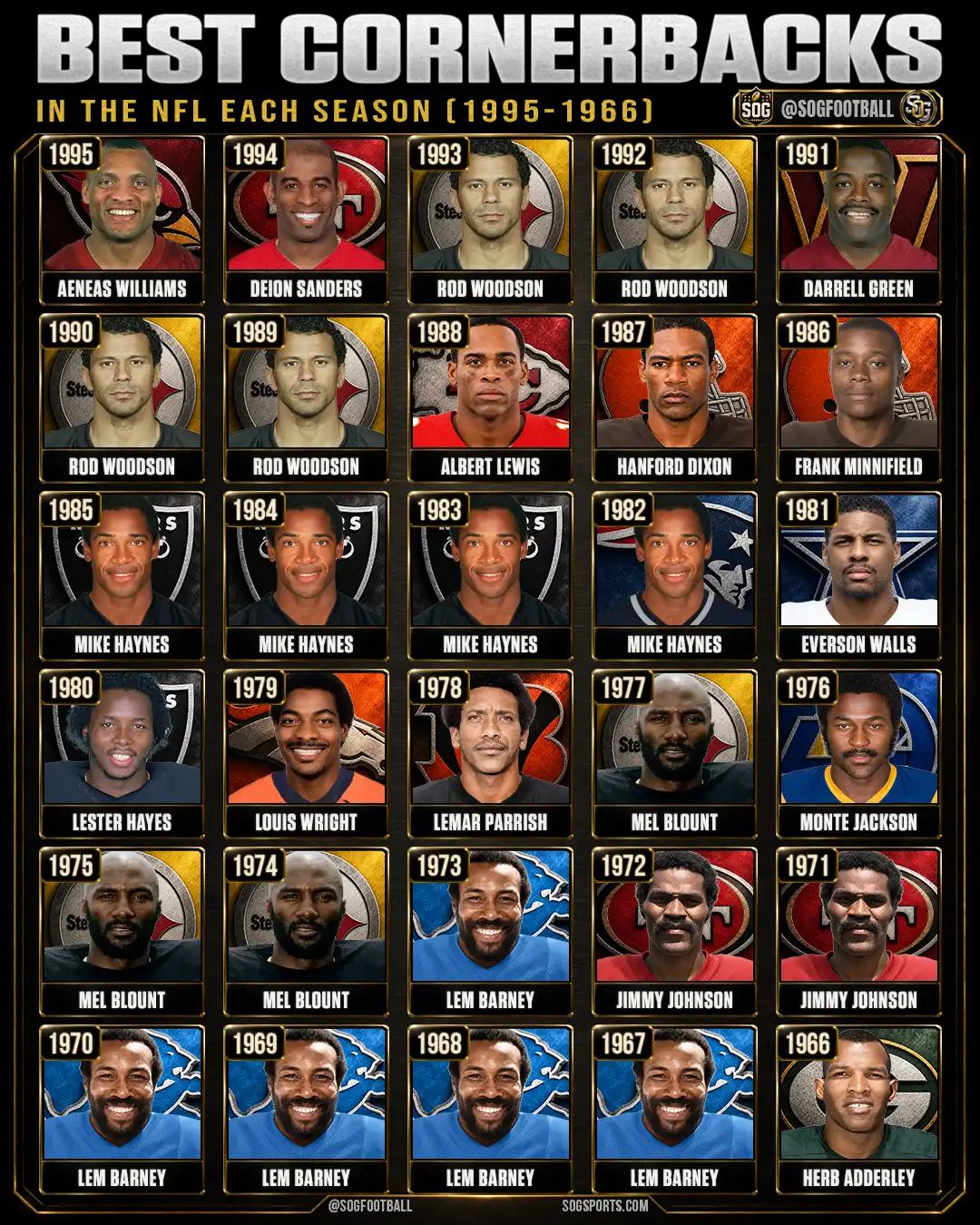
Ranking the best cornerback in the NFL each season from 1995 to 1966, featuring Aeneas Williams, Deion Sanders, Rod Woodson, Darrell Green, Mike Haynes, Mel Blount, Lem Barney, and more.
1995: Aeneas Williams, Arizona Cardinals
Aeneas Williams was in the heart of his prime in 1995, and the production matched the film. He recorded 6 interceptions, earned first-team All-Pro honors and continued building a reputation as one of the league’s smartest outside corners.
Williams did not have Deion Sanders’ publicity machine or Rod Woodson’s return-game profile. He simply read releases, anticipated breaks and found the football over and over. Arizona could trust him against top assignments, and he rarely gave away easy yards through bad positioning.
1994: Deion Sanders, San Francisco 49ers
Deion Sanders’ 1994 season is one of the most iconic cornerback seasons ever. He joined the San Francisco 49ers, won Defensive Player of the Year and helped San Francisco win the Super Bowl.
He finished with 6 interceptions and returned 3 for touchdowns. This was peak Prime Time: explosive, confident, dangerous and impossible to ignore.
1993: Rod Woodson, Pittsburgh Steelers
Rod Woodson’s 1993 season was a masterpiece of all-around defensive back play. He won Defensive Player of the Year and gave the Pittsburgh Steelers elite coverage, tackling and playmaking.
Woodson was a complete football player whose value extended beyond coverage. He could tackle like a safety, return kicks and flip a game with one defensive play.
1992: Rod Woodson, Pittsburgh Steelers
Rod Woodson’s 1992 season kept him firmly in the conversation as football’s most complete corner. He earned first-team All-Pro honors while giving Pittsburgh elite coverage, open-field tackling and return value from the same roster spot.
Woodson could crowd a receiver, run vertically, blitz, tackle like a safety and immediately become a scoring threat after a turnover. Plenty of corners have had one defining strength. At this point in his career, Woodson seemed to have all of them at once.
1991: Darrell Green, Washington Redskins
Darrell Green’s speed was legendary, but his 1991 season was about much more than chasing receivers from behind. He was the veteran cover man on a 14–2 Washington team that finished the job with a Super Bowl championship.
Green played with clean technique, toughness and the confidence to challenge vertical routes without panicking. Washington’s defense rarely gave opponents cheap points, and Green’s ability to keep the top on the coverage was a major reason the unit could stay aggressive underneath.
1990: Rod Woodson, Pittsburgh Steelers
By 1990, Rod Woodson had moved from exciting young athlete to one of the league’s most dependable defensive stars. He earned first-team All-Pro honors and remained a threat in coverage, run support and the return game.
This was still Woodson at corner before the later move to safety added another chapter to his career. He had the burst to close on the ball, the strength to finish tackles and the instincts to turn a mistake into field position. Few defensive backs affected as many parts of a game.
1989: Rod Woodson, Pittsburgh Steelers
Rod Woodson’s 1989 season was the point where the rest of the league had to stop talking about potential. He earned first-team All-Pro honors and gave Pittsburgh a corner who could match speed, play through contact and contribute as a dangerous returner.
The athleticism was obvious, but Woodson’s competitiveness made the package work. He attacked tackles, trusted his recovery speed and played as though every throw in his direction belonged to him. The future Hall of Famer had arrived in full.
1988: Albert Lewis, Kansas City Chiefs
Albert Lewis gave Kansas City something rare for the late 1980s: a 6-foot-2 corner with the speed and patience to stay outside against almost any type of receiver. He made the Pro Bowl in 1988 and was already one of the league’s most respected matchup defenders.
Lewis also carried unusual special-teams value as a premier kick blocker. That part of his game matters because it shows how much ground he could cover and how quickly he could close. His interception total was modest that season, but his coverage and all-around impact were not.
1987: Hanford Dixon, Cleveland Browns
Hanford Dixon was a major part of Cleveland’s identity in 1987. He played with confidence at the line, challenged receivers throughout the route and helped the Browns reach a second straight AFC Championship Game.
Dixon and Frank Minnifield formed one of the defining cornerback pairings of the decade, the kind of tandem that belongs in any discussion of the best cornerback duos of its era. Dixon gets the individual nod for 1987 because his coverage, physicality and edge matched the personality of that entire defense.
1986: Frank Minnifield, Cleveland Browns
Frank Minnifield gets the 1986 spot after helping Cleveland build one of the league’s toughest secondaries. He was smaller than many outside receivers, but he never played that way. His feet, leverage and willingness to challenge routes made him difficult to separate from.
Minnifield earned a Pro Bowl selection as the Browns went 12–4 and reached the AFC Championship Game. Alongside Hanford Dixon, he gave Cleveland two corners who could play with the aggression of the Dawg Pound without losing their discipline in coverage.
1985: Mike Haynes, Los Angeles Raiders
Mike Haynes was still at the top of the position in 1985. He earned All-Pro recognition with a style built less on gambling than on balance, length and an almost effortless ability to stay square through a receiver’s release.
The Raiders could trust Haynes outside without constantly rolling help toward him. He understood spacing, used the sideline as an extra defender and rarely looked hurried. At a position that can turn chaotic in one step, Haynes made elite coverage look controlled.
1984: Mike Haynes, Los Angeles Raiders
Haynes followed the Raiders’ championship season with one of the most productive years of his career. He intercepted 6 passes, led the NFL with 220 interception-return yards and earned first-team All-Pro honors.
His 97-yard return against Miami showed the danger that came after the catch, but the foundation was still coverage technique. Haynes played with size, patience and a clean understanding of leverage. Quarterbacks could not simply wait for him to lose position because he rarely did.
1983: Mike Haynes, Los Angeles Raiders
Mike Haynes did not join the Raiders until the second half of the 1983 season, but his arrival changed the ceiling of an already talented defense. He played the final five regular-season games, then started throughout a postseason run that ended with a dominant Super Bowl win.
Haynes intercepted Joe Theismann in Super Bowl XVIII and gave Los Angeles another elite outside cover man opposite Lester Hayes. The regular-season sample was short, but the level of play and championship impact were strong enough to earn the spot.
1982: Mike Haynes, New England Patriots
The strike reduced the 1982 season to nine games, but Mike Haynes remained one of football’s safest cornerback selections. He earned first-team All-Pro recognition and continued to win with the same smooth movement and disciplined technique that had defined his Patriots career.
Haynes could handle vertical speed without opening the gate too early, and his size made him comfortable contesting bigger targets. Even before the Raiders chapter, he had already established himself as one of the era’s complete cover corners.
1981: Everson Walls, Dallas Cowboys
Everson Walls had a rookie season that still feels outrageous. He led the NFL with 11 interceptions in 1981 and immediately became one of the league’s biggest defensive playmakers.
Walls did not rely on classic stopwatch speed. He won with instincts, anticipation and timing. Some corners chase the football. Walls seemed to know where it was going.
1980: Lester Hayes, Oakland Raiders
Lester Hayes’ 1980 season is one of the great cornerback peaks. He won Defensive Player of the Year, helped the Oakland Raiders win the Super Bowl and produced one of the biggest takeaway seasons ever.
Hayes recorded 13 interceptions, a number that still looks ridiculous. His physical coverage, confidence and ball skills made him the most dangerous cornerback in football that year.
1979: Louis Wright, Denver Broncos
Louis Wright was one of the pillars of Denver’s Orange Crush defense, and 1979 was another season in which his value went well beyond the interception column. He earned first-team All-Pro honors with the size and speed to play receivers physically without giving away the deep ball.
Wright could press, tackle and stay composed when isolated outside. The lack of modern target data makes his peak easier to overlook, but contemporary recognition was clear: offenses treated him as one of the hardest corners in football to attack.
1978: Lemar Parrish, Washington Redskins
Lemar Parrish arrived in Washington in 1978 and immediately gave the secondary a jolt. He intercepted 9 passes in his first season with the Redskins, pairing his natural coverage instincts with the return ability that had already made him one of the league’s most dangerous defensive backs.
Parrish could flip a game after the catch, but he was not simply hunting highlights. His quick feet and feel for quarterback timing allowed him to stay tight enough that other corners often saw more targets. The change of teams did nothing to slow his playmaking.
1977: Mel Blount, Pittsburgh Steelers
Mel Blount remained the most intimidating matchup at the position in 1977. His size and reach allowed him to disrupt receivers before routes could develop, while his speed kept him from being reduced to a pure bump-and-run specialist.
Blount finished with 6 interceptions and earned first-team All-Pro honors. The league would soon tighten its contact rules, but in 1977 he was still using every inch of the rulebook to make outside receivers miserable.
1976: Monte Jackson, Los Angeles Rams
Monte Jackson’s 1976 season was not merely a good year hidden in an older record book. He led the NFL with 10 interceptions, returned three of them for touchdowns and earned first-team All-Pro honors for a Rams defense that finished among the league’s best.
Jackson had the speed to challenge deep routes and the confidence to break aggressively when he read the quarterback. The rewards were enormous: one mistake in his direction could become six points before the offense had time to react.
1975: Mel Blount, Pittsburgh Steelers
Blount’s 1975 season was his signature year. He won Defensive Player of the Year, made first-team All-Pro and helped the Pittsburgh Steelers win another Super Bowl.
He finished with 11 interceptions and was so physically dominant that his style became part of the conversation around future coverage rules. Very few corners have ever controlled a season like Blount did in 1975.
1974: Mel Blount, Pittsburgh Steelers
Before the awards and 11-interception explosion of 1975, Mel Blount was already the outside enforcer for a defense becoming the foundation of a dynasty. His size let him control releases, but he also had the speed to stay connected once a receiver finally escaped the line.
Pittsburgh won the franchise’s first Super Bowl behind a championship defense filled with Steelers legends, and Blount’s ability to disrupt timing was central to how the Steelers played. The box score was quieter than the following year. The physical control he exerted on games was already there.
1973: Lem Barney, Detroit Lions
Lem Barney’s 1973 season showed that his early-career interception surge had grown into sustained cornerback excellence. He earned another Pro Bowl selection and remained the defender Detroit trusted to challenge throws outside.
Barney played with smooth feet and a natural understanding of quarterback intent. He could stay in phase without staring at the receiver, then locate the ball quickly enough to become the offensive player at the catch point. That combination kept him near the top of the position well beyond his famous rookie season.
1972: Jimmy Johnson, San Francisco 49ers
Jimmy Johnson was the picture of controlled cornerback play in 1972. He earned first-team All-Pro honors and helped San Francisco win a third straight NFC West title with a style based on patience, length and almost flawless positioning.
Johnson was not chasing every underneath fake or gambling for attention. He stayed connected, trusted his technique and made quarterbacks work through progressions. The calmness was part of the dominance. Very few snaps forced him into recovery mode.
1971: Jimmy Johnson, San Francisco 49ers
Johnson’s 1971 season belongs here because he remained one of football’s most dependable cover men while the 49ers returned to the NFC Championship Game. His length and intelligence fit an era in which corners could play physically, but his game was never based on contact alone.
He read route combinations, stayed disciplined against double moves and gave San Francisco a steady answer outside. Johnson did not need to turn every target into a highlight. He simply made completions hard to find.
1970: Lem Barney, Detroit Lions
Lem Barney was still a major force in 1970, recording 7 interceptions as Detroit reached the playoffs. His rookie season had introduced the ball skills. This year showed they were part of a larger, repeatable coverage game.
Barney could jump routes without becoming reckless because he had the athletic ability to recover when a receiver threatened vertically. Quarterbacks had to account for both possibilities: the tight coverage and the chance that a late throw would end up going the other way.
1969: Lem Barney, Detroit Lions
Barney’s 1969 season continued one of the best starts ever by an NFL cornerback. He intercepted 8 passes and remained a threat to turn any mistake into a major return for Detroit.
His game was built on more than hands. Barney understood route depth, watched quarterbacks without losing contact and accelerated through the catch point. By his third season, testing him had already become one of the least appealing options in the Lions secondary.
1968: Lem Barney, Detroit Lions
Lem Barney followed his spectacular debut with another strong season in 1968, intercepting 7 passes and earning a second straight Pro Bowl selection. The league had adjusted to him, and it did not matter much.
Barney’s natural feel for routes separated him from corners who relied mainly on athleticism. He stayed balanced, read the quarterback and found the football without losing control of the receiver. The rookie season was not a fluke. It was the start of a real peak.
1967: Lem Barney, Detroit Lions
Lem Barney’s rookie season remains one of the great defensive debuts in NFL history. He led the league with 10 interceptions, returned three for touchdowns and won Defensive Rookie of the Year.
Most rookie corners enter the league expecting to be tested. Barney turned those tests into points. His instincts, closing burst and confidence with the ball immediately made him one of football’s most dangerous defensive backs.
1966: Herb Adderley, Green Bay Packers
Herb Adderley gets the 1966 spot at the height of Green Bay’s championship run. He earned first-team All-Pro honors and gave Vince Lombardi’s defense a corner with true recovery speed, polished ball skills and the toughness to play in a far more physical passing era.
The Packers won the NFL title and then the first Super Bowl, with Adderley providing the kind of outside coverage that let the rest of the defense stay aggressive. He is a fitting starting point for this timeline: an old-school champion whose movement and playmaking would still translate.
Closest Calls on the List
Cornerback debates get messy because the best cover player is not always the player with the loudest takeaway total. These are the seasons where the runner-up had a serious case and the final choice came down to the type of value SOG Sports weighted most.
2025: Christian Gonzalez vs. Patrick Surtain II and Derek Stingley Jr.
Stingley had the strongest All-Pro case and Surtain remained a premier assignment corner. Gonzalez missed three regular-season games, so his selection is not based on superior availability or interception production. SOG Sports gives him the narrow edge for the difficulty of New England’s outside assignments, his Pro Bowl-level coverage and the sack-plus-interception finish in the AFC Championship Game.
2024: Patrick Surtain II vs. Derek Stingley Jr.
Stingley was excellent and had a strong argument as the league’s most dangerous playmaking cover corner. Surtain gets the nod because he paired top-end matchup work with four interceptions, 11 passes defended and the Defensive Player of the Year award.
2023: Jaylon Johnson vs. DaRon Bland
Bland’s five interception-return touchdowns were historic and gave Dallas a weekly scoring threat on defense. Johnson was the cleaner down-to-down cover corner, allowed fewer easy wins and still produced four interceptions of his own. For this list, the steadier coverage won a very close debate.
2022: Sauce Gardner vs. Patrick Surtain II
Surtain was already playing at an elite level, but Gardner’s rookie season was too complete to pass over. First-team All-Pro, Defensive Rookie of the Year and 20 passes defended in a first NFL season is a rare combination at any position.
2019: Stephon Gilmore vs. Tre’Davious White
White tied Gilmore with six interceptions and was outstanding for Buffalo. Gilmore’s man-coverage workload, two defensive touchdowns and Defensive Player of the Year award pushed him ahead by a narrow margin.
2015: Patrick Peterson vs. Josh Norman
Norman made more splash plays and was central to Carolina’s 15–1 season. Peterson gets the SOG Sports vote because Arizona asked him to handle a broader range of true No. 1 assignments in man coverage, and he delivered a first-team All-Pro season for a 13-win contender.
2009: Darrelle Revis vs. Charles Woodson
Woodson won Defensive Player of the Year and filled the stat sheet as a cover man, blitzer and turnover creator. Revis gets the nod because his weekly receiver assignment list was absurd and his pure coverage was about as close to flawless as the position has seen.
2000: Champ Bailey vs. Sam Madison
Madison had the stronger established résumé and another excellent season in Miami. Bailey’s combination of five interceptions, elite recovery speed and growing man-coverage responsibility made him the SOG Sports pick, but this is one of the years where a different answer is completely reasonable.
1994: Deion Sanders vs. Rod Woodson
Woodson remained one of the most complete defensive backs in football. Deion’s season had the full package: six interceptions, three defensive touchdowns, Defensive Player of the Year and a Super Bowl championship after immediately changing a unit filled with San Francisco 49ers defensive legends.
1987: Hanford Dixon vs. Frank Minnifield
The Cleveland teammates were close enough that separating them almost feels unfair. Minnifield was the tighter technician, while Dixon brought more length and set the emotional tone of the pairing. Dixon gets the 1987 spot. Minnifield takes 1986.
1980: Lester Hayes vs. Louis Wright
Wright was an elite outside corner and deserves more attention in historical debates. Hayes’ 13 interceptions, Defensive Player of the Year award and championship run are simply too much to overcome.
1974: Mel Blount vs. Emmitt Thomas
Thomas had the louder interception case, while Blount’s season was about physical control and what his coverage allowed Pittsburgh to do as its championship defense took shape. The tiebreaker favored the corner who most changed the geometry and timing of the passing game.
1973: Lem Barney vs. Willie Brown
Brown remained one of the league’s premier veteran corners, and this debate can go either way. Barney gets the nod for his combination of coverage range, ball skills and the responsibility he continued to carry in Detroit’s secondary.
Full Year-by-Year Table: Best Cornerback Every Year in NFL History
The table below provides a quick year-by-year reference for every selection from 1966 through 2025.
| Year | Best Cornerback | Full Team Name |
|---|---|---|
| 2025 | Christian Gonzalez | New England Patriots |
| 2024 | Patrick Surtain II | Denver Broncos |
| 2023 | Jaylon Johnson | Chicago Bears |
| 2022 | Sauce Gardner | New York Jets |
| 2021 | Jalen Ramsey | Los Angeles Rams |
| 2020 | Jalen Ramsey | Los Angeles Rams |
| 2019 | Stephon Gilmore | New England Patriots |
| 2018 | Stephon Gilmore | New England Patriots |
| 2017 | Jalen Ramsey | Jacksonville Jaguars |
| 2016 | Aqib Talib | Denver Broncos |
| 2015 | Patrick Peterson | Arizona Cardinals |
| 2014 | Richard Sherman | Seattle Seahawks |
| 2013 | Richard Sherman | Seattle Seahawks |
| 2012 | Richard Sherman | Seattle Seahawks |
| 2011 | Darrelle Revis | New York Jets |
| 2010 | Darrelle Revis | New York Jets |
| 2009 | Darrelle Revis | New York Jets |
| 2008 | Nnamdi Asomugha | Oakland Raiders |
| 2007 | Antonio Cromartie | San Diego Chargers |
| 2006 | Champ Bailey | Denver Broncos |
| 2005 | Champ Bailey | Denver Broncos |
| 2004 | Ronde Barber | Tampa Bay Buccaneers |
| 2003 | Ty Law | New England Patriots |
| 2002 | Patrick Surtain | Miami Dolphins |
| 2001 | Ronde Barber | Tampa Bay Buccaneers |
| 2000 | Champ Bailey | Washington Redskins |
| 1999 | Charles Woodson | Oakland Raiders |
| 1998 | Ty Law | New England Patriots |
| 1997 | Deion Sanders | Dallas Cowboys |
| 1996 | Deion Sanders | Dallas Cowboys |
| 1995 | Aeneas Williams | Arizona Cardinals |
| 1994 | Deion Sanders | San Francisco 49ers |
| 1993 | Rod Woodson | Pittsburgh Steelers |
| 1992 | Rod Woodson | Pittsburgh Steelers |
| 1991 | Darrell Green | Washington Redskins |
| 1990 | Rod Woodson | Pittsburgh Steelers |
| 1989 | Rod Woodson | Pittsburgh Steelers |
| 1988 | Albert Lewis | Kansas City Chiefs |
| 1987 | Hanford Dixon | Cleveland Browns |
| 1986 | Frank Minnifield | Cleveland Browns |
| 1985 | Mike Haynes | Los Angeles Raiders |
| 1984 | Mike Haynes | Los Angeles Raiders |
| 1983 | Mike Haynes | Los Angeles Raiders |
| 1982 | Mike Haynes | New England Patriots |
| 1981 | Everson Walls | Dallas Cowboys |
| 1980 | Lester Hayes | Oakland Raiders |
| 1979 | Louis Wright | Denver Broncos |
| 1978 | Lemar Parrish | Washington Redskins |
| 1977 | Mel Blount | Pittsburgh Steelers |
| 1976 | Monte Jackson | Los Angeles Rams |
| 1975 | Mel Blount | Pittsburgh Steelers |
| 1974 | Mel Blount | Pittsburgh Steelers |
| 1973 | Lem Barney | Detroit Lions |
| 1972 | Jimmy Johnson | San Francisco 49ers |
| 1971 | Jimmy Johnson | San Francisco 49ers |
| 1970 | Lem Barney | Detroit Lions |
| 1969 | Lem Barney | Detroit Lions |
| 1968 | Lem Barney | Detroit Lions |
| 1967 | Lem Barney | Detroit Lions |
| 1966 | Herb Adderley | Green Bay Packers |
FAQ: Best NFL Cornerback From Every Season
Who was the best cornerback in 2025?
Christian Gonzalez is SOG Sports’ 2025 selection. He recorded 10 passes defended in 14 regular-season games, earned a Pro Bowl invitation and sealed the AFC Championship Game with an interception. Derek Stingley Jr. and Patrick Surtain II had equally serious cases, so this is an editorial tiebreaker rather than an uncontested statistical result.
Who was the best cornerback in 2024?
Patrick Surtain II of the Denver Broncos was the best cornerback in 2024. He finished with four interceptions and 11 passes defended, scored a defensive touchdown and became only the second cornerback since 2010 to win Defensive Player of the Year.
Who was the best cornerback in 2023?
Jaylon Johnson of the Chicago Bears gets the 2023 spot. DaRon Bland’s pick-six record was the season’s biggest cornerback headline, but Johnson provided the more consistent coverage from snap to snap while still producing four interceptions.
Who had the best cornerback season ever?
There is no uncontested answer. Darrelle Revis in 2009, Deion Sanders in 1994, Lester Hayes in 1980, Mel Blount in 1975, Champ Bailey in 2006 and Stephon Gilmore in 2019 all built seasons with a legitimate claim.
Why is Darrelle Revis picked over Charles Woodson in 2009?
Woodson won Defensive Player of the Year and created more splash plays. Revis gets the nod because of the difficulty of his weekly assignments and how completely he removed elite receivers in isolated man coverage.
Does playoff performance count?
Yes, but the regular season comes first. A great postseason can break a close tie, as it did in a few seasons on this list, but it cannot replace a weaker four-month body of work.
Why is Deion Sanders not listed every year in the 1990s?
Because this is a season-by-season ranking, not a career ranking. Deion was the defining corner of the decade, but Rod Woodson, Aeneas Williams and Darrell Green each produced individual seasons that deserved the top spot.
Who appears the most on this list?
Lem Barney appears five times, the most of any corner on the list. Rod Woodson and Mike Haynes each appear four times, while Richard Sherman and Darrelle Revis each claim three consecutive seasons. The repeated names show how difficult it was to knock the true peaks off the top.
What matters more for cornerbacks: interceptions or coverage?
Coverage matters more, but interceptions still matter. A corner who gets avoided every week can provide more value than a player with a larger interception total and less consistent coverage. The strongest seasons usually combine both.
More Cornerback and Defensive Rankings
For the broader secondary, compare the best safeties of all-time. The defensive history series also includes the best linebackers of all-time and the best defensive players in NFL history.
For franchise-by-franchise coverage, use the NFL team all-time player rankings hub.
Browse the SOG Sports NFL hub for more football history. For daily graphics and debates, follow @sogfootball on Instagram.
What the Year-by-Year Cornerback List Shows
No single statistic travels cleanly across every era. Herb Adderley and Mel Blount played under rules that allowed much more contact. Darrelle Revis and Champ Bailey worked in a league increasingly built around spread formations and precision passing. Modern corners face motion, stacks, condensed splits and rules designed to give receivers room.
The common thread is control. Lester Hayes and Lem Barney owned seasons through takeaways, while Revis and Nnamdi Asomugha showed that avoidance can be its own form of production. From Adderley in 1966 to Gonzalez in 2025, the selections identify the corner who most changed an opponent’s passing options in that particular year.
