
Trey McBride leads this ranking of the best tight ends every year NFL season, with George Kittle, Travis Kelce, Rob Gronkowski, Tony Gonzalez, Kellen Winslow and John Mackey defining other eras. McBride gets the 2025 spot after setting the position’s single-season receptions record and becoming the Arizona Cardinals’ most dependable receiving weapon.
The list covers every completed season from 1966 through 2025. Receiving production matters, but the evaluation also weighs blocking, efficiency, touchdown value, All-Pro recognition, formation flexibility, team impact, postseason performance and era. That broader standard is essential at a position whose responsibilities have changed dramatically over six decades.
This is a yearly peak exercise rather than a career ranking. Our best tight ends of all-time ranking compares full résumés, while the best tight ends in the NFL today evaluates the current position entering 2026.
How We Picked the Best Tight Ends Every Year
Tight end is one of the hardest offensive positions to compare across eras. In older seasons, a tight end’s value often came from blocking, toughness, third-down reliability and occasional explosive plays. In the modern NFL, the best tight ends can be full-time receiving weapons, slot mismatches, red-zone targets and still important blockers in the run game.
That is why this ranking does not simply follow receptions or yards. A player’s role, era, blocking value, touchdown impact, awards, team success and matchup difficulty all matter. A tight end who puts up wide receiver numbers obviously has a strong case, but a complete tight end who changes the entire structure of an offense can be just as valuable.
- Receiving production: Receptions, yards, touchdowns, yards per catch and consistency.
- Matchup value: How difficult the tight end was to cover for linebackers, safeties and corners.
- Blocking and physicality: Especially important for older eras and complete modern tight ends.
- Awards and recognition: All-Pro selections, Pro Bowls, major award voting and league-wide respect.
- Team impact: How much the player shaped the offense and helped define winning football.
The best tight end each season is the player who had the strongest overall year at the position, not automatically the player with the biggest fantasy football line.
Best Tight Ends Each Year, 2025–1996
2025: Trey McBride, Arizona Cardinals
Trey McBride gets the 2025 spot because he paired record-setting volume with consistent chain-moving value. Arizona’s passing game changed quarterbacks during the season, yet McBride remained the coverage problem opponents could identify without reliably solving.
NFL’s official 2025 statistics credit McBride with 126 receptions, 1,239 receiving yards and 11 touchdowns. The 126 catches established a new single-season record for a tight end, surpassing Zach Ertz’s previous mark of 116. McBride’s volume, reliability and red-zone growth gave him the clearest all-around production case at the position.
2024: George Kittle, San Francisco 49ers
George Kittle’s 2024 season was a reminder that tight end greatness is not only about catching passes. He was still an elite receiving threat, but his blocking and physical presence also helped define the San Francisco 49ers offense.
Kittle finished with 78 catches, 1,106 yards and 8 touchdowns. He stretched the field better than most tight ends, punished defenders after the catch and remained one of the rare players at the position who could dominate without needing manufactured touches.
2023: George Kittle, San Francisco 49ers
Kittle was the best tight end of 2023 because he gave the San Francisco 49ers elite efficiency and complete positional value. He did not need the heaviest target share to make a huge impact.
He posted 1,020 receiving yards and 6 touchdowns, leading all tight ends in receiving yards while still bringing top-tier blocking value. In a 49ers offense loaded with weapons, Kittle still found ways to separate himself.
2022: Travis Kelce, Kansas City Chiefs
Travis Kelce’s 2022 season was one of the great tight end years ever. The Kansas City Chiefs traded Tyreek Hill before the season, and Kelce became even more important to Patrick Mahomes and the Chiefs’ passing game.
He finished with 110 receptions, 1,338 yards and 12 touchdowns. He was the best receiving tight end in football, a red-zone machine and the most trusted target on a Super Bowl-winning offense.
2021: Travis Kelce, Kansas City Chiefs
Kelce remained the standard in 2021. Even when defenses knew Kansas City wanted to work through him in big moments, he still found soft spots, won leverage and kept drives alive.
He recorded 92 catches, 1,125 yards and 9 touchdowns. His chemistry with Mahomes was already at a historic level, and his route running made him feel less like a tight end and more like a power slot receiver.
2020: Travis Kelce, Kansas City Chiefs
Kelce’s 2020 season was ridiculous. He set a new standard for tight end receiving production and became the clear engine of the Kansas City Chiefs passing game.
He finished with 105 receptions, 1,416 receiving yards and 11 touchdowns. At the time, that was the most receiving yards ever by a tight end in a single season. He was uncoverable in the middle of the field and lethal in every important situation.
2019: George Kittle, San Francisco 49ers
Kittle’s 2019 season was not his biggest statistical year, but it might be one of the best examples of his complete value. He was a violent blocker, an explosive receiver and the heartbeat of a San Francisco 49ers team that reached the Super Bowl.
He finished with 85 catches, 1,053 yards and earned first-team All-Pro honors. Kittle brought receiving production and tone-setting physicality in the same package.
2018: Travis Kelce, Kansas City Chiefs
Travis Kelce and George Kittle both had monster cases in 2018. Kittle broke the single-season tight end yardage record, but Kelce’s combination of catches, yards, touchdowns and role in a historic Kansas City Chiefs offense gives him the edge here.
Kelce finished with 103 receptions, 1,336 yards and 10 touchdowns. He was the reliable middle-of-the-field weapon for Patrick Mahomes’ MVP season and one of the most efficient red-zone targets in football.
2017: Rob Gronkowski, New England Patriots
Rob Gronkowski’s 2017 season showed that even after injuries, he could still be the most overwhelming tight end in the sport. When healthy, he was too big for defensive backs and too athletic for linebackers.
Gronk finished with 69 catches, 1,084 yards and 8 touchdowns in 14 games. He earned first-team All-Pro honors and remained the New England Patriots’ most dangerous matchup weapon.
2016: Travis Kelce, Kansas City Chiefs
Kelce’s 2016 season was when he fully took over as the league’s next great tight end. He was smooth, sudden and far more polished as a route runner than most players at the position.
He finished with 85 catches, 1,125 yards and led all tight ends in receiving yards. Kansas City’s passing game needed a true featured target, and Kelce became that guy.
2015: Rob Gronkowski, New England Patriots
Gronkowski was still the NFL’s biggest tight end mismatch in 2015. Defenses could know the ball was going his way and still not have a good answer.
He posted 72 receptions, 1,176 yards and 11 touchdowns. His ability to dominate seams, win in the red zone and block like an extra lineman made him the most complete tight end in football.
2014: Rob Gronkowski, New England Patriots
Gronk’s 2014 comeback season was special. After injuries slowed him, he returned as the most dangerous tight end in the league and helped power the New England Patriots to a Super Bowl title.
He finished with 82 catches, 1,124 yards and 12 touchdowns. This was peak Gronk: huge, physical, explosive and almost impossible to tackle cleanly.
2013: Jimmy Graham, New Orleans Saints
Jimmy Graham’s 2013 season was one of the best pure receiving seasons ever by a tight end. The New Orleans Saints used him like a matchup nightmare, and he rewarded them with massive production.
Graham caught 86 passes for 1,215 yards and 16 touchdowns. The touchdown total was the separator. Near the goal line and up the seam, he was almost unfair.
2012: Tony Gonzalez, Atlanta Falcons
Tony Gonzalez was still elite in 2012, long after most tight ends would have faded. His game aged beautifully because it was built on intelligence, hands, body control and route feel.
Gonzalez finished with 93 receptions, 930 yards and 8 touchdowns for the Atlanta Falcons. He was Matt Ryan’s most dependable possession target and still one of the best red-zone tight ends in football.
2011: Rob Gronkowski, New England Patriots
Gronkowski’s 2011 season is one of the defining tight end years in NFL history. He became a force who changed how defenses had to treat the position.
He caught 90 passes for 1,327 yards and set the tight end record with 17 receiving touchdowns. He also scored once as a runner, giving him 18 total touchdowns. For a tight end, that is absurd.
2010: Jason Witten, Dallas Cowboys
Jason Witten’s 2010 season was a classic Witten year: reliable, tough, precise and productive. He was never about flash first. He was about being open when the Dallas Cowboys needed him.
Witten finished with 94 catches, 1,002 yards and 9 touchdowns. He gave Dallas a true security blanket and proved again why he was one of the most consistent tight ends ever.
2009: Antonio Gates, San Diego Chargers
Antonio Gates was still a premier receiving tight end in 2009. His basketball background always showed in how he boxed out defenders, adjusted to the ball and won in tight windows.
He recorded 79 catches, 1,157 yards and 8 touchdowns. Gates was one of the central reasons the San Diego Chargers passing game remained so dangerous.
2008: Tony Gonzalez, Kansas City Chiefs
Gonzalez’s 2008 season was one of the best late-prime years by any tight end. Even with defenses focused on him, he kept producing at an elite level.
He finished with 96 receptions, 1,058 yards and 10 touchdowns. That kind of volume at tight end was still rare, and Gonzalez made it look routine for the Kansas City Chiefs.
2007: Jason Witten, Dallas Cowboys
Jason Witten was the best tight end in football in 2007 because he combined huge production with complete reliability. Tony Romo trusted him in every situation.
Witten caught 96 passes for 1,145 yards and 7 touchdowns. He was not the fastest tight end in the league, but his route timing and toughness made him almost impossible to take away.
2006: Antonio Gates, San Diego Chargers
Gates remained one of football’s most dangerous tight ends in 2006. The San Diego Chargers had LaDainian Tomlinson destroying defenses on the ground, and Gates made the passing game just as difficult to handle.
He finished with 71 catches, 924 yards and 9 touchdowns. In scoring areas, he was still one of the league’s most trusted weapons.
2005: Antonio Gates, San Diego Chargers
Gates’ 2005 season was the full star version of his game. He was too athletic for linebackers, too strong for many defensive backs and too natural at the catch point.
He posted 89 receptions, 1,101 yards and 10 touchdowns. That was elite receiver production from a tight end, and it made him the clear top player at the position.
2004: Antonio Gates, San Diego Chargers
Gates broke out in 2004 and immediately changed the way people viewed him. He was still relatively new to the NFL, but his movement skills and ball skills were obvious right away.
He caught 81 passes for 964 yards and 13 touchdowns. That touchdown production made him one of the most dangerous red-zone targets in football.
2003: Tony Gonzalez, Kansas City Chiefs
Gonzalez was the most polished tight end in football by 2003. He could win underneath, split wide, settle into zones and catch the ball through contact.
He finished with 71 catches, 916 yards and 10 touchdowns. The Kansas City Chiefs offense was loaded, and Gonzalez was one of the pieces that made it so difficult to defend.
2002: Tony Gonzalez, Kansas City Chiefs
Gonzalez’s 2002 season was not his biggest statistical year, but he remained the best all-around tight end in the league. His consistency and route craft separated him from the field.
He gave the Kansas City Chiefs a dependable inside target and continued his run as the position’s standard. Even in seasons without monster numbers, Gonzalez’s week-to-week value was obvious.
2001: Tony Gonzalez, Kansas City Chiefs
Gonzalez was already the safest tight end answer in football by 2001. He had the hands, body control and route awareness to win in any coverage.
He posted 73 receptions, 917 yards and 6 touchdowns. His ability to produce year after year is part of what made his career so historic.
2000: Tony Gonzalez, Kansas City Chiefs
Tony Gonzalez’s 2000 season was one of his best. He caught 93 passes for 1,203 yards and 9 touchdowns, giving the Kansas City Chiefs elite receiving production from the tight end spot.
At this point, Gonzalez was the best tight end in football and one of the league’s premier receiving weapons.
1999: Tony Gonzalez, Kansas City Chiefs
Gonzalez’s 1999 season was the beginning of his run as the NFL’s most consistent tight end. He had already shown flashes, but this was the year he fully became a star.
He finished with 76 catches, 849 yards and 11 touchdowns. His combination of hands, size and basketball-style positioning made him a nightmare in the red zone.
1998: Shannon Sharpe, Denver Broncos
Shannon Sharpe’s 1998 season capped off Denver’s championship repeat with another high-level tight end year. He supplied receiving value while serving as a tone-setter and emotional force for the Broncos.
Sharpe finished with 64 catches, 768 yards and 10 touchdowns. His numbers, leadership and role in Denver’s Super Bowl offense make him the pick.
1997: Shannon Sharpe, Denver Broncos
Sharpe was one of the central weapons in Denver’s 1997 championship season. His speed and toughness made him a difficult matchup, and his personality matched the confidence of that Broncos team.
He caught 72 passes for 1,107 yards, which was huge production for a tight end in that era. Sharpe gave John Elway a matchup advantage every week.
1996: Shannon Sharpe, Denver Broncos
Sharpe’s 1996 season was one of the best of his career. He was athletic enough to stretch the field and physical enough to handle the middle.
He finished with 80 receptions, 1,062 yards and 10 touchdowns. That mix of volume and scoring made him the clear top tight end of the season.
Best Tight Ends Each Year, 1995–1966
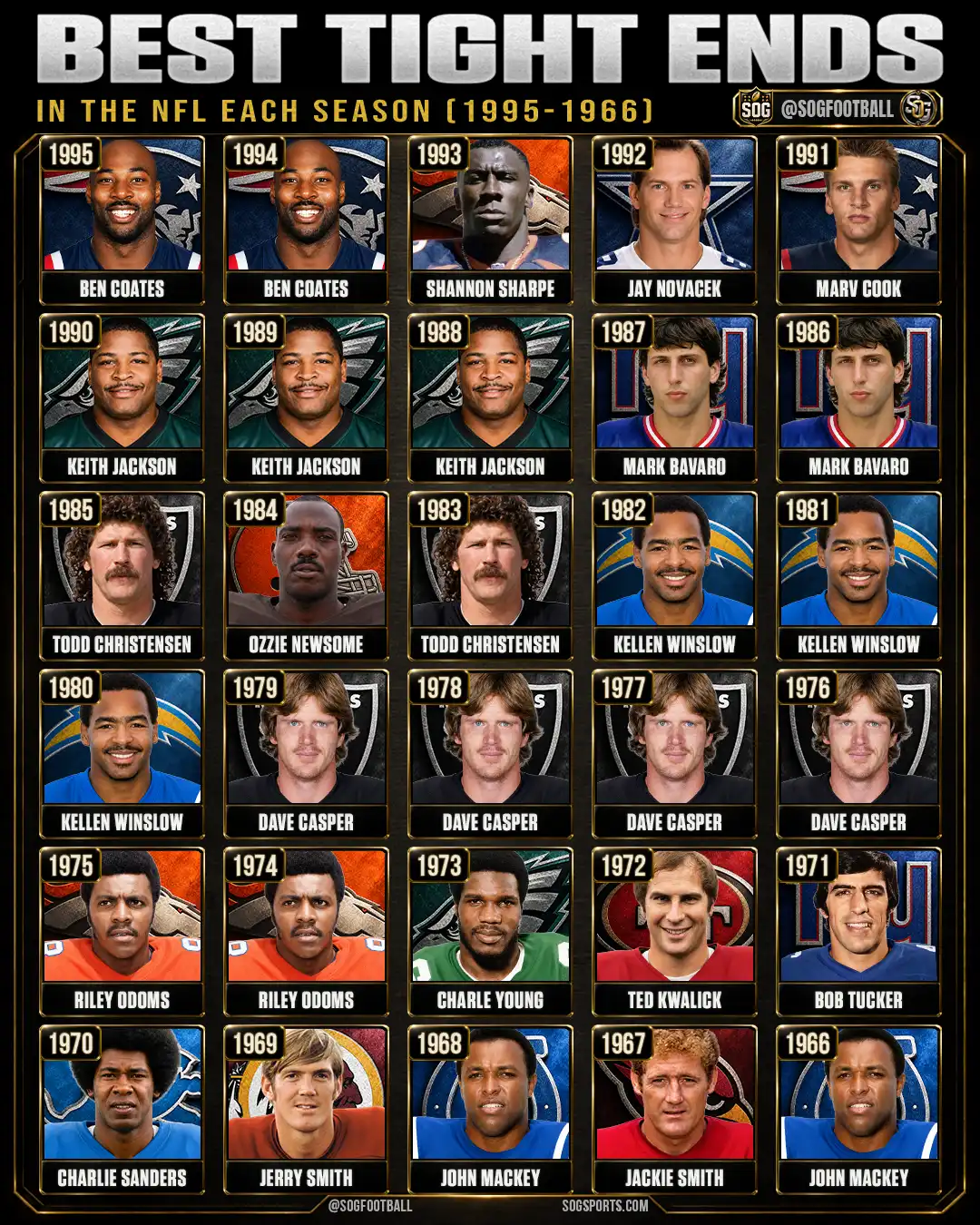
Ranking the best tight end in the NFL each season from 1995 to 1966, featuring Ben Coates, Shannon Sharpe, Jay Novacek, Keith Jackson, Mark Bavaro, Kellen Winslow, Dave Casper, John Mackey, and more.
1995: Ben Coates, New England Patriots
Ben Coates was one of the toughest tight end covers of the mid-1990s, and 1995 kept him right near the top of the position. Drew Bledsoe trusted him, and Coates gave the New England Patriots a physical, reliable target in the middle of the field.
He was not a finesse player. Coates won with strength, body control and toughness after the catch. That made him one of the defining tight ends of this stretch.
1994: Ben Coates, New England Patriots
Coates’ 1994 season was a true breakout. He caught 96 passes for 1,174 yards and 7 touchdowns, setting a new standard for tight end volume at the time.
For a tight end in the mid-1990s, those numbers were massive. Coates became the centerpiece of the New England Patriots passing game and one of the league’s hardest players to handle over the middle.
1993: Shannon Sharpe, Denver Broncos
Sharpe’s 1993 season showed the league what was coming. He caught 81 passes for 995 yards and 9 touchdowns, giving the Denver Broncos a dynamic receiving tight end before that became common.
He was faster and more explosive than most linebackers could handle, and he played with the confidence of a player who knew he was changing the position.
1992: Jay Novacek, Dallas Cowboys
Jay Novacek was the perfect tight end for the Dallas Cowboys dynasty offense. He did not need to be the biggest star on a roster full of Hall of Fame talent. He just needed to be open at the right time, and he usually was.
Novacek gave Troy Aikman a dependable target in the middle of the field and helped Dallas stay balanced. His value was in timing, trust and fit.
1991: Marv Cook, New England Patriots
Marv Cook had a huge 1991 season for the New England Patriots. He caught 82 passes for 808 yards, giving New England one of the most productive tight end seasons in the league.
Cook was not a long-term all-time name like Gonzalez or Sharpe, but this list is about individual seasons. In 1991, his production and role were strong enough to earn the spot.
1990: Keith Jackson, Philadelphia Eagles
Keith Jackson remained one of the best tight ends in football in 1990. He was athletic, polished and productive in the Philadelphia Eagles offense.
Jackson gave the Eagles a receiving threat who could win down the seam and create problems for linebackers. His early-career run was one of the best by any tight end of that era.
1989: Keith Jackson, Philadelphia Eagles
Jackson’s 1989 season continued his rise as one of the league’s top tight ends. He had already arrived as a rookie, and by his second season, he was a trusted weapon for the Philadelphia Eagles.
He combined receiver-like movement with tight end size. That made him one of the hardest matchups in football at the position.
1988: Keith Jackson, Philadelphia Eagles
Keith Jackson’s rookie season was outstanding. He caught 81 passes for 869 yards and 6 touchdowns, immediately becoming one of the best tight ends in the NFL and an eventual fixture among the greatest Philadelphia Eagles.
Rookie tight ends usually need time. Jackson looked ready right away. His athleticism and receiving polish made him an instant star for the Philadelphia Eagles.
1987: Mark Bavaro, New York Giants
Mark Bavaro was one of the toughest tight ends of the 1980s. His 1987 season came in a shortened year, but his value to the New York Giants remained clear.
Bavaro’s value included blocking, tone-setting toughness and a perfect fit with the Giants’ physical identity.
1986: Mark Bavaro, New York Giants
Bavaro’s 1986 season was his signature year. He caught 66 passes for 1,001 yards and helped the New York Giants win the Super Bowl.
He was tough, physical and reliable, which made him exactly the kind of tight end Bill Parcells wanted. Bavaro’s production and blocking made this one of the best tight end seasons of the decade.
1985: Todd Christensen, Los Angeles Raiders
Todd Christensen was one of the most productive receiving tight ends of the 1980s. In 1985, he remained a major part of the Los Angeles Raiders passing game.
Christensen won with route running, hands and chemistry with the quarterback. He was a high-volume tight end before that became normal.
1984: Ozzie Newsome, Cleveland Browns
Ozzie Newsome gets the 1984 spot because of his consistency, hands and importance to the Cleveland Browns offense. He was one of the smoothest tight ends of his generation.
Newsome did not always need explosive numbers to prove his value. He was dependable, smart and technically clean, which is why he stayed near the top of the position for so long.
1983: Todd Christensen, Los Angeles Raiders
Christensen’s 1983 season was one of the great receiving tight end seasons of the era. He caught 92 passes for 1,247 yards and 12 touchdowns.
That level of tight end production was huge for the early 1980s. Christensen was a matchup problem before the league was fully built around tight end mismatches.
1982: Kellen Winslow, San Diego Chargers
Kellen Winslow’s 1982 season came in a strike-shortened year, but he remained the most dynamic tight end in football. In Air Coryell, Winslow was more than a traditional tight end.
He lined up in different spots, stressed coverages and helped redefine what the position could be for the San Diego Chargers. Even in a shortened season, his impact stood out.
1981: Kellen Winslow, San Diego Chargers
Winslow kept pushing the position forward in 1981. He caught 88 passes for more than 1,000 yards, giving the San Diego Chargers a receiving weapon defenses struggled to match.
He was too athletic for most linebackers and too big for many defensive backs. That mismatch is still the foundation of modern tight end play.
1980: Kellen Winslow, San Diego Chargers
Winslow’s 1980 season was a landmark moment for the position. He caught 89 passes for 1,290 yards, setting a new tight end receiving standard.
Winslow stretched the field, moved around formations and became a centerpiece in one of football’s most creative passing offenses.
1979: Dave Casper, Oakland Raiders
Dave Casper was still one of football’s best tight ends in 1979. He brought size, toughness and receiving ability to the Oakland Raiders offense.
Casper was the kind of tight end who could block in a physical game and still punish a defense as a pass-catcher. That complete value kept him at the top of the position.
1978: Dave Casper, Oakland Raiders
Casper’s 1978 season was one of his best receiving years. He caught 62 passes for 852 yards and 9 touchdowns, huge numbers for a tight end in that era.
He was dependable in big moments, physical after the catch and trusted in the red zone. Few tight ends of the 1970s had that kind of all-around impact.
1977: Dave Casper, Oakland Raiders
Casper’s 1977 season continued his run as one of the defining tight ends of the decade. He gave the Oakland Raiders a reliable target who could win in traffic and produce in important situations.
His playoff heroics and regular-season consistency made him more than a stat-sheet player. Casper was a big-game tight end.
1976: Dave Casper, Oakland Raiders
Casper’s 1976 season helped establish him as the best tight end in football. He was physical enough for Oakland’s style and skilled enough to be a serious receiving threat.
He scored 10 touchdowns and helped the Oakland Raiders win the Super Bowl. That combination of production and winning gives him a strong case.
1975: Riley Odoms, Denver Broncos
Riley Odoms was one of the most talented tight ends of the 1970s. In 1975, he gave the Denver Broncos a dangerous receiving option at a position that was still often viewed through blocking first.
Odoms had size, athleticism and enough receiving skill to stretch defenses in ways many tight ends could not.
1974: Riley Odoms, Denver Broncos
Odoms’ 1974 season showed why he was such a valuable piece for the Denver Broncos. He had the frame of a traditional tight end but could create problems as a pass-catcher.
He was one of the AFC’s top players at the position and helped move the tight end role toward more receiving responsibility.
1973: Charle Young, Philadelphia Eagles
Charle Young had a standout 1973 season with the Philadelphia Eagles. He brought athleticism and receiving production to the Eagles at a time when few tight ends were featured that heavily.
Young’s size and movement made him a difficult matchup, and his season stands out as one of the better tight end years of the early 1970s.
1972: Ted Kwalick, San Francisco 49ers
Ted Kwalick was a strong receiving tight end for the San Francisco 49ers, and 1972 was one of his best years. He had enough speed to threaten defenses and enough toughness to work through contact.
Kwalick gave the 49ers a dependable passing-game piece in an era when tight end production was not always easy to find.
1971: Bob Tucker, New York Giants
Bob Tucker’s 1971 season was a big one for the New York Giants. He caught 59 passes for 791 yards, excellent production for a tight end in that era.
Tucker was reliable, productive and heavily involved in the offense. For a one-year tight end ranking, that kind of usage matters.
1970: Charlie Sanders, Detroit Lions
Charlie Sanders was one of the most athletic tight ends of his generation. In 1970, he gave the Detroit Lions a dangerous weapon who could stretch the field from the position.
Sanders had the smoothness and receiving ability that would later help make him a Hall of Famer. His prime helped raise expectations for what a tight end could do.
1969: Jerry Smith, Washington Redskins
Jerry Smith was a major receiving threat for the Washington Redskins, and 1969 was one of his strongest seasons. He was undersized compared to many traditional tight ends, but he knew how to get open and finish plays.
Smith was especially dangerous near the goal line. His receiving value made him one of the best tight ends of his era.
1968: John Mackey, Baltimore Colts
John Mackey was one of the most important tight ends in NFL history, and 1968 showed why. He was physical, explosive and dangerous after the catch in a way few tight ends had been before him.
Mackey helped the Baltimore Colts win the NFL championship and remained one of the defining players at the position.
1967: Jackie Smith, St. Louis Cardinals
Jackie Smith gets the 1967 spot because he was one of the best receiving tight ends in football. He had the speed to threaten defenses and the toughness to work the middle.
Smith’s best years with the St. Louis Cardinals helped prove that tight ends could be legitimate downfield weapons, not just extra blockers.
1966: John Mackey, Baltimore Colts
John Mackey opens the list as the best tight end of 1966. He brought rare athleticism, power and big-play ability to the position.
Mackey was ahead of his time. He could block, run through tackles and turn short throws into long gains, which made him the perfect starting point for this year-by-year ranking.
Closest Calls on the List
Some years had an obvious answer. Others came down to what you value most: receiving volume, blocking, touchdowns, team impact or all-around tight end play.
2024: George Kittle, San Francisco 49ers vs. Trey McBride, Arizona Cardinals
McBride had a strong case because of his target volume and role in Arizona’s offense, but Kittle’s efficiency, blocking and all-around dominance gave him the edge. Kittle was still the more complete tight end.
2023: George Kittle, San Francisco 49ers vs. Travis Kelce, Kansas City Chiefs
Kelce was still excellent, but Kittle led tight ends in receiving yards and brought far more blocking value. In a loaded San Francisco offense, he still managed to stand out.
2018: Travis Kelce, Kansas City Chiefs vs. George Kittle, San Francisco 49ers
This is one of the hardest modern tight end debates. Kittle set the single-season tight end receiving yardage record, but Kelce had 103 catches, 1,336 yards and 10 touchdowns in Patrick Mahomes’ MVP offense. The touchdown edge and total role push Kelce slightly ahead here.
2013: Jimmy Graham, New Orleans Saints vs. Vernon Davis, San Francisco 49ers
Vernon Davis had a big touchdown season and remained one of the league’s best athletes at the position. Graham’s 1,215 yards and 16 touchdowns were too much to pass up.
2011: Rob Gronkowski, New England Patriots vs. Jimmy Graham, New Orleans Saints
Graham was fantastic in 2011 and would have been the pick in many seasons. Gronkowski’s place among the single-season receiving-touchdown leaders and his complete physical dominance made his year even stronger.
2007: Jason Witten, Dallas Cowboys vs. Tony Gonzalez, Kansas City Chiefs
Gonzalez was still great, but Witten’s 96-catch, 1,145-yard season gave Dallas elite consistency and production. It was one of Witten’s cleanest peak years.
1984: Ozzie Newsome, Cleveland Browns vs. Todd Christensen, Los Angeles Raiders
Christensen had a strong argument because of his receiving production, but Newsome’s consistency, hands and overall value keep him at the top for 1984.
1976: Dave Casper, Oakland Raiders vs. Riley Odoms, Denver Broncos
Odoms was one of the league’s best tight ends, but Casper’s touchdown production and role on a Super Bowl-winning Raiders team give him the edge.
Full Year-by-Year Table: Best Tight End Every Year in NFL History
Use the table below as a quick reference for every selection from 2025 through 1966.
| Year | Best Tight End | Full Team Name |
|---|---|---|
| 2025 | Trey McBride | Arizona Cardinals |
| 2024 | George Kittle | San Francisco 49ers |
| 2023 | George Kittle | San Francisco 49ers |
| 2022 | Travis Kelce | Kansas City Chiefs |
| 2021 | Travis Kelce | Kansas City Chiefs |
| 2020 | Travis Kelce | Kansas City Chiefs |
| 2019 | George Kittle | San Francisco 49ers |
| 2018 | Travis Kelce | Kansas City Chiefs |
| 2017 | Rob Gronkowski | New England Patriots |
| 2016 | Travis Kelce | Kansas City Chiefs |
| 2015 | Rob Gronkowski | New England Patriots |
| 2014 | Rob Gronkowski | New England Patriots |
| 2013 | Jimmy Graham | New Orleans Saints |
| 2012 | Tony Gonzalez | Atlanta Falcons |
| 2011 | Rob Gronkowski | New England Patriots |
| 2010 | Jason Witten | Dallas Cowboys |
| 2009 | Antonio Gates | San Diego Chargers |
| 2008 | Tony Gonzalez | Kansas City Chiefs |
| 2007 | Jason Witten | Dallas Cowboys |
| 2006 | Antonio Gates | San Diego Chargers |
| 2005 | Antonio Gates | San Diego Chargers |
| 2004 | Antonio Gates | San Diego Chargers |
| 2003 | Tony Gonzalez | Kansas City Chiefs |
| 2002 | Tony Gonzalez | Kansas City Chiefs |
| 2001 | Tony Gonzalez | Kansas City Chiefs |
| 2000 | Tony Gonzalez | Kansas City Chiefs |
| 1999 | Tony Gonzalez | Kansas City Chiefs |
| 1998 | Shannon Sharpe | Denver Broncos |
| 1997 | Shannon Sharpe | Denver Broncos |
| 1996 | Shannon Sharpe | Denver Broncos |
| 1995 | Ben Coates | New England Patriots |
| 1994 | Ben Coates | New England Patriots |
| 1993 | Shannon Sharpe | Denver Broncos |
| 1992 | Jay Novacek | Dallas Cowboys |
| 1991 | Marv Cook | New England Patriots |
| 1990 | Keith Jackson | Philadelphia Eagles |
| 1989 | Keith Jackson | Philadelphia Eagles |
| 1988 | Keith Jackson | Philadelphia Eagles |
| 1987 | Mark Bavaro | New York Giants |
| 1986 | Mark Bavaro | New York Giants |
| 1985 | Todd Christensen | Los Angeles Raiders |
| 1984 | Ozzie Newsome | Cleveland Browns |
| 1983 | Todd Christensen | Los Angeles Raiders |
| 1982 | Kellen Winslow | San Diego Chargers |
| 1981 | Kellen Winslow | San Diego Chargers |
| 1980 | Kellen Winslow | San Diego Chargers |
| 1979 | Dave Casper | Oakland Raiders |
| 1978 | Dave Casper | Oakland Raiders |
| 1977 | Dave Casper | Oakland Raiders |
| 1976 | Dave Casper | Oakland Raiders |
| 1975 | Riley Odoms | Denver Broncos |
| 1974 | Riley Odoms | Denver Broncos |
| 1973 | Charle Young | Philadelphia Eagles |
| 1972 | Ted Kwalick | San Francisco 49ers |
| 1971 | Bob Tucker | New York Giants |
| 1970 | Charlie Sanders | Detroit Lions |
| 1969 | Jerry Smith | Washington Redskins |
| 1968 | John Mackey | Baltimore Colts |
| 1967 | Jackie Smith | St. Louis Cardinals |
| 1966 | John Mackey | Baltimore Colts |
FAQ: Best Tight End Every Year in NFL History
Who was the best tight end in 2025?
Trey McBride of the Arizona Cardinals was the best tight end in 2025. His 126 receptions, 1,239 receiving yards and 11 touchdowns gave him the strongest all-around production case at the position.
Who was the best tight end in 2024?
George Kittle of the San Francisco 49ers gets the 2024 spot because of his receiving production, efficiency and elite blocking value. Trey McBride had a strong case, but Kittle’s complete tight end play gave him the edge.
Who was the best tight end in 2022?
Travis Kelce of the Kansas City Chiefs was the best tight end in 2022. He caught 110 passes for 1,338 yards and 12 touchdowns while serving as the No. 1 weapon for a Super Bowl-winning Chiefs offense.
Who had the best tight end season ever?
There are several fair answers. Rob Gronkowski in 2011, Travis Kelce in 2020 or 2022, Jimmy Graham in 2013, Kellen Winslow in 1980 and Tony Gonzalez in 2000 all belong in the conversation.
Why is Travis Kelce picked over George Kittle in 2018?
George Kittle had the yardage record, so the debate is extremely close. Kelce gets the nod because he had 103 catches, 1,336 yards, 10 touchdowns and was a central piece of an offense led by two of the greatest Kansas City Chiefs ever.
Why do blocking tight ends matter in this ranking?
Because tight end is not the same as wide receiver. Receiving production matters a lot, but the best tight ends also shape the run game, protect edges, create formation flexibility and make an offense less predictable.
Who appears the most on this list?
Tony Gonzalez appears seven times, the most of any tight end on the list. Travis Kelce follows with five, while Rob Gronkowski, Antonio Gates, Shannon Sharpe and Dave Casper each appear four times.
Who was the best tight end in 2011?
Rob Gronkowski of the New England Patriots was the best tight end in 2011. His 17 receiving touchdowns and 18 total touchdowns made it one of the most dominant seasons ever at the position.
Who was the best tight end in 1980?
Kellen Winslow of the San Diego Chargers was the best tight end in 1980. His 89 catches and 1,290 yards helped redefine what a tight end could be in a modern passing offense.
Who was the best tight end in 1966?
John Mackey of the Baltimore Colts was the best tight end in 1966. He was one of the first truly explosive tight ends, combining blocking, power and big-play receiving ability.
More NFL Tight End Rankings and Records
Career volume is covered in the NFL career receptions leaders and the career receiving-touchdown leaders.
For more passing-game history, read the best quarterbacks of all-time and best wide receivers of all-time. Browse the SOG Sports NFL hub for the complete football archive.
For daily football graphics and debates, follow @sogfootball on Instagram.
What the Year-by-Year Tight End List Shows
The position’s evolution is visible in the names. John Mackey and Jackie Smith supplied rare downfield value in an era when tight ends were asked to block first. Kellen Winslow and Shannon Sharpe expanded formation possibilities. Tony Gonzalez and Antonio Gates normalized major receiving volume, while Rob Gronkowski, Travis Kelce and George Kittle showed different ways to combine receiving, scoring and structural value.
Tony Gonzalez leads the page with seven selections, evidence of both his peak and remarkable consistency. McBride’s record-setting 2025 season represents the newest version of the position: a tight end who can function as the primary passing-game engine. Each yearly choice still comes back to the same question, which player created the most complete tight end value in that season?
