
Puka Nacua leads this ranking of the best wide receivers every year in NFL history, with Ja’Marr Chase, Tyreek Hill, Justin Jefferson, Cooper Kupp, Jerry Rice, Randy Moss and Lance Alworth among the other yearly selections. Nacua gets the 2025 spot over receiving-yardage leader Jaxon Smith-Njigba because his 129 catches, 1,715 yards, physical run-after-catch value and broader role created the strongest all-around case.
The list covers every completed season from 1966 through 2025. Regular-season production carries the most weight, followed by efficiency, touchdown value, All-Pro recognition, assignment difficulty, team context, postseason impact and the degree to which a receiver separated from his peers. Era matters because a 1,000-yard season in a lower-volume passing environment cannot be judged exactly like a modern 150-target season.
This is a season-by-season exercise, not a career ranking. Readers comparing full résumés can use our best wide receivers of all-time ranking, while the best wide receivers in the NFL today covers the current hierarchy entering 2026.
How We Picked the Best Wide Receiver Every Year
Wide receiver has changed a lot across NFL history. In older eras, passing volume was lower, defensive contact was more physical and a 1,000-yard season could be a massive achievement. In the modern game, receivers are moved all over formations, fed higher target shares and asked to win against more varied coverages.
This ranking therefore goes beyond a receiving-yard leaderboard. Yards matter, but so do receptions, touchdowns, yards per catch, All-Pro voting, playoff impact, quarterback situation, team context and how much fear the receiver created. A receiver who forces constant safety help can be just as valuable as one who wins the raw yardage title.
- Production: Receptions, receiving yards, touchdowns and yards from scrimmage.
- Dominance: How clearly the receiver separated from the rest of the position.
- Efficiency and explosiveness: Yards per catch, big plays and defensive attention.
- Awards and recognition: All-Pro honors, Pro Bowls, Offensive Player of the Year and MVP consideration.
- Era context: How passing volume and defensive rules shaped that season.
The goal is to find the wide receiver who owned each season, not simply the player with the most targets.
Best Wide Receivers Each Year, 2025–1996
2025: Puka Nacua, Los Angeles Rams
Puka Nacua gets the 2025 spot over Jaxon Smith-Njigba and Ja’Marr Chase because he supplied the strongest blend of volume, efficiency, toughness and versatility. Smith-Njigba led the NFL with 1,793 receiving yards, but Nacua converted 129 of 166 targets and consistently created value on routes at every level.
Nacua had a league-high 129 receptions, 1,715 receiving yards and 10 receiving touchdowns in 16 games. He also added 105 rushing yards and a touchdown, reinforcing the Los Angeles Rams’ ability to build touches around him without making the offense predictable.
2024: Ja’Marr Chase, Cincinnati Bengals
Ja’Marr Chase’s 2024 season was one of the cleanest wide receiver picks on the list. He won the receiving triple crown, leading the NFL in receptions, receiving yards and receiving touchdowns.
Chase finished with 127 catches, 1,708 yards and 17 touchdowns. His chemistry with Joe Burrow was devastating, and the production held up far beyond any system explanation. Chase won vertically, after the catch, in the red zone and on the kind of high-leverage downs where everybody knew the ball could be coming his way.
2023: Tyreek Hill, Miami Dolphins
Tyreek Hill’s 2023 season was speed turned into weekly panic. The Miami Dolphins offense was built around spacing, timing and explosive windows, and Hill was the player who made the whole thing terrifying.
He caught 119 passes for 1,799 yards and 13 touchdowns. Defenses played deep, tilted safeties and still could not fully keep him from changing games. Hill paired that speed with precise routes, sudden cuts and almost unanswerable acceleration after a free release.
2022: Justin Jefferson, Minnesota Vikings
Justin Jefferson was the best receiver in football in 2022 because he combined huge volume with elite route running and ridiculous catch-point ability. He was the Minnesota Vikings passing offense in so many big moments.
Jefferson finished with 128 receptions, 1,809 yards and won Offensive Player of the Year. The Bills game catch became the highlight, but the full season was bigger than one play. He was the league’s most consistent high-end receiving weapon.
2021: Cooper Kupp, Los Angeles Rams
Cooper Kupp’s 2021 season is one of the greatest wide receiver seasons ever. He won the receiving triple crown, then carried that dominance into the playoffs and finished the year as Super Bowl MVP.
Kupp posted 145 receptions, 1,947 yards and 16 touchdowns in the regular season. His route running, timing with Matthew Stafford and ability to win from the slot made him almost impossible to take away for the Los Angeles Rams.
2020: Davante Adams, Green Bay Packers
Davante Adams was the best receiver in football in 2020 because nobody had a better answer for press coverage, releases and red-zone separation. Even when defenses knew Aaron Rodgers wanted him, Adams kept winning for the Green Bay Packers.
He finished with 115 catches, 1,374 yards and 18 touchdowns in only 14 games. That touchdown rate was absurd, and his footwork at the line of scrimmage was the best in the league.
2019: Michael Thomas, New Orleans Saints
Michael Thomas’ 2019 season was pure volume dominance. He was not a deep-speed receiver, but he won so consistently underneath and intermediate that defenses still could not stop it.
Thomas set the single-season receptions record with 149 catches, added 1,725 yards and won Offensive Player of the Year. “Can’t Guard Mike” felt like the weekly scouting report for every New Orleans Saints opponent.
2018: DeAndre Hopkins, Houston Texans
DeAndre Hopkins was at the peak of his powers in 2018. His hands, body control and sideline work made him one of the toughest receivers in football to defend, even when coverage was good.
Hopkins finished with 115 receptions, 1,572 yards and 11 touchdowns for the Houston Texans. He could win contested catches, create late separation and bail out throws that most receivers could not even reach.
2017: DeAndre Hopkins, Houston Texans
Hopkins’ 2017 season was impressive because the Houston Texans quarterback situation changed, but his production stayed elite. He kept winning no matter who was throwing the ball.
He caught 96 passes for 1,378 yards and led the league with 13 receiving touchdowns. His strength at the catch point and ability to produce through difficult circumstances made this one of his best seasons.
2016: Antonio Brown, Pittsburgh Steelers
Antonio Brown was still the standard at wide receiver in 2016. His route running, quickness and sideline control gave the Pittsburgh Steelers a receiver who could win in every area of the field.
Brown finished with 106 catches, 1,284 yards and 12 touchdowns. Julio Jones had the yardage argument, but Brown’s week-to-week consistency, scoring and complete receiving profile give him the edge.
2015: Julio Jones, Atlanta Falcons
Julio Jones’ 2015 season was a physical masterpiece. He had the size of a power receiver, the speed of a deep threat and the movement skills to separate like a smaller player.
Jones caught 136 passes for 1,871 yards with the Atlanta Falcons. That yardage total remains one of the highest ever, and it came with constant defensive attention. Atlanta knew its passing game ran through Julio, and so did everyone else.
2014: Antonio Brown, Pittsburgh Steelers
Antonio Brown’s 2014 season was the full superstar version of his game. He could win outside, inside, short, deep, against man, against zone and after the catch.
Brown finished with 129 receptions, 1,698 yards and 13 touchdowns. Brown’s production forced opponents to change how they played the Pittsburgh Steelers every week.
2013: Josh Gordon, Cleveland Browns
Josh Gordon’s 2013 season was one of the wildest receiver peaks ever. He played only 14 games and still led the league in receiving yards.
Gordon finished with 87 catches, 1,646 yards and 9 touchdowns. The quarterback situation with the Cleveland Browns was far from ideal, which makes the season even more impressive. For that one year, he looked unstoppable.
2012: Calvin Johnson, Detroit Lions
Calvin Johnson’s 2012 season is one of the great statistical seasons in NFL history. He broke Jerry Rice’s single-season receiving yards record and did it while seeing constant attention.
Johnson caught 122 passes for 1,964 yards with the Detroit Lions. The touchdown total was strangely low, but the yardage dominance was too overwhelming to ignore. Megatron was the best receiver on the planet.
2011: Calvin Johnson, Detroit Lions
Johnson’s 2011 season had the touchdown production that 2012 lacked. He was the league’s most terrifying downfield and red-zone receiver, with the size to overpower corners and the speed to run away from safeties.
He finished with 96 receptions, 1,681 yards and 16 touchdowns. The Detroit Lions could throw it up, and Johnson could make it look like a smart decision.
2010: Roddy White, Atlanta Falcons
Roddy White’s 2010 season was one of the strongest all-around receiver years of the decade. He was consistent, tough, productive and central to the Atlanta Falcons offense.
White led the league with 115 receptions, added 1,389 yards and scored 10 touchdowns. He did not always get the historical attention of bigger names, but that season was elite.
2009: Andre Johnson, Houston Texans
Andre Johnson was the best receiver in football in 2009 because he combined size, speed and production in a way very few receivers ever have. He looked like a power forward running wide receiver routes.
Johnson caught 101 passes for an NFL-best 1,569 yards and 9 touchdowns. The Houston Texans passing game leaned heavily on him, and he kept delivering against every kind of coverage.
2008: Larry Fitzgerald, Arizona Cardinals
Larry Fitzgerald’s 2008 regular season was excellent, but his postseason is what makes this year feel iconic. He was already one of the best receivers in football, then he turned the playoffs into his personal highlight reel.
Fitzgerald had 96 catches, 1,431 yards and 12 touchdowns in the regular season, then exploded during the Arizona Cardinals run to the Super Bowl. His hands, body control and contested-catch ability were as good as it gets.
2007: Randy Moss, New England Patriots
Randy Moss’ 2007 season was one of the most dominant receiver seasons ever. Pairing Moss with Tom Brady on the New England Patriots created a nightmare that defenses never really solved.
Moss caught 98 passes for 1,493 yards and set the single-season receiving touchdown record with 23 touchdowns. His vertical threat changed every coverage shell New England faced.
2006: Marvin Harrison, Indianapolis Colts
Marvin Harrison was still an elite route runner and technician in 2006. In an Indianapolis Colts offense filled with trust and timing, Harrison remained Peyton Manning’s most precise weapon.
He caught 95 passes for 1,366 yards and 12 touchdowns. Indianapolis went on to win the Super Bowl, and Harrison’s regular-season consistency helped set the foundation.
2005: Steve Smith Sr., Carolina Panthers
Steve Smith Sr. was unbelievable in 2005. At 5-foot-9, he played with the violence, confidence and explosiveness of a much bigger receiver.
Smith won the receiving triple crown with 103 receptions, 1,563 yards and 12 touchdowns. The Carolina Panthers passing game revolved around him, and defenses still could not contain him.
2004: Terrell Owens, Philadelphia Eagles
Terrell Owens’ 2004 season in Philadelphia was exactly what the Eagles had been missing. He gave Donovan McNabb a true superstar receiver and instantly changed the ceiling of the offense.
Owens caught 77 passes for 1,200 yards and 14 touchdowns in only 14 games. His combination of power, speed and after-the-catch violence made him one of the league’s most difficult covers.
2003: Randy Moss, Minnesota Vikings
Randy Moss’ 2003 season was another reminder that no receiver changed defensive geometry like he did. Safeties had to cheat deep, corners needed help and one mistake could become six points.
Moss finished with 111 catches, 1,632 yards and 17 touchdowns for the Minnesota Vikings. His numbers were huge, and the fear he created was even bigger.
2002: Marvin Harrison, Indianapolis Colts
Marvin Harrison’s 2002 season was a record-setting masterpiece. His chemistry with Peyton Manning was already operating at a historic level.
Harrison set the single-season receptions record with 143 catches, while adding 1,722 yards and 11 touchdowns. He won with timing, route precision and hands that almost never betrayed him for the Indianapolis Colts.
2001: Terrell Owens, San Francisco 49ers
Terrell Owens was one of football’s most physically overwhelming receivers in 2001. He could beat press coverage, run through contact and turn short catches into explosive plays.
Owens caught 93 passes for 1,412 yards and 16 touchdowns. He was the clear centerpiece of the San Francisco 49ers passing attack and one of the league’s most dangerous players with the ball in his hands.
2000: Randy Moss, Minnesota Vikings
Moss’ 2000 season kept him right at the top of the position. His blend of long speed, body control and effortless acceleration made every snap feel dangerous.
He finished with 1,437 receiving yards and 15 touchdowns for the Minnesota Vikings. Even when he was not catching the ball, he changed coverages just by being on the field.
1999: Marvin Harrison, Indianapolis Colts
Harrison’s 1999 season was the year he fully became one of the league’s premier receivers. He and Peyton Manning were beginning one of the greatest quarterback-receiver partnerships ever.
Harrison posted 115 receptions, 1,663 yards and 12 touchdowns for the Indianapolis Colts. His route running was so clean that he made difficult separation look routine.
1998: Randy Moss, Minnesota Vikings
Randy Moss arrived in 1998 and immediately changed the league. Rookie receivers are not supposed to terrify defenses like that, but Moss was different.
He caught 69 passes for 1,313 yards and an NFL-best 17 receiving touchdowns. His vertical dominance helped the Minnesota Vikings build one of the most explosive offenses ever.
1997: Cris Carter, Minnesota Vikings
Cris Carter was still one of the NFL’s best receivers in 1997. He did not have Randy Moss’ speed or Jerry Rice’s all-around résumé, but his hands and red-zone skill were elite.
Carter caught 89 passes for 1,069 yards and 13 touchdowns. Around the goal line and on contested throws, the Minnesota Vikings star was one of the safest targets in football.
1996: Jerry Rice, San Francisco 49ers
Jerry Rice was still great in 1996, even after years of already building the strongest receiver résumé in football history. He remained the standard for route running, conditioning and competitive consistency.
Rice caught 108 passes for 1,254 yards and 8 touchdowns. It was not his most explosive season, but he was still the league’s most complete receiver for the San Francisco 49ers.
Best Wide Receivers Each Year, 1995–1966
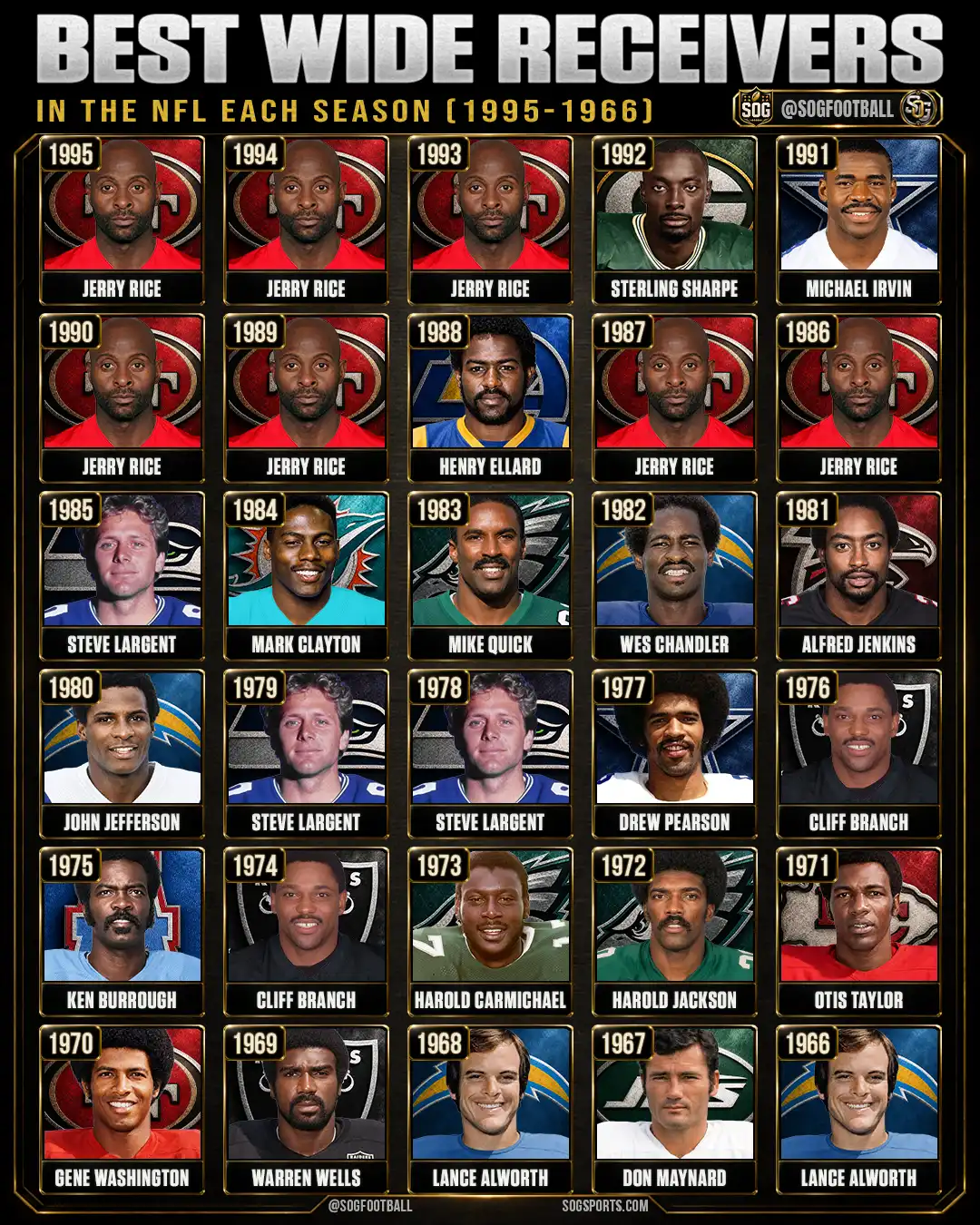
Ranking the best wide receiver in the NFL each season from 1995 to 1966, featuring Jerry Rice, Sterling Sharpe, Michael Irvin, Steve Largent, Mark Clayton, Lance Alworth, Don Maynard, and more.
1995: Jerry Rice, San Francisco 49ers
Jerry Rice’s 1995 season was one of the greatest wide receiver seasons ever. He was already the best receiver in football history, and then he produced one of his biggest statistical years.
Rice caught 122 passes for 1,848 yards and 15 touchdowns. The volume, efficiency and scoring all matched the eye test. He was still the complete receiver for the San Francisco 49ers: routes, hands, yards after catch and competitive edge.
1994: Jerry Rice, San Francisco 49ers
Rice’s 1994 season helped drive one of the best 49ers teams ever. Steve Young won MVP, San Francisco won the Super Bowl and Rice remained the best receiver in football.
He finished with 112 receptions, 1,499 yards and 13 touchdowns. He was the defining weapon in one of the league’s most dangerous offenses.
1993: Jerry Rice, San Francisco 49ers
Rice was still operating at a ridiculous level in 1993. His precision, stamina and ability to win after the catch kept him above the rest of the position.
He caught 98 passes for 1,503 yards and 15 touchdowns for the San Francisco 49ers. Few receivers have ever combined volume and scoring as naturally as Rice did during this stretch.
1992: Sterling Sharpe, Green Bay Packers
Sterling Sharpe’s 1992 season was special. Before injuries cut his career short, he looked like a receiver who could challenge anyone in football.
Sharpe caught 108 passes for 1,461 yards and 13 touchdowns. He had power, hands, route strength and a huge role in the Green Bay Packers offense. This was an elite peak.
1991: Michael Irvin, Dallas Cowboys
Michael Irvin’s 1991 season was the year the Dallas Cowboys passing game truly became dangerous. He gave the Cowboys a physical, emotional No. 1 receiver who could win big outside.
Irvin finished with 93 catches for a league-leading 1,523 yards. His swagger matched the rise of the Cowboys, and his production gave Troy Aikman a true centerpiece.
1990: Jerry Rice, San Francisco 49ers
Rice’s 1990 season was another year where he made greatness look normal. He caught 100 passes for 1,502 yards and 13 touchdowns.
At this point, defenses knew every detail of the problem and still could not fix it. Rice was too precise, too conditioned and too complete for the San Francisco 49ers.
1989: Jerry Rice, San Francisco 49ers
Rice was the best receiver in football in 1989, and it was not close. He had the deep speed to punish coverage, the route craft to create separation and the hands to finish everything.
He caught 82 passes for 1,483 yards and 17 touchdowns. San Francisco won another Super Bowl, and Rice remained the sport’s most dangerous receiver.
1988: Henry Ellard, Los Angeles Rams
Henry Ellard’s 1988 season deserves more attention. In an era full of great names, he gave the Los Angeles Rams one of the league’s most explosive receiving seasons.
Ellard caught 86 passes for an NFL-best 1,414 yards and 10 touchdowns. His speed and big-play ability made him the right choice for this year.
1987: Jerry Rice, San Francisco 49ers
Jerry Rice’s 1987 season is one of the most absurd scoring seasons in NFL history. In a strike-shortened year, he still caught 22 receiving touchdowns.
He added 1,078 yards in only 12 games and made the impossible feel normal for the San Francisco 49ers. The touchdown pace alone makes this one of the strongest picks on the entire list.
1986: Jerry Rice, San Francisco 49ers
Rice’s 1986 season was the true beginning of his takeover. He had already flashed, but this was the year he became an unstoppable weekly problem.
He caught 86 passes for 1,570 yards and 15 touchdowns. The combination of explosive plays and red-zone dominance announced that the San Francisco 49ers had a new standard at receiver.
1985: Steve Largent, Seattle Seahawks
Steve Largent was one of the most polished receivers of his generation, and 1985 was another prime example of his consistency. He was not the biggest or fastest receiver in football, but he was always open when it mattered.
Largent finished with 79 receptions and 1,287 yards. His route running, hands and toughness made him one of the safest receivers in the league and the clear offensive identity of the Seattle Seahawks passing game.
1984: Mark Clayton, Miami Dolphins
Mark Clayton’s 1984 season was a touchdown explosion. Dan Marino had one of the greatest quarterback seasons ever, and Clayton was his most dangerous scoring target.
Clayton caught 73 passes for 1,389 yards and 18 touchdowns. That touchdown total was massive for the era and helped make the Miami Dolphins passing offense feel futuristic.
1983: Mike Quick, Philadelphia Eagles
Mike Quick’s 1983 season was one of the great single-year receiving peaks of the decade. He gave the Philadelphia Eagles a true No. 1 receiver who could win downfield and produce explosive plays.
Quick finished with an NFL-best 1,409 receiving yards and 13 touchdowns. He had size, speed and enough big-play juice to separate himself from the field.
1982: Wes Chandler, San Diego Chargers
Wes Chandler’s 1982 season came in a strike-shortened year, but his production was ridiculous. In only eight games, he still crossed 1,000 yards.
Chandler caught 49 passes for 1,032 yards and 9 touchdowns. His 129.0 receiving yards per game remain the NFL single-season record, and his role in the San Diego Chargers’ Air Coryell offense made him one of the era’s most dangerous receivers.
1981: Alfred Jenkins, Atlanta Falcons
Alfred Jenkins had a monster 1981 season for the Atlanta Falcons. He was one of the league’s most productive receivers and a major vertical threat.
Jenkins finished with 70 receptions, 1,358 yards and 13 touchdowns. That blend of yardage and scoring gives him the strongest case for the year.
1980: John Jefferson, San Diego Chargers
John Jefferson was one of football’s most exciting receivers at the start of the 1980s. He had speed, hands and the ability to turn the San Diego Chargers passing game into a fireworks show.
Jefferson caught 82 passes for 1,340 yards and 13 touchdowns. With the Chargers, he was a perfect fit for one of the league’s most aggressive passing attacks.
1979: Steve Largent, Seattle Seahawks
Largent’s 1979 season showed why he became one of the most respected receivers in NFL history. He was precise, dependable and tough enough to win without needing overwhelming size.
He caught 66 passes for 1,237 yards and 9 touchdowns. The Seattle Seahawks could count on him every week, and his efficiency made him one of the best receivers in football.
1978: Steve Largent, Seattle Seahawks
Largent was already building his Hall of Fame case by 1978. His ability to separate with route running and finish difficult catches made him stand out in a lower-volume passing era.
He finished with 71 catches, 1,168 yards and 8 touchdowns. Those were outstanding numbers for the time, and they matched his reputation as one of the Seattle Seahawks’ cleanest technicians.
1977: Drew Pearson, Dallas Cowboys
Drew Pearson was the perfect big-game receiver for the Dallas Cowboys. He was not always the flashiest statistical player, but he was trusted, tough and constantly involved in important moments.
In 1977, Pearson helped Dallas win the Super Bowl and remained one of Roger Staubach’s most reliable targets. His route running and clutch production make him the pick.
1976: Cliff Branch, Oakland Raiders
Cliff Branch’s 1976 season gave the Oakland Raiders one of the most dangerous vertical threats in football. His speed forced defenses to respect the deep ball on every snap.
Branch caught 46 passes for 1,111 yards and 12 touchdowns. His yards per catch and scoring impact were exactly what the Raiders needed during a Super Bowl season.
1975: Ken Burrough, Houston Oilers
Ken Burrough’s 1975 season was one of the best receiving years of the decade. He gave the Houston Oilers a true downfield weapon and led the league in receiving yards.
Burrough finished with 53 receptions, 1,063 yards and 8 touchdowns. In that era, a 1,000-yard season carried real weight, and Burrough earned this spot.
1974: Cliff Branch, Oakland Raiders
Branch’s 1974 season was his breakout into the league’s elite. His speed changed how defenses handled the Oakland Raiders, and he became one of football’s most feared deep threats.
He caught 60 passes for 1,092 yards and 13 touchdowns. He led the league in receiving yards and touchdowns, making this one of the easier picks of the 1970s.
1973: Harold Carmichael, Philadelphia Eagles
Harold Carmichael’s 1973 season was a major year for a receiver with rare size and catch radius. At 6-foot-8, he presented a matchup problem that looked completely different from most receivers of his era.
Carmichael caught 67 passes for 1,116 yards and 9 touchdowns. He led the league in receptions and receiving yards, which makes his case very strong.
1972: Harold Jackson, Philadelphia Eagles
Harold Jackson was one of the best deep threats in football in 1972. He gave the Philadelphia Eagles explosive receiving value at a time when passing games were not built the way they are now.
Jackson finished with 62 receptions and 1,048 yards. His speed and big-play ability made him one of the most dangerous receivers of that season.
1971: Otis Taylor, Kansas City Chiefs
Otis Taylor was a big, physical receiver who could dominate after the catch. In 1971, he was one of the most difficult wideouts in football to tackle and one of the most efficient receiving weapons in the league.
Taylor posted 1,110 receiving yards and 7 touchdowns. His combination of size, strength and downfield ability made him a perfect fit for the Kansas City Chiefs.
1970: Gene Washington, San Francisco 49ers
Gene Washington was a smooth, dangerous receiver for the San Francisco 49ers, and 1970 was one of his best seasons. He had the ability to stretch the field and produce touchdowns in a lower-volume passing environment.
Washington finished with 1,100 receiving yards and 12 touchdowns. His scoring impact and big-play ability make him the right pick.
1969: Warren Wells, Oakland Raiders
Warren Wells was one of pro football’s most explosive receivers in 1969. His speed and vertical ability made him a perfect match for the Oakland Raiders’ aggressive passing game.
Wells caught 47 passes for 1,260 yards and 14 touchdowns. That is an outrageous yards-per-catch season, and it stands out even across eras.
1968: Lance Alworth, San Diego Chargers
Lance Alworth was one of the first truly modern-looking wide receivers. He was smooth, fast and explosive, with the kind of big-play skill that made him a nightmare in the AFL.
In 1968, Alworth caught 68 passes for 1,312 yards and 10 touchdowns. His production and style with the San Diego Chargers both belong near the top of any receiver history discussion.
1967: Don Maynard, New York Jets
Don Maynard’s 1967 season was one of the best of his Hall of Fame career. He gave the New York Jets a deep threat who could consistently punish defenses vertically.
Maynard finished with 71 catches, 1,434 yards and 10 touchdowns. His chemistry with Joe Namath helped make New York’s passing game one of the most dangerous in football.
1966: Lance Alworth, San Diego Chargers
Lance Alworth opens the list as the best receiver of 1966. He was one of the most explosive players in football and the kind of wideout who helped push the passing game forward.
Alworth caught 73 passes for 1,383 yards and 13 touchdowns. That production was massive for the era, and his speed made him one of the most feared receivers in the sport.
Closest Calls on the List
Some years had an obvious answer. Others came down to style, team context and what kind of receiver value mattered most that season.
2025: Puka Nacua, Los Angeles Rams vs. Jaxon Smith-Njigba, Seattle Seahawks vs. Ja’Marr Chase, Cincinnati Bengals
Jaxon Smith-Njigba had the receiving-yardage argument, and Ja’Marr Chase remained one of the best receivers in the league. Puka gets the nod because he led the league in receptions, finished near the top in yards, scored 10 touchdowns and carried a huge all-around role in the Rams offense.
2024: Ja’Marr Chase, Cincinnati Bengals vs. Justin Jefferson, Minnesota Vikings
Jefferson was still elite, but Chase’s triple crown season makes this one clean. Leading the league in catches, yards and touchdowns is hard to argue against.
2021: Cooper Kupp, Los Angeles Rams vs. Davante Adams, Green Bay Packers
Davante Adams was still spectacular, but Kupp’s triple crown, Offensive Player of the Year award, playoff dominance and Super Bowl MVP finish make 2021 his season.
2018: DeAndre Hopkins, Houston Texans vs. Julio Jones, Atlanta Falcons
Julio Jones led the league in receiving yards and had a strong case. Hopkins had the better touchdown production, cleaner catch-point dominance and stronger all-around argument for this list.
2016: Antonio Brown, Pittsburgh Steelers vs. Julio Jones, Atlanta Falcons
Julio had the bigger yardage total, but Brown had more receptions, more touchdowns and a steadier full-season case. It is one of the tighter modern debates.
2012: Calvin Johnson, Detroit Lions vs. Brandon Marshall, Chicago Bears
Marshall was outstanding in Chicago and had a massive target share, but Calvin Johnson breaking the single-season receiving yardage record makes him impossible to pass up.
2009: Andre Johnson, Houston Texans vs. Larry Fitzgerald, Arizona Cardinals
Fitzgerald was still elite after his legendary playoff run the year before, but Andre Johnson had the stronger regular season. His size-speed dominance and league-leading yardage give him the edge.
1992: Sterling Sharpe, Green Bay Packers vs. Jerry Rice, San Francisco 49ers
Rice was still Rice, which makes every debate difficult. Sharpe’s 108-catch, 1,461-yard, 13-touchdown season gives him the better 1992 case specifically.
Full Year-by-Year Table: Best Wide Receiver Every Year in NFL History
Use the table below as a quick reference for every selection from 2025 through 1966.
| Year | Best Wide Receiver | Full Team Name |
|---|---|---|
| 2025 | Puka Nacua | Los Angeles Rams |
| 2024 | Ja’Marr Chase | Cincinnati Bengals |
| 2023 | Tyreek Hill | Miami Dolphins |
| 2022 | Justin Jefferson | Minnesota Vikings |
| 2021 | Cooper Kupp | Los Angeles Rams |
| 2020 | Davante Adams | Green Bay Packers |
| 2019 | Michael Thomas | New Orleans Saints |
| 2018 | DeAndre Hopkins | Houston Texans |
| 2017 | DeAndre Hopkins | Houston Texans |
| 2016 | Antonio Brown | Pittsburgh Steelers |
| 2015 | Julio Jones | Atlanta Falcons |
| 2014 | Antonio Brown | Pittsburgh Steelers |
| 2013 | Josh Gordon | Cleveland Browns |
| 2012 | Calvin Johnson | Detroit Lions |
| 2011 | Calvin Johnson | Detroit Lions |
| 2010 | Roddy White | Atlanta Falcons |
| 2009 | Andre Johnson | Houston Texans |
| 2008 | Larry Fitzgerald | Arizona Cardinals |
| 2007 | Randy Moss | New England Patriots |
| 2006 | Marvin Harrison | Indianapolis Colts |
| 2005 | Steve Smith Sr. | Carolina Panthers |
| 2004 | Terrell Owens | Philadelphia Eagles |
| 2003 | Randy Moss | Minnesota Vikings |
| 2002 | Marvin Harrison | Indianapolis Colts |
| 2001 | Terrell Owens | San Francisco 49ers |
| 2000 | Randy Moss | Minnesota Vikings |
| 1999 | Marvin Harrison | Indianapolis Colts |
| 1998 | Randy Moss | Minnesota Vikings |
| 1997 | Cris Carter | Minnesota Vikings |
| 1996 | Jerry Rice | San Francisco 49ers |
| 1995 | Jerry Rice | San Francisco 49ers |
| 1994 | Jerry Rice | San Francisco 49ers |
| 1993 | Jerry Rice | San Francisco 49ers |
| 1992 | Sterling Sharpe | Green Bay Packers |
| 1991 | Michael Irvin | Dallas Cowboys |
| 1990 | Jerry Rice | San Francisco 49ers |
| 1989 | Jerry Rice | San Francisco 49ers |
| 1988 | Henry Ellard | Los Angeles Rams |
| 1987 | Jerry Rice | San Francisco 49ers |
| 1986 | Jerry Rice | San Francisco 49ers |
| 1985 | Steve Largent | Seattle Seahawks |
| 1984 | Mark Clayton | Miami Dolphins |
| 1983 | Mike Quick | Philadelphia Eagles |
| 1982 | Wes Chandler | San Diego Chargers |
| 1981 | Alfred Jenkins | Atlanta Falcons |
| 1980 | John Jefferson | San Diego Chargers |
| 1979 | Steve Largent | Seattle Seahawks |
| 1978 | Steve Largent | Seattle Seahawks |
| 1977 | Drew Pearson | Dallas Cowboys |
| 1976 | Cliff Branch | Oakland Raiders |
| 1975 | Ken Burrough | Houston Oilers |
| 1974 | Cliff Branch | Oakland Raiders |
| 1973 | Harold Carmichael | Philadelphia Eagles |
| 1972 | Harold Jackson | Philadelphia Eagles |
| 1971 | Otis Taylor | Kansas City Chiefs |
| 1970 | Gene Washington | San Francisco 49ers |
| 1969 | Warren Wells | Oakland Raiders |
| 1968 | Lance Alworth | San Diego Chargers |
| 1967 | Don Maynard | New York Jets |
| 1966 | Lance Alworth | San Diego Chargers |
FAQ: Best Wide Receiver Every Year in NFL History
Who was the best wide receiver in 2025?
Puka Nacua of the Los Angeles Rams was the best wide receiver in 2025. He led the league with 129 receptions, finished with 1,715 receiving yards and 10 touchdowns, and gave the Rams one of the most complete receiver seasons in the NFL.
Who was the best wide receiver in 2024?
Ja’Marr Chase of the Cincinnati Bengals was the best wide receiver in 2024. He won the receiving triple crown with 127 catches, 1,708 yards and 17 touchdowns.
Who had the best wide receiver season ever?
There are several strong answers. Jerry Rice in 1995, Cooper Kupp in 2021, Calvin Johnson in 2012, Randy Moss in 2007, Marvin Harrison in 2002 and Steve Smith Sr. in 2005 all belong in the conversation.
Why is Puka Nacua picked over Jaxon Smith-Njigba in 2025?
Jaxon Smith-Njigba had the receiving-yardage case, but Puka Nacua had the stronger all-around season. He led the league in receptions, finished near the top in receiving yards, scored 10 touchdowns and carried a huge role in the Los Angeles Rams offense.
Why is Cooper Kupp picked for 2021?
Kupp won the receiving triple crown, won Offensive Player of the Year, dominated the playoffs and finished the season as Super Bowl MVP. It is one of the most complete receiver seasons ever.
Why is Calvin Johnson picked in 2012?
Calvin Johnson is the 2012 pick because he broke the single-season receiving yards record with 1,964 yards. Even with only five touchdowns, the yardage dominance was too historic to ignore.
Who appears the most on this list?
Jerry Rice appears more than anyone else, which matches his status as the greatest wide receiver ever. Randy Moss, Marvin Harrison, Antonio Brown, Calvin Johnson, DeAndre Hopkins, Steve Largent, Cliff Branch and Lance Alworth also appear multiple times.
What matters more for wide receivers: yards or touchdowns?
Both matter, but neither decides the ranking by itself. A receiver with huge yardage, massive touchdown production, elite efficiency or overwhelming defensive attention can have the best season depending on the year.
Who was the best wide receiver in 2007?
Randy Moss of the New England Patriots was the best wide receiver in 2007. His 23 receiving touchdowns remain the single-season NFL record.
Who was the best wide receiver in 1995?
Jerry Rice of the San Francisco 49ers was the best wide receiver in 1995. He caught 122 passes for 1,848 yards and 15 touchdowns in one of the greatest seasons of his career.
More NFL Wide Receiver Rankings and Records
For the career view, compare the NFL career receiving-yard leaders, the career receptions leaders and the career receiving-touchdown leaders.
For a modern statistical snapshot, see the receiving-yard leaders since 2020. The broader offense series also includes the best quarterbacks of all-time, best tight ends of all-time and best running backs of all-time.
Browse the SOG Sports NFL hub for more historical rankings. For daily football graphics and debates, follow @sogfootball on Instagram.
What the Year-by-Year Wide Receiver List Shows
The clearest pattern is that there is no single statistical route to being the best receiver in a season. Lance Alworth and Cliff Branch created value through vertical pressure in lower-volume eras. Jerry Rice combined elite volume, efficiency and scoring. Randy Moss could alter a coverage shell before the snap, while modern leaders such as Cooper Kupp, Justin Jefferson and Puka Nacua can dominate through target volume and formation flexibility.
Jerry Rice’s eight selections are the most on the page and underline the length of his peak. The yearly format also protects shorter peaks from being swallowed by career totals: Sterling Sharpe in 1992, Josh Gordon in 2013 and Cooper Kupp in 2021 each earned a season on its own terms. From Lance Alworth in 1966 to Puka Nacua in 2025, every selection reflects the receiver who best defined that specific year.
