SOG Sports has not named the fastest NFL player of 2026 yet. The 2026 regular season is still ahead, so the top slot remains open instead of being awarded from preseason reputation alone. Jahmyr Gibbs is the 2025 selection, Xavier Worthy represents 2024 after setting the official NFL Scouting Combine 40-yard-dash record, and Tyreek Hill owns the largest share of the modern era.
This is an opinion-based year-by-year ranking of the fastest NFL players every year since 1967. It measures football speed rather than blindly sorting 40-yard-dash times. Game acceleration, long speed in pads, return ability, vertical impact, tracking data, documented track performance and the standards of each era all matter.
Each year refers to the NFL season that began in that calendar year. The supplied graphic order is preserved from 1967 through 2026, including the intentionally unresolved 2026 slot.
How We Picked the Fastest NFL Player Every Year
There is no official league award for the fastest player, and the available evidence changes dramatically by era. NFL Next Gen Stats supplies public player-tracking speed for the modern period. The NFL’s official historical Combine database covers participants since 2003. Earlier seasons require more careful use of track credentials, verified production, film-supported reputation and era-relative impact.
- Game speed: acceleration, pursuit-angle destruction and the ability to retain speed while carrying, tracking or returning the ball.
- Verified measurements: official Combine times and Next Gen Stats readings receive more weight than old hand-timed or promotional claims.
- Track résumé: Olympic, world-class or major collegiate sprint results matter when they translated to football.
- Explosive production: long touchdowns, yards per catch and return scores help show that the speed affected games.
- Strategic effect: the strongest candidates changed coverage depth, return strategy, contain rules or defensive spacing.
- Era context: players are compared with the speed environment and available evidence of their own season.
A 40-yard dash measures straight-line acceleration in controlled conditions. Football requires reacting, cutting, wearing equipment and preserving speed while completing a position-specific task, so the fastest known 40 does not automatically win every season.
Fastest NFL Players Each Year, 2026–1997

Fastest NFL players for every season from 1997 through 2026, featuring Jahmyr Gibbs, Xavier Worthy, Tyreek Hill, Raheem Mostert, Chris Johnson, Devin Hester, Michael Vick, Randy Moss and Deion Sanders.
2026 — No Selection Yet
SOG Sports has not named a 2026 winner yet. The graphic intentionally leaves the upcoming season open, and the article should not turn preseason testing or reputation into a completed-season verdict. The selection will be made from regular-season evidence such as repeated top-speed plays, explosive production and the way a player’s acceleration changes defensive angles.
2025 — Jahmyr Gibbs
Jahmyr Gibbs is the SOG Sports choice for 2025 because his speed repeatedly appeared in live NFL conditions. He reached 22.42 mph on a 42-yard run against Chicago, and NFL Research later noted that three of the four fastest ball-carrier speeds through Week 12 belonged to him.
Gibbs separates himself through acceleration after the cut. Xavier Worthy has the stronger controlled 40-yard-dash argument, but Gibbs produced the more complete season-long game-speed case.
2024 — Xavier Worthy
Xavier Worthy owns the cleanest measured-speed case on the list. His official 4.21-second 40-yard dash at the 2024 NFL Scouting Combine broke John Ross’ record and remains the fastest official time in the Combine database.
This selection gives more weight to verified testing than most years. Tyreek Hill had the deeper NFL résumé, but Worthy’s record was exceptional enough to make him the defining speed player of 2024.
2023 — Tyreek Hill
Tyreek Hill was still the league’s most frightening speed weapon in 2023. His first step, deep speed and ability to erase pursuit angles kept Miami’s offense explosive all season.
Hill finished the year with 1,799 receiving yards and 13 touchdowns, and a huge part of that production came from the constant fear his speed created. Defenses played him deep, shaded help his way and still gave up big plays.
2022 — Tyreek Hill
Hill’s move to Miami did not slow him down at all. If anything, the Dolphins built one of the league’s most speed-friendly passing games around him.
He posted 1,710 receiving yards in 2022 and immediately proved his speed was portable outside Kansas City. Whether he was running deep routes, crossers or quick throws into space, Hill remained the fastest problem on the field.
2021 — Tyreek Hill
By 2021, everyone knew what Tyreek Hill was going to do, and that still did not make him easy to stop. His speed forced defenses to back up, which opened room for Kansas City’s entire offense.
Hill’s greatest weapon was how quickly he could reach top gear. Many fast players need build-up space. Hill could turn a short route into a sprint before defenders had their feet under them.
2020 — Raheem Mostert
Raheem Mostert receives the 2020 selection because NFL Next Gen Stats measured him at 23.09 mph on an 80-yard touchdown against the New York Jets. He also reached 22.73 mph on another early-season score.
Tyreek Hill remained the more complete speed threat, but Mostert owned the clearest single-season top-speed display. His one-cut acceleration was ideally suited to San Francisco’s outside-zone system.
2019 — Tyreek Hill
Tyreek Hill’s 2019 season kept him at the top of the speed conversation. Even when injuries limited parts of his year, his presence still changed the way defenses lined up.
Hill did not need 10 catches to scare a secondary. One deep route was enough to force cushions, safety help and defensive panic. That is what separates true game-breaking speed from ordinary speed.
2018 — Tyreek Hill
Hill’s 2018 season was one of the best examples of speed turning into production. He posted 1,479 receiving yards and 12 receiving touchdowns, while also adding return value.
Patrick Mahomes’ arm and Hill’s speed created one of the most dangerous vertical combinations in football. Defenders could be in decent position and still lose once Hill found open grass.
2017 — Tyreek Hill
In 2017, Hill was already more than a gadget player. He became a true wide receiver while keeping the same return-man explosiveness that made him terrifying as a rookie.
His deep speed forced defenses to treat every snap like a possible vertical shot. That constant pressure made him the fastest player in the league’s imagination as much as on the field.
2016 — Tyreek Hill
Tyreek Hill’s rookie season announced one of the fastest players the NFL had ever seen. Kansas City used him as a receiver, runner and returner, and every touch felt dangerous.
He scored as a receiver, rusher, punt returner and kick returner in 2016. That all-purpose speed made him the clear pick for the year.
2015 — John Brown
John Brown gets the 2015 spot because his vertical speed gave Arizona a true field-stretching threat. He was not the biggest receiver, but he could run past coverage and force safeties to stay honest.
Brown cleared 1,000 receiving yards in 2015, and his speed was a major reason the Cardinals’ passing game felt so explosive. He could win deep, separate on crossers and turn defensive hesitation into big gains.
2014 — DeSean Jackson
DeSean Jackson remained one of the NFL’s most dangerous deep threats in 2014. His speed was different because he paired it with elite tracking and timing.
Jackson did not need a huge frame or contested-catch style. His whole game was built on creating separation early, stacking defensive backs and forcing quarterbacks to trust that he would run under the ball.
2013 — Trindon Holliday
Trindon Holliday’s 2013 season was split between the Denver Broncos and New York Giants, a detail the original draft omitted. His selection comes from track-level acceleration and the return-game danger he continued to create.
Holliday was not a major offensive contributor, so this is a narrow speed pick. In open field, however, few players reached top gear as quickly.
2012 — Trindon Holliday
Holliday split 2012 between Houston and Denver and scored on both a punt return and a kickoff return during the regular season. He then added two return touchdowns in Denver’s postseason loss to Baltimore.
His limited offensive role keeps this from being a complete-player argument. As a return specialist, his acceleration made every lost coverage lane potentially fatal.
2011 — DeSean Jackson
DeSean Jackson was still one of the NFL’s scariest speed players in 2011. His deep routes stretched defenses, and his punt-return ability gave him another way to change games.
Jackson’s speed was smooth and sudden at the same time. He could glide past defenders, then hit another gear when the ball was in the air.
2010 — DeSean Jackson
Jackson’s 2010 season gave us one of the most famous speed plays in NFL history: the walk-off punt return against the Giants. It was not just a return touchdown. It was a reminder that Jackson could end a game from anywhere.
That year captured his full speed profile. He was a deep receiver, a return threat and a player defensive coordinators had to circle before every matchup.
2009 — Chris Johnson
Chris Johnson’s 2009 season is one of the greatest speed seasons in NFL history. He rushed for 2,006 yards and finished with more than 2,500 yards from scrimmage, turning Tennessee’s offense into a weekly home-run threat.
Johnson had already run a 4.24-second 40-yard dash at the combine, and 2009 proved that number was not just track speed. He could split defenders, outrun angles and make long touchdowns look routine.
2008 — Chris Johnson
Chris Johnson entered the NFL as one of the fastest running backs ever measured at the combine. His rookie season made the speed obvious immediately.
Johnson could press the line, plant his foot and turn the corner before linebackers could recover. His acceleration gave Tennessee a completely different offensive element.
2007 — Devin Hester
Devin Hester set an NFL record with six combined kick-return touchdowns in 2007, four on kickoffs and two on punts. Opponents increasingly chose directional or shortened kicks rather than giving him a normal return.
Hester’s football speed came from vision, balance and the ability to change direction without surrendering momentum. Ted Ginn Jr. was a credible raw-speed challenger, but Hester’s strategic effect was unmatched.
2006 — Devin Hester
Hester’s rookie season produced six return touchdowns: three on punts, two on kickoffs and one on a missed field goal. He then opened Super Bowl XLI with a 92-yard kickoff-return touchdown.
The speed worked because Hester could manipulate blocks, hesitate and then accelerate through a lane before it closed. No other 2006 player turned speed into more immediate special-teams damage.
2005 — Jerome Mathis
Jerome Mathis averaged 28.6 yards on 54 kickoff returns, gained 1,542 return yards and scored twice as a rookie. Those figures made him one of the season’s clearest speed specialists.
Mathis’ broader NFL career was brief, but for this specific year his straight-line burst and repeated long returns gave him a strong seasonal case.
2004 — Dante Hall
Dante Hall was still one of the NFL’s most dangerous returners in 2004. His speed was not only straight-line. It was the stop-start quickness that made tacklers miss in tight spaces.
Hall could turn a crowded return into open field with one cut. Once he cleared the first wave, the chase was usually over.
2003 — Dante Hall
Dante Hall returned two punts and two kickoffs for touchdowns in 2003, including scores in four consecutive games. The “Human Joystick” nickname captured how his lateral quickness and acceleration worked together.
Hall did not need a clean runway. He could reverse field, make multiple defenders miss and still recover enough speed to finish.
2002 — Michael Vick
Michael Vick changed what quarterback speed could look like. His 4.3-level burst and left-handed playmaking made him unlike anything defenses had prepared for at the position.
In 2002, Vick’s speed was already the central problem. Defenses could cover the receivers and still lose because Vick could break contain and outrun linebackers, safeties and sometimes corners.
2001 — Randy Moss
Randy Moss gets the 2001 spot because his long speed at 6-foot-4 made him a different kind of matchup. He was not just fast. He was fast with a huge catch radius and elite ball tracking.
Moss forced defenses to back up before the snap. When he got even with a corner, he was usually gone. That speed-plus-size combination remains one of the rarest physical packages in NFL history.
2000 — Randy Moss
Moss was still the most terrifying deep threat in football in 2000. Minnesota could stretch the field vertically on any play because Moss changed the geometry of coverage.
His speed looked effortless. He did not always look like he was sprinting, but defensive backs kept falling behind anyway.
1999 — Randy Moss
Randy Moss’ 1999 season continued the momentum from his historic rookie year. Defenses were already giving him extra attention, and he still created explosive plays.
Moss made deep speed feel inevitable. Even with safety help, he could climb over coverage or simply run past it.
1998 — Randy Moss
Randy Moss’ rookie season changed the NFL immediately. He scored 17 receiving touchdowns and averaged nearly 20 yards per catch, giving Minnesota one of the most explosive passing attacks ever.
His speed was the first thing opponents had to solve, and most of them could not solve it. Moss did not just run by defenders. He made entire coverage plans feel too slow.
1997 — Deion Sanders
Deion Sanders was still one of the fastest players in the NFL in 1997. Even later in his career, his recovery speed and return ability remained elite.
Deion’s speed was not only about running straight ahead. It was about closing space, baiting quarterbacks and making up ground that other corners could not.
Fastest NFL Players Each Year, 1996–1967
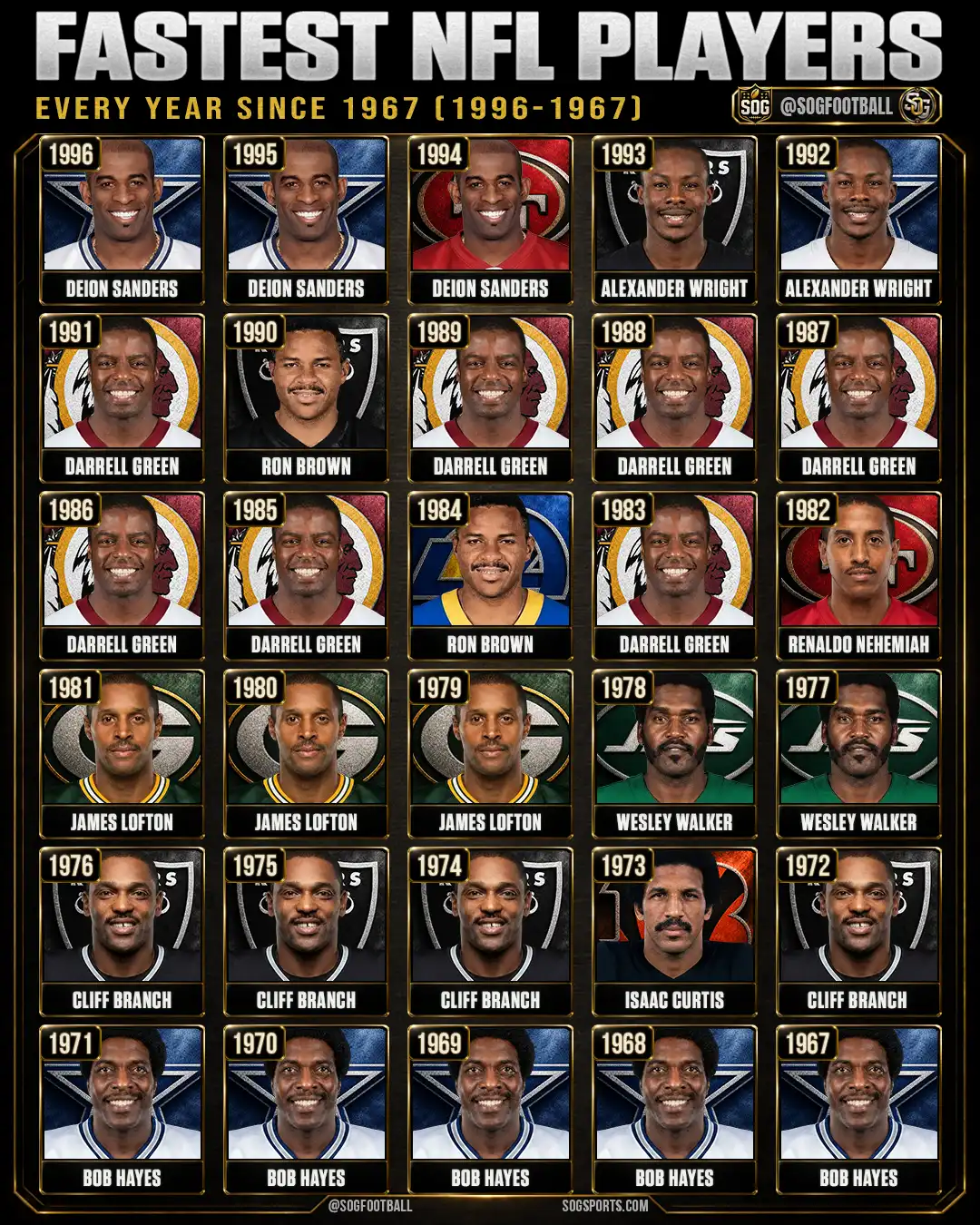
Fastest NFL players for every season from 1967 through 1996, featuring Bob Hayes, Cliff Branch, Isaac Curtis, Wesley Walker, James Lofton, Renaldo Nehemiah, Ron Brown, Darrell Green, Alexander Wright and Deion Sanders.
1996 — Deion Sanders
Deion Sanders gets 1996 because he was still the standard for cornerback speed. His ability to close throwing windows and erase space made quarterbacks feel like open receivers were not really open.
Few players have ever looked faster in pads. Deion’s recovery speed allowed him to gamble in ways most defensive backs could never survive.
1995 — Deion Sanders
Deion’s 1995 season showed how game-changing his speed could be on a championship team. With Dallas, he gave the Cowboys a corner who could tilt matchups and shrink the field.
His speed also affected special teams and offense whenever he touched those phases. There were fast players in the league, but Deion’s speed felt like an event.
1994 — Deion Sanders
Deion Sanders had one of the great defensive seasons of the 1990s in 1994. He won Defensive Player of the Year and helped San Francisco win the Super Bowl.
His speed was the foundation. He could undercut throws, recover from baited routes and turn interceptions into immediate scoring chances. In 1994, nobody made speed look more valuable.
1993 — Alexander Wright
Alexander Wright was one of the league’s pure burners in the early 1990s. His speed made him a deep threat and kick-return weapon, even if he did not have the same all-around résumé as some bigger names.
This pick is about raw pace. Wright had the type of straight-line acceleration that defensive backs and coverage units had to respect.
1992 — Alexander Wright
Alexander Wright split the 1992 season between the Dallas Cowboys and Los Angeles Raiders, correcting the original table’s single-team listing. His role increased after the move to Los Angeles, where his speed produced two receiving touchdowns.
This is one of the list’s least production-driven choices. Wright’s case rests on top-end pace and league-wide reputation, with Darrell Green remaining a defensible alternative.
1991 — Darrell Green
Darrell Green’s speed aged better than almost any player in NFL history. In 1991, he was still one of the fastest defenders in the league and a nightmare for receivers trying to separate deep.
Green’s long career is part of the legend, but his prime speed was even more impressive. He could run with almost anyone and still had the instincts to finish plays.
1990 — Ron Brown
Ron Brown receives the 1990 selection on the strength of world-class sprint credentials and the speed he still brought to the Los Angeles Raiders. His NFL role was smaller than Darrell Green’s, making this a pure-speed choice rather than an overall-football-value choice.
Green is the stronger answer when game impact receives the most weight. Brown wins only when Olympic-caliber straight-line speed is treated as the deciding factor.
1989 — Darrell Green
Darrell Green was still the league’s speed standard in 1989. His cornerback style depended on confidence, recovery and the ability to challenge deep routes without panic.
Green could give a receiver space and still close it. That kind of speed changes how a defense can play.
1988 — Darrell Green
Green’s 1988 season came in the middle of his run as one of the NFL’s most feared speed defenders. He had rare acceleration and even rarer long-speed endurance.
He was not just a track athlete playing football. Green had the football intelligence to use his speed at the exact right moments.
1987 — Darrell Green
Darrell Green gets 1987 because his speed was still one of Washington’s biggest advantages. He could cover deep, recover on double moves and chase down plays from across the field.
His speed also had psychological value. Receivers knew they had to win cleanly, because Green could erase a small mistake with one burst.
1986 — Darrell Green
Green’s 1986 season fits the list because he was widely viewed as one of the NFL’s fastest men. His sprinting ability became part of his football identity.
He won speed competitions and backed it up on Sundays. That combination of reputation and game tape makes him the clear pick.
1985 — Darrell Green
Darrell Green was already building his legend by 1985. His ability to stay attached to receivers down the field gave Washington a defensive weapon that few teams had.
Speed is most dangerous when it comes with technique. Green had both, which is why he kept appearing in this range.
1984 — Ron Brown
Ron Brown entered the 1984 NFL season after winning Olympic gold with the United States’ 4×100-meter relay team. That résumé gives him one of the strongest documented pure-sprint cases in league history.
Brown’s selection is based more on verified track speed than NFL production. Darrell Green was already the more accomplished football player, but Brown’s Olympic performance made him the clearest raw-speed choice for this year.
1983 — Darrell Green
Darrell Green’s rookie season immediately introduced elite speed to Washington’s defense. He entered the league as one of the fastest players in football and quickly proved it was not just pre-draft hype.
His speed gave him a margin for error most corners never had. That is why he became a long-term fixture on lists like this.
1982 — Renaldo Nehemiah
Renaldo Nehemiah entered the NFL after becoming the first hurdler to break 13 seconds in the 110-meter hurdles, running a then-world-record 12.93 in 1981. No other 1982 player had a cleaner world-class speed résumé.
His football career was modest, and hurdling speed is not identical to receiving speed. This choice rewards rare documented athleticism while acknowledging that James Lofton offered more NFL-specific evidence.
1981 — James Lofton
James Lofton was one of the NFL’s premier deep threats in the early 1980s. His speed, stride length and route ability made him extremely dangerous down the field.
Lofton was more than a burner, but speed was the piece that made his receiving game stretch defenses vertically.
1980 — James Lofton
Lofton’s 1980 season continued his rise as one of the most explosive receivers in football. He could win with long speed, body control and smooth acceleration.
Defenses had to respect him deep, and that created space for everything else Green Bay wanted to do in the passing game.
1979 — James Lofton
James Lofton gets the 1979 spot because his speed made him one of the most exciting young receivers in football. He brought track-style movement to a classic wide receiver frame.
Lofton’s ability to glide downfield made him look different. Corners could be in phase early and still lose once he opened up his stride.
1978 — Wesley Walker
Wesley Walker was one of the fastest receivers of his era. His deep speed gave the Jets a constant home-run threat.
Walker averaged huge yards per catch across his prime, and that was not an accident. His speed forced defenses to respect the vertical game every week.
1977 — Wesley Walker
Walker’s 1977 season kept him near the top of the speed conversation. He was smooth, explosive and especially dangerous on deep throws.
There are receivers who run fast in shorts, and then there are receivers who play fast with the ball in the air. Walker belonged in the second group.
1976 — Cliff Branch
Cliff Branch was one of the great vertical receivers of the 1970s. His speed fit perfectly with the Raiders’ aggressive downfield passing style.
Branch could stretch the defense, win deep and force safeties to widen their responsibilities. That kind of speed helped make Oakland’s offense dangerous.
1975 — Cliff Branch
Branch gets 1975 because he was still one of the league’s best pure burners. He was not just fast for the era. He was game-breaking fast.
His long speed gave Ken Stabler and the Raiders a weapon that could flip field position in one throw.
1974 — Cliff Branch
Cliff Branch led the NFL with 1,092 receiving yards and 13 receiving touchdowns in 1974. The original draft incorrectly said he averaged more than 20 yards per catch; the verified figure was 18.2.
The corrected number still supports an exceptional speed season. Branch combined world-class sprint background with league-leading NFL production.
1973 — Isaac Curtis
Isaac Curtis made an immediate impact as a rookie, averaging 18.7 yards per reception and scoring nine receiving touchdowns. His pace forced defensive backs to protect against the vertical route from the beginning of his career.
Cliff Branch was already a credible challenger, but Curtis’ instant production gives him the edge for this season.
1972 — Cliff Branch
Cliff Branch entered the NFL with documented track speed, including an NCAA championship-meet record in the 100 meters. His rookie receiving production was limited, so this is primarily an athletic-profile selection.
That limitation should be stated plainly. Bob Hayes offered the stronger established NFL résumé, but Branch represented the league’s next great vertical-speed weapon and soon validated the projection.
1971 — Bob Hayes
Bob Hayes gets 1971 because his Olympic speed still defined how people talked about fast NFL players. Even later in his career, his name was the standard.
Hayes changed football because defensive backs had to respect speed in a different way. His presence helped popularize more zone coverage because pure man coverage against him could become dangerous quickly.
1970 — Bob Hayes
Bob Hayes remained one of football’s ultimate speed symbols in 1970. His track background gave him a credibility no other NFL player could match.
He had already won Olympic gold in the 100 meters, and that world-class sprint speed made him a vertical threat unlike almost anyone before him.
1969 — Bob Hayes
Bob Hayes’ speed remained one of the league’s most unusual competitive advantages in 1969. Dallas could force defensive backs to retreat early, creating room for the rest of the offense before Hayes was even targeted.
His historical importance is sometimes exaggerated into unsupported claims about single-handedly inventing specific coverages. The safer conclusion is still powerful: his pace demanded defensive treatment rarely seen before his arrival.
1968 — Bob Hayes
Bob Hayes gets 1968 because his speed was still the most obvious athletic separator in the NFL. He brought Olympic sprinting to professional football and made defenses adjust.
In an era before today’s combine obsession, Hayes was proof that track speed could translate into real football fear.
1967 — Bob Hayes
Bob Hayes opens the list as the fastest NFL player in 1967. His combination of Olympic gold-medal speed and receiving production made him one of the most unique athletes in league history.
Hayes was not just “fast for a football player.” He was legitimately world-class fast. That is why he is the perfect starting point for a year-by-year speed ranking.
What the Speed Evidence Can and Cannot Prove
Modern tracking is useful but role-dependent
Next Gen Stats can identify the maximum speed reached by a ball carrier on a play, but it does not place every player’s top speed on every route or coverage snap into the same public leaderboard. A running back with a clean 80-yard lane has a different opportunity to reach maximum speed than a cornerback reacting in coverage.
Official and unofficial 40 times should not be mixed
Xavier Worthy’s 4.21 and Chris Johnson’s 4.24 are official NFL Scouting Combine results. Famous older claims attached to Darrell Green, Deion Sanders and other legends were produced under different timing conditions. They remain part of football history but should not be presented as directly interchangeable electronic measurements.
Track speed is evidence, not a complete football verdict
Bob Hayes, Ron Brown and Renaldo Nehemiah have documented world-class track cases. That establishes rare raw speed. The ranking still considers whether the athlete could release, cut, track the ball, read blocks or finish plays in NFL conditions.
Repeat selections show how the speed role evolved
Hayes owns the late 1960s, vertical receivers define much of the 1970s, Darrell Green controls the mid-to-late 1980s, and Deion Sanders and Randy Moss dominate the 1990s. The modern list shifts toward return specialists, official Combine records and tracking-supported game speed, with Tyreek Hill appearing six times.
Closest Calls on the List
2025 — Jahmyr Gibbs vs. Xavier Worthy
Worthy owns the better controlled measurement, but Gibbs built the stronger 2025 game-speed portfolio. Repeated 22-mph plays and explosive production gave Gibbs the edge.
2024 — Xavier Worthy vs. Tyreek Hill
Hill remained the more proven NFL speed weapon. Worthy wins this year because 4.21 seconds created a new official measurement standard, not because one rookie season had already surpassed Hill’s full résumé.
2020 — Raheem Mostert vs. Tyreek Hill
Hill offered the broader offensive threat, but Mostert supplied the clearest tracked top-speed evidence. His 23.09-mph touchdown is the decisive fact for a list focused on that season.
2009 — Chris Johnson vs. DeSean Jackson
Jackson was a terrifying vertical receiver and returner. Johnson’s 2,006 rushing yards, 2,509 scrimmage yards and verified 4.24 speed created the more complete blend of measurement, workload and breakaway production.
1998 — Randy Moss vs. Deion Sanders
Sanders remained one of football’s fastest defenders, but Moss’ rookie season changed the league more dramatically. Seventeen receiving touchdowns and nearly 20 yards per catch made his speed the defining athletic story of the year.
1990 — Ron Brown vs. Darrell Green
Brown wins only under a pure-sprint interpretation because of his Olympic résumé. Green had the stronger NFL-specific case, making this the clearest example of why track speed and football speed can produce different answers.
Complete Table: Fastest NFL Player Every Year
| Year | Player | Team(s) |
|---|---|---|
| 2026 | No Selection Yet | TBD |
| 2025 | Jahmyr Gibbs | Detroit Lions |
| 2024 | Xavier Worthy | Kansas City Chiefs |
| 2023 | Tyreek Hill | Miami Dolphins |
| 2022 | Tyreek Hill | Miami Dolphins |
| 2021 | Tyreek Hill | Kansas City Chiefs |
| 2020 | Raheem Mostert | San Francisco 49ers |
| 2019 | Tyreek Hill | Kansas City Chiefs |
| 2018 | Tyreek Hill | Kansas City Chiefs |
| 2017 | Tyreek Hill | Kansas City Chiefs |
| 2016 | Tyreek Hill | Kansas City Chiefs |
| 2015 | John Brown | Arizona Cardinals |
| 2014 | DeSean Jackson | Washington Redskins |
| 2013 | Trindon Holliday | Denver Broncos / New York Giants |
| 2012 | Trindon Holliday | Houston Texans / Denver Broncos |
| 2011 | DeSean Jackson | Philadelphia Eagles |
| 2010 | DeSean Jackson | Philadelphia Eagles |
| 2009 | Chris Johnson | Tennessee Titans |
| 2008 | Chris Johnson | Tennessee Titans |
| 2007 | Devin Hester | Chicago Bears |
| 2006 | Devin Hester | Chicago Bears |
| 2005 | Jerome Mathis | Houston Texans |
| 2004 | Dante Hall | Kansas City Chiefs |
| 2003 | Dante Hall | Kansas City Chiefs |
| 2002 | Michael Vick | Atlanta Falcons |
| 2001 | Randy Moss | Minnesota Vikings |
| 2000 | Randy Moss | Minnesota Vikings |
| 1999 | Randy Moss | Minnesota Vikings |
| 1998 | Randy Moss | Minnesota Vikings |
| 1997 | Deion Sanders | Dallas Cowboys |
| 1996 | Deion Sanders | Dallas Cowboys |
| 1995 | Deion Sanders | Dallas Cowboys |
| 1994 | Deion Sanders | San Francisco 49ers |
| 1993 | Alexander Wright | Los Angeles Raiders |
| 1992 | Alexander Wright | Dallas Cowboys / Los Angeles Raiders |
| 1991 | Darrell Green | Washington Redskins |
| 1990 | Ron Brown | Los Angeles Raiders |
| 1989 | Darrell Green | Washington Redskins |
| 1988 | Darrell Green | Washington Redskins |
| 1987 | Darrell Green | Washington Redskins |
| 1986 | Darrell Green | Washington Redskins |
| 1985 | Darrell Green | Washington Redskins |
| 1984 | Ron Brown | Los Angeles Rams |
| 1983 | Darrell Green | Washington Redskins |
| 1982 | Renaldo Nehemiah | San Francisco 49ers |
| 1981 | James Lofton | Green Bay Packers |
| 1980 | James Lofton | Green Bay Packers |
| 1979 | James Lofton | Green Bay Packers |
| 1978 | Wesley Walker | New York Jets |
| 1977 | Wesley Walker | New York Jets |
| 1976 | Cliff Branch | Oakland Raiders |
| 1975 | Cliff Branch | Oakland Raiders |
| 1974 | Cliff Branch | Oakland Raiders |
| 1973 | Isaac Curtis | Cincinnati Bengals |
| 1972 | Cliff Branch | Oakland Raiders |
| 1971 | Bob Hayes | Dallas Cowboys |
| 1970 | Bob Hayes | Dallas Cowboys |
| 1969 | Bob Hayes | Dallas Cowboys |
| 1968 | Bob Hayes | Dallas Cowboys |
| 1967 | Bob Hayes | Dallas Cowboys |
FAQ: Fastest NFL Players Every Year
Who is the fastest NFL player for 2026?
No player has been selected yet. As of August 3, 2026, SOG Sports is leaving the upcoming season open until regular-season tracking data and game evidence make the choice defensible.
Who was the fastest NFL player in 2025?
Jahmyr Gibbs is the SOG Sports selection. His repeated 22-mph game speed, including a 22.42-mph run against Chicago, gives him the strongest 2025 case.
Who owns the fastest official NFL Combine 40 time?
Xavier Worthy owns the official NFL Scouting Combine record at 4.21 seconds, set in 2024. John Ross previously held the record at 4.22.
Who has the strongest case as the fastest NFL player ever?
The answer depends on the standard. Bob Hayes has the strongest verified Olympic sprint case, Xavier Worthy has the official Combine record, Tyreek Hill has an exceptional modern game-speed résumé, and Darrell Green, Deion Sanders and Chris Johnson combine speed with sustained NFL performance.
Why is the list not based only on 40-yard-dash times?
A 40 measures controlled straight-line acceleration. Football speed also includes reacting, cutting, maintaining balance, wearing equipment, reading leverage and reaching top gear while completing a football task.
Last reviewed: August 3, 2026. The 2026 regular-season selection remains intentionally open.
Conclusion
The fastest NFL players every year since 1967 reflect several forms of speed. Bob Hayes brought verified Olympic sprinting into professional football. Cliff Branch and Wesley Walker turned long speed into vertical offense. Darrell Green and Deion Sanders used recovery speed to change coverage, while Devin Hester and Dante Hall made kicking to them a strategic risk.
Modern measurements make the evidence cleaner but not automatic. Worthy owns the official Combine record, Mostert produced one of the strongest tracked top-speed seasons, and Gibbs supplied the best 2025 combination of repeated speed and game impact. Tyreek Hill remains the defining speed player of the tracking era. The 2026 answer will be earned during the season rather than guessed before it.
More NFL Rankings
Continue with our ranking of the fastest NFL players ever, which compares game speed, track credentials and verified testing across full careers.
- Best Wide Receivers of All-Time
- Best Running Backs of All-Time
- Best Cornerbacks of All-Time
- Best Running Back Every Year in NFL History
For daily football graphics and debates, follow SOG Football on Instagram.
