Stephen Curry is the most frequently selected player on SOG Sports’ best NBA shooters every year list, earning 12 of the 60 seasons from 1967 through 2026. Ray Allen is next with eight selections, followed by Reggie Miller with six and Larry Bird with five. Kon Knueppel is the 2026 choice after becoming the first rookie to lead the NBA in made threes.
This is an editorial year-by-year ranking, not an official award or a list of three-point percentage leaders. The selections weigh volume, accuracy, shot difficulty, movement shooting, off-dribble creation, free-throw touch, postseason performance and the way each shooter changed defensive coverage in that specific season.
- How We Selected the Best NBA Shooter Each Year
- Eligibility and Season Scope
- Best NBA Shooters Each Year: 2026–1997
- Best NBA Shooters Each Year: 1996–1967
- What the 60-Year List Reveals
- Closest Calls and Most Debatable Seasons
- Complete Year-by-Year Table
- Frequently Asked Questions
- Conclusion
- Related NBA Rankings
How We Selected the Best NBA Shooter Each Year
The primary question is not simply who posted the highest percentage. A low-volume specialist can lead a category without carrying the same difficulty, responsibility or defensive attention as a player taking movement threes, deep pull-ups or late-clock jumpers.
- Volume and efficiency: makes, attempts and accuracy are considered together rather than in isolation.
- Shot creation: pull-ups, movement attempts, contested jumpers and late-clock shooting receive additional weight.
- Spacing value: the ranking considers how far defenses extended and how much attention the shooter created away from the ball.
- Complete touch: midrange and free-throw accuracy matter, especially in seasons when the three-point shot was uncommon or unavailable.
- Postseason shooting: regular-season performance controls the selection, but playoff shot-making can break a close tie.
- Era context: every player is judged against the shooting environment and strategic demands of his own season.
The result is SOG Sports’ evaluation of the best and most influential shooting season, not a claim that every choice can be settled by one statistic.
Eligibility and Season Scope
Each year refers to the season ending in that calendar year. For example, 2026 means the 2025–26 NBA season, while 1997 means 1996–97. Regular-season statistics are the main evidence unless postseason performance is specifically identified as a tiebreaker.
The list covers NBA seasons only. ABA statistics are not included. Before the NBA introduced the three-point line in 1979–80, selections rely more heavily on field-goal efficiency, free-throw shooting, documented range, pull-up ability, scoring responsibility and contemporary reputation. Repeated selections are allowed because the purpose is to identify the best shooter in each individual season.
Best NBA Shooters Each Year: 2026–1997

SOG Sports’ best NBA shooter for every season ending from 2026 through 1997.
2026 — Kon Knueppel
Season evidence: 273 made threes on 42.5% shooting in 81 games.
Knueppel is SOG Sports’ 2026 choice because he became the first rookie to lead the NBA in made threes, pairing league-leading volume with exceptional accuracy. Stephen Curry remained the more proven and more difficult shooter to defend, but Knueppel’s full-season combination of availability, efficiency and production wins this specific season.
2025 — Stephen Curry
Season evidence: 311 made threes, 4.4 per game and 39.7% from deep in 70 games.
Anthony Edwards and Malik Beasley finished with more total threes, but Curry still carried the league’s hardest shot diet. His pull-ups, relocation attempts and shooting threat well beyond the line created more defensive distortion than the raw leaderboard alone could measure.
2024 — Stephen Curry
Season evidence: 357 made threes on 40.8% shooting.
Curry led the league in makes while maintaining elite efficiency on nearly 12 attempts per game. The gap between his volume, difficulty and off-ball gravity and the rest of the field made this one of the clearer modern selections.
2023 — Stephen Curry
Season evidence: 273 made threes on 42.7% shooting in 56 games.
Availability kept Curry from leading the league in total makes, but his rate and accuracy remained unmatched at the top end. Nearly five threes per game at that percentage, with so many created off the dribble, gave him the strongest shooting profile when healthy.
2022 — Stephen Curry
Season evidence: 285 made threes on 38.0% shooting, followed by a championship and Finals MVP.
The regular-season percentage was below Curry’s usual standard, so this is not a pure efficiency pick. He broke the NBA career three-point record during the season, then supplied the decisive postseason shooting run, including 31 made threes in the Finals.
2021 — Stephen Curry
Season evidence: 337 made threes, 5.3 per game and 42.1% from deep.
Defenses loaded toward Curry on a roster with less shooting support than the championship teams, yet he still won the scoring title and produced one of the best volume-efficiency combinations ever. This season is surpassed only by his own 2016 peak in the modern discussion.
2020 — Damian Lillard
Season evidence: 270 made threes, 4.1 per game and 40.1% from deep while averaging 30.0 points.
Curry appeared in only five games, and Lillard took over as the league’s premier deep pull-up threat. The distance and self-created difficulty of his attempts separate him from Duncan Robinson and the season’s strongest catch-and-shoot specialists.
2019 — Stephen Curry
Season evidence: 354 made threes on 43.7% shooting.
Curry produced the second-highest three-point total of his career while sharing possessions with Kevin Durant and Klay Thompson. His movement without the ball remained the engine of Golden State’s spacing and gives him the edge over other high-volume marksmen.
2018 — Stephen Curry
Season evidence: 212 made threes on 42.3% shooting in 51 games.
Durability is the main weakness in this selection, but Curry’s per-game production and shot difficulty still placed him at the top when available. His ability to shoot immediately after changes of direction or from several feet beyond the arc remained unique.
2017 — Stephen Curry
Season evidence: 324 made threes on 41.1% shooting.
Kevin Durant’s arrival reduced some of Curry’s scoring burden, but it did not reduce his shooting influence. Defenses still had to extend farther and react earlier to Curry than to any other player, opening the floor for the entire roster.
2016 — Stephen Curry
Season evidence: an NBA-record 402 made threes on 45.4% shooting, with 50.4% from the field and 90.8% at the line.
This is the strongest shooting season in NBA history. Curry combined unprecedented volume, elite accuracy, deep pull-ups, movement threes and a scoring title while becoming the league’s first unanimous MVP.
2015 — Stephen Curry
Season evidence: 286 made threes on 44.3% shooting.
Curry won his first MVP and championship while turning the pull-up three into a central weapon for a title offense. Kyle Korver was more accurate, but Curry created far more of his own attempts and exerted greater possession-to-possession pressure.
2014 — Stephen Curry
Season evidence: 261 made threes on 42.4% shooting.
Before the MVP awards arrived, Curry had already become the league’s most complete three-point creator. He could punish defenders off the catch, from the pick-and-roll or after a broken possession without sacrificing efficiency.
2013 — Stephen Curry
Season evidence: a then-record 272 made threes on 45.3% shooting.
The record mattered, but the method mattered more. Curry generated high-difficulty attempts with his handle and release speed, establishing the shooting template that would reshape the league over the next decade.
2012 — Ray Allen
Season evidence: 106 made threes on 45.3% shooting in the lockout-shortened season.
Stephen Curry posted a slightly higher percentage in only 26 games, while Steve Nash remained the broader efficiency benchmark. Allen gets the selection because his movement shooting, workload and constant off-ball attention supplied the strongest complete season among the leading candidates.
2011 — Ray Allen
Season evidence: 168 made threes on 44.4% shooting.
Allen’s accuracy came while sprinting through screens and preparing his feet before the catch, not from a diet of stationary corner attempts. That combination of repeatable mechanics and movement volume made him the pre-Curry standard.
2010 — Steve Nash
Season evidence: 50.7% from the field, 42.6% from three and 93.8% at the line.
Nash controlled one of the league’s best offenses while threatening every coverage with his jumper. He did not approach Allen’s three-point volume, but his all-court accuracy and off-dribble touch gave him the best complete shooting season.
2009 — Ray Allen
Season evidence: 199 made threes on 40.9% shooting.
Allen’s release and route-running remained essential to Boston’s half-court spacing. The selection values his ability to sustain accuracy while taking shots directly out of hard cuts, pin-downs and late-game actions.
2008 — Steve Nash
Season evidence: 50.4% from the field, 47.0% from three and 90.6% at the line.
Nash paired the league’s cleanest perimeter efficiency with a large playmaking workload. His pull-up threat forced defenders over screens, which made both his passing windows and the Suns’ rolling lanes wider.
2007 — Steve Nash
Season evidence: 53.2% from the field, 45.5% from three and 89.9% at the line.
Nash missed the formal 50-40-90 benchmark by a fraction at the foul line, but his total shooting line was still extraordinary. He punished defenders for going under screens and converted difficult short pull-ups when bigs stepped forward.
2006 — Ray Allen
Season evidence: a then-record 269 made threes on 41.2% shooting.
Allen combined record-setting volume with the athleticism to create shots rather than merely finish possessions. His balance coming off screens and ability to rise in transition established the era’s clearest high-volume shooting standard.
2005 — Kyle Korver
Season evidence: 226 made threes on 40.5% shooting.
Korver’s role was narrower than Ray Allen’s, but his entire offensive value was built around rapid preparation, relocation and catch-and-shoot punishment. The sheer frequency with which he converted that specialist role gives him the season.
2004 — Peja Stojaković
Season evidence: 240 made threes on 43.3% shooting while averaging 24.2 points.
Stojaković paired specialist-level accuracy with star scoring volume, finishing fourth in MVP voting. At 6-foot-10, he could shoot over closeouts and move through Sacramento’s actions without needing the ball to remain dangerous.
2003 — Ray Allen
Season evidence: 37.7% from three across 76 games split between Milwaukee and Seattle.
The percentage was not one of Allen’s career highs, making this a closer call than the surrounding years. His combination of movement shooting, pull-up range and primary-scorer responsibility still gave him the broadest shooting package in the league.
2002 — Ray Allen
Season evidence: 229 made threes on 43.4% shooting.
Allen supplied major volume without becoming a stationary specialist. He could create off the bounce, shoot in transition and fly off screens, making his efficiency more valuable than an identical percentage on easier attempts.
2001 — Ray Allen
Season evidence: 202 made threes on 43.3% shooting.
Milwaukee’s run to the Eastern Conference Finals was powered in part by Allen’s spacing and shot creation. He blended star-level scoring responsibility with specialist accuracy, which is the central reason he wins this season.
2000 — Ray Allen
Season evidence: 172 made threes on 42.3% shooting.
Allen was entering his prime as a complete perimeter scorer, but the repeatability of his jumper already separated him. He could turn a narrow opening into a clean release without needing his feet perfectly set.
1999 — Reggie Miller
Season evidence: 89 made threes in 50 games, with 38.5% from deep and 91.5% at the line.
The lockout season reduced every player’s total volume, so Miller’s value is better understood through rate and defensive attention. Indiana built actions around his constant movement, and his shooting remained especially valuable in late-game and playoff possessions.
1998 — Reggie Miller
Season evidence: 42.9% from three.
Miller paired that accuracy with one of the league’s most demanding off-ball workloads. His playoff shooting against Chicago reinforced the regular-season case, but the pick is rooted in the way his movement shaped Indiana’s offense all year.
1997 — Glen Rice
Season evidence: 26.8 points per game, 47.7% from the field and 47.0% from three.
Rice delivered one of the cleanest high-volume wing shooting seasons ever. Reggie Miller had the stronger long-term résumé, but Rice’s combination of scoring burden and near-automatic perimeter accuracy makes 1997 his season.
Best NBA Shooters Each Year: 1996–1967
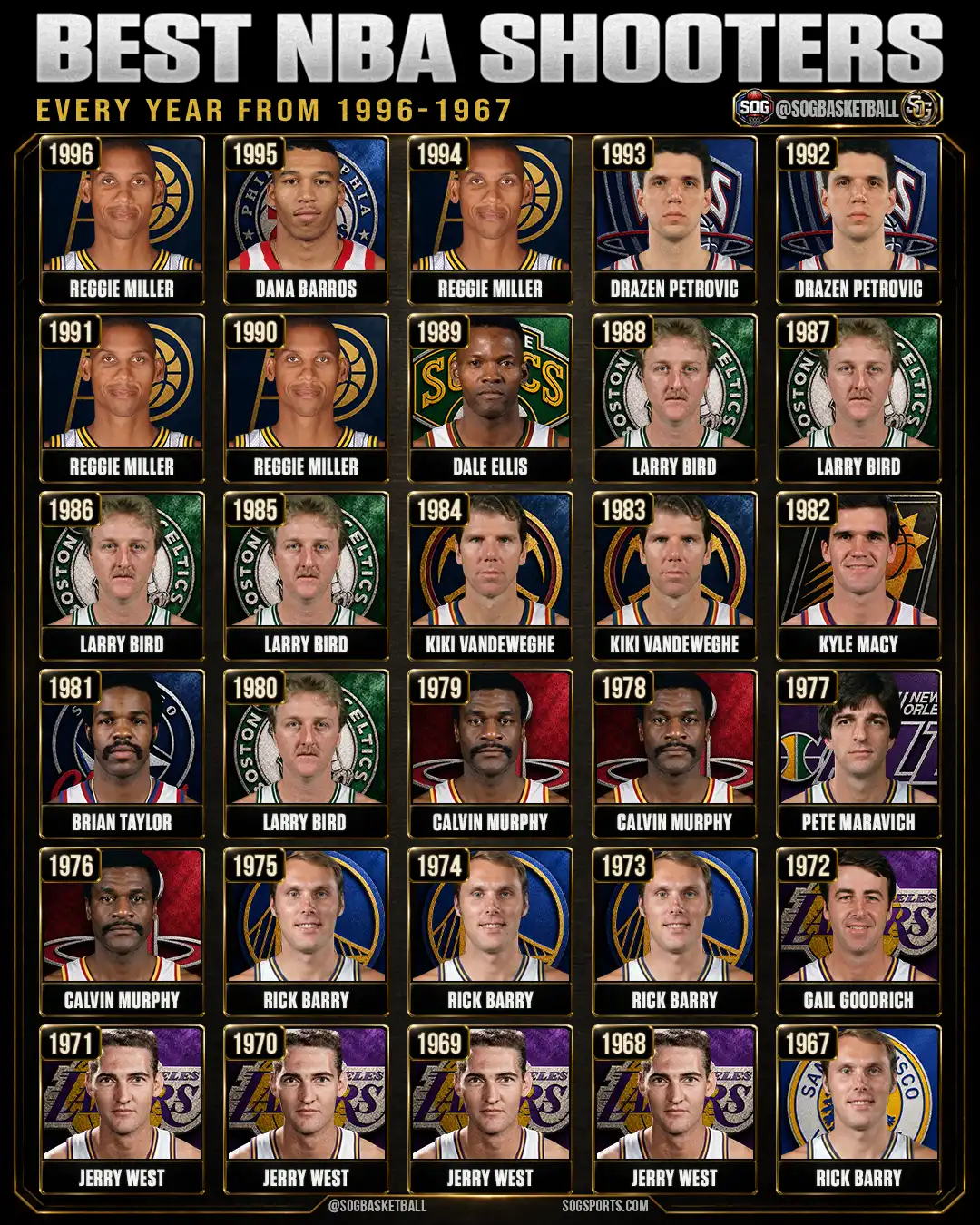
SOG Sports’ best NBA shooter for every season ending from 1996 through 1967.
1996 — Reggie Miller
Season evidence: 41.0% from three and 86.3% at the line.
Miller’s percentages only tell part of the story because defenders chased him through possessions before he touched the ball. His stamina, release speed and confidence on tightly contested attempts made him the league’s most influential movement shooter.
1995 — Dana Barros
Season evidence: 20.6 points per game and 46.4% from three on 5.2 attempts per game.
Barros produced a one-season shooting peak that was too strong to ignore. Miller remained the more established threat, but Barros combined exceptional accuracy with enough self-created offense to earn the narrow selection.
1994 — Reggie Miller
Season evidence: 42.1% from three.
Miller’s playoff moments later that spring strengthened his reputation, but his regular-season movement and efficiency already justified the choice. He created spacing by running defenders through screens until a single mistake produced an open jumper.
1993 — Dražen Petrović
Season evidence: 22.3 points per game, 51.8% from the field and 44.9% from three.
Petrović combined extreme accuracy with a real scoring workload rather than a specialist role. His willingness to shoot quickly and through pressure made the season feel modern decades later.
1992 — Dražen Petrović
Season evidence: 20.6 points per game, 50.8% from the field and 44.4% from three.
Petrović’s first full season as a featured NBA scorer immediately established him among the league’s purest shooters. His compact release and confidence allowed New Jersey to use him both on and off the ball.
1991 — Reggie Miller
Season evidence: 91.8% at the free-throw line, with a lower 34.8% mark from three.
This is not a percentage-leader selection. Miller gets the nod because his range, movement and ability to draw defenders away from the action made him a more consequential shooter than the raw three-point number suggests, though this remains one of the list’s closest calls.
1990 — Reggie Miller
Season evidence: 41.4% from three while averaging 24.6 points.
Miller paired high-level accuracy with a growing scoring burden and an off-ball style that opponents were not accustomed to defending. His willingness to treat the three as a primary weapon placed him ahead of the era’s lower-volume percentage leaders.
1989 — Dale Ellis
Season evidence: 27.5 points per game, 162 made threes and 47.8% from deep.
Ellis produced a perimeter season that looked years ahead of its time. Larry Bird had the stronger overall shooting résumé, but injuries limited Bird while Ellis combined star scoring volume with one of the best three-point percentages in the league.
1988 — Larry Bird
Season evidence: 29.9 points per game on 52.7% from the field, 41.4% from three and 91.6% at the line.
Bird’s second straight 50-40-90 season came with near-30-point scoring volume and a wide variety of difficult jumpers. The combination of precision, self-creation and late-clock confidence made him the clear choice.
1987 — Larry Bird
Season evidence: 52.5% from the field, 40.0% from three and 91.0% at the line.
Bird became the first NBA player to record a 50-40-90 season with enough makes to satisfy the modern benchmark. His touch extended from the post and midrange to the new three-point line without any area feeling ornamental.
1986 — Larry Bird
Season evidence: 49.6% from the field, 42.3% from three and 89.6% at the line.
Bird’s shooting helped anchor one of the greatest teams ever, and his percentages came with superstar shot difficulty. He could punish switches in the post, shoot over forwards and convert off-balance late-clock attempts.
1985 — Larry Bird
Season evidence: 28.7 points per game on 52.2% from the field and 42.7% from three.
Bird was already the league’s most complete jump shooter, combining deep range for the era with an automatic midrange game. His ability to create shots without losing efficiency separates him from the season’s specialists.
1984 — Kiki Vandeweghe
Season evidence: 29.4 points per game on 55.8% shooting from the field.
Three-point volume was still minimal across the league, so Vandeweghe’s selection rests on scoring efficiency and repeatable midrange touch. He generated star-level output without relying on power at the rim or a high free-throw volume alone.
1983 — Kiki Vandeweghe
Season evidence: 26.7 points per game on 54.7% from the field and 87.5% at the line.
Vandeweghe’s smooth release and ability to find the same shooting pockets repeatedly made him one of the league’s cleanest scorers. The pick reflects all-around jump-shot reliability rather than three-point production in an era that barely used the line.
1982 — Kyle Macy
Season evidence: 51.4% from the field, 39.0% from three and 89.9% at the line.
Campy Russell and Andrew Toney posted higher three-point percentages, but Macy offered the strongest complete shooting line across the floor and foul line. His 100 three-point attempts were also meaningful volume for the NBA’s third season with the arc.
1981 — Brian Taylor
Season evidence: an NBA-leading 38.3% from three.
The league was still experimenting with the arc, and most teams treated it as a rare change-up. Taylor’s willingness to use the shot and lead the NBA in accuracy made his range more valuable and unusual than the raw percentage appears today.
1980 — Larry Bird
Season evidence: 21.3 points per game with 40.6% from three during the line’s first NBA season.
Bird immediately understood how the new shot could complement his midrange touch and passing. His combination of size, confidence and perimeter accuracy gave Boston a shooting weapon few forwards could match.
1979 — Calvin Murphy
Season evidence: 20.2 points per game with 92.8% at the free-throw line.
With no three-point line, Murphy’s case rests on mechanics, pull-up touch and one of the league’s most dependable foul-line strokes. His compact release helped a small guard score efficiently against longer defenders.
1978 — Calvin Murphy
Season evidence: 25.6 points per game with 91.8% at the free-throw line.
Murphy combined high-volume guard scoring with a jumper that could be released before larger defenders recovered. His shot profile was built around midrange precision, a far more important skill in the spacing of the 1970s.
1977 — Pete Maravich
Season evidence: a league-leading 31.1 points per game.
Maravich was not the percentage leader, but his range and shot-making difficulty were extraordinary before deep attempts carried an extra point. Calvin Murphy offered the cleaner efficiency case; Maravich wins because his shooting created a much larger offensive burden and stretched the accepted boundaries of the era.
1976 — Calvin Murphy
Season evidence: 21.0 points per game, 49.3% from the field and 90.7% at the line.
Murphy’s accuracy was especially impressive for a 5-foot-9 guard who often had to rise quickly before contests arrived. His pull-up jumper and foul shooting made him one of the league’s safest perimeter scorers.
1975 — Rick Barry
Season evidence: 30.6 points per game and 90.4% at the line, followed by a championship and Finals MVP.
Barry’s underhand free throws attract attention, but his larger shooting package was the reason he could lead a title offense. He created from the wings, converted difficult midrange looks and possessed deeper range than the rules rewarded.
1974 — Rick Barry
Season evidence: 25.1 points per game and 89.9% at the line.
Barry’s quick release and willingness to shoot from extended distance gave Golden State a modern-looking perimeter scorer. His efficiency was not flawless, but his range and responsibility separated him from lower-volume specialists.
1973 — Rick Barry
Season evidence: 22.3 points per game and 90.2% at the line.
Returning to the NBA after his ABA years, Barry immediately restored his place among the league’s best shooters. He could score without a three-point bonus from areas that later became central to perimeter offense.
1972 — Gail Goodrich
Season evidence: 25.9 points per game on 48.7% from the field and 85.0% at the line.
Jerry West remained the more famous shooter, but Goodrich supplied the Lakers’ highest scoring average during their 69-win championship season. His left-handed jumper, pace and efficiency give him the narrow season-specific edge.
1971 — Jerry West
Season evidence: 26.9 points per game while shooting 49.4% from the field.
West’s pull-up balance and usable range were exceptional in a league still organized around the paint. His mechanics translated across transition, half-court isolations and pressure possessions.
1970 — Jerry West
Season evidence: a league-leading 31.2 points per game on 49.7% shooting.
West carried superstar scoring volume while maintaining outstanding guard efficiency for the era. Many of his deep jumpers would have been threes under modern rules, but even without the bonus they remained a central weapon.
1969 — Jerry West
Season evidence: 25.9 points per game and an 82.1% free-throw mark.
West’s postseason shot-making, including becoming the first Finals MVP despite the Lakers losing the series, strengthens a close regular-season case. His pull-up jumper and late-game accuracy made him the era’s perimeter standard.
1968 — Jerry West
Season evidence: 26.3 points per game on 51.4% shooting from the field.
West combined scoring volume with remarkable accuracy for a guard in a center-dominated league. His ability to stop into a balanced jumper before defenders could recover made the shot difficult to remove.
1967 — Rick Barry
Season evidence: a league-leading 35.6 points per game with 88.4% at the line.
Barry’s scoring title came through a varied jump-shot package, aggressive wing creation and elite touch at the stripe. Jerry West remained an obvious alternative, but Barry’s enormous season-long scoring burden gives him the opening selection.
What the 60-Year List Reveals
Stephen Curry owns the modern era
Curry receives 12 selections, the most of any player. His total includes seven straight seasons from 2013 through 2019 and another five-year run from 2021 through 2025. The dominance is not based only on made threes. He repeatedly combined league-leading volume with self-created difficulty and off-ball gravity.
Ray Allen bridges the Reggie Miller and Curry eras
Allen’s eight selections stretch from Milwaukee through Seattle and Boston. Miller established the movement-shooting blueprint, Allen added greater on-ball scoring responsibility and Curry later expanded the same concepts to deeper range and larger volume.
The three-point line changes the evidence, not the definition
The NBA introduced the arc in 1979–80, creating a clear statistical category for long-range shooting. Earlier selections cannot be compared through three-point percentage, so the article emphasizes touch, documented distance, pull-up accuracy, free throws and how rare perimeter creation was within that era.
Only 21 players fill all 60 seasons
The list is concentrated because shooting greatness tends to remain stable. Curry, Allen, Miller, Bird, Barry, West, Nash and Murphy account for 45 of the 60 selections, leaving only 15 seasons for the other 13 players.
Closest Calls and Most Debatable Seasons
2026: Kon Knueppel over Stephen Curry
Knueppel led the NBA with 273 threes and made 42.5% of them as a rookie. Curry remained the more difficult individual cover, but Knueppel’s league-leading total, efficiency and 81-game availability form the stronger season-specific case.
2025: Stephen Curry over Anthony Edwards and Malik Beasley
Edwards and Beasley finished first and second in total makes, while Curry ranked third. Curry stays on top because he remained significantly more responsible for creating his own threes and forcing defenses to guard several feet beyond the line.
2022: Stephen Curry despite a 38.0% regular season
Luke Kennard led the league in percentage, and several specialists were more accurate. Curry’s selection relies on shot difficulty, breaking the career three-point record and a championship postseason capped by a Finals MVP performance.
2012: Ray Allen over Steve Nash and Stephen Curry
Curry shot 45.5% from three but played only 26 games, while Nash offered stronger all-around efficiency. Allen combined 45.3% shooting with a larger sample and the league’s most established movement-shooting workload.
1991: Reggie Miller despite an ordinary three-point percentage
Miller’s 34.8% mark makes this one of the least statistically obvious selections. The choice values his free-throw touch, range and the defensive attention produced by his off-ball movement, but it remains a legitimate debate with the season’s higher-percentage specialists.
1982: Kyle Macy over the percentage leaders
Campy Russell and Andrew Toney were more accurate from three. Macy’s case is the complete line: 51.4% from the field, 39.0% from three and 89.9% at the stripe while taking meaningful long-range volume for the era.
1972: Gail Goodrich over Jerry West
West was the stronger all-time shooter, but Goodrich led the 69-win Lakers in scoring and shot 48.7% from the field. The selection is intentionally season-specific rather than a judgment of their full careers.
Complete Year-by-Year Table
| Year | Player | Team |
|---|---|---|
| 2026 | Kon Knueppel | Charlotte Hornets |
| 2025 | Stephen Curry | Golden State Warriors |
| 2024 | Stephen Curry | Golden State Warriors |
| 2023 | Stephen Curry | Golden State Warriors |
| 2022 | Stephen Curry | Golden State Warriors |
| 2021 | Stephen Curry | Golden State Warriors |
| 2020 | Damian Lillard | Portland Trail Blazers |
| 2019 | Stephen Curry | Golden State Warriors |
| 2018 | Stephen Curry | Golden State Warriors |
| 2017 | Stephen Curry | Golden State Warriors |
| 2016 | Stephen Curry | Golden State Warriors |
| 2015 | Stephen Curry | Golden State Warriors |
| 2014 | Stephen Curry | Golden State Warriors |
| 2013 | Stephen Curry | Golden State Warriors |
| 2012 | Ray Allen | Boston Celtics |
| 2011 | Ray Allen | Boston Celtics |
| 2010 | Steve Nash | Phoenix Suns |
| 2009 | Ray Allen | Boston Celtics |
| 2008 | Steve Nash | Phoenix Suns |
| 2007 | Steve Nash | Phoenix Suns |
| 2006 | Ray Allen | Seattle SuperSonics |
| 2005 | Kyle Korver | Philadelphia 76ers |
| 2004 | Peja Stojaković | Sacramento Kings |
| 2003 | Ray Allen | Milwaukee Bucks / Seattle SuperSonics |
| 2002 | Ray Allen | Milwaukee Bucks |
| 2001 | Ray Allen | Milwaukee Bucks |
| 2000 | Ray Allen | Milwaukee Bucks |
| 1999 | Reggie Miller | Indiana Pacers |
| 1998 | Reggie Miller | Indiana Pacers |
| 1997 | Glen Rice | Charlotte Hornets |
| 1996 | Reggie Miller | Indiana Pacers |
| 1995 | Dana Barros | Philadelphia 76ers |
| 1994 | Reggie Miller | Indiana Pacers |
| 1993 | Dražen Petrović | New Jersey Nets |
| 1992 | Dražen Petrović | New Jersey Nets |
| 1991 | Reggie Miller | Indiana Pacers |
| 1990 | Reggie Miller | Indiana Pacers |
| 1989 | Dale Ellis | Seattle SuperSonics |
| 1988 | Larry Bird | Boston Celtics |
| 1987 | Larry Bird | Boston Celtics |
| 1986 | Larry Bird | Boston Celtics |
| 1985 | Larry Bird | Boston Celtics |
| 1984 | Kiki Vandeweghe | Denver Nuggets |
| 1983 | Kiki Vandeweghe | Denver Nuggets |
| 1982 | Kyle Macy | Phoenix Suns |
| 1981 | Brian Taylor | San Diego Clippers |
| 1980 | Larry Bird | Boston Celtics |
| 1979 | Calvin Murphy | Houston Rockets |
| 1978 | Calvin Murphy | Houston Rockets |
| 1977 | Pete Maravich | New Orleans Jazz |
| 1976 | Calvin Murphy | Houston Rockets |
| 1975 | Rick Barry | Golden State Warriors |
| 1974 | Rick Barry | Golden State Warriors |
| 1973 | Rick Barry | Golden State Warriors |
| 1972 | Gail Goodrich | Los Angeles Lakers |
| 1971 | Jerry West | Los Angeles Lakers |
| 1970 | Jerry West | Los Angeles Lakers |
| 1969 | Jerry West | Los Angeles Lakers |
| 1968 | Jerry West | Los Angeles Lakers |
| 1967 | Rick Barry | San Francisco Warriors |
Frequently Asked Questions
Who appears most often as the best NBA shooter?
Stephen Curry appears most often with 12 selections. Ray Allen has eight, Reggie Miller has six, Larry Bird has five, and Rick Barry and Jerry West have four apiece.
Who is the 2026 selection?
Kon Knueppel is the 2026 choice after making a league-leading 273 threes at a 42.5% rate as a Charlotte Hornets rookie. Stephen Curry was the closest alternative.
What is the greatest shooting season on the list?
Stephen Curry’s 2016 season is the strongest. He made a record 402 threes at 45.4%, shot 50.4% overall and 90.8% from the line, won the scoring title and became the first unanimous NBA MVP.
When did the NBA introduce the three-point line?
The NBA introduced the three-point line for the 1979–80 season. Seasons before 1980 therefore require a different evaluation based on touch, range, jump-shot creation, field-goal efficiency and free-throw accuracy.
Is the list based only on three-point percentage?
No. Percentage without volume or difficulty can be misleading. The ranking also weighs total makes, attempts, movement shooting, pull-up creation, defensive attention, free throws, midrange skill, postseason performance and era context.
Last reviewed: August 3, 2026.
Conclusion
The best NBA shooters every year list starts with Rick Barry in 1967 and ends with Kon Knueppel in 2026, but Stephen Curry is its central figure. His 12 selections and record-setting 2016 season show the largest leap in volume, range and defensive influence the league has seen.
The earlier names still require proper era context. Jerry West, Barry and Calvin Murphy built their cases without a three-point bonus; Bird, Miller and Allen expanded the perimeter role after the arc arrived; Curry then made extreme range and volume foundational to championship offense.
Related NBA Rankings
Continue with the best point guards of all-time, the best NBA players of all-time and the best NBA centers every year. The complete basketball archive is available through the SOG Sports NBA hub.
For daily graphics and debates, follow SOG Basketball on Instagram.
