
Best NHL Goalies Every Year From 1967 to 2026
The best NHL goalies every year list is a year-by-year look at the netminders who owned their era, carried playoff runs, stole regular-season games and changed how teams felt when they had a lead. Goalie greatness is not always clean to measure, because the job depends on team defense, era scoring, workload, playoff pressure and how often a goalie had to save a season by himself.
This list follows the graphic order from 1967 through 2026. It starts with legends like Ed Giacomin, Gump Worsley, Jacques Plante, Tony Esposito and Ken Dryden, then moves through Bernie Parent, Billy Smith, Grant Fuhr, Patrick Roy, Dominik Hasek, Martin Brodeur, Tim Thomas, Carey Price, Andrei Vasilevskiy, Igor Shesterkin, Linus Ullmark and Connor Hellebuyck.
The goal is simple: pick the goalie who had the strongest case in each season. Some years are about regular-season dominance. Some are about playoff heroics. Some are about a goalie carrying a team farther than it probably should have gone. The best goalie in a given year is usually the one who made the crease feel like the safest place in hockey.
Table of Contents
How We Picked the Best NHL Goalie Every Year
Goalie rankings are never just about wins. A great team can inflate a goalie’s record, and a bad team can hide a brilliant season. That is why this list looks at the full picture: save percentage, goals-against average, shutouts, workload, awards, playoff runs, pressure moments and how much of the team’s success truly depended on the goalie.
For older eras, the comparison is even trickier. Save percentage was not always tracked the same way, and the style of goaltending changed dramatically over time. Jacques Plante, Gump Worsley, Ken Dryden and Tony Esposito played a different game than Dominik Hasek, Patrick Roy, Martin Brodeur and Andrei Vasilevskiy. That does not make the older seasons less valuable. It just means they need era context.
- Regular-season dominance: Vezina-level play, elite save percentage, shutouts and workload.
- Playoff impact: Stanley Cup runs, Conn Smythe-level performances and series-stealing games.
- Team context: whether the goalie carried a weaker roster or strengthened an already great team.
- Era context: scoring environment, goalie equipment, schedule length and style of play.
- Peak value: how clearly the goalie separated from the rest of the league that season.
- Legacy moments: seasons that became part of NHL goalie history.
The best NHL goalie each year is the one whose season had the strongest mix of numbers, impact and historical weight.
Best NHL Goalies Each Year, 2026–1997
2026 — Andrei Vasilevskiy
Andrei Vasilevskiy takes the 2026 slot on the graphic as the modern standard for high-end goalie trust. Even after years of heavy playoff mileage, his size, athleticism and ability to settle a game still make him one of the most respected goalies in hockey.
Vasilevskiy’s case is built on more than one season. He has been the goalie opponents expect to see in the biggest moments, and that reputation matters in a year-by-year list where the crease can swing quickly from one star to another.
2025 — Connor Hellebuyck
Connor Hellebuyck belongs here because his regular-season consistency has become almost automatic. Winnipeg has leaned on him heavily for years, and he keeps giving the Jets elite work despite facing difficult minutes and heavy responsibility.
Hellebuyck is not a flashy goalie in the way Dominik Hasek was, but he is incredibly dependable. He reads plays early, stays square, handles volume and gives his team a chance almost every night.
2024 — Connor Hellebuyck
Hellebuyck’s 2024 season was a classic elite-workload goalie year. He finished with a Vezina-caliber résumé, a save percentage around the top of the league and the kind of steady dominance that carried Winnipeg through long stretches.
What makes Hellebuyck special is how repeatable his game feels. He does not need chaos to look great. He wins with positioning, patience and the ability to make hard saves look routine.
2023 — Linus Ullmark
Linus Ullmark’s 2023 season was one of the best regular-season goalie years of the modern era. He went 40-6-1, posted a 1.89 goals-against average and finished with a .938 save percentage for a historically dominant Bruins team.
Boston’s defensive structure helped, but Ullmark was not just along for the ride. He made the saves a great team still needs, won the Vezina Trophy and gave the Bruins elite stability from October through April.
2022 — Igor Shesterkin
Igor Shesterkin owned 2022 with a season that felt like a direct throwback to the days when one goalie could drag a team higher than expected. He finished with a .935 save percentage, a 2.07 goals-against average and won the Vezina Trophy.
Shesterkin’s athleticism and calm made him nearly impossible to solve for long stretches. The Rangers had talent, but his goaltending was the biggest reason they felt dangerous every night.
2021 — Andrei Vasilevskiy
Vasilevskiy’s 2021 season was about both regular-season excellence and playoff authority. He was already established as one of the league’s best goalies, but Tampa Bay’s repeat Stanley Cup run pushed his reputation to another level.
He won the Conn Smythe Trophy and repeatedly slammed the door in elimination and closeout games. Some goalies have strong numbers. Vasilevskiy had numbers, presence and championship timing.
2020 — Andrei Vasilevskiy
Vasilevskiy gets 2020 because he was the backbone of Tampa Bay’s Stanley Cup run. In a strange postseason environment, the Lightning needed calm, endurance and elite goaltending. Vasilevskiy gave them all of it.
He started every playoff game for Tampa Bay and handled the pressure of a team trying to erase past playoff disappointment. That kind of workload during a Cup run carries serious weight.
2019 — Ben Bishop
Ben Bishop’s 2019 season was brilliant. He posted a .934 save percentage and a goals-against average under 2.00, giving Dallas one of the best goalie seasons of the year.
Bishop’s size and positioning made him look impossible to beat when he was locked in. He did not win the Vezina that season, but his actual level of play gives him a strong case for the year.
2018 — Marc-Andre Fleury
Marc-Andre Fleury’s 2018 season was about more than the stat sheet. He became the emotional face of the Vegas Golden Knights’ miracle expansion run and played some of the best hockey of his career.
Fleury posted a strong regular season, then helped carry Vegas all the way to the Stanley Cup Final. His athletic saves, confidence and playoff poise made him the defining goalie story of 2018.
2017 — Sergei Bobrovsky
Sergei Bobrovsky was the clear goalie of the year in 2017. He won the Vezina Trophy after posting 41 wins, a 2.06 goals-against average and a .931 save percentage.
Bobrovsky’s game was built on explosion and flexibility, but that season also showed how controlled he could be. Columbus had one of its best years, and Bobrovsky was the main reason.
2016 — Braden Holtby
Braden Holtby’s 2016 season was a regular-season machine. He tied the NHL single-season wins record with 48 victories and won the Vezina Trophy.
Washington was loaded, but Holtby gave that team the calm, structured goaltending it needed. His positioning, tracking and consistency made him the league’s safest choice that year.
2015 — Carey Price
Carey Price’s 2015 season is one of the greatest goalie seasons ever. He won the Hart Trophy, Vezina Trophy, Ted Lindsay Award and Jennings Trophy, a rare sweep that showed how dominant he was.
Price posted a .933 save percentage and a 1.96 goals-against average, but the numbers only tell part of it. Montreal felt like a different team because Price was in net. He was calm, efficient and almost unbeatable at his peak.
2014 — Tuukka Rask
Tuukka Rask gets 2014 after a Vezina-winning season with Boston. He finished with a .930 save percentage and gave the Bruins elite, composed goaltending behind a strong defensive team.
Rask’s style was not dramatic. He rarely looked out of control, and that was the point. His positioning and patience made him one of the hardest goalies in the league to beat cleanly.
2013 — Tuukka Rask
Rask’s 2013 season was another outstanding year, especially when Boston pushed all the way to the Stanley Cup Final. In a shortened regular season, he gave the Bruins steady, high-level play.
His playoff run strengthened the case. Rask was sharp, composed and capable of stealing stretches of series, which is exactly what a team needs from a top goalie.
2012 — Jonathan Quick
Jonathan Quick’s 2012 season was the perfect mix of regular-season excellence and playoff dominance. He posted a 1.95 goals-against average and a .929 save percentage in the regular season, then became nearly unbeatable in the playoffs.
Quick won the Conn Smythe Trophy as the Kings captured the Stanley Cup. His athleticism, edge work and desperation saves made Los Angeles feel like it had a wall behind its defense.
2011 — Tim Thomas
Tim Thomas had one of the most unforgettable goalie seasons in NHL history in 2011. He finished with a .938 save percentage, won the Vezina Trophy and then carried that form into a Stanley Cup run.
Thomas was not textbook, and that made him fascinating. He battled, scrambled, attacked shooters and refused to let plays die. His Conn Smythe-winning playoff run sealed the year.
2010 — Ryan Miller
Ryan Miller’s 2010 season combined elite NHL work with a massive international spotlight. He won the Vezina Trophy after posting a .929 save percentage and became the backbone of Buffalo’s season.
His Olympic performance for the United States added to the feeling that he was the best goalie in the world that year. Miller was sharp, calm and technically clean under heavy pressure.
2009 — Tim Thomas
Tim Thomas gets 2009 after a Vezina-winning season in Boston. He posted a .933 save percentage and gave the Bruins elite goaltending with a style that looked chaotic but worked beautifully.
Thomas made difficult saves from unusual positions and seemed to fight through every second chance. He did not look like every other top goalie, which made his peak even more memorable.
2008 — Martin Brodeur
Martin Brodeur was still the standard in 2008. He won the Vezina Trophy and continued to give New Jersey elite durability, puck-handling and late-game confidence.
Brodeur’s greatness was not just about saves. He controlled dump-ins, helped his defensemen and made the Devils’ system work more smoothly than it could have with almost anyone else.
2007 — Martin Brodeur
Brodeur’s 2007 season was one of his finest. He won 48 games, captured the Vezina Trophy and carried a massive workload while still playing at an elite level.
The Devils trusted him with everything. He was a goaltender, a third defenseman with the puck and one of the most reliable closers in hockey.
2006 — Miikka Kiprusoff
Miikka Kiprusoff owned 2006 with a Vezina-winning season in Calgary. He posted a 2.07 goals-against average and a .923 save percentage, giving the Flames the kind of goaltending identity that made every game tight.
Kiprusoff was calm, compact and difficult to rattle. Calgary could play low-event hockey because it trusted him to win the margins.
2005 — No Player
There is no player for 2005 because the NHL season was canceled due to the lockout. No games meant no regular-season goalie race, no Vezina campaign and no playoff run to judge.
It is the one year on the list where the right answer is simply no player.
2004 — Miikka Kiprusoff
Kiprusoff’s 2004 season was one of the great breakout goalie stories of the era. He posted a 1.69 goals-against average and a .933 save percentage in the regular season, then helped carry Calgary all the way to the Stanley Cup Final.
That playoff run changed his career. Kiprusoff went from strong goalie to franchise backbone almost overnight, and 2004 remains the signature season of his peak.
2003 — Jean-Sébastien Giguère
Jean-Sébastien Giguère gets 2003 because his playoff run was unforgettable. He carried Anaheim to the Stanley Cup Final and won the Conn Smythe Trophy despite the Ducks falling short.
Giguère was huge in net, especially with the era’s equipment and butterfly style. He swallowed shots, shut down angles and turned Anaheim into one of the toughest teams to finish off.
2002 — Jose Theodore
Jose Theodore’s 2002 season was a massive individual achievement. He won both the Hart Trophy and Vezina Trophy after posting a .931 save percentage for Montreal.
Theodore was quick, confident and spectacular when the Canadiens needed him most. His season stands as one of the strongest underdog goalie runs of the early 2000s.
2001 — Patrick Roy
Patrick Roy gets 2001 because he was still a championship-level force. Colorado won the Stanley Cup, and Roy gave that loaded team the postseason goaltending it needed to finish the job.
Roy was past the early Montreal version of his career, but the big-game presence remained. His ability to rise in playoff moments is why he appears so often on lists like this.
2000 — Ed Belfour
Ed Belfour’s 2000 season kept him among the league’s top goalies. Dallas was still a defensive heavyweight, and Belfour gave the Stars veteran poise and technical strength in net.
His game was intense, competitive and structured. Belfour played with an edge, and that edge fit perfectly with the identity of those Stars teams.
1999 — Dominik Hasek
Dominik Hasek gets 1999 because he was still the most difficult goalie in the world to solve. His style looked impossible to teach: flips, sprawls, kicks, lunges and saves that seemed to come from nowhere.
Hasek’s late-1990s run is one of the strongest goalie peaks ever. Even when Buffalo was not the most talented team, he could make every game feel winnable.
1998 — Dominik Hasek
Hasek’s 1998 season was legendary. He won the Hart Trophy and Vezina Trophy, then led the Czech Republic to Olympic gold in Nagano.
That year captured the full Hasek experience. He was unpredictable, brilliant and mentally exhausting for shooters. There may never be another goalie quite like him.
1997 — Dominik Hasek
Dominik Hasek’s 1997 season was the start of his back-to-back Hart Trophy run. He posted elite numbers, won the Vezina and proved a goalie could be the most valuable player in the league.
Buffalo leaned on him heavily, and Hasek answered with one of the most dominant individual goalie seasons of the decade.
Best NHL Goalies Each Year, 1996–1967
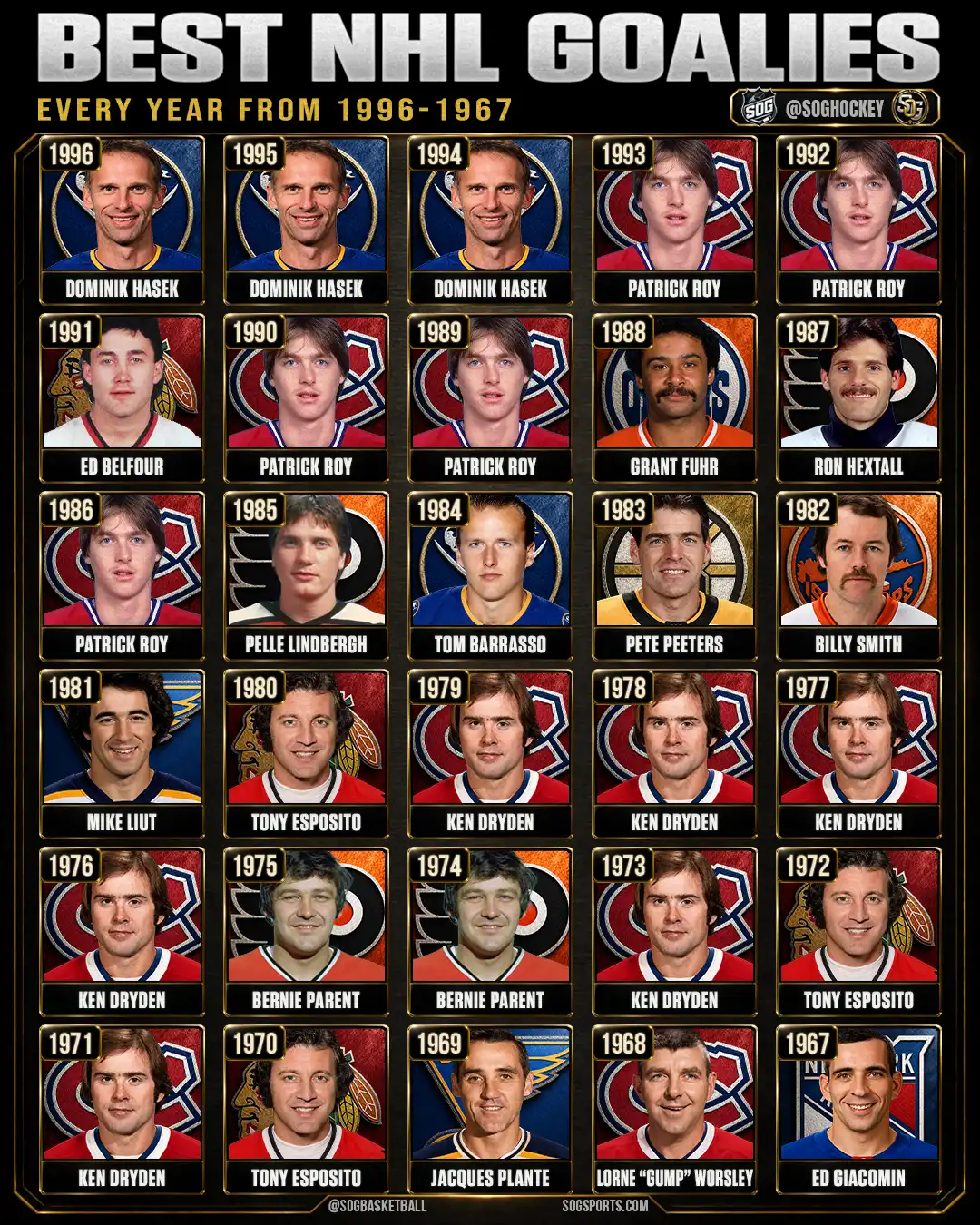
Best NHL goalies every year from 1996 to 1967, featuring Dominik Hasek, Patrick Roy, Ed Belfour, Grant Fuhr, Ron Hextall, Ken Dryden, Tony Esposito, Bernie Parent, Jacques Plante, and more.
1996 — Dominik Hasek
Hasek gets 1996 because he had already become the league’s most unique goalie. His flexibility, reads and desperation saves made him look less like a system goalie and more like an artist trying to ruin every scoring chance.
Even before his Hart Trophy seasons, Hasek had the aura of a goalie who could turn a normal night into something strange for shooters.
1995 — Dominik Hasek
Hasek’s 1995 season continued his rise as the league’s toughest goalie to beat. He won the Vezina Trophy and gave Buffalo elite goaltending in a shortened season.
His save percentage again sat near the top of the league, and his style kept forcing opponents into frustration. Hasek did not just stop shots. He made shooters question what they had seen.
1994 — Dominik Hasek
Dominik Hasek’s 1994 season was his true arrival as a superstar. He posted a .930 save percentage, won the Vezina Trophy and gave Buffalo one of the league’s best individual goalie seasons.
This was the year the hockey world fully realized Hasek was different. He was not technically traditional, but the puck kept staying out of the net.
1993 — Patrick Roy
Patrick Roy’s 1993 season is defined by playoff greatness. Montreal won the Stanley Cup, and Roy won the Conn Smythe Trophy after repeatedly stealing overtime games and tight series.
His calm under pressure became part of his legend. The Canadiens were not the most obvious Cup favorite, but Roy’s postseason pushed them all the way.
1992 — Patrick Roy
Roy was already the best big-game goalie in hockey by 1992. His regular-season play kept Montreal competitive, and his playoff reputation made every matchup feel dangerous.
He had the technique, confidence and edge that defined the butterfly generation before it became the standard for everyone.
1991 — Ed Belfour
Ed Belfour’s 1991 season was one of the best rookie goalie seasons ever. He won the Calder Trophy and Vezina Trophy while giving Chicago elite goaltending right away.
Belfour had a fiery style, but underneath it was real technical strength. He stepped into the league and immediately looked like a franchise goalie.
1990 — Patrick Roy
Roy gets 1990 because he remained one of the league’s premier goalies during Montreal’s post-1986 Cup years. His combination of technique, confidence and playoff memory kept him ahead of most of the pack.
By this point, Roy was no longer just a young goalie with a miracle run. He was a proven superstar at the position.
1989 — Patrick Roy
Patrick Roy’s 1989 season strengthened his case as the best goalie in the world. Montreal reached the Stanley Cup Final, and Roy’s goaltending was a major reason the Canadiens remained a serious contender.
His butterfly style helped change the position. Roy did not just win games; he helped shape what the next generation of goalies wanted to become.
1988 — Grant Fuhr
Grant Fuhr gets 1988 because he was the perfect goalie for the Oilers’ dynasty. Edmonton played aggressively, traded chances and trusted Fuhr to make the save when chaos arrived.
Fuhr’s regular-season numbers did not always look like modern goalie dominance, but his pressure saves and Stanley Cup résumé mattered. In big moments, Edmonton trusted him completely.
1987 — Ron Hextall
Ron Hextall’s 1987 season was explosive. He won the Vezina Trophy, took home the Conn Smythe despite Philadelphia losing the Stanley Cup Final, and brought an aggressive puck-handling style that made him feel different.
Hextall was intense, athletic and fearless. His playoff run against Edmonton remains one of the strongest losing-team Conn Smythe cases in NHL history.
1986 — Patrick Roy
Patrick Roy’s rookie playoff run in 1986 is one of the great goalie origin stories. Montreal won the Stanley Cup, and Roy won the Conn Smythe Trophy as a 20-year-old.
That spring changed everything. Roy looked fearless, composed and technically ahead of his time. It was the start of one of the greatest goalie careers ever.
1985 — Pelle Lindbergh
Pelle Lindbergh’s 1985 season was brilliant and heartbreaking in hindsight. He won the Vezina Trophy and helped lead Philadelphia to the Stanley Cup Final.
Lindbergh was quick, confident and in complete command during his peak. His career was tragically cut short, but 1985 remains a season that showed just how special he was.
1984 — Tom Barrasso
Tom Barrasso had an incredible rookie season in 1984. He won both the Calder Trophy and Vezina Trophy, rare proof that he was already among the league’s best goalies right away.
Barrasso was young, poised and technically advanced for his age. Buffalo had a franchise goalie almost immediately.
1983 — Pete Peeters
Pete Peeters gets 1983 after a dominant regular season with Boston. He won the Vezina Trophy and posted one of the league’s best goals-against marks.
Peeters gave the Bruins stability and high-end performance during a season where he clearly separated himself from most of the league’s goalie field.
1982 — Billy Smith
Billy Smith was built for playoff hockey, and 1982 captured that reputation. He was the backbone of the Islanders dynasty and won the Vezina Trophy during another championship season.
Smith was fiery, competitive and difficult to rattle. The Islanders had stars everywhere, but their dynasty needed his edge in net.
1981 — Mike Liut
Mike Liut gets 1981 after a huge season with St. Louis. He won the Pearson Award and was one of the strongest MVP-level goalie stories of the year.
Liut carried a heavy workload and gave the Blues one of the best seasons in franchise goalie history. His year deserves more attention than it usually gets.
1980 — Tony Esposito
Tony Esposito was still giving Chicago elite goaltending in 1980. Even as the league changed around him, his reflexes, angles and consistency remained strong.
Esposito’s style helped bridge eras. He had already been a star for years, but he was still good enough to claim another spot on this list.
1979 — Ken Dryden
Ken Dryden gets 1979 because he closed his career as part of Montreal’s dynasty with another Stanley Cup season. Dryden’s numbers were helped by an incredible team, but his value was real.
He gave the Canadiens size, calm and intelligence in net. Montreal could dominate possession, and when opponents broke through, Dryden was usually waiting.
1978 — Ken Dryden
Dryden’s 1978 season was another championship year in the middle of Montreal’s dynasty. His regular-season record and playoff reliability made him the natural choice.
Dryden did not always face the same volume as goalies on weaker teams, but when pressure arrived, he had the poise to handle it. That was a major part of Montreal’s greatness.
1977 — Ken Dryden
Ken Dryden’s 1977 season came during one of the greatest team seasons in NHL history. The Canadiens were dominant, and Dryden gave them elite goaltending behind that machine.
He posted a brilliant regular season and helped Montreal finish the job in the playoffs. Few teams have ever had a better combination of defensive structure and goalie confidence.
1976 — Ken Dryden
Dryden returned to the top of the list in 1976 as Montreal began another Stanley Cup run. His size and calm made him a perfect fit behind a team that could control games from every zone.
Dryden’s best seasons can be hard to separate from Montreal’s dominance, but that should not erase how dependable he was when the biggest moments arrived.
1975 — Bernie Parent
Bernie Parent’s 1975 season completed one of the greatest two-year goalie peaks in NHL history. He won another Vezina Trophy and another Conn Smythe as Philadelphia repeated as Stanley Cup champion.
Parent was technically sharp, mentally tough and brilliant under playoff pressure. For those two Flyers Cup seasons, he was the best goalie in the world.
1974 — Bernie Parent
Bernie Parent’s 1974 season is one of the greatest goalie seasons ever. He won 47 games, posted a 1.89 goals-against average, won the Vezina Trophy and then won the Conn Smythe as the Flyers captured the Stanley Cup.
Philadelphia’s style was physical and intimidating, but Parent was the final wall. His goaltending gave the Broad Street Bullies championship balance.
1973 — Ken Dryden
Ken Dryden gets 1973 after helping Montreal win another Stanley Cup. He was already established as one of the league’s premier goalies, and his calm style fit the Canadiens perfectly.
Dryden’s presence made Montreal feel almost impossible to shake. Even when games tightened, he rarely looked rushed.
1972 — Tony Esposito
Tony Esposito was still one of the league’s strongest goaltenders in 1972. Chicago leaned on him heavily, and his reflexes made him one of the toughest goalies to beat during the early 1970s.
His ability to handle pressure and produce strong seasons year after year keeps him in the middle of this era’s goalie debate.
1971 — Ken Dryden
Ken Dryden’s 1971 playoff run is one of the most famous goalie arrivals in NHL history. He had barely played in the regular season, then helped Montreal win the Stanley Cup and took home the Conn Smythe Trophy.
It was a stunning rise. Dryden stepped into the highest-pressure spot in hockey and looked like he had been built for it.
1970 — Tony Esposito
Tony Esposito’s rookie season in 1970 was sensational. He posted 15 shutouts, won the Calder Trophy and shared the Vezina Trophy.
That kind of immediate impact is rare. Esposito gave Chicago a star goalie right away and became one of the defining netminders of the decade.
1969 — Jacques Plante
Jacques Plante gets 1969 because even late in his career, he was still changing games. With St. Louis, he helped give the Blues elite goaltending and veteran structure.
Plante’s hockey mind was as important as his reflexes. He understood angles, positioning and puck movement at a level that influenced generations of goalies.
1968 — Lorne “Gump” Worsley
Gump Worsley gets 1968 after a strong season in Montreal’s crease. He was tough, experienced and trusted on a Canadiens team that knew how to win.
Worsley did not look like the modern athletic goalie, but he battled, competed and gave Montreal exactly what it needed during another championship-era season.
1967 — Ed Giacomin
Ed Giacomin opens the list in 1967 as one of the top goalies of the late Original Six era. His quickness, workload and consistency made him the standout choice for the year.
Giacomin became one of the faces of Rangers goaltending, and his peak seasons helped define what high-level crease play looked like before the expansion era fully changed the league.
Closest Calls on the List
Goalie debates are always tough because a Vezina season, a playoff run and a high save percentage do not always point to the same player. These were some of the hardest years to sort out.
2025 — Connor Hellebuyck vs. Andrei Vasilevskiy
Vasilevskiy has the stronger championship reputation, but Hellebuyck’s regular-season consistency gives him the cleaner year-specific case. When a goalie handles that kind of workload and stays near the top of the league, he is hard to pass.
2023 — Linus Ullmark vs. Igor Shesterkin
Shesterkin was still elite, but Ullmark’s numbers were too strong to ignore. A 40-win season with a .938 save percentage made him the clear regular-season choice, even if Boston’s playoff exit complicates the memory.
2019 — Ben Bishop vs. Andrei Vasilevskiy
Vasilevskiy had the award case, but Bishop’s save percentage and overall level were outstanding. Bishop gets the nod here because his season was one of the cleanest examples of elite shot-stopping in that year.
2018 — Marc-Andre Fleury vs. Pekka Rinne
Rinne won the Vezina Trophy, but Fleury’s expansion-team story and playoff run made 2018 feel like his year. This is one of those debates where awards and narrative pull in different directions.
2012 — Jonathan Quick vs. Henrik Lundqvist
Lundqvist won the Vezina, but Quick’s regular season plus Conn Smythe-winning Stanley Cup run gives him the stronger full-season case. His playoff dominance is the separator.
2004 — Miikka Kiprusoff vs. Martin Brodeur
Brodeur had the bigger established résumé, but Kiprusoff’s breakout season and Calgary’s Cup Final run made him the defining goalie story of 2004. His numbers were elite and his impact was obvious.
1993 — Patrick Roy vs. Ed Belfour
Belfour had a strong regular-season case, but Roy’s playoff run was too big to ignore. Montreal’s Stanley Cup and Roy’s Conn Smythe swing the year toward him.
1974 — Bernie Parent vs. Tony Esposito
Esposito was still great, but Parent’s 1974 season had everything: wins, Vezina-level regular-season play, a Stanley Cup and a Conn Smythe. That is one of the strongest goalie years ever.
Full Year-by-Year Table: Best NHL Goalie Every Year
| Year | Best NHL Goalie | Team Shown |
|---|---|---|
| 2026 | Andrei Vasilevskiy | Tampa Bay Lightning |
| 2025 | Connor Hellebuyck | Winnipeg Jets |
| 2024 | Connor Hellebuyck | Winnipeg Jets |
| 2023 | Linus Ullmark | Boston Bruins |
| 2022 | Igor Shesterkin | New York Rangers |
| 2021 | Andrei Vasilevskiy | Tampa Bay Lightning |
| 2020 | Andrei Vasilevskiy | Tampa Bay Lightning |
| 2019 | Ben Bishop | Dallas Stars |
| 2018 | Marc-Andre Fleury | Vegas Golden Knights |
| 2017 | Sergei Bobrovsky | Columbus Blue Jackets |
| 2016 | Braden Holtby | Washington Capitals |
| 2015 | Carey Price | Montreal Canadiens |
| 2014 | Tuukka Rask | Boston Bruins |
| 2013 | Tuukka Rask | Boston Bruins |
| 2012 | Jonathan Quick | Los Angeles Kings |
| 2011 | Tim Thomas | Boston Bruins |
| 2010 | Ryan Miller | Buffalo Sabres |
| 2009 | Tim Thomas | Boston Bruins |
| 2008 | Martin Brodeur | New Jersey Devils |
| 2007 | Martin Brodeur | New Jersey Devils |
| 2006 | Miikka Kiprusoff | Calgary Flames |
| 2005 | No Player | No NHL Season |
| 2004 | Miikka Kiprusoff | Calgary Flames |
| 2003 | Jean-Sébastien Giguère | Anaheim Mighty Ducks |
| 2002 | Jose Theodore | Montreal Canadiens |
| 2001 | Patrick Roy | Colorado Avalanche |
| 2000 | Ed Belfour | Dallas Stars |
| 1999 | Dominik Hasek | Buffalo Sabres |
| 1998 | Dominik Hasek | Buffalo Sabres |
| 1997 | Dominik Hasek | Buffalo Sabres |
| 1996 | Dominik Hasek | Buffalo Sabres |
| 1995 | Dominik Hasek | Buffalo Sabres |
| 1994 | Dominik Hasek | Buffalo Sabres |
| 1993 | Patrick Roy | Montreal Canadiens |
| 1992 | Patrick Roy | Montreal Canadiens |
| 1991 | Ed Belfour | Chicago Blackhawks |
| 1990 | Patrick Roy | Montreal Canadiens |
| 1989 | Patrick Roy | Montreal Canadiens |
| 1988 | Grant Fuhr | Edmonton Oilers |
| 1987 | Ron Hextall | Philadelphia Flyers |
| 1986 | Patrick Roy | Montreal Canadiens |
| 1985 | Pelle Lindbergh | Philadelphia Flyers |
| 1984 | Tom Barrasso | Buffalo Sabres |
| 1983 | Pete Peeters | Boston Bruins |
| 1982 | Billy Smith | New York Islanders |
| 1981 | Mike Liut | St. Louis Blues |
| 1980 | Tony Esposito | Chicago Blackhawks |
| 1979 | Ken Dryden | Montreal Canadiens |
| 1978 | Ken Dryden | Montreal Canadiens |
| 1977 | Ken Dryden | Montreal Canadiens |
| 1976 | Ken Dryden | Montreal Canadiens |
| 1975 | Bernie Parent | Philadelphia Flyers |
| 1974 | Bernie Parent | Philadelphia Flyers |
| 1973 | Ken Dryden | Montreal Canadiens |
| 1972 | Tony Esposito | Chicago Blackhawks |
| 1971 | Ken Dryden | Montreal Canadiens |
| 1970 | Tony Esposito | Chicago Blackhawks |
| 1969 | Jacques Plante | St. Louis Blues |
| 1968 | Lorne “Gump” Worsley | Montreal Canadiens |
| 1967 | Ed Giacomin | New York Rangers |
FAQ: Best NHL Goalies Every Year
Who is listed as the best NHL goalie in 2026?
Andrei Vasilevskiy is listed as the best NHL goalie in 2026 on this graphic. His long run as one of hockey’s most trusted big-game goalies keeps him near the top of the modern goalie conversation.
Who was the best NHL goalie in 2025?
Connor Hellebuyck is listed as the best NHL goalie in 2025. His consistency, workload and ability to keep Winnipeg competitive every night make him the clear choice on this list.
Who was the best NHL goalie in 2024?
Connor Hellebuyck is also listed as the best NHL goalie in 2024. That season gave him another Vezina-level case and reinforced his status as one of the most dependable goalies of his generation.
Why is 2005 listed as no player?
There is no player for 2005 because the NHL season was canceled due to the lockout. With no games, no playoffs and no Vezina race, there was no goalie season to rank.
Who appears most often on this list?
Dominik Hasek, Patrick Roy and Ken Dryden appear most often because each had long stretches where he either dominated the league individually or anchored a championship-level team.
Who had the greatest single goalie season on this list?
Carey Price’s 2015 season has one of the strongest arguments because he won the Hart Trophy, Vezina Trophy, Ted Lindsay Award and Jennings Trophy. Tim Thomas in 2011, Dominik Hasek in 1998, Bernie Parent in 1974 and Patrick Roy in 1993 also belong in that debate.
Why is Dominik Hasek listed so many times?
Dominik Hasek is listed so often because his 1990s peak was one of the most dominant goalie runs ever. His save percentages, Vezina wins, Hart Trophy seasons and unique style made him the defining goalie of that era.
Why does Patrick Roy rank highly in several years?
Patrick Roy ranks highly because he combined regular-season excellence with some of the best playoff goaltending in NHL history. His 1986, 1993 and 2001 Stanley Cup runs are major parts of his legacy.
Is this list only based on Vezina Trophy winners?
No. Vezina Trophy voting is important, but this list is not just a copy of award winners. Playoff dominance, Conn Smythe runs, team context, workload and historical impact all matter too.
What makes a goalie the best in a specific season?
The best goalie in a season usually combines elite numbers with clear team impact. Save percentage, workload, goals saved, playoff performance, clutch games and how much confidence he gives the team all matter.
Conclusion
The best NHL goalies every year list shows how much the position has evolved. Ed Giacomin, Gump Worsley, Jacques Plante and Tony Esposito came from an era where goaltending was more reactive and equipment was smaller. Ken Dryden and Bernie Parent then helped define the 1970s with championship-level calm and technical excellence.
The 1980s and 1990s brought a different kind of goalie star. Billy Smith gave the Islanders edge. Grant Fuhr made the big save for Edmonton’s dynasty. Ron Hextall changed how aggressive a goalie could be with the puck. Patrick Roy helped popularize the butterfly and became one of the greatest playoff goalies ever. Dominik Hasek then broke every textbook rule and still became the most dominant goalie in the world.
The 2000s and 2010s gave the position more variety. Martin Brodeur brought durability and puck-handling. Jean-Sébastien Giguère and Miikka Kiprusoff had unforgettable runs. Tim Thomas won with chaos and battle. Carey Price gave the league one of the cleanest modern goalie peaks. Jonathan Quick, Ryan Miller, Tuukka Rask and Sergei Bobrovsky each had seasons where they looked like the safest answer in net.
The modern era belongs to names like Andrei Vasilevskiy, Igor Shesterkin, Linus Ullmark and Connor Hellebuyck. They play in a faster, more skilled league, where every mistake can become a backdoor tap-in or a one-timer. That makes elite goaltending even harder.
Across every era, the job remains the same. The best goalies give their teams belief. From Ed Giacomin in 1967 to Andrei Vasilevskiy in 2026, these are the goalies who defined the crease year by year.
More NHL All-Time Rankings
For more hockey history, start with our NHL rankings hub for all-time lists, current player debates, scoring records and positional rankings.
You can also keep going with our best NHL players of all-time, best NHL centers of all-time, most points in a single NHL season and most goals scored in a single NHL season. For more hockey graphics and debates, follow SOG Hockey on Instagram.
