SOG Sports ranks Bijan Robinson and Brian Robinson Jr. as the best running back duo in the NFL entering the 2026 season. Atlanta combines the league’s most complete lead back with a proven downhill complement, giving the Falcons more answers than any other backfield on this list.
This is a subjective 32-team projection based on current rosters as of July 30, 2026, verified 2025 production, role fit, receiving value, durability and the quality of each team’s second back. It is not a list of the two biggest names on every depth chart, and it is not a fantasy-football ranking. The question is which pairing gives its NFL offence the strongest two-player backfield right now.
The supplied graphic order is preserved from No. 1 through No. 32.
Table of Contents
How We Ranked the Best Running Back Duos in the NFL Today
The lead back carries the most weight, but this ranking cannot be won by one player alone. Our separate 2026 NFL running back ranking measures individual quality. This page asks how much the second runner adds and whether the two skill sets make the offence harder to defend.
- Lead-back quality: current rushing, receiving, explosive-play and every-down value.
- Second-back credibility: whether the complement can handle meaningful snaps rather than simply occupy a roster spot.
- Skill-set fit: how well speed, power, receiving, protection and short-yardage roles work together.
- Verified 2025 production: recent NFL performance matters more than reputation alone.
- 2026 role and health: new teams, injuries, rookie transitions and competition for touches are included.
- Offensive environment: blocking, quarterback threat and scheme can raise or lower the practical value of a pairing.
The highest-ranked duos combine a top runner with a second back who changes the answer for the defence. A star-heavy room with an unproven reserve can still rank well, but it loses ground to a pairing that has already demonstrated two-player value.
Eligibility and 2026 Scope
Each NFL team is represented by one primary two-back combination from the supplied graphics. Rookies are eligible, but their college production is treated as projection rather than proven NFL value. Fullbacks are excluded unless they function as conventional runners, and a third back may be mentioned when a committee makes the two-player designation less certain.
The final completed season included is 2025. All 2026 statements reflect rosters and transactions verified through July 30, 2026. Injured players remain eligible when they are still part of the team’s expected backfield, but recovery uncertainty affects placement.
Best Running Back Duos in the NFL Today: 1-10

The top 10 NFL running back duos entering the 2026 season, led by Bijan Robinson and Brian Robinson Jr.
1. Bijan Robinson & Brian Robinson Jr.
2025 context: Bijan Robinson led the NFL in yards from scrimmage, and Atlanta added Brian Robinson Jr. to replace Tyler Allgeier as the physical complement.
Atlanta earns the top spot because it combines the best lead back in this ranking with a second runner who already has extensive NFL starting experience. Bijan can win inside, bounce a run outside, detach as a receiver and stay on the field in any personnel package. Brian gives the Falcons a heavier downhill option without forcing the offense to remove its lead back from the passing plan.
The case over the Los Angeles Rams and Detroit Lions is top-end quality. Williams and Corum may divide conventional rushing work more evenly, while Gibbs and Pacheco offer a sharper speed-power contrast. Atlanta still has the highest weekly ceiling because Bijan can control a game in more ways than any other back listed here, and Brian is credible enough to punish defenses that treat the second spot as an afterthought.
2. Kyren Williams & Blake Corum
2025 context: Williams rushed for 1,252 yards and 10 touchdowns, while Corum continued developing into a real rotational runner.
The Rams have the strongest argument for the best true two-back rotation. Williams is decisive in Sean McVay’s zone concepts, protects the football and converts scoring chances, while Corum runs with similar patience and enough contact balance to preserve the structure of the offense when Williams rests.
They sit behind Atlanta because neither back creates the same matchup problems as Bijan Robinson. They stay ahead of Detroit because the division of labour is already clear and both players fit the same core run menu. This pairing should give Los Angeles one of the league’s most stable rushing floors entering 2026.
3. Jahmyr Gibbs & Isiah Pacheco
2025 context: Gibbs produced 1,223 rushing yards, 616 receiving yards and 18 total touchdowns before Detroit added Pacheco in free agency.
Gibbs is the most explosive lead back among the top three duos. His acceleration stresses pursuit angles, and his receiving skill lets Detroit create favourable matchups without substituting. Pacheco arrives as the direct, violent runner who can handle inside work and protect Gibbs from unnecessary collisions.
The newness of the pairing keeps Detroit below the two established combinations above it. Pacheco also must show that his forceful style remains efficient after recent wear. If the fit translates immediately, this could become the league’s most difficult backfield to defend because the Lions can alternate perimeter speed and downhill pressure without changing offensive intent.
4. TreVeyon Henderson & Rhamondre Stevenson
2025 context: Henderson led New England with 215 touches, 1,132 yards from scrimmage and 10 touchdowns as a rookie.
Henderson’s first season established the explosive half of this combination. He can erase pursuit angles, contribute as a receiver and turn a normal crease into a scoring play. Stevenson remains the bigger back who can press interior gaps, finish through contact and handle protection responsibilities.
New England ranks this high because both players have three-down traits rather than one-dimensional roles. The limitation is consistency: Henderson still has only one completed NFL season, and Stevenson’s recent availability and efficiency have fluctuated. The ceiling belongs with the top groups, but the résumé is not yet as settled as the first three.
5. Travis Etienne Jr. & Alvin Kamara
2025 context: Etienne reached 1,000 rushing yards for the third time in four seasons, then joined Kamara, the Saints’ career rushing leader.
New Orleans can put two proven receiving backs on the field and force a defense to reveal its coverage rules. Kamara remains a polished route runner with rare balance in space, while Etienne supplies more straight-line burst and recent early-down volume. Screens, option routes and motion packages should all be available without telegraphing which player will receive the ball.
The pair ranks fifth rather than first because age and workload uncertainty matter. Kamara is no longer at his physical peak, and both backs are most dangerous when their touches are managed intelligently. Their passing-game value gives them a higher tactical ceiling than several heavier duos below them.
6. Saquon Barkley & Tank Bigsby
2025 context: Barkley recorded a second straight 1,000-yard season with Philadelphia, while Bigsby returned as an experienced reserve and kick returner.
Barkley alone gives Philadelphia a top-six foundation. He can threaten every gap, create explosive runs after the blocking picture breaks down and contribute on passing downs. Behind the Eagles’ offensive line, his combination of vision and long speed remains one of the position’s best.
Bigsby is a sturdy second option, but his offensive role in Philadelphia has been smaller than the No. 2 backs attached to the five duos above. That is the separating point. The Eagles may have the best individual runner outside Atlanta, yet this ranking measures two players, so the uncertainty behind Barkley prevents a higher slot.
7. Derrick Henry & Justice Hill
2026 context: Henry remains Baltimore’s power runner, while Hill returns as the quicker passing-down complement after recovering from a neck injury.
Henry still forces defensive coordinators to commit bodies and tackle correctly for four quarters. Baltimore’s quarterback run threat widens lanes, and Henry’s finishing power turns modest blocking advantages into drive-sustaining gains. Hill supplies the change of pace, receiving value and open-field speed that the backfield needs when the offense moves away from heavy personnel.
The ranking accounts for Henry’s age and Hill’s recent injury. Baltimore is more dependent on its lead back than the balanced rooms above it, and a decline from Henry would change the group quickly. For a playoff game built around physical control, however, few duos are easier to trust.
8. D’Andre Swift & Kyle Monangai
2025 context: Swift rushed for 1,087 yards and Monangai added 783, making Chicago the only team with two 750-yard rushers.
Chicago’s placement is based on proof rather than projection. Swift provides outside-zone burst, receiving ability and enough elusiveness to punish linebackers in space. Monangai gives the Bears a more compact runner who can work through contact and keep the offense from relying on one style.
The pair does not have a top-five individual back, which caps the ceiling compared with Atlanta, Detroit or Philadelphia. Its strength is repeatability. Both runners have already produced in the same offense, and that established workload split makes Chicago a safer choice than several star-heavy rooms below it.
9. Jeremiyah Love & Tyler Allgeier
2026 context: Arizona selected Love third overall and added Allgeier after his productive run as Atlanta’s power complement.
This is the boldest top-10 projection. Love enters the league with rare acceleration, receiving potential and the size to grow into a complete featured back. Allgeier supplies the NFL experience, short-yardage reliability and tackle-breaking style that should prevent Arizona from overloading its rookie immediately.
The ranking assumes Love’s college traits translate quickly. That is a meaningful risk, especially above established combinations such as Cook and Davis or Warren and Dowdle. Arizona still lands ninth because the rookie’s ceiling is unusually high and Allgeier is a much stronger safety net than most first-year backs receive.
10. James Cook III & Ray Davis
2025 context: Cook led the NFL with 1,621 rushing yards, while Davis contributed as a runner and earned first-team All-Pro recognition on special teams.
Cook’s 2025 season moved this backfield into the top 10. He combines patience, one-cut acceleration and receiving skill with an offense that creates favourable boxes through Josh Allen. Davis is the sturdier complement who can absorb interior carries and contribute when the game becomes more physical.
Buffalo is slightly below Arizona because Davis has not yet forced an equal offensive share, while Love and Allgeier project as a more distinct two-back attack. Cook is the better proven lead runner, though, and another season near his 2025 level would make No. 10 look conservative.
Best Running Back Duos in the NFL Today: 11-20
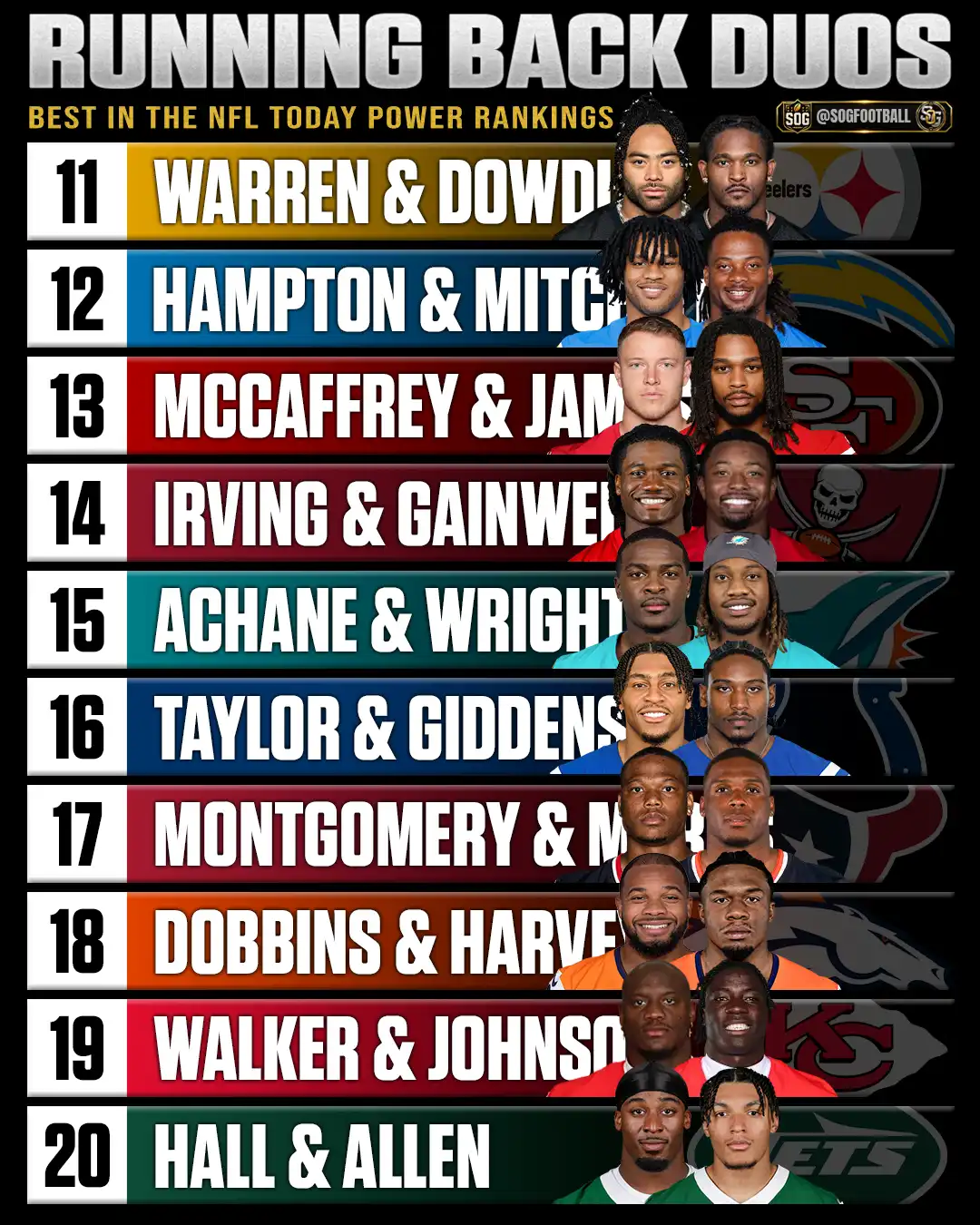
NFL running back duos ranked 11 through 20.
11. Jaylen Warren & Rico Dowdle
2025 context: Dowdle rushed for 1,076 yards and completed a second consecutive 1,000-yard season before signing with Pittsburgh.
Pittsburgh has two backs who can stay on the field for complete series. Warren runs through contact, catches naturally and creates yards after initial penetration. Dowdle offers more conventional early-down volume and arrives with consecutive 1,000-yard seasons.
The duo misses the top 10 because it lacks the singular game-breaking talent of Cook, Love or Bijan Robinson. It may still be one of the league’s most functional committees. The Steelers can divide work according to opponent rather than hiding a weakness, which gives the room a high floor.
12. Omarion Hampton & Keaton Mitchell
2025 context: Hampton rushed for 545 yards in nine games as a rookie, while Mitchell averaged 5.8 yards per carry on 59 attempts.
Hampton gives the Chargers a powerful lead-back profile with enough burst to create more than the blocking provides. Mitchell is the opposite type of problem: a lighter, faster runner who can hit the perimeter or punish a defence after Hampton has forced it to condense.
Both players still carry availability questions, and the sample of sustained NFL production is limited. That keeps the duo below Pittsburgh’s more established pairing. The skill-set fit is excellent, though, and a healthy season could push Los Angeles comfortably into the top 10.
13. Christian McCaffrey & Jordan James
2026 context: McCaffrey remains San Francisco’s offensive centrepiece, while James enters his second season after recording no regular-season touches as a rookie.
McCaffrey is the reason San Francisco remains this high. His route running, vision, receiving production and ability to align anywhere make him one of the league’s most valuable offensive players. A healthy McCaffrey can carry a backfield ranking by himself.
This is also the clearest example of why the list is about duos. James is an intriguing scheme fit, but he has not yet produced in an NFL regular-season game. San Francisco sits behind Hampton and Mitchell because the second half of the pairing is almost entirely projection, and McCaffrey’s recent injury history adds another layer of risk.
14. Bucky Irving & Kenneth Gainwell
2025 context: Irving rushed for 588 yards in an injury-shortened season, while Gainwell produced 537 rushing yards and 486 receiving yards.
Irving’s change of direction and ability to create in tight spaces give Tampa Bay a dynamic lead option. He can turn a poorly blocked play into a manageable down and offers real receiving value. Gainwell adds a reliable passing-down profile, protection experience and enough rushing production to handle larger stretches if needed.
The concern is whether Irving can sustain a full featured workload and whether Gainwell’s career-best 2025 usage carries into a new offence. Tampa Bay ranks ahead of Miami because the second back is more proven. Miami has the greater explosive ceiling, but the Buccaneers offer a more secure division of labour.
15. De’Von Achane & Jaylen Wright
2025 context: Achane generated 1,350 rushing yards, 1,838 yards from scrimmage and 5.7 yards per carry before signing a long-term extension.
No duo below the top five has a faster lead weapon than Achane. His acceleration changes pursuit geometry, and his receiving ability makes him dangerous even when defenses anticipate outside runs. Wright offers similar straight-line speed and gives Miami the option to preserve the same explosive identity when Achane rests.
That similarity is both a strength and a limitation. The Dolphins do not have the same proven power counter found in the highest-ranked rooms, and Wright still needs a larger body of production. The pair could finish far above No. 15, but durability, short-yardage consistency and second-back proof keep the projection measured.
16. Jonathan Taylor & D.J. Giddens
2025 context: Taylor rushed for 1,585 yards and 18 touchdowns, while Giddens recorded 96 yards on 26 carries as a rookie.
Taylor remains one of the league’s best pure runners. He has the speed to finish long gains, the power to survive interior volume and the track record to carry Indianapolis for weeks at a time. That lead-back quality prevents the Colts from falling farther.
Giddens is still an unproven second piece, which is why this room trails several less glamorous but more complete committees. Indianapolis is closer to San Francisco’s star-heavy model than Chicago’s balanced rotation. If Giddens becomes a dependable 8-to-10-touch option, the duo can move quickly toward the top 10.
17. David Montgomery & Woody Marks
Montgomery gives Houston a patient, physical runner who scored eight rushing touchdowns in 2025 before arriving in a trade with Detroit. Marks brings more receiving flexibility and lateral quickness, giving the Texans a clearer contrast than a Montgomery-Mixon pairing would have offered.
The slot remains No. 17 because the ranking order is preserved, but the name must reflect the current roster. Houston also has other depth options, so Marks’ exact share is not guaranteed. The pairing has a strong situational fit, yet it needs on-field evidence in the same offence before it can challenge the established groups above.
18. J.K. Dobbins & RJ Harvey
2026 context: Denver re-signed Dobbins to a two-year contract and returns Harvey after his rookie season, with Jonah Coleman also competing for work.
Dobbins has repeatedly shown efficient burst when healthy, and his decisive style fits a Denver run game that wants backs to get downhill. Harvey brings more open-field acceleration and receiving upside, giving the Broncos a second runner who can threaten space rather than merely spell the starter.
Health and workload clarity are the reasons for the middle ranking. Dobbins has a substantial injury history, and Denver’s depth makes a clean two-player split uncertain. The room may be better than No. 18 in aggregate, but the specific duo carries more volatility than Montgomery and Marks.
19. Kenneth Walker III & Emmett Johnson
2025 context: Walker rushed for 1,027 yards and later won Super Bowl LX MVP. Kansas City then added rookie Emmett Johnson, who led the Big Ten with 1,451 rushing yards.
Walker gives Kansas City an explosive runner capable of creating outside the designed track. His stop-start ability and contact balance can solve plays that do not develop cleanly, a valuable addition to an offence that already stresses every area of the field.
Johnson is a promising rookie rather than a proven NFL complement. That keeps the Chiefs behind Denver despite Walker’s stronger recent résumé. The upside is substantial because Kansas City may not need Johnson to carry heavy volume immediately; it only needs him to provide dependable relief and punish lighter boxes.
20. Breece Hall & Braelon Allen
2025 context: Hall rushed for 1,065 yards and produced 1,415 yards from scrimmage, while Allen returns after an MCL injury shortened his second season.
Hall still has the burst, receiving talent and open-field creativity to anchor a much higher-ranked room. Allen provides the natural physical counter at 235 pounds and can reduce Hall’s exposure to the hardest interior carries.
The ranking reflects uncertainty rather than a lack of talent. Allen must prove he is fully back and capable of maintaining efficiency in a meaningful role, while the Jets need the offence around the pair to create stable game scripts. On traits alone, this is one of the strongest duos outside the top 10.
Best Running Back Duos in the NFL Today: 21-32
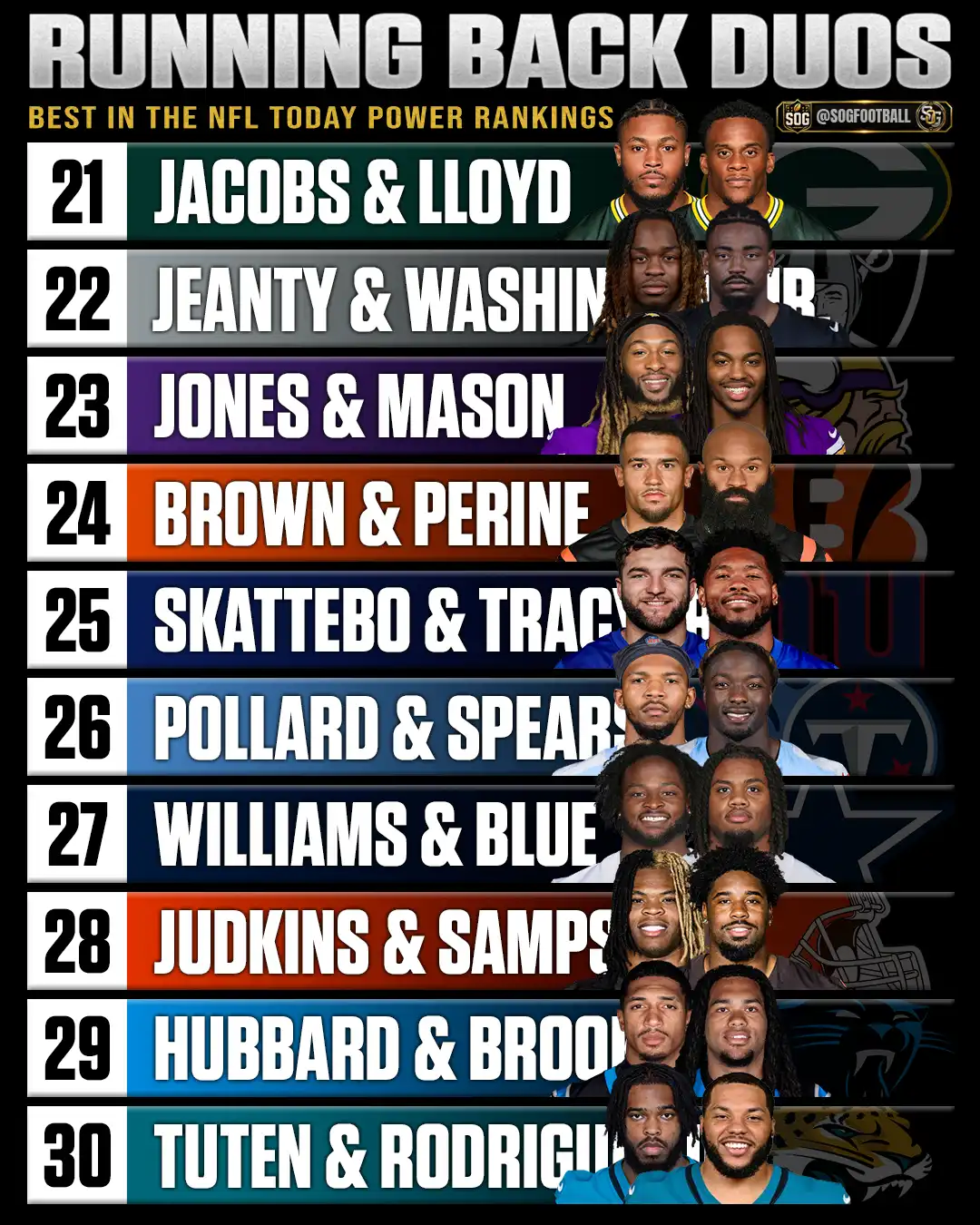
NFL running back duos ranked 21 through 30 entering the 2026 season.
21. Josh Jacobs & MarShawn Lloyd
2026 context: Jacobs remains Green Bay’s volume runner, while Lloyd enters another season with upside but limited NFL availability.
Jacobs gives Green Bay a reliable early-down identity. He can press the line patiently, finish runs through arm tackles and handle the kind of volume that allows an offence to stay balanced. Lloyd has the burst and receiving traits to become a useful contrast.
The second player is still mostly theoretical at the NFL level. Injuries have prevented Lloyd from establishing a dependable role, so the Packers remain more reliant on Jacobs than the ranking’s strongest duos. If Lloyd stays available, Green Bay has a straightforward path to outperforming No. 21.
22. Ashton Jeanty & Mike Washington Jr.
2025 context: Jeanty posted 975 rushing yards and 1,321 yards from scrimmage as a rookie. Washington joins the room after a 1,070-yard college season.
Jeanty’s rookie year confirmed that his contact balance and receiving ability translate. He can carry a large role, force missed tackles and remain useful when Las Vegas falls behind. Washington adds 4.33 speed and a potential big-play complement.
The Raiders are lower than Green Bay because the second half of the duo has not taken an NFL snap. Jeanty may already be the superior lead back, but this list rewards two-player certainty. Washington’s development is the swing factor that could move the pair well above this position.
23. Aaron Jones Sr. & Jordan Mason
2025 context: Mason rushed for 758 yards at 4.8 per carry, while Jones added 548 yards at 4.2 per carry.
Minnesota has an experienced pairing with a clear stylistic split. Jones remains the smoother receiver and zone runner, while Mason supplies more direct power and proved capable of handling meaningful volume. The Vikings can choose the better matchup without asking either player to do everything.
Age limits the long-term ceiling, and neither back enters 2026 with the same top-end profile as Jacobs or Jeanty. The room is dependable, though. It belongs above several younger pairings because both players have already shown they can produce against NFL defences.
24. Chase Brown & Samaje Perine
2025 context: Brown rushed for 1,019 yards, caught 69 passes for 437 yards and scored 11 total touchdowns.
Brown developed into the complete lead back Cincinnati needed. His speed creates chunk gains, while the receiving volume shows he can remain central when the Bengals lean on the passing game. Perine adds protection value, toughness and familiarity with situational work.
The gap from Minnesota comes down to second-back rushing upside. Perine is a trustworthy role player, but he is less likely than Mason to carry a full game plan if the starter is unavailable. Cincinnati’s top-end production is strong enough to keep the duo in the middle of the list.
25. Cam Skattebo & Tyrone Tracy Jr.
2025 context: Skattebo scored seven total touchdowns in eight games before an ankle injury, and Tracy continued to provide rushing and receiving versatility.
Skattebo’s physicality and balance gave the Giants an immediate offensive identity before the injury. Tracy is a natural complement because his background and movement skills allow him to contribute in space and on passing downs.
This ranking depends heavily on Skattebo’s recovery. If he returns at full strength, the duo has more ceiling than several veteran pairs above it. Until that is established, New York belongs in the projection-heavy section rather than the proven middle tier.
26. Tony Pollard & Tyjae Spears
2025 context: Pollard rushed for 1,082 yards, while Spears was limited to 283 rushing yards during an injury-affected season.
Pollard remains a productive lead runner with enough receiving value to function in any game script. Spears can be a sharp change-up when healthy, especially on routes and outside runs that let him attack space.
The problem is overlap and availability. Neither player is a consistent short-yardage hammer, and Spears has not been healthy enough to force the balanced workload Tennessee once envisioned. The talent can outperform No. 26, but the duo needs a full season of complementary production.
27. Javonte Williams & Jaydon Blue
2025 context: Williams rushed for 1,201 yards and 13 touchdowns, while Blue enters his second season with an opportunity to claim a larger complementary role.
Williams revived his career by giving Dallas dependable power and red-zone finishing. He runs behind his pads, stays square through contact and gives the Cowboys a clear early-down option. Blue supplies the speed and receiving potential that the lead back does not consistently provide.
The uncertainty belongs entirely to the second spot. Blue must show he can protect the quarterback and turn limited touches into efficient production. Williams’ 2025 season creates a higher floor than the ranking suggests, but the duo remains incomplete until Blue earns a stable role.
28. Quinshon Judkins & Dylan Sampson
2025 context: Judkins led Cleveland with 827 rushing yards and seven touchdowns. Sampson added 175 rushing yards and 271 receiving yards.
Judkins gives Cleveland a young volume runner with power and goal-line value. Sampson offers a different tempo and showed more receiving utility than his rushing total suggests during his rookie season.
The ranking is conservative because the Browns’ 2025 rushing efficiency was uneven and both players are still developing. Their ages and complementary traits create one of the better long-term outlooks in the bottom five. A stronger offensive environment could make this pair rise faster than most teams around it.
29. Chuba Hubbard & Jonathon Brooks
2026 context: Hubbard remains Carolina’s established lead back, while Brooks is attempting to return after consecutive seasons affected by ACL rehabilitation.
Hubbard provides the reliable portion of this projection. He can handle volume, run through contact and keep the offence on schedule even when the blocking is imperfect. Brooks has the talent to add more receiving and explosive-play value.
The ranking cannot assume a full return before Brooks proves it. Carolina also added veteran competition, so the second-back role may not be exclusive. If Brooks regains his pre-injury movement, this duo has a much higher ceiling, but availability has to carry real weight.
30. Bhayshul Tuten & Chris Rodriguez Jr.
2025 context: Rodriguez produced 500 rushing yards and six touchdowns, while Tuten enters 2026 with an opportunity to take over the lead role.
Tuten’s speed gives Jacksonville a potential home-run runner, and Rodriguez supplies the heavier short-yardage profile. The contrast makes sense on paper and should allow the Jaguars to separate roles clearly.
The placement reflects the absence of a proven NFL lead season. Rodriguez has shown useful depth production, but Tuten must establish that he can process blocks, protect the passer and hold up under increased volume. This room is intriguing, not yet dependable.
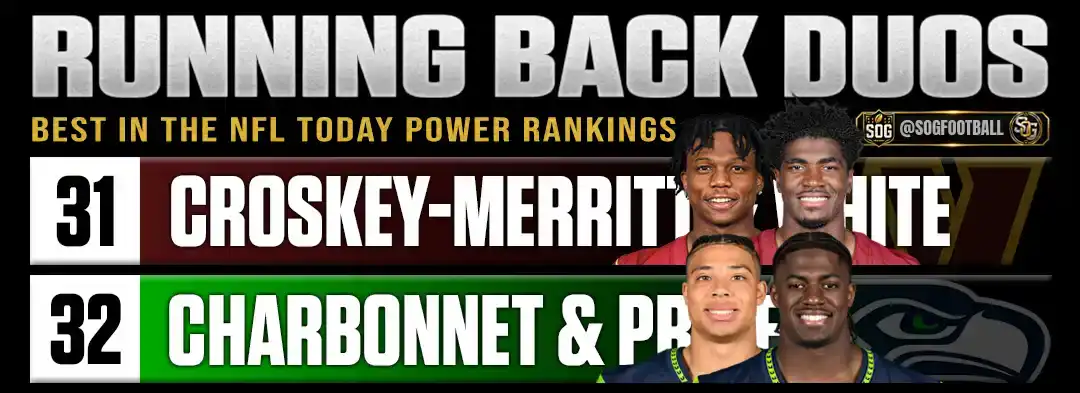
The final two NFL running back duos in the 2026 power ranking.
31. Jacory Croskey-Merritt & Rachaad White
2025 context: Croskey-Merritt rushed for 805 yards and eight touchdowns, while White arrived after recording 572 rushing yards and 40 receptions.
Washington has more proven production than a typical No. 31 backfield. Croskey-Merritt showed decisive downhill ability as a rookie, and White brings receiving experience plus a larger body of starting work.
The low placement reflects uncertainty about hierarchy and efficiency rather than a lack of usable players. Washington also has additional veteran depth, so the touches may spread beyond the featured pair. The duo can move up if Croskey-Merritt takes a clear second-year step and White settles into a defined passing-down role.
32. Zach Charbonnet & Jadarian Price
2026 context: Charbonnet is recovering from an ACL injury, while Seattle selected Price with the 32nd overall pick after he averaged 6.0 yards per carry at Notre Dame.
Seattle closes the ranking because both 2026 roles contain significant uncertainty. Charbonnet has already shown power, receiving usefulness and starter-level stretches, but his recovery timeline matters. Price brings first-round athletic upside, kick-return production and the chance to win a major role immediately.
This pair may have the easiest path to making the ranking look wrong. A healthy Charbonnet and a quick rookie transition would create a strong power-explosiveness combination. Until both questions are answered, No. 32 is the safest projection rather than a declaration that Seattle lacks talent.
Biggest Debates and Ranking Pressure Points
Why Atlanta ranks above Los Angeles and Detroit
The Rams have the most established two-player rotation, and Detroit may have the best speed-power contrast. Atlanta wins because Bijan Robinson is the strongest all-around lead back in the ranking and Brian Robinson Jr. is already a proven NFL volume runner. The Falcons have the best combination of individual ceiling and credible relief work.
How much should one superstar carry a duo ranking?
Saquon Barkley, Christian McCaffrey and Jonathan Taylor keep their teams high despite less certainty behind them. The ranking still penalizes those rooms because a duo should survive a starter’s absence and offer a meaningful tactical change. That is why Chicago, Pittsburgh and Tampa Bay can challenge more famous backfields even without the same top-end name.
Which rookie-heavy pairing has the greatest upside?
Jeremiyah Love and Tyler Allgeier have the highest immediate projection because Allgeier gives Arizona a proven complement. Ashton Jeanty and Mike Washington Jr. may eventually form the better long-term pair, while Seattle’s Jadarian Price could make the No. 32 ranking look overly cautious. Rookie placement remains the least certain part of the list because college traits do not guarantee NFL pass protection, processing or durability.
Which lower-ranked duo could rise fastest?
Seattle has the sharpest upward path if Charbonnet’s recovery progresses and Price handles an immediate role. Cleveland’s young Judkins-Sampson combination and Washington’s Croskey-Merritt-White pairing also have more proven or developmental value than their bottom-five slots suggest. These are preseason rankings, so clarity in training camp can change the bottom third quickly.
Complete Running Back Duo Power Rankings
| Rank | Running Back Duo |
|---|---|
| 1 | Bijan Robinson & Brian Robinson Jr. |
| 2 | Kyren Williams & Blake Corum |
| 3 | Jahmyr Gibbs & Isiah Pacheco |
| 4 | TreVeyon Henderson & Rhamondre Stevenson |
| 5 | Travis Etienne Jr. & Alvin Kamara |
| 6 | Saquon Barkley & Tank Bigsby |
| 7 | Derrick Henry & Justice Hill |
| 8 | D’Andre Swift & Kyle Monangai |
| 9 | Jeremiyah Love & Tyler Allgeier |
| 10 | James Cook III & Ray Davis |
| 11 | Jaylen Warren & Rico Dowdle |
| 12 | Omarion Hampton & Keaton Mitchell |
| 13 | Christian McCaffrey & Jordan James |
| 14 | Bucky Irving & Kenneth Gainwell |
| 15 | De’Von Achane & Jaylen Wright |
| 16 | Jonathan Taylor & D.J. Giddens |
| 17 | David Montgomery & Woody Marks |
| 18 | J.K. Dobbins & RJ Harvey |
| 19 | Kenneth Walker III & Emmett Johnson |
| 20 | Breece Hall & Braelon Allen |
| 21 | Josh Jacobs & MarShawn Lloyd |
| 22 | Ashton Jeanty & Mike Washington Jr. |
| 23 | Aaron Jones Sr. & Jordan Mason |
| 24 | Chase Brown & Samaje Perine |
| 25 | Cam Skattebo & Tyrone Tracy Jr. |
| 26 | Tony Pollard & Tyjae Spears |
| 27 | Javonte Williams & Jaydon Blue |
| 28 | Quinshon Judkins & Dylan Sampson |
| 29 | Chuba Hubbard & Jonathon Brooks |
| 30 | Bhayshul Tuten & Chris Rodriguez Jr. |
| 31 | Jacory Croskey-Merritt & Rachaad White |
| 32 | Zach Charbonnet & Jadarian Price |
FAQ: Best Running Back Duos in the NFL Today
Who is the best running back duo in the NFL entering 2026?
Bijan Robinson and Brian Robinson Jr. rank first because Atlanta pairs the NFL’s 2025 scrimmage-yards leader with a proven physical complement. The Rams and Lions have stronger arguments for the most balanced rotation, but the Falcons own the highest overall ceiling.
Why are Kyren Williams and Blake Corum ranked above Jahmyr Gibbs and Isiah Pacheco?
Williams and Corum have already worked together successfully in the same offensive structure. Gibbs may be the best individual player among the four, but Pacheco is new to Detroit, so the Rams receive a small advantage for established fit and role certainty.
Why are Christian McCaffrey and Jordan James only 13th?
McCaffrey remains one of football’s most complete backs, but James entered 2026 without a regular-season NFL touch. A duo ranking must account for the second player, and San Francisco has less proven two-back value than the teams above it.
Which pairing is the fastest in the NFL?
De’Von Achane and Jaylen Wright have the strongest pure-speed case. Jahmyr Gibbs and Isiah Pacheco offer a better blend of acceleration and power, while Travis Etienne Jr. and Alvin Kamara bring more established receiving versatility.
Why is Joe Mixon not listed with David Montgomery?
Houston released Mixon on March 6, 2026. The current Texans pairing used in the article is David Montgomery and Woody Marks, even though the supplied No. 17 graphic still requires that manual correction.
Last reviewed: July 30, 2026.
Conclusion
Bijan Robinson and Brian Robinson Jr. lead the best running back duos in the NFL entering 2026 because Atlanta combines the ranking’s strongest all-purpose back with a credible power complement. The Rams offer the most established rotation, and Detroit has the most dangerous speed-power ceiling.
The order becomes less certain as rookies, injury recoveries and new team fits enter the equation. That uncertainty is part of a current power ranking, but every slot should still reflect the actual roster. Houston’s No. 17 correction is therefore necessary, while the remaining order stays faithful to the supplied graphics.
Related NFL Rankings
- Best Running Backs in the NFL Today
- Best Running Backs of All-Time
- Best Running Back in the NFL Every Year
- Best Wide Receiver Duos in the NFL Today
For daily football graphics and debates, follow SOG Football on Instagram.
