Magic Johnson is the best point guard of all-time. Stephen Curry ranks second and owns the strongest challenge because his shooting altered the dimensions of NBA offense, but Magic’s combination of playmaking, size, postseason control and five championships gives him the narrow edge.
This is a subjective career ranking, not an official NBA list or an assists leaderboard. Peak performance, longevity, offensive creation, defense, postseason play, championship contribution and era context all matter. Active players are evaluated through the completed 2025-26 season, which means Shai Gilgeous-Alexander’s second straight MVP, Luka Dončić’s second scoring title and Jalen Brunson’s championship and Finals MVP are included.
The supplied graphic determines the No. 1 through No. 30 order. The article explains that order, corrects the underlying facts and addresses the closest omissions without silently changing the editorial ranking.
- How We Ranked the Best Point Guards of All-Time
- Eligibility and Position Classification
- Honourable Mentions and Toughest Cuts
- Best Point Guards of All-Time: 1-10
- Best Point Guards of All-Time: 11-20
- Best Point Guards of All-Time: 21-30
- Biggest Ranking Debates
- Complete Point Guard Ranking
- FAQ
- Sources and Data Notes
- Conclusion
- More NBA Rankings
How We Ranked the Best Point Guards of All-Time
Point guard has changed more than almost any position. Bob Cousy and Oscar Robertson played before the three-point line. Magic Johnson attacked with the size of a forward. Steve Nash and Chris Paul mastered spread pick-and-roll basketball. Stephen Curry created value while moving without the ball, and modern lead guards such as Shai Gilgeous-Alexander and Luka Dončić often carry the scoring burden once associated with shooting guards.
The ranking therefore measures how completely each player controlled offense rather than rewarding one statistical profile. The main criteria are:
- Peak performance: how high the player’s best regular seasons and playoff runs reached.
- Playmaking and offensive control: passing, decision-making, ball security, pace management and the ability to create efficient shots for an entire lineup.
- Scoring value: efficiency, shot creation, shooting range, rim pressure and performance against playoff defenses.
- Postseason contribution: championship role, Finals production, adaptability and performance in high-leverage series.
- Longevity and durability: how long the player remained a top creator or valuable starter.
- Defense: point-of-attack pressure, positional versatility, team-defense awareness and All-Defensive-level seasons.
- Era dominance: how far the player separated from his contemporaries and how well his core skills translate across styles.
Championships matter, but they are not treated as an individual statistic. Chris Paul and John Stockton are not automatically pushed below every champion, just as role players with several rings are not candidates for this list. The same balance applies to career totals, MVP awards and advanced metrics.
Eligibility and Position Classification
The ranking includes NBA and pre-merger NBA careers, with regular-season and postseason performance both considered. Career statistics are regular-season per-game averages, and active-player accomplishments are current through the end of the 2025-26 season.
Hybrid guards qualify when initiating offense was a defining part of their role. That is why Allen Iverson, Shai Gilgeous-Alexander, Luka Dončić, Kyrie Irving and Penny Hardaway are included even though each also logged substantial time beside another ball-handler or was listed at shooting guard. The classification is based on responsibility, not only the position label beside a player’s name.
Incomplete careers are eligible because the graphic includes active stars, but unfinished longevity is treated as a real limitation. Shai, Luka and Jalen Brunson receive credit for what they have already accomplished without assuming future championships or awards.
Honourable Mentions and Toughest Cuts
Kevin Johnson was the hardest omission. He averaged 17.9 points and 9.1 assists, made five All-NBA teams and reached the 1993 NBA Finals. His first step and paint creation compare favourably with several players in the final ten. Mark Price narrowly keeps the last position because the ranking gives extra weight to his shooting efficiency, four All-NBA selections and how naturally his pick-and-roll game would translate to modern spacing.
Lenny Wilkens, Jo Jo White, Maurice Cheeks and Jrue Holiday also had serious cases. Wilkens combined nine All-Star selections with high-end playmaking. White won two championships and the 1974 Finals MVP. Cheeks paired efficient organization with championship defense, while Holiday’s two titles and perimeter defense make him one of the strongest modern omissions. The top 30 cutoff rewards the included players’ peak creation, individual awards or longer stretches as a primary offensive engine.
Best Point Guards of All-Time: 1-10

The top 10 best point guards of all-time, led by Magic Johnson, Stephen Curry and Oscar Robertson.
1. Magic Johnson
Career Stats & Accolades: 19.5 PPG, 7.2 RPG, 11.2 APG; 5 NBA championships, 3 MVP awards, 3 Finals MVP awards and 10 All-NBA selections.
Magic Johnson ranks first because no point guard has matched his blend of passing command and championship responsibility. At 6-foot-9, he could initiate in transition, punish smaller defenders in the post, rebound and immediately launch the break. His career average of 11.2 assists remains the highest in NBA history.
The decisive advantage over Curry is not simply ring count. Magic was the organizing force of five champions and won three Finals MVP awards while playing several offensive roles. Curry was the better shooter and scorer, but Magic provided more direct possession-to-possession playmaking and greater positional flexibility. A career interrupted at age 31 limits his longevity case, yet his prime was long enough and productive enough to hold the top spot.
2. Stephen Curry
Career Stats & Accolades: 24.8 PPG, 4.7 RPG, 6.3 APG through 2025-26; 4 NBA championships, 2 MVP awards, the 2022 Finals MVP and 11 All-NBA selections.
Stephen Curry is the greatest shooting point guard and the closest challenger to Magic. His value is not captured by assists alone. Defenders follow him well beyond the three-point line, creating open cuts, slips and four-on-three situations before he touches the ball.
Curry’s four championships and unanimous 2015-16 MVP eliminate the old argument that his style could not anchor a dynasty. He also remained a high-volume scorer deep into his thirties. Magic stays first because he owns the stronger traditional playmaking and Finals résumé, but Curry has a credible No. 1 case for anyone who weighs scoring efficiency and offensive gravity most heavily.
3. Oscar Robertson
Career Stats & Accolades: 25.7 PPG, 7.5 RPG, 9.5 APG; 1 NBA championship, the 1964 MVP, 12 All-Star selections and 9 First-Team All-NBA selections.
Oscar Robertson was the prototype for the large, physically imposing lead creator. He averaged a triple-double in 1961-62 and nearly did it across his first five seasons combined, decades before the achievement became a regular part of NBA discussion.
Robertson ranks behind Magic and Curry because his Cincinnati teams produced less postseason success and his championship came later beside Kareem Abdul-Jabbar. He remains comfortably third because his combination of scoring volume, rebounding and passing was far ahead of the guard standard of his era. Modern jumbo creators follow a path that Robertson established.
4. Isiah Thomas
Career Stats & Accolades: 19.2 PPG, 3.6 RPG, 9.3 APG; 2 NBA championships, the 1990 Finals MVP, 12 All-Star selections and 5 All-NBA selections.
Isiah Thomas earns fourth through postseason leadership. He was the primary creator and emotional centre of Detroit teams that had to get through opponents led by Larry Bird, Michael Jordan and Magic Johnson. The Pistons won consecutive titles without another top-tier offensive superstar controlling the ball.
Thomas does not have the regular-season MVP or efficiency profile of several guards below him. His case rests on the difficulty of his playoff path, his ability to generate offense against physical defenses and his central role in two championships. That winning peak gives him the edge over Chris Paul’s superior longevity and cleaner regular-season decision-making.
5. Chris Paul
Career Stats & Accolades: 16.8 PPG, 4.4 RPG, 9.2 APG; 12 All-Star selections, 11 All-NBA selections, 9 All-Defensive selections, 5 assist titles and 6 steals titles.
Chris Paul retired in February 2026 after 21 seasons, finishing second in NBA history in both assists and steals. Few guards have combined pick-and-roll precision, ball security, midrange scoring and point-of-attack defense for so long. His teams repeatedly improved when he arrived because he reduced wasted possessions and made role players easier to use.
The championship gap matters, especially against Isiah and the two players above him. Paul reached the 2021 Finals but never won the title, and injuries affected several promising playoff runs. He remains fifth because his complete two-way body of work is stronger than the shorter career Shai has assembled so far. For modern assist context, see the most assists in the NBA since 2000.
6. Shai Gilgeous-Alexander
Career Stats & Accolades: 25.3 PPG, 4.7 RPG, 5.3 APG through 2025-26; 2 MVP awards, the 2025 NBA championship and Finals MVP, the 2025 scoring title and 4 consecutive First-Team All-NBA selections.
Shai Gilgeous-Alexander’s No. 6 placement is the ranking’s boldest peak-over-longevity choice. By age 27, he had won consecutive MVP awards, led Oklahoma City to a championship and produced four straight First-Team All-NBA seasons. His deceleration, footwork and body control let him reach the paint without relying on three-point volume, while his low turnover rate makes the scoring easier to build around.
He sits below Paul because eight seasons do not yet match 21 years of top-level organization and defense. He clears Stockton, Iverson, Nash and Kidd because none combined back-to-back MVPs with a Finals MVP. The placement rewards completed accomplishments, not a projection, and it can still move in either direction as his career develops.
7. John Stockton
Career Stats & Accolades: 13.1 PPG, 2.7 RPG, 10.5 APG; 10 All-Star selections, 11 All-NBA selections, 5 All-Defensive selections and the NBA career records for assists and steals.
John Stockton owns the strongest longevity and precision case among traditional floor generals. His 15,806 assists and 3,265 steals are not products of one brief peak. He played all 82 games in 16 different seasons and ran Utah’s offense with exceptional timing, durability and ball security.
Stockton ranks below Paul because he carried a smaller individual scoring burden and never reached the same MVP-level peak. He ranks above Iverson, Nash and Kidd because his record-setting production lasted so long without sacrificing efficiency or defense. His repeated appearances near the top of the single-season NBA assists leaderboard show how sustained that control was.
8. Allen Iverson
Career Stats & Accolades: 26.7 PPG, 3.7 RPG, 6.2 APG; the 2001 MVP, 4 scoring titles, 3 steals titles, 7 All-NBA selections and a 2001 Finals appearance.
Allen Iverson is classified here as a lead guard because Philadelphia’s offense depended on his ball-handling and shot creation, even when lineups listed him beside another point guard. His scoring pressure carried a limited offensive roster to the 2001 Finals, and his MVP peak was higher than the regular-season peak of Stockton or Kidd.
Efficiency and defensive size keep him outside the top seven. Iverson often had to create difficult shots, but some of that difficulty came from a style that was harder to scale beside other creators. He stays ahead of Nash because the ranking values his playoff scoring burden, Finals run and ability to manufacture offense when a possession broke down.
9. Steve Nash
Career Stats & Accolades: 14.3 PPG, 3.0 RPG, 8.5 APG; 2 MVP awards, 7 All-NBA selections, 5 assist titles and four 50-40-90 seasons.
Steve Nash directed some of the most efficient offenses of the 2000s through pace, shooting and constant pick-and-roll pressure. He could score far more than his volume suggested, but his willingness to keep the defense moving made Phoenix harder to load up against.
Nash owns two MVPs, a major advantage over Kidd, yet never reached the NBA Finals and gave opponents more to attack defensively. That keeps him behind Iverson’s championship-series peak and Stockton’s longevity. His place at No. 9 reflects an offensive prime that changed how teams valued spacing and early-clock creation without ignoring the postseason and defensive limitations.
10. Jason Kidd
Career Stats & Accolades: 12.6 PPG, 6.3 RPG, 8.7 APG; 1 NBA championship, 10 All-Star selections, 6 All-NBA selections, 9 All-Defensive selections and 5 assist titles.
Jason Kidd closes the top 10 as the most complete non-scoring guard in this range. He immediately turned the New Jersey Nets into consecutive Finals teams by improving their transition offense, rebounding and perimeter defense. Later, he rebuilt his jumper and became an essential veteran on Dallas’ 2011 champion.
Kidd’s weak early-career shooting prevented him from reaching Nash’s offensive ceiling, while he never carried Iverson’s scoring responsibility. His defense, adaptability and ability to influence a game without high usage separate him from Westbrook at No. 11. The top-10 cutoff rewards a career that contributed to winning in several distinct ways.
Best Point Guards of All-Time: 11-20
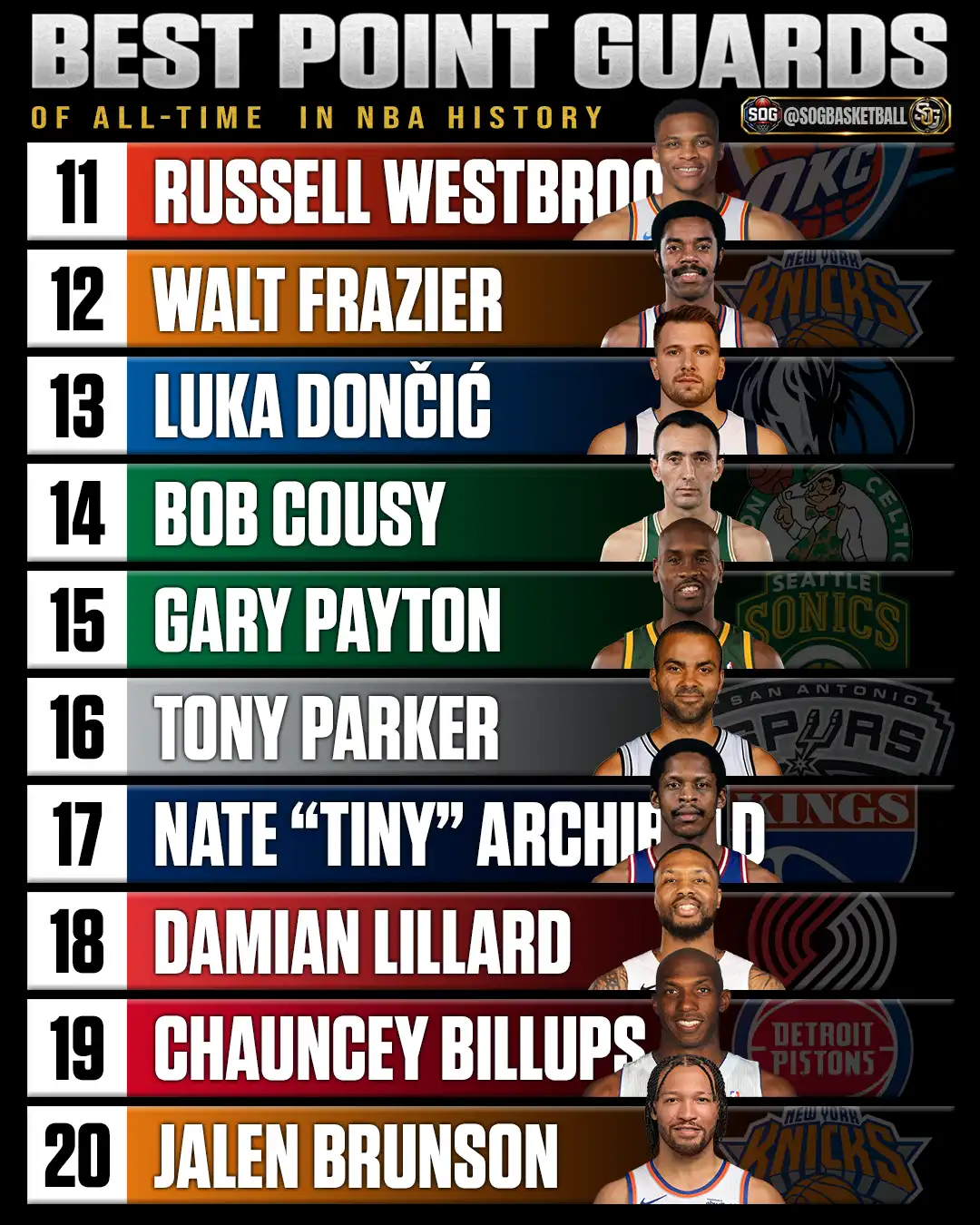
Point guards ranked 11 through 20, from Russell Westbrook and Walt Frazier to Chauncey Billups and Jalen Brunson.
11. Russell Westbrook
Career Stats & Accolades: 20.9 PPG, 6.9 RPG, 8.0 APG through 2025-26; the 2017 MVP, 9 All-Star selections, 9 All-NBA selections, 2 scoring titles, 3 assist titles and the career triple-double record.
Russell Westbrook had a higher statistical peak than Kidd and a more forceful downhill game than anyone below him. His 2016-17 MVP season combined late-game creation, rebounding and relentless rim attacks while Oklahoma City reorganized after Kevin Durant’s departure.
He misses the top 10 because his shooting, turnovers and off-ball limitations became easier to target in later playoff rounds. Kidd offered more defensive flexibility and adapted more smoothly as his athleticism declined. Westbrook still belongs ahead of Frazier because an MVP peak and repeated league-leading production carry enormous weight.
12. Walt Frazier
Career Stats & Accolades: 18.9 PPG, 5.9 RPG, 6.1 APG; 2 NBA championships, 7 All-Star selections, 6 All-NBA selections and 7 First-Team All-Defensive selections.
Walt Frazier was a genuine two-way lead guard, not merely the organizer of a balanced Knicks team. He pressured ball-handlers, rebounded his position and created efficient offense without monopolizing possessions. His 36 points, 19 assists and 7 rebounds in Game 7 of the 1970 Finals remain one of the finest closeout performances by any guard.
Frazier’s peak did not last as long as Stockton’s or Paul’s, and he never won an MVP. He ranks ahead of Luka and Cousy because his two championships came with major offensive and defensive responsibility. Westbrook’s MVP-level individual creation narrowly keeps Frazier at No. 12.
13. Luka Dončić
Career Stats & Accolades: 29.2 PPG, 8.5 RPG, 8.2 APG through 2025-26; 6 All-Star selections, 6 First-Team All-NBA selections, 2 scoring titles and a 2024 Finals appearance.
Luka Dončić already has one of the strongest offensive résumés ever assembled by a 27-year-old guard. In 2025-26, he led the league at 33.5 points per game and earned his sixth First-Team All-NBA selection, his first with the Los Angeles Lakers. His strength, pace manipulation and skip passing allow him to solve switching, drop coverage and traps.
Thirteenth is a career-completion penalty, not a judgment that thirteen point guards played better at their peak. Luka has no MVP or championship yet, and his defense and conditioning have been less consistent than his offensive output. He ranks above Cousy because his individual scoring-playmaking combination is stronger, but below Frazier and Westbrook because their completed résumés include either championships or an MVP.
14. Bob Cousy
Career Stats & Accolades: 18.4 PPG, 5.2 RPG, 7.5 APG; 6 NBA championships, the 1957 MVP, 13 All-Star selections, 12 All-NBA selections and 8 assist titles.
Bob Cousy gave the early NBA its first famous playmaking guard. His dribbling, open-court passing and willingness to attempt creative deliveries helped Boston play faster and made the position more expressive.
The challenge is era translation. Cousy’s shooting efficiency was low by later standards, the league was smaller and his championships came beside Bill Russell on loaded teams. The ranking still respects how far he separated from contemporary guards, placing him above Payton and Parker. Luka’s superior individual creation pushes Cousy down one spot despite the far stronger title count.
15. Gary Payton
Career Stats & Accolades: 16.3 PPG, 3.9 RPG, 6.7 APG; 1 NBA championship, the 1996 Defensive Player of the Year, 9 All-Star selections, 9 All-NBA selections and 9 First-Team All-Defensive selections.
Gary Payton has the best defensive case among point guards. He could crowd quick guards, absorb contact from bigger creators and disrupt an offense without needing constant help. Seattle’s 1996 Finals run also showed that he could lead a contender as a scorer and playmaker.
His championship came later in a reduced Miami role, and his half-court offense never reached the level of the names above him. Payton stays ahead of Parker because he carried more two-way responsibility across his prime. Cousy’s MVP and dynasty résumé keep Payton from climbing higher.
16. Tony Parker
Career Stats & Accolades: 15.5 PPG, 2.7 RPG, 5.6 APG; 4 NBA championships, the 2007 Finals MVP, 6 All-Star selections and 4 All-NBA selections.
Tony Parker supplied the Spurs with paint pressure that their methodical reputation can obscure. His speed, change of direction and floater punished big defenders before the modern spacing boom made those attacks easier. By the middle of his career, he was often San Antonio’s leading regular-season scorer.
Parker ranks below Payton because he was not a comparable defender or primary franchise anchor. He ranks above Archibald, Lillard and Billups because four titles and a Finals MVP pair real individual production with sustained team success. His placement recognizes that he was a central creator, not simply a passenger beside Tim Duncan.
17. Nate “Tiny” Archibald
Career Stats & Accolades: 18.8 PPG, 2.3 RPG, 7.4 APG; 1 NBA championship, 6 All-Star selections and 5 All-NBA selections.
In 1972-73, Nate Archibald became the only player to win both the NBA scoring and assists titles in the same season under the league’s official criteria. That season captured his rare burden as a small guard who had to break down defenses, score at the rim and create nearly everything for Kansas City-Omaha.
Injuries shortened his highest-level years, but he later adjusted into a steadier organizer for Boston’s 1981 champion. Parker’s longer championship prime keeps Tiny at No. 17, while the scoring-assist peak gives him the advantage over Lillard’s more one-dimensional postseason résumé.
18. Damian Lillard
Career Stats & Accolades: 25.1 PPG, 4.3 RPG, 6.7 APG; 9 All-Star selections, 7 All-NBA selections, the 2013 Rookie of the Year and selection to the NBA 75th Anniversary Team.
Damian Lillard combined deep pull-up range with repeated late-game shot creation. His two series-ending playoff shots became symbols of his confidence, but the larger case is eleven Portland seasons as the primary scorer and organizer of a frequent playoff team.
Lillard missed the entire 2025-26 season while recovering from an Achilles injury, so his career averages did not change. He ranks below Archibald because he has no scoring title, MVP or Finals appearance. He remains above Billups and Brunson because his individual prime lasted longer and carried a much larger regular-season offensive burden.
19. Chauncey Billups
Career Stats & Accolades: 15.2 PPG, 2.9 RPG, 5.4 APG; 1 NBA championship, the 2004 Finals MVP, 5 All-Star selections, 3 All-NBA selections and 2 All-Defensive selections.
Chauncey Billups was built for balanced teams. He spaced the floor, attacked mismatches, defended strong guards and understood when to shift from organizer to scorer. Detroit reached six consecutive conference finals during his tenure, with Billups controlling the highest-leverage possessions.
His regular-season peak was lower than Lillard’s and his career averages do not resemble the giant numbers of modern high-usage guards. He ranks ahead of Brunson because his contention window and two-way consistency lasted longer. Brunson’s 2026 title has made that comparison much closer than it was a year earlier.
20. Jalen Brunson
Career Stats & Accolades: 19.2 PPG, 3.2 RPG, 5.3 APG through 2025-26; the 2026 NBA championship and Finals MVP, the 2026 Eastern Conference Finals MVP, 3 All-Star selections and 3 All-NBA selections.
Jalen Brunson’s ranking changed meaningfully in 2026. He led New York to its first championship since 1973 and scored 45 points in the Game 5 clincher to win Finals MVP. That run answered the central question about whether his footwork-heavy, below-the-rim scoring could remain the centre of a title offense.
He remains twentieth because his star-level window is shorter than every guard immediately above him, and he has not produced a regular-season MVP season. Brunson now owns a stronger championship peak than Lillard, but Lillard’s decade of high-volume All-NBA offense still wins the full-career comparison. Another few seasons near this level would move Brunson substantially higher.
Best Point Guards of All-Time: 21-30
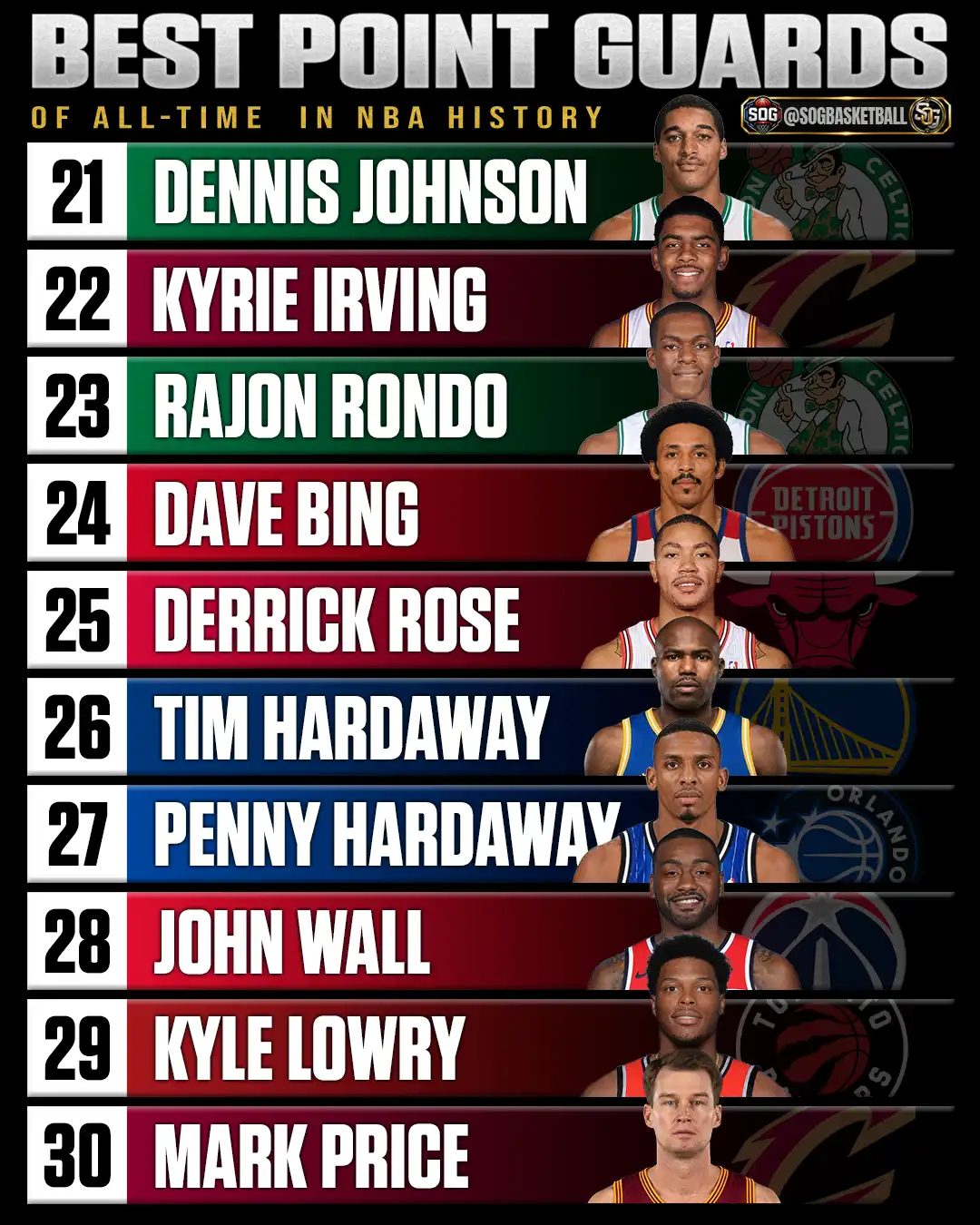
Point guards ranked 21 through 30, including Dennis Johnson, Kyrie Irving, Derrick Rose, Kyle Lowry and Mark Price.
21. Dennis Johnson
Career Stats & Accolades: 14.1 PPG, 3.9 RPG, 5.0 APG; 3 NBA championships, the 1979 Finals MVP, 5 All-Star selections, 2 All-NBA selections and 9 All-Defensive selections.
Dennis Johnson adapted to three championship environments. He won Finals MVP as an attacking guard in Seattle, handled major responsibility in Phoenix and later became Boston’s defensive backcourt specialist and secondary creator.
His offensive peak was not as high as Brunson’s, and his efficiency was inconsistent. Johnson stays ahead of Kyrie because his defense, availability and championship portability produced a more complete career. He is one of the clearest examples of a guard whose value rises when postseason role and matchup responsibility receive proper weight.
22. Kyrie Irving
Career Stats & Accolades: 23.7 PPG, 4.1 RPG, 5.6 APG; 1 NBA championship, 9 All-Star selections and 3 All-NBA selections.
Kyrie Irving has a stronger pure scoring toolkit than most guards ranked above him. His handle, touch with either hand and pull-up shooting let him create efficient offense against set playoff defenses. The championship-winning three over Curry in Game 7 of the 2016 Finals is the signature result of that skill.
Irving missed the 2025-26 season while recovering from a torn ACL. Durability, limited regular-season award recognition and several disrupted team tenures keep him outside the top 20. Dennis Johnson contributed more consistent defense and championship structure, while Kyrie’s peak scoring places him above Rondo and Bing.
23. Rajon Rondo
Career Stats & Accolades: 9.8 PPG, 4.5 RPG, 7.9 APG; 2 NBA championships, 4 All-Star selections, 1 All-NBA selection, 4 All-Defensive selections and 3 assist titles.
Rajon Rondo was a creative passer with the processing speed to exploit playoff adjustments. During Boston’s contending years, he rebounded, pressured the ball and used misdirection to feed three veteran scorers. He later became a valuable postseason organizer for the 2020 Lakers.
Rondo’s shooting and low scoring volume allowed defenses to leave him unattended, limiting how easily his game fit every lineup. Kyrie offered much greater individual offense, while Dennis Johnson brought stronger two-way balance. Rondo stays ahead of Bing because his best postseason stretches and two championships carry more weight than Bing’s regular-season scoring.
24. Dave Bing
Career Stats & Accolades: 20.3 PPG, 3.8 RPG, 6.0 APG; 7 All-Star selections, 3 All-NBA selections, the 1967 Rookie of the Year and selection to the NBA 75th Anniversary Team.
Dave Bing was a scoring lead guard before that archetype became common. He averaged 27.1 points in his second season and combined quickness with enough passing to organize Detroit’s offense.
His teams won only one playoff series during his prime, which makes it difficult to place him near champions with similar individual recognition. He ranks above Rose because his high-level production lasted much longer. Rondo’s postseason value narrowly moves Bing down to No. 24 despite the superior scoring résumé.
25. Derrick Rose
Career Stats & Accolades: 17.4 PPG, 3.2 RPG, 5.2 APG; the 2011 MVP, 3 All-Star selections, 1 First-Team All-NBA selection and the 2009 Rookie of the Year.
Derrick Rose’s 2010-11 season is the strongest individual peak in the final six. At 22, he became the youngest MVP in league history and drove Chicago to 62 wins with explosive rim pressure and improved pull-up shooting.
The ranking cannot ignore how quickly knee injuries ended that version of his game. Rose deserves credit for rebuilding himself into a productive veteran, but he never returned to an All-NBA level and played only 52 career playoff games. Bing’s longer prime keeps Rose at No. 25, while the MVP peak gives him the edge over Tim Hardaway and Penny.
26. Tim Hardaway
Career Stats & Accolades: 17.7 PPG, 3.3 RPG, 8.2 APG; 5 All-Star selections, 5 All-NBA selections and induction into the Basketball Hall of Fame.
Tim Hardaway combined the crossover that bears his name with genuine lead-guard production. He created high-tempo offense for Run TMC, then changed pace and became the organizer of physical Miami playoff teams.
Hardaway never reached the Finals and was not a high-end defender, which limits his argument against the champions above him. His five All-NBA selections and career average of 8.2 assists give him a more complete résumé than Penny’s injury-shortened prime. Rose’s MVP season remains the separator at No. 25.
27. Penny Hardaway
Career Stats & Accolades: 15.2 PPG, 4.5 RPG, 5.0 APG; 4 All-Star selections, 3 All-NBA selections and a 1995 Finals appearance.
Penny Hardaway looked like a future top-10 point guard during his first three seasons. At 6-foot-7, he could pass over traps, post smaller defenders and score efficiently without slowing Orlando’s offense. He finished third in MVP voting in 1995-96.
Knee injuries changed his trajectory before he built the longevity needed for a higher all-time placement. His prime was more versatile than Wall’s and Price’s, but Tim Hardaway produced nearly twice as many All-NBA-calibre seasons. Penny ranks here because peak quality matters, even when the complete career falls short of the initial promise.
28. John Wall
Career Stats & Accolades: 18.7 PPG, 4.2 RPG, 8.9 APG; 5 All-Star selections, 1 All-NBA selection and 1 All-Defensive selection.
John Wall’s speed turned defensive rebounds into immediate scoring chances. At his best, he combined that open-court pressure with strong passing volume and enough defense to carry Washington to repeated playoff appearances.
Wall never advanced beyond the second round, and injuries limited him to 647 career games. Penny’s best seasons reached a higher MVP level, while Lowry built a longer winning career. Wall stays above Lowry because his prime as a primary creator was clearly stronger and his career assist average ranks among the best on the list.
29. Kyle Lowry
Career Stats & Accolades: 13.8 PPG, 4.2 RPG, 6.0 APG through 2025-26; 1 NBA championship, 6 All-Star selections and 1 All-NBA selection.
Kyle Lowry’s value came from accumulation rather than one overwhelming skill. He spaced the floor, drew charges, defended larger guards and made quick passing decisions that kept Toronto’s offense connected. In the 2019 championship run, he supplied the organization and toughness required beside Kawhi Leonard.
Lowry never reached Wall’s individual peak or Price’s shooting efficiency, and he made only one All-NBA team. His title, long prime and ability to help several roster styles win place him inside the top 30. He is the strongest example near the cutoff of total team value outweighing raw scoring averages.
30. Mark Price
Career Stats & Accolades: 15.2 PPG, 2.6 RPG, 6.7 APG; 4 All-Star selections, 4 All-NBA selections and career shooting marks of 40.2% from three and 90.4% at the line.
Mark Price earns the final spot because his pick-and-roll shooting would translate cleanly to any era. He could turn the corner, punish defenders who went under and force big men to leave the paint. In 1988-89, he joined the 50-40-90 club while averaging 18.9 points and 8.4 assists.
Injuries shortened his prime, and Cleveland never reached the Finals, leaving Kevin Johnson with a legitimate argument for No. 30. Price’s four All-NBA selections, superior shooting and scalable off-ball value narrowly win the final comparison. The gap between No. 30 and the best omissions is smaller than the number suggests.
Biggest Ranking Debates
Magic Johnson vs. Stephen Curry
Magic wins the No. 1 decision because he combined direct playmaking control with five championships and three Finals MVP awards. Curry is the better scorer and has the greater effect away from the ball. The conclusion changes only if shooting efficiency and spacing value are weighted more heavily than traditional creation and Finals responsibility.
Chris Paul vs. Shai Gilgeous-Alexander
Shai already owns the stronger championship peak: two MVPs, a title and a Finals MVP. Paul owns more than twice as many seasons, eleven All-NBA selections and one of the best two-way point guard careers ever. SOG Sports keeps Paul fifth because this is a career ranking, while Shai’s No. 6 position recognizes that his completed peak has already passed the non-championship résumés immediately below him.
Stockton, Iverson, Nash and Kidd
These four represent different definitions of point guard greatness. Stockton offers longevity and records, Iverson offers the highest scoring burden, Nash offers the best regular-season offensive peak and Kidd offers the broadest defense-rebounding-passing package. The final order values Stockton’s sustained precision, Iverson’s MVP and Finals run, Nash’s two MVPs and Kidd’s adaptable all-around career in that sequence.
How High Can the Active Guards Climb?
Shai, Luka and Brunson all improved their cases through the completed 2025-26 season. Shai can challenge the top five by adding longevity. Luka can make a major jump with an MVP or championship, while Brunson now needs sustained All-NBA seasons to match the career depth of the guards above him. No future accomplishment is assumed in the present order.
Complete Best Point Guards of All-Time Ranking
| Rank | Player Name |
|---|---|
| 1 | Magic Johnson |
| 2 | Stephen Curry |
| 3 | Oscar Robertson |
| 4 | Isiah Thomas |
| 5 | Chris Paul |
| 6 | Shai Gilgeous-Alexander |
| 7 | John Stockton |
| 8 | Allen Iverson |
| 9 | Steve Nash |
| 10 | Jason Kidd |
| 11 | Russell Westbrook |
| 12 | Walt Frazier |
| 13 | Luka Dončić |
| 14 | Bob Cousy |
| 15 | Gary Payton |
| 16 | Tony Parker |
| 17 | Nate “Tiny” Archibald |
| 18 | Damian Lillard |
| 19 | Chauncey Billups |
| 20 | Jalen Brunson |
| 21 | Dennis Johnson |
| 22 | Kyrie Irving |
| 23 | Rajon Rondo |
| 24 | Dave Bing |
| 25 | Derrick Rose |
| 26 | Tim Hardaway |
| 27 | Penny Hardaway |
| 28 | John Wall |
| 29 | Kyle Lowry |
| 30 | Mark Price |
FAQ: Best Point Guards of All-Time
Who is the best point guard of all-time?
Magic Johnson is SOG Sports’ No. 1 point guard because he paired the highest career assist average in NBA history with five championships, three MVP awards and three Finals MVP awards.
Does Stephen Curry have a case over Magic Johnson?
Yes. Curry has the stronger shooting, scoring-efficiency and off-ball gravity case. Magic remains first here because he provided more direct playmaking control and owns the stronger Finals résumé.
Why is Shai Gilgeous-Alexander already ranked sixth?
Shai is sixth because his completed résumé already includes consecutive MVP awards, a championship, a Finals MVP, a scoring title and four straight First-Team All-NBA selections. His shorter career keeps him below Chris Paul and prevents the ranking from assuming future success.
Why are Allen Iverson and Luka Dončić classified as point guards?
Both qualify because they functioned as primary ball-handlers and offensive initiators. The ranking uses lead-guard responsibility rather than relying only on the position listed in a lineup.
Who is the best defensive point guard ever?
Gary Payton has the strongest case. He won Defensive Player of the Year and made nine consecutive First-Team All-Defensive teams while carrying significant offensive responsibility.
Last reviewed: July 30, 2026.
Conclusion
Magic Johnson remains No. 1 among the best point guards of all-time because his passing, size and postseason control translated into five championships and three Finals MVP awards. Stephen Curry has the strongest counterargument, built on unmatched shooting gravity, four titles and a longer late-career scoring run.
The rest of the ranking reflects the position’s evolution from pass-first organizers to high-volume offensive engines. The central standard remains the same: the greatest point guards create advantages, control decisions and make a team function at a championship level.
More NBA Rankings
Continue with the best NBA point guard from every season or explore the SOG Sports NBA hub.
- Most assists in a single NBA season
- Most assists in the NBA since 2000
- Most points scored in the NBA since 2000
- NBA Defensive Player of the Year winners by season
Follow SOG Basketball on Instagram for more rankings and basketball history graphics.
