
Kareem Abdul-Jabbar is the greatest center in NBA history. His six MVP awards, six championships, 38,387 points and two decades of elite play give him the most complete résumé at the position. Shaquille O’Neal ranks second for delivering the most overwhelming physical peak, followed by Wilt Chamberlain, Bill Russell and Nikola Jokić.
The top five alone show why this debate is so difficult. Wilt owns the wildest numbers. Russell won more than anyone. Shaq forced entire rosters to change. Jokić has turned the center into a championship-level passing engine. Hakeem Olajuwon, Moses Malone, David Robinson, George Mikan and Dwight Howard round out a top 10 built through completely different styles of dominance.
This ranking evaluates each player’s peak, talent, career production, awards, two-way impact, playoff performance, longevity and influence on the position. Active players are evaluated through the 2025-26 NBA season.
Last reviewed: August 9, 2026.
Table of Contents
How We Ranked the Best NBA Centers
No single formula can perfectly compare Bill Russell’s defense, Wilt Chamberlain’s statistical dominance, Kareem Abdul-Jabbar’s longevity, Shaquille O’Neal’s power and Nikola Jokić’s playmaking. The position has changed too much for career totals or championship counts to settle the order by themselves.
The ranking follows this general framework:
- Peak dominance and overall ability: 30% – How much the center could control a game at his absolute best, including scoring, creation, rebounding and defense.
- Career production and longevity: 25% – The length of the prime, year-to-year consistency, durability and total statistical value.
- Awards and league standing: 20% – MVPs, All-NBA teams, Defensive Player of the Year awards, All-Defensive teams and All-Star selections.
- Playoff performance and championship value: 15% – How well the player’s game translated in the postseason and how much responsibility he carried on contenders.
- Era impact and positional influence: 10% – Dominance relative to the player’s competition and how much he changed the possibilities of the position.
These percentages are a framework, not a calculator that produces an automatic answer. Championships matter, but a center does not receive equal credit for being the best player on a title team and filling a smaller role on one. The same principle applies to statistics: pace, rule changes, league size and the availability of tracked defensive data all affect comparisons across eras.
Eligibility and Historical Scope
The ranking is limited to players who spent most of their prime at center. Karl-Anthony Towns and Victor Wembanyama have played in two-big lineups and can be labelled as center-forwards, but their careers and historical cases are still rooted in center play.
NBA and BAA accomplishments receive the most weight. ABA production also counts when evaluating the complete professional careers of players such as Moses Malone and Artis Gilmore.
Blocks and steals did not become official NBA statistics until the 1973-74 season. That tracking gap matters when discussing Bill Russell, Wilt Chamberlain and other early centers whose defensive numbers are incomplete. Active players receive credit only for what they have accomplished through 2025-26. Future potential can strengthen the context of a placement, but it cannot replace completed production.
Best NBA Centers of All-Time: 1-10
1. Kareem Abdul-Jabbar
Career Stats & Accolades: 24.6 PPG, 11.2 RPG, six MVPs, six NBA championships, two Finals MVPs and 19 All-Star selections.
Kareem Abdul-Jabbar has the strongest complete case at center. He entered the league as an immediate superstar, won a championship and Finals MVP in Milwaukee, then remained an elite interior force long enough to become the foundation of the Showtime Lakers. His skyhook was not simply a signature move; it was a high-volume shot that opponents knew was coming and still could not reliably stop.
Longevity separates Kareem from the other No. 1 candidates. He scored 38,387 points, held the NBA career scoring record for nearly 39 years and made 15 All-NBA teams across 20 seasons. Shaq reached a more violent peak, Wilt produced larger numbers and Russell won more championships, but none matched Kareem’s balance of individual awards, team success, scoring, durability and late-career value.
2. Shaquille O’Neal
Career Stats & Accolades: 23.7 PPG, 10.9 RPG, one MVP, four NBA championships, three Finals MVPs and 15 All-Star selections.
Shaquille O’Neal at his best was the hardest center in league history to guard with normal personnel. Single coverage usually meant a dunk, deep seal or foul. Extra help opened the floor for shooters, while undersized frontcourts could be worn down before the fourth quarter even started.
The three-peat from 2000 through 2002 is the heart of his argument. Shaq won three straight Finals MVPs and averaged 35.9 points and 15.2 rebounds across those three championship series. Free-throw shooting, conditioning and a shorter stretch of total dominance keep him behind Kareem, but if the question is which center created the biggest matchup crisis at his peak, Shaq may be the answer.
3. Wilt Chamberlain
Career Stats & Accolades: 30.1 PPG, 22.9 RPG, four MVPs, two NBA championships, one Finals MVP and 13 All-Star selections.
Wilt Chamberlain turned the box score into something that still looks fictional. He averaged 50.4 points and 25.7 rebounds in 1961-62, scored 100 points in one game and remains the NBA’s career rebounding leader with 23,924. He also led the league in assists once, proving that his game could evolve beyond relentless individual scoring.
The criticism is not that Wilt failed to win; two championships and six Finals appearances settle that. The issue is that Russell’s Celtics repeatedly defeated his teams, creating a postseason gap between Wilt’s individual production and Russell’s team results. Wilt still ranks higher here because his offensive burden, rebounding and physical dominance were too extreme to place below anyone outside Kareem and Shaq.
4. Bill Russell
Career Stats & Accolades: 15.1 PPG, 22.5 RPG, five MVPs, 11 NBA championships and 12 All-Star selections.
Bill Russell is the greatest defensive center and most accomplished winner in NBA history. Boston won 11 championships in his 13 seasons because he controlled the parts of the game that were hardest to measure at the time. His rim protection discouraged attempts, his rebounding ended possessions and his outlet passing started the Celtics’ transition attack.
Official block totals would make his résumé easier to explain, but the NBA did not track the statistic during his career. Russell ranks fourth because Kareem, Shaq and Wilt paired historic interior impact with far greater scoring responsibility. A ranking that gives more weight to championships, defense and leadership could reasonably place him first.
5. Nikola Jokić
Career Stats & Accolades: 27.7 PPG, 12.9 RPG and 10.7 APG in 2025-26; three MVPs, one NBA championship, one Finals MVP, eight All-NBA selections and eight All-Star selections.
Nikola Jokić has already created the strongest offensive center résumé since Shaq. He scores efficiently from every useful area, controls the defensive glass and sees passing windows that most point guards miss. Denver can build an entire championship offense around his decisions without needing a traditional lead ball-handler to organize every possession.
The 2023 championship proved that the style translated when opponents could prepare for it across four playoff rounds. Jokić has since averaged a triple-double in consecutive regular seasons, including 27.7 points, 12.9 rebounds and 10.7 assists in 2025-26. His defense is not at the level of the other inner-circle centers, but his offensive advantage is large enough to put him fifth with time still available to climb.
6. Hakeem Olajuwon
Career Stats & Accolades: 21.8 PPG, 11.1 RPG, 3.1 BPG, one MVP, two NBA championships, two Finals MVPs and two Defensive Player of the Year awards.
Hakeem Olajuwon may have the most complete skill set of any center. His footwork and counters made him an elite isolation scorer, while his speed, timing and hands allowed him to protect the rim, switch onto smaller players and create steals. He remains the official career leader with 3,830 blocked shots.
His 1993-94 season is one of the strongest two-way campaigns ever: MVP, Defensive Player of the Year, NBA champion and Finals MVP. He repeated as champion and Finals MVP in 1995 while Houston defeated teams led by Karl Malone, Charles Barkley, David Robinson and Shaquille O’Neal. The shorter run of MVP-level regular seasons keeps Hakeem just outside the top five, but his postseason ceiling compares with anyone.
7. Moses Malone
Career Stats & Accolades: 20.6 PPG and 12.2 RPG across the ABA and NBA; three NBA MVPs, one NBA championship, one Finals MVP and 12 NBA All-Star selections.
Moses Malone treated offensive rebounds like a repeatable scoring action rather than a lucky second chance. His strength, anticipation and motor allowed him to establish inside position before defenders understood where the miss was going. He led the NBA in rebounding six times and remains one of the greatest offensive rebounders ever.
The 1982-83 season was the complete version of his game. Moses won MVP, averaged 24.5 points and 15.3 rebounds, then led Philadelphia to a 12-1 postseason and swept Kareem’s Lakers in the Finals. His game was less versatile than Hakeem’s, but three MVPs and a dominant title run give him a stronger all-time case than the centers below him.
8. David Robinson
Career Stats & Accolades: 21.1 PPG, 10.6 RPG, 2.5 BPG, one MVP, one Defensive Player of the Year award, two NBA championships and 10 All-Star selections.
David Robinson looked like a modern transition big dropped into the 1990s. He could outrun opposing centers, finish above the rim, face up from midrange and recover defensively with unusual speed. His combination of scoring volume and defensive range made him a yearly MVP and Defensive Player of the Year candidate during his prime.
Robinson won the 1994 scoring title by producing 71 points on the final day of the season, then earned MVP in 1995. Hakeem’s domination of their conference-finals matchup remains the biggest mark against him, but one series should not erase a decade of elite two-way play. Robinson later adjusted his role beside Tim Duncan and helped San Antonio win two championships.
9. George Mikan
Career Stats & Accolades: 23.1 PPG, 13.4 RPG, five BAA/NBA championships, three scoring titles and six All-NBA First Team selections.
George Mikan was professional basketball’s first dominant big man. Before him, teams were not automatically built around a center. Mikan’s hooks, rebounding and interior strength changed that idea and helped the Minneapolis Lakers win five championships from 1949 through 1954.
The sport changed in response to his dominance. The lane was widened, goaltending rules evolved and the infamous 19-18 game between Minneapolis and Fort Wayne helped demonstrate why basketball needed a shot clock. His era was smaller and less developed than the ones that followed, but historical distance cannot erase how decisively he controlled it.
10. Dwight Howard
Career Stats & Accolades: 15.7 PPG, 11.8 RPG, 1.8 BPG, three Defensive Player of the Year awards, one NBA championship, eight All-NBA selections and eight All-Star selections.
Dwight Howard’s late-career role changes made his Orlando peak easier to forget. From 2008 through 2011, he was the league’s best rebounder, most imposing rim protector and most explosive vertical finisher. Orlando could surround him with four shooters because Howard covered so much space on defense and created efficient offense without needing designed jump shots.
He remains the only player to win three consecutive Defensive Player of the Year awards. Howard also led the Magic past LeBron James and the Cavaliers to reach the 2009 NBA Finals. His limited post counters and uneven free-throw shooting prevent a higher placement, but his best four-year stretch was more dominant than the reputations of several centers often ranked above him.
Best NBA Centers of All-Time: 11-20
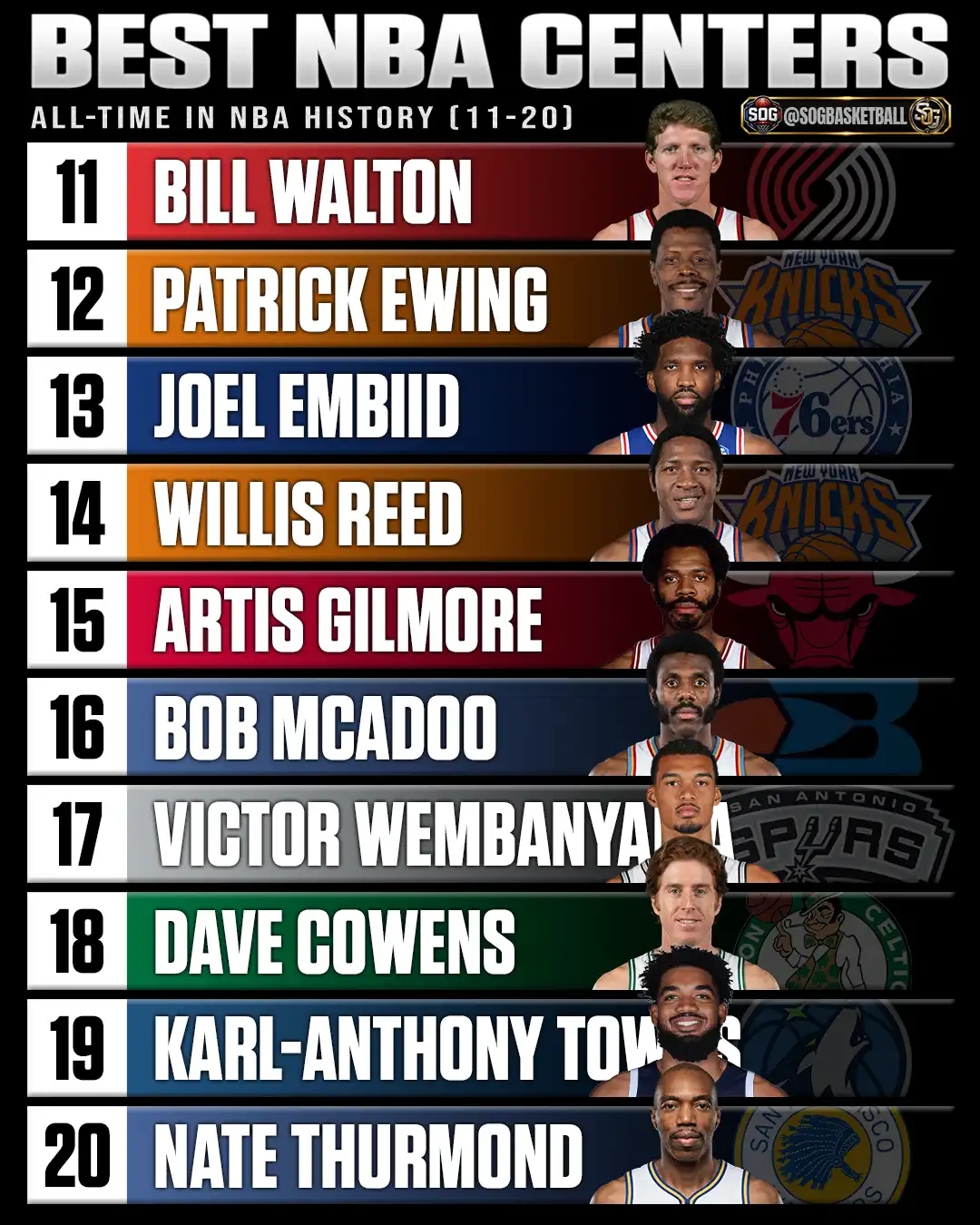
Best NBA centers of all-time ranked 11-20, featuring Bill Walton, Patrick Ewing, Joel Embiid, Willis Reed, Artis Gilmore, Bob McAdoo, Victor Wembanyama, Dave Cowens, Karl-Anthony Towns and Nate Thurmond.
11. Bill Walton
Career Stats & Accolades: 13.3 PPG, 10.5 RPG, 3.4 APG, one MVP, two NBA championships, one Finals MVP and two All-Star selections.
Bill Walton is the ultimate peak-over-longevity case. Healthy Walton controlled games with anticipation rather than isolation volume. He protected the rim, initiated offense with passing, dominated the glass and made every part of Portland’s movement system work faster.
He led the Trail Blazers to the 1977 championship and won Finals MVP, then earned league MVP the next season despite playing only 58 games. Injuries destroyed the chance to build normal career totals, but his prime was clearly championship-level. A later title as Boston’s Sixth Man of the Year showed how easily his intelligence translated into a smaller role.
12. Patrick Ewing
Career Stats & Accolades: 21.0 PPG, 9.8 RPG, 2.4 BPG, 11 All-Star selections, seven All-NBA selections and three All-Defensive selections.
Patrick Ewing became the face of the Knicks during one of the deepest center eras in league history. He provided reliable post scoring, a strong face-up jumper and high-level rim protection while carrying a large offensive burden. His 1989-90 peak of 28.6 points, 10.9 rebounds and 4.0 blocks shows how complete he could be.
Ewing never won a championship or MVP, which creates the separation between him and the top 11. Still, New York reached the 1994 Finals and remained a serious Eastern Conference threat for most of the decade. His durability, production and defensive value give him the strongest completed career in this range.
13. Joel Embiid
Career Stats & Accolades: 33.1 PPG, 10.2 RPG and 4.2 APG in his 2022-23 MVP season; one MVP, two scoring titles, five All-NBA selections and seven All-Star selections.
Joel Embiid is one of the most skilled scoring centers ever. He can overpower switches, face up slower defenders, create from the elbows, stretch beyond the arc and draw fouls at a historic rate. At his best, he also protects the rim well enough to anchor a top defense.
His 2022-23 MVP season and consecutive scoring titles give him a higher regular-season peak than most centers outside the top 10. The problem is availability and postseason translation. Philadelphia has never reached the conference finals during his career, and injuries have repeatedly limited either Embiid or the version of him available in the playoffs. That gap keeps his tremendous peak at No. 13.
14. Willis Reed
Career Stats & Accolades: 18.7 PPG, 12.9 RPG, one MVP, two NBA championships, two Finals MVPs and seven All-Star selections.
Willis Reed was the emotional and tactical center of the greatest teams in Knicks history. He could score from the post or midrange, rebound against larger opponents and defend the interior without needing the offense to stop around him. New York’s ball movement worked because Reed could contribute without demanding every possession.
The famous entrance before Game 7 of the 1970 Finals is only the final image of a much larger season. Reed became the first player to win All-Star Game MVP, regular-season MVP and Finals MVP in the same year. Injuries shortened his prime, but two championships as the central big man give him a postseason edge over several statistically stronger centers.
15. Artis Gilmore
Career Stats & Accolades: 18.8 PPG, 12.3 RPG and 2.4 BPG across the ABA and NBA; one ABA MVP, one ABA championship and 11 combined All-Star selections.
Artis Gilmore’s historical case suffers when his ABA prime is treated like a footnote. He entered professional basketball by averaging 23.8 points and 17.8 rebounds, winning MVP and leading Kentucky to the championship as a rookie. His size, strength and efficiency immediately made him one of the sport’s best centers.
Gilmore remained productive after the leagues merged and eventually played 17 professional seasons. He was not a high-post creator or dynamic face-up scorer, but few centers finished more efficiently or controlled the glass more consistently. Counting the full career places him comfortably inside the top 20.
16. Bob McAdoo
Career Stats & Accolades: 22.1 PPG, 9.4 RPG, one MVP, three scoring titles, two NBA championships and five All-Star selections.
Bob McAdoo was a scoring big before floor-spacing centers became normal. He ran the floor, attacked from the face-up game and consistently made jumpers over slower defenders. From 1974 through 1976, he won three straight scoring titles and averaged more than 30 points each season.
McAdoo’s 1974-75 MVP season peaked at 34.5 points and 14.1 rebounds per game. His prime as a franchise star was shorter than the careers above him, but he later reinvented himself as a devastating reserve on two championship Lakers teams. That combination of MVP-level offense and winning role flexibility earns No. 16.
17. Victor Wembanyama
Career Stats & Accolades: 25.0 PPG, 11.5 RPG and 3.1 BPG in 2025-26; one Defensive Player of the Year award, one All-NBA selection, two All-Defensive selections, two All-Star selections and one Rookie of the Year award.
Victor Wembanyama is the ranking’s shortest and most controversial résumé, but it is no longer built on potential alone. By age 22, he had become the youngest and first unanimous Defensive Player of the Year, made All-NBA First Team and led San Antonio to the NBA Finals. His length changes shots that would normally be open, while his recovery speed allows him to correct breakdowns from several feet away.
Offensively, he already combines three-point range, face-up creation and above-the-rim finishing in a body the league has never seen. The risk is obvious: three seasons cannot match the accumulated value of the Hall of Famers around him. No. 17 rewards a historically fast start without pretending his final legacy is settled.
18. Dave Cowens
Career Stats & Accolades: 17.6 PPG, 13.6 RPG, 3.8 APG, one MVP, two NBA championships and eight All-Star selections.
Dave Cowens was undersized for a center even in the 1970s, but he played with enough force and energy to erase that limitation. He defended the post, chased rebounds outside his area, moved the ball and ran the floor harder than most opposing big men. Boston’s offense benefited from having a center who could make quick decisions away from the basket.
Cowens averaged 20.5 points, 16.2 rebounds and 4.1 assists during his 1972-73 MVP season. He then helped the Celtics win championships in 1974 and 1976. His lower scoring efficiency holds him below the more dominant offensive centers, but his two-way activity made him the foundation of another successful Boston era.
19. Karl-Anthony Towns
Career Stats & Accolades: 20.1 PPG, 11.9 RPG and 3.0 APG in 2025-26; one NBA championship, three All-NBA selections, six All-Star selections and one Rookie of the Year award.
Karl-Anthony Towns has a legitimate claim as the greatest high-volume shooting center ever. His combination of three-point accuracy, post touch and free-throw shooting forces opposing centers to defend every level of the floor. The shooting is not cosmetic; it changes the spacing available to every teammate.
For years, defense and uneven playoff results kept his all-time case below his talent. The 2026 postseason changed the discussion. Towns helped the Knicks win the championship and recorded the highest single-postseason plus-minus in the NBA’s 30 years of play-by-play data. He still lacks the defensive peak of most centers above him, but the title gives his offensive impact a championship-level result.
20. Nate Thurmond
Career Stats & Accolades: 15.0 PPG, 15.0 RPG, seven All-Star selections, five All-Defensive selections and the first officially recorded quadruple-double.
Nate Thurmond spent his prime battling Wilt Chamberlain, Bill Russell and Kareem Abdul-Jabbar, which made recognition unusually difficult. He was strong enough to defend the post, mobile enough to cover space and relentless enough to average at least 18 rebounds in five different seasons.
Scoring efficiency is the weakness in his profile, especially compared with the centers above him. Defense was the separator, even though blocks were not officially tracked until the final years of his career. In 1974, Thurmond produced the NBA’s first officially recorded quadruple-double with 22 points, 14 rebounds, 13 assists and 12 blocks.
Best NBA Centers of All-Time: 21-30
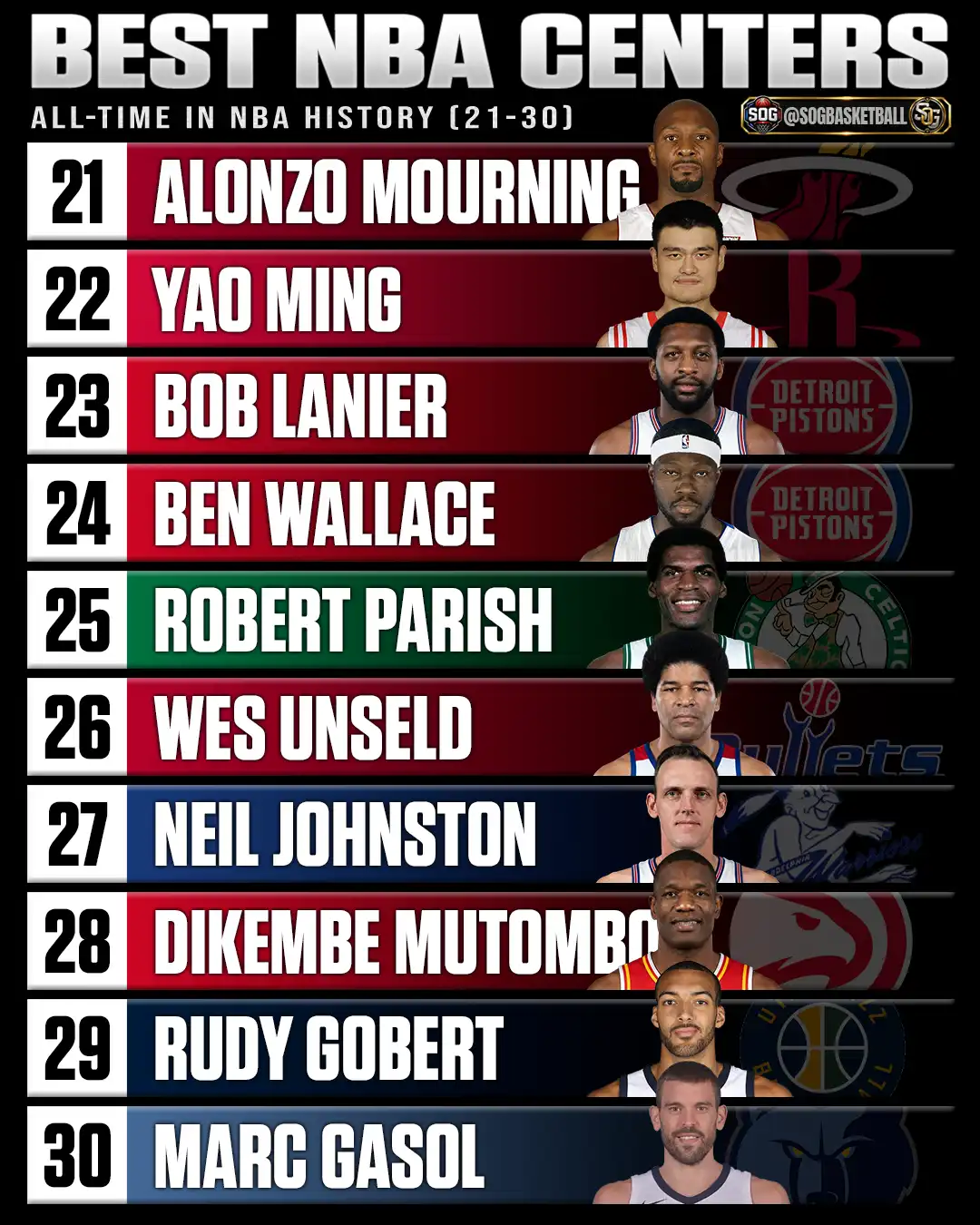
Best NBA centers of all-time ranked 21-30, featuring Alonzo Mourning, Yao Ming, Bob Lanier, Ben Wallace, Robert Parish, Wes Unseld, Neil Johnston, Dikembe Mutombo, Rudy Gobert and Marc Gasol.
21. Alonzo Mourning
Career Stats & Accolades: 17.1 PPG, 8.5 RPG, 2.8 BPG, two Defensive Player of the Year awards, one NBA championship and seven All-Star selections.
Alonzo Mourning played with a level of force that became the identity of the early Miami Heat. He could score through contact, defend stronger centers and erase mistakes at the rim. At his peak, only Dikembe Mutombo and Hakeem Olajuwon had comparable shot-blocking résumés.
Mourning won consecutive Defensive Player of the Year awards in 1999 and 2000 while averaging more than 20 points in both seasons. Kidney disease interrupted his prime and changed the second half of his career. His return to contribute meaningful defense during Miami’s 2006 championship added a fitting final chapter.
22. Yao Ming
Career Stats & Accolades: 19.0 PPG, 9.2 RPG, 1.9 BPG, eight All-Star selections and five All-NBA selections.
Yao Ming’s value cannot be reduced to being 7-foot-6. He had soft touch with either hand, reliable range from midrange and the free-throw line, strong passing instincts and enough lower-body strength to establish deep position. Healthy Yao could score efficiently against the best centers of his generation.
Across 2006-07 and 2007-08, Yao averaged 23.4 points and 10.1 rebounds while anchoring a strong defense. Foot and leg injuries limited him to 486 regular-season games and ended his career at 30. He ranks this high because the list rewards demonstrated peak ability, not just longevity, but the short runway prevents a top-20 placement.
23. Bob Lanier
Career Stats & Accolades: 20.1 PPG, 10.1 RPG, 3.1 APG, eight All-Star selections and one All-Star Game MVP.
Bob Lanier was a powerful interior scorer with more finesse than his frame suggested. He could finish with either hand, hit from midrange and pass well enough to punish aggressive help. During his Detroit prime, he regularly produced 20-point, 10-rebound seasons despite playing through knee problems.
The weakness is team success. Lanier never reached the NBA Finals and spent much of his best individual stretch on incomplete Pistons teams. His later seasons in Milwaukee proved he could contribute to a contender, but the absence of a defining playoff run keeps him in the lower half of the top 30.
24. Ben Wallace
Career Stats & Accolades: 5.7 PPG, 9.6 RPG, 2.0 BPG, four Defensive Player of the Year awards, one NBA championship, five All-NBA selections and four All-Star selections.
Ben Wallace built a Hall of Fame career without a dependable scoring package. He was only 6-foot-9, yet his strength, timing, second jump and motor allowed him to defend much larger centers. Detroit could play aggressively on the perimeter because Wallace was waiting behind the action.
He tied the career record with four Defensive Player of the Year awards and anchored the defense that upset the Lakers in the 2004 Finals. His offense was a real limitation, particularly at the free-throw line, so he could not carry the same total burden as the centers above him. Few players have ever created more value while taking fewer shots.
25. Robert Parish
Career Stats & Accolades: 14.5 PPG, 9.1 RPG, 1.5 BPG, four NBA championships, nine All-Star selections and 1,611 regular-season games.
Robert Parish was the durable interior constant of Boston’s 1980s dynasty. He ran the floor, finished efficiently, protected the rim and hit enough midrange jumpers to keep the lane available for Larry Bird and Kevin McHale. His willingness to thrive without being the first option made the Celtics’ frontcourt fit together.
Parish held the NBA games-played record for nearly 30 years before LeBron James passed his total of 1,611 in March 2026. Longevity is the center of his case, but he was more than a player who simply lasted. Parish made nine All-Star teams and remained a dependable two-way starter deep into his thirties.
26. Wes Unseld
Career Stats & Accolades: 10.8 PPG, 14.0 RPG, 3.9 APG, one MVP, one NBA championship, one Finals MVP and five All-Star selections.
Wes Unseld was barely 6-foot-7, but his strength and positioning made him one of the league’s best rebounders. His outlet passing was equally important. Unseld could turn a defensive board into an open layup before the opposing center had crossed half court.
He joined Wilt Chamberlain as one of only two players to win Rookie of the Year and MVP in the same season. Unseld later led Washington to the 1978 championship and won Finals MVP. His low scoring totals make the placement difficult, but his screening, rebounding and passing drove winning in ways that standard box scores only partially capture.
27. Neil Johnston
Career Stats & Accolades: 19.4 PPG, 11.3 RPG, three scoring titles, six All-Star selections and one NBA championship.
Neil Johnston was one of the NBA’s first great scoring centers after George Mikan. His sweeping hook became the foundation of an offense that needed efficient half-court scoring in a much slower era. Johnston won three straight scoring titles from 1953 through 1955 and also led the league in field-goal percentage three times.
He helped the Philadelphia Warriors win the 1956 championship, averaging 22.1 points and 12.5 rebounds during the regular season. A serious knee injury ended his career after only eight seasons. The era and shortened résumé make direct comparison difficult, but his production was clearly elite relative to his competition.
28. Dikembe Mutombo
Career Stats & Accolades: 9.8 PPG, 10.3 RPG, 2.8 BPG, four Defensive Player of the Year awards, eight All-Star selections and six All-Defensive selections.
Dikembe Mutombo was one of the most intimidating rim protectors basketball has produced. His length, timing and patience allowed him to challenge shots without constantly abandoning rebounding position. He led the league in blocks three times and rebounding twice.
Mutombo’s signature playoff moment came in 1994, when Denver became the first No. 8 seed to defeat a No. 1 seed. He finished the five-game upset of Seattle with 31 blocks. Limited self-created offense keeps him below the more balanced centers, but four Defensive Player of the Year awards make his defensive résumé impossible to ignore.
29. Rudy Gobert
Career Stats & Accolades: Four Defensive Player of the Year awards, four All-NBA selections, nine All-Defensive selections and three All-Star selections.
Rudy Gobert has been one of the NBA’s most valuable regular-season defenders for more than a decade. His presence changes which shots opponents attempt, not just the shots he blocks. He also creates efficient offense through screening, offensive rebounding and vertical spacing without requiring post touches.
The playoff criticism is not invented. Smaller lineups have forced him into uncomfortable perimeter decisions, and his limited self-creation makes it harder to punish switches at the other end. Still, some failures blamed on Gobert were also products of weak point-of-attack defense around him. Tying the record with four Defensive Player of the Year awards gives him a top-30 case even with those limitations.
30. Marc Gasol
Career Stats & Accolades: 14.0 PPG, 7.4 RPG, 3.4 APG, one Defensive Player of the Year award, one NBA championship, two All-NBA selections and three All-Star selections.
Marc Gasol closes the list because his best qualities connected every part of a team. He directed defenses with positioning and communication, facilitated offense from the elbows and scored efficiently without monopolizing possessions. Memphis’ Grit and Grind identity depended on his intelligence as much as its physicality.
Gasol won Defensive Player of the Year in 2013 and later adapted into a floor-spacing, high-post role on Toronto’s 2019 championship team. His defense against Joel Embiid and ability to move the ball were essential during that run. The career totals are modest compared with other candidates, but his peak two-way value translated directly to winning.
Biggest Debates in the Ranking
Kareem vs. Shaq for No. 1
Shaq has the stronger argument if the question is which center was hardest to stop for one playoff series. Kareem wins the broader career comparison. He matched elite peak value with far more longevity, six MVPs, six championships and meaningful production into his forties. That complete résumé breaks the tie.
Wilt vs. Russell
Wilt produced the superior individual statistics and carried a much larger scoring burden. Russell won 11 championships, transformed defense and repeatedly beat Wilt’s teams. This list places Wilt third because it gives slightly more weight to total on-court production, but Russell at No. 3 or even No. 1 is a defensible interpretation of center greatness.
Why Jokić is already in the top five
Jokić is not fifth because of projected accomplishments. He already has three MVPs, a championship, a Finals MVP, eight All-NBA selections and consecutive seasons averaging a triple-double. The unresolved question is how high he can climb if he adds another championship or several more elite seasons.
Wembanyama is the biggest risk
No other player ranks this high after three seasons. Wembanyama’s case rests on completed achievements that would already represent an excellent career for most centers: Rookie of the Year, Defensive Player of the Year, All-NBA First Team and a Finals appearance. The aggressive part is assuming that an extraordinary start deserves more weight than a decade of very good production from another candidate.
Defense creates the hardest comparisons
Wallace, Mutombo and Gobert all rank despite limited self-created offense because elite rim protection can shape every possession. Their combined 12 DPOY awards show the scale of that impact. The complete history of the award is available in our list of NBA Defensive Player of the Year winners.
Complete Top 30 NBA Centers of All-Time Table
This table provides a quick reference for the full ranking. More detailed statistics and accolades are included in each player’s section above.
| Rank | Center |
|---|---|
| 1 | Kareem Abdul-Jabbar |
| 2 | Shaquille O’Neal |
| 3 | Wilt Chamberlain |
| 4 | Bill Russell |
| 5 | Nikola Jokić |
| 6 | Hakeem Olajuwon |
| 7 | Moses Malone |
| 8 | David Robinson |
| 9 | George Mikan |
| 10 | Dwight Howard |
| 11 | Bill Walton |
| 12 | Patrick Ewing |
| 13 | Joel Embiid |
| 14 | Willis Reed |
| 15 | Artis Gilmore |
| 16 | Bob McAdoo |
| 17 | Victor Wembanyama |
| 18 | Dave Cowens |
| 19 | Karl-Anthony Towns |
| 20 | Nate Thurmond |
| 21 | Alonzo Mourning |
| 22 | Yao Ming |
| 23 | Bob Lanier |
| 24 | Ben Wallace |
| 25 | Robert Parish |
| 26 | Wes Unseld |
| 27 | Neil Johnston |
| 28 | Dikembe Mutombo |
| 29 | Rudy Gobert |
| 30 | Marc Gasol |
Frequently Asked Questions About the Best NBA Centers
Who is the best center in NBA history?
Kareem Abdul-Jabbar ranks first because he combines six MVPs, six championships, two Finals MVPs, 38,387 points and elite longevity. Shaquille O’Neal has the strongest peak argument, while Bill Russell has the best championship and defensive case.
Who are the top five NBA centers ever?
The top five are Kareem Abdul-Jabbar, Shaquille O’Neal, Wilt Chamberlain, Bill Russell and Nikola Jokić.
Which center had the greatest peak?
Shaquille O’Neal has the best peak argument because he won three consecutive championships and Finals MVPs while averaging 35.9 points and 15.2 rebounds across those Finals. Wilt Chamberlain’s 1961-62 season and Hakeem Olajuwon’s 1994 postseason are the other strongest candidates.
Who is the greatest defensive center ever?
Bill Russell ranks as the greatest defensive center because his rim protection, rebounding and transition impact drove 11 championship teams. Hakeem Olajuwon has the strongest modern statistical case, while Ben Wallace, Dikembe Mutombo, Dwight Howard and Rudy Gobert own the largest DPOY totals.
Why is Nikola Jokić already ranked fifth?
Jokić has completed an inner-circle résumé with three MVPs, a championship, a Finals MVP and eight All-NBA selections. Consecutive seasons averaging a triple-double strengthen a case already built on one of the greatest offensive peaks at any position.
Why is Victor Wembanyama already ranked 17th?
Wembanyama became the youngest and first unanimous Defensive Player of the Year, made All-NBA First Team and reached the Finals by age 22. His placement remains aggressive because the career is only three seasons old, but it is supported by major completed accomplishments rather than potential alone.
Why are ABA accomplishments included?
ABA production is included when evaluating the full professional careers of players who later became major NBA centers. Ignoring those seasons would erase much of Artis Gilmore’s prime and part of Moses Malone’s development. NBA and BAA accomplishments still receive the greatest weight.
Which active centers are in the top 30?
Nikola Jokić, Joel Embiid, Victor Wembanyama, Karl-Anthony Towns and Rudy Gobert are active members of the ranking through the 2025-26 season.
Conclusion
Kareem Abdul-Jabbar ranks first because no center matches his complete combination of peak play, awards, championships, scoring and longevity. Shaq, Wilt and Russell each own a stronger argument in one specific area, but Kareem’s résumé has the fewest weaknesses.
The position continues to evolve. Jokić has made passing the center of a championship offense, Towns helped normalize extreme shooting range from the five and Wembanyama is already changing which shots offenses believe are available. The style keeps moving forward, but every player in the top 30 controlled the game in a way that defined his era.
More NBA All-Time Rankings
Continue with our best NBA players of all-time, best point guards in NBA history, NBA career scoring leaders and NBA career rebounding leaders.
For more basketball rankings, graphics and debates, follow @SOGBasketball on Instagram.
