
Matthew Stafford was the best quarterback in the NFL during the 2025 season. The Los Angeles Rams veteran led the league with 4,707 passing yards and 46 touchdowns, threw only eight interceptions and won the closest AP NFL MVP vote in more than two decades.
This list selects the best quarterback in the NFL every season of the Super Bowl era, beginning with Bart Starr in 1966 and continuing through Stafford in 2025. The displayed year refers to the NFL season, not the calendar year in which the Super Bowl was played. The 2025 selection therefore covers the regular season that began in 2025 and the playoffs completed in February 2026.
The ranking is not determined by passing yards alone. Regular-season production, efficiency, rushing value, availability, awards, supporting cast, team importance and postseason performance all matter. Some years produced an obvious MVP. Others required a choice between the better regular-season résumé and the quarterback who ultimately solved the postseason.
How We Picked the Best Quarterback Each NFL Season
This is a SOG Sports editorial ranking rather than an official league award list. Every supplied quarterback and season remains in the original order, while the analysis explains why that player received the selection and where the closest counterarguments come from.
- Passing production: Yards, touchdowns, completion rate, yards per attempt and the difficulty of the quarterback’s workload.
- Efficiency and decision-making: Interceptions, sacks, passer rating, ball security and the ability to avoid empty possessions.
- Rushing value: Designed runs, scrambles, short-yardage production and the pressure created outside the pocket.
- Awards and recognition: MVP voting, All-Pro teams, Pro Bowls and other season-specific honors.
- Team importance: How much the offense depended on the quarterback and the quality of the support around him.
- Postseason performance: Playoff results do not erase the regular season, but they can settle a close comparison.
- Era context: Passing rules, schedule length, offensive systems and the statistical environment of the season.
The most important distinction is between the best regular-season quarterback and the best quarterback across the complete season. Most selections align with the strongest regular-season case. The 2023 Patrick Mahomes choice is the clearest postseason-driven exception, while the 2024 Josh Allen selection depends on MVP value rather than having the best passing statistics.
Best Quarterbacks Each NFL Season, 2025-1996
2025 — Matthew Stafford
Matthew Stafford delivered the strongest regular-season quarterback résumé of 2025. At 37, he completed 65.0 percent of his passes for 4,707 yards, 46 touchdowns and only 8 interceptions, leading the NFL in both yards and touchdown passes while posting a 109.2 passer rating.
Stafford earned first-team All-Pro honors and won NFL MVP in an exceptionally close vote over Drake Maye. Maye was more efficient by passer rating and led New England to 14 wins, but Stafford carried the league’s highest-scoring offense, produced 15 more touchdown passes and maintained aggressive downfield creation without giving the ball away.
2024 — Josh Allen
Josh Allen threw for 3,731 yards, 28 touchdowns and only 6 interceptions, then added 531 rushing yards and 12 rushing touchdowns. Buffalo went 13-4 after moving on from Stefon Diggs and Gabe Davis, yet the offense remained one of the league’s most productive units.
Lamar Jackson had the stronger statistical passing season and earned first-team All-Pro recognition, making this a genuine debate rather than an automatic MVP selection. Allen gets the fixed SOG Sports spot because he reduced the reckless mistakes that had defined some earlier seasons, accounted for 41 total touchdowns and remained the central solution for an offense without a first-team All-Pro skill player.
2023 — Patrick Mahomes
Patrick Mahomes’ 2023 regular season was below his usual standard. He threw for 4,183 yards, 27 touchdowns and 14 interceptions, while Lamar Jackson won MVP and first-team All-Pro honors after leading Baltimore to the AFC’s best record.
This selection is driven by the complete season rather than the regular season alone. Mahomes won four playoff games, repeatedly solved elite defenses and finished with 333 passing yards, 66 rushing yards and the overtime-winning touchdown drive in Super Bowl LVIII. His third Super Bowl MVP is the reason he remains first in the supplied order.
2022 — Patrick Mahomes
Mahomes’ 2022 season was one of the strongest quarterback years of the modern era. Kansas City traded Tyreek Hill before the season, and instead of slowing down, Mahomes became harder to defend because he spread the ball everywhere.
He threw for 5,250 yards, 41 touchdowns and won NFL MVP. Then he carried that form into the playoffs and won the Super Bowl. This was the season that fully proved Mahomes could dominate without one specific superstar wide receiver.
2021 — Aaron Rodgers
Aaron Rodgers’ 2021 season was another masterclass in efficiency. He was not chasing empty volume. He was controlling games, protecting the ball and punishing defenses whenever they gave him even a small opening.
Rodgers threw 37 touchdowns with only 4 interceptions and won his second straight MVP. His connection with Davante Adams was devastating, and his command before the snap remained as sharp as any quarterback in football.
2020 — Aaron Rodgers
Rodgers’ 2020 season was one of the cleanest passing seasons ever. He looked completely comfortable in Matt LaFleur’s offense and turned Green Bay into one of the league’s most efficient attacks.
He threw for 4,299 yards, 48 touchdowns and only 5 interceptions, winning NFL MVP. The accuracy, timing and red-zone execution were all elite. Rodgers had an answer for almost everything defenses tried.
2019 — Lamar Jackson
Lamar Jackson’s 2019 season changed how people talked about quarterback play. Baltimore built an offense around his speed, vision and improved passing, and defenses never really solved it.
Jackson threw 36 touchdowns, ran for 1,206 yards and won unanimous NFL MVP. He was not simply a running quarterback. He was the centerpiece of a unique offense that made opponents look slow and unprepared.
2018 — Patrick Mahomes
Patrick Mahomes’ 2018 season was the arrival of a superstar. In his first full year as a starter, he played with a level of creativity and confidence that immediately changed the league.
Mahomes threw for 5,097 yards, 50 touchdowns and won NFL MVP. The no-look throws, deep shots, off-platform lasers and weekly fireworks were real, but so was the production. This was one of the great quarterback breakout seasons ever.
2017 — Tom Brady
Tom Brady was still the best quarterback in football in 2017, even deep into a career that had already secured his all-time résumé. The Patriots leaned on his accuracy, timing and command, and he kept playing at an MVP level.
Brady threw for 4,577 yards, 32 touchdowns and won NFL MVP at age 40. His arm strength was still there, his decision-making was elite and his control of the offense remained unmatched.
2016 — Matt Ryan
Matt Ryan’s 2016 season was the best year of his career and one of the most efficient quarterback seasons of the decade. Atlanta’s offense was explosive, balanced and nearly impossible to cover.
Ryan threw for 4,944 yards, 38 touchdowns and only 7 interceptions, winning NFL MVP. His connection with Julio Jones was the headline, but Ryan spread the ball around beautifully and made Kyle Shanahan’s offense sing.
2015 — Cam Newton
Cam Newton’s 2015 season was unlike anything else in the league. Carolina went 15-1 because Newton gave the Panthers a power-running threat, a deep passer and a red-zone weapon all in one quarterback.
Newton threw 35 touchdown passes, ran for 636 yards, scored 10 rushing touchdowns and won NFL MVP. He carried an offense without a top-end wide receiver and made it look dangerous anyway.
2014 — Aaron Rodgers
Rodgers’ 2014 season was peak precision. He threw with remarkable accuracy, avoided mistakes and gave Green Bay one of the league’s most dangerous passing attacks.
He finished with 4,381 yards, 38 touchdowns and only 5 interceptions, winning NFL MVP. When Rodgers was in rhythm that year, the Packers offense felt almost automatic.
2013 — Peyton Manning
Peyton Manning’s 2013 season is the most statistically explosive quarterback season ever. Denver’s offense looked unstoppable for most of the year, and Manning was the reason everything worked.
He threw for an NFL-record 5,477 yards and an NFL-record 55 touchdowns, winning NFL MVP. The numbers were absurd, but the weekly control was just as impressive. Manning was diagnosing defenses before the ball was even snapped.
2012 — Tom Brady
Tom Brady’s 2012 season was another year of outstanding efficiency and control in New England. Peyton Manning had a great comeback season in Denver, and Aaron Rodgers remained brilliant, but Brady’s command of the Patriots offense gives him the edge here.
Brady threw for 4,827 yards, 34 touchdowns and only 8 interceptions. New England led the league in scoring, and Brady remained the engine behind one of football’s most adaptable offenses.
2011 — Aaron Rodgers
Aaron Rodgers’ 2011 season is one of the best quarterback seasons ever. Green Bay went 15-1, and Rodgers played with a level of efficiency that felt almost unfair.
He threw for 4,643 yards, 45 touchdowns and only 6 interceptions, finishing with a then-record 122.5 passer rating and winning NFL MVP. This was Rodgers at his sharpest.
2010 — Tom Brady
Brady’s 2010 season was a perfect example of how much control he had over the game. New England traded Randy Moss during the season, shifted its offensive identity and somehow became even more efficient.
Brady threw 36 touchdowns and only 4 interceptions, winning NFL MVP. He was patient, precise and almost impossible to bait into mistakes.
2009 — Drew Brees
Drew Brees was brilliant in 2009. New Orleans had a creative offense, but Brees was the player who made the timing, spacing and aggression all work.
He threw for 4,388 yards, 34 touchdowns and led the NFL in completion percentage. He finished the season by leading the Saints to their first Super Bowl title. The accuracy and rhythm were outstanding from start to finish.
2008 — Peyton Manning
Peyton Manning’s 2008 season was not his biggest statistical year, but it was one of his most impressive from a command standpoint. After a slow start, he pulled Indianapolis back into the playoff picture and won MVP.
Manning threw for 4,002 yards, 27 touchdowns and kept the Colts offense steady through injuries and inconsistency. His value was clearest in how much he stabilized everything around him.
2007 — Tom Brady
Brady’s 2007 season was a full offensive explosion. With Randy Moss stretching the field and New England attacking defenses aggressively, Brady put together one of the greatest passing seasons ever.
He threw for 4,806 yards, an NFL-record-at-the-time 50 touchdowns and only 8 interceptions, winning NFL MVP. The Patriots went undefeated in the regular season, and Brady was the driving force.
2006 — Peyton Manning
Peyton Manning was the best quarterback in football in 2006 because he combined strong regular-season play with the playoff finish that had been missing from his résumé.
He threw for 4,397 yards, 31 touchdowns and then led Indianapolis to a Super Bowl title. Manning won Super Bowl MVP, finally pairing his regular-season dominance with a championship run.
2005 — Peyton Manning
Manning’s 2005 season was another year in which he controlled the league from the line of scrimmage. Indianapolis was balanced, explosive and incredibly efficient.
He threw for 3,747 yards, 28 touchdowns and only 10 interceptions. The raw totals were not as wild as 2004, but Manning’s command of the offense kept him at the top of the position.
2004 — Peyton Manning
Peyton Manning’s 2004 season was a landmark year for quarterback efficiency. He set the single-season touchdown record at the time and made Indianapolis’ passing game look almost unstoppable.
Manning threw for 4,557 yards, 49 touchdowns and only 10 interceptions, winning NFL MVP. His 121.1 passer rating was historic, and the Colts offense felt like it had answers before the defense even lined up.
2003 — Peyton Manning
Manning’s 2003 season was another step in his rise from top quarterback to all-time great. He shared MVP honors and gave Indianapolis one of the league’s most reliable passing attacks.
He threw for 4,267 yards, 29 touchdowns and led the Colts with his usual mix of pre-snap control, accuracy and rhythm. The command was what separated him.
2002 — Rich Gannon
Rich Gannon’s 2002 season was one of the great late-career quarterback peaks. In the Raiders offense, he became a high-volume, highly efficient passer who controlled games with rhythm and accuracy.
Gannon threw for 4,689 yards, 26 touchdowns and won NFL MVP. He led Oakland to the Super Bowl and proved that a veteran quarterback in the right system could still own an entire season.
2001 — Kurt Warner
Kurt Warner’s 2001 season was another brilliant year inside the Greatest Show on Turf. The Rams had speed everywhere, but Warner’s timing and aggressiveness made the whole offense come alive.
He threw for 4,830 yards, 36 touchdowns and won NFL MVP. The ball came out on time, the deep shots were fearless and St. Louis remained one of the most dangerous offenses in NFL history.
2000 — Peyton Manning
Peyton Manning’s 2000 season was one of the early proof points that he was going to become the league’s defining quarterback. The Colts offense was young, explosive and built around his command.
Manning threw for 4,413 yards, 33 touchdowns and continued building his connection with Marvin Harrison and Edgerrin James. The MVPs came later, but this was already top-level quarterback play.
1999 — Kurt Warner
Kurt Warner’s 1999 season is one of the greatest surprise breakouts in NFL history. He went from unknown backup to MVP, Super Bowl champion and the face of the league’s most explosive offense.
Warner threw for 4,353 yards, 41 touchdowns and won both NFL MVP and Super Bowl MVP. The story was incredible, but the play was even better.
1998 — Randall Cunningham
Randall Cunningham’s 1998 season was a late-career masterpiece. With Randy Moss and Cris Carter stretching defenses, Cunningham played efficient, explosive football for one of the best offenses ever.
He threw for 3,704 yards, 34 touchdowns and only 10 interceptions. Minnesota went 15-1, and Cunningham’s deep ball helped make that offense feel unstoppable.
1997 — Brett Favre
Brett Favre’s 1997 season kept him at the top of the quarterback world. Green Bay was the defending champion, and Favre was still playing with the fearless style that made him the league’s most exciting passer.
He threw for 3,867 yards, 35 touchdowns and won a share of NFL MVP. The turnovers were part of the ride, but the playmaking and leadership kept Green Bay in Super Bowl contention.
1996 — Brett Favre
Favre’s 1996 season was the peak of his first great run. He won MVP, led the Packers to the Super Bowl and played with a mix of arm talent, toughness and improvisation that few quarterbacks could match.
He threw for 3,899 yards, 39 touchdowns and helped bring Green Bay its first Super Bowl title in nearly 30 years. Favre was reckless at times, but in 1996, the rewards were enormous.
Best Quarterbacks Each NFL Season, 1995-1966
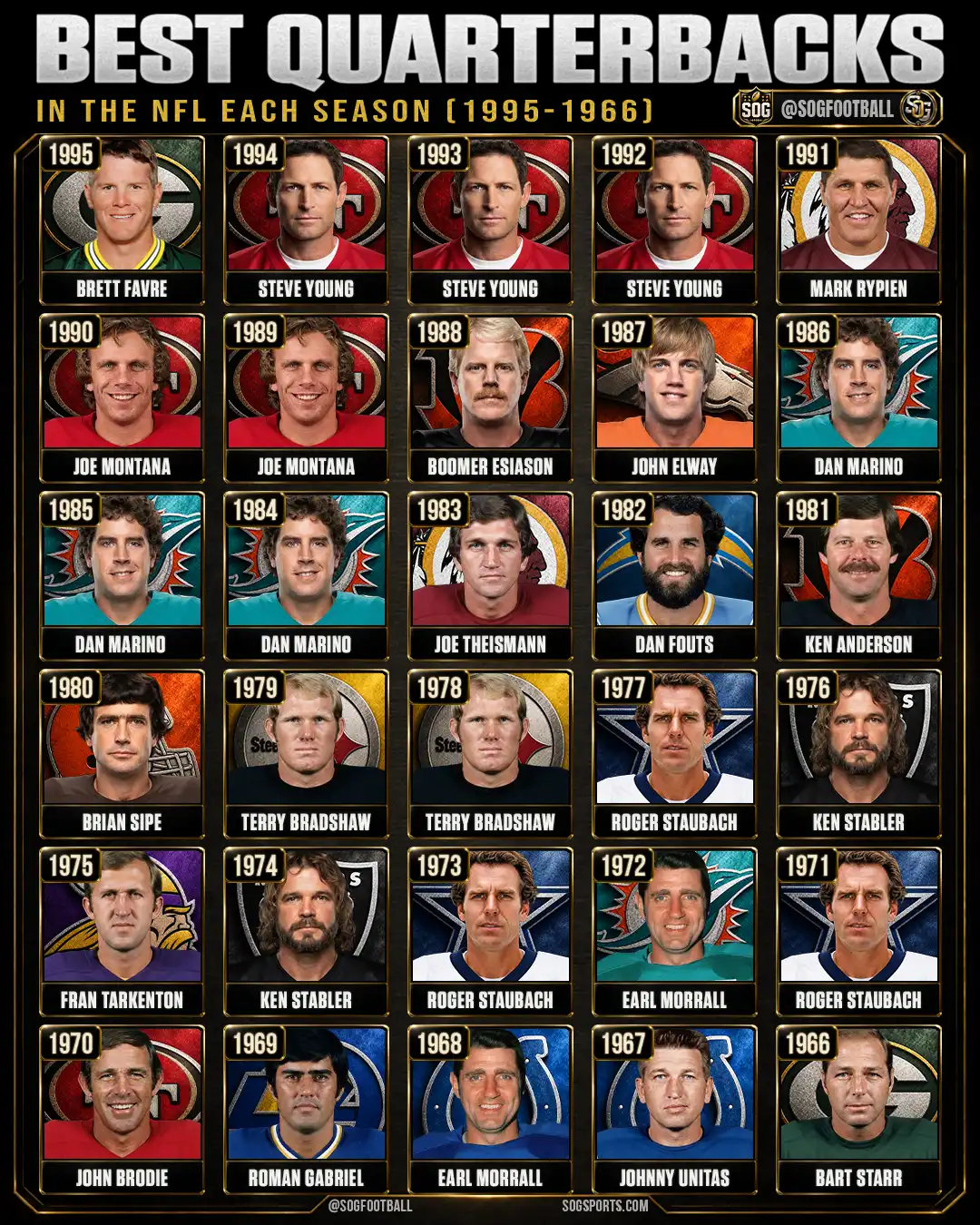
Best quarterbacks in the NFL each season from 1966 through 1995, featuring Brett Favre, Steve Young, Joe Montana, Dan Marino, John Elway, Terry Bradshaw, Roger Staubach, Johnny Unitas and Bart Starr.
1995 — Brett Favre
Brett Favre’s 1995 season was the first MVP year of his three-year run. Green Bay had its franchise quarterback, and Favre played with the confidence, arm strength and fearlessness that made him impossible to ignore.
He threw for 4,413 yards, 38 touchdowns and won NFL MVP. The big throws, mistakes, chaos and brilliance all came together. Favre was the league’s most electric quarterback.
1994 — Steve Young
Steve Young’s 1994 season was the year he fully stepped out from under Joe Montana’s shadow. He won MVP, won the Super Bowl and delivered one of the cleanest all-around quarterback seasons ever.
Young threw for 3,969 yards, 35 touchdowns and only 10 interceptions, then dominated the Super Bowl with six touchdown passes. His efficiency, mobility and championship finish make this one of the strongest quarterback seasons on the list.
1993 — Steve Young
Steve Young threw for 4,023 yards, 29 touchdowns and 16 interceptions, becoming the first 49ers quarterback to cross 4,000 passing yards. He led the NFL with a 101.5 passer rating and added 407 rushing yards and two rushing scores.
San Francisco did not reach the Super Bowl, but Young’s efficiency and mobility gave the offense a dimension it had not possessed in the same form under Joe Montana. The 1994 championship season was still ahead, yet by 1993 Young had already established himself as the league’s most complete quarterback.
1992 — Steve Young
Steve Young won NFL MVP after throwing for 3,465 yards, 25 touchdowns and only 7 interceptions. He led the league in completion percentage, touchdown rate and passer rating while adding 537 rushing yards and four more scores.
The transition from Joe Montana could have fractured San Francisco’s championship window. Instead, Young gave the 49ers an efficient passer who could also turn pressure into explosive rushing gains. This was the season he became the clear centerpiece of the offense.
1991 — Mark Rypien
Mark Rypien threw for 3,564 yards, 28 touchdowns and 11 interceptions while averaging 8.5 yards per attempt. Washington finished 14-2 and produced one of the most balanced, efficient offenses of the Super Bowl era.
Rypien benefited from an excellent offensive line and deep supporting cast, but he maximized those advantages with accurate downfield passing and very few negative plays. He then threw six touchdowns across three playoff wins and earned Super Bowl MVP after beating Buffalo.
1990 — Joe Montana
Joe Montana threw for 3,944 yards, 26 touchdowns and 16 interceptions, winning his second consecutive NFL MVP. San Francisco finished 14-2 and entered the postseason one victory away from pursuing a third straight championship.
The interception total was higher than in Montana’s 1989 masterpiece, but his command of the offense remained the position’s standard. He consistently delivered the ball before pressure arrived and gave Jerry Rice opportunities to create after the catch.
1989 — Joe Montana
Joe Montana completed 70.2 percent of his passes for 3,521 yards, 26 touchdowns and only 8 interceptions. His 112.4 passer rating led the NFL and remained the single-season record until Steve Young surpassed it five years later.
Montana was even sharper in the postseason, throwing 11 touchdowns without an interception across three games. San Francisco won Super Bowl XXIV by 45 points, and Montana collected both NFL MVP and Super Bowl MVP.
1988 — Boomer Esiason
Boomer Esiason’s 1988 season was the best of his career. Cincinnati’s offense was creative, physical and explosive, and Esiason was the left-handed engine behind it.
He threw for 3,572 yards, 28 touchdowns and won NFL MVP. The Bengals reached the Super Bowl, and Esiason gave them one of the league’s most dangerous passing attacks.
1987 — John Elway
John Elway threw for 3,198 yards and 19 touchdowns during the strike-shortened season, then added 304 rushing yards and four rushing scores. Denver depended on his arm strength and movement to create offense when structure broke down.
Joe Montana produced the cleaner statistical season, but Elway won NFL MVP because of how much Denver’s offense asked him to solve. He carried the Broncos back to the Super Bowl and repeatedly converted low-percentage situations that few quarterbacks could survive.
1986 — Dan Marino
Dan Marino was still operating at an extraordinary level in 1986. The release, arm strength and aggression were all exceptional, and Miami’s passing game continued to run through him.
Marino threw for 4,746 yards and 44 touchdowns. Those numbers are huge in any era, but especially in the mid-1980s. Few quarterbacks have ever made high-volume passing look that natural.
1985 — Dan Marino
Dan Marino followed his record-setting 1984 season with 4,137 passing yards and 30 touchdowns. Miami finished 12-4 and handed the eventual champion Chicago Bears their only loss of the season.
The interception total rose to 21, but Marino remained the league’s most dangerous pure passer. His release neutralized pressure, and Miami could build an outstanding offense around shotgun timing and vertical routes without a dominant running game.
1984 — Dan Marino
Dan Marino’s 1984 season changed quarterback statistics forever. He threw for 5,084 yards and 48 touchdowns, numbers that looked almost impossible at the time.
He won NFL MVP, led Miami to the Super Bowl and showed what a modern passing explosion could look like before the league fully became pass-first. Marino was ahead of the sport.
1983 — Joe Theismann
Joe Theismann’s 1983 season was the best of his career. Washington was coming off a championship, and Theismann played with the efficiency and command of a quarterback in complete control.
He threw for 3,714 yards, 29 touchdowns and won NFL MVP. Washington’s offense had balance and toughness, but Theismann’s passing gave it another level.
1982 — Dan Fouts
Dan Fouts threw for 2,883 yards and 17 touchdowns in only nine games during the strike-shortened 1982 season. His 320.3 passing yards per game led the league by a wide margin, and he earned first-team All-Pro and Offensive Player of the Year honors.
Air Coryell asked Fouts to attack areas of the field that most teams approached cautiously. He consistently pushed the ball through tight windows to Kellen Winslow, Charlie Joiner and Wes Chandler, keeping San Diego at the front of the league’s passing revolution.
1981 — Ken Anderson
Ken Anderson’s 1981 season was a brilliant mix of accuracy, efficiency and leadership. Cincinnati reached the Super Bowl, and Anderson played the best football of his career.
He threw for 3,754 yards, 29 touchdowns and only 10 interceptions, winning NFL MVP. His 98.4 passer rating was outstanding for the era.
1980 — Brian Sipe
Brian Sipe’s 1980 season gave Cleveland one of the most exciting passing years in franchise history. The “Kardiac Kids” lived in close games, and Sipe’s aggression was a major reason why.
He threw for 4,132 yards, 30 touchdowns and won NFL MVP. It was not always neat, but it was productive, bold and unforgettable.
1979 — Terry Bradshaw
Terry Bradshaw set career highs with 3,724 passing yards and 26 touchdowns, although his aggressive style also produced 25 interceptions. Pittsburgh went 12-4 and finished among the NFL’s highest-scoring teams.
Bradshaw’s selection is strengthened by the postseason. He threw for 309 yards and two touchdowns in Super Bowl XIV, winning his second consecutive Super Bowl MVP and giving the Steelers their fourth championship in six seasons.
1978 — Terry Bradshaw
Bradshaw’s 1978 season was his regular-season peak. Pittsburgh opened up the passing game, and Bradshaw responded with the best statistical year of his career.
He threw 28 touchdown passes, won NFL MVP and led the Steelers to a Super Bowl win. This was the season that proved Bradshaw was not simply along for the ride on a great team.
1977 — Roger Staubach
Roger Staubach threw for 2,620 yards, 18 touchdowns and 9 interceptions, leading the NFL with an 87.0 passer rating. Dallas finished 12-2 and scored more points than any other NFC team.
Staubach combined disciplined pocket passing with the ability to escape and create after a play broke down. He then led three postseason victories, including a decisive Super Bowl XII win over Denver.
1976 — Ken Stabler
Ken Stabler completed a league-best 66.7 percent of his passes for 2,737 yards and 27 touchdowns. Oakland went 13-1, and his 103.4 passer rating was comfortably the best mark in football.
The Raiders had a physical roster, but Stabler gave them precision and calm in high-leverage possessions. He led Oakland through three playoff wins and completed the season with the franchise’s first Super Bowl championship.
1975 — Fran Tarkenton
Fran Tarkenton’s 1975 season was the best of his long career. He was creative, accurate, mobile and still one of the hardest quarterbacks in football to pin down.
Tarkenton threw for 2,994 yards, 25 touchdowns and won NFL MVP. His scrambling style helped shape the future of quarterback play, but he was also an outstanding passer.
1974 — Ken Stabler
Stabler’s 1974 season was his MVP year and one of the best quarterback seasons of the decade. He played with rhythm, toughness and a calm that matched the Raiders’ personality.
He threw 26 touchdown passes, won NFL MVP and gave Oakland one of the league’s most efficient passing attacks. When the Raiders needed a throw, Stabler usually found it.
1973 — Roger Staubach
Staubach’s 1973 season was one of his cleanest passing years. He led the league in passer rating and gave Dallas a quarterback who could win from structure or chaos.
Staubach threw 23 touchdown passes and remained one of the NFL’s most efficient and dangerous players. His ability to improvise without losing control made him different.
1972 — Earl Morrall
Earl Morrall took over after Bob Griese broke his ankle and went 9-0 as Miami’s starting quarterback. He threw 11 touchdowns against seven interceptions, led the NFL in passer rating and earned first-team All-Pro recognition.
Griese returned during the postseason and finished the perfect season, but Morrall preserved it through the most vulnerable stretch of Miami’s schedule. The Dolphins did not need high passing volume. They needed clean decisions, play-action accuracy and protection of the football, and Morrall supplied all three.
1971 — Roger Staubach
Roger Staubach threw for 1,882 yards, 15 touchdowns and only 4 interceptions, leading the NFL with a 104.8 passer rating. Dallas won all 10 of his regular-season starts after coach Tom Landry ended the early quarterback rotation.
Staubach’s mobility added stress to a balanced Cowboys offense without making it reckless. He won three playoff games, threw two touchdowns in Super Bowl VI and was named the game’s MVP.
1970 — John Brodie
John Brodie’s 1970 season was the best of his career. He gave San Francisco a high-level passing season and helped lead the 49ers to the NFC Championship Game.
Brodie threw for 2,941 yards, 24 touchdowns and won NFL MVP. He was accurate, experienced and in complete command of the offense.
1969 — Roman Gabriel
Roman Gabriel’s 1969 season was a powerful blend of size, arm strength and efficiency. The Rams were one of the best teams in football, and Gabriel was the leader of the offense.
He threw 24 touchdown passes and won NFL MVP. In an era in which passing numbers were lower, Gabriel’s production and team success stood out clearly.
1968 — Earl Morrall
Earl Morrall’s 1968 season was one of the best backup-turned-starter stories ever. After Johnny Unitas was injured, Morrall took over the Colts offense and played at an MVP level.
He threw for 2,909 yards, 26 touchdowns and won NFL MVP. Baltimore’s season ended painfully in Super Bowl III, but Morrall’s regular season was still outstanding.
1967 — Johnny Unitas
Johnny Unitas threw for 3,428 yards and 20 touchdowns, winning NFL MVP and leading Baltimore to an 11-1-2 record. The Colts missed the playoffs only because the Rams won the Coastal Division tiebreaker.
Unitas remained the model for pocket toughness and late-game control. He attacked downfield, absorbed pressure and handled the line-of-scrimmage responsibilities that later became central to the modern quarterback position.
1966 — Bart Starr
Bart Starr completed 62.2 percent of his passes for 2,257 yards, 14 touchdowns and only 3 interceptions. His 105.0 passer rating led the NFL, and he won the league’s Most Valuable Player award.
Green Bay then won the NFL Championship and defeated Kansas City in the first AFL-NFL World Championship Game. Starr threw for 250 yards and two touchdowns in that victory, earning the first Super Bowl MVP award.
Hardest Decisions and Closest Calls
Several seasons came down to a genuine disagreement about what “best” should mean. These comparisons explain the most important judgment calls without changing the supplied selections.
2025 — Matthew Stafford vs. Drake Maye
Stafford won MVP by only five voting points, receiving 366 to Maye’s 361. Maye completed 72.0 percent of his passes, led the NFL with a 113.5 passer rating and helped New England finish 14-3. Stafford gets the selection because he led the league in yards and touchdowns, threw 46 scores against only eight interceptions and directed the NFL’s highest-scoring offense.
2024 — Josh Allen vs. Lamar Jackson
Jackson threw for 4,172 yards, 41 touchdowns and only four interceptions, added 915 rushing yards and was selected as the first-team All-Pro quarterback. Allen won MVP after accounting for 41 total touchdowns, throwing a career-low six interceptions and carrying a reworked Buffalo offense to 13 wins. The supplied ranking values Allen’s overall team burden and MVP result, even though Jackson owned the stronger statistical case.
2023 — Patrick Mahomes vs. Lamar Jackson
Jackson was the clear regular-season winner. He earned MVP and first-team All-Pro honors while leading Baltimore to the AFC’s best record. Mahomes gets the full-season selection because Kansas City won four postseason games and he finished the run with another Super Bowl MVP, including the overtime drive that defeated San Francisco.
2016 — Matt Ryan vs. Tom Brady
Brady went 11-1 after returning from suspension and produced a better touchdown-to-interception ratio. Ryan played the complete season, led the league in passer rating and yards per attempt, won MVP and directed an Atlanta offense that reached the Super Bowl. The larger full-season body of work keeps Ryan first.
2012 — Tom Brady vs. Peyton Manning and Aaron Rodgers
Manning earned first-team All-Pro recognition during his comeback season, while Rodgers led the league in passer rating. Brady threw for 4,827 yards, accounted for 38 total touchdowns and directed a New England offense that led the NFL with 557 points. The choice prioritizes the overall scale and adaptability of the Patriots offense.
2009 — Drew Brees vs. Peyton Manning
Manning won MVP and led Indianapolis to a 14-0 start before the Colts rested starters. Brees led the NFL in completion percentage, touchdown rate and passer rating, then defeated Manning in the Super Bowl and won the game’s MVP award. His efficiency and postseason finish break the tie.
1991 — Mark Rypien vs. Steve Young and Jim Kelly
Young led the league in passer rating and Kelly directed Buffalo back to the Super Bowl. Rypien combined outstanding downfield efficiency with a 14-2 record, protected the ball and completed the season with Super Bowl MVP. His supporting cast was excellent, but his execution within that offense was nearly flawless.
1987 — John Elway vs. Joe Montana
Montana threw 31 touchdowns against 13 interceptions and posted a much higher passer rating. Elway won MVP because Denver depended more heavily on his ability to create without ideal protection or structure. This selection emphasizes individual burden and late-down problem-solving over statistical efficiency.
1972 — Earl Morrall vs. Roger Staubach
Staubach was the league’s most efficient passer when healthy, but a shoulder injury cost him most of the regular season. Morrall went 9-0 after replacing Bob Griese, led the league in passer rating and earned first-team All-Pro recognition while preserving Miami’s undefeated campaign.
Complete Table: Best Quarterback Every Super Bowl-Era NFL Season
| Season | Best Quarterback | Team |
|---|---|---|
| 2025 | Matthew Stafford | Los Angeles Rams |
| 2024 | Josh Allen | Buffalo Bills |
| 2023 | Patrick Mahomes | Kansas City Chiefs |
| 2022 | Patrick Mahomes | Kansas City Chiefs |
| 2021 | Aaron Rodgers | Green Bay Packers |
| 2020 | Aaron Rodgers | Green Bay Packers |
| 2019 | Lamar Jackson | Baltimore Ravens |
| 2018 | Patrick Mahomes | Kansas City Chiefs |
| 2017 | Tom Brady | New England Patriots |
| 2016 | Matt Ryan | Atlanta Falcons |
| 2015 | Cam Newton | Carolina Panthers |
| 2014 | Aaron Rodgers | Green Bay Packers |
| 2013 | Peyton Manning | Denver Broncos |
| 2012 | Tom Brady | New England Patriots |
| 2011 | Aaron Rodgers | Green Bay Packers |
| 2010 | Tom Brady | New England Patriots |
| 2009 | Drew Brees | New Orleans Saints |
| 2008 | Peyton Manning | Indianapolis Colts |
| 2007 | Tom Brady | New England Patriots |
| 2006 | Peyton Manning | Indianapolis Colts |
| 2005 | Peyton Manning | Indianapolis Colts |
| 2004 | Peyton Manning | Indianapolis Colts |
| 2003 | Peyton Manning | Indianapolis Colts |
| 2002 | Rich Gannon | Oakland Raiders |
| 2001 | Kurt Warner | St. Louis Rams |
| 2000 | Peyton Manning | Indianapolis Colts |
| 1999 | Kurt Warner | St. Louis Rams |
| 1998 | Randall Cunningham | Minnesota Vikings |
| 1997 | Brett Favre | Green Bay Packers |
| 1996 | Brett Favre | Green Bay Packers |
| 1995 | Brett Favre | Green Bay Packers |
| 1994 | Steve Young | San Francisco 49ers |
| 1993 | Steve Young | San Francisco 49ers |
| 1992 | Steve Young | San Francisco 49ers |
| 1991 | Mark Rypien | Washington Redskins |
| 1990 | Joe Montana | San Francisco 49ers |
| 1989 | Joe Montana | San Francisco 49ers |
| 1988 | Boomer Esiason | Cincinnati Bengals |
| 1987 | John Elway | Denver Broncos |
| 1986 | Dan Marino | Miami Dolphins |
| 1985 | Dan Marino | Miami Dolphins |
| 1984 | Dan Marino | Miami Dolphins |
| 1983 | Joe Theismann | Washington Redskins |
| 1982 | Dan Fouts | San Diego Chargers |
| 1981 | Ken Anderson | Cincinnati Bengals |
| 1980 | Brian Sipe | Cleveland Browns |
| 1979 | Terry Bradshaw | Pittsburgh Steelers |
| 1978 | Terry Bradshaw | Pittsburgh Steelers |
| 1977 | Roger Staubach | Dallas Cowboys |
| 1976 | Ken Stabler | Oakland Raiders |
| 1975 | Fran Tarkenton | Minnesota Vikings |
| 1974 | Ken Stabler | Oakland Raiders |
| 1973 | Roger Staubach | Dallas Cowboys |
| 1972 | Earl Morrall | Miami Dolphins |
| 1971 | Roger Staubach | Dallas Cowboys |
| 1970 | John Brodie | San Francisco 49ers |
| 1969 | Roman Gabriel | Los Angeles Rams |
| 1968 | Earl Morrall | Baltimore Colts |
| 1967 | Johnny Unitas | Baltimore Colts |
| 1966 | Bart Starr | Green Bay Packers |
Frequently Asked Questions
Who was the best quarterback in the NFL in 2025?
Matthew Stafford was SOG Sports’ choice as the best quarterback of the 2025 season. He led the NFL with 4,707 passing yards and 46 touchdown passes, threw only eight interceptions and won AP NFL MVP.
Why does the list begin in 1966?
The list covers every season of the Super Bowl era. The 1966 season ended with Green Bay defeating Kansas City in the first AFL-NFL World Championship Game, later renamed Super Bowl I.
What does each year on the list represent?
Each number refers to the NFL season year. The 2025 selection covers the regular season that began in 2025 and the playoffs completed in February 2026.
How much do the playoffs matter?
The regular season provides the foundation of each selection, but postseason performance can settle a close debate. It carries the most weight when the regular-season cases are reasonably comparable, although the 2023 Mahomes selection is a deliberate exception based heavily on his championship run.
Who appears most often on the list?
Peyton Manning appears six times, the most of any quarterback. Tom Brady and Aaron Rodgers each appear four times, while Patrick Mahomes, Brett Favre, Steve Young and Dan Marino each appear three times.
What was the greatest quarterback season on the list?
Peyton Manning’s 2013 season is the strongest statistical answer. He set NFL records with 5,477 passing yards and 55 touchdown passes while winning MVP and directing the highest-scoring offense in league history at the time.
Sources and Data Notes
This article covers the 1966 through 2025 NFL seasons. Regular-season performance is the starting point for every selection, with postseason play, awards, rushing production, team context and era adjustments used to separate close candidates.
Season length, passing rules and offensive environments changed substantially between 1966 and 2025. Raw yardage and touchdown totals are therefore considered within their era rather than compared as if every quarterback played under identical conditions.
Final season included: 2025
Last reviewed: July 22, 2026
Conclusion
Matthew Stafford is the latest selection after leading the NFL in passing yards and touchdowns and winning the 2025 MVP award. His season continues a Super Bowl-era line that runs through Josh Allen, Patrick Mahomes, Aaron Rodgers, Tom Brady, Peyton Manning, Joe Montana, Dan Marino, Roger Staubach, Johnny Unitas and Bart Starr.
The position has changed from lower-volume pocket passing to an era in which quarterbacks are expected to create explosive plays, protect the ball, diagnose complex coverage and often contribute as runners. The methods changed, but every player on this list produced the season that SOG Sports judged to be the strongest at quarterback for that year.
More NFL Rankings
Visit the SOG Sports NFL hub for more historical rankings, franchise lists and statistical leaderboards.
Continue with our best quarterbacks of all-time ranking, best running backs of all-time ranking, best wide receivers of all-time ranking and best tight ends of all-time ranking. For daily graphics and football debates, follow SOG Football on Instagram.
