Zdeno Chara owns the fastest shot in NHL history under the league’s official Hardest Shot standard. His 108.8 mph blast at the 2012 NHL All-Star Skills Competition remains the benchmark, narrowly ahead of Shea Weber’s 108.5 mph result from 2015.
The SOG Sports ranking goes beyond that official record book. It compares NHL All-Star results, AHL and team skills competitions, NHL EDGE in-game tracking and historically feared shooters from before standardized radar. That makes this a ranking of the hardest-shooting players with NHL experience, not a claim that every number was recorded under identical conditions.
How We Ranked the Fastest Shots in NHL History
The ranking begins with the best publicly documented shot-speed evidence. NHL All-Star Hardest Shot results carry the most weight because the event created a recognizable league standard. AHL skills results and club competitions still matter, but their setup, radar calibration and shooting distance may differ. NHL EDGE provides a third category: puck speed recorded during real games, where a player does not receive a clean runway and repeated attempts at a stationary puck.
Historical shooters require a different test. Bobby Hull, Dennis Hull, Bernie Geoffrion and Denis Potvin built their reputations before public, standardized shot tracking became normal. Their placement considers contemporary accounts, the role of the slap shot in their scoring and how strongly opponents associated them with raw shooting power. A reported historical number is not treated as directly interchangeable with an NHL All-Star reading.
Shot utility breaks close calls. Accuracy, release timing, repeatability and the ability to bring that power into a game can outweigh a single showcase result. That is why seven-time Hardest Shot winner Al MacInnis ranks above players with higher one-off readings, and why Alex Ovechkin and Steven Stamkos remain relevant even though their defining advantage was turning power into repeatable scoring pressure.
Eligibility and Scope
Players must have appeared in at least one NHL game. Evidence may come from an NHL or AHL skills event, a team competition, NHL EDGE game tracking or well-established historical reporting. The list does not include KHL-only record holders or attempt to merge every hockey league into one universal leaderboard. Active players are evaluated through the completed 2025-26 NHL season and public results available by the review date.
What the Top 10 Reveals
Nine of the top 10 have a widely reported mark of at least 105 mph. Only three reached that threshold in the NHL All-Star Hardest Shot event: Chara, Weber and Al Iafrate. The others did it in an AHL event, a club competition, NHL EDGE game tracking or a historical test. MacInnis is the exception, and his seven NHL Hardest Shot victories show why repeatability can be more persuasive than one maximum reading.
Fastest NHL Shots: Nos. 30-21
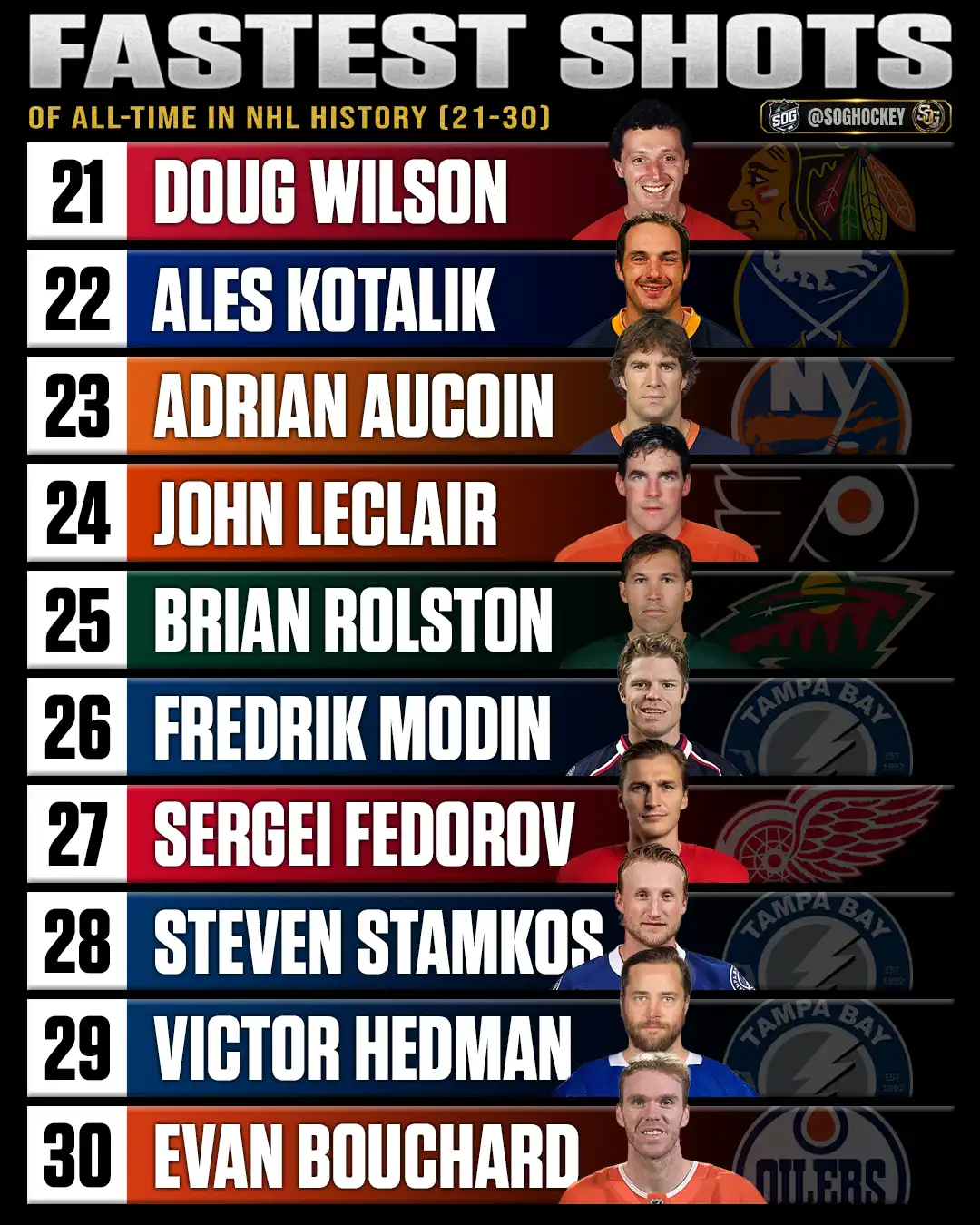
NHL players ranked 21 through 30 for the fastest shots of all-time, featuring Doug Wilson, Ales Kotalik, Adrian Aucoin, John LeClair, Sergei Fedorov, and more.
30. Evan Bouchard
Evan Bouchard opens the ranking because his point shot combines modern tracked power with unusually high volume. NHL EDGE has recorded him above 100 mph in game action, and he regularly produces 90-plus mph attempts rather than reaching that range once in a controlled showcase.
Bouchard is at his best when the shot does more than chase a maximum speed. He changes angles along the blue line, shoots through layered traffic and creates deflections for Edmonton. His peak velocity does not approach the competition marks at the top, but his ability to use a heavy shot against an organized penalty kill earns the final position.
29. Victor Hedman
Victor Hedman won the 2022 NHL Hardest Shot event at 103.2 mph, giving him an official result that several higher-ranked historical names cannot match. His size and long shooting motion help him transfer force without losing the balance needed to recover defensively. Tampa Bay has trusted that shot on the power play for well over a decade, even as his larger value came from puck movement and complete defense. That broader career places him among the best NHL players of the 2010s, but No. 29 here isolates the shooting trait.
28. Steven Stamkos
Steven Stamkos belongs on the list because shot speed is partly about how quickly the puck arrives after a pass. His left-circle one-timer required little settling time, yet still carried enough force to beat goaltenders who knew exactly where he wanted the puck.
Unlike the defensemen who can take several strides into a skills-event attempt, Stamkos built his case inside a power-play structure. The release, accuracy and ability to shoot across his body made the shot more dangerous than a radar number alone would suggest.
27. Sergei Fedorov
Sergei Fedorov won the 2002 NHL Hardest Shot competition with a 101.5 mph blast. That result is notable because Fedorov was a speed-and-skill center rather than a defenseman whose role naturally created full point-shot windups. His lower-body strength and balance allowed him to generate power while moving, changing lanes or shooting through a defender. The shot was only one part of the all-around toolkit that also places Fedorov among the best centers in NHL history.
26. Fredrik Modin
Fredrik Modin won the 2001 NHL Hardest Shot event at 102.1 mph, giving him a cleaner speed argument than several more famous scorers in this range. He used a strong base and full follow-through to produce a heavy shot from the wing. Modin did not build an identity around the event, but the measurement prevents his placement from resting on reputation alone.
25. Brian Rolston
Brian Rolston’s slap shot stood out because he could use it at pace. He was willing to wind up on a rush, including in situations where most forwards would switch to a wrist shot, and that changed how a goaltender had to read his approach.
Rolston does not have one universally accepted league-event mark that settles his position. He ranks here because the combination of skating speed, compact power and real-game willingness made his shot distinctive rather than merely hard in practice.
24. John LeClair
John LeClair generated power from a wide, stable base and did not need to drift far from the scoring areas to use it. In Philadelphia, his one-timer and set shot made him dangerous from the circles while his size still demanded attention near the crease. His ranking is based on game translation, not a standardized skills record, so the lack of directly comparable public measurement keeps him behind the verified competition results ahead.
23. Adrian Aucoin
Adrian Aucoin shared the 2004 NHL Hardest Shot title with Sheldon Souray after both reached 102.2 mph. That official event result is the foundation of his ranking.
Aucoin was also a natural point shooter. He could drive the puck through traffic and force defenders to respect the lane, giving the speed practical value on the power play. He stays in the 20s because his peak mark and shooting reputation were not as extreme as the cases nearer the top.
22. Ales Kotalik
Ales Kotalik’s hard-shot reputation was reinforced by a reported 105-plus mph result in a club skills setting. The venue prevents a direct comparison with Chara’s NHL All-Star record, but it confirms that Kotalik brought more than a quick shootout release. He could generate force with a shorter motion than many defensemen, making the shot useful from the wing and on the power play. The uncertainty around a standardized league reading holds him outside the top 20.
21. Doug Wilson
Doug Wilson starts the top 21 as one of the defining hard-shooting defensemen of the 1980s. His slap shot powered offense from the Chicago blue line and gave him a direct scoring threat rather than limiting him to a distributor’s role.
Wilson’s era offers less reliable public shot-speed evidence than the NHL All-Star competition years. His placement therefore rests on the repeated game effect of the shot, not an attempt to assign modern precision to an older measurement environment.
Fastest NHL Shots: Nos. 20-11
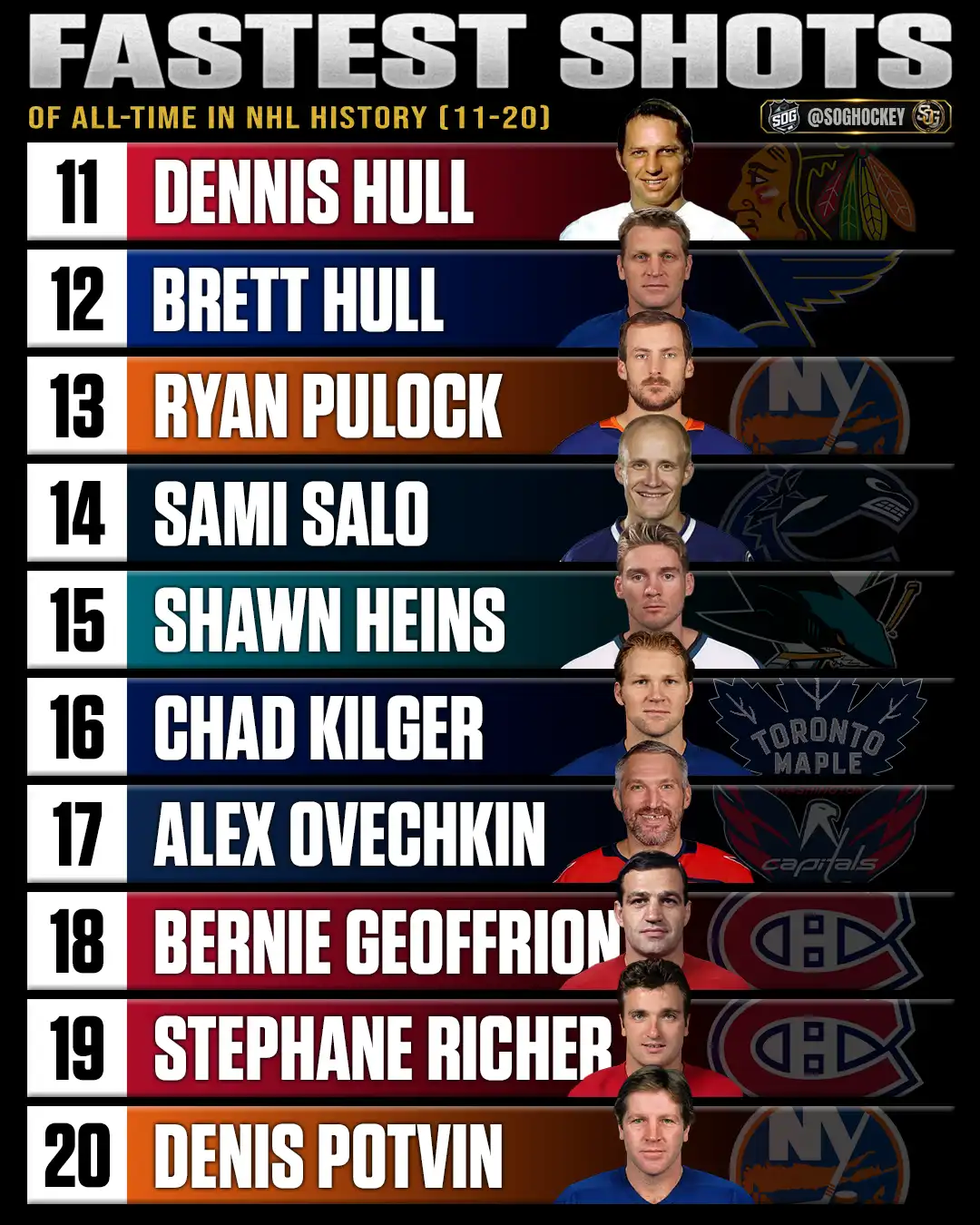
NHL players ranked 11 through 20 for the fastest shots of all-time, featuring Dennis Hull, Brett Hull, Ryan Pulock, Sami Salo, and Alex Ovechkin.
20. Denis Potvin
Denis Potvin’s point shot was part of the attacking pressure that made the New York Islanders so difficult to contain. He could step into open ice, beat a goaltender from distance or create a rebound while still carrying the responsibilities of a franchise defenseman. No standardized public mark allows a clean comparison with the modern names, but power, accuracy and scoring translation were all documented parts of his game.
19. Stephane Richer
Stephane Richer had the kind of hard shot that could beat goaltenders before a screen or deflection became necessary. He generated notable force for a forward and could release it within normal offensive movement rather than only from a planted position. Richer’s ranking relies more on his era reputation and the shot’s scoring value than on an official Hardest Shot result. He sits ahead of Potvin because raw shooting power was more central to how opponents described and defended him.
18. Bernie Geoffrion
Bernie “Boom Boom” Geoffrion cannot be evaluated through a modern radar table. His importance is that he popularized the slap shot as an offensive weapon, using a full-body windup that made the prevailing wrist-shot game look less threatening by comparison.
That historical influence does not prove he would beat today’s fastest readings. It does establish that shot power was inseparable from his identity and that goaltenders of his time regarded the release as exceptional. No. 18 balances that importance with the uncertainty of cross-era measurement.
17. Alex Ovechkin
Alex Ovechkin won the 2018 NHL Hardest Shot event at 101.3 mph, becoming the first forward to win since Fedorov in 2002. The official mark is only part of his case. His left-circle one-timer made that power repeatable from a known location against prepared penalty kills.
Ovechkin ranks below several players with larger showcase numbers because this board still prioritizes maximum velocity. Few have converted a hard shot into more scoring value, a distinction reflected in the highest-scoring seasons in NHL history.
16. Chad Kilger
Chad Kilger’s case is much stronger than his modest scoring résumé suggests. He recorded a 106.6 mph blast at the Toronto Maple Leafs’ 2006 team skills competition, surpassing the club record then associated with Al Iafrate.
The number is not part of the NHL All-Star record book, so it cannot be treated as if it came from the same setup as Chara’s 108.8. Still, a reported 106.6 mph club result is direct speed evidence, not folklore. The event distinction is the main reason Kilger remains outside the top 10.
15. Shawn Heins
Shawn Heins once produced a reported 106.0 mph shot in a minor-pro skills competition. Contemporary reporting on the result noted that the stick used for it was displayed at the Hockey Hall of Fame, giving his inclusion a firmer basis than his brief NHL résumé might imply.
Heins is a useful reminder that a hardest-shot list is not a ranking of overall hockey careers. His power was the exceptional trait. The non-NHL event setting and limited big-league track record keep him behind shooters who paired measurement with a longer NHL identity.
14. Sami Salo
Sami Salo repeatedly won hardest-shot honors in Vancouver’s club skills events, including a reported 102.7 mph result in 2012. More important, the same shot functioned as a genuine power-play weapon for the Canucks. Salo combined weight with enough accuracy to make blockers and goaltenders account for the release before the puck reached him. That repeatability moves him ahead of the more specialist-driven cases below, even without an NHL All-Star winning mark.
13. Ryan Pulock
Ryan Pulock owns one of the strongest modern game-data cases. NHL EDGE has tracked him above 100 mph repeatedly, including a 101.34 mph goal in December 2024. Producing those speeds against live pressure is a different challenge from taking multiple clean attempts in a skills event.
Pulock’s placement rewards frequency as much as peak. His point shot forces penalty killers to close earlier and creates offense even when the first puck does not reach the net. He ranks just outside the top 12 because the maximum public readings ahead of him are more extreme.
12. Brett Hull
Brett Hull was a complete shooter rather than a pure radar specialist. His one-timer combined force, timing and a release point that often changed at the final instant, leaving goaltenders with less reaction time than the windup suggested. A useful definition of shot speed includes how quickly the puck is delivered and how little time the goalie receives. Hull stays outside the top 10 because the best measured-velocity cases are clearer than his.
11. Dennis Hull
Dennis Hull finishes one spot outside the top 10 on the strength of a slap shot that carried its own reputation rather than borrowing entirely from his brother Bobby. He had the strength and long motion associated with the era’s most intimidating shooters.
The limitation is evidence. Dennis played before standardized public tracking, so his case cannot be reduced to a comparable maximum. Historical testimony places him above most reputation-based entries, while the lack of a trustworthy common measurement keeps him below the top 10.
Fastest NHL Shots: Nos. 10-1

The 10 fastest shots in NHL history, featuring Zdeno Chara, Shea Weber, Al MacInnis, Al Iafrate, Bobby Hull, Martin Frk, Tage Thompson, Sheldon Souray, Colin Miller, and Arber Xhekaj.
10. Arber Xhekaj
Arber Xhekaj reaches the top 10 after winning the 2026 Canadiens Skills Competition at 107.3 mph. He also reached 107.2 mph in Montreal’s 2024 event, so the number was not a single unexplained spike.
The caution is the venue. A club skills event is not the NHL All-Star Hardest Shot competition, and slight differences in distance, setup or radar can matter at this level. Xhekaj therefore gets credit for repeated 107-plus power without being moved ahead of players whose evidence came from a league event, an AHL record or game tracking.
9. Colin Miller
Colin Miller recorded a 105.5 mph blast at the 2015 AHL All-Star Skills Competition. It stood as the AHL record until Martin Frk reached 109.2 in 2020.
Miller later reinforced the result under NHL EDGE, reaching 102.59 mph in a 2024 game and 103.08 mph during the 2024-25 regular season. That cross-setting evidence matters: the AHL number was exceptional, and modern game tracking still identified him as one of the NHL’s hardest shooters.
8. Sheldon Souray
Sheldon Souray shares the 2004 NHL Hardest Shot title with Adrian Aucoin at 102.2 mph, but that result understates his maximum public case. He later produced a reported 106.7 mph shot at Edmonton’s 2009 team skills competition.
Souray also translated the power into a defining part of his NHL offense. His point shot dictated power-play spacing and made shot blocking an uncomfortable assignment. The mix of an official event win, a larger club reading and real-game production pushes him above several players with one cleaner number.
7. Tage Thompson
Tage Thompson set the NHL EDGE tracking-era benchmark with a 106.00 mph attempt against Dallas on December 31, 2024. Six days later, he scored on a 103.7 mph one-timer, then the fastest goal captured in the tracking era.
Those marks carry unusual weight because they came during games. Thompson had to read a pass, create his shooting window and release under pressure rather than step into a stationary puck. He is also a forward, while defensemen usually have more opportunities to build momentum into a full slap shot.
6. Martin Frk
Martin Frk owns the highest major North American professional skills-event number on the ranking: 109.2 mph at the 2020 AHL All-Star Skills Competition. That surpassed Chara’s NHL record reading by 0.4 mph.
Frk is not No. 1 because the event category matters. His result belongs to the AHL record book, while Chara and Weber established their marks in the NHL’s showcase. Frk also had a much smaller NHL footprint than the top five. If this list sorted only the largest public radar number, however, he would lead it.
5. Bobby Hull
Bobby Hull is the highest-ranked shooter from before the NHL All-Star radar standard. NHL historical coverage has cited a slap shot measured at roughly 118 mph, but older testing conditions and speed-gun technology make that figure unsuitable for direct comparison with Chara’s result.
The larger case is beyond dispute. Hull’s curved wooden stick, full windup and exceptional strength made his slap shot central to how opponents defended Chicago. Goaltenders and spectators anticipated the release before the puck arrived. No. 5 recognizes that era-defining power without presenting an old test as modern laboratory evidence.
4. Al Iafrate
Al Iafrate changed the scale of the NHL Hardest Shot event when he reached 105.2 mph in 1993. The winning mark was 9.2 mph faster than the inaugural 1990 result and remained the event record until Chara reached 105.4 in 2009. A 105-plus result with the sticks and shooting environment of the early 1990s separated Iafrate dramatically from the field. Chara and Weber eventually pushed higher, but he established the first lasting triple-digit benchmark.
3. Al MacInnis
Al MacInnis never matched Iafrate’s 105.2 mph peak in a winning NHL All-Star attempt. He ranks ahead of him because MacInnis won the Hardest Shot event seven times, more than any other player, including four consecutive victories from 1997 through 2000.
That repeatability carried into games. MacInnis could place the puck, shoot through pressure and build an offense around the threat from the point. His ranking rewards the strongest combination of repeated competition success and useful NHL shot power before the Chara-Weber era.
2. Shea Weber
Shea Weber came closer to Chara’s record than anyone in the official NHL All-Star event. He won at 108.5 mph in 2015, followed with 108.1 in 2016 and completed a third consecutive victory in 2017.
Weber’s argument is not merely that one attempt missed the record by 0.3 mph. His one-timer was a foundational power-play weapon in Nashville and Montreal, and the repeat results confirmed that his maximum was sustainable. He owns a reasonable claim as the most dangerous in-game point shooter of the top two, but Chara still has the higher official number.
1. Zdeno Chara
Zdeno Chara is No. 1 because 108.8 mph remains the official NHL Hardest Shot record. He set it in Ottawa on January 29, 2012, improving the 105.9 mph standard he had established one year earlier.
The result was no isolated maximum. Chara won five consecutive Hardest Shot competitions from 2007 through 2012, with no event held in 2010. His 6-foot-9 frame, long stick and ability to load the shaft created extraordinary force, but repeatability is the final separator. Frk produced a larger AHL number and Weber came within three-tenths in the NHL event. Neither displaced Chara’s record or his five-event run.
Measurement Debates That Shape the Ranking
Why Chara Ranks Ahead of Martin Frk
Frk’s 109.2 mph AHL result is 0.4 mph faster than Chara’s 108.8. Chara remains first because the article is anchored to NHL history and treats the NHL All-Star event as the primary competition standard. Chara also won that event five times and carried the shot through a long NHL career. Frk owns the largest radar number on the board; Chara owns the strongest NHL record case.
Why MacInnis Ranks Ahead of Iafrate
Iafrate wins the peak-speed comparison, 105.2 mph to MacInnis’ best winning mark of 100.4. MacInnis wins the repeated-evidence comparison by seven Hardest Shot titles to Iafrate’s three. Because this ranking weighs a shooter’s full case rather than sorting one maximum column, MacInnis’ competition longevity and game utility earn the one-position edge.
Why Club Skills Readings Need a Label
Xhekaj, Souray and Kilger all have reported club-event results above 106 mph. Those numbers are useful evidence, but they are not entries in the NHL All-Star record book. Radar position, distance to the net, puck setup and event procedure can affect a reading. The ranking credits the power while refusing to erase the difference between competitions.
Why Bobby Hull’s Reported Mark Is Not No. 1
Hull’s often-cited 118 mph measurement came from a different technological era, without the standardized event conditions used for modern NHL comparisons. Treating it as exact would create false precision. Hull ranks fifth because the historical evidence overwhelmingly supports an extraordinary shot, while the top four own either official league measurements or unmatched event repeatability.
Skills Competition Power vs. In-Game Power
A skills event gives a shooter room to approach a stationary puck and take repeated attempts. NHL EDGE records the chaos of an actual game. That is why Thompson’s 106.00 mph attempt is especially persuasive, and why Pulock and Bouchard receive credit for repeated tracked power even when their maximums trail the biggest showcase numbers.
Full Ranking of the Fastest Shots in NHL History
| Rank | Player | Public Mark | Measurement Context |
|---|---|---|---|
| 1 | Zdeno Chara | 108.8 mph | 2012 NHL All-Star Skills |
| 2 | Shea Weber | 108.5 mph | 2015 NHL All-Star Skills |
| 3 | Al MacInnis | 100.4 mph | Best winning mark; seven NHL event wins |
| 4 | Al Iafrate | 105.2 mph | 1993 NHL All-Star Skills |
| 5 | Bobby Hull | Reported 118 mph | Historical, non-standardized test |
| 6 | Martin Frk | 109.2 mph | 2020 AHL All-Star Skills |
| 7 | Tage Thompson | 106.00 mph | 2024-25 NHL EDGE game attempt |
| 8 | Sheldon Souray | Reported 106.7 mph | 2009 Oilers team skills event |
| 9 | Colin Miller | 105.5 mph | 2015 AHL All-Star Skills |
| 10 | Arber Xhekaj | 107.3 mph | 2026 Canadiens team skills event |
| 11 | Dennis Hull | Not standardized | Historical shot reputation |
| 12 | Brett Hull | Not standardized | One-timer power and release |
| 13 | Ryan Pulock | 101.34 mph goal | 2024-25 NHL EDGE game tracking |
| 14 | Sami Salo | Reported 102.7 mph | 2012 Canucks team skills event |
| 15 | Shawn Heins | Reported 106.0 mph | Minor-pro skills event |
| 16 | Chad Kilger | 106.6 mph | 2006 Maple Leafs team skills event |
| 17 | Alex Ovechkin | 101.3 mph | 2018 NHL All-Star Skills |
| 18 | Bernie Geoffrion | Not standardized | Historical slap-shot pioneer |
| 19 | Stephane Richer | Not standardized | Era and in-game reputation |
| 20 | Denis Potvin | Not standardized | Era and in-game reputation |
| 21 | Doug Wilson | Not standardized | Era and in-game reputation |
| 22 | Ales Kotalik | Reported 105+ mph | Club skills setting |
| 23 | Adrian Aucoin | 102.2 mph | 2004 NHL All-Star Skills |
| 24 | John LeClair | Not standardized | In-game shot reputation |
| 25 | Brian Rolston | Not standardized | In-game shot reputation |
| 26 | Fredrik Modin | 102.1 mph | 2001 NHL All-Star Skills |
| 27 | Sergei Fedorov | 101.5 mph | 2002 NHL All-Star Skills |
| 28 | Steven Stamkos | Not standardized | One-timer power and release |
| 29 | Victor Hedman | 103.2 mph | 2022 NHL All-Star Skills |
| 30 | Evan Bouchard | 100+ mph | NHL EDGE game tracking |
Sources and Data Notes
This is a subjective SOG Sports ranking, not an official NHL leaderboard. It compares measurements from different environments and labels those environments rather than treating every radar result as interchangeable. NHL EDGE references apply to the league’s puck-and-player tracking era, which began in 2021-22. Historical entries without a standardized public result are evaluated through established shot reputation and in-game use. Active-player context was reviewed through the completed 2025-26 season.
- NHL.com’s history and science of the Hardest Shot event provides the Chara and Frk record context and the event-win totals for MacInnis, Chara and Weber.
- NHL Hardest Shot winners and results from 1990 through 2016 supports the official marks for Iafrate, MacInnis, Modin, Fedorov, Aucoin, Souray, Chara and Weber.
- The AHL’s 2020 Skills recap documents Frk’s 109.2 mph record and Miller’s previous 105.5 mph AHL standard.
- NHL EDGE’s report on Tage Thompson’s 106.00 mph attempt documents the in-game tracking-era benchmark.
- The Montreal Canadiens’ 2026 Hardest Shot result documents Xhekaj’s 107.3 mph club-event reading.
Last Reviewed: August 14, 2026.
Conclusion
Zdeno Chara remains the answer to the official NHL question because his 108.8 mph shot still leads the league’s Hardest Shot record book. Martin Frk owns the larger AHL number, Shea Weber came closest under the NHL standard and Tage Thompson produced the strongest modern in-game tracking result. The gaps between those settings are exactly why the fastest shots in NHL history require context instead of one misleading sort of every reported radar reading.
