Wayne Gretzky is SOG Sports’ No. 1 choice among the best NHL centers of all-time. He no longer owns the NHL career goals record, which Alex Ovechkin broke in 2025, but Gretzky’s 2,857 points, 1,963 assists, nine Hart Trophies, 10 scoring titles and four Stanley Cups still give him the strongest overall case at the position.
This is a subjective career ranking, not a points leaderboard. Peak dominance, playoff performance, two-way responsibility, longevity, awards, era context and the ability to drive a championship team all affect placement. The supplied graphic order from No. 1 through No. 30 is preserved.
How We Ranked the Best NHL Centers of All-Time
Centers are asked to influence more areas of the ice than any other forward position. Offensive creation remains the starting point, but the ranking also rewards players who defended difficult matchups, controlled possession through the middle, elevated linemates and delivered in the Stanley Cup Playoffs.
- Peak performance: how dominant the player was at his absolute best.
- Career production: goals, assists, points, scoring rate and sustained offensive value.
- Playoff performance: postseason production, championship contribution and performance in the biggest games.
- Two-way impact: defensive responsibility, matchup value, faceoffs and all-situations trust.
- Individual recognition: Hart, Art Ross, Ted Lindsay, Conn Smythe, Selke and All-Star honours.
- Longevity and durability: how long the player remained a high-level center.
- Era context: league size, scoring environment, schedule length and style of play.
Eligibility and Scope
The ranking evaluates NHL careers through the end of the 2025–26 season, including the 2026 Stanley Cup Playoffs. Active players are ranked on what they have already accomplished rather than projected future achievements.
Players must have spent a meaningful portion of their careers at center. Mark Messier qualifies because center was a major part of his prime and championship identity, even though he also played left wing. International performance can strengthen a case, but NHL regular-season and playoff work carries the most weight. Early stars are judged against the conditions of their own eras, and pre-NHL Stanley Cup context is acknowledged when relevant.
Table of Contents
Honourable Mentions and Toughest Cuts
Mike Modano was the hardest modern omission. He combined 1,374 points, speed, defensive value and a Stanley Cup while becoming the defining American center of his generation. Adam Oates and Jean Ratelle had stronger pure playmaking cases than several included players, but neither matched the same blend of peak, playoff value and complete résumé.
Denis Savard, Syl Apps, Milt Schmidt, Newsy Lalonde, Henrik Sedin and Jonathan Toews also had legitimate top-30 arguments. Savard and Sedin offered high-end offensive creation, Apps and Schmidt were dominant stars in smaller-league eras, Lalonde was one of hockey’s earliest scoring icons, and Toews built an outstanding championship and two-way résumé. The final cuts came down to how much weight to place on peak offense, longevity and individual awards.
Best NHL Centers of All-Time: Rankings No. 1–10

SOG Sports’ top 10 NHL centers of all-time, led by Wayne Gretzky, Mario Lemieux, Sidney Crosby, Connor McDavid and Jean Béliveau.
1. Wayne Gretzky
Career résumé: 2,857 points, 894 goals, 1,963 assists, four Stanley Cups, nine Hart Trophies, 10 scoring titles and two Conn Smythe Trophies.
Gretzky ranks first because no other center created such a massive separation from his peers over a full career. Alex Ovechkin passed his NHL goals record in 2025, but Gretzky remains the league’s career leader in assists and points by margins that still look unreasonable decades later.
His intelligence was the defining advantage. Gretzky manipulated defenders before receiving the puck, found passing lanes that did not appear open and controlled the game from behind the net. Mario Lemieux reached a comparable level at his best, but Gretzky’s combination of peak, durability, awards, playoff scoring and sustained production leaves him at No. 1.
2. Mario Lemieux
Career résumé: 1,723 points, 690 goals, 1,033 assists, two Stanley Cups as a player, three Hart Trophies, six Art Ross Trophies and two Conn Smythe Trophies.
Lemieux owns the strongest talent-based challenge to Gretzky. At 6-foot-4, he combined reach and power with the hands, patience and vision of a much smaller playmaker. He could beat a team by carrying the puck through traffic, finishing from distance or slowing the game until a passing lane appeared.
Availability is the separator. Illness and injuries limited Lemieux to 915 regular-season games, while Gretzky played 1,487. Lemieux’s scoring rate and best seasons keep him comfortably above every center except Gretzky, but the shorter career prevents him from taking the top spot.
3. Sidney Crosby
Career résumé through 2025–26: 1,761 points, 654 goals, 1,107 assists, three Stanley Cups, two Hart Trophies, three Ted Lindsay Awards, two Art Ross Trophies and two Conn Smythe Trophies.
Crosby ranks third because his résumé has almost no empty category. He has led the league in points, led it in goals, won regular-season MVPs, captained three championship teams and twice received the Conn Smythe Trophy. In 2025–26, he passed Lemieux to become the Penguins’ career points leader and reached 1,761 points despite missing meaningful time during his prime.
His game also aged unusually well. Crosby evolved from a rush scorer into one of the league’s best below the goal line, remained strong on faceoffs and continued producing while taking difficult matchups. Connor McDavid has the higher offensive peak, but Crosby’s completed playoff and championship record keeps him third for now.
4. Connor McDavid
Career résumé through 2025–26: 1,220 points in 794 games, three Hart Trophies, six Art Ross Trophies, five Ted Lindsay Awards, one Rocket Richard Trophy and one Conn Smythe Trophy.
McDavid is already the greatest transition attacker of the modern era. His speed matters, but the more important skill is his ability to change pace while controlling the puck. Defenders have to protect against the outside burst, which creates inside lanes for McDavid and passing options for everyone around him.
He strengthened his case again in 2025–26 by scoring 138 points, winning a sixth Art Ross Trophy and tying Gretzky with a fifth Ted Lindsay Award. McDavid’s regular-season peak is strong enough to challenge anyone below the top two. Crosby remains one place higher because of three Stanley Cups, two Conn Smythe wins and a longer record of elite two-way playoff hockey.
5. Jean Béliveau
Career résumé: 1,219 points, 507 goals, 10 Stanley Cups as a player, two Hart Trophies, one scoring title and one Conn Smythe Trophy.
Béliveau was the ideal first-line center for the NHL’s most successful dynasty. His size and reach created space, but he was not simply a power player. He carried the puck smoothly, distributed it with patience and remained dangerous around the net.
The championship count is not treated as an automatic argument, because Béliveau played on loaded Montreal teams. His placement reflects how central he was to those teams. He won the inaugural Conn Smythe Trophy in 1965 and remained a major playoff contributor across multiple generations of Canadiens champions. Messier had greater career totals, but Béliveau’s peak as a pure center and dynasty anchor earns the edge.
6. Mark Messier
Career résumé: 1,887 points, 694 goals, six Stanley Cups, two Hart Trophies and one Conn Smythe Trophy.
Messier brought a rare combination of straight-line power, scoring, defensive commitment and emotional authority. He could play center or left wing, but his work through the middle was essential to the Oilers after Gretzky left and to the Rangers during their 1994 championship run.
His versatility strengthens the case but also creates the main limitation compared with Béliveau, who has a cleaner identity as a career center. Messier’s longevity, postseason production and success as the lead figure on two franchises keep him above the rest of this tier.
7. Stan Mikita
Career résumé: 1,467 points, four Art Ross Trophies, two Hart Trophies, two Lady Byng Trophies and one Stanley Cup.
Mikita was one of the league’s most creative and competitive centers before becoming one of its most disciplined. His curved-stick innovation is part of the historical story, but the ranking is driven by production: four scoring titles and consecutive seasons winning both the Hart and Art Ross.
He does not have the same championship or playoff résumé as Béliveau and Messier, which keeps him seventh. Against Yzerman and Sakic, Mikita’s advantage is individual dominance relative to his era. Few centers have collected that many seasons as the league’s clear best scorer.
8. Steve Yzerman
Career résumé: 1,755 points, 692 goals, three Stanley Cups, one Conn Smythe Trophy and one Selke Trophy.
Yzerman’s career contains two Hall of Fame versions of the same player. Early in Detroit’s rise, he was a devastating offensive center who scored 155 points in 1988–89. Later, he accepted fewer chances and heavier defensive responsibility as the Red Wings became a championship team.
That transformation is central to his ranking. Yzerman proved he could carry an offense and then adjust his game without losing his importance. Mikita ranks one place higher because of the scoring titles and MVPs; Yzerman stays ahead of Sakic because his offensive peak was higher and his elite run lasted longer.
9. Joe Sakic
Career résumé: 1,641 points, 625 goals, two Stanley Cups, one Hart Trophy and one Conn Smythe Trophy.
Sakic’s release, decision-making and calm under pressure made him one of the safest players in hockey to trust with a decisive possession. He could score off the rush, attack a seam on the power play or create a clean chance without holding the puck for long.
His 2000–01 season and playoff run gave him the Hart, the Stanley Cup and one of the strongest modern captaincy seasons. Yzerman’s longer prime and higher single-season peak create the narrow separation at No. 8, while Sakic’s combination of scoring, leadership and postseason production keeps him above Esposito.
10. Phil Esposito
Career résumé: 1,590 points, 717 goals, five Art Ross Trophies, two Hart Trophies and two Stanley Cups.
Esposito changed expectations for offensive production at center. He became the first NHL player to reach 100 points and later the first to score 70 goals, thriving around the crease through positioning, strength and relentless shot volume.
The Boston environment was exceptionally favourable, with Bobby Orr driving play from the back end, but Esposito’s results were too far ahead of most contemporaries to dismiss as circumstance. He closes the top 10 because the players above him offered either greater playoff leadership, stronger two-way value or a more portable all-around game.
Best NHL Centers of All-Time: Rankings No. 11–20
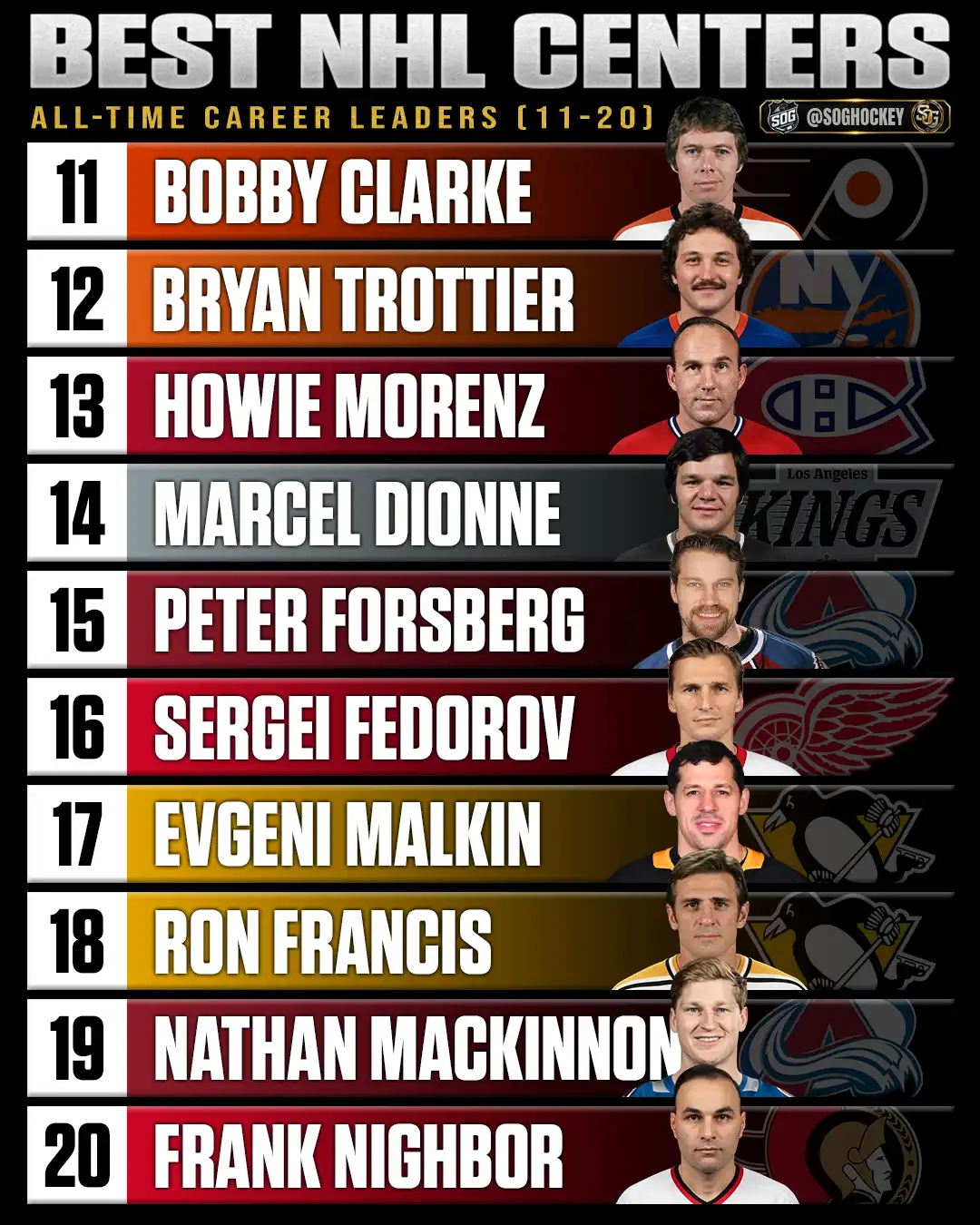
NHL centers ranked No. 11 through No. 20, including Bobby Clarke, Bryan Trottier, Howie Morenz, Marcel Dionne and Peter Forsberg.
11. Bobby Clarke
Career résumé: 1,210 points, two Stanley Cups and three Hart Trophies.
Clarke was the engine of the Philadelphia Flyers’ championship teams. He combined top-level playmaking with relentless puck pressure, defensive responsibility and a willingness to turn every shift into a confrontation.
Three Hart Trophies give him an individual peak that separates him from Trottier, even though Trottier owns the larger championship total. Clarke falls outside the top 10 because his pure offensive ceiling was lower than Esposito’s and his career production trails the centers immediately above him.
12. Bryan Trottier
Career résumé: 1,425 points, six Stanley Cups, one Hart Trophy, one Art Ross Trophy, one Conn Smythe Trophy and one Calder Trophy.
Trottier was the complete middle-ice presence of the Islanders dynasty. He could produce like a scoring champion, defend difficult assignments, win battles and adapt his game to the demands of a long playoff series.
His four Cups with the Islanders were followed by two veteran championships in Pittsburgh. Clarke’s three MVP seasons give him the slight edge at No. 11, but Trottier’s lack of a major weakness makes him one of the easiest centers on the list to imagine succeeding in any era.
13. Howie Morenz
Career résumé: three Hart Trophies, three Stanley Cups and two league scoring titles.
Morenz was one of the NHL’s first genuine superstars. His speed through the neutral zone was overwhelming in the 1920s and early 1930s, when the league was smaller, travel was harsher and offensive systems were far less developed.
Direct statistical comparison with modern players is limited by schedule length and rule differences. Morenz ranks this high because he was repeatedly recognized as the league’s best player and drove championship teams. The uncertainty of cross-era translation keeps him behind Clarke and Trottier.
14. Marcel Dionne
Career résumé: 1,771 points, 731 goals, one Art Ross Trophy and two Lester B. Pearson Awards.
Dionne was one of the greatest regular-season offensive centers in league history. He scored at least 100 points eight times and remained an elite producer without spending his prime on a dynasty-level roster.
The playoff résumé is the unavoidable limitation. Dionne never reached the Stanley Cup Final and played only 49 postseason games. His scoring keeps him above Forsberg and Fedorov, but the absence of a deep signature playoff run prevents a top-10 placement.
15. Peter Forsberg
Career résumé: 885 points in 708 games, two Stanley Cups, one Hart Trophy, one Art Ross Trophy and one Calder Trophy.
Forsberg combined elite passing with a heavy, confrontational style. He protected the puck through contact, created offense from below the circles and was comfortable turning a playoff game into a battle of attrition.
His 1.25 points-per-game average reflects the level he reached when healthy. Injuries limited the volume of his career, which is why Dionne remains ahead. Forsberg gets the edge over Fedorov because his best offensive seasons were more productive and he was the primary creator on championship-calibre teams.
16. Sergei Fedorov
Career résumé: 1,179 points, three Stanley Cups, one Hart Trophy, one Ted Lindsay Award and two Selke Trophies.
Fedorov had one of the broadest skill sets ever seen at center. He could accelerate through open ice, finish, distribute, defend top players and even move to defense when Detroit needed it.
His 1993–94 Hart season is one of the strongest two-way campaigns by any forward. Forsberg’s superior scoring rate creates the difference at No. 15, while Fedorov’s versatility and defensive peak place him above Malkin despite Malkin’s larger offensive totals.
17. Evgeni Malkin
Career résumé through 2025–26: 1,407 points, 533 goals, three Stanley Cups, one Hart Trophy, two Art Ross Trophies, one Ted Lindsay Award and one Conn Smythe Trophy.
Malkin’s best hockey was violent in the best possible way. He attacked through the middle with size and speed, protected the puck on extended possessions and could take over a playoff round when Pittsburgh’s offense needed a different driver from Crosby.
He led the 2009 playoffs with 36 points and won the Conn Smythe, then led the postseason in scoring again during Pittsburgh’s 2017 Cup run. Fedorov ranks higher because of his defensive range and positional versatility, but Malkin’s peak offense and playoff scoring clearly separate him from the remaining active-era centers below.
18. Ron Francis
Career résumé: 1,798 points, 1,249 assists, two Stanley Cups, one Selke Trophy and three Lady Byng Trophies.
Francis built one of the most valuable quiet careers in league history. He ranks second all-time in assists and fifth in points, yet rarely played with the individual spotlight attached to comparable totals.
His intelligence made him a reliable defensive center and an ideal secondary star on Pittsburgh’s championship teams. Francis ranks below Malkin because his peak never reached Hart-and-Conn-Smythe dominance, but his longevity and complete game keep him ahead of MacKinnon for now.
19. Nathan MacKinnon
Career résumé through 2025–26: 1,142 points, one Stanley Cup, one Hart Trophy, one Ted Lindsay Award, one Calder Trophy and one Rocket Richard Trophy.
MacKinnon attacks with a combination of speed and force that few centers have matched. His first steps create separation, while his strength allows him to keep possession after defenders close the initial gap.
He added another major piece in 2025–26 by scoring a career-high 53 goals, winning the Rocket Richard Trophy and finishing with 127 points. MacKinnon’s peak already belongs much higher than No. 19. Francis remains ahead because of the enormous longevity gap, but another few elite seasons could move MacKinnon several places.
20. Frank Nighbor
Career résumé: five Stanley Cup championships across pre-NHL and NHL competition, one Hart Trophy and the first two Lady Byng Trophies.
Nighbor was the prototype for the defensive center long before the Selke Trophy existed. Contemporary accounts emphasized his stick work, anticipation and ability to disrupt opponents without sacrificing offensive contribution.
He won the first Hart Trophy in 1924 and was the original Lady Byng recipient. The scarcity of complete data and the distance of his era make exact comparisons difficult, so he lands at No. 20 rather than being pushed artificially higher or excluded for playing a different version of the sport.
Best NHL Centers of All-Time: Rankings No. 21–30
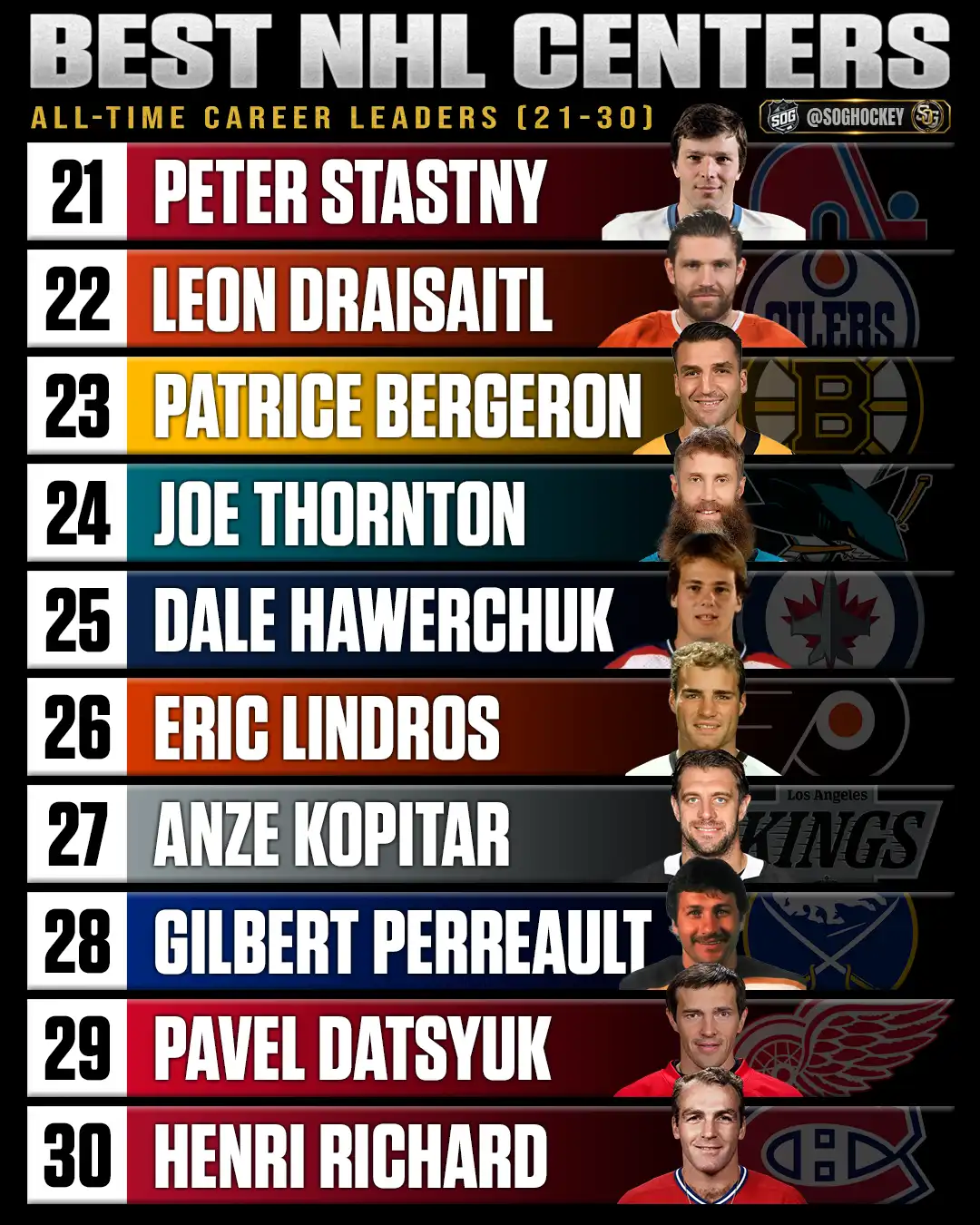
NHL centers ranked No. 21 through No. 30, featuring Peter Stastny, Leon Draisaitl, Patrice Bergeron, Joe Thornton and Anze Kopitar.
21. Peter Stastny
Career résumé: 1,239 points in 977 games and one Calder Trophy.
Stastny entered the NHL at 24 and immediately became one of the league’s best offensive centers. During the 1980s, only Gretzky recorded more points. His vision, timing and ability to create through traffic translated instantly from European hockey.
The lack of a Stanley Cup, Hart Trophy or extended playoff run keeps him outside the top 20. His production rate gives him the edge over Draisaitl at this stage, although Draisaitl has a clear path to move ahead with more healthy seasons and postseason success.
22. Leon Draisaitl
Career résumé through 2025–26: 1,053 points, 434 goals, one Hart Trophy, one Art Ross Trophy, one Ted Lindsay Award and one Rocket Richard Trophy.
Draisaitl combines power, passing touch and one of the most dangerous one-timers in hockey. He is often grouped with McDavid, but his individual résumé stands on its own: an MVP season, a scoring title, a goal-scoring title and repeated elite playoff production.
He became the first German-born player to reach 1,000 NHL points in 2025–26 and finished with 97 points in 65 games before a lower-body injury ended his regular season. Stastny’s full-career scoring rate keeps him narrowly ahead, while Draisaitl’s lack of a Stanley Cup remains the main missing item.
23. Patrice Bergeron
Career résumé: 1,040 points, one Stanley Cup and an NHL-record six Selke Trophies.
Bergeron is the modern standard for defensive center play. His value came from positioning, anticipation and control rather than chasing hits or relying on reputation. Boston could deploy him against the opponent’s best line, trust him on either special-teams unit and still expect first-line offense.
Six Selke Trophies make the defensive case unmatched. He ranks below Draisaitl and Stastny because his offensive peak was meaningfully lower, but Bergeron’s complete game gives him the edge over Thornton despite Thornton’s much larger scoring totals.
24. Joe Thornton
Career résumé: 1,539 points, 1,109 assists, one Hart Trophy and one Art Ross Trophy.
Thornton was one of the best possession passers of his era. His size allowed him to protect the puck until coverage broke, and his patience turned routine offensive-zone possessions into high-quality chances.
The 2005–06 Hart and Art Ross season showed his ceiling, but the absence of a Stanley Cup and uneven playoff reputation affect placement. Bergeron contributed less offense but offered a stronger all-situations championship profile, which is why Thornton sits one place lower.
25. Dale Hawerchuk
Career résumé: 1,409 points, 518 goals and one Calder Trophy.
Hawerchuk carried an enormous offensive burden for Winnipeg and produced at a star level in an era crowded with Gretzky, Lemieux and several other historically productive centers. He reached 100 points six times and rarely had the supporting cast enjoyed by the dynasty stars above him.
Team context explains part of the limited playoff résumé, but it cannot be ignored entirely. Thornton’s Hart season and larger playmaking totals place him ahead, while Hawerchuk’s sustained offensive excellence gives him the edge over the shorter peak of Lindros.
26. Eric Lindros
Career résumé: 865 points in 760 games, one Hart Trophy and one Lester B. Pearson Award.
Lindros at his peak was one of the most physically imposing centers the league has seen. He carried the puck like a power forward, created like a playmaker and forced defenders to account for the possibility of contact on every entry.
His 1994–95 MVP season and the Legion of Doom years showed a top-10 level ceiling. Concussions and other injuries prevented the career from accumulating enough high-end seasons to rank there. He stays above Kopitar because this ranking gives Lindros’ overwhelming peak a slight advantage over Kopitar’s longevity.
27. Anze Kopitar
Career résumé: 1,316 points, 452 goals, two Stanley Cups, two Selke Trophies and three Lady Byng Trophies.
Kopitar retired after the 2025–26 season as the Kings’ franchise leader in games, assists and points. His size, puck protection and defensive awareness allowed Los Angeles to use him in difficult matchups without sacrificing offensive creation.
He was the first-line center on both Kings championship teams and remained productive for 20 seasons. Lindros ranks higher because of the superior peak, while Kopitar’s playoff role and two-way résumé place him ahead of Perreault and Datsyuk.
28. Gilbert Perreault
Career résumé: 1,326 points, 512 goals, one Calder Trophy and one Lady Byng Trophy.
Perreault gave the expansion Buffalo Sabres an immediate franchise identity. His edge work, hands and ability to attack defenders one-on-one made the French Connection one of the defining offensive lines of the 1970s.
He reached the Stanley Cup Final once but never won, and he lacks the major MVP hardware of the centers ranked higher. His offensive longevity keeps him above Datsyuk, whose two-way peak was stronger but whose NHL counting totals were significantly lower.
29. Pavel Datsyuk
Career résumé: 918 points in 953 games, two Stanley Cups, three Selke Trophies and four Lady Byng Trophies.
Datsyuk paired highlight-reel puck skill with elite defensive anticipation. His takeaways were not empty gambles; they often came from reading the next pass early and closing the lane before an opponent recognized the danger.
At his best, he was one of the league’s most complete forwards. His NHL career was shorter than many players around him, and he never produced a 100-point season, which limits the placement. The combination of creativity, defense and championship value still makes him a clear top-30 center.
30. Henri Richard
Career résumé: 1,046 points and an NHL-record 11 Stanley Cups as a player.
Richard’s championship count is unmatched, but the ranking does not treat rings as an individual statistic. He played on extraordinarily deep Montreal teams and did not reach the same personal offensive peak or award level as most centers above him.
He was still a major contributor, not a passenger. Richard produced for nearly two decades, scored the Cup-winning goal in Game 7 of the 1971 Final and repeatedly filled important roles on title teams. His winning, longevity and two-way utility secure the final spot.
Biggest Debates in the NHL Center Rankings
Why is Sidney Crosby still ranked above Connor McDavid?
Crosby remains third because his career is more complete through the 2025–26 season. McDavid owns the better regular-season scoring peak and added his sixth Art Ross and fifth Ted Lindsay in 2026. Crosby counters with three Stanley Cups, two Conn Smythe Trophies, 206 playoff points and a longer record of elite performance in every type of game.
This is not a permanent verdict. McDavid is already close enough that another major playoff run or several more peak seasons could reverse the order.
Is Patrice Bergeron too low at No. 23?
Bergeron has a reasonable top-20 argument because six Selke Trophies represent unmatched defensive recognition. His placement reflects the strength of the offensive résumés above him. Stastny, Draisaitl and Thornton reached levels as scoring engines that Bergeron never did, while several earlier players paired stronger offense with championship or MVP value.
How much should injuries help Peter Forsberg and Eric Lindros?
Injuries do not create credit for games a player did not play, but peak quality still matters in an all-time ranking. Forsberg and Lindros were dominant enough when healthy to remain ahead of several players with larger career totals. Forsberg ranks much higher because he sustained his level longer, won two Cups and added both a Hart and Art Ross Trophy.
Complete Best NHL Centers of All-Time Ranking
| Rank | Player | Primary Team(s) |
|---|---|---|
| 1 | Wayne Gretzky | Edmonton Oilers |
| 2 | Mario Lemieux | Pittsburgh Penguins |
| 3 | Sidney Crosby | Pittsburgh Penguins |
| 4 | Connor McDavid | Edmonton Oilers |
| 5 | Jean Béliveau | Montreal Canadiens |
| 6 | Mark Messier | Edmonton Oilers / New York Rangers |
| 7 | Stan Mikita | Chicago Blackhawks |
| 8 | Steve Yzerman | Detroit Red Wings |
| 9 | Joe Sakic | Colorado Avalanche |
| 10 | Phil Esposito | Boston Bruins |
| 11 | Bobby Clarke | Philadelphia Flyers |
| 12 | Bryan Trottier | New York Islanders |
| 13 | Howie Morenz | Montreal Canadiens |
| 14 | Marcel Dionne | Los Angeles Kings |
| 15 | Peter Forsberg | Colorado Avalanche |
| 16 | Sergei Fedorov | Detroit Red Wings |
| 17 | Evgeni Malkin | Pittsburgh Penguins |
| 18 | Ron Francis | Hartford Whalers / Pittsburgh Penguins |
| 19 | Nathan MacKinnon | Colorado Avalanche |
| 20 | Frank Nighbor | Ottawa Senators |
| 21 | Peter Stastny | Quebec Nordiques |
| 22 | Leon Draisaitl | Edmonton Oilers |
| 23 | Patrice Bergeron | Boston Bruins |
| 24 | Joe Thornton | San Jose Sharks |
| 25 | Dale Hawerchuk | Winnipeg Jets |
| 26 | Eric Lindros | Philadelphia Flyers |
| 27 | Anze Kopitar | Los Angeles Kings |
| 28 | Gilbert Perreault | Buffalo Sabres |
| 29 | Pavel Datsyuk | Detroit Red Wings |
| 30 | Henri Richard | Montreal Canadiens |
FAQ: Best NHL Centers of All-Time
Who is the best NHL center of all-time?
Wayne Gretzky is the best NHL center of all-time in this ranking. He remains the league’s career leader in assists and points and combines the greatest offensive résumé with nine Hart Trophies, four Stanley Cups and two Conn Smythe Trophies.
Does Wayne Gretzky still hold the NHL goals record?
No. Alex Ovechkin scored his 895th career goal on April 6, 2025, to pass Gretzky’s total of 894. Gretzky still owns the NHL career records for assists and points.
Why is Sidney Crosby ranked ahead of Connor McDavid?
Crosby is ranked ahead because he has three Stanley Cups, two Conn Smythe Trophies and a longer completed career through 2025–26. McDavid has the stronger regular-season scoring peak and could move ahead as his career continues.
Who is the best defensive center in NHL history?
Patrice Bergeron has the strongest award-based case after winning an NHL-record six Selke Trophies. Frank Nighbor, Bobby Clarke, Sergei Fedorov, Pavel Datsyuk and Anze Kopitar also belong in the broader all-time two-way discussion.
How were active NHL centers evaluated?
Active players were evaluated only on completed work through the 2025–26 regular season and playoffs. Future production, projected awards and hypothetical championships were not counted.
Sources and Data Notes
This ranking was last reviewed on July 30, 2026. Regular-season totals include the completed 2025–26 season, and playoff context includes the 2026 Stanley Cup Playoffs.
- NHL Records: most career points by a center
- NHL Records: trophy winners and award history
- NHL Records: Stanley Cup winners
- Hockey Hall of Fame honoured-member database
- NHL.com: Alex Ovechkin passes Wayne Gretzky’s career goals record
- NHL.com: 2025–26 Art Ross and Rocket Richard results
- NHL.com: final 2025–26 totals for Sidney Crosby and Evgeni Malkin
- NHL.com: Leon Draisaitl’s final 2025–26 regular-season totals
- NHL.com: Anze Kopitar’s retirement and final career totals
Pre-NHL and early-NHL records are less complete than modern statistics. Frank Nighbor’s championship résumé includes Stanley Cup competition that predates the NHL. Position classifications can also vary for hybrid forwards; Messier is included because center was a meaningful part of his prime and championship role.
Conclusion
Gretzky remains No. 1 because the loss of the goals record does not erase his unmatched advantage in assists, points, awards and sustained offensive control. Lemieux owns the closest peak argument, while Crosby stays ahead of McDavid because his championship and playoff résumé is more complete through 2025–26.
The difficult part begins after the top four. Béliveau, Messier, Mikita, Yzerman, Sakic and Esposito reached greatness in very different ways, and the lower half forces direct choices between offense, defense, longevity and peak. That balance is what makes center the deepest position in hockey history.
Related NHL Rankings
Continue with the best NHL center from every season since 1967 to compare how the position changed across eras.
For the statistical side of the debate, see the leaders for the most points in a single NHL season, most goals in a single NHL season and most assists in a single NHL season.
