Bobby Orr is the SOG Sports pick as the greatest NHL defenseman of all-time. No other blue-liner matches his combination of scoring dominance, transition control, individual awards and playoff value at his peak.
This is a subjective top 30, not an official NHL leaderboard. Doug Harvey, Ray Bourque, Nicklas Lidström and Eddie Shore complete the top five, but the full ranking considers much more than points. It weighs peak play, longevity, puck movement, defensive responsibility, postseason performance, awards and dominance relative to each player’s era.
Table of Contents
- How We Ranked the Best NHL Defensemen Ever
- Best NHL Defensemen of All-Time: 1–10
- Best NHL Defensemen of All-Time: 11–20
- Best NHL Defensemen of All-Time: 21–30
- Biggest Debates on the List
- Toughest Omissions
- Complete Top 30
- More NHL Rankings
How We Ranked the Best NHL Defensemen Ever
The ranking starts with each defenseman’s ability to control games from the back end. Scoring matters, but so do retrievals, breakout passing, defending top forwards, special-teams value, workload and the ability to remain effective when playoff space disappears.
Regular-season and postseason NHL performance both count. International results provide context, but NHL work drives the order. Players who spent meaningful time at forward, including Red Kelly and Dit Clapper, are eligible because their careers as defensemen were substantial enough to stand on their own.
Era adjustment is essential. Eddie Shore, King Clancy, Earl Seibert and Sprague Cleghorn played before the Norris Trophy existed, while modern defensemen face a deeper talent pool and a faster, more system-heavy game. Active players are evaluated only on what they completed through the 2025–26 season. For the position’s place in the wider sport, see the SOG Sports ranking of the best NHL players of all-time.
Best NHL Defensemen of All-Time: 1–10

The top 10 NHL defensemen of all-time, led by Bobby Orr, Doug Harvey, Ray Bourque, Nicklas Lidström and Eddie Shore.
1. Bobby Orr
Bobby Orr did not simply add offense from the blue line. He became Boston’s primary transition engine, carried the puck through pressure and forced opponents to defend a fourth attacker without giving up the responsibilities of a No. 1 defenseman.
His eight consecutive Norris Trophies remain the record, and he is still the only defenseman to win the Art Ross Trophy as the NHL scoring leader. Orr also won two Conn Smythe Trophies and, in 1969–70, became the only player to win the Stanley Cup, Conn Smythe, Hart, Art Ross and Norris in the same season. Injuries shortened the career, but they did not lower the peak.
2. Doug Harvey
Doug Harvey controlled pace before end-to-end offense became a defining part of the position. His first pass could beat a forecheck, and his patience let Montreal dictate when a game sped up or slowed down.
Seven Norris Trophies and six Stanley Cups support the résumé, but Harvey’s real separation was command. Orr reached a higher individual ceiling. Harvey offers the strongest pre-Orr case for a defenseman who could organize an entire game from the back end.
3. Ray Bourque
Ray Bourque combines high-end peak play with the best longevity case at the position. He handled first-pair minutes for more than two decades without becoming a specialist late in his career.
Bourque won five Norris Trophies and retired with 1,579 regular-season points, still the NHL record for a defenseman. The 2001 Stanley Cup was a fitting finish, but No. 3 is built on the standard he maintained long before that final run.
4. Nicklas Lidström
Nicklas Lidström solved problems before they became emergencies. His positioning, stick detail and first pass kept Detroit in possession, while his reads allowed him to defend without chasing hits or taking unnecessary penalties.
He won seven Norris Trophies, four Stanley Cups and the 2002 Conn Smythe during a 20-season career spent entirely with the Red Wings. Bourque gets the narrow edge for greater offensive volume and a slightly heavier carry burden, but Lidström has the cleanest low-mistake case on the list.
5. Eddie Shore
Eddie Shore dominated an era in which defensemen rarely received the league’s highest individual recognition. He won four Hart Trophies as NHL MVP, a total that captures how far his influence extended beyond normal blue-line expectations.
Direct comparison with modern players is difficult because schedules, equipment and tactics were radically different. The ranking rewards separation from contemporaries, and few defensemen have ever separated from their own era as clearly as Shore.
6. Denis Potvin
Denis Potvin was the foundational defenseman of the New York Islanders dynasty. He could lead a rush, finish a hit, run the power play and close a game without changing personnel.
Three Norris Trophies and four consecutive Stanley Cups give Potvin both peak and postseason weight. His career was shorter than Bourque’s or Lidström’s, but his best seasons combined offense, physical control and leadership at a level few defensemen have matched.
7. Red Kelly
Red Kelly brought forward-level skill and decision-making to Detroit’s blue line. He moved the puck cleanly, defended without relying on constant physicality and won the inaugural Norris Trophy in 1954.
Kelly later became a championship center in Toronto, which complicates a defense-only comparison. His four Stanley Cups with Detroit and his work before the position switch still form a top-10 defensive résumé by themselves.
8. Larry Robinson
Larry Robinson gave Montreal size and reach without sacrificing puck movement. He could erase an entry, make the next pass and stay on the ice against top competition in the biggest games.
Robinson won two Norris Trophies, the 1978 Conn Smythe and six Stanley Cups. He did not have Coffey’s scoring ceiling, but his offense, shutdown value and postseason workload created a more balanced all-time case.
9. Paul Coffey
Paul Coffey turned skating into an offensive system. He could exit his own zone, beat the first layer through the neutral zone and arrive as a scoring threat before the defense reset.
His 48 goals in 1985–86 remain the single-season record for a defenseman. Three Norris Trophies, four Stanley Cups and 1,531 career points make the top 10 unavoidable. The players above him get the edge for a more complete defensive burden, not because Coffey’s offense was ordinary.
10. Chris Chelios
Chris Chelios closes the top 10 with a career built on adaptability. He could contribute on the power play in his prime, defend physically, kill penalties and remain effective as the NHL changed around him.
Three Norris Trophies and three Stanley Cups give Chelios the hardware, while his longevity shows how many different assignments he could handle. He ranks behind Coffey because his peak was less singular, but his complete defensive résumé is stronger than several more productive scorers below him.
Best NHL Defensemen of All-Time: 11–20
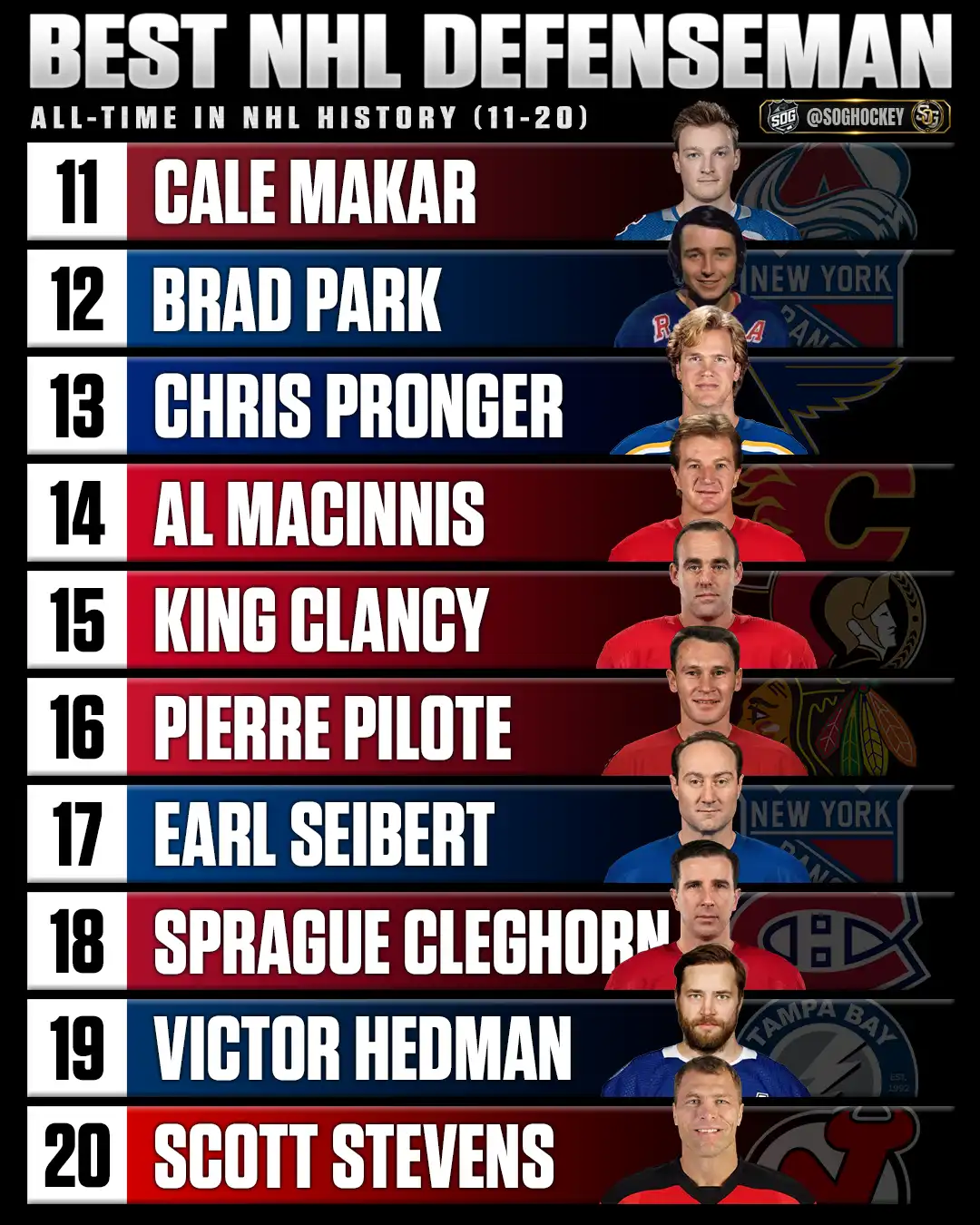
The best NHL defensemen ever ranked No. 11 through No. 20, featuring Cale Makar, Brad Park, Chris Pronger, Al MacInnis and King Clancy.
11. Cale Makar
Cale Makar already owns a rare mix of individual and playoff accomplishments. His edge work creates clean exits and controlled entries, while his ability to change direction under pressure opens passing lanes that are unavailable to most defensemen.
Through 2025–26, Makar had won two Norris Trophies, a Calder Trophy, a Stanley Cup and a Conn Smythe. He was also a Norris finalist in six consecutive seasons, finishing second in 2026. The completed peak earns No. 11, while the shorter career keeps him outside the top 10 for now. His rookie season is also covered in the SOG Sports history of Calder Trophy winners.
12. Brad Park
Brad Park is the clearest example of why award counts require context. He repeatedly finished behind Orr and later Potvin in Norris voting, yet still established himself as a top defenseman for both the New York Rangers and Boston Bruins.
Park combined physical defense with high-end passing and puck control. He sits just behind Makar because the active Avalanche star has already produced a more decisive individual and championship peak, not because Park lacked a No. 1 defenseman’s game.
13. Chris Pronger
Chris Pronger’s reach, edge and outlet passing let him take over every part of a shift. Opponents had to account for him at the blue line, in front of the net and during the first pass out of the zone.
In 1999–2000, Pronger won both the Hart and Norris, making him the only defenseman other than Orr to win league MVP in the expansion era. He later won the Stanley Cup with Anaheim. Injuries limited the longevity, but his best seasons were strong enough to challenge the top 10.
14. Al MacInnis
Al MacInnis is remembered for the slap shot, but the shot mattered because the rest of his game kept him on the ice in every important situation. He moved the puck efficiently, ran the power play and developed into a dependable first-pair defender.
The 1989 Conn Smythe with Calgary and 1999 Norris with St. Louis show two different versions of his value. That combination of playoff offense, longevity and all-around growth gives him the edge over the historical cases immediately below.
15. King Clancy
King Clancy was one of the NHL’s first defensemen to turn speed and aggression into sustained offense. When he retired in 1936, he was the highest-scoring defenseman in league history.
The raw totals cannot be compared directly with modern seasons. Clancy earns this position because his style expanded what teams expected from the blue line and because he stood out so clearly within the NHL’s early tactical structure.
16. Pierre Pilote
Pierre Pilote won three consecutive Norris Trophies from 1963 through 1965. He combined mobility and toughness while carrying major responsibility for Chicago on both sides of the puck.
Pilote lacks the broader public profile of several players below him, but the award peak is not a historical accident. He was the position’s standard between Harvey’s prime and Orr’s arrival.
17. Earl Seibert
Earl Seibert was one of the NHL’s most accomplished defensemen before the Norris Trophy existed. His size and physical play stood out, but he also had enough skill to contribute offensively and earn repeated postseason All-Star recognition.
Seibert’s placement is an era-adjusted judgment. The modern résumé lacks a neat trophy count, yet his sustained standing among the best defensemen of the 1930s supports a place ahead of several shorter peaks.
18. Sprague Cleghorn
Sprague Cleghorn played an aggressive style suited to hockey’s formative years. He carried the puck, produced offense and brought a physical presence that could control a game, even if that edge sometimes crossed into costly discipline.
The sport was less standardized during his career, so precision comparisons are impossible. Cleghorn remains this high because he was a defining defenseman in the NHL’s earliest seasons rather than simply a famous name from that period.
19. Victor Hedman
Victor Hedman became Tampa Bay’s matchup and transition anchor. His size closes space, his skating prevents opponents from exposing that size, and his passing lets the Lightning move directly from a defensive stop to offense.
Hedman won the 2018 Norris, the 2020 Conn Smythe and Stanley Cups in 2020 and 2021. His playoff value is the separator at this point in the list because he delivered his best two-way hockey during three consecutive trips to the Stanley Cup Final.
20. Scott Stevens
Scott Stevens controlled the middle of the ice through timing, strength and the threat of contact. New Jersey could pressure elsewhere because Stevens protected the most dangerous areas and handled difficult playoff minutes.
He won three Stanley Cups with the Devils and the 2000 Conn Smythe. The lower offensive ceiling keeps him behind Hedman, but a ranking of defensemen has to account for the way Stevens changed entries, puck decisions and opponent behavior.
Best NHL Defensemen of All-Time: 21–30
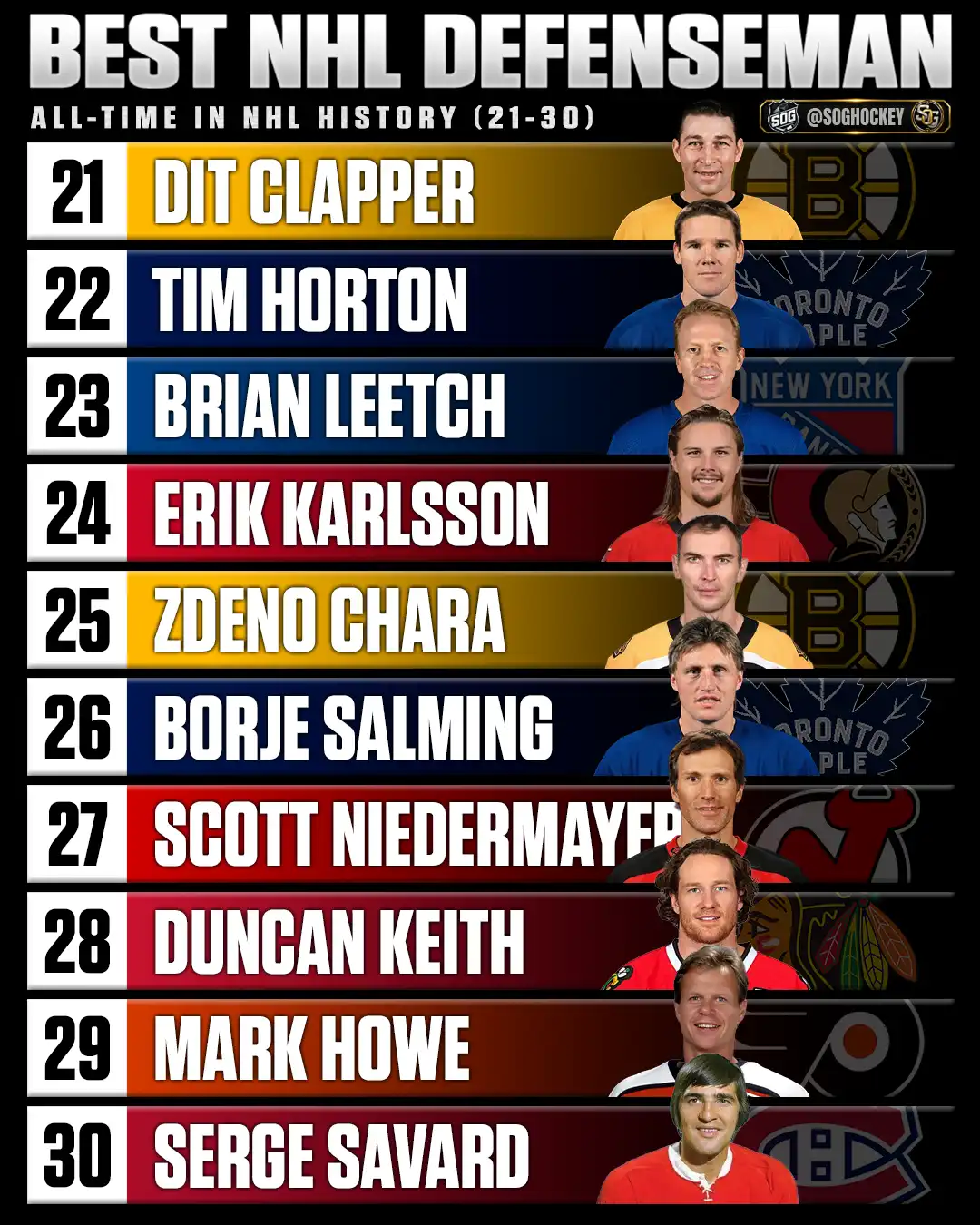
The best NHL defensemen ever ranked No. 21 through No. 30, featuring Dit Clapper, Tim Horton, Brian Leetch, Erik Karlsson, Zdeno Chara and Börje Salming.
21. Dit Clapper
Dit Clapper reached postseason All-Star level at both right wing and defense, a rare split that reflects his intelligence and adaptability. His years on the blue line were not a late-career cameo. They were a substantial second phase of a Hall of Fame career.
The position change makes his defenseman résumé harder to compare with a lifelong blue-liner. Clapper still belongs in the top 30 because his work at defense was strong enough to be evaluated independently of what he had already accomplished at forward.
22. Tim Horton
Tim Horton gave Toronto strength, durability and a steady first pass through the franchise’s 1960s championship run. He defended physically without turning every shift into a gamble and could absorb a heavy workload against top lines.
Horton played on four Stanley Cup winners with the Maple Leafs. He never won the Norris, but his long stretch as a dependable top-pair defenseman creates a stronger complete-career case than a trophy count alone suggests.
23. Brian Leetch
Brian Leetch used skating and anticipation to move the New York Rangers through every zone. He could escape pressure himself, find the first option early or become the extra attacker when a lane opened.
Leetch won two Norris Trophies and became the first United States-born player to win the Conn Smythe during the Rangers’ 1994 championship run. His offensive and playoff peaks are high enough to challenge the top 20, but the list gives a narrow edge to the broader defensive cases above him.
24. Erik Karlsson
Erik Karlsson’s best seasons were exercises in territorial control. He turned retrievals into clean exits, gained the offensive zone with possession and created scoring chances before opponents could establish coverage.
Three Norris Trophies and 101 points in 2022–23 place his offensive peak among the best ever at the position. Injuries interrupted several prime seasons, and the all-around defensive résumé is less complete than the players above, which creates the gap between peak talent and all-time placement.
25. Zdeno Chara
Zdeno Chara’s reach changed the geometry of Boston’s defensive zone. He could protect the slot, close along the boards and recover across space that would normally require two defenders.
Chara won the 2009 Norris and captained the Bruins to the 2011 Stanley Cup. His offense was never the primary source of his value, but the length of his shutdown prime and the responsibility he carried make this much more than a size-based case.
26. Börje Salming
Börje Salming was a pioneering European star in the NHL and an exceptional defenseman independent of that history. He handled pressure, moved the puck through traffic and played major minutes for Toronto without backing away from a physical era.
Salming never won the Norris or Stanley Cup, so his case relies on sustained performance and influence rather than a trophy stack. His career helped change how NHL teams evaluated European players while maintaining a true No. 1 defenseman’s workload.
27. Scott Niedermayer
Scott Niedermayer’s skating solved problems in both directions. He could recover defensively, lead a controlled exit and join the rush without making the play feel forced.
Niedermayer won the 2004 Norris, four Stanley Cups and the 2007 Conn Smythe with Anaheim. He sits lower than his hardware might suggest because his peak was less individually dominant than the offensive engines above, but his complete game gives him one of the strongest arguments to move up.
28. Duncan Keith
Duncan Keith was the minutes engine of Chicago’s three-Cup run. He retrieved pucks under pressure, moved them before the forecheck settled and could stay on the ice against top competition without losing transition value.
Two Norris Trophies and the 2015 Conn Smythe establish both regular-season and postseason peaks. His place among the era’s leading players is explored further in the SOG Sports ranking of the best NHL players of the 2010s.
29. Mark Howe
Mark Howe was a precise two-way defenseman whose game did not depend on one obvious signature trait. He skated well, moved the puck quickly and defended with the positioning needed to support aggressive Philadelphia teams.
Howe never won the Norris or Stanley Cup, which limits the top-end résumé. His long run of first-pair quality and repeated presence in the Norris conversation still gives him the edge over several more decorated but less complete candidates at the cutoff.
30. Serge Savard
Serge Savard closes the ranking as a central defender on eight Montreal Stanley Cup teams. He read pressure, killed penalties and gave the Canadiens a reliable answer when a playoff series became tighter and more physical.
Savard became the first defenseman to win the Conn Smythe in 1969. His individual regular-season peak was not as high as several omissions, but his postseason responsibility and sustained championship contribution earn the final place.
Biggest Debates on the List
Bobby Orr vs. Doug Harvey
Harvey offers the stronger longevity and dynasty-control argument, but Orr reached a level no other defenseman has touched. Winning scoring titles while remaining the league’s best all-around defenseman gives Orr the decisive advantage.
Ray Bourque vs. Nicklas Lidström
This is the closest comparison in the top five. Lidström owns more Norris Trophies and Stanley Cups, while Bourque produced more offense and carried a larger share of Boston’s identity for longer. The ranking gives Bourque a slight edge for volume and workload, not because there is a meaningful defensive gap.
How High Should Cale Makar Already Rank?
No. 11 separates completed peak from completed career. Makar already has two Norris Trophies, a Conn Smythe and six straight finalist seasons, so placing him much lower would undervalue what he has done. Keeping him outside the top 10 respects the longevity that Chelios, Coffey and the defensemen above them still hold.
How Much Should Offense Matter?
Defensemen create value before the puck reaches the offensive zone. Coffey, Karlsson and Leetch gain ground through transition and scoring, while Stevens, Horton and Chara gain it by denying entries and protecting dangerous space. The order rewards both paths, then uses playoff translation, workload and longevity to separate them.
Toughest Omissions
Rod Langway is the hardest defensive omission. His two Norris Trophies and shutdown value create a direct challenge to the final group, but the ranking favors Savard’s postseason résumé, Howe’s two-way consistency and the transition offense supplied by Niedermayer and Keith.
Rob Blake, Guy Lapointe, Sergei Zubov, Phil Housley, Drew Doughty, Shea Weber and Brent Burns also have credible top-30 cases. Doughty and Langway have the strongest arguments if awards and difficult defensive minutes receive more weight. Housley and Burns rise when career offense matters more. The cutoff ultimately favors a mix of peak, sustained No. 1 usage and playoff value rather than one defining statistic.
Complete Top 30 NHL Defensemen Ranking
| Rank | Player |
|---|---|
| 1 | Bobby Orr |
| 2 | Doug Harvey |
| 3 | Ray Bourque |
| 4 | Nicklas Lidström |
| 5 | Eddie Shore |
| 6 | Denis Potvin |
| 7 | Red Kelly |
| 8 | Larry Robinson |
| 9 | Paul Coffey |
| 10 | Chris Chelios |
| 11 | Cale Makar |
| 12 | Brad Park |
| 13 | Chris Pronger |
| 14 | Al MacInnis |
| 15 | King Clancy |
| 16 | Pierre Pilote |
| 17 | Earl Seibert |
| 18 | Sprague Cleghorn |
| 19 | Victor Hedman |
| 20 | Scott Stevens |
| 21 | Dit Clapper |
| 22 | Tim Horton |
| 23 | Brian Leetch |
| 24 | Erik Karlsson |
| 25 | Zdeno Chara |
| 26 | Börje Salming |
| 27 | Scott Niedermayer |
| 28 | Duncan Keith |
| 29 | Mark Howe |
| 30 | Serge Savard |
More NHL Rankings
For a current team comparison, see the SOG Sports projection of the best defenses in the NHL today.
Follow @SOGHockey on Instagram for more NHL rankings, graphics and debates.
