
Nathan MacKinnon was the best NHL center for the 2025–26 season, narrowly beating Connor McDavid once the postseason is included. This opinion-based list identifies the best center from every season ending in 1967 through 2026, with the year referring to the season’s ending year. In other words, 2026 means 2025–26 and 1967 means 1966–67.
The regular season creates the baseline, but it does not automatically settle every year. Scoring, awards and postseason All-Star voting carry major weight. Playoff production, two-way responsibility and championship-level performance can overturn the result when the regular-season cases are close enough or the postseason gap is exceptional. That approach produces obvious choices such as Wayne Gretzky in most of the 1980s, plus harder calls such as MacKinnon over McDavid in 2026, Ryan O’Reilly over McDavid in 2019 and Steve Yzerman over Peter Forsberg in 1998.
How We Picked the Best NHL Center Every Year
This is a year-by-year editorial ranking, not a list of official award winners. A Stanley Cup does not automatically make someone the best center, and the Art Ross Trophy does not automatically end the debate. The goal is to identify the player who had the strongest complete season at the position.
- Regular-season performance: goals, assists, points, scoring rate, availability and separation from other centers.
- Two-way value: defensive responsibility, matchup difficulty, puck possession, faceoffs and special-teams usage when the evidence is available.
- Awards and recognition: Hart, Art Ross, Ted Lindsay, Selke and postseason NHL All-Star voting. The postseason All-Star teams are based on the regular season, not the midseason All-Star Game.
- Playoff performance: individual production, quality of play, rounds advanced and Conn Smythe-level value.
- Era context: scoring environments, schedule length and how the responsibilities of a center changed across generations.
The regular season receives the most weight because every player has the same opportunity to build that résumé. The playoffs become decisive when an elite regular-season center also produces a major postseason advantage. Players are classified by their primary position in that specific season.
Best NHL Centers by Season, 2026–1997
2026 — Nathan MacKinnon
Nathan MacKinnon is the 2026 choice after pairing an elite regular season with the stronger playoff finish among the leading centers. He scored 53 goals with 74 assists for 127 points in 80 games, won the Rocket Richard Trophy and drove Colorado to the Presidents’ Trophy. Connor McDavid led the NHL with 138 points, won the Ted Lindsay Award and was voted First-Team All-Star at center, so he had the better regular-season résumé. MacKinnon closed the gap by producing 15 points in 13 playoff games while the Avalanche reached the Western Conference Final. McDavid had six points in Edmonton’s first-round exit.
2025 — Leon Draisaitl
Leon Draisaitl gets the 2025 spot over Nathan MacKinnon after leading the NHL with 52 goals in only 71 games. He added 54 assists for 106 points, finished as a Hart Trophy finalist and scored six overtime goals during the regular season. MacKinnon earned First-Team All-Star honors at center with 116 points, but Draisaitl’s postseason was the separator. He tied Connor McDavid for the playoff scoring lead with 33 points in 22 games and helped Edmonton reach a second straight Stanley Cup Final.
2024 — Connor McDavid
Connor McDavid did not win the 2024 Hart Trophy, but no center matched his full season. He recorded 100 assists and 132 points in 76 regular-season games, then delivered 42 points in 25 playoff games as Edmonton came within one win of the Stanley Cup. McDavid became the first skater from the losing finalist to win the Conn Smythe Trophy since Reggie Leach in 1976. Nathan MacKinnon had the stronger regular-season awards case, but McDavid’s record-level postseason made this decision clear.
2023 — Connor McDavid
McDavid’s 2023 season was the most overwhelming offensive year by a center since Mario Lemieux’s prime. He scored 64 goals, added 89 assists and finished with 153 points, leading the NHL in all three categories. The result was a sweep of the Hart Trophy, Art Ross Trophy, Ted Lindsay Award and Rocket Richard Trophy. Edmonton did not get beyond the second round, but McDavid still produced 20 points in 12 playoff games. No postseason alternative came close to erasing the regular-season gap.
2022 — Connor McDavid
Connor McDavid led the NHL with 123 points in 80 games and then raised his production in the playoffs. He scored 10 goals with 23 assists for 33 points in 16 postseason games, carrying Edmonton to the Western Conference Final. Auston Matthews won the Hart Trophy after a 60-goal regular season, but McDavid’s combination of league-leading offense and a far deeper playoff run gave him the stronger complete season at center.
2021 — Connor McDavid
McDavid turned the shortened 56-game season into a personal scoring clinic. He finished with 33 goals, 72 assists and 105 points, ending 21 points ahead of teammate Leon Draisaitl and 36 ahead of the highest-scoring player outside Edmonton. McDavid won the Hart Trophy unanimously, captured the Art Ross Trophy and took the Ted Lindsay Award. The Oilers were swept in the opening round, but the regular-season separation was too large for any playoff center to overcome.
2020 — Nathan MacKinnon
Nathan MacKinnon narrowly edges Leon Draisaitl for 2020 because the playoff difference was enormous. Draisaitl led the league with 110 points and won the Hart, Art Ross and Ted Lindsay awards. MacKinnon countered with 93 points in 69 games, finished second in Hart voting and then scored 25 points in 15 postseason games as Colorado reached Game 7 of the second round. Edmonton was eliminated in the qualifying round, with Draisaitl recording six points in four games. Draisaitl owned the regular season, but MacKinnon had the better overall campaign.
2019 — Ryan O’Reilly
Ryan O’Reilly is the 2019 selection after producing one of the best two-way championship seasons by a center in this era. Connor McDavid was the superior offensive player with 116 points, but Edmonton missed the playoffs. O’Reilly set career highs with 28 goals, 49 assists and 77 points, won the Selke Trophy and then shared the NHL playoff scoring lead with 23 points in 26 games. He led the Stanley Cup Final with nine points, won the Conn Smythe Trophy and helped St. Louis capture the first championship in franchise history.
2018 — Connor McDavid
McDavid led the NHL with 108 points and won his second straight Art Ross Trophy in 2018. Edmonton missed the playoffs, which left room for a postseason challenger, but no center built a strong enough full-season case to pass him. Evgeny Kuznetsov led the playoffs with 32 points during Washington’s Stanley Cup run, yet McDavid’s regular-season advantage and unmatched transition offense kept him on top. He was already forcing teams to defend the neutral zone differently whenever he touched the puck.
2017 — Sidney Crosby
Sidney Crosby gets the 2017 spot over Connor McDavid in one of the strongest regular-season-versus-postseason debates on the list. McDavid won the Hart and Art Ross trophies with 100 points. Crosby scored an NHL-best 44 goals, finished with 89 points and remained the more complete defensive and matchup center. He then added 27 points in 24 playoff games, won a second straight Stanley Cup and earned his second consecutive Conn Smythe Trophy. That finish narrowly outweighs McDavid’s regular-season edge.
2016 — Sidney Crosby
Crosby’s 2016 season changed after Pittsburgh’s midyear coaching change. He recovered from a slow start to finish with 36 goals and 85 points, placing second in Hart voting, then became the central piece of the Penguins’ speed-driven playoff attack. Crosby scored 19 points in 24 postseason games, handled difficult matchups and won the Conn Smythe Trophy as Pittsburgh captured the Stanley Cup. Patrick Kane was the league’s regular-season MVP, but among centers, Crosby’s complete season stood alone.
2015 — Jonathan Toews
Jonathan Toews was not the highest-scoring center in 2015, but his value became clearer as the games grew harder. He recorded 66 points during the regular season, finished near the top of Selke voting and remained Chicago’s first choice for difficult matchups, defensive-zone starts and late-game situations. Toews then produced 21 points in 23 playoff games and captained the Blackhawks to their third Stanley Cup in six seasons. John Tavares and Sidney Crosby had better regular-season totals, but neither matched Toews’ full-season contribution.
2014 — Sidney Crosby
Sidney Crosby was the obvious center choice in 2014. He led the NHL with 104 points, finished 17 points clear of the next player and won the Hart, Art Ross and Ted Lindsay awards. Anže Kopitar answered with a strong two-way season and a Stanley Cup run, but his 70-point regular season left too much ground to recover. Crosby’s playoffs were below his standard, yet his regular-season command of the position was decisive.
2013 — Sidney Crosby
Crosby played only 36 of the 48 games in the lockout-shortened 2013 season, but he was still the league’s best center when available. He scored 15 goals with 41 assists for 56 points, one behind scoring champion Martin St. Louis despite missing the final quarter of the schedule. Crosby returned for the playoffs and added 15 points in 14 games as Pittsburgh reached the Eastern Conference Final. Jonathan Toews had the championship argument, but Crosby’s per-game advantage was too substantial.
2012 — Evgeni Malkin
Evgeni Malkin took over Pittsburgh’s offense while Crosby missed most of the season. Malkin scored 50 goals, added 59 assists and led the NHL with 109 points in 75 games. He won the Hart Trophy, Art Ross Trophy and Ted Lindsay Award, giving him the cleanest regular-season résumé of any center. Los Angeles star Anže Kopitar had the better postseason and won the Stanley Cup, but Malkin’s 33-point regular-season advantage kept the choice from flipping.
2011 — Henrik Sedin
Henrik Sedin followed his MVP season with another elite year as Vancouver’s offensive organizer. He recorded 75 assists and 94 points, then added 22 points in 25 playoff games as the Canucks won the Presidents’ Trophy and reached Game 7 of the Stanley Cup Final. Ryan Kesler supplied stronger goal scoring and Selke-winning defense, but Henrik’s playmaking remained the foundation of the league’s best regular-season team and carried into the postseason.
2010 — Henrik Sedin
Henrik Sedin is the corrected 2010 selection. Sidney Crosby scored 51 goals, shared the Rocket Richard Trophy and had five more playoff points, but Henrik owned the regular-season center race. He produced 29 goals, 83 assists and 112 points, won the Hart and Art Ross trophies and was voted First-Team All-Star at center. Vancouver and Pittsburgh both exited in the second round, so the postseason did not create enough separation to overturn Henrik’s superior regular-season case.
2009 — Evgeni Malkin
Malkin led the NHL with 113 points in the regular season and was even better during Pittsburgh’s championship run. He recorded 14 goals and 22 assists for 36 points in 24 playoff games, the highest postseason total since Wayne Gretzky in 1993. Malkin won the Conn Smythe Trophy as the Penguins defeated Detroit in a seven-game Stanley Cup Final. Crosby was excellent beside him, but Malkin had the stronger production in both parts of the season.
2008 — Pavel Datsyuk
Pavel Datsyuk combined first-line offense with the best defensive work of any star center in 2008. He scored 31 goals with 66 assists for 97 points and won the Selke and Lady Byng trophies. Datsyuk then added 23 playoff points as Detroit won the Stanley Cup. Evgeni Malkin scored nine more regular-season points and also reached the Final, but Datsyuk’s defensive advantage and championship finish gave him the better complete year.
2007 — Sidney Crosby
Crosby became the face of the league in 2007. At 19 years old, he scored 36 goals with 84 assists for an NHL-leading 120 points, becoming the youngest player to win the Art Ross Trophy. He also captured the Hart Trophy and the player-voted Lester B. Pearson Award, now called the Ted Lindsay Award. Pittsburgh lost in the first round, but no other center paired a credible playoff case with anything close to Crosby’s regular-season performance.
2006 — Eric Staal
Eric Staal’s 2006 season earns the spot over Hart and Art Ross winner Joe Thornton. Thornton had the best regular season with 125 points, but Staal was already a 100-point superstar before the playoffs began. He then led the postseason with 28 points in 25 games as Carolina won the Stanley Cup. Staal’s regular-season base was strong enough that the championship run could legitimately overturn Thornton’s 25-point scoring advantage.
2005 — No NHL Season Played
No selection is made for 2005 because the entire 2004–05 NHL season was canceled during the lockout. The league played no regular-season or playoff games, and the Stanley Cup was not awarded. This is the only blank season in the 1967–2026 range.
2004 — Brad Richards
Brad Richards put together the best full season by a center in 2004. He recorded 26 goals, 53 assists and 79 points during the regular season, then scored 26 points in 23 playoff games as Tampa Bay won its first Stanley Cup. Richards produced seven game-winning goals in the postseason and received the Conn Smythe Trophy. Joe Sakic and Mats Sundin had strong regular seasons, but neither matched Richards when the playoffs were included.
2003 — Peter Forsberg
Peter Forsberg was at his most complete in 2003. He led the NHL with 77 assists and 106 points, won the Hart and Art Ross trophies and finished with a plus-52 rating. Forsberg’s combination of puck protection, physical play and creativity made him difficult to match with any single type of defender. Colorado was upset in the first round, but the regular-season gap over the other centers was large enough to preserve his place.
2002 — Joe Sakic
Joe Sakic was voted First-Team All-Star at center in 2002 after recording 26 goals, 53 assists and 79 points. The total did not match his 2001 peak, but his all-situations value remained exceptional. Sakic added 19 points in 21 playoff games as Colorado reached Game 7 of the Western Conference Final. Steve Yzerman authored a remarkable championship run while playing through a serious knee injury, but Sakic’s larger regular-season body of work gives him the narrow overall edge.
2001 — Joe Sakic
Sakic’s 2001 season delivered everything this ranking rewards. He scored 54 goals with 64 assists for 118 points, won the Hart Trophy, Lester B. Pearson Award and Lady Byng Trophy, then led all playoff scorers with 26 points. Colorado won the Stanley Cup after a seven-game Final against New Jersey. Sakic was the best regular-season center and remained the offensive engine of the champion, leaving little room for debate.
2000 — Mike Modano
Mike Modano gets the 2000 spot after combining high-end offense with another deep postseason. He scored 38 goals and finished with 81 points in 77 regular-season games, then added 23 points in 23 playoff games as Dallas returned to the Stanley Cup Final. Steve Yzerman won the Selke Trophy and was voted First-Team All-Star at center, but Modano’s larger offensive role and stronger postseason production create the better full-season case.
1999 — Peter Forsberg
Forsberg scored 30 goals with 67 assists for 97 points in 78 games, leading all NHL centers in scoring in 1999. His postseason strengthened the choice: 24 points in 19 games while Colorado reached Game 7 of the Western Conference Final. Forsberg’s ability to create through contact gave the Avalanche a different type of offensive engine than the league’s smaller playmakers. No other center matched his blend of regular-season production and playoff output.
1998 — Steve Yzerman
Steve Yzerman is the corrected 1998 selection over Peter Forsberg. Forsberg had the better regular season with 91 points, while Yzerman led Detroit with 69. The postseason changed the result. Yzerman recorded six goals and 18 assists for a playoff-leading 24 points in 22 games, won the Conn Smythe Trophy and captained the Red Wings to a second straight Stanley Cup. His two-way responsibilities and championship production were enough to overcome the regular-season scoring gap.
1997 — Mario Lemieux
Mario Lemieux remained the NHL’s most dangerous center in the final season before his first retirement. He scored 50 goals with 72 assists for a league-leading 122 points in 76 games and won his sixth Art Ross Trophy. Eric Lindros carried Philadelphia to the Stanley Cup Final and had an excellent postseason, but Lemieux’s regular-season advantage was too large. Even after years of injuries and illness, his scoring efficiency remained unmatched.
Best NHL Centers by Season, 1996–1967
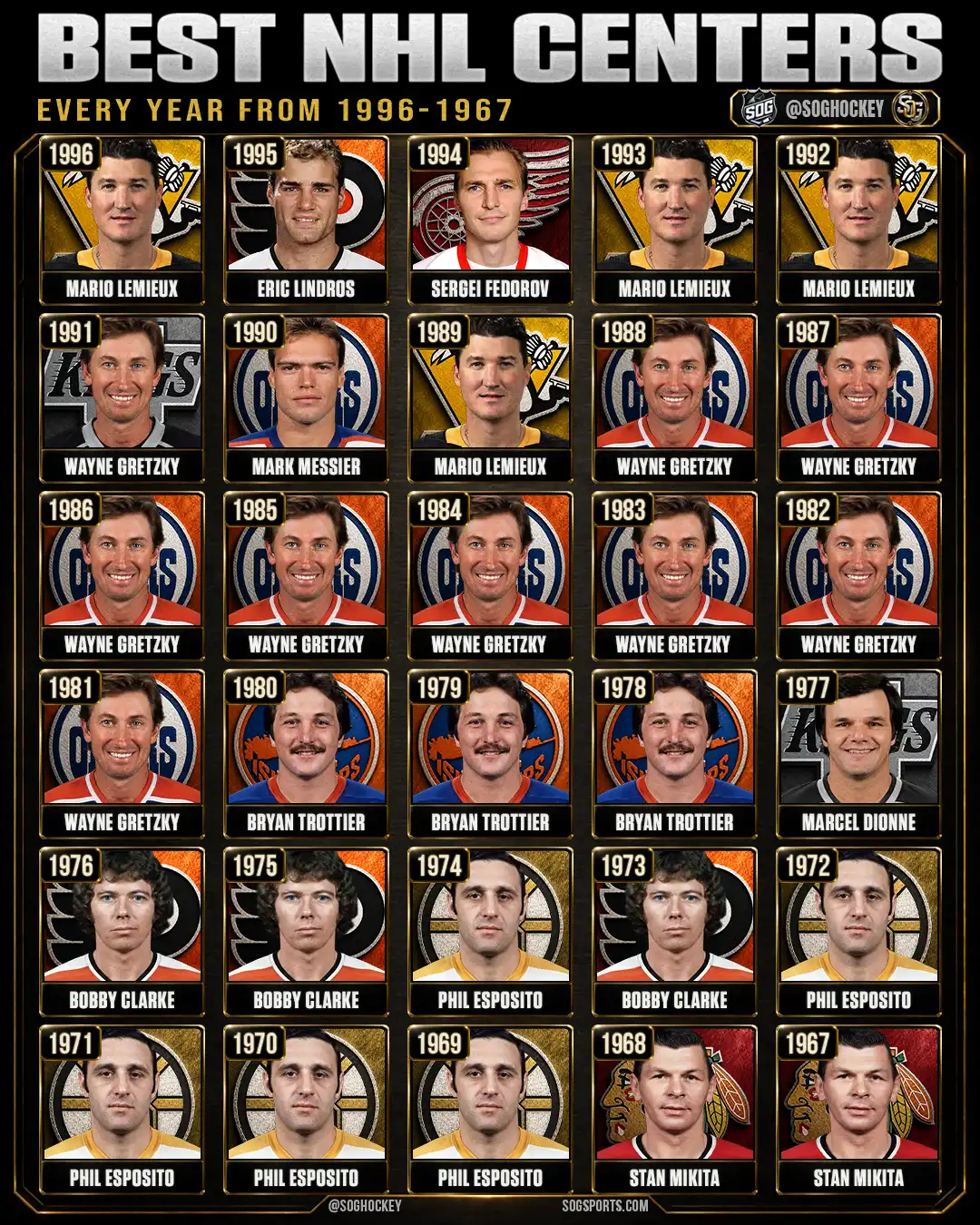
SOG Sports selections for the best NHL center in every season from 1996 through 1967.
1996 — Mario Lemieux
Lemieux’s 1996 season belongs among the greatest offensive years ever recorded. He scored 69 goals, added 92 assists and finished with 161 points in only 70 games. Lemieux won the Hart and Art Ross trophies, then produced 27 points in 18 playoff games as Pittsburgh reached the Eastern Conference Final. Joe Sakic won the Stanley Cup and led the playoffs in scoring, but Lemieux’s regular-season performance created an insurmountable lead.
1995 — Eric Lindros
Eric Lindros reached his early-career peak during the shortened 1995 season. He scored 29 goals with 41 assists for 70 points in 46 games, tying Jaromir Jagr for the league lead and winning the Hart Trophy and Lester B. Pearson Award. Lindros then helped Philadelphia reach the Eastern Conference Final. His combination of top-end production, physical control and postseason value made him the clear center choice.
1994 — Sergei Fedorov
Sergei Fedorov produced one of the strongest two-way regular seasons in NHL history. He scored 56 goals with 64 assists for 120 points and won the Hart Trophy, Lester B. Pearson Award and Selke Trophy. Mark Messier answered with a legendary Stanley Cup and playoff run for the New York Rangers, but Fedorov’s regular-season level was too high to overturn. Few centers have ever combined 50-goal offense with award-winning defense in the same year.
1993 — Mario Lemieux
Lemieux’s 1993 season remains almost impossible to process. He underwent treatment for Hodgkin lymphoma, missed 24 games and still led the NHL with 69 goals, 91 assists and 160 points in 60 appearances. His 2.67 points per game are the third-highest single-season rate in league history. Lemieux won the Hart, Art Ross and Lester B. Pearson awards. No playoff result could erase a regular season that far beyond the rest of the position.
1992 — Mario Lemieux
Lemieux led the NHL with 131 points despite playing only 64 regular-season games, then took over the playoffs. He recorded 34 points in 15 postseason games, won the Conn Smythe Trophy and led Pittsburgh to a second consecutive Stanley Cup. Lemieux missed time after suffering a broken hand in the second round, returned and still finished as the playoff scoring leader. This was a complete regular-season and postseason victory.
1991 — Wayne Gretzky
Wayne Gretzky scored 41 goals, added 122 assists and led the NHL with 163 points in 78 games. He won the Art Ross Trophy and remained the league’s best center over the full regular-season schedule. Mario Lemieux returned from a lengthy injury absence to produce a remarkable Conn Smythe-winning playoff run for Pittsburgh, but he played only 26 regular-season games. Gretzky’s much larger body of work keeps the 1991 selection.
1990 — Mark Messier
Mark Messier proved Edmonton could remain a champion after Gretzky’s departure. He scored 45 goals with 84 assists for 129 points in 79 games and won the Hart Trophy. Messier then added 31 points in 22 playoff games as the Oilers captured their fifth Stanley Cup in seven seasons. His speed, physical pressure and ability to drive offense without Gretzky made this the defining season of his Edmonton career.
1989 — Mario Lemieux
Lemieux came within one point of becoming the second player in NHL history to reach 200. He finished with 85 goals, 114 assists and 199 points in 76 games, leading the league in both goals and points. Gretzky won the Hart Trophy after a brilliant first season in Los Angeles, but Lemieux’s 31-point scoring advantage and superior goal total make him the center choice. It was the closest anyone has come to matching Gretzky’s highest offensive peaks.
1988 — Wayne Gretzky
Mario Lemieux won the Hart Trophy and outscored Gretzky 168 to 149 during the regular season, but Gretzky’s postseason changed the final verdict. He produced 12 goals and 31 assists for 43 points in 19 playoff games, won the Conn Smythe Trophy and led Edmonton to the Stanley Cup. Gretzky was already operating at a 186-point pace over that season’s 80-game schedule. With the regular-season gap partly explained by missed games, his playoff advantage was enough to win the full-season comparison.
1987 — Wayne Gretzky
Gretzky finished with 62 goals, 121 assists and 183 points, winning his eighth consecutive Hart Trophy and seventh straight Art Ross Trophy. Edmonton then won the Stanley Cup, with Gretzky supplying 34 playoff points in 21 games. Lemieux was beginning to close the offensive distance, but Gretzky still led the league by 42 points and remained the central force behind the champion.
1986 — Wayne Gretzky
Gretzky set the NHL single-season record with 215 points, a total that still stands. His 163 assists were also a record and would have led the scoring race without any of his 52 goals. Edmonton’s bid for a third straight Stanley Cup ended in the second round, but no playoff center came remotely close to matching the regular-season gap. Gretzky finished 74 points ahead of Lemieux, the league’s second-leading scorer.
1985 — Wayne Gretzky
Gretzky recorded 73 goals, 135 assists and 208 points, then delivered one of the greatest playoff runs ever. He scored 17 goals with 30 assists for 47 points in 18 postseason games, won the Conn Smythe Trophy and led Edmonton to a second straight Stanley Cup. The regular season and playoffs pointed to the same conclusion: Gretzky was operating on a different offensive level from every other center.
1984 — Wayne Gretzky
Gretzky scored 87 goals and finished with 205 points in only 74 games, giving him a second 200-point season. He then added 35 points in 19 playoff games as Edmonton defeated the four-time defending champion New York Islanders and won its first Stanley Cup. Gretzky was the league’s top scorer, most valuable player and offensive centerpiece of the new champion.
1983 — Wayne Gretzky
Gretzky led the NHL with 71 goals, 125 assists and 196 points. He finished 72 points ahead of the next-highest scorer and then recorded 38 points in 16 playoff games as Edmonton reached its first Stanley Cup Final. The Islanders swept the Oilers, but the postseason still confirmed that Gretzky’s offense translated against the league’s best teams.
1982 — Wayne Gretzky
Gretzky’s 1982 season produced the single-season record of 92 goals, along with 120 assists and 212 points. He became the first player to reach 200 points and won the Hart, Art Ross and Lester B. Pearson awards. Edmonton was upset in the opening round, but a 65-point lead over the league’s second-highest scorer left no realistic center alternative.
1981 — Wayne Gretzky
In his second NHL season, Gretzky scored 55 goals with 109 assists for 164 points. He won the Hart and Art Ross trophies and finished 29 points ahead of Marcel Dionne. Edmonton was still developing into a championship team, but Gretzky had already separated himself as the league’s defining offensive center.
1980 — Bryan Trottier
Bryan Trottier gets the 1980 spot over Wayne Gretzky and Marcel Dionne because of his total two-way and postseason value. Gretzky and Dionne each scored 137 points, while Trottier had 104. Trottier then recorded 29 points in 21 playoff games, handled the Islanders’ hardest center assignments, won the Conn Smythe Trophy and led the franchise to its first Stanley Cup. The regular-season scoring gap was significant, but this was the postseason that launched a four-year dynasty.
1979 — Bryan Trottier
Trottier had the best statistical season of his career in 1979. He scored 47 goals, added 87 assists and led the NHL with 134 points in 76 games. Trottier won the Hart and Art Ross trophies while providing the physical and defensive details expected from a top matchup center. The Islanders had not yet broken through in the playoffs, but no other center matched his regular-season performance.
1978 — Bryan Trottier
Trottier scored 46 goals with 77 assists for 123 points in 77 games and was voted First-Team All-Star at center. He gave the emerging Islanders a player who could run the offense, win battles below the goal line and take difficult defensive assignments. Marcel Dionne and Gilbert Perreault remained outstanding scorers, but Trottier’s complete regular season placed him at the top of the position.
1977 — Marcel Dionne
Marcel Dionne scored 53 goals with 69 assists for 122 points and was voted First-Team All-Star at center. He also won the Lady Byng Trophy. Guy Lafleur, a right wing, won the Art Ross Trophy with 136 points, so Dionne was not the league scoring champion as the original draft stated. Among centers, however, Dionne’s offensive production and recognition made him the strongest choice.
1976 — Bobby Clarke
Bobby Clarke recorded 30 goals, 89 assists and 119 points in 76 games and won the Hart Trophy. Philadelphia fell short of a third straight Stanley Cup, but Clarke remained the league’s most complete center through the regular season and another run to the Final. His scoring, checking and ability to dictate the emotional temperature of a game all mattered.
1975 — Bobby Clarke
Clarke scored 27 goals with 89 assists for 116 points and won his second Hart Trophy. He then led Philadelphia through four playoff rounds as the Flyers repeated as Stanley Cup champions. Clarke did not need to lead the league in points to control games. His defensive pressure, faceoff work, puck distribution and willingness to play against top lines gave Philadelphia its identity.
1974 — Phil Esposito
Phil Esposito led the NHL with 68 goals and 145 points, winning the Hart and Art Ross trophies. He added 18 points in 16 playoff games as Boston reached the Stanley Cup Final. Bobby Clarke won the championship with Philadelphia and had the stronger defensive profile, but Esposito’s 58-point regular-season advantage was far too large to overturn.
1973 — Bobby Clarke
Bobby Clarke is the choice despite Phil Esposito’s league-leading 130 points. Clarke recorded 37 goals, 67 assists and 104 points, won the Hart Trophy and was also voted the NHL’s most outstanding player by his peers through the Lester B. Pearson Award. His defensive responsibility and ability to drive Philadelphia’s rapid rise added value that raw scoring did not capture. Esposito had the bigger number; Clarke had the stronger all-around season.
1972 — Phil Esposito
Esposito scored 66 goals with 67 assists for an NHL-leading 133 points, then produced 24 points in 15 playoff games as Boston won the Stanley Cup. Jean Ratelle challenged him during the regular season and Bobby Clarke was becoming the league’s best two-way center, but Esposito finished the year as both the scoring champion and the offensive centerpiece of the champion.
1971 — Phil Esposito
Esposito shattered the NHL scoring standard with 76 goals, 76 assists and 152 points in 78 games. He became the first player to reach 70 goals and the first to surpass 130 points. Esposito won the Art Ross Trophy and the inaugural Lester B. Pearson Award. Boston’s first-round playoff loss was disappointing, but the regular-season separation was historic enough that the selection never became vulnerable.
1970 — Phil Esposito
Esposito scored 43 goals with 56 assists for 99 points, then exploded for 27 points in 14 playoff games. Boston swept St. Louis in the Stanley Cup Final, and Esposito led the postseason in scoring while centering the league’s most dangerous attack. Bobby Orr was the best player on the team, but among centers, Esposito had the strongest full season.
1969 — Phil Esposito
Esposito broke out with 49 goals, 77 assists and 126 points in 74 games. He became the first NHL player to exceed 100 points in a season and won the Hart and Art Ross trophies. Boston did not reach the Stanley Cup Final, but no center came close to matching the scale of his offensive leap.
1968 — Stan Mikita
Stan Mikita led the NHL with 87 points in 72 games and repeated as the winner of the Hart, Art Ross and Lady Byng trophies. His 40 goals showed he was not merely a distributor, while his discipline and puck control allowed Chicago to play through him in every situation. Jean Béliveau had the stronger team result with Montreal’s Stanley Cup, but Mikita’s regular-season advantage kept him first among centers.
1967 — Stan Mikita
Mikita opens the list with one of the cleanest award sweeps by a center. He scored 35 goals, added 62 assists and led the NHL with 97 points in 70 games. Mikita won the Hart, Art Ross and Lady Byng trophies and was voted First-Team All-Star at center. His blend of scoring, playmaking and discipline makes him the clear selection for the 1966–67 season.
What the Year-by-Year List Shows
Wayne Gretzky appears 9 times, the most of any player. Connor McDavid, Sidney Crosby, Mario Lemieux and Phil Esposito are next with 5 selections each. That distribution captures the difference between a long run of unquestioned control and shorter peaks interrupted by injuries, position rivals or playoff-driven choices.
Edmonton leads all teams with 15 selections, followed by Pittsburgh with 12 and Colorado with 6. The list contains 60 ending years but only 59 seasons played because the 2004–05 season was canceled. It also shows how rarely a postseason specialist wins this comparison without first building a strong regular-season case. O’Reilly in 2019, Yzerman in 1998 and Trottier in 1980 needed a championship run and Conn Smythe-level performance to overcome much larger scoring totals elsewhere.
Closest Calls and Hardest Decisions
2026: Nathan MacKinnon over Connor McDavid
McDavid won the Art Ross Trophy, Ted Lindsay Award and First-Team All-Star spot at center. MacKinnon won the Rocket Richard Trophy, led the NHL in even-strength scoring and powered the Presidents’ Trophy winner. The deciding difference was the postseason: Colorado reached the Western Conference Final while Edmonton exited in the first round.
2025: Leon Draisaitl over Nathan MacKinnon
MacKinnon had 116 points and narrowly won the First-Team All-Star vote at center. Draisaitl scored 52 goals in 71 games, finished as a Hart finalist and then tied for the playoff scoring lead during Edmonton’s run to the Stanley Cup Final. That postseason edge moved Draisaitl ahead.
2020: Nathan MacKinnon over Leon Draisaitl
Draisaitl swept the Hart, Art Ross and Ted Lindsay awards, so this is not a rejection of his regular season. MacKinnon was the Hart runner-up and followed with 25 playoff points in 15 games, while Edmonton was eliminated after four qualifying-round games. It is one of the few seasons where the postseason difference was large enough to overturn an MVP résumé.
2019: Ryan O’Reilly over Connor McDavid
McDavid’s 116 points made him the best offensive center. O’Reilly’s case required more than a Stanley Cup: he had a career-high 77 points, won the Selke, shared the playoff scoring lead and captured the Conn Smythe. That combination of regular-season two-way value and postseason excellence created the stronger complete season.
2010: Henrik Sedin over Sidney Crosby
Crosby’s 51 goals, shared Rocket Richard Trophy and slightly better playoff production made this close. Henrik still led the NHL with 112 points, won the Hart and Art Ross trophies and was voted First-Team All-Star. Because both teams exited in the second round, the playoffs did not create enough distance to overturn the regular season.
1998: Steve Yzerman over Peter Forsberg
Forsberg’s 91 points gave him the better regular season. Yzerman answered with a playoff-leading 24 points, the Conn Smythe Trophy and a second straight Stanley Cup while handling the most important center assignments for Detroit. The postseason was decisive.
1988: Wayne Gretzky over Mario Lemieux
Lemieux won the Hart and led Gretzky by 19 regular-season points. Gretzky had played 13 fewer games, then produced 43 points in 19 playoff games and won the Conn Smythe as Edmonton captured the Cup. The missed-game context and postseason gap narrowly swung the result.
Full Year-by-Year Table: Best NHL Center Every Season
| Year | Best NHL Center | Team |
|---|---|---|
| 2026 | Nathan MacKinnon | Colorado Avalanche |
| 2025 | Leon Draisaitl | Edmonton Oilers |
| 2024 | Connor McDavid | Edmonton Oilers |
| 2023 | Connor McDavid | Edmonton Oilers |
| 2022 | Connor McDavid | Edmonton Oilers |
| 2021 | Connor McDavid | Edmonton Oilers |
| 2020 | Nathan MacKinnon | Colorado Avalanche |
| 2019 | Ryan O’Reilly | St. Louis Blues |
| 2018 | Connor McDavid | Edmonton Oilers |
| 2017 | Sidney Crosby | Pittsburgh Penguins |
| 2016 | Sidney Crosby | Pittsburgh Penguins |
| 2015 | Jonathan Toews | Chicago Blackhawks |
| 2014 | Sidney Crosby | Pittsburgh Penguins |
| 2013 | Sidney Crosby | Pittsburgh Penguins |
| 2012 | Evgeni Malkin | Pittsburgh Penguins |
| 2011 | Henrik Sedin | Vancouver Canucks |
| 2010 | Henrik Sedin | Vancouver Canucks |
| 2009 | Evgeni Malkin | Pittsburgh Penguins |
| 2008 | Pavel Datsyuk | Detroit Red Wings |
| 2007 | Sidney Crosby | Pittsburgh Penguins |
| 2006 | Eric Staal | Carolina Hurricanes |
| 2005 | No NHL Season Played | 2004–05 lockout |
| 2004 | Brad Richards | Tampa Bay Lightning |
| 2003 | Peter Forsberg | Colorado Avalanche |
| 2002 | Joe Sakic | Colorado Avalanche |
| 2001 | Joe Sakic | Colorado Avalanche |
| 2000 | Mike Modano | Dallas Stars |
| 1999 | Peter Forsberg | Colorado Avalanche |
| 1998 | Steve Yzerman | Detroit Red Wings |
| 1997 | Mario Lemieux | Pittsburgh Penguins |
| 1996 | Mario Lemieux | Pittsburgh Penguins |
| 1995 | Eric Lindros | Philadelphia Flyers |
| 1994 | Sergei Fedorov | Detroit Red Wings |
| 1993 | Mario Lemieux | Pittsburgh Penguins |
| 1992 | Mario Lemieux | Pittsburgh Penguins |
| 1991 | Wayne Gretzky | Los Angeles Kings |
| 1990 | Mark Messier | Edmonton Oilers |
| 1989 | Mario Lemieux | Pittsburgh Penguins |
| 1988 | Wayne Gretzky | Edmonton Oilers |
| 1987 | Wayne Gretzky | Edmonton Oilers |
| 1986 | Wayne Gretzky | Edmonton Oilers |
| 1985 | Wayne Gretzky | Edmonton Oilers |
| 1984 | Wayne Gretzky | Edmonton Oilers |
| 1983 | Wayne Gretzky | Edmonton Oilers |
| 1982 | Wayne Gretzky | Edmonton Oilers |
| 1981 | Wayne Gretzky | Edmonton Oilers |
| 1980 | Bryan Trottier | New York Islanders |
| 1979 | Bryan Trottier | New York Islanders |
| 1978 | Bryan Trottier | New York Islanders |
| 1977 | Marcel Dionne | Los Angeles Kings |
| 1976 | Bobby Clarke | Philadelphia Flyers |
| 1975 | Bobby Clarke | Philadelphia Flyers |
| 1974 | Phil Esposito | Boston Bruins |
| 1973 | Bobby Clarke | Philadelphia Flyers |
| 1972 | Phil Esposito | Boston Bruins |
| 1971 | Phil Esposito | Boston Bruins |
| 1970 | Phil Esposito | Boston Bruins |
| 1969 | Phil Esposito | Boston Bruins |
| 1968 | Stan Mikita | Chicago Black Hawks |
| 1967 | Stan Mikita | Chicago Black Hawks |
FAQ: Best NHL Centers Every Year
Who was the best NHL center in 2026?
Nathan MacKinnon was SOG Sports’ best NHL center for the 2025–26 season. Connor McDavid had the better regular-season awards résumé, but MacKinnon combined 53 goals and 127 points with a much deeper playoff run.
Which center appears most often?
Wayne Gretzky appears nine times, covering every season from 1981 through 1988 and again in 1991. Connor McDavid, Sidney Crosby, Mario Lemieux and Phil Esposito each appear five times.
What was the best single season by an NHL center?
Wayne Gretzky’s 1985–86 season is the strongest statistical answer because he set the NHL record with 215 points and the still-standing record of 163 assists. Gretzky’s 1984–85 season has the stronger combined regular-season and playoff case because he followed 208 points with 47 playoff points, a Stanley Cup and the Conn Smythe Trophy.
Why is there no selection for 2005?
The entire 2004–05 NHL season was canceled during the lockout. No regular-season games or playoffs were played, and the Stanley Cup was not awarded.
How much do the playoffs matter in this ranking?
The regular season remains the baseline, but the playoffs can change a close result or overcome a moderate gap when the postseason performance is exceptional. A Stanley Cup by itself is not enough; the player must also have an individually strong regular season and a major role in the playoff run.
Nathan MacKinnon takes the 2026 spot because his 53-goal regular season and deeper playoff run narrowly outweigh Connor McDavid’s scoring title and regular-season honors. Across the full list, Wayne Gretzky remains the standard with nine selections, while McDavid, Crosby, Lemieux and Esposito each own five. The defining principle stays consistent from 1967 through 2026: regular-season excellence builds the case, and truly exceptional playoff performance can finish it.
Related NHL Rankings
For more context on the largest offensive seasons featured here, compare the most points in a single NHL season, the most goals scored in a single NHL season and the most assists in a single NHL season.
