Wayne Gretzky is SOG Sports’ choice as the best NHL player of all time. His record nine Hart Trophies, 10 scoring titles, four Stanley Cups and unmatched control of the league’s record book still separate him from every other skater. Bobby Orr ranks second for producing the greatest peak ever by a defenseman, while Mario Lemieux, Gordie Howe and Sidney Crosby complete the top five.
This is a ranking of NHL skaters, not goaltenders. Goalies are evaluated separately in our ranking of the best NHL goalies of all time. The list is updated through the completed 2025-26 season, so Alex Ovechkin’s career goals record, Connor McDavid’s sixth Art Ross Trophy and Nikita Kucherov’s second Hart Trophy are part of the evaluation.
Last reviewed: August 31, 2026.
Table of Contents
How We Ranked the Best NHL Players Ever
This is a subjective SOG Sports ranking built on NHL performance. Peak dominance carries the most weight, followed by sustained regular-season value, playoff performance, awards, championships, positional influence and longevity. International results and accomplishments in other leagues can break a close tie, but they do not replace an NHL résumé.
Era matters. A raw point total cannot fully compare Frank Nighbor’s low-scoring 1920s with Wayne Gretzky’s 1980s or Connor McDavid’s modern NHL. The ranking therefore asks how far each player stood above his peers and how much control he exerted over games. Centers are especially prominent because they influence offense, transition play, faceoffs and defensive assignments. For a position-specific comparison, see the best NHL centers ever.
Goalies are excluded because their statistics, workload and influence require a different framework. The ranking also separates greatness from career volume. A shorter, overwhelming peak can beat a longer career, which is why Orr and Lemieux remain above several players with more games and points.
Best NHL Players of All Time: Nos. 1-10

The top 10 NHL skaters of all time, led by Wayne Gretzky, Bobby Orr, Mario Lemieux, Gordie Howe, Sidney Crosby and Connor McDavid.
1. Wayne Gretzky
Gretzky’s case no longer depends on owning the career goals record. Alex Ovechkin passed that mark in 2025, yet Gretzky still owns the career records for assists and points by enormous margins. He also won the Hart Trophy nine times, the Art Ross Trophy 10 times and the Stanley Cup four times with the Edmonton Oilers.
The separator is how thoroughly Gretzky controlled offense. He combined the best anticipation and passing vision in league history with record-setting finishing, then elevated that production in the playoffs. No other skater owns a comparable blend of peak, hardware, team success and distance from his contemporaries.
2. Bobby Orr
Orr changed the ceiling for a defenseman. He won a record eight consecutive Norris Trophies, captured three straight Hart Trophies and remains the only defenseman to win the Art Ross Trophy, which he did twice. He also won two Stanley Cups and two Conn Smythe Trophies with the Boston Bruins.
Knee injuries kept his prime far shorter than the careers of Gretzky, Howe or Crosby. The years Orr did have were so complete that longevity becomes the only serious argument against him at No. 2. He dictated breakouts, created offense and recovered defensively at a level the position had never seen.
3. Mario Lemieux
Lemieux is the closest forward comparison to Gretzky at his best. His reach, hands and patience allowed him to score through traffic or hold the puck long enough to create a passing lane that did not appear to exist. Six Art Ross Trophies and three Hart Trophies show how often he ruled the regular season.
He also drove Pittsburgh to consecutive championships and won the Conn Smythe Trophy in both runs. Cancer, back problems and other health issues cost him a large portion of his prime, but they did not reduce the level he reached when available. Orr narrowly gets the edge because he transformed an entire position.
4. Gordie Howe
Howe’s six Hart Trophies, six scoring titles and four Stanley Cups establish much more than a longevity case. During his peak, he was the league’s standard for scoring, strength and durability. He could finish, create for linemates and control the physical terms of a game without sacrificing production.
His 26 NHL seasons stretch the résumé far beyond most stars, but the ranking does not reward years alone. Howe stayed near the top of the sport across changing eras, which is why he remains ahead of every modern challenger except Gretzky, Orr and Lemieux.
5. Sidney Crosby
Crosby owns the strongest complete résumé of the salary-cap era. He captained the Pittsburgh Penguins to three Stanley Cups, won consecutive Conn Smythe Trophies and added two Hart and two Art Ross Trophies. By the end of 2025-26, he had also extended the NHL record for point-per-game seasons to 21.
His placement reflects more than scoring. Crosby adapted from a rush-driven young superstar into the league’s best below-the-goal-line center, faceoff option and possession problem. McDavid has produced the higher offensive peak, but Crosby’s championship record, postseason awards and two decades of complete center play keep him fifth for now.
6. Connor McDavid
McDavid’s 2025-26 scoring title was his sixth, tying Gordie Howe and Mario Lemieux for second behind Gretzky. His acceleration with the puck changes defensive spacing before a play is fully formed, while his passing and finishing prevent opponents from overcommitting to either threat.
Three Hart Trophies, a Conn Smythe Trophy and another Ted Lindsay Award in 2026 already give him a top-six case. He ranks just behind Crosby because this list weighs the full body of NHL work, not because his peak is lower. More elite seasons and a championship run could move McDavid into the top five.
7. Jean Béliveau
Béliveau paired first-line production with one of hockey’s greatest winning résumés. He won 10 Stanley Cups as a player, captained five championship teams and became the first Conn Smythe Trophy winner in 1965. Two Hart Trophies support the individual side of the case.
His size and reach made him difficult to separate from the puck, but his patience was just as important. Béliveau could slow a possession, draw defenders and create the next play. That blend of star value, leadership and postseason success gives him the edge over the two great goal-scoring wings immediately behind him.
8. Alex Ovechkin
Ovechkin is the NHL’s career goals leader and the most accomplished goal scorer of the post-lockout era. Nine Maurice Richard Trophies, three Hart Trophies and the records for power-play goals and 30-goal seasons show that his finishing was not limited to one setup, season or stage of his career.
His 2018 Stanley Cup and Conn Smythe Trophy removed the major postseason gap from his résumé. Ovechkin remains behind Béliveau because the Montreal center offered more two-way and playmaking value alongside a far deeper championship record. As a pure goal scorer, however, nobody on this list has a stronger career claim.
9. Bobby Hull
Hull made speed and shooting power work together in a way that overwhelmed Original Six defenses. He led the NHL in goals seven times, won three scoring titles and two Hart Trophies, and became the league’s first player to reach 50 goals more than once.
This ranking is based on NHL performance, so his later WHA production does not inflate the case. Even within that boundary, Hull’s peak as a left wing was extraordinary. Ovechkin’s longer NHL dominance and superior career goal-scoring record place him one spot higher.
10. Maurice Richard
Richard was the first NHL player to score 50 goals in 50 games and the first to reach 500 career goals. He won eight Stanley Cups with the Montreal Canadiens, including the franchise’s run of five consecutive championships from 1956 through 1960.
The numbers matter, but Richard’s postseason aggression and cultural importance strengthen the case. He became the defining scoring star of his era and delivered many of his biggest moments when the pressure rose. Hull produced more regular-season scoring dominance; Richard answers with the better championship résumé.
Best NHL Players of All Time: Nos. 11-20
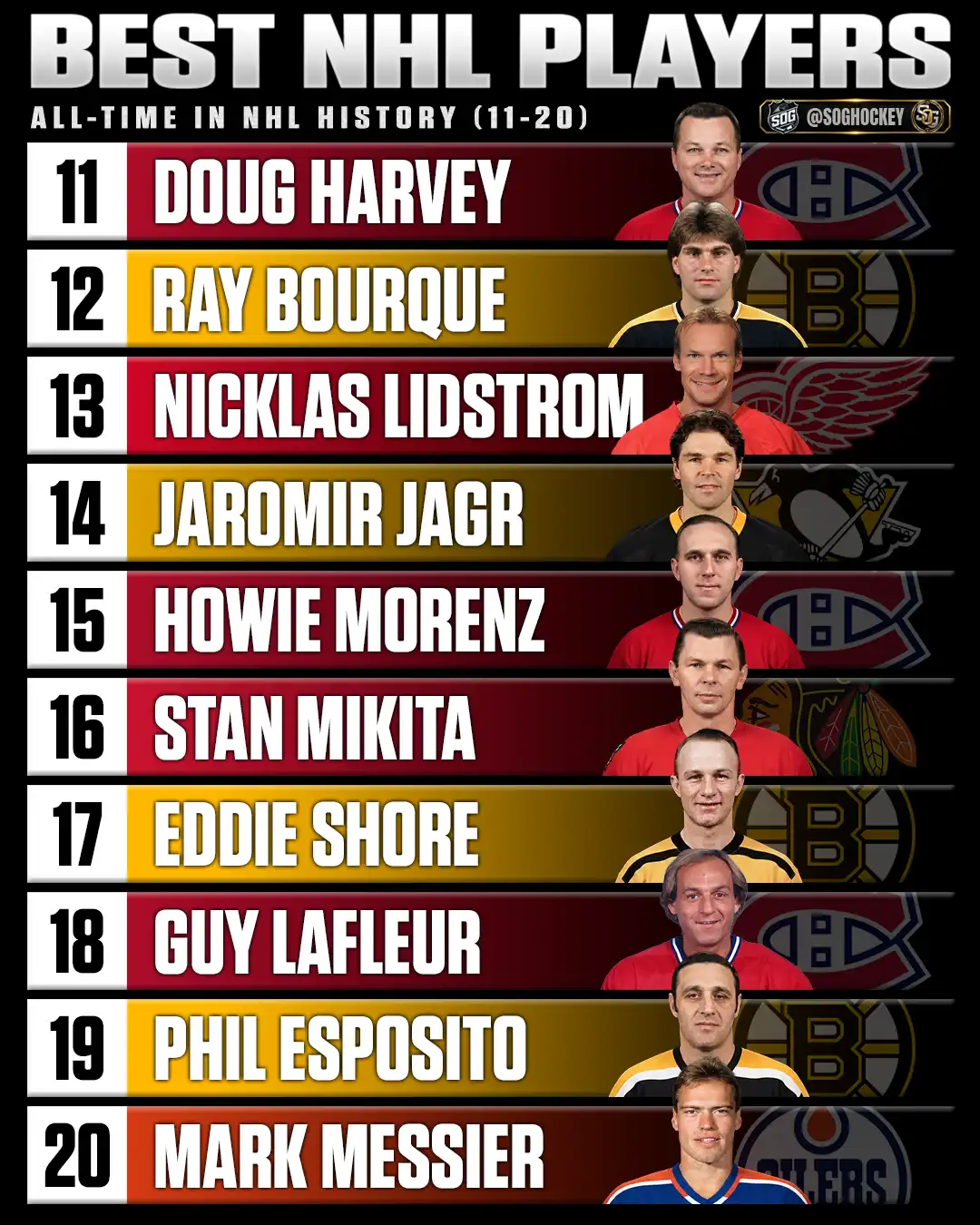
The NHL skaters ranked No. 11 through No. 20, beginning with Doug Harvey, Ray Bourque and Nicklas Lidstrom.
11. Doug Harvey
Harvey’s seven Norris Trophies trail only Orr, and he was the organizing force behind Montreal’s transition game during six championship seasons. Rather than forcing low-percentage plays, he controlled pace, waited for forecheckers to commit and delivered the puck to the right exit.
That influence makes him the first player outside the top 10. Bourque and Lidstrom had longer résumés in a larger league, but Harvey’s dominance over his peers and role in modernizing puck possession from the blue line give him the narrow edge.
12. Ray Bourque
Bourque is the NHL’s career scoring leader among defensemen and won the Norris Trophy five times. He sustained top-pair defensive and offensive value for more than two decades, spending nearly all of that run as the foundation of the Boston Bruins.
His 2001 Stanley Cup with Colorado supplied the championship that had eluded him in Boston, but the ranking is built on the entire career. Few players at any position combine peak, consistency and volume as cleanly as Bourque.
13. Nicklas Lidstrom
Lidstrom won seven Norris Trophies, four Stanley Cups and the 2002 Conn Smythe Trophy during a career spent entirely with Detroit. His game was based on angle control, first-pass accuracy and reading pressure before it arrived rather than recovering from mistakes with reckless movement.
The gap between Lidstrom and Bourque is almost entirely a matter of preference. Bourque gets the slight advantage for greater individual scoring volume; Lidstrom owns the stronger championship résumé and was the cleaner positional defender.
14. Jaromir Jagr
Jagr ranks second in NHL career points behind Gretzky and won five Art Ross Trophies, including four in a row. His lower-body strength and puck protection extended possessions until a passing or shooting lane opened, making him unusually difficult to defend even when the game slowed down.
Two early Stanley Cups, a Hart Trophy and productive seasons deep into his 40s give him both peak and longevity. The three defensemen above him receive credit for controlling more phases of the game, but Jagr has the strongest winger résumé outside the top 10.
15. Howie Morenz
Morenz was the NHL’s first great speed superstar. He won three Hart Trophies and twice led the league in scoring during an era with fewer games, lower totals and a very different offensive environment. Comparing raw points would badly understate how far he stood above many of his contemporaries.
His placement reflects era-adjusted dominance and the attacking pressure he created for Montreal. Morenz does not have the modern statistical volume of the names around him, but he was one of the league’s defining players before the Original Six era fully formed.
16. Stan Mikita
Mikita won four Art Ross Trophies and two Hart Trophies while developing into a far more disciplined and complete center than he had been early in his career. In 1967 and 1968, he won the Hart, Art Ross and Lady Byng in the same season, a rare combination of production, value and restraint.
He also helped Chicago win the 1961 Stanley Cup and remained the club’s offensive reference point for years. Morenz’s historical peak receives a small advantage, while Mikita offers the longer modern résumé.
17. Eddie Shore
Shore won four Hart Trophies, more than any other defenseman, and led Boston’s blue line to two Stanley Cups. His rushing, edge and willingness to absorb heavy minutes made him one of the league’s central figures before the Norris Trophy existed.
Evaluating Shore requires era context because defensemen of the 1920s and 1930s played under different rules and statistical conditions. His MVP record is the clearest measure of how highly he was valued at the time.
18. Guy Lafleur
Lafleur won three straight scoring titles from 1976 through 1978, two Hart Trophies and the 1977 Conn Smythe Trophy. He was the primary offensive accelerator for a Montreal team that won four consecutive Cups, attacking with speed and a powerful shot off the rush.
His absolute peak belongs higher than No. 18. The careers above him either lasted longer at a similar level or produced a greater positional advantage, which keeps Lafleur just outside the top group despite five championships.
19. Phil Esposito
Esposito became the first NHL player to score 100 points in a season and won five Art Ross Trophies in a six-year span. His ability to establish position near the net turned rebounds, tips and short passes into a repeatable scoring system for Boston.
He also won two Hart Trophies and two Stanley Cups. Lafleur ranks one spot higher because of his transition game and central role in a longer dynasty, while Esposito’s case rests on one of the largest offensive peaks the league had seen before Gretzky.
20. Mark Messier
Messier won six Stanley Cups, two Hart Trophies and the 1984 Conn Smythe Trophy. He remains the only player to captain two different franchises to a championship, first with Edmonton and then with the New York Rangers in 1994.
He could score, defend, play through contact and shift between wing and center as team needs changed. His regular-season peak was not as overwhelming as Esposito’s, but his playoff longevity and leadership give him a secure place in the top 20.
Best NHL Players of All Time: Nos. 21-30
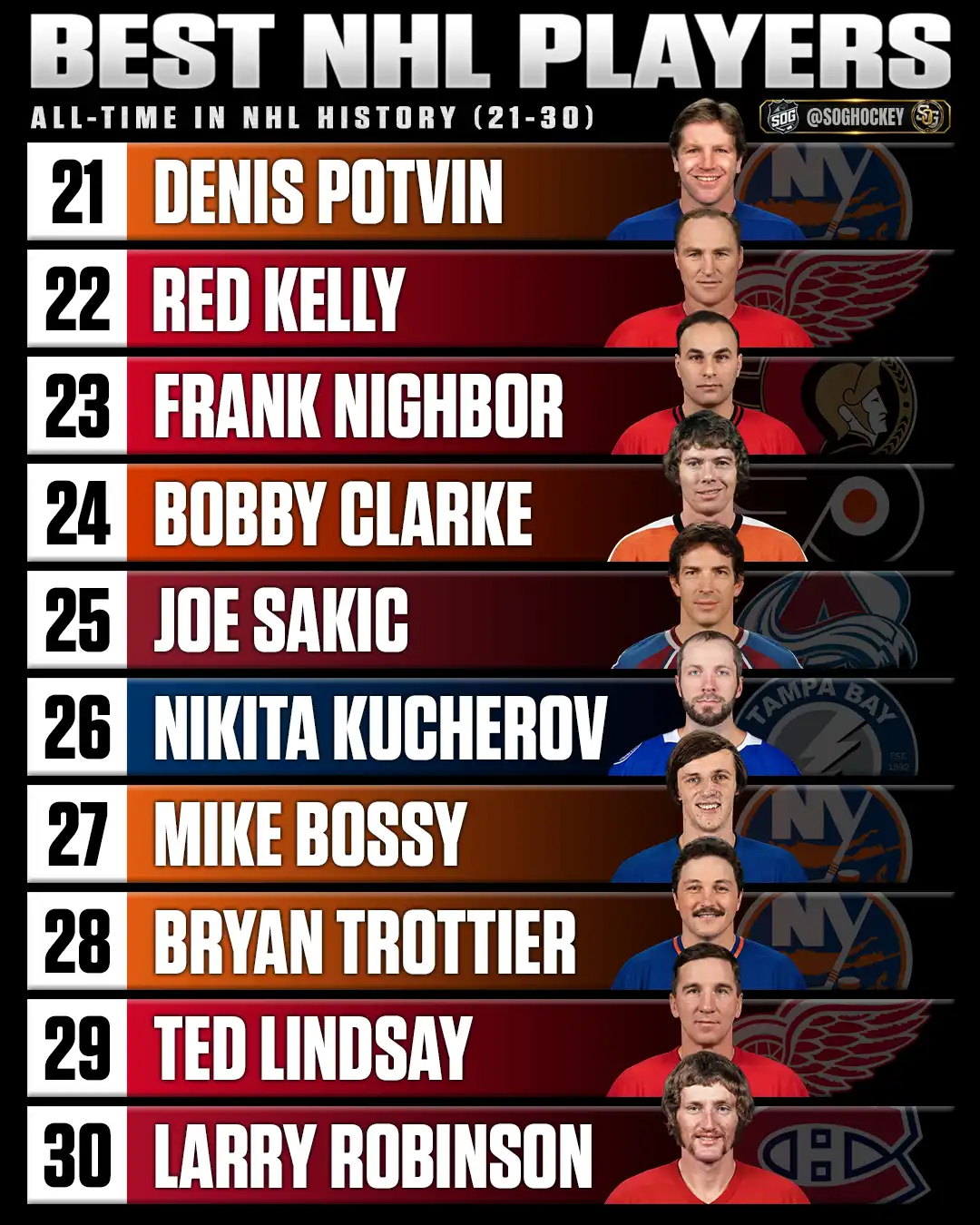
The NHL skaters ranked No. 21 through No. 30, led by Denis Potvin, Red Kelly and Frank Nighbor.
21. Denis Potvin
Potvin won three Norris Trophies and captained the New York Islanders to four consecutive Stanley Cups. His value came from the whole package: he broke pressure with the puck, produced like a top offensive defenseman and brought enough physical force to control the front of the net.
He was also the first defenseman to reach 1,000 NHL points. Messier’s longer career and championship success with two franchises keep him 20th, but Potvin’s peak belongs with the best defensemen ever.
22. Red Kelly
Kelly built a Hall of Fame case at two positions. He won the inaugural Norris Trophy as a Detroit defenseman, then shifted to center in Toronto and remained a championship-level contributor. His eight Stanley Cups split evenly between the Red Wings and Maple Leafs.
That versatility is not a novelty; it is the reason he ranks this high. Kelly could drive possession from the blue line or handle the two-way responsibilities of center without becoming a lesser player.
23. Frank Nighbor
Nighbor was the original model for the defensive center. He won the first Hart Trophy in 1924 and the first two Lady Byng Trophies, recognition of both his value and the intelligence of his play. Contemporary accounts consistently emphasized his anticipation, stick work and ability to disrupt attacks.
Early NHL statistics cannot capture those responsibilities as completely as modern data would. His placement is an era-adjusted judgment that rewards how distinctly he shaped the idea of a complete center.
24. Bobby Clarke
Clarke won three Hart Trophies and captained Philadelphia to consecutive Stanley Cups in 1974 and 1975. His playmaking drove the offense, but his checking, faceoffs and relentless pressure made him valuable in every game state.
The Flyers’ physical identity can overshadow how skilled he was. Clarke earned this spot because he combined top-end production with the matchup work expected from a two-way center, then delivered that value in championship seasons.
25. Joe Sakic
Sakic won two Stanley Cups with the Quebec-Colorado franchise and captured the 1996 Conn Smythe Trophy. His 2000-01 season added the Hart and Ted Lindsay awards, confirming a peak that matched his reputation for calm, high-leverage scoring.
His release was quick enough to beat goaltenders without a long setup, and his decision-making kept Colorado’s best attacks organized. Clarke gets the slight edge for three MVP seasons and greater defensive influence; Sakic answers with superior career scoring volume.
26. Nikita Kucherov
Kucherov added a second Hart Trophy in 2026 after finishing the season with 130 points in 76 games. He already owned three Art Ross Trophies and played the central creative role in Tampa Bay’s consecutive Stanley Cup championships in 2020 and 2021.
His best work is not only the final pass. Kucherov manipulates defenders several touches before the scoring chance, using delays and disguised puck movement to change coverage. He moves ahead of several retired stars because his peak now includes repeated scoring titles, two MVP seasons and major playoff production.
27. Mike Bossy
Bossy scored 573 goals in only 752 regular-season games, the highest goals-per-game rate in NHL history. He is also the only player with nine consecutive 50-goal seasons. Four straight Stanley Cups and the 1982 Conn Smythe Trophy show that his finishing translated to the playoffs.
A back injury limited him to 10 seasons, creating the central tradeoff in his ranking. Bossy’s peak and efficiency were top-20 quality; the shorter career places him behind Kucherov and the longer two-way résumés immediately above.
28. Bryan Trottier
Trottier was the two-way center at the heart of the Islanders’ four straight championships. He won the Hart and Art Ross in 1979, the Conn Smythe in 1980 and later added two more Stanley Cups with Pittsburgh.
His defensive work and physical play created room for Bossy without reducing his own production. Bossy receives the higher spot because his goal-scoring rate was singular; Trottier’s broader game and six championships make the difference between them extremely small.
29. Ted Lindsay
Lindsay won four Stanley Cups and the 1950 scoring title as the left wing on Detroit’s Production Line. His aggressive forechecking and finishing gave the line a different dimension from Howe’s power and Sid Abel’s playmaking.
His historical influence also matters. Lindsay helped organize the players’ association despite significant personal risk, changing the relationship between players and ownership. The on-ice résumé earns top-30 consideration; the effect on the sport breaks a close cutoff decision.
30. Larry Robinson
Robinson closes the ranking with six Stanley Cups, two Norris Trophies and the 1978 Conn Smythe Trophy. He could end a rush with reach and strength, then turn the same possession into a clean Montreal breakout.
His role on a loaded Canadiens dynasty can make the individual case easy to underrate. Robinson supplied top-pair defense, puck movement and postseason reliability over a long career. That complete résumé gives him the final spot over several higher-scoring forwards and defensemen with less team success.
Biggest Decisions in the Ranking
Why is Bobby Orr ahead of Mario Lemieux?
Both careers were shortened by health problems, so peak value becomes the deciding factor. Lemieux reached a scoring level few forwards have approached, but Orr combined scoring titles with record-setting defenseman awards and changed how teams could attack from the blue line. The positional advantage gives Orr second place.
Why is Sidney Crosby ahead of Connor McDavid?
McDavid has already produced the greater regular-season scoring peak. Crosby still owns the fuller career through 2025-26: three Stanley Cups, two Conn Smythe Trophies and 21 point-per-game seasons alongside MVP and scoring-title hardware. This is one of the list’s most likely future changes because McDavid is still adding prime seasons.
Why is Alex Ovechkin only eighth after breaking the goals record?
The career goals record makes Ovechkin the strongest pure scorer in the ranking, but the list measures more than goals. The seven skaters above him add larger playmaking, defensive or center-position value, and most pair that broader influence with comparable MVP recognition or deeper championship résumés.
Who were the toughest omissions?
Steve Yzerman, Marcel Dionne, Paul Coffey, Chris Chelios and Peter Forsberg were the closest skaters outside the top 30. Dionne and Coffey have exceptional career production, while Forsberg’s peak compares favorably with several inclusions. The final spots favored Bossy’s unmatched scoring rate, Trottier and Robinson’s complete championship résumés, and Lindsay’s combination of star play and lasting influence on player rights.
Complete Top 30 NHL Players of All Time
The table preserves the full SOG Sports ranking. Positions reflect each player’s primary NHL role, with Red Kelly listed at both defenseman and center because he built major portions of his career at each position.
| Rank | Player | Position |
|---|---|---|
| 1 | Wayne Gretzky | Center |
| 2 | Bobby Orr | Defenseman |
| 3 | Mario Lemieux | Center |
| 4 | Gordie Howe | Right Wing |
| 5 | Sidney Crosby | Center |
| 6 | Connor McDavid | Center |
| 7 | Jean Béliveau | Center |
| 8 | Alex Ovechkin | Left Wing |
| 9 | Bobby Hull | Left Wing |
| 10 | Maurice Richard | Right Wing |
| 11 | Doug Harvey | Defenseman |
| 12 | Ray Bourque | Defenseman |
| 13 | Nicklas Lidstrom | Defenseman |
| 14 | Jaromir Jagr | Right Wing |
| 15 | Howie Morenz | Center |
| 16 | Stan Mikita | Center |
| 17 | Eddie Shore | Defenseman |
| 18 | Guy Lafleur | Right Wing |
| 19 | Phil Esposito | Center |
| 20 | Mark Messier | Center |
| 21 | Denis Potvin | Defenseman |
| 22 | Red Kelly | Defenseman/Center |
| 23 | Frank Nighbor | Center |
| 24 | Bobby Clarke | Center |
| 25 | Joe Sakic | Center |
| 26 | Nikita Kucherov | Right Wing |
| 27 | Mike Bossy | Right Wing |
| 28 | Bryan Trottier | Center |
| 29 | Ted Lindsay | Left Wing |
| 30 | Larry Robinson | Defenseman |
More NHL Rankings
- Best NHL Centers of All Time
- Best NHL Goalies of All Time
- Best NHL Players of the 2010s
- Fastest Shots in NHL History
Follow @SOGHockey for more NHL graphics, rankings and debates.
