
Sidney Crosby ranks as the best NHL player of the 2010s. Alex Ovechkin is second, Patrick Kane is third, Evgeni Malkin is fourth and Erik Karlsson rounds out the top five. Crosby gets the No. 1 spot because nobody else matched his decade-long blend of production, two-way value and postseason dominance.
This ranking covers the ten NHL seasons ending in the 2010s, from 2009-10 through 2018-19. That scope includes Chicago’s 2010 Stanley Cup and St. Louis’ 2019 championship but excludes the pandemic-shortened 2019-20 season. Only performance within that window affects placement.
The order follows the supplied top-30 ranking. Peak dominance, sustained production, major awards, playoff impact, positional value and two-way play all matter. Stanley Cups strengthen a case, but they do not turn a team accomplishment into an individual statistic.
For more cross-era comparisons, explore the SOG Sports NHL rankings hub.
Last reviewed: August 11, 2026.
Best NHL Players of the 2010s: Key Facts
- No. 1 player: Sidney Crosby.
- Decade scoring leader: Crosby, with 819 regular-season points.
- Decade goal leader: Alex Ovechkin, with 439 regular-season goals.
- Highest-ranked defenseman: Erik Karlsson at No. 5.
- Highest-ranked goalie: Henrik Lundqvist at No. 9.
- Position breakdown: 17 forwards, eight defensemen and five goalies.
- Ranking window: 2009-10 through 2018-19.
Top 10 NHL Players of the 2010s
| Rank | Player | Position | Primary Team |
|---|---|---|---|
| 1 | Sidney Crosby | Center | Pittsburgh Penguins |
| 2 | Alex Ovechkin | Left Wing | Washington Capitals |
| 3 | Patrick Kane | Right Wing | Chicago Blackhawks |
| 4 | Evgeni Malkin | Center | Pittsburgh Penguins |
| 5 | Erik Karlsson | Defense | Ottawa Senators |
| 6 | Patrice Bergeron | Center | Boston Bruins |
| 7 | Connor McDavid | Center | Edmonton Oilers |
| 8 | Steven Stamkos | Center | Tampa Bay Lightning |
| 9 | Henrik Lundqvist | Goalie | New York Rangers |
| 10 | Anze Kopitar | Center | Los Angeles Kings |
How We Ranked the Best NHL Players of the 2010s
Cross-position rankings cannot be reduced to one statistic. Centers control the middle of the ice and often carry defensive assignments. Wingers can tilt a season through scoring. No. 1 defensemen drive breakouts while handling the hardest minutes, and goalies can decide a playoff series without recording a point.
The evaluation leans most heavily on the following areas:
- Peak dominance: How far a player separated from the league at their best.
- Sustained performance: Production, availability and consistency across the ranking window.
- Individual recognition: Hart, Art Ross, Rocket Richard, Norris, Selke, Vezina, Ted Lindsay and Conn Smythe results.
- Playoff impact: Performance in high-leverage games, not Stanley Cup count by itself.
- Complete value: Defense, transition, special teams, matchup burden and positional responsibility.
- Decade ownership: How strongly the player became identified with NHL hockey during these ten seasons.
Players are judged only on work completed from 2009-10 through 2018-19. Connor McDavid’s future brilliance cannot fill seasons before his debut, while achievements from Pavel Datsyuk’s and Zdeno Chara’s earlier primes cannot be borrowed to inflate their 2010s cases.
Best NHL Players of the 2010s: 1-10
1. Sidney Crosby
Sidney Crosby owns the strongest all-around case. He led all players in the ranking window with 819 regular-season points despite playing only 653 games, a reminder of both his scoring rate and the time he lost to injuries. He also won the 2013-14 Hart Trophy and two Stanley Cups.
The separator is the postseason. Crosby won consecutive Conn Smythe Trophies in 2016 and 2017 while impacting games as a scorer, playmaker, faceoff option and responsible center. Ovechkin had more goals and Kane played more games, but Crosby’s complete résumé gives him No. 1.
2. Alex Ovechkin
Alex Ovechkin scored 439 regular-season goals during the ten-season window, 69 more than any other player. He won six Rocket Richard Trophies from 2012-13 through 2018-19 and added the 2012-13 Hart Trophy.
The 2018 Stanley Cup run completed the decade. Ovechkin led the playoffs with 15 goals, won the Conn Smythe Trophy and erased the only major gap in his 2010s résumé. Crosby’s broader two-way and playoff profile keeps Ovechkin second, but the goal-scoring edge is enormous.
3. Patrick Kane
Patrick Kane paired championship production with the decade’s second-highest point total. His 796 regular-season points trailed only Crosby, and his 2015-16 season produced 106 points, the Art Ross Trophy, Hart Trophy and Ted Lindsay Award.
Kane also won Stanley Cups in 2010, 2013 and 2015, taking the Conn Smythe in 2013. His edge work, patience and ability to hold the puck until a passing lane opened made him the defining offensive winger of Chicago’s dynasty.
4. Evgeni Malkin
Evgeni Malkin’s best season was one of the decade’s most overwhelming. He scored 50 goals and 109 points in 2011-12 to win the Art Ross, Hart and Ted Lindsay awards.
Malkin could run through a defense with size, speed and hands that rarely appear in the same player. Injuries limited his accumulated totals, but he remained a major piece of Pittsburgh’s 2016 and 2017 championships. His peak keeps him above every player outside the top three.
5. Erik Karlsson
Erik Karlsson was the decade’s most dynamic offensive defenseman. He won the Norris Trophy in 2012 and 2015, then scored 82 points in 2015-16, an extraordinary total for a defenseman in that scoring environment.
At his best, Karlsson was Ottawa’s breakout, transition game and half-court offense rolled into one player. His 2017 postseason, produced while playing through ankle damage, nearly carried the Senators to the Stanley Cup Final. Keith and Doughty had stronger championship résumés; Karlsson had the higher individual peak.
6. Patrice Bergeron
Patrice Bergeron won four Selke Trophies during the ranking window and finished as a finalist every year from 2011-12 through 2018-19. That sustained recognition matches what his shifts showed: elite defensive positioning, faceoff value, penalty killing and possession play without sacrificing offense.
Bergeron also helped Boston win the 2011 Stanley Cup and reach two more Finals. His case is not built on a vague reputation for doing little things. It is built on controlling difficult minutes better than any forward of the decade.
7. Connor McDavid
Connor McDavid entered the NHL in 2015, so this is the ranking’s clearest peak-versus-longevity decision. By the end of 2018-19, he had already won two Art Ross Trophies, the 2016-17 Hart Trophy and two Ted Lindsay Awards.
His speed changed defensive spacing immediately. McDavid could attack through the middle without slowing down, force defenders to retreat and still find a late passing lane. Four seasons are not enough to challenge the full-decade leaders, but the level was too high to place him outside the top 10. Compare his larger career case with the best centers in NHL history.
8. Steven Stamkos
Steven Stamkos scored 370 goals in the ranking window, second only to Ovechkin. His 60-goal season in 2011-12 remains one of the rare modern campaigns to reach that mark, and his release made him a threat from nearly any clean shooting lane.
Major injuries cost him games during his prime and Tampa Bay’s championships arrived after this ranking window. The scoring volume and elite peak still make Stamkos a clear top-10 choice.
9. Henrik Lundqvist
Henrik Lundqvist is the highest-ranked goalie because he combined peak performance with the most convincing full-decade consistency. He won the 2012 Vezina Trophy, remained a regular presence in the award voting and carried the Rangers to the 2014 Stanley Cup Final.
Price reached a higher single-season peak and Quick produced the decade’s best goalie playoff run. Lundqvist supplied elite goaltending more reliably from one season to the next, often behind teams that could not give him much scoring support.
10. Anze Kopitar
Anze Kopitar closes the top 10 with the decade’s best combination of center size, playmaking and matchup value outside Crosby and Bergeron. He led the 2012 and 2014 champions in playoff scoring and later won Selke Trophies in 2016 and 2018.
Kopitar was the player Los Angeles trusted against top lines, on both special teams and in late-game situations. He was rarely the loudest superstar in the league, but his fingerprints were all over two championship runs.
Best NHL Players of the 2010s: 11-20
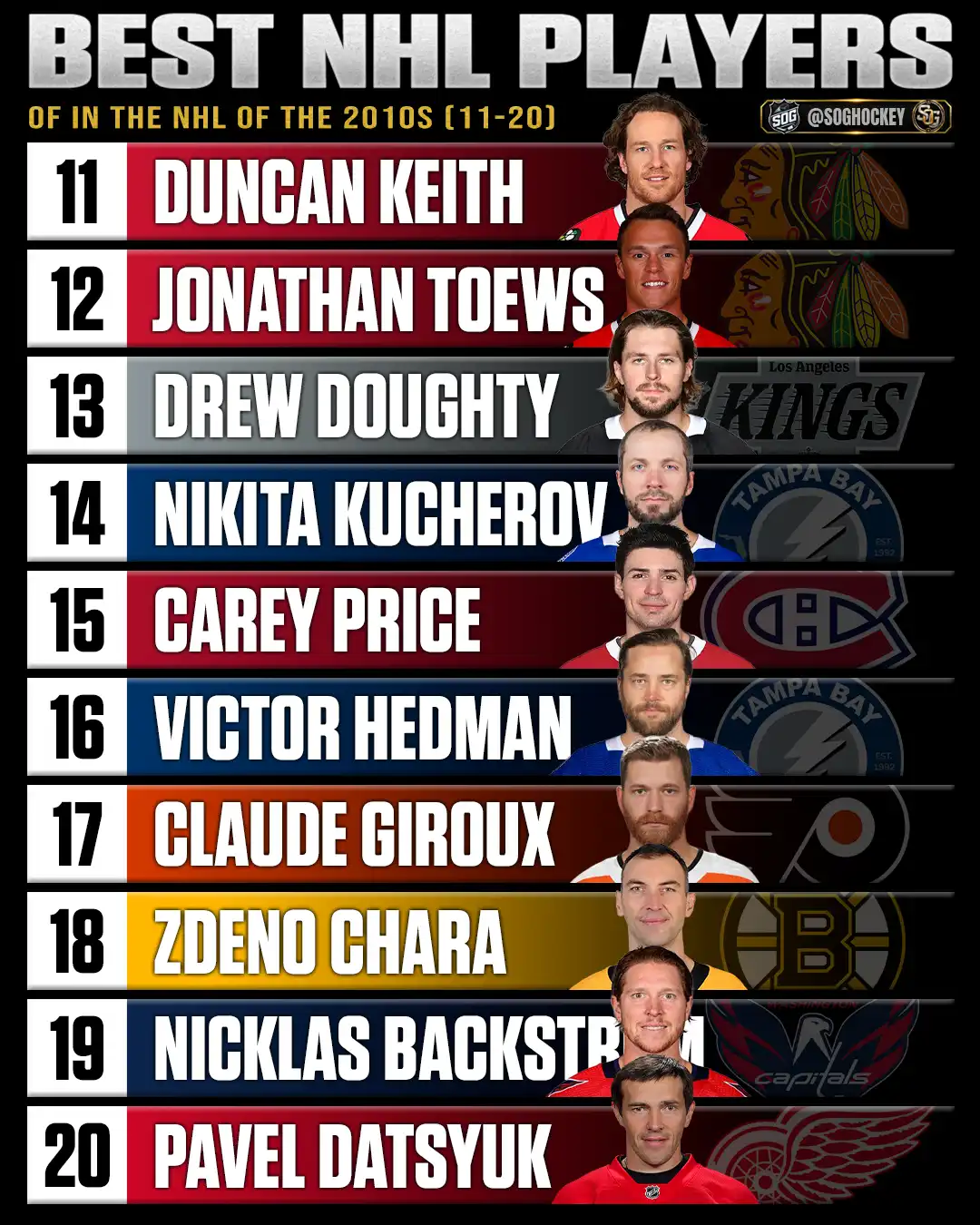
Best NHL players in the 2010s ranked from 11-20, featuring Duncan Keith, Jonathan Toews, Drew Doughty, Nikita Kucherov, Carey Price, Victor Hedman, Claude Giroux, Zdeno Chara, Nicklas Backstrom and Pavel Datsyuk.
11. Duncan Keith
Duncan Keith was the minute-eating engine of Chicago’s three championship teams. He won the Norris Trophy in 2010 and 2014, then averaged more than 31 minutes per game during the 2015 playoffs and earned the Conn Smythe Trophy.
Karlsson created more offense, but no defenseman on this list owns a better blend of decade longevity, hardware and championship workload. Keith missing the top 10 says more about the strength of the field than the quality of his case.
12. Jonathan Toews
Jonathan Toews anchored Chicago down the middle throughout its dynasty. He won the Conn Smythe Trophy in 2010, the Selke in 2013 and three Stanley Cups while taking the hardest matchups and major faceoff assignments.
His offensive totals do not match the scoring stars around him, so leadership alone cannot carry the placement. The ranking rewards how Toews’ two-way game held up in high-leverage minutes across three different championship runs.
13. Drew Doughty
Drew Doughty played massive minutes against elite forwards while driving the Kings out of their own end. He was central to the 2012 and 2014 Stanley Cup runs and won the Norris Trophy in 2016.
Doughty’s regular-season production undersells his value because Los Angeles leaned on him to solve every type of shift. He could defend a rush, move the puck under pressure and stay on the ice when a playoff game tightened.
14. Nikita Kucherov
Nikita Kucherov needed only the back half of the decade to build a top-15 case. His 128 points in 2018-19 set the single-season record for a Russian-born NHL player at the time and earned him the Art Ross, Hart and Ted Lindsay awards.
The limitation is postseason timing: Tampa Bay’s two Stanley Cups came after this ranking window, and its record-setting 2018-19 regular season ended in a first-round sweep. Kucherov’s offensive ceiling still demands this placement.
15. Carey Price
Carey Price produced the best single goalie season of the decade. In 2014-15, he won the Hart, Vezina, Jennings and Ted Lindsay awards while posting a .933 save percentage and carrying a limited Montreal offense.
Lundqvist ranks higher because his elite play was steadier across the full window. Price’s peak was higher, but injuries and year-to-year variation make the total decade less complete.
16. Victor Hedman
Victor Hedman grew into the prototype for a modern No. 1 defenseman. At 6-foot-6, he could erase space defensively, skate the puck through pressure and create offense without giving up matchup value.
Hedman won the 2018 Norris Trophy and finished third in the voting in both 2017 and 2019. His best championship work came after this window, so this placement isolates the rise that made those later runs possible.
17. Claude Giroux
Claude Giroux ranks fourth in regular-season scoring across the ten-season window with 735 points. He drove Philadelphia’s power play, created through traffic and remained productive through changing linemates and team quality.
His 102-point season in 2017-18 was the peak, but the absence of a major individual award or deep championship run limits the placement. Few players below him carried a larger share of their team’s offense for longer.
18. Zdeno Chara
Zdeno Chara entered the decade at 32 and still remained one of its most difficult shutdown assignments. His reach, strength and defensive reads allowed Boston to play an aggressive structure around him.
Chara captained the Bruins to the 2011 Stanley Cup and two additional Finals during the window. His Norris season came just before this cutoff, which keeps him below the defensemen whose individual peaks landed inside it.
19. Nicklas Backstrom
Nicklas Backstrom recorded 716 points, the sixth-highest total of the decade window. He controlled Washington’s power play with patience and disguised passing, and his chemistry with Ovechkin was a partnership rather than a one-way benefit.
Backstrom added 23 points during the 2018 championship run. He never won a major individual award, but his sustained playmaking and central role on an eventual champion create a strong top-20 case.
20. Pavel Datsyuk
Pavel Datsyuk’s 2010s sample lasted only through 2015-16, but the early portion still contained elite hockey. He won the 2010 Selke Trophy and remained one of the league’s best players at stealing pucks, protecting possession and turning a defensive read into instant offense.
This ranking does not borrow from his pre-2010 prime. Datsyuk stays in the top 20 because his actual level during the window remained exceptional, even if the shorter sample prevents a higher placement.
Best NHL Players of the 2010s: 21-30
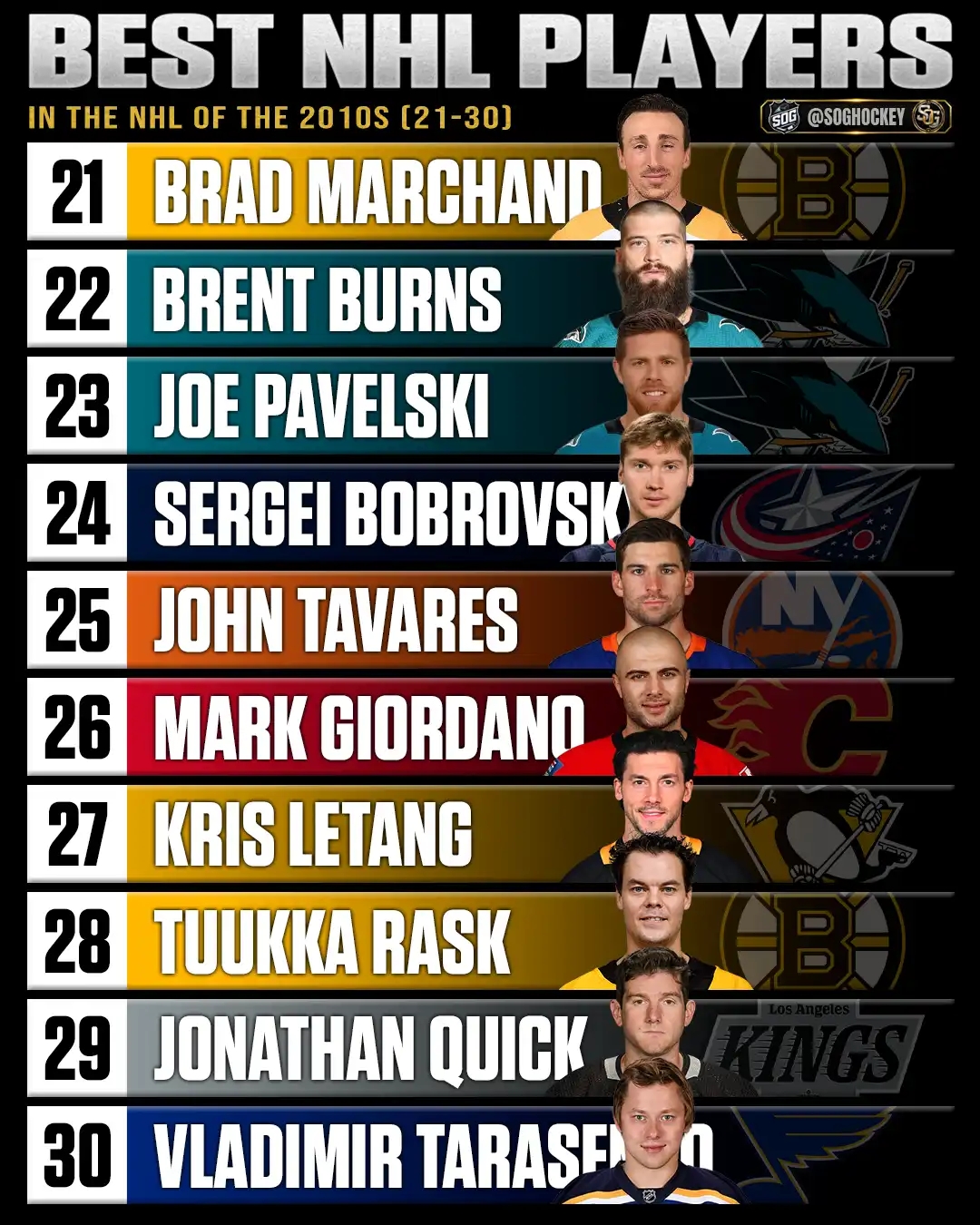
Best NHL players in the 2010s ranked from 21-30, featuring Brad Marchand, Brent Burns, Joe Pavelski, Sergei Bobrovsky, John Tavares, Mark Giordano, Kris Letang, Tuukka Rask, Jonathan Quick and Vladimir Tarasenko.
21. Brad Marchand
Brad Marchand began the window as an agitating middle-six winger and ended it as a 100-point superstar. He helped Boston win the 2011 Stanley Cup, became an elite penalty killer and developed into one of the league’s most efficient five-on-five scorers.
The late arrival of his offensive peak keeps him outside the top 20. By 2018-19, however, Marchand was already one of the most complete wingers in hockey.
22. Brent Burns
Brent Burns was a volume shooter and transition weapon from the blue line. He won the 2017 Norris Trophy after scoring 29 goals and 76 points, then reached 83 points in 2018-19.
His risk-heavy style created defensive tradeoffs, but San Jose accepted them because few defensemen could pressure an opponent’s structure the way Burns did. He was central to the Sharks’ 2016 run to the Final.
23. Joe Pavelski
Joe Pavelski built his value through anticipation rather than overwhelming speed. He scored 297 goals during the ranking window, excelled on deflections and became one of the league’s most reliable net-front scorers.
Pavelski captained San Jose to the 2016 Stanley Cup Final and consistently produced in the playoffs. The lack of major awards caps the ranking, but his decade had almost no wasted seasons.
24. Sergei Bobrovsky
Sergei Bobrovsky won the Vezina Trophy in 2013 and 2017, the only goalie in the ranking window to win it twice. His explosiveness allowed him to recover when Columbus’ structure broke down.
The case is less stable in the playoffs, where his results swung dramatically before the 2019 upset of Tampa Bay. Two Vezinas are impossible to ignore, but Lundqvist, Price and Rask produced cleaner overall decade profiles.
25. John Tavares
John Tavares was a dependable first-line center for the Islanders before moving to Toronto. He finished third in Hart voting in 2012-13, then scored a career-high 47 goals in 2018-19.
Tavares combined strong hands around the net with difficult center responsibilities, but his teams won only one playoff series during this ranking window. That gap separates him from the centers above.
26. Mark Giordano
Mark Giordano’s late peak was remarkable. At 35, he scored 74 points, posted a plus-39 rating and won the 2019 Norris Trophy while driving Calgary to the top seed in the Western Conference.
One dominant season does not create the whole case. Giordano had already been playing top-pair minutes for years, and the Norris run gave that steady value an elite peak.
27. Kris Letang
Kris Letang powered Pittsburgh’s transition game and played a major role in the 2016 Stanley Cup run, including the winning goal in the deciding game of the Final. His skating gave the Penguins a clean way out of pressure and let their forwards attack with speed.
The injury context matters. Letang contributed during the 2016-17 regular season but missed the entire 2017 playoffs after neck surgery. His talent belongs higher; the lost games and interrupted résumé keep him at No. 27.
28. Tuukka Rask
Tuukka Rask paired a 2014 Vezina Trophy with one of the decade’s strongest long-term save-percentage profiles. He backstopped Boston to the 2013 and 2019 Stanley Cup Finals and rarely forced the Bruins to survive volatile goaltending.
Rask’s style was quiet, which sometimes hid how often he controlled rebounds and prevented second chances. He lacks Price’s singular peak and Quick’s Conn Smythe run, but his consistency belongs in the top 30.
29. Jonathan Quick
Jonathan Quick produced the decade’s most dominant goalie playoff run in 2012. He posted a .946 save percentage across 20 games, went 16-4 and won the Conn Smythe Trophy as Los Angeles captured its first Stanley Cup.
Quick helped win another championship in 2014, but his regular-season performance was less consistent than the goalies ranked above him. This placement rewards the playoff ceiling without ignoring the full ten-season sample.
30. Vladimir Tarasenko
Vladimir Tarasenko closes the ranking with a blend of regular-season scoring and championship value. He produced five straight 30-goal seasons, reached 40 in 2015-16 and scored 11 times during the 2019 playoffs.
Tarasenko’s shot and strength made him the focal point of St. Louis’ offense before the roster finally broke through. The Cup run gives him the edge over several excellent players left outside the top 30.
Toughest Omissions From the Top 30
Ryan Getzlaf was the hardest forward to leave out. He combined high-end playmaking with the size and defensive responsibility to handle playoff hockey, but Anaheim did not reach the Final during the window and his peak production fell just short of the forwards near the cutoff.
Shea Weber had the strongest defenseman case outside the list. His shot, physicality and matchup value made him a true No. 1, but Karlsson, Keith, Doughty, Hedman, Chara, Burns, Giordano and Letang created an unusually crowded blue-line field.
Corey Perry, Joe Thornton, Marian Hossa, P.K. Subban, Marc-Andre Fleury and Ryan Suter also received serious consideration. Each has a credible argument, which is why the bottom of a cross-position top 30 is much harder than the top.
Biggest Debates in the 2010s Ranking
Why Crosby Ranks Ahead of Ovechkin
Ovechkin scored 125 more goals than Crosby during the window and won six Rocket Richard Trophies. Crosby counters with the higher points-per-game rate, stronger defensive value and consecutive Conn Smythe runs. The gap is narrow, but this formula gives slightly more weight to total game control and playoff performance than pure goal volume.
Why McDavid Is Already Seventh
McDavid played only four seasons, so seventh is the ceiling for such a short sample. The aggressive part is placing him this high at all. Two scoring titles, a Hart Trophy and a level of speed-driven creation that immediately changed the league make his partial decade stronger than many full ones.
Why Karlsson Leads the Defensemen
Keith and Doughty own the better championship cases. Karlsson gets the edge because his peak was more individually transformative: two Norris Trophies, elite scoring and an offense that flowed through him like it normally would through a superstar center.
Why Lundqvist Leads the Goalies
Price owns the best single season and Quick owns the best playoff run. Lundqvist wins the category through repeated excellence. His Vezina record, postseason workload and consistency across almost the entire window create the least fragile goalie case.
Complete Top 30 NHL Players of the 2010s
| Rank | Player | Primary Team | Defining 2010s Accomplishment |
|---|---|---|---|
| 1 | Sidney Crosby | Pittsburgh Penguins | Two Conn Smythe Trophies and Stanley Cups in 2016 and 2017. |
| 2 | Alex Ovechkin | Washington Capitals | 439 goals, six decade Rocket Richard Trophies and the 2018 Conn Smythe. |
| 3 | Patrick Kane | Chicago Blackhawks | Three Stanley Cups and the 2015-16 Hart and Art Ross trophies. |
| 4 | Evgeni Malkin | Pittsburgh Penguins | Won the 2011-12 Hart with 50 goals and 109 points. |
| 5 | Erik Karlsson | Ottawa Senators | Two Norris Trophies and an 82-point season. |
| 6 | Patrice Bergeron | Boston Bruins | Four Selke Trophies and the 2011 Stanley Cup. |
| 7 | Connor McDavid | Edmonton Oilers | Two Art Ross Trophies and the 2016-17 Hart Trophy. |
| 8 | Steven Stamkos | Tampa Bay Lightning | Scored 60 goals in 2011-12 and 370 across the decade window. |
| 9 | Henrik Lundqvist | New York Rangers | Won the 2012 Vezina and reached the 2014 Stanley Cup Final. |
| 10 | Anze Kopitar | Los Angeles Kings | Two Stanley Cups and Selke Trophies in 2016 and 2018. |
| 11 | Duncan Keith | Chicago Blackhawks | Three Stanley Cups, two Norris Trophies and the 2015 Conn Smythe. |
| 12 | Jonathan Toews | Chicago Blackhawks | Three Stanley Cups, the 2010 Conn Smythe and the 2013 Selke. |
| 13 | Drew Doughty | Los Angeles Kings | Two Stanley Cups and the 2016 Norris Trophy. |
| 14 | Nikita Kucherov | Tampa Bay Lightning | Won the 2018-19 Hart and Art Ross with 128 points. |
| 15 | Carey Price | Montreal Canadiens | Swept the Hart, Vezina, Jennings and Ted Lindsay awards in 2014-15. |
| 16 | Victor Hedman | Tampa Bay Lightning | Won the 2018 Norris Trophy. |
| 17 | Claude Giroux | Philadelphia Flyers | Ranked fourth in decade points and scored 102 in 2017-18. |
| 18 | Zdeno Chara | Boston Bruins | Captained the Bruins to the 2011 Stanley Cup and two more Finals. |
| 19 | Nicklas Backstrom | Washington Capitals | Recorded 716 points and won the 2018 Stanley Cup. |
| 20 | Pavel Datsyuk | Detroit Red Wings | Won the 2010 Selke and sustained elite two-way play into his mid-30s. |
| 21 | Brad Marchand | Boston Bruins | Won the 2011 Stanley Cup and reached 100 points in 2018-19. |
| 22 | Brent Burns | San Jose Sharks | Won the 2017 Norris Trophy after scoring 29 goals. |
| 23 | Joe Pavelski | San Jose Sharks | Scored 297 goals and captained the Sharks to the 2016 Final. |
| 24 | Sergei Bobrovsky | Columbus Blue Jackets | Won Vezina Trophies in 2013 and 2017. |
| 25 | John Tavares | New York Islanders | Finished third in 2013 Hart voting and scored 47 goals in 2018-19. |
| 26 | Mark Giordano | Calgary Flames | Won the 2019 Norris Trophy with 74 points and a plus-39 rating. |
| 27 | Kris Letang | Pittsburgh Penguins | Drove the 2016 championship transition game and scored the Cup-winning goal. |
| 28 | Tuukka Rask | Boston Bruins | Won the 2014 Vezina and reached the 2013 and 2019 Finals. |
| 29 | Jonathan Quick | Los Angeles Kings | Won the 2012 Conn Smythe and two Stanley Cups. |
| 30 | Vladimir Tarasenko | St. Louis Blues | Produced five straight 30-goal seasons and won the 2019 Stanley Cup. |
Frequently Asked Questions
Who was the best NHL player of the 2010s?
Sidney Crosby ranks first because he combined the decade’s highest regular-season point total with elite two-way value, two Stanley Cups and consecutive Conn Smythe Trophies.
Who are the top five NHL players of the 2010s?
The top five are Sidney Crosby, Alex Ovechkin, Patrick Kane, Evgeni Malkin and Erik Karlsson.
Why is Crosby ranked ahead of Ovechkin?
Ovechkin was comfortably the decade’s best goal scorer. Crosby gets the narrow overall edge through his scoring rate, center responsibilities, defensive value and back-to-back Conn Smythe playoff runs.
Why is Connor McDavid only seventh?
McDavid played four seasons within the ranking window. His peak already belonged among the decade’s best, but Crosby, Ovechkin, Kane and the other players above him completed much longer 2010s résumés.
Who was the best defenseman of the 2010s?
Erik Karlsson ranks first among defensemen at No. 5 overall. Duncan Keith, Drew Doughty and Victor Hedman follow him on this list.
Who was the best goalie of the 2010s?
Henrik Lundqvist ranks first among goalies at No. 9 overall. Carey Price had the highest single-season peak, while Jonathan Quick produced the strongest playoff run.
What seasons count as the NHL’s 2010s?
This ranking uses the ten seasons ending in the 2010s, from 2009-10 through 2018-19. It includes the 2010 Stanley Cup and excludes the 2019-20 season.
Is this ranking based only on points?
No. Production matters, but the ranking also weighs peak performance, defense, goaltending, major awards, playoff impact, positional value and sustained excellence.
Final Takeaway
Sidney Crosby earns the top spot because he supplied the decade’s strongest total package. Alex Ovechkin owned the goal-scoring race, Patrick Kane powered a dynasty and Connor McDavid reached a historic level in only four seasons, but Crosby combined elite regular-season production with the best playoff résumé.
The rest of the top 30 shows why the decade resists one simple formula. Karlsson drove offense from defense, Bergeron controlled the hardest two-way minutes, Price reached an MVP goalie peak and Quick authored a nearly unbeatable postseason. Different positions created value in different ways, and the ranking is strongest when those differences are evaluated rather than flattened.
More NHL Rankings
Continue with the SOG Sports NHL rankings hub and our ranking of the best NHL centers ever.
You can also compare the decade’s stars with the best NHL goalie from every season and the best NHL center from every season. For more hockey graphics and debates, follow SOG Hockey on Instagram.
