
Matthew Schaefer is the 2026 Calder Trophy winner after a record-setting rookie season with the New York Islanders. The 18-year-old defenseman scored 23 goals, recorded 59 points in 82 games and received every first-place vote.
This complete list covers every official Calder Trophy winner in NHL history, beginning with Carl Voss in 1933 and ending with the youngest winner the award has ever had. It includes 93 winners across 94 year slots. The only gap is 2005, when the canceled 2004-05 NHL season produced no award.
The full history stretches from early stars such as Syl Apps, Frank Brimsek and Terry Sawchuk through Bobby Orr, Teemu Selanne, Martin Brodeur, Alex Ovechkin, Cale Makar and Connor Bedard. For performance-based companion lists focused on the expansion era, compare these official winners with the best NHL centers from every year and the best NHL goalies from every year.
Last reviewed: August 6, 2026.
- Key Facts
- Method and Year Labels
- Calder Trophy Winners, 2026-1997
- Calder Trophy Winners, 1996-1967
- Calder Trophy Winners, 1966-1933
- Notable Races and Eligibility Oddities
- Complete Year-by-Year Table
- Frequently Asked Questions
- Sources and Data Notes
- Conclusion
- More NHL Year-by-Year Lists
- Related NHL Records and Rankings
Calder Trophy Winners: Key Facts
- Latest winner: Matthew Schaefer, New York Islanders, in 2026.
- Youngest winner: Schaefer, who was 18 years and 223 days old on the final day of the 2025-26 regular season.
- Greatest scoring season: Teemu Selanne set rookie records with 76 goals and 132 points in 1992-93.
- First official winner: Carl Voss of the Detroit Red Wings in 1933.
- Only year without a winner: 2005, when the entire 2004-05 NHL season was canceled.
- Most winners by one franchise: The Toronto Maple Leafs and Chicago Blackhawks are tied with 10 each.
How This Calder Trophy Winners List Works
This is an objective award-history list, not a SOG Sports ranking. Each entry is the official rookie of the year recognized for the season ending in the displayed year. For example, Matthew Schaefer is listed under 2026 because he won for the 2025-26 season, while Carl Voss is listed under 1933 for 1932-33.
The NHL recognizes Voss as the first winner in 1933. Beginning in 1936-37, league president Frank Calder purchased a trophy each year for the outstanding rookie to keep permanently. After Calder died in 1943, the NHL introduced the Calder Memorial Trophy that remains in use today and kept the earlier rookie winners in the award’s official history.
The winner is selected by the Professional Hockey Writers Association. Under the current rules, a player cannot have appeared in more than 25 games in any previous season or in six or more games in each of two previous seasons in a major professional league. A player who has turned 26 by September 15 of that season is also ineligible.
Statistics in the individual sections are regular-season rookie totals. Career accomplishments provide context, but they do not change who officially won the award.
Calder Trophy Winners Each Year, 2026-1997
2026: Matthew Schaefer, New York Islanders
Schaefer produced 23 goals and 59 points in 82 games while averaging 24:41 of ice time, the highest mark among NHL rookies. He tied the single-season goal record for a rookie defenseman and set the points record for an 18-year-old defenseman. Schaefer appeared first on all 198 ballots, making him the first unanimous Calder winner since Selanne in 1993.
2025: Lane Hutson, Montreal Canadiens
Hutson led all rookies with 60 assists and 66 points while playing all 82 games. His edge work, deception and ability to create passing lanes turned Montreal’s power play into his laboratory. A defenseman did not merely survive the rookie race; he drove it.
2024: Connor Bedard, Chicago Blackhawks
Bedard recorded 22 goals and 61 points in only 68 games despite playing on a rebuilding Chicago roster. A fractured jaw cost him six weeks, but no other rookie matched his combination of shot creation, playmaking and nightly defensive attention.
2023: Matty Beniers, Seattle Kraken
Beniers scored 24 goals and 57 points while handling a responsible two-way role for a 100-point playoff team. Seattle needed more than empty-calorie offense from its first major young star, and Beniers gave the Kraken dependable work in all three zones.
2022: Moritz Seider, Detroit Red Wings
Seider stepped directly into top-pair responsibility and finished with 50 points. His physicality, puck movement and willingness to handle difficult matchups separated him from a strong field that included Trevor Zegras and Michael Bunting.
2021: Kirill Kaprizov, Minnesota Wild
Kaprizov scored 27 goals and 51 points in 55 games during the shortened 2020-21 season. Minnesota had spent years searching for a game-breaking forward; Kaprizov arrived with the hands, pace and confidence to become one immediately.
2020: Cale Makar, Colorado Avalanche
Makar posted 50 points in 57 games and led all NHL rookies with 0.88 points per game. His first full season already featured the skating, controlled entries and offensive command that would soon make him one of the best players in hockey.
2019: Elias Pettersson, Vancouver Canucks
Pettersson scored 28 goals and 66 points in 71 games. His one-timer drew attention, but his spatial awareness and ability to manipulate defenders made the larger impression. Vancouver had its new franchise forward.
2018: Mathew Barzal, New York Islanders
Barzal erupted for 85 points, including three five-point games. His speed through the neutral zone and ability to create off the rush gave the Islanders an elite young playmaker and produced one of the highest-scoring rookie seasons of the salary-cap era.
2017: Auston Matthews, Toronto Maple Leafs
Matthews opened his career with four goals in his NHL debut and finished with 40 goals and 69 points. Patrik Laine kept the race interesting, but Matthews’ even-strength scoring and immediate impact at center made him the clear choice.
2016: Artemi Panarin, Chicago Blackhawks
Panarin entered the NHL as a 24-year-old with years of professional experience in Russia, then produced 30 goals and 77 points. His age became part of the debate, but his vision, hands and instant chemistry with Patrick Kane made the on-ice case overwhelming.
2015: Aaron Ekblad, Florida Panthers
Ekblad recorded 39 points while playing more than 21 minutes per game as an 18-year-old defenseman. Florida trusted him with substantial responsibility immediately, and he responded with size, composure and a dangerous point shot.
2014: Nathan MacKinnon, Colorado Avalanche
MacKinnon scored 24 goals and 63 points while helping Colorado jump from the NHL’s second-worst record to a division title. His speed changed games even before the rest of his offensive toolkit reached its eventual peak.
2013: Jonathan Huberdeau, Florida Panthers
Huberdeau recorded 31 points in the 48-game lockout-shortened season. He tied Nail Yakupov for the rookie scoring lead, and his playmaking and puck skill helped him win a close vote over Brendan Gallagher and Brandon Saad.
2012: Gabriel Landeskog, Colorado Avalanche
Landeskog finished with 22 goals and 52 points while delivering far more physical and defensive value than a typical teenage winger. He tied Ryan Nugent-Hopkins in points, but his complete 82-game season helped him win the tiebreaker in voters’ minds.
2011: Jeff Skinner, Carolina Hurricanes
Skinner scored 31 goals and 63 points as an 18-year-old. His figure-skating background showed up in his balance and edge work, allowing him to slip through traffic and create clean looks before defenders could square him up.
2010: Tyler Myers, Buffalo Sabres
The 6-foot-8 Myers recorded 48 points and averaged more than 23 minutes per game. He won because the unusual combination of reach, mobility and offensive production already looked like the profile of a top-pair NHL defenseman.
2009: Steve Mason, Columbus Blue Jackets
Mason won 33 games, led the NHL with 10 shutouts and helped Columbus reach the playoffs for the first time in franchise history. Rookie goalies rarely control an award race, but his workload and immediate team impact left little doubt.
2008: Patrick Kane, Chicago Blackhawks
Kane led all rookies with 72 points and gave Chicago the creative offensive star its rebuild needed. His hands and playmaking were already elite, and his arrival alongside Jonathan Toews helped reset the direction of the franchise.
2007: Evgeni Malkin, Pittsburgh Penguins
Malkin scored 33 goals and 85 points, leading all rookies in goals, assists and points. His size, reach and skill through the middle gave Pittsburgh a second franchise center next to Sidney Crosby.
2006: Alex Ovechkin, Washington Capitals
Ovechkin’s 52 goals and 106 points would have made him an easy winner in almost any season. The fact that Sidney Crosby scored 102 points made the race historic rather than routine. Ovechkin combined elite production with a physical, shot-heavy style the league had never seen from a rookie.
2005: No Winner
The NHL canceled the entire 2004-05 season because of the lockout. With no regular season and no eligible performance window to evaluate, the Calder Trophy was not awarded.
2004: Andrew Raycroft, Boston Bruins
Raycroft won 29 games with a .926 save percentage and a 2.05 goals-against average. Those results helped Boston finish second in the Eastern Conference and placed him comfortably ahead of fellow finalists Michael Ryder and Trent Hunter.
2003: Barret Jackman, St. Louis Blues
Jackman won with defense rather than a large point total. He handled difficult minutes, played with bite and gave St. Louis a dependable shutdown presence, edging Henrik Zetterberg in one of the era’s more interesting offense-versus-defense votes.
2002: Dany Heatley, Atlanta Thrashers
Heatley scored 26 goals and 67 points, giving the young Thrashers their first true offensive cornerstone. His shot and ability to find scoring areas translated immediately despite limited support around him.
2001: Evgeni Nabokov, San Jose Sharks
Nabokov won 32 games with a .915 save percentage and six shutouts. San Jose gave him a starter’s workload, and his athletic, composed play turned a position of uncertainty into a franchise strength.
2000: Scott Gomez, New Jersey Devils
Gomez produced 70 points and then added 10 more during New Jersey’s Stanley Cup run. He supplied speed and playmaking to a veteran team without needing a protected rookie role.
1999: Chris Drury, Colorado Avalanche
Drury scored 20 goals and quickly earned trust in important situations. His rookie value was not built on one loud statistic; it came from finishing ability, defensive awareness and a mature game that fit a contender.
1998: Sergei Samsonov, Boston Bruins
Samsonov scored 22 goals and 47 points while bringing speed and one-on-one creativity to Boston. At 19, he looked comfortable attacking NHL defenders in space and gave the Bruins a dynamic young winger.
1997: Bryan Berard, New York Islanders
Berard recorded 48 points as a 19-year-old offensive defenseman. His skating and puck movement made him the centerpiece of the Islanders’ blue line and the clear winner over Jarome Iginla and Jim Campbell.
Calder Trophy Winners Each Year, 1996-1967
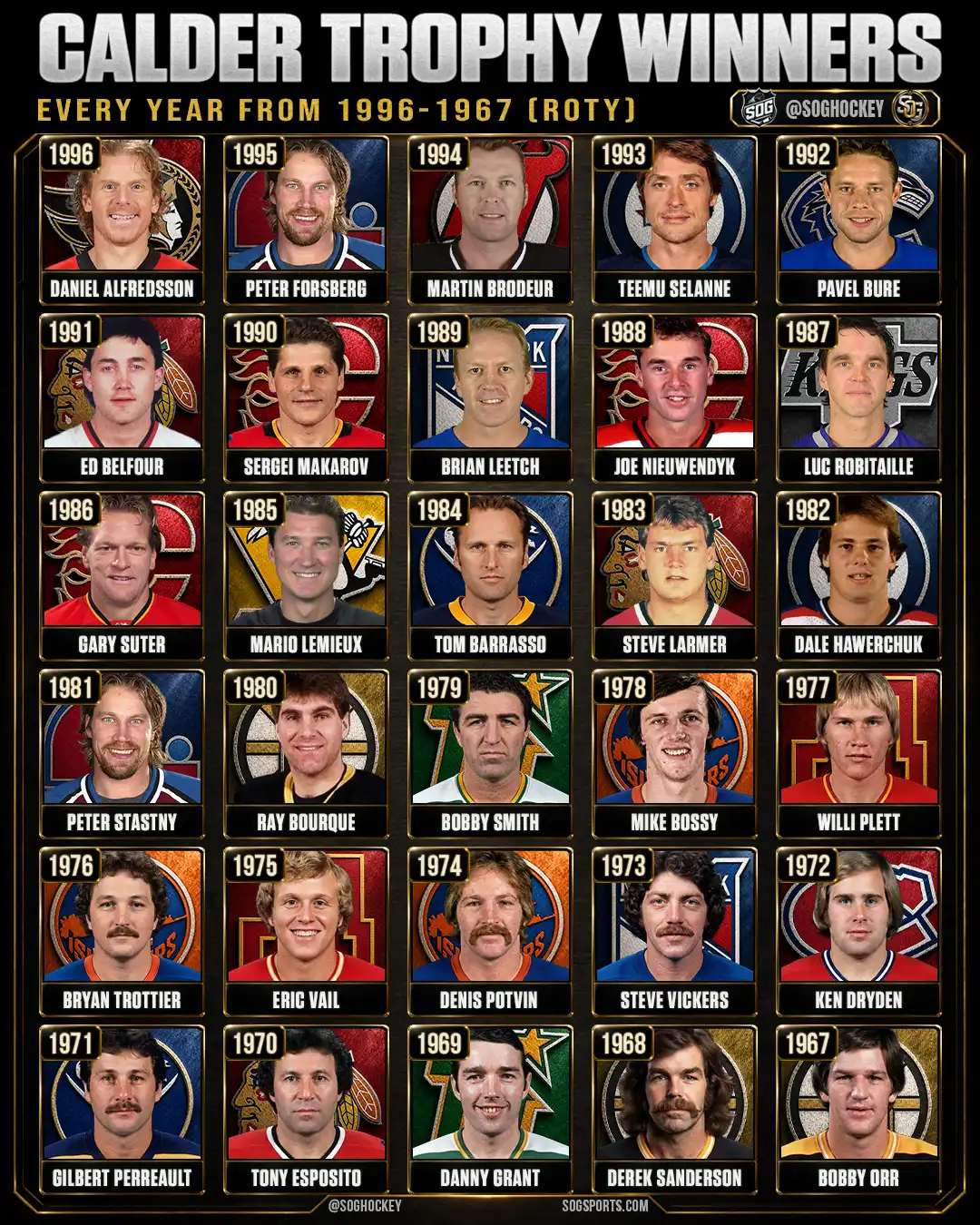
Calder Trophy winners every year from 1996 to 1967.
1996: Daniel Alfredsson, Ottawa Senators
Alfredsson scored 26 goals and 61 points, giving a struggling expansion-era Ottawa team its first lasting star. His intelligence and playmaking translated immediately, and the rookie season became the opening chapter of a Hall of Fame career.
1995: Peter Forsberg, Quebec Nordiques
Forsberg recorded 50 points in 47 games during the lockout-shortened season. His strength on the puck, vision and edge made him look built for playoff hockey before he had even completed his first NHL schedule.
1994: Martin Brodeur, New Jersey Devils
Brodeur won 27 games and helped New Jersey reach the Eastern Conference Final. His puck handling, calm positioning and durability eventually became career trademarks, and all three were visible during his Calder season.
1993: Teemu Selanne, Winnipeg Jets
Selanne scored 76 goals and 132 points, setting NHL rookie records that still stand. He did not merely lead his class; he tied for fifth in league scoring and produced the strongest offensive rookie season the sport has seen.
1992: Pavel Bure, Vancouver Canucks
Bure scored 34 goals in 65 games and transformed Vancouver’s attack with explosive speed. Few rookies have created a greater sense that something could happen every time they touched the puck.
1991: Ed Belfour, Chicago Blackhawks
Belfour won 43 games, led the NHL in save percentage and captured both the Calder and Vezina trophies. He was not simply the best rookie; he was already one of the league’s best goalies.
1990: Sergei Makarov, Calgary Flames
Makarov recorded 86 points at age 31 after an accomplished career in the Soviet Union. His victory exposed the gap in the NHL’s rookie definition and helped prompt the age restriction introduced the following season.
1989: Brian Leetch, New York Rangers
Leetch produced 23 goals and 71 points from the blue line. His skating and ability to control transition play gave the Rangers a franchise defenseman and made him an easy choice in a strong rookie class.
1988: Joe Nieuwendyk, Calgary Flames
Nieuwendyk scored 51 goals and 92 points, pairing elite finishing with a polished two-way center’s game. Reaching 50 goals as a rookie placed him in rare company even during the high-scoring 1980s.
1987: Luc Robitaille, Los Angeles Kings
Robitaille answered every pre-draft concern about his skating with 45 goals and 84 points. His timing, hands and ability to disappear into scoring space mattered far more than straight-line speed.
1986: Gary Suter, Calgary Flames
Suter recorded 68 points as a rookie defenseman and immediately became central to Calgary’s transition game. His puck movement and willingness to join the attack separated him in a year with several productive first-year players.
1985: Mario Lemieux, Pittsburgh Penguins
Lemieux scored on his first NHL shift and finished with 43 goals and 100 points. Pittsburgh had drafted him to rescue the franchise, and it took only one season to see that the talent matched the expectation.
1984: Tom Barrasso, Buffalo Sabres
Barrasso went directly from high school to the NHL and won both the Calder and Vezina trophies at age 18. That leap is almost unthinkable for a modern goalie, which makes his rookie season one of the award’s most unusual accomplishments.
1983: Steve Larmer, Chicago Black Hawks
Larmer scored 43 goals and 90 points, then built a reputation for durability that matched the production. His first full season was the start of an 884-game consecutive-games streak.
1982: Dale Hawerchuk, Winnipeg Jets
Hawerchuk recorded 45 goals and 103 points at age 18. Winnipeg improved by 48 standings points and reached the playoffs, a dramatic turnaround driven by its new franchise center.
1981: Peter Stastny, Quebec Nordiques
Stastny scored 39 goals and 109 points after defecting from Czechoslovakia. His transition to North America was seamless on the ice, and his total remains one of the highest ever by an NHL rookie.
1980: Ray Bourque, Boston Bruins
Bourque posted 17 goals and 65 points while playing a complete game from the blue line. He looked less like a rookie learning the league and more like the foundational defenseman Boston would build around for two decades.
1979: Bobby Smith, Minnesota North Stars
Smith produced 30 goals and 74 points, bringing size and playmaking to a Minnesota team that needed a young offensive centerpiece. His arrival helped set up the North Stars’ rise in the early 1980s.
1978: Mike Bossy, New York Islanders
Bossy scored 53 goals and 91 points, immediately establishing the release and off-puck timing that would define his career. He was the first rookie in league history to reach 50 goals.
1977: Willi Plett, Atlanta Flames
Plett scored 33 goals while adding a level of physical intimidation rarely paired with rookie production. His combination of finishing, size and edge made him a distinctive winner.
1976: Bryan Trottier, New York Islanders
Trottier recorded 32 goals and 95 points while already playing the responsible two-way game that would anchor an Islanders dynasty. He looked ready for major postseason assignments from the beginning.
1975: Eric Vail, Atlanta Flames
Vail scored 39 goals, the highest total by a rookie that season. His career never reached the heights of several winners around him, but the Calder rewards one rookie season, and his was excellent.
1974: Denis Potvin, New York Islanders
Potvin recorded 54 points and handled heavy responsibility as a 20-year-old defenseman. His power, puck skill and authority became central to the identity of the Islanders teams that later won four straight Stanley Cups.
1973: Steve Vickers, New York Rangers
Vickers scored 30 goals and 53 points for a veteran Rangers contender, leading NHL rookies in both categories. He found a productive role immediately without needing sheltered minutes on a team built to compete.
1972: Ken Dryden, Montreal Canadiens
Dryden had already won the 1971 Conn Smythe Trophy after only six regular-season appearances, yet he remained Calder-eligible. He followed that playoff run by winning 39 games in his official rookie season, creating one of the strangest award timelines in NHL history.
1971: Gilbert Perreault, Buffalo Sabres
Perreault scored 38 goals and 72 points for the expansion Sabres. His skating and puck skill gave Buffalo an immediate identity and the centerpiece around which the French Connection line would form.
1970: Tony Esposito, Chicago Black Hawks
Esposito recorded 38 wins and 15 shutouts while capturing both the Calder and Vezina trophies. Fifteen shutouts remain an extraordinary total in any era, never mind for a first-year starter.
1969: Danny Grant, Minnesota North Stars
Grant scored 34 goals and 65 points in the NHL’s second post-expansion season. He gave Minnesota the legitimate scoring threat it had lacked during its debut year.
1968: Derek Sanderson, Boston Bruins
Sanderson brought 24 goals, faceoff skill, defensive value and plenty of personality to a rapidly improving Boston team. His arrival gave the Bruins another important piece around Bobby Orr and Phil Esposito.
1967: Bobby Orr, Boston Bruins
Orr recorded 13 goals and 41 points in 61 games as an 18-year-old defenseman. The totals were excellent, but the greater revelation was his ability to control games with skating from the blue line. The sport was beginning to see a position change in real time.
Calder Trophy Winners Each Year, 1966-1933
The Calder history did not begin with the 1967 expansion era. The NHL recognizes rookie winners back to 1933, while Frank Calder began purchasing a physical trophy for the winner in 1936-37. These early results include Original Six stars, short-career surprises and several goalies who took over a starting job immediately.
1966: Brit Selby, Toronto Maple Leafs
Selby brought speed and defensive commitment to a veteran Toronto roster. His rookie season was the final Calder-winning campaign before the NHL expanded from six teams to 12.
1965: Roger Crozier, Detroit Red Wings
Crozier took over Detroit’s net and handled a massive workload immediately. His quickness and competitive style established him as the Red Wings’ starter before his famous Conn Smythe-winning playoff run the following year.
1964: Jacques Laperriere, Montreal Canadiens
Laperriere stepped into Montreal’s defense with the poise and puck movement of a far more experienced player. His Calder season opened a career built on elite defensive play and six Stanley Cup championships.
1963: Kent Douglas, Toronto Maple Leafs
Douglas gave Toronto steady work from the blue line and won the Stanley Cup in the same season. Earning a regular role on a championship roster made his rookie impact easy to recognize.
1962: Bobby Rousseau, Montreal Canadiens
Rousseau added speed, scoring and versatility to a Montreal team transitioning from one dynasty core to the next. He quickly became a dependable part of the Canadiens’ forward group.
1961: Dave Keon, Toronto Maple Leafs
Keon’s skating, defensive awareness and clean puck management made him look like a complete NHL center from the start. The Calder was the first major honor in a career that eventually made him one of the defining Maple Leafs.
1960: Bill Hay, Chicago Black Hawks
Hay centered Bobby Hull and Murray Balfour on Chicago’s Million Dollar Line. His playmaking and size gave the Black Hawks a balanced rookie center who fit immediately between two dangerous wingers.
1959: Ralph Backstrom, Montreal Canadiens
Backstrom earned a regular role on one of the most loaded teams in league history and won the Stanley Cup as a rookie. His speed and two-way reliability helped him stand out even on a Montreal dynasty.
1958: Frank Mahovlich, Toronto Maple Leafs
Mahovlich arrived with rare size, smooth skating and obvious scoring ability. The rookie season introduced a power winger who would become one of the most productive players of the Original Six era.
1957: Larry Regan, Boston Bruins
Regan supplied immediate offense for a Boston team that reached the Stanley Cup Final. His scoring helped him win a close rookie race over Toronto goalie Ed Chadwick.
1956: Glenn Hall, Detroit Red Wings
Hall took over Detroit’s crease and began the 502 consecutive complete games that became one of hockey’s most untouchable records. His durability was already astonishing before anyone knew how long the streak would last.
1955: Ed Litzenberger, Chicago Black Hawks
Litzenberger found a larger opportunity after moving from Montreal to Chicago during the season. His scoring and playmaking gave the Black Hawks a badly needed young offensive piece.
1954: Camille Henry, New York Rangers
Henry overcame his small frame with speed, timing and a sharp scoring touch. He gave the Rangers an immediate power-play weapon and became one of the era’s most recognizable undersized forwards.
1953: Gump Worsley, New York Rangers
Worsley faced a heavy workload behind a last-place Rangers team and still emerged as the league’s top rookie. The record around him was poor, but his athletic saves and toughness were impossible to miss.
1952: Bernie Geoffrion, Montreal Canadiens
Geoffrion scored 30 goals as a rookie and brought the booming shot that inspired his “Boom Boom” nickname. His arrival added another major offensive weapon to Montreal’s emerging dynasty.
1951: Terry Sawchuk, Detroit Red Wings
Sawchuk won 44 games and recorded 11 shutouts in his first full season. Detroit did not ease him into the job; he immediately delivered one of the strongest rookie goalie seasons in NHL history.
1950: Jack Gelineau, Boston Bruins
Gelineau went from college hockey to carrying most of Boston’s goaltending workload. His NHL career was brief, but his first season was strong enough to earn the award over a productive rookie class.
1949: Pentti Lund, New York Rangers
Lund brought responsible two-way play and enough scoring to become an immediate regular for New York. His victory also made him the first Finnish-born player to win a major NHL award.
1948: Jim McFadden, Detroit Red Wings
McFadden supplied Detroit with dependable scoring down the middle and helped the Red Wings reach the Stanley Cup Final. He fit smoothly into a deep team without needing star treatment.
1947: Howie Meeker, Toronto Maple Leafs
Meeker scored 27 goals and won the Stanley Cup as a rookie. His speed and relentless style gave Toronto immediate energy during the first championship season of a new dynasty.
1946: Edgar Laprade, New York Rangers
Laprade’s value came from skating, defensive responsibility and disciplined center play. He won without a huge scoring total, an early example of Calder voters rewarding a complete game.
1945: Frank McCool, Toronto Maple Leafs
McCool took over Toronto’s net and helped the Maple Leafs win the Stanley Cup in his rookie season. Health problems shortened his career dramatically, but his debut remains one of the most successful ever by a rookie goalie.
1944: Gus Bodnar, Toronto Maple Leafs
Bodnar scored only 15 seconds into his NHL debut, setting a league record for the fastest first goal by a debuting player. He finished the season with 40 assists, a Maple Leafs rookie record that stood until 2017.
1943: Gaye Stewart, Toronto Maple Leafs
Stewart brought finishing ability and physical edge to Toronto as a 19-year-old. His immediate scoring impact earned the award before military service interrupted the next stage of his career.
1942: Grant Warwick, New York Rangers
Warwick added speed and balanced scoring to a Rangers team that finished first in the regular-season standings. He earned meaningful minutes on a contender instead of building numbers in a protected role.
1941: Johnny Quilty, Montreal Canadiens
Quilty gave Montreal an immediate scoring lift and led NHL rookies offensively. His career was soon interrupted by military service, leaving the Calder season as his clearest NHL peak.
1940: Kilby MacDonald, New York Rangers
MacDonald carved out a useful role on a deep Rangers team and ended his rookie season as a Stanley Cup champion. His value came from fitting into a winning lineup rather than carrying the offense.
1939: Frank Brimsek, Boston Bruins
Brimsek won the Calder and Vezina trophies while backstopping Boston to the Stanley Cup. Nicknamed “Mr. Zero,” he delivered 10 shutouts and one of the greatest rookie goalie seasons the league has ever seen.
1938: Cully Dahlstrom, Chicago Black Hawks
Dahlstrom gave Chicago a steady two-way presence, then helped the Black Hawks complete an improbable Stanley Cup run. He remains one of the few players to win the Calder and the Cup in the same rookie season.
1937: Syl Apps, Toronto Maple Leafs
Apps recorded 45 points in 48 games and immediately looked like one of the NHL’s best centers. He was the first winner to receive the annual trophy purchased by league president Frank Calder.
1936: Mike Karakas, Chicago Black Hawks
Karakas took over Chicago’s crease and established himself as one of the league’s top young goalies. His quick, acrobatic style gave the Black Hawks stability at the most important position.
1935: Sweeney Schriner, New York Americans
Schriner scored 40 points in 48 games and led all first-year players. He turned that immediate production into a Hall of Fame career and remains the only New York Americans player to win the award.
1934: Russ Blinco, Montreal Maroons
Blinco became a reliable center for the Maroons and brought speed to a veteran lineup. His win preserves a piece of history from a franchise that disappeared only four years later.
1933: Carl Voss, Detroit Red Wings
Voss is recognized by the NHL as its first rookie of the year. The permanent Calder Memorial Trophy did not yet exist, but his 1932-33 season begins the official winner history that continues through Schaefer in 2026.
Notable Calder Races and Eligibility Oddities
1933 and 1937: Why Two Starting Dates Appear
The NHL’s official winner list begins with Carl Voss in 1933. Frank Calder began buying a physical trophy for the outstanding rookie in 1936-37, when Syl Apps won, and the permanent Calder Memorial Trophy was introduced after Calder died in 1943. That is why some histories emphasize 1937 even though the league recognizes winners back to 1933.
2024: Connor Bedard vs. Brock Faber
Bedard led all rookies in goals and points despite missing 14 games. Faber played every game, averaged nearly 25 minutes and handled a far more demanding defensive role. The contrast made this a legitimate offense-versus-responsibility debate, but Bedard’s scoring advantage carried the vote.
2017: Auston Matthews vs. Patrik Laine
Laine scored 36 goals in 73 games and briefly looked capable of taking the goal-scoring lead. Matthews finished with 40 goals, played center and appeared in all 82 games, giving him the stronger complete-season case.
2012: Gabriel Landeskog vs. Ryan Nugent-Hopkins
Both players finished with 52 points. Nugent-Hopkins reached the total in only 62 games, while Landeskog played 82 and supplied more physical and defensive value. Voters preferred Landeskog’s full-season impact.
2006: Alex Ovechkin vs. Sidney Crosby
Crosby’s 102 points would have won most Calder races. Ovechkin answered with 52 goals, 106 points and a level of physical dominance rarely seen from a rookie, turning an exceptional debate into a decisive result.
1990: Sergei Makarov Changes the Rules
Makarov was a 31-year-old international star when he won. Beginning in 1990-91, the NHL added the age restriction that now makes players who are at least 26 by September 15 ineligible for rookie status.
1980: Why Wayne Gretzky Was Ineligible
Gretzky tied Marcel Dionne for the NHL scoring lead with 137 points in 1979-80, but his full professional season in the World Hockey Association made him ineligible for the Calder. Ray Bourque won the award instead.
1972: Ken Dryden Wins After the Conn Smythe
Dryden won the 1971 Conn Smythe Trophy before he had played enough regular-season games to lose rookie eligibility. He then won the Calder the following season, reversing the order in which those two honors would normally arrive.
Complete Year-by-Year Table: Calder Trophy Winners
The year below is the season-ending award year. The table contains all 93 official winners in NHL history and one no-award entry for the canceled 2004-05 season.
| Year | Winner | Team |
|---|---|---|
| 2026 | Matthew Schaefer | New York Islanders |
| 2025 | Lane Hutson | Montreal Canadiens |
| 2024 | Connor Bedard | Chicago Blackhawks |
| 2023 | Matty Beniers | Seattle Kraken |
| 2022 | Moritz Seider | Detroit Red Wings |
| 2021 | Kirill Kaprizov | Minnesota Wild |
| 2020 | Cale Makar | Colorado Avalanche |
| 2019 | Elias Pettersson | Vancouver Canucks |
| 2018 | Mathew Barzal | New York Islanders |
| 2017 | Auston Matthews | Toronto Maple Leafs |
| 2016 | Artemi Panarin | Chicago Blackhawks |
| 2015 | Aaron Ekblad | Florida Panthers |
| 2014 | Nathan MacKinnon | Colorado Avalanche |
| 2013 | Jonathan Huberdeau | Florida Panthers |
| 2012 | Gabriel Landeskog | Colorado Avalanche |
| 2011 | Jeff Skinner | Carolina Hurricanes |
| 2010 | Tyler Myers | Buffalo Sabres |
| 2009 | Steve Mason | Columbus Blue Jackets |
| 2008 | Patrick Kane | Chicago Blackhawks |
| 2007 | Evgeni Malkin | Pittsburgh Penguins |
| 2006 | Alex Ovechkin | Washington Capitals |
| 2005 | No winner | No NHL season |
| 2004 | Andrew Raycroft | Boston Bruins |
| 2003 | Barret Jackman | St. Louis Blues |
| 2002 | Dany Heatley | Atlanta Thrashers |
| 2001 | Evgeni Nabokov | San Jose Sharks |
| 2000 | Scott Gomez | New Jersey Devils |
| 1999 | Chris Drury | Colorado Avalanche |
| 1998 | Sergei Samsonov | Boston Bruins |
| 1997 | Bryan Berard | New York Islanders |
| 1996 | Daniel Alfredsson | Ottawa Senators |
| 1995 | Peter Forsberg | Quebec Nordiques |
| 1994 | Martin Brodeur | New Jersey Devils |
| 1993 | Teemu Selanne | Winnipeg Jets |
| 1992 | Pavel Bure | Vancouver Canucks |
| 1991 | Ed Belfour | Chicago Blackhawks |
| 1990 | Sergei Makarov | Calgary Flames |
| 1989 | Brian Leetch | New York Rangers |
| 1988 | Joe Nieuwendyk | Calgary Flames |
| 1987 | Luc Robitaille | Los Angeles Kings |
| 1986 | Gary Suter | Calgary Flames |
| 1985 | Mario Lemieux | Pittsburgh Penguins |
| 1984 | Tom Barrasso | Buffalo Sabres |
| 1983 | Steve Larmer | Chicago Black Hawks |
| 1982 | Dale Hawerchuk | Winnipeg Jets |
| 1981 | Peter Stastny | Quebec Nordiques |
| 1980 | Ray Bourque | Boston Bruins |
| 1979 | Bobby Smith | Minnesota North Stars |
| 1978 | Mike Bossy | New York Islanders |
| 1977 | Willi Plett | Atlanta Flames |
| 1976 | Bryan Trottier | New York Islanders |
| 1975 | Eric Vail | Atlanta Flames |
| 1974 | Denis Potvin | New York Islanders |
| 1973 | Steve Vickers | New York Rangers |
| 1972 | Ken Dryden | Montreal Canadiens |
| 1971 | Gilbert Perreault | Buffalo Sabres |
| 1970 | Tony Esposito | Chicago Black Hawks |
| 1969 | Danny Grant | Minnesota North Stars |
| 1968 | Derek Sanderson | Boston Bruins |
| 1967 | Bobby Orr | Boston Bruins |
| 1966 | Brit Selby | Toronto Maple Leafs |
| 1965 | Roger Crozier | Detroit Red Wings |
| 1964 | Jacques Laperriere | Montreal Canadiens |
| 1963 | Kent Douglas | Toronto Maple Leafs |
| 1962 | Bobby Rousseau | Montreal Canadiens |
| 1961 | Dave Keon | Toronto Maple Leafs |
| 1960 | Bill Hay | Chicago Black Hawks |
| 1959 | Ralph Backstrom | Montreal Canadiens |
| 1958 | Frank Mahovlich | Toronto Maple Leafs |
| 1957 | Larry Regan | Boston Bruins |
| 1956 | Glenn Hall | Detroit Red Wings |
| 1955 | Ed Litzenberger | Chicago Black Hawks |
| 1954 | Camille Henry | New York Rangers |
| 1953 | Gump Worsley | New York Rangers |
| 1952 | Bernie Geoffrion | Montreal Canadiens |
| 1951 | Terry Sawchuk | Detroit Red Wings |
| 1950 | Jack Gelineau | Boston Bruins |
| 1949 | Pentti Lund | New York Rangers |
| 1948 | Jim McFadden | Detroit Red Wings |
| 1947 | Howie Meeker | Toronto Maple Leafs |
| 1946 | Edgar Laprade | New York Rangers |
| 1945 | Frank McCool | Toronto Maple Leafs |
| 1944 | Gus Bodnar | Toronto Maple Leafs |
| 1943 | Gaye Stewart | Toronto Maple Leafs |
| 1942 | Grant Warwick | New York Rangers |
| 1941 | Johnny Quilty | Montreal Canadiens |
| 1940 | Kilby MacDonald | New York Rangers |
| 1939 | Frank Brimsek | Boston Bruins |
| 1938 | Cully Dahlstrom | Chicago Black Hawks |
| 1937 | Syl Apps | Toronto Maple Leafs |
| 1936 | Mike Karakas | Chicago Black Hawks |
| 1935 | Sweeney Schriner | New York Americans |
| 1934 | Russ Blinco | Montreal Maroons |
| 1933 | Carl Voss | Detroit Red Wings |
Frequently Asked Questions About Calder Trophy Winners
Who won the Calder Trophy in 2026?
Matthew Schaefer of the New York Islanders won the 2026 Calder Trophy. He scored 23 goals and 59 points in 82 games and appeared first on every ballot.
Who had the greatest Calder Trophy season ever?
Teemu Selanne has the strongest case. He scored 76 goals and 132 points for the Winnipeg Jets in 1992-93, setting rookie records that still stand.
Why was there no Calder Trophy winner in 2005?
The entire 2004-05 NHL season was canceled because of the lockout. No games meant no rookie season to evaluate, so the league did not award the trophy.
Who was the first Calder Trophy winner in NHL history?
Carl Voss of the Detroit Red Wings is the first winner in the NHL’s official history, earning rookie of the year for the 1932-33 season. Frank Calder began purchasing an annual trophy for the winner in 1936-37, and the permanent Calder Memorial Trophy was introduced after his death in 1943.
Which team has the most Calder Trophy winners?
The Toronto Maple Leafs and Chicago Blackhawks share the NHL record with 10 Calder winners each. Auston Matthews is Toronto’s most recent winner, while Connor Bedard is Chicago’s latest.
Sources and Data Notes
The award history and team assignments were checked against the NHL’s official Calder Memorial Trophy winners list. Rookie qualifications follow the league’s official hockey operations guidelines. Player totals are regular-season statistics from the season for which the award was won.
Scope: Every official NHL rookie of the year from 1933 through 2026. The displayed year is the season-ending year. The 2005 row represents the canceled 2004-05 season. Last reviewed August 6, 2026.
Calder Trophy Winners From Carl Voss to Matthew Schaefer
Matthew Schaefer is the latest name in an official history that stretches back to Carl Voss in 1933. His unanimous 2026 victory belongs near the most distinctive results on the list: Brimsek winning the Calder, Vezina and Stanley Cup in 1939, Sawchuk’s 44-win debut, Selanne’s 76-goal eruption, Dryden winning the award after the Conn Smythe and Makarov prompting an eligibility change.
The award cannot predict an entire career. It can, however, capture the exact season when a new player proved he already belonged. Across forwards, defensemen and goalies, these are the 93 official winners who defined NHL rookie excellence from 1933 through 2026.
More NHL Year-by-Year Lists
Continue through SOG Sports’ expansion-era season-by-season NHL history:
