Ja’Marr Chase and Tee Higgins are SOG Sports’ No. 1 wide receiver duo entering the 2026 NFL season. Chase can dictate an entire coverage plan, while Higgins is dangerous enough to punish any defense that treats him like an ordinary second option. That proven top-end combination gives the Cincinnati Bengals the narrow edge over the Dallas Cowboys, Los Angeles Rams, Detroit Lions and Minnesota Vikings.
This is an opinion-based 2026 preseason power ranking of the best wide receiver duos in the NFL today. It evaluates the two receivers shown for every team, not the depth of the entire receiver room, and weighs recent performance, projected role, complementary skills, quarterback and scheme fit, availability and realistic upside for the upcoming season.
Ranking Criteria and 2026 Eligibility
Every NFL team appears once. New acquisitions and rookies are eligible because the ranking projects the 2026 season rather than simply repeating 2025 receiving totals. A highly drafted rookie can raise a duo’s ceiling, but an unproven NFL role also creates more risk than a pairing with established chemistry.
- Top-end ability: How much coverage attention the better receiver demands.
- Quality of the second option: Whether the other receiver can consistently punish single coverage.
- Complementary traits: Route running, vertical speed, size, contested catches, yards after the catch and red-zone value.
- 2026 fit: Expected role, quarterback fit, offensive structure and how the two skill sets work together.
- Reliability and upside: Recent production, availability, development and the realistic range of outcomes.
This is not a fantasy-football ranking and it is not an official NFL list. It is SOG Sports’ evaluation of how difficult each specified pairing should be to defend in real football as of July 30, 2026.
Best Wide Receiver Duos in the NFL Today: 1–10

SOG Sports’ top 10 wide receiver duos entering the 2026 NFL season, led by Ja’Marr Chase and Tee Higgins.
1. Ja’Marr Chase and Tee Higgins, Cincinnati Bengals
Chase and Higgins remain the most complete answer because Cincinnati does not have a normal WR1-WR2 split. Chase is a threat to win at every level and can turn routine completions into game-changing plays. Higgins brings the size, body control and boundary skill to function like a lead receiver when coverage rotates toward Chase.
The Bengals also have the advantage of continuity. Lamb and Pickens may have a similarly frightening ceiling, but Chase and Higgins have already shown that their games can coexist without either receiver becoming a decoy. Availability is the only meaningful concern. When both are on the field, no other duo presents a cleaner coverage dilemma.
2. CeeDee Lamb and George Pickens, Dallas Cowboys
Lamb can run an offense from the slot, move outside, handle volume and create after the catch. Pickens supplies the vertical tracking, catch-point strength and sideline ability that can punish defenses for rolling help toward Lamb. Their styles fit without asking either player to abandon what he does best.
Dallas lands second because the pair still has a little less established two-man consistency than Cincinnati’s duo. The talent is good enough to take the top spot, but Chase and Higgins enter 2026 with the stronger proof of concept.
3. Puka Nacua and Davante Adams, Los Angeles Rams
Nacua and Adams create problems with technique and physicality rather than relying on one kind of route. Nacua can win through contact, uncover against zone and create yards after the catch. Adams still brings advanced release work, route pacing and red-zone detail that gives his quarterback an answer when the field shrinks.
This may be the most quarterback-friendly pairing in the ranking. The concern is longer-term durability and age compared with the two duos above them, not the quality of their route running or their ability to control important downs.
4. Amon-Ra St. Brown and Jameson Williams, Detroit Lions
St. Brown and Williams have one of the clearest role combinations in football. St. Brown controls the middle of the field with timing, toughness and route precision. Williams forces safeties to respect speed that can erase pursuit angles and open space underneath even when he is not targeted.
Detroit ranks fourth because Williams still has to sustain top-level production over a larger sample to match the second receivers in the top three. The fit itself is nearly perfect, and another complete season from Williams could move the Lions higher.
5. Justin Jefferson and Jordan Addison, Minnesota Vikings
Jefferson gives Minnesota the best possible foundation for a duo. He separates against man coverage, understands leverage against zone and can still finish catches when the coverage wins the rep. Addison benefits from that attention, but he is not merely a space-filler. He has the route detail and vertical skill to beat favorable matchups on his own.
The Vikings sit fifth because the four duos above them offer either a more proven power complement or a sharper contrast of physical traits. Jefferson is good enough to carry this pair into the top five, and Addison has the talent to erase that small gap.
6. A.J. Brown and Romeo Doubs, New England Patriots
New England’s new pairing jumps directly into the top six because Brown changes the geometry of an offense. He wins through contact, creates explosive plays on in-breaking routes and demands safety help outside. Doubs is a sturdy complement with reliable hands, boundary experience and the ability to work as a bigger inside target.
The projection is aggressive, but the roles make sense. Brown is the coverage-dictating No. 1, while Doubs does not need manufactured volume to be useful. The only reason this duo is not higher is that it must establish chemistry in a new offense.
7. Jaylen Waddle and Courtland Sutton, Denver Broncos
Waddle and Sutton give Denver a natural speed-and-size combination. Waddle can stress a defense horizontally on crossers and vertically with acceleration that changes safety depth. Sutton gives the Broncos a larger boundary target who can win late in the down and provide a dependable option near the goal line.
The pieces complement each other better than two receivers with overlapping games would. Denver ranks seventh because the pairing is new and still has to prove how the target distribution will work, but the ceiling is comfortably inside the top 10.
8. Jaxon Smith-Njigba and Rashid Shaheed, Seattle Seahawks
Smith-Njigba enters 2026 after leading the NFL with 1,793 receiving yards, giving Seattle a true offense-driving receiver. Shaheed adds a different kind of stress with instant vertical speed and open-field explosiveness. Defenses cannot crowd Smith-Njigba’s intermediate routes without accepting more risk behind them.
Seattle’s receiver room is deeper than this two-player label, but the specified duo still belongs eighth. Shaheed has not carried the same receiving volume as the second options above him, which keeps the Seahawks from climbing even higher.
9. Mike Evans and Ricky Pearsall, San Francisco 49ers
Evans gives San Francisco a proven outside scorer with rare consistency, size and ball tracking. Pearsall offers movement ability, quick separation and room to grow into a larger role. In a well-designed offense, the contrast can create clean answers against both man and zone coverage.
The uncertainty is straightforward. Evans is entering a later career stage, while Pearsall has not yet produced a full season as a high-volume second option. Their best version is better than ninth, but the range of outcomes is wider than it is for the duos above them.
10. Chris Olave and Jordyn Tyson, New Orleans Saints
Olave is a polished three-level route runner who can create separation without needing the offense to scheme every touch. Tyson, selected eighth overall in the 2026 NFL Draft, brings first-round talent, ball skills and the versatility to line up in different spots.
This is one of the list’s biggest projection bets. Tyson has not taken an NFL snap, and his college availability history adds uncertainty. The Saints still make the top 10 because Olave supplies a strong floor and Tyson has the talent to become a legitimate second coverage problem quickly.
Best Wide Receiver Duos in the NFL Today: 11–20
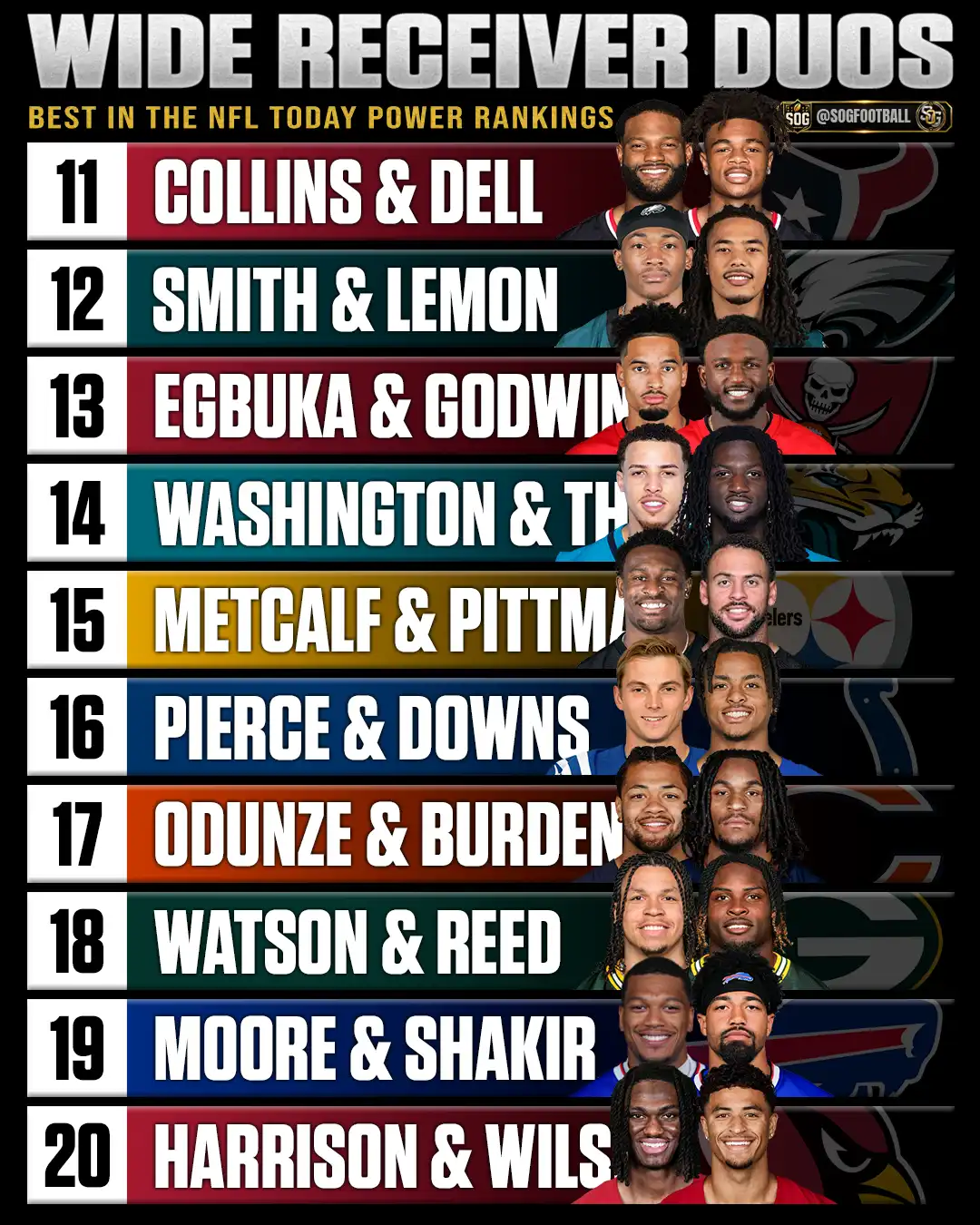
SOG Sports’ wide receiver duo rankings from No. 11 through No. 20 entering the 2026 NFL season.
11. Nico Collins and Tank Dell, Houston Texans
Collins supplies size, vertical strength and the ability to stay productive against tight coverage. Dell brings sudden route breaks and a much smaller, quicker target profile that is difficult to match with the same type of cornerback. On pure talent and stylistic balance, Houston has a top-10 case.
The ranking discounts uncertainty more than ability. The Texans need a dependable stretch of shared availability and stable roles before this duo can be placed above the more bankable pairings in front of it.
12. DeVonta Smith and Makai Lemon, Philadelphia Eagles
Smith becomes Philadelphia’s established lead receiver after the A.J. Brown trade, and his separation, body control and ability to play inside or outside make him well suited for the job. Lemon, the No. 20 pick and the reigning Biletnikoff Award winner, adds toughness, route feel and yards-after-catch potential.
The Eagles could finish much higher than 12th if Lemon’s college game translates immediately. Until he proves it against NFL coverage, the duo remains one step below the established top 10.
13. Emeka Egbuka and Chris Godwin, Tampa Bay Buccaneers
Egbuka and Godwin give Tampa Bay two receivers who understand spacing, work through traffic and can move around the formation. The pairing should be dependable on timing routes and third down, with enough strength after the catch to turn short completions into useful gains.
The Buccaneers rank behind Philadelphia because this duo projects as more steady than explosive. It can outperform No. 13 through consistency, but it may not force the same extreme coverage adjustments as the groups above it.
14. Parker Washington and Brian Thomas Jr., Jacksonville Jaguars
Washington led Jacksonville with 847 receiving yards in 2025, while Thomas still owns the size-speed profile to rebound from a quieter second season. Washington can uncover from different alignments, and Thomas can stretch the boundary in a way that changes where safeties are allowed to help.
The Jaguars also have Jakobi Meyers and a deep receiver room, so this ranking isolates the two players named in the graphic rather than judging the entire group. Thomas returning to his top form would make No. 14 look conservative.
15. DK Metcalf and Michael Pittman Jr., Pittsburgh Steelers
Pittsburgh has built a physically imposing tandem. Metcalf brings vertical speed that is unusual for his size, while Pittman offers a large possession target who can work intermediate routes and absorb contact. Pittman’s arrival should make it harder for defenses to devote extra attention to Metcalf on every important down.
The Steelers sit 15th because the pairing is new and the offense must show it can consistently feed both receivers. The raw matchup problem is strong enough to produce a top-10 season.
16. Alec Pierce and Josh Downs, Indianapolis Colts
Pierce and Downs fit together cleanly. Pierce threatens the deep boundary and forces the secondary to defend vertical space. Downs wins earlier in routes with quickness, awareness and slot separation. One creates room for the other without requiring identical targets.
Indianapolis lands in the middle because neither receiver has yet shown the same coverage-dictating profile as the lead options above them. As a functional football partnership, however, this duo has very few wasted traits.
17. Rome Odunze and Luther Burden III, Chicago Bears
Odunze and Burden give Chicago a high-upside young combination. Odunze has the frame and ball skills to become a boundary No. 1, while Burden can create with the ball and threaten from multiple alignments. Their games have enough contrast to grow together rather than compete for the exact same role.
The Bears are ranked on possibility as much as proof. A major jump from both players would push them well above 17th, but the list cannot treat development as guaranteed.
18. Christian Watson and Jayden Reed, Green Bay Packers
Watson supplies rare long speed for a receiver with his length, and Reed brings quickness, toughness and formation versatility. Green Bay can use the pair to stretch a defense in different directions, with Watson creating vertical space and Reed attacking the voids that appear underneath.
Health and a crowded target distribution keep the Packers at 18th. Their best snaps look like a much higher-ranked duo, but consistent weekly volume has been harder to project.
19. DJ Moore and Khalil Shakir, Buffalo Bills
Moore gives Buffalo a proven receiver who can beat man coverage and create after the catch. Shakir is a reliable middle-of-the-field option who plays with strong contact balance and understands how to stay available for his quarterback. The pairing should provide a useful blend of outside creation and inside efficiency.
This is another new duo that needs to establish its hierarchy. Buffalo has enough complementary targets to spread the ball around, so Moore and Shakir must show that they can become a true two-receiver problem rather than simply the leading names in a balanced room.
20. Marvin Harrison Jr. and Michael Wilson, Arizona Cardinals
Harrison remains the reason Arizona has a high ceiling at receiver. His size, route polish and catch radius give him the tools to become the kind of No. 1 who lifts the value of everyone around him. Wilson provides a bigger complementary target who can work the boundary and exploit lighter coverage.
The Cardinals rank 20th because the projection still depends on Harrison turning potential into week-to-week takeover production. If that leap arrives in 2026, this duo can move into the top half quickly.
Best Wide Receiver Duos in the NFL Today: 21–32
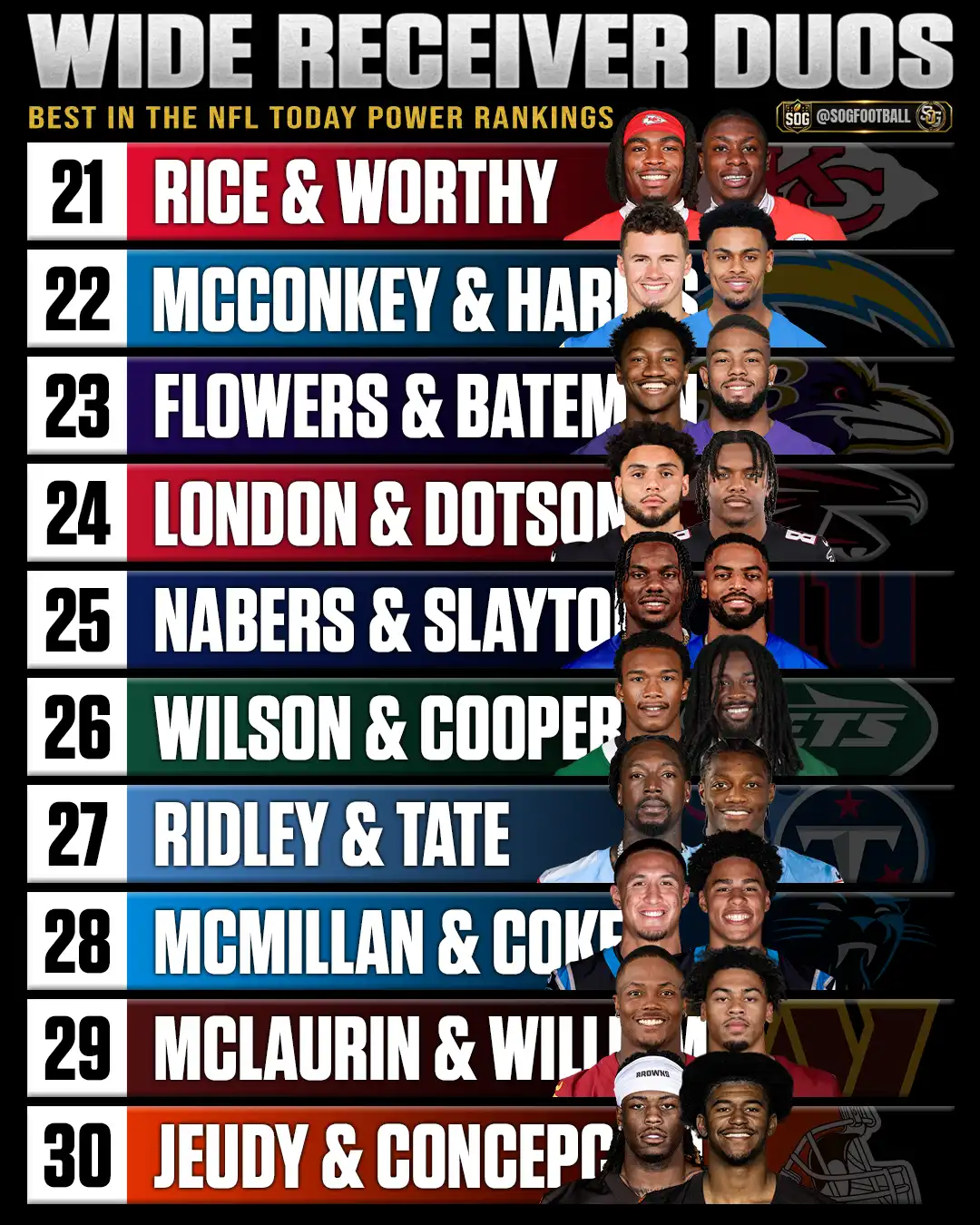
SOG Sports’ wide receiver duo rankings from No. 21 through No. 30 entering the 2026 NFL season.
21. Rashee Rice and Xavier Worthy, Kansas City Chiefs
Rice can work through contact and create after shorter completions, while Worthy’s speed forces defensive backs to protect grass far beyond the catch point. The traits fit a creative passing game and give Kansas City several ways to manufacture explosive plays.
The Chiefs sit 21st because this pairing needs a steadier stretch of shared availability and production before it can be ranked with the more proven duos. The quarterback and scheme give them one of the clearest paths to outperforming their slot.
22. Ladd McConkey and Tre Harris, Los Angeles Chargers
McConkey gives the Chargers a precise separator who can win quickly and stay friendly to his quarterback. Harris brings more size and vertical potential, creating the outline of a balanced long-term partnership.
McConkey has already established the stronger half of the duo. The ranking depends on Harris turning flashes into consistent outside production. If that happens, Los Angeles will have a pair that belongs much closer to the top 15.
23. Zay Flowers and Rashod Bateman, Baltimore Ravens
Flowers is the movement player, capable of separating underneath and turning space into extra yards. Bateman offers a smoother vertical and intermediate target with more size on the outside. Their skills make sense together and can punish defenses that devote too much attention to Baltimore’s running game.
The Ravens remain 23rd because the passing attack has not consistently made this duo carry the offense. The talent is better than the ranking, but the weekly two-receiver impact has to become more dependable.
24. Drake London and Jahan Dotson, Atlanta Falcons
London is a legitimate lead target with the frame, hands and route strength to win when coverage is tight. Dotson adds speed and alignment flexibility after joining Atlanta in the offseason. The Falcons do not need Dotson to become a second No. 1; they need him to punish the space created by London.
The concern is that Dotson has not consistently produced like a high-end second receiver. A cleaner role in Atlanta could change that and move this duo several places higher.
25. Malik Nabers and Darius Slayton, New York Giants
Nabers gives the Giants a true centerpiece with acceleration, catch-point ability and yards-after-catch force. Slayton remains a useful vertical complement who can clear space and make defenses pay for sitting on shorter routes.
New York ranks 25th because the gap between the first and second option is wider than it is for most teams above them. Nabers can carry a large share of the passing game, but this exercise rewards two receivers who independently change coverage decisions.
26. Garrett Wilson and Omar Cooper Jr., New York Jets
Wilson is a high-level separator with the movement skill to win from several alignments. Cooper, selected 30th overall in the 2026 NFL Draft, gives the Jets a young receiver with big-play ability and a chance to grow beside an established No. 1.
The upside is obvious, but Cooper has no NFL sample yet. That makes No. 26 a fair starting point rather than a statement about his long-term ceiling. An immediate rookie impact would send the Jets upward.
27. Calvin Ridley and Carnell Tate, Tennessee Titans
Ridley still provides route tempo and vertical experience, while Tate arrives as the fourth overall pick with polished body control, a large catch radius and downfield ability. Tennessee has the ingredients for a more dangerous outside passing game than it had a year ago.
The Titans rank 27th because Tate is a rookie and Ridley must prove the pairing can produce consistently in its new offensive context. The talent gives them one of the largest ranges of outcomes on the list.
28. Tetairoa McMillan and Jalen Coker, Carolina Panthers
McMillan gives Carolina a large, fluid target who can win outside and develop into the coverage-dictating player this duo needs. Coker complements him with size, route development and a willingness to work through congested areas.
This is a young pairing with a credible growth path, but it still needs to prove that both receivers can command meaningful volume at the same time. The Panthers could beat No. 28 without either player needing a dramatic stylistic change.
29. Terry McLaurin and Antonio Williams, Washington Commanders
McLaurin remains the stable piece: a dependable route runner with speed, toughness and years of production as Washington’s top receiver. Williams, a third-round rookie, was drafted for his separation and ability to move between the slot and perimeter.
The Commanders have not handed Williams a defined No. 2 role, so this ranking is intentionally cautious. If his advanced route work earns him immediate snaps, the duo can rise. For now, McLaurin is carrying most of the proven value.
30. Jerry Jeudy and KC Concepcion, Cleveland Browns
Jeudy provides the established separation skills, while Concepcion brings versatility, open-field creativity and return value after Cleveland selected him 24th overall. The Browns can use the rookie in motion, from the slot and on designed touches while he develops as a complete receiver.
Cleveland also has a crowded receiver competition, which makes the final hierarchy less certain than the graphic suggests. The duo has playmaking ability, but it must first secure a consistent share of the offense.
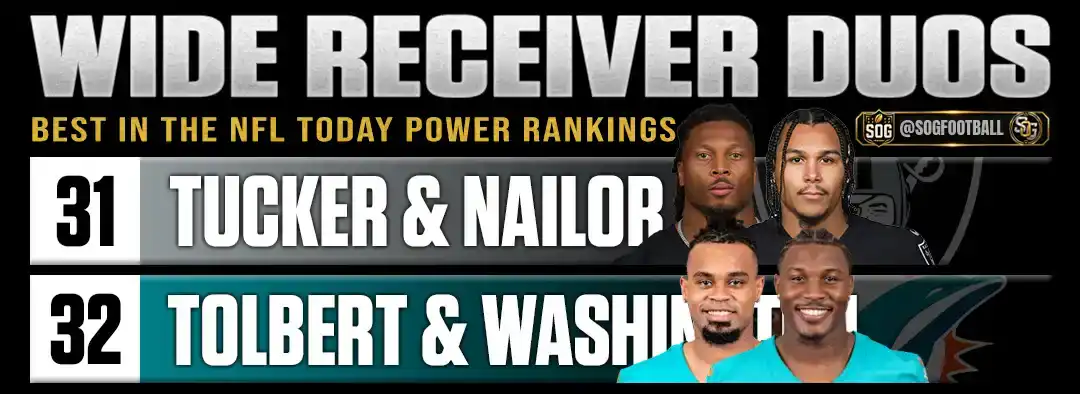
The Las Vegas Raiders and Miami Dolphins complete SOG Sports’ 2026 wide receiver duo power rankings.
31. Tre Tucker and Jalen Nailor, Las Vegas Raiders
Tucker and Nailor give Las Vegas speed and the potential for more vertical stress than the ranking might imply. Both can fit useful roles, and Nailor’s arrival gives the Raiders another receiver capable of threatening space outside.
The pair ranks 31st because neither player has established himself as a coverage-dictating, high-volume No. 1. One of them must make that jump before the Raiders can compare with teams that already have a proven lead receiver.
32. Jalen Tolbert and Malik Washington, Miami Dolphins
Tolbert offers outside size and downfield ability, while Washington brings quickness, versatility and yards-after-catch potential. The traits are complementary enough to form a functional pairing in Miami’s rebuilt receiver room.
The Dolphins finish 32nd because the duo lacks the established top-end production found everywhere else on the list. That creates opportunity as well as uncertainty. A breakout from either receiver would give Miami a straightforward path out of the final spot.
Biggest Debates and What Could Change the Ranking
Why Chase and Higgins beat Lamb and Pickens
The difference is proof, not raw talent. Dallas may have the more explosive best-case outcome if Lamb and Pickens both hit their ceilings, but Cincinnati enters 2026 with years of evidence that Chase and Higgins can function together as two legitimate primary targets. That continuity breaks a very close tie.
How much should new pairings be trusted?
Brown and Doubs, Waddle and Sutton, Metcalf and Pittman, Moore and Shakir, and London and Dotson all look logical on paper. The ranking still applies a small chemistry penalty because route timing, target distribution and quarterback trust must be earned in live games. A new duo can climb quickly once the fit becomes real rather than theoretical.
Rookies create the widest range of outcomes
Tyson, Lemon, Cooper, Tate, Williams and Concepcion are being evaluated through draft investment, college production and expected roles rather than NFL results. Their teams may have chosen them to contribute immediately, but a projection should not be treated as completed development. That is why several rookie-based duos have exciting ceilings but conservative starting positions.
Deep receiver rooms complicate a two-player ranking
Seattle, Jacksonville, Green Bay, Buffalo and Cleveland have other receivers who could command meaningful targets. This list follows the two-player combinations selected in the graphics, so it does not automatically reward a team for having the deepest third or fourth option. It asks a narrower question: how strong is the specified duo?
Complete 2026 Wide Receiver Duo Rankings Table
| Rank | Wide Receiver Duo | Team |
|---|---|---|
| 1 | Ja’Marr Chase & Tee Higgins | Cincinnati Bengals |
| 2 | CeeDee Lamb & George Pickens | Dallas Cowboys |
| 3 | Puka Nacua & Davante Adams | Los Angeles Rams |
| 4 | Amon-Ra St. Brown & Jameson Williams | Detroit Lions |
| 5 | Justin Jefferson & Jordan Addison | Minnesota Vikings |
| 6 | A.J. Brown & Romeo Doubs | New England Patriots |
| 7 | Jaylen Waddle & Courtland Sutton | Denver Broncos |
| 8 | Jaxon Smith-Njigba & Rashid Shaheed | Seattle Seahawks |
| 9 | Mike Evans & Ricky Pearsall | San Francisco 49ers |
| 10 | Chris Olave & Jordyn Tyson | New Orleans Saints |
| 11 | Nico Collins & Tank Dell | Houston Texans |
| 12 | DeVonta Smith & Makai Lemon | Philadelphia Eagles |
| 13 | Emeka Egbuka & Chris Godwin | Tampa Bay Buccaneers |
| 14 | Parker Washington & Brian Thomas Jr. | Jacksonville Jaguars |
| 15 | DK Metcalf & Michael Pittman Jr. | Pittsburgh Steelers |
| 16 | Alec Pierce & Josh Downs | Indianapolis Colts |
| 17 | Rome Odunze & Luther Burden III | Chicago Bears |
| 18 | Christian Watson & Jayden Reed | Green Bay Packers |
| 19 | DJ Moore & Khalil Shakir | Buffalo Bills |
| 20 | Marvin Harrison Jr. & Michael Wilson | Arizona Cardinals |
| 21 | Rashee Rice & Xavier Worthy | Kansas City Chiefs |
| 22 | Ladd McConkey & Tre Harris | Los Angeles Chargers |
| 23 | Zay Flowers & Rashod Bateman | Baltimore Ravens |
| 24 | Drake London & Jahan Dotson | Atlanta Falcons |
| 25 | Malik Nabers & Darius Slayton | New York Giants |
| 26 | Garrett Wilson & Omar Cooper Jr. | New York Jets |
| 27 | Calvin Ridley & Carnell Tate | Tennessee Titans |
| 28 | Tetairoa McMillan & Jalen Coker | Carolina Panthers |
| 29 | Terry McLaurin & Antonio Williams | Washington Commanders |
| 30 | Jerry Jeudy & KC Concepcion | Cleveland Browns |
| 31 | Tre Tucker & Jalen Nailor | Las Vegas Raiders |
| 32 | Jalen Tolbert & Malik Washington | Miami Dolphins |
FAQ: Best Wide Receiver Duos in the NFL Today
Who is the best wide receiver duo in the NFL entering 2026?
Ja’Marr Chase and Tee Higgins rank first because they combine a game-changing lead receiver with a second option who can produce like a No. 1. Their established chemistry gives Cincinnati the tiebreaker over Dallas.
Is this ranking based only on 2025 receiving statistics?
No. Recent production matters, but the ranking also considers 2026 roster changes, expected roles, complementary traits, availability, quarterback and scheme fit, and the uncertainty attached to rookies or new partnerships.
Which new wide receiver duo could rise the most?
A.J. Brown and Romeo Doubs in New England and Jaylen Waddle and Courtland Sutton in Denver have the strongest immediate cases. Both pairings combine a clear lead receiver with a complementary second option, but each must establish chemistry in a new offense.
Why are rookie-based duos ranked cautiously?
Draft position and college production can support a projection, but they cannot replace NFL evidence. Jordyn Tyson, Makai Lemon, Omar Cooper Jr., Carnell Tate, Antonio Williams and KC Concepcion could all outperform their starting positions, but their roles and week-to-week consistency remain unproven.
Which lower-ranked duo has the clearest breakout path?
Garrett Wilson and Omar Cooper Jr. have one of the highest ceilings in the bottom quarter of the list. Wilson already supplies the proven lead-receiver skill, so an immediate impact from Cooper would change the Jets’ ranking quickly.
Last reviewed: July 30, 2026.
Conclusion
The Bengals enter 2026 with the best wide receiver duo in the NFL because Ja’Marr Chase and Tee Higgins combine top-end talent, complementary size and established chemistry. CeeDee Lamb and George Pickens are close enough to take No. 1 if Dallas turns its ceiling into a complete season, while Puka Nacua and Davante Adams offer the most polished challenge from the NFC.
The largest movement will come from new pairings and rookies. Until those projections become NFL evidence, Cincinnati remains the standard.
Related NFL Rankings
Continue with these closely related SOG Sports rankings and receiving leaderboards:
