
Shai Gilgeous-Alexander was the best point guard in the NBA for the 2025-26 season. The Oklahoma City Thunder star won his second consecutive NBA MVP after averaging 31.1 points and 6.6 assists, leading the league’s best regular-season team and producing another remarkably efficient scoring year. Jalen Brunson’s championship and Finals MVP made the latest decision considerably closer than the regular-season awards suggest.
This list selects the best point guard in the NBA every season, beginning with the Basketball Association of America’s inaugural 1946-47 campaign and continuing through 2025-26. Each displayed year refers to the season that ended in that calendar year, so the 2026 selection represents 2025-26 and the 1947 selection represents 1946-47.
The two accompanying graphics cover the selections from 1967 through 2026. The complete written article and season-by-season table extend the project through the league’s earliest years, when assists were credited far more strictly and professional basketball operated without a shot clock.
The responsibilities of the position have changed dramatically over that span. Ernie Calverley, Howie Dallmar and Bob Davies established the earliest playmaking standards. Bob Cousy brought speed and creativity to the league’s first dynasty. Oscar Robertson turned the position into an all-around production role. Magic Johnson made transition offense a championship system. John Stockton, Steve Nash, Jason Kidd and Chris Paul controlled possessions through passing and decision-making. Stephen Curry stretched defenses beyond anything the sport had previously seen, while Luka Dončić and Gilgeous-Alexander brought size and high-volume scoring to the modern point guard role.
How We Picked the Best Point Guard Each NBA Season
This is a subjective year-by-year ranking rather than an assists leaderboard or an official NBA award. The selection for each season is the point guard who had the strongest overall case when individual production, role, efficiency, team importance and postseason results are considered together.
- Offensive control: Decision-making, pace, ball security, half-court command and responsibility within the offense.
- Scoring value: Volume, efficiency, shot creation, rim pressure, shooting range and late-clock production.
- Playmaking: Assists, passing difficulty, defensive manipulation and the ability to improve teammates’ scoring opportunities.
- Availability: Games played and the amount of the season in which the player delivered top-level value.
- Defense: Point-of-attack defense, positioning, activity and overall two-way influence.
- Awards and recognition: MVP voting, All-NBA teams, All-Star selections and other season-specific honours.
- Team and playoff impact: The player’s role in winning, postseason performance and how heavily his team depended on him.
- Era context: The rules, style and strategic responsibilities placed on point guards during that season.
Hybrid guards are assigned to one predominant position for this series. Luka Dončić and Shai Gilgeous-Alexander qualify because of their primary creation responsibilities. Jerry West, Allen Iverson and James Harden are treated primarily as shooting guards, preventing the same player from being used to strengthen several position lists.
Availability matters, but the supplied editorial order from 1967 through 2026 remains unchanged. The 2020 Stephen Curry selection is the clearest exception because a broken left hand limited him to five appearances. That section explains the unusual reasoning rather than presenting his abbreviated season as directly comparable to a complete campaign.
Historical statistics also require context. Assists were awarded much more conservatively in the NBA’s earliest seasons, the 24-second shot clock did not arrive until 1954-55 and the three-point line was not introduced until 1979-80. Raw totals from different eras are therefore used as evidence rather than treated as perfectly equivalent measurements.
Table of Contents
- How We Picked the Best Point Guard Each NBA Season
- Best Point Guards Each Season, 2026-1997
- Best Point Guards Each Season, 1996-1967
- Best Point Guards Each Season, 1966-1947
- Hardest Decisions and Closest Calls
- Complete Season-by-Season Table
- Frequently Asked Questions
- Sources and Data Notes
- Conclusion
- More NBA Rankings
Best Point Guards Each NBA Season, 2026-1997
2026 — Shai Gilgeous-Alexander
Shai Gilgeous-Alexander followed his first MVP season by becoming the NBA’s back-to-back Most Valuable Player. He averaged 31.1 points and 6.6 assists, earned first-team All-NBA recognition and also won the league’s Clutch Player of the Year Award. Oklahoma City finished 64-18 and entered the playoffs as the defending champion and the best regular-season team in basketball.
Jalen Brunson made this a serious debate by leading New York to the championship and winning Finals MVP. Gilgeous-Alexander still gets the selection because his regular-season performance was stronger over a much larger sample, his efficiency remained exceptional and he was the central player on the league’s most consistent team before the playoffs began.
2025 — Shai Gilgeous-Alexander
Gilgeous-Alexander completed one of the most decorated point guard seasons in league history. He averaged 32.7 points, 6.4 assists, 5.0 rebounds and 1.7 steals, won the scoring title and earned his first NBA MVP.
He carried that production through the postseason, leading the Thunder to the NBA championship and winning Finals MVP. Gilgeous-Alexander became only the fourth player to win the scoring title, regular-season MVP and Finals MVP during the same campaign. His ability to generate efficient offense without playing recklessly gave Oklahoma City a dependable answer in every close game.
2024 — Luka Dončić
Luka Dončić controlled a larger share of his team’s offense than any other point guard in 2023-24. He led the NBA with 33.9 points per game while adding 9.2 rebounds and 9.8 assists, finishing only two-tenths of an assist short of averaging a triple-double.
Shai Gilgeous-Alexander had the stronger regular-season team record, but Dončić separated himself during Dallas’ run through the Western Conference. His ability to hunt matchups, punish switches and create passes after forcing a second defender helped take the Mavericks to the NBA Finals.
2023 — Luka Dončić
Dončić averaged 32.4 points, 8.6 rebounds and 8.0 assists while carrying an enormous offensive workload. His combination of strength, footwork and passing allowed him to control possessions without relying on traditional point guard speed.
Dallas missing the postseason keeps this from being an easy selection. Gilgeous-Alexander was more efficient, provided better defense and helped Oklahoma City exceed expectations. Dončić remains the choice because of the scale of his scoring and playmaking responsibilities, but this was one of the narrowest modern decisions.
2022 — Luka Dončić
Dončić averaged 28.4 points, 9.1 rebounds and 8.7 assists during the regular season before lifting his production in the playoffs. Dallas trusted him to create against nearly every defensive coverage, from switches and traps to packed paint schemes.
The Mavericks defeated the 64-win Phoenix Suns and reached the Western Conference Finals. Dončić’s size allowed him to slow the game down, identify the weakest defender and repeatedly manufacture efficient possessions in a playoff environment designed to eliminate easy options.
2021 — Stephen Curry
Stephen Curry won the scoring title with 32.0 points per game while shooting 42.1 percent from three on extremely difficult volume. He added 5.8 assists and 5.5 rebounds despite facing aggressive traps and constant attention away from the ball.
Golden State lacked the spacing and secondary creation of its championship teams, making Curry’s efficiency even more impressive. Defenses could build their entire plan around stopping him and still struggled to prevent his shooting, relocation and rapid release from creating usable offense.
2020 — Stephen Curry
Curry’s 2019-20 season is the most unconventional selection on the list. A broken left hand limited him to five games, meaning Luka Dončić, Damian Lillard and Chris Paul each produced far more regular-season value over a complete campaign.
Curry remains the fixed SOG Sports selection because he entered the season as the defining point guard of his era and the standard against which modern guard offense was still measured. This is an editorial exception rather than a claim that five games outweighed the full seasons produced by the other leading candidates.
2019 — Stephen Curry
Curry averaged 27.3 points, 5.3 rebounds and 5.2 assists while making 354 three-pointers at a 43.7 percent rate. Even with Kevin Durant sharing the offense, Curry’s movement and shooting remained the element that most consistently distorted opposing coverages.
Golden State reached its fifth consecutive NBA Finals. Curry’s value became especially clear when injuries forced him to assume more of the scoring burden, including a sweep of Portland in the Western Conference Finals.
2018 — Stephen Curry
Curry averaged 26.4 points on 49.5 percent shooting from the field and 42.3 percent from three. A knee injury limited him to 51 regular-season games, creating a legitimate availability argument for Damian Lillard.
Curry’s efficiency and championship performance keep him in the top spot. He returned for the playoffs, restored Golden State’s preferred offensive structure and helped the Warriors win their second consecutive title. His movement forced defenders to make decisions before he even received the ball.
2017 — Russell Westbrook
Russell Westbrook averaged 31.6 points, 10.7 rebounds and 10.4 assists, becoming the first player since Oscar Robertson to average a triple-double for an entire season. He also set the single-season record at the time with 42 triple-doubles and won NBA MVP.
Oklahoma City lost Kevin Durant and shifted almost every important possession toward Westbrook. The result was not always controlled or efficient, but his transition pressure, rebounding and late-game creation gave the Thunder enough offense to remain a playoff team.
2016 — Stephen Curry
Curry produced one of the greatest offensive regular seasons in NBA history. He averaged 30.1 points, 6.7 assists and 5.4 rebounds, joined the 50-40-90 club and became the first unanimous MVP.
His 402 made three-pointers obliterated the previous single-season record, while Golden State won an NBA-record 73 regular-season games. Curry’s pull-up shooting forced teams to defend several feet beyond the traditional three-point line and permanently expanded the space available to modern offenses.
2015 — Stephen Curry
Curry averaged 23.8 points, 7.7 assists and 2.0 steals while leading Golden State to 67 wins and earning his first NBA MVP. The numbers were excellent, but his larger contribution was the structure his shooting provided for the entire Warriors offense.
Golden State could combine Curry’s on-ball pick-and-roll creation with his off-ball movement, making it difficult for opponents to choose one coverage. The Warriors completed the season by winning the franchise’s first championship since 1975.
2014 — Stephen Curry
Curry averaged 24.0 points and 8.5 assists, establishing himself as a complete primary creator rather than merely the league’s most dangerous shooter. His handle and pull-up range allowed Golden State to generate offense late in possessions without needing a conventional size advantage.
Chris Paul earned first-team All-NBA recognition and led the league in assists and steals, so this was not an obvious decision. Curry gets the fixed selection because Golden State depended more heavily on his scoring gravity and because his particular combination of volume shooting and playmaking was beginning to reshape the position.
2013 — Chris Paul
Chris Paul averaged 16.9 points, 9.7 assists and 2.4 steals, earning first-team All-NBA and first-team All-Defensive honours. He led the league in steals and committed only 2.3 turnovers per game despite controlling most of the Clippers’ half-court possessions.
Lob City supplied the highlights, but Paul supplied the order. He manipulated pick-and-roll defenders, created lobs without forcing them and remained one of the league’s most dependable late-game midrange shooters.
2012 — Chris Paul
Paul transformed the Clippers immediately after arriving in Los Angeles. During the lockout-shortened season, he averaged 19.8 points, 9.1 assists and 2.5 steals while finishing third in MVP voting.
His influence went beyond creating dunks for Blake Griffin and DeAndre Jordan. Paul stabilized close games, reduced empty possessions and gave the Clippers a ball-handler capable of dictating matchups against playoff defenses.
2011 — Derrick Rose
Derrick Rose averaged 25.0 points, 7.7 assists and 4.1 rebounds, winning NBA MVP at age 22. Chicago finished with a league-best 62-20 record despite lacking another high-volume perimeter creator.
Rose’s first step and body control created rim pressure against defenses waiting for him in the paint. He also improved as a pull-up shooter and late-clock scorer, giving a defense-first Bulls roster the offensive engine it needed to reach the Eastern Conference Finals.
2010 — Steve Nash
Steve Nash averaged 16.5 points and a league-leading 11.0 assists while shooting 50.7 percent from the field, 42.6 percent from three and 93.8 percent from the foul line.
Phoenix returned to the Western Conference Finals with Nash directing one of the league’s best offenses. His ability to keep his dribble alive, change angles and wait for a defender to commit repeatedly turned ordinary pick-and-roll possessions into open shots.
2009 — Chris Paul
Paul followed his MVP-calibre breakout with 22.8 points, 11.0 assists and 2.8 steals per game. He led the NBA in both assists and steals for the second consecutive season.
New Orleans leaned on Paul for nearly every phase of guard play. He initiated the offense, created efficient shots for teammates, generated turnovers defensively and remained an effective scorer without surrendering control of the possession.
2008 — Chris Paul
Paul averaged 21.1 points, 11.6 assists and 2.7 steals, leading the league in assists and steals while taking New Orleans to 56 wins. He finished second to Kobe Bryant in MVP voting and earned first-team All-NBA recognition.
This was the season Paul moved from outstanding young point guard to one of basketball’s most influential players. His balance of scoring, passing, ball security and defense gave him one of the most complete point guard campaigns of the 2000s.
2007 — Steve Nash
Nash averaged 18.6 points and 11.6 assists while shooting 53.2 percent from the field and 45.5 percent from three. His precision allowed Phoenix to play fast without becoming careless.
The Suns won 61 games and finished with the NBA’s highest-rated offense. Nash could attack before the defense was set, but he was equally effective in the half court, where his shooting punished defenders for going under screens and his passing punished them for stepping forward.
2006 — Steve Nash
Nash averaged 18.8 points and 10.5 assists, shot 51.2 percent from the field and won his second consecutive NBA MVP. His value became even clearer with Amar’e Stoudemire missing nearly the entire season.
Phoenix still won 54 games and reached the Western Conference Finals. Nash adjusted the offense around different finishers without losing the spacing, pace or rapid decision-making that made the Suns so difficult to defend.
2005 — Steve Nash
Nash’s arrival changed Phoenix immediately. He averaged 15.5 points and a league-leading 11.5 assists, helping the Suns improve from 29 wins to 62 and earning NBA MVP.
The Seven Seconds or Less offense relied on more than simply playing fast. Nash consistently advanced the ball before the defense could organize, created efficient attempts early in the shot clock and punished opponents that attempted to slow the game down.
2004 — Jason Kidd
Jason Kidd averaged 15.5 points, 9.2 assists and 6.4 rebounds while leading the NBA in assists. His shooting remained inconsistent, but few point guards contributed in as many other areas.
Kidd could rebound and trigger transition without waiting for an outlet pass, defend either guard position and generate scoring opportunities before New Jersey entered a set offense. That complete floor game kept the Nets competitive even as the roster around him changed.
2003 — Jason Kidd
Kidd produced 18.7 points, 8.9 assists and 6.3 rebounds per game, earning first-team All-NBA recognition for the second consecutive season with New Jersey.
The Nets returned to the NBA Finals despite lacking the half-court scoring talent of most contenders. Kidd compensated by pushing the pace, creating transition chances and giving New Jersey a defensive guard who could rebound well enough to begin possessions himself.
2002 — Jason Kidd
Kidd’s first season in New Jersey changed the direction of the franchise. He averaged 14.7 points, 9.9 assists and 7.3 rebounds, finished second in MVP voting and helped the Nets improve from 26 wins to 52.
New Jersey reached the NBA Finals because Kidd connected every part of the roster. His rebounding started fast breaks, his passing rewarded runners and his size allowed him to defend several perimeter roles without being hidden.
2001 — Jason Kidd
Kidd averaged 16.9 points, 9.8 assists and 6.4 rebounds during his final full season with Phoenix. He led the league in assists and earned first-team All-NBA recognition.
His scoring efficiency was not comparable to the best modern guards, but Kidd affected games through possession volume, passing, rebounding and defense. Phoenix trusted him to organize the offense while also taking the most difficult perimeter matchup.
2000 — Gary Payton
Gary Payton delivered the best offensive season of his career, averaging 24.2 points, 8.9 assists and 6.5 rebounds. He earned first-team All-NBA and first-team All-Defensive honours.
Payton could pressure the ball, switch onto larger guards and attack smaller defenders in the post. His selection reflects genuine two-way control rather than defensive reputation alone. For the complete historical award list, see every NBA Defensive Player of the Year winner by season.
1999 — Jason Kidd
In the lockout-shortened season, Kidd averaged 16.9 points, a league-leading 10.8 assists and 6.8 rebounds. He earned first-team All-NBA recognition and helped Phoenix win 27 of its 50 games.
Kidd’s rebounding and hit-ahead passing produced opportunities before opponents could establish their defense. He was not the league’s most efficient scoring guard, but he created value on more parts of the floor than the other point guard candidates.
1998 — Gary Payton
Payton averaged 19.2 points, 8.3 assists and 2.3 steals for a Seattle team that won 61 games. He earned first-team All-NBA and first-team All-Defensive recognition.
His physicality gave Seattle options that most teams did not have at point guard. Payton could pressure opposing ball-handlers, score from the post, create in the pick-and-roll and remain on the floor against larger perimeter lineups.
1997 — John Stockton
John Stockton averaged 14.4 points and 10.5 assists while shooting 54.8 percent from the field. Utah won 64 games and reached the NBA Finals for the first time in franchise history.
Tim Hardaway earned first-team All-NBA recognition and Gary Payton offered greater scoring and defensive pressure. Stockton gets the selection because of his efficiency, ball security, partnership with Karl Malone and command of a Jazz offense that produced the West’s best record.
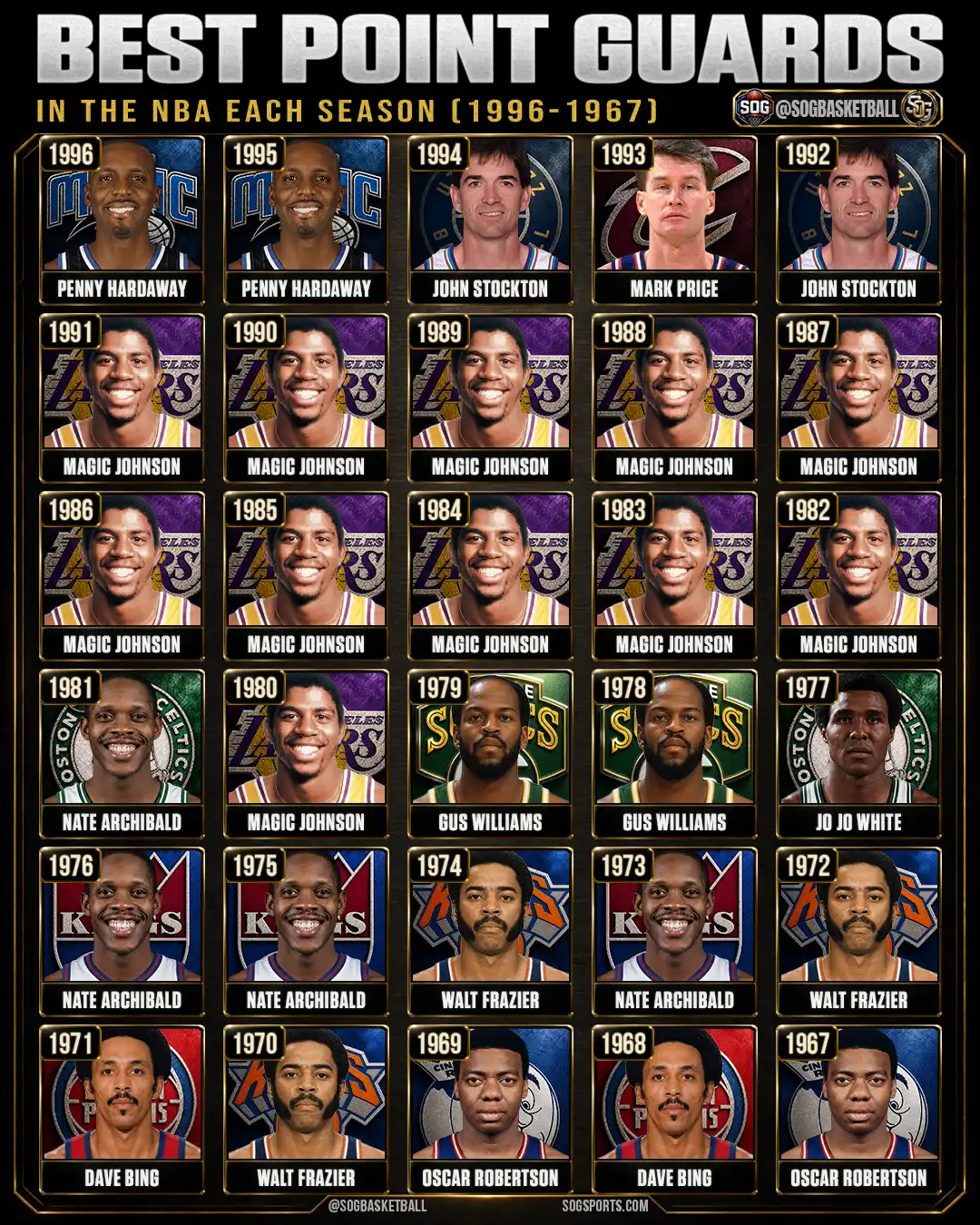
Best point guards in the NBA each season from 1967 through 1996, featuring Penny Hardaway, John Stockton, Magic Johnson, Nate Archibald, Walt Frazier, Oscar Robertson, Dave Bing, and more.
Best Point Guards Each NBA Season, 1996-1967
1996 — Penny Hardaway
Penny Hardaway averaged 21.7 points, 7.1 assists and 4.3 rebounds, earning first-team All-NBA recognition for the second consecutive season. At 6-foot-7, he could create passing angles unavailable to smaller guards while still scoring efficiently.
Shaquille O’Neal missed 28 games, forcing Hardaway to carry a larger share of Orlando’s offense. Gary Payton won Defensive Player of the Year and led Seattle to the Finals, but Penny’s scoring efficiency and expanded offensive responsibility give him the fixed selection.
1995 — Penny Hardaway
Hardaway averaged 20.9 points, 7.2 assists and 4.4 rebounds while shooting 51.2 percent from the field. He earned first-team All-NBA honours during only his second professional season.
Orlando reached the NBA Finals with Hardaway supplying the perimeter creation around O’Neal. His size allowed him to see over traps, finish against smaller defenders and shift between conventional point guard duties and off-ball scoring.
1994 — John Stockton
Stockton averaged 12.6 assists per game, leading the NBA for the seventh consecutive season. Utah’s offense depended on his ability to deliver passes at the exact moment Karl Malone or another cutter gained leverage.
The basic Stockton-Malone pick-and-roll was familiar to every opponent, yet Stockton’s patience made it difficult to predict which read he would choose. He rarely chased individual scoring totals when an earlier pass could create a cleaner possession.
1993 — Mark Price
Mark Price averaged 18.2 points and 8.0 assists, earning first-team All-NBA recognition. He shot 48.4 percent from the field, 41.6 percent from three and 94.8 percent from the foul line.
Price was an early example of how shooting could multiply a point guard’s playmaking. Defenders could not comfortably go under screens, and aggressive coverage allowed him to release the ball to open teammates before the second defender recovered.
1992 — John Stockton
Stockton averaged 13.7 assists per game, the second-highest single-season mark in NBA history. He also contributed 15.8 points while shooting better than 48 percent from the field.
Utah reached the Western Conference Finals with Stockton controlling the pace and feeding Malone in nearly every useful area of the floor. His passing totals were enormous, but the more important quality was how rarely those assists came at the cost of reckless possessions.
1991 — Magic Johnson
Magic Johnson averaged 19.4 points, 12.5 assists and 7.0 rebounds, finishing second in MVP voting and earning first-team All-NBA recognition.
The Lakers no longer played at the constant speed of their earlier Showtime teams, but Magic adapted. He used his size in the post, controlled half-court matchups and led Los Angeles back to the NBA Finals without Kareem Abdul-Jabbar anchoring the roster.
1990 — Magic Johnson
Magic averaged 22.3 points, 11.5 assists and 6.6 rebounds, winning the third MVP award of his career. He also shot 38.4 percent from three, a major improvement that complicated the usual defensive approach against him.
Los Angeles won 63 games with Magic balancing transition creation, post scoring and half-court passing. By this stage, he could punish opponents whether they gave him space, assigned a smaller defender or switched a forward onto him.
1989 — Magic Johnson
Magic won NBA MVP after averaging 22.5 points, 12.8 assists and 7.9 rebounds. He posted the highest scoring average of his career while continuing to create more than 12 assists per game.
The Lakers reached the NBA Finals with Magic taking on additional scoring responsibility. His combination of post strength and transition passing allowed him to control the game without relying on one specific pace or lineup structure.
1988 — Magic Johnson
Magic averaged 19.6 points, 11.9 assists and 6.2 rebounds while leading Los Angeles through a demanding postseason. The Lakers became the first team since the 1969 Celtics to repeat as NBA champions.
His ability to adjust within a series separated him from other point guards. Magic could speed up a game, attack a mismatch from the post or spend several possessions feeding Abdul-Jabbar and James Worthy in their preferred areas.
1987 — Magic Johnson
Magic produced his greatest individual season, averaging 23.9 points, 12.2 assists and 6.3 rebounds. He won NBA MVP, led the Lakers to 65 victories and finished the postseason as Finals MVP.
The increased scoring made him almost impossible to scheme against. Defenders who backed away risked allowing Magic to build momentum, while tighter coverage gave him a direct path to the paint or an easy passing angle over the top.
1986 — Magic Johnson
Magic averaged 18.8 points, a league-leading 12.6 assists and 5.9 rebounds. He controlled an offense that finished near the top of the NBA while sharing possessions with Abdul-Jabbar and Worthy.
Los Angeles fell short of the Finals, but Magic remained the position’s most complete creator. His rebounding allowed the Lakers to skip the outlet pass and begin attacking immediately after a defensive stop.
1985 — Magic Johnson
Magic averaged 18.3 points, 12.6 assists and 6.2 rebounds while shooting 56.1 percent from the field. Los Angeles returned to the Finals and defeated Boston after losing to the Celtics the previous year.
Magic’s passing dictated the speed of the series, but his efficiency was equally important. He did not need high shot volume to create pressure because every drive, post touch and transition push forced the defense to account for several possibilities.
1984 — Magic Johnson
Magic led the NBA with 13.1 assists per game while adding 17.6 points and 7.3 rebounds. The Lakers once again reached the Finals, where they lost a seven-game series to Boston.
His size allowed Los Angeles to use him as both the lead ball-handler and a frontcourt initiator. Even when opponents interrupted the initial break, Magic could carry the same advantage into a half-court set.
1983 — Magic Johnson
Magic averaged 16.8 points, 10.5 assists and 8.6 rebounds, leading the league in assists and earning first-team All-NBA honours.
The Lakers reached a third consecutive Finals despite dealing with major injuries by the end of the postseason. Magic’s ability to fill the rebounding, passing and scoring columns gave Los Angeles a stable center of offense even as available lineups changed.
1982 — Magic Johnson
Magic nearly averaged a triple-double with 18.6 points, 9.6 rebounds and 9.5 assists. He also led the NBA with 2.7 steals per game.
Los Angeles won the championship, and Magic earned his second Finals MVP in three seasons. He could dominate a series without leading his team in shot attempts because his rebounding, passing and positional flexibility influenced nearly every possession.
1981 — Nate Archibald
Nate “Tiny” Archibald averaged 13.8 points and 7.7 assists, earning second-team All-NBA recognition and helping Boston win the championship.
His role differed from the enormous scoring burden he carried earlier in his career. With Larry Bird, Robert Parish and Kevin McHale supplying frontcourt production, Archibald’s speed and decision-making gave the Celtics the reliable guard play needed to connect those pieces.
1980 — Magic Johnson
Magic averaged 18.0 points, 7.7 rebounds and 7.3 assists as a rookie. He joined a veteran Lakers roster and immediately gave the team a larger, faster primary ball-handler.
His season ended with one of the most famous rookie performances in league history. With Abdul-Jabbar unavailable for Game 6 of the Finals, Magic produced 42 points, 15 rebounds and seven assists as Los Angeles clinched the championship. He became the first rookie to win Finals MVP.
1979 — Gus Williams
Gus Williams averaged 19.2 points and 4.0 assists during the regular season before increasing his scoring in the playoffs. His quickness gave Seattle a direct attacking option alongside Dennis Johnson’s defense and Jack Sikma’s interior play.
The SuperSonics won the championship by defeating Washington in a Finals rematch. Williams’ ability to turn defensive rebounds and loose possessions into immediate pressure was essential to Seattle’s offense throughout the run.
1978 — Gus Williams
Williams averaged 20.0 points and 4.1 assists in his first season with Seattle. He supplied the speed and scoring aggression that helped transform a team that began the year poorly into a championship contender.
Seattle reached the NBA Finals and pushed Washington to seven games. Williams was not a traditional pass-first organizer, but his ability to break down defenders and create points before the defense became set made him the fixed selection.
1977 — Jo Jo White
Jo Jo White averaged 19.6 points, 6.0 assists and 4.7 rebounds, earning second-team All-NBA recognition. He played all 82 games and averaged more than 40 minutes per night.
Boston’s championship core was aging, but White remained a dependable scorer and organizer. His postseason scoring increased as the Celtics reached the Eastern Conference Semifinals, reinforcing his value beyond a steady regular-season stat line.
1976 — Nate Archibald
Archibald averaged 24.8 points and 7.9 assists, earning first-team All-NBA recognition. His speed forced defenders to retreat early, creating room for pull-up shots and passing lanes into the paint.
Kansas City did not have the supporting talent of the league’s leading contenders, so Archibald carried a larger creation burden than most point guards. He remained productive without the three-point spacing modern guards use to open driving lanes.
1975 — Nate Archibald
Archibald averaged 26.5 points and 6.8 assists, returning to All-NBA form after injuries disrupted the previous season. His quickness remained one of the most difficult individual problems in professional basketball.
He gave Kansas City a true offensive engine. Archibald could turn the corner before larger defenders arrived, stop suddenly for a jumper or draw help and deliver the ball to an open teammate. The lack of a three-point line made the space he created even more valuable.
1974 — Walt Frazier
Walt Frazier averaged 20.5 points, 6.9 assists and 6.7 rebounds, earning first-team All-NBA and first-team All-Defensive honours.
Frazier’s selection rests on balance. He could initiate New York’s offense, score efficiently from the midrange, rebound his position and defend the opponent’s best guard. Few point guards from any era have combined those responsibilities as evenly.
1973 — Nate Archibald
Archibald averaged 34.0 points and 11.4 assists, becoming the only player in NBA history to lead the league in both scoring and assists during the same season.
The Kings won only 36 games, but Archibald’s individual offensive responsibility was extraordinary. He created the majority of the team’s best shots while also carrying a scoring workload normally associated with a high-volume wing or center.
1972 — Walt Frazier
Frazier averaged 23.2 points, 6.7 rebounds and 5.8 assists while contributing elite perimeter defense. He earned first-team All-NBA and first-team All-Defensive honours as New York returned to the NBA Finals.
Jerry West produced a tremendous season for the champion Lakers, but this series classifies West primarily as a shooting guard. Among the players eligible at point guard, Frazier’s two-way responsibility and postseason importance give him the selection.
1971 — Dave Bing
Dave Bing averaged 27.0 points, 5.0 assists and 4.4 rebounds and earned first-team All-NBA recognition. Detroit depended heavily on his ability to create shots against defenses that could crowd the paint without a three-point line.
West again has a strong argument when treated as a point guard, but he is classified as a shooting guard for this position series. Bing’s scoring volume, handle and playmaking responsibility make him the top eligible choice.
1970 — Walt Frazier
Frazier averaged 20.9 points, 8.2 assists and 6.0 rebounds while earning first-team All-Defensive recognition. New York won 60 games and finished the season with its first NBA championship.
His defining performance came in Game 7 of the Finals against the Lakers. With Willis Reed limited by injury, Frazier recorded 36 points and 19 assists, controlling the deciding game as both a scorer and facilitator.
1969 — Oscar Robertson
Oscar Robertson averaged 24.7 points, 9.8 assists and 6.4 rebounds, earning first-team All-NBA recognition. His size allowed him to protect the ball, post smaller guards and rebound like a forward.
Cincinnati struggled as a team, but Robertson remained one of the league’s most productive offensive players. His ability to combine scoring and playmaking at that volume established a model later followed by larger primary creators.
1968 — Dave Bing
Bing averaged 27.1 points, 6.4 assists and 4.7 rebounds, leading the NBA in total points and earning first-team All-NBA recognition.
He attacked with speed but did not rely exclusively on transition. Bing could create pull-up shots, reach the paint and initiate Detroit’s half-court offense, giving him one of the league’s largest perimeter workloads.
1967 — Oscar Robertson
Robertson averaged 30.5 points, 10.7 assists and 6.2 rebounds, earning first-team All-NBA honours. He combined point guard decision-making with the size and strength to punish switches and smaller defenders.
The Big O controlled nearly every part of Cincinnati’s offense. He could lead the team in scoring or assists on any night, rebound well enough to start the break himself and create efficient chances in a league without modern spacing.
Best Point Guards Each NBA Season, 1966-1947
1966 — Oscar Robertson
Robertson averaged 31.3 points, 11.1 assists and 7.7 rebounds, leading the NBA in assists and finishing third in MVP voting. He earned first-team All-NBA recognition for the sixth consecutive season.
The volume is remarkable even before accounting for his efficiency and workload. Cincinnati placed the ball in Robertson’s hands to initiate the offense, create his own shot and solve late-clock possessions. Defenders had to deal with a 6-foot-5 guard who could see over pressure, overpower smaller matchups and still deliver more than 11 assists per game.
1965 — Oscar Robertson
Robertson averaged 30.4 points, 11.5 assists and 9.0 rebounds. He led the league in assists, made first-team All-NBA and again approached a triple-double average across a full season.
The Royals did not possess the interior dominance of Boston or Philadelphia, so Robertson had to manufacture offense through guard creation. He could slow down and operate from the post, push the ball after rebounds or attack set defenses with strength and precise passing. No other eligible point guard matched his complete offensive responsibility.
1964 — Oscar Robertson
Robertson won NBA MVP after averaging 31.4 points, 11.0 assists and 9.9 rebounds. Cincinnati won 55 games, the strongest regular-season finish of Robertson’s Royals career.
This was not simply a statistical award. Robertson controlled a top contender while combining the responsibilities of a scoring leader, lead passer and high-level rebounder. His ability to produce efficient offense in several different ways made him one of the few perimeter players capable of breaking the center-dominated MVP pattern of the era.
1963 — Oscar Robertson
Robertson averaged 28.3 points, 10.4 assists and 9.5 rebounds, earning first-team All-NBA recognition. He led the league in assists while nearly averaging a triple-double for the second consecutive season.
Cincinnati reached the Eastern Division Finals, where the Royals pushed the eventual champion Celtics to seven games. Robertson’s postseason creation gave Boston a problem it could not solve with one defender, even though the Celtics possessed the league’s deepest and best defensive roster.
1962 — Oscar Robertson
Robertson averaged 30.8 points, 12.5 rebounds and 11.4 assists, becoming the first player in NBA history to average a triple-double for an entire season.
The achievement is even more striking because assists were credited more conservatively than they are today. Robertson did not accumulate those numbers by chasing uncontested rebounds or operating in a five-out offense. He carried the scoring and passing burden in a crowded half court while playing more than 44 minutes per game.
1961 — Oscar Robertson
Robertson entered the NBA and immediately averaged 30.5 points, 10.1 rebounds and 9.7 assists. He won Rookie of the Year, led the league in assists and earned first-team All-NBA honours.
Few rookies in any sport have arrived with a more complete offensive game. Robertson’s size allowed him to play through contact, his vision translated immediately against professional defenses and his rebounding let him begin fast breaks without waiting for an outlet pass. He displaced an aging Bob Cousy as the position’s top player in his first season.
1960 — Bob Cousy
Bob Cousy averaged 19.4 points, 9.5 assists and 4.7 rebounds, leading the NBA in assists for the eighth consecutive season. Boston won 59 games and repeated as champion.
Cousy was no longer the league MVP version of himself, but he remained the organizer of the NBA’s most effective transition attack. His passing allowed Bill Russell’s rebounds to become immediate scoring chances, while his creativity gave Boston a half-court option when opponents prevented the initial break.
1959 — Bob Cousy
Cousy averaged 20.0 points, 8.6 assists and 5.5 rebounds, once again leading the league in assists and earning first-team All-NBA recognition.
Boston won 52 games and swept Minneapolis in the Finals, beginning its run of eight consecutive championships. Russell anchored the defense, but Cousy determined how quickly the Celtics converted stops into offense. His willingness to pass early helped Boston attack before opposing centers could protect the paint.
1958 — Bob Cousy
Cousy averaged 18.0 points, 7.1 assists and 5.0 rebounds, leading the NBA in assists and making first-team All-NBA. Boston finished with the league’s best record and returned to the Finals.
The Celtics lost the championship series after Russell suffered an ankle injury, but Cousy remained the league’s strongest point guard over the full season. He combined creative transition passing with enough scoring pressure to prevent defenders from treating him as a distributor only.
1957 — Bob Cousy
Cousy averaged 20.6 points, 7.5 assists and 4.8 rebounds, won NBA MVP and helped Boston capture the first championship in franchise history.
Russell’s arrival completed the Celtics defensively, while Cousy gave the team its offensive personality. He pushed the pace, improvised passes that few guards attempted and remained a major scorer when Boston needed half-court offense. This was the clearest peak of his career and the defining point guard season of the 1950s.
1956 — Bob Cousy
Cousy averaged 18.8 points, 8.9 assists and 6.8 rebounds, leading the league in assists and earning first-team All-NBA recognition.
Boston had not yet added Russell, so Cousy carried more responsibility for generating advantages with an offense-first roster. His passing totals came in the final season before the MVP-winning breakthrough, but the style was already established: advance the ball quickly, force the defense to turn and deliver the pass before the opening disappeared.
1955 — Bob Cousy
Cousy averaged 21.2 points, 7.8 assists and 6.0 rebounds, finishing second in the NBA in scoring and leading the league in assists.
The introduction of the 24-second shot clock transformed professional basketball, and Cousy was perfectly suited for the faster environment. He could create in the open court, control the ball without slowing the pace and turn extra possessions into efficient opportunities for Boston’s shooters.
1954 — Bob Cousy
Cousy averaged 19.2 points, 7.2 assists and 5.5 rebounds, leading the league in assists and making first-team All-NBA.
This was the final season before the shot clock, when teams could hold the ball and reduce the number of meaningful possessions. Cousy still produced passing numbers that stood well above the league. His willingness to attack and create gave Boston an offensive identity that was far more ambitious than the slowest teams of the era.
1953 — Bob Cousy
Cousy averaged 19.8 points, 7.7 assists and 6.3 rebounds, winning the first of eight consecutive assist titles and earning first-team All-NBA recognition.
His postseason included a 50-point performance in a four-overtime victory over Syracuse. Cousy repeatedly extended the game with late free throws and scored throughout the extra periods, showing that his value was not limited to setting up teammates. This was the season he clearly became the NBA’s premier point guard.
1952 — Bob Cousy
Cousy averaged 21.7 points, 6.7 assists and 6.4 rebounds, earning first-team All-NBA recognition during only his second season.
Andy Phillip led the league with 8.2 assists per game, but Cousy supplied a much stronger scoring threat while remaining one of the league’s leading passers. His combination of production and creativity marked the beginning of the transition from Bob Davies’ era to Cousy’s long run at the top.
1951 — Bob Davies
Bob Davies averaged 15.2 points, 4.6 assists and 3.1 rebounds, earning first-team All-NBA recognition. He was the lead guard for a Rochester team that won the only championship in franchise history.
Davies made one of the decisive plays of the Finals, driving to draw a foul and making two late free throws in Game 7 against New York. Andy Phillip led the league in assists, but Davies combined high-level playmaking with more scoring and championship control. Before Cousy fully emerged, Davies was professional basketball’s most complete point guard.
1950 — Bob Davies
Davies averaged 14.0 points and 4.6 assists, earning first-team All-NBA recognition for the second consecutive season.
Rochester won 51 games, the most in the league, and Davies remained the backcourt engine of one of basketball’s strongest teams. Andy Phillip and Dick McGuire produced larger assist totals, but Davies offered the better overall blend of passing, scoring and team success. His dribbling and change-of-direction ability were particularly valuable in an era with far less spacing.
1949 — Bob Davies
Davies averaged 15.1 points and a league-leading 5.4 assists, earning first-team All-BAA recognition in Rochester’s first season in the league.
The Royals finished 45-15 and edged the Minneapolis Lakers for the Western Division’s best record. Davies gave Rochester a true offensive organizer at a time when many teams still divided ball-handling duties among several guards. His combination of scoring and passing made him the clearest early predecessor to Cousy.
1948 — Howie Dallmar
Howie Dallmar averaged 12.2 points and 2.5 assists, led the BAA in total assists and earned first-team All-BAA recognition.
Those passing numbers look modest by modern standards, but early scorekeepers generally awarded an assist only when the pass led almost immediately to a basket. Dallmar directed a Philadelphia team that returned to the Finals after winning the league’s first championship. Buddy Jeannette won the title as Baltimore’s player-coach, but Dallmar produced the stronger full regular season.
1947 — Ernie Calverley
Ernie Calverley led the BAA’s inaugural season with 3.4 assists per game while scoring 14.3 points. He earned second-team All-BAA recognition for the Providence Steamrollers.
Calverley played in a league where no team averaged 80 points and field-goal percentages remained around 30 percent. Creating more than three credited assists per game under those conditions represented a meaningful playmaking advantage. Bob Feerick had the stronger all-around season as a guard-forward, but Calverley was the clearest point guard and the league’s first official assists leader.
Hardest Decisions and Closest Calls
Some seasons produced a clear selection. Others required a choice between regular-season availability, individual production, team success and postseason performance. These were the most important debates within the final order.
2026 — Shai Gilgeous-Alexander vs. Jalen Brunson
Gilgeous-Alexander won his second consecutive MVP, averaged 31.1 points and led Oklahoma City to a 64-18 record. Brunson delivered the stronger postseason ending by leading New York to the championship and winning Finals MVP. Shai’s larger full-season advantage keeps him first, while Brunson’s playoff run makes this much closer than the regular-season award voting indicates.
2024 — Luka Dončić vs. Shai Gilgeous-Alexander
Gilgeous-Alexander offered better efficiency, defense and regular-season team success. Dončić led the league in scoring, nearly averaged a triple-double and controlled Dallas’ run to the NBA Finals. Luka’s combination of regular-season volume and postseason creation gives him the edge.
2020 — Stephen Curry and the Availability Exception
Curry played only five games, so this selection cannot be defended through conventional season value. Dončić made first-team All-NBA, Lillard made the second team and Paul led Oklahoma City to a surprising 44-28 record. Curry remains in place because the supplied order is fixed, but the section openly identifies it as the list’s major exception rather than hiding the availability problem.
2018 — Stephen Curry vs. Damian Lillard
Lillard played 73 games, made first-team All-NBA and carried a heavier regular-season workload. Curry appeared in only 51 games but was substantially more efficient and returned to help Golden State win the championship. The selection prioritizes Curry’s level when available and his postseason influence, while acknowledging that Lillard supplied more total regular-season value.
2014 — Stephen Curry vs. Chris Paul
Paul led the league in assists and steals and earned first-team All-NBA recognition. Curry averaged 24.0 points and 8.5 assists while carrying more of Golden State’s scoring creation. Paul had the cleaner traditional point guard résumé, but Curry’s combined shooting and playmaking burden gives him the fixed SOG Sports selection.
1997 — John Stockton vs. Tim Hardaway and Gary Payton
Hardaway made first-team All-NBA, while Payton brought the strongest scoring-defense combination. Stockton made the third team but directed a 64-win offense and helped Utah reach the NBA Finals. His efficiency, passing and team control provide the basis for selecting him over guards with stronger individual award placements.
1996 — Penny Hardaway vs. Gary Payton
Hardaway averaged 21.7 points and 7.1 assists while making first-team All-NBA. Payton won Defensive Player of the Year, led the league in steals and helped Seattle reach the Finals. Penny’s efficient scoring and expanded responsibility while O’Neal missed time narrowly win the comparison.
1952 — Bob Cousy vs. Andy Phillip
Phillip led the league with 8.2 assists per game, a huge total for the pre-shot-clock era. Cousy averaged 21.7 points while still creating 6.7 assists and earning first-team All-NBA recognition. Cousy’s broader offensive burden gives him the edge even before his run of eight consecutive assist titles began.
1948 — Howie Dallmar vs. Buddy Jeannette
Dallmar led the league in assists, made first-team All-BAA and helped Philadelphia return to the Finals. Jeannette served as a player-coach and led Baltimore to the championship. Dallmar’s superior regular-season recognition and playmaking production outweigh the championship tiebreaker.
How Jerry West Was Classified
West regularly handled lead-guard responsibilities and has a strong statistical argument for several early-1970s selections. This series assigns hybrid players to one predominant position, and West is classified as a shooting guard. That decision keeps the position pages from using the same historically versatile player in several different lists.
Complete Table: Best Point Guard Every Season in NBA History
| Season | Best Point Guard | Team |
|---|---|---|
| 2025-26 | Shai Gilgeous-Alexander | Oklahoma City Thunder |
| 2024-25 | Shai Gilgeous-Alexander | Oklahoma City Thunder |
| 2023-24 | Luka Dončić | Dallas Mavericks |
| 2022-23 | Luka Dončić | Dallas Mavericks |
| 2021-22 | Luka Dončić | Dallas Mavericks |
| 2020-21 | Stephen Curry | Golden State Warriors |
| 2019-20 | Stephen Curry | Golden State Warriors |
| 2018-19 | Stephen Curry | Golden State Warriors |
| 2017-18 | Stephen Curry | Golden State Warriors |
| 2016-17 | Russell Westbrook | Oklahoma City Thunder |
| 2015-16 | Stephen Curry | Golden State Warriors |
| 2014-15 | Stephen Curry | Golden State Warriors |
| 2013-14 | Stephen Curry | Golden State Warriors |
| 2012-13 | Chris Paul | Los Angeles Clippers |
| 2011-12 | Chris Paul | Los Angeles Clippers |
| 2010-11 | Derrick Rose | Chicago Bulls |
| 2009-10 | Steve Nash | Phoenix Suns |
| 2008-09 | Chris Paul | New Orleans Hornets |
| 2007-08 | Chris Paul | New Orleans Hornets |
| 2006-07 | Steve Nash | Phoenix Suns |
| 2005-06 | Steve Nash | Phoenix Suns |
| 2004-05 | Steve Nash | Phoenix Suns |
| 2003-04 | Jason Kidd | New Jersey Nets |
| 2002-03 | Jason Kidd | New Jersey Nets |
| 2001-02 | Jason Kidd | New Jersey Nets |
| 2000-01 | Jason Kidd | Phoenix Suns |
| 1999-00 | Gary Payton | Seattle SuperSonics |
| 1998-99 | Jason Kidd | Phoenix Suns |
| 1997-98 | Gary Payton | Seattle SuperSonics |
| 1996-97 | John Stockton | Utah Jazz |
| 1995-96 | Penny Hardaway | Orlando Magic |
| 1994-95 | Penny Hardaway | Orlando Magic |
| 1993-94 | John Stockton | Utah Jazz |
| 1992-93 | Mark Price | Cleveland Cavaliers |
| 1991-92 | John Stockton | Utah Jazz |
| 1990-91 | Magic Johnson | Los Angeles Lakers |
| 1989-90 | Magic Johnson | Los Angeles Lakers |
| 1988-89 | Magic Johnson | Los Angeles Lakers |
| 1987-88 | Magic Johnson | Los Angeles Lakers |
| 1986-87 | Magic Johnson | Los Angeles Lakers |
| 1985-86 | Magic Johnson | Los Angeles Lakers |
| 1984-85 | Magic Johnson | Los Angeles Lakers |
| 1983-84 | Magic Johnson | Los Angeles Lakers |
| 1982-83 | Magic Johnson | Los Angeles Lakers |
| 1981-82 | Magic Johnson | Los Angeles Lakers |
| 1980-81 | Nate Archibald | Boston Celtics |
| 1979-80 | Magic Johnson | Los Angeles Lakers |
| 1978-79 | Gus Williams | Seattle SuperSonics |
| 1977-78 | Gus Williams | Seattle SuperSonics |
| 1976-77 | Jo Jo White | Boston Celtics |
| 1975-76 | Nate Archibald | Kansas City Kings |
| 1974-75 | Nate Archibald | Kansas City-Omaha Kings |
| 1973-74 | Walt Frazier | New York Knicks |
| 1972-73 | Nate Archibald | Kansas City-Omaha Kings |
| 1971-72 | Walt Frazier | New York Knicks |
| 1970-71 | Dave Bing | Detroit Pistons |
| 1969-70 | Walt Frazier | New York Knicks |
| 1968-69 | Oscar Robertson | Cincinnati Royals |
| 1967-68 | Dave Bing | Detroit Pistons |
| 1966-67 | Oscar Robertson | Cincinnati Royals |
| 1965-66 | Oscar Robertson | Cincinnati Royals |
| 1964-65 | Oscar Robertson | Cincinnati Royals |
| 1963-64 | Oscar Robertson | Cincinnati Royals |
| 1962-63 | Oscar Robertson | Cincinnati Royals |
| 1961-62 | Oscar Robertson | Cincinnati Royals |
| 1960-61 | Oscar Robertson | Cincinnati Royals |
| 1959-60 | Bob Cousy | Boston Celtics |
| 1958-59 | Bob Cousy | Boston Celtics |
| 1957-58 | Bob Cousy | Boston Celtics |
| 1956-57 | Bob Cousy | Boston Celtics |
| 1955-56 | Bob Cousy | Boston Celtics |
| 1954-55 | Bob Cousy | Boston Celtics |
| 1953-54 | Bob Cousy | Boston Celtics |
| 1952-53 | Bob Cousy | Boston Celtics |
| 1951-52 | Bob Cousy | Boston Celtics |
| 1950-51 | Bob Davies | Rochester Royals |
| 1949-50 | Bob Davies | Rochester Royals |
| 1948-49 | Bob Davies | Rochester Royals |
| 1947-48 | Howie Dallmar | Philadelphia Warriors |
| 1946-47 | Ernie Calverley | Providence Steamrollers |
Frequently Asked Questions
Who was the best point guard in the NBA in 2025-26?
Shai Gilgeous-Alexander was SOG Sports’ choice as the best point guard of the 2025-26 season. He won his second consecutive MVP after averaging 31.1 points and helping Oklahoma City finish with a 64-18 record.
What does each year on the list represent?
Each year represents the NBA season that ended during that calendar year. The 2026 selection covers 2025-26, the 2025 selection covers 2024-25 and the 1947 selection covers the inaugural 1946-47 BAA season.
Why are the BAA seasons included?
The NBA officially includes the Basketball Association of America’s three seasons from 1946-47 through 1948-49 in its historical records. The BAA was renamed the NBA after absorbing the remaining National Basketball League teams before the 1949-50 season.
How were combo guards classified?
Hybrid players were assigned to one predominant position for the SOG Sports position series. Luka Dončić and Shai Gilgeous-Alexander qualify as point guards because of their primary creation roles, while Jerry West, Allen Iverson and James Harden are treated primarily as shooting guards.
Who appears most often on the list?
Magic Johnson appears 11 times, the most of any player. Bob Cousy appears nine times, while Stephen Curry and Oscar Robertson each appear seven times. Jason Kidd follows with five selections.
What was the greatest point guard season on the list?
Stephen Curry’s 2015-16 season is the strongest choice. He became the first unanimous MVP, averaged 30.1 points on 50-40-90 shooting, made a record 402 three-pointers and led Golden State to 73 regular-season wins.
Why were assist averages so low in the NBA’s earliest seasons?
Early scorekeepers applied a much stricter definition of an assist, usually requiring the pass to lead almost immediately to a basket. Teams also played at a slower pace before the 24-second shot clock was introduced in 1954-55, reducing the total number of possessions and scoring opportunities.
Sources and Data Notes
This article covers every season recognized in NBA history, beginning with the 1946-47 BAA season and continuing through 2025-26. Regular-season performance is the primary basis for each selection, with postseason impact used as an important factor in close comparisons.
The BAA’s three seasons from 1946-47 through 1948-49 are included because the NBA recognizes them as part of its official history. Statistical comparisons from the earliest years have limitations because assists were credited differently, rebounds were not recorded during the first three seasons and the league did not adopt the shot clock until 1954-55.
Position classifications are editorial decisions made for consistency across SOG Sports position lists. Basketball roles have changed across eras, and several players could reasonably qualify at more than one guard position. The ranking order itself is a SOG Sports opinion rather than an official NBA designation.
Final season included: 2025-26
Last reviewed: July 22, 2026
Conclusion
Shai Gilgeous-Alexander is the latest selection as the best point guard in the NBA, earning the 2026 spot after winning his second consecutive MVP. His combination of controlled scoring, efficiency and late-game creation places him at the front of a position that now demands much more individual offense than it did in earlier eras.
The complete history shows how the role evolved. Ernie Calverley became the league’s first assists leader. Bob Davies established an early all-around standard before Bob Cousy turned fast-break passing into the identity of a dynasty. Oscar Robertson added unprecedented scoring and rebounding, Magic Johnson used size and vision to control championship teams, and Stephen Curry changed how far defenses needed to extend.
From the BAA’s first season in 1946-47 through the completed 2025-26 campaign, these are the point guards SOG Sports selected as the best of every year in NBA history.
More NBA Rankings
Continue exploring NBA history with our ranking of the most points scored in NBA Finals history. You can also review every NBA Defensive Player of the Year winner by season, including Gary Payton’s historic win as a point guard.
Follow @sogbasketball for the most up to date NBA rankings!
