
This ranking identifies the best NBA center every year each season from 1967 through 2026. Victor Wembanyama leads the completed 2025–26 season, while Wilt Chamberlain begins the list with his championship season in 1966–67.
The winner is not automatically the highest scorer or the player with the most famous name. Regular-season production, All-NBA recognition, defense, efficiency, team dependence and postseason performance all matter.
The supplied rankings are preserved exactly. The audit is limited to fact-checking, stronger historical context, clearer methodology, improved structure, internal links and table formatting.
Table of Contents
- Quick Answer
- How the Best Center Is Chosen
- How the Season Years Work
- Who Qualifies as a Center?
- Best NBA Centers by Year: 2026–1997
- Best NBA Centers by Year: 1996–1967
- Closest Calls and Playoff Overrides
- Centers With the Most Selections
- Full Year-by-Year Table
- FAQ
- Sources and Data Notes
- Conclusion
- More NBA Rankings
Quick Answer: Who Was the Best NBA Center Each Year?
Victor Wembanyama was the best center of the 2025–26 NBA season. He averaged 25.0 points, 11.5 rebounds and 3.1 blocks, won unanimous Defensive Player of the Year, made the All-NBA First Team and led San Antonio to the NBA Finals as Western Conference Finals MVP.
The longest runs belong to Kareem Abdul-Jabbar, Hakeem Olajuwon and Shaquille O’Neal, who each lead eight seasons. Nikola Jokić owns six selections, followed by Dwight Howard with five and Moses Malone with four.
How the Best NBA Center Is Chosen
The ranking begins with regular-season performance, but it does not end there. The strongest case usually combines elite production with major awards, defensive impact and team success.
- Individual production: scoring, rebounding, passing, shot blocking, steals and efficiency.
- Recognition: MVP voting, All-NBA, All-Defensive teams, Defensive Player of the Year and All-Star selection.
- Two-way value: rim protection, defensive rebounding, screening, spacing and the ability to create or finish offense.
- Postseason performance: playoff production, matchup difficulty, championship impact and how far the player carried his team.
- Era and role: the responsibilities placed on centers in that season rather than applying one modern statistical standard to every decade.
All-NBA First Team selection is a major signal, but it is not an automatic answer. Hakeem Olajuwon in 1995, Kareem Abdul-Jabbar in 1985, Hakeem in 1986 and Moses Malone in 1981 all receive the selection because their postseason impact overcame a weaker regular-season voting result.
How the Season Years Work
Each year refers to the season that ended in that calendar year. Therefore, 2026 means the 2025–26 season, 2000 means the 1999–2000 season and 1967 means the 1966–67 season.
This format keeps the table compact and matches how championship and award seasons are commonly discussed.
Who Qualifies as a Center?
Traditional centers qualify automatically. Hybrid big men also qualify when they were officially recognised at center or performed a major share of their value at the position.
That rule is why Tim Duncan appears in 2013 and Anthony Davis appears in 2018 and 2020. Davis was listed as a center-forward on the 2018 All-NBA First Team and occupied the center slot on the 2020 All-NBA First Team. The rule is applied according to the player’s role in that specific season rather than his most familiar career label.
Best NBA Centers by Year: 2026–1997
2026 — Victor Wembanyama — San Antonio Spurs
Victor Wembanyama earns the 2026 spot after pairing an elite regular season with the strongest postseason by any center. Nikola Jokić remained the superior offensive engine, but Wembanyama supplied a larger two-way impact and carried San Antonio to the NBA Finals.
Wembanyama averaged 25.0 points, 11.5 rebounds and a league-leading 3.1 blocks. He became the first unanimous Defensive Player of the Year, made the All-NBA First Team and won Western Conference Finals MVP. That combination of regular-season defense and playoff success gives him the edge over Jokić.
2025 — Nikola Jokić — Denver Nuggets
Nikola Jokić remained the best center in basketball in 2025 because his offensive control was still almost impossible to match. Even when other stars had stronger award cases, Jokić’s combination of scoring, rebounding and playmaking kept him at the top of the position.
He averaged roughly 29.6 points, 12.7 rebounds and 10.2 assists, putting together one of the most complete statistical seasons ever by a center. A true big man averaging a triple-double while scoring efficiently is still hard to process, even after years of watching Jokić do impossible things.
2024 — Nikola Jokić — Denver Nuggets
Jokić’s 2024 season was another MVP-level masterpiece. Denver’s offense ran through him on almost every important possession, and he made the game look slow while everyone else tried to catch up.
He averaged 26.4 points, 12.4 rebounds and 9.0 assists, winning his third NBA MVP. His passing from the elbows, touch around the rim and ability to punish double-teams made him the league’s most complete offensive hub.
2023 — Nikola Jokić — Denver Nuggets
Jokić’s 2023 season ended with the championship run that fully locked in his place among the greatest centers ever. The regular season was elite, but the playoffs made the year feel historic.
He averaged 24.5 points, 11.8 rebounds and 9.8 assists in the regular season, then led Denver to its first NBA title while winning Finals MVP. His postseason passing and scoring control were ridiculous. Teams threw different coverages at him, and he solved almost all of them.
2022 — Nikola Jokić — Denver Nuggets
Jokić’s 2022 season was one of the best carry jobs by a center in modern NBA history. Denver was missing Jamal Murray and Michael Porter Jr. for most of the year, which put even more responsibility on Jokić’s shoulders.
He averaged 27.1 points, 13.8 rebounds and 7.9 assists, winning his second straight NBA MVP. The Nuggets were held together by his scoring, passing, rebounding and decision-making every night.
2021 — Nikola Jokić — Denver Nuggets
Jokić’s 2021 season was his official MVP breakthrough. He had already been one of the league’s most skilled big men, but this was the year he became the best center in basketball without much debate.
He averaged 26.4 points, 10.8 rebounds and 8.3 assists, playing every game and winning NBA MVP. The durability mattered. So did the passing. So did the scoring touch. Jokić was not just a great center anymore. He was one of the best players in the world.
2020 — Nikola Jokić — Denver Nuggets
Jokić’s 2020 season was not his statistical peak, but it was another step toward becoming the center who would soon own the league. His regular season was strong, and his playoff run in the bubble showed just how dangerous Denver could be when the offense ran through him.
He averaged 19.9 points, 9.7 rebounds and 7.0 assists, then helped lead the Nuggets to the Western Conference Finals. The passing was already elite, and his ability to score in the biggest playoff moments was becoming harder to deny.
2019 — Nikola Jokić — Denver Nuggets
Jokić’s 2019 season was the year he fully arrived as an All-NBA center. Denver won 54 games, and Jokić was the engine behind everything.
He averaged 20.1 points, 10.8 rebounds and 7.3 assists, earning first-team All-NBA honors. Most centers finished plays. Jokić created them, organized them and still scored efficiently when Denver needed a basket.
2018 — Joel Embiid — Philadelphia 76ers
Joel Embiid’s 2018 season was the first full proof that he could be one of the most dominant two-way big men in basketball. Philadelphia’s rise depended heavily on his scoring, rim protection and physical presence.
Embiid averaged 22.9 points, 11.0 rebounds and 1.8 blocks. He gave the 76ers a true franchise center, one who could score on the block, defend the paint and bring a level of personality that made the team feel dangerous again.
2017 — Rudy Gobert — Utah Jazz
Rudy Gobert gets the 2017 spot because of his defensive impact. He was not a high-volume scorer, but he controlled the paint, protected the rim and gave Utah one of the league’s best defensive foundations.
Gobert averaged 14.0 points, 12.8 rebounds and 2.6 blocks, finishing as one of the NBA’s most valuable defenders. His screens, rolls, rim protection and rebounding made him more important than the box score alone showed.
2016 — DeMarcus Cousins — Sacramento Kings
DeMarcus Cousins’ 2016 season was his offensive peak. Sacramento was not a clean situation, but Cousins still put together one of the most dominant statistical center seasons of the decade.
He averaged 26.9 points, 11.5 rebounds and 3.3 assists. Cousins could score on the block, face up, hit jumpers, pass from the high post and overwhelm smaller defenders with power. At his best, he was a nightmare matchup.
2015 — Marc Gasol — Memphis Grizzlies
Marc Gasol’s 2015 season was a masterclass in complete center play. He did not dominate with raw athleticism. He won with positioning, passing, defense, touch and basketball IQ.
Gasol averaged 17.4 points, 7.8 rebounds and 3.8 assists, earning first-team All-NBA honors. Memphis’ identity ran through him on both ends, and his mix of skill and toughness made him the best center of the year.
2014 — Joakim Noah — Chicago Bulls
Joakim Noah’s 2014 season was one of the most unique center seasons of the modern era. Derrick Rose was injured, Chicago needed someone to organize the offense and anchor the defense, and Noah did both.
He averaged 12.6 points, 11.3 rebounds, 5.4 assists and 1.5 blocks, won Defensive Player of the Year and finished fourth in MVP voting. His passing from the high post and relentless defense made him the heart of the Bulls.
2013 — Tim Duncan — San Antonio Spurs
Tim Duncan was technically deep into his career by 2013, but he was still playing elite center basketball. San Antonio leaned on his defense, decision-making and interior scoring, and he delivered another All-NBA season.
Duncan averaged 17.8 points, 9.9 rebounds and 2.7 blocks, helping the Spurs reach the NBA Finals. He was not the flashiest center in the league, but his two-way impact was still enormous.
2012 — Dwight Howard — Orlando Magic
Dwight Howard was still the league’s most physically dominant center in 2012. The situation in Orlando was messy, but Howard’s individual production and defensive presence remained elite.
He averaged 20.6 points, 14.5 rebounds and 2.1 blocks. Even without another Defensive Player of the Year award that season, he was still the center opponents had to plan around in the paint.
2011 — Dwight Howard — Orlando Magic
Howard’s 2011 season was probably the best of his career. He had the defense, the rebounding, the athletic finishing and enough post growth to carry a huge two-way burden.
He averaged 22.9 points, 14.1 rebounds and 2.4 blocks, winning his third straight Defensive Player of the Year. Orlando’s system depended on him protecting the rim and finishing everything inside.
2010 — Dwight Howard — Orlando Magic
Howard remained the NBA’s premier defensive center in 2010. Orlando’s identity was built around his ability to erase mistakes at the rim and dominate the glass.
He averaged 18.3 points, 13.2 rebounds and 2.8 blocks, winning Defensive Player of the Year. His offensive game was still limited in some ways, but his defensive value was overwhelming.
2009 — Dwight Howard — Orlando Magic
Dwight Howard’s 2009 season was the year his dominance reached the NBA Finals. He gave Orlando a defensive anchor, a lob threat and the kind of rebounding force that changed every matchup.
Howard averaged 20.6 points, 13.8 rebounds and 2.9 blocks, winning Defensive Player of the Year. The Magic built a Finals team around his rim protection and inside gravity.
2008 — Dwight Howard — Orlando Magic
Howard’s 2008 season showed that he had fully become the next dominant center. His athleticism, rebounding and finishing made him almost impossible to handle near the rim.
He averaged 20.7 points, 14.2 rebounds and 2.1 blocks. Even before his deepest playoff run, Howard already looked like the clear future of the center position.
2007 — Amar’e Stoudemire — Phoenix Suns
Amar’e Stoudemire gets the 2007 spot because his blend of explosion, finishing and pick-and-roll chemistry with Steve Nash was devastating. He was not a traditional defensive center, but offensively he gave Phoenix an elite big-man weapon.
Stoudemire averaged 20.4 points and 9.6 rebounds, shooting over 57 percent from the field. In the Seven Seconds or Less Suns offense, his rim pressure made everything open up.
2006 — Shaquille O’Neal — Miami Heat
Shaquille O’Neal was no longer at his absolute peak in 2006, but he was still the most important true center on a championship team. Miami needed his size, gravity and interior scoring to complete its title run.
Shaq averaged 20.0 points and 9.2 rebounds in the regular season, then helped the Heat win the NBA championship. Dwyane Wade was the Finals superstar, but Shaq’s presence still shaped the entire roster.
2005 — Shaquille O’Neal — Miami Heat
Shaq’s first season in Miami was a major success. He immediately changed the Heat’s ceiling and remained one of the most efficient interior scorers in basketball.
He averaged 22.9 points, 10.4 rebounds and 2.3 blocks, finishing second in MVP voting. Even past his Lakers peak, Shaq was still the center nobody wanted to deal with inside.
2004 — Shaquille O’Neal — Los Angeles Lakers
Shaq’s 2004 season was the final year of his Lakers run, and he was still an elite force. The Lakers had more star names around him, but the offense and interior pressure still leaned heavily on his dominance.
He averaged 21.5 points, 11.5 rebounds and 2.5 blocks. The peak was fading slightly, but Shaq was still the most physically overwhelming center in the league.
2003 — Shaquille O’Neal — Los Angeles Lakers
Shaq’s 2003 season was another year of massive production. He punished single coverage, forced double-teams and made every Lakers possession feel different because of his presence.
He averaged 27.5 points, 11.1 rebounds and 2.4 blocks. Even as the Lakers fell short of another title, Shaq’s individual dominance was still the center standard.
2002 — Shaquille O’Neal — Los Angeles Lakers
Shaq’s 2002 season ended with the Lakers completing a three-peat, and he was still the biggest matchup problem in basketball. His power around the rim changed entire defensive game plans.
He averaged 27.2 points, 10.7 rebounds and 2.0 blocks, then won another Finals MVP. At his peak, defending Shaq was less about stopping him and more about surviving the damage.
2001 — Shaquille O’Neal — Los Angeles Lakers
Shaq’s 2001 season was another dominant year in the middle of the Lakers dynasty. The regular season was strong, but the postseason is what made the year feel unstoppable.
He averaged 28.7 points, 12.7 rebounds and 2.8 blocks, then powered through the playoffs and won Finals MVP. His size, touch and physicality were too much for almost everyone.
2000 — Shaquille O’Neal — Los Angeles Lakers
Shaquille O’Neal’s 2000 season is one of the greatest center seasons ever. He was the league’s most dominant player, the MVP and the centerpiece of a championship team.
Shaq averaged 29.7 points, 13.6 rebounds and 3.0 blocks, winning NBA MVP, the scoring title and Finals MVP. This was peak Shaq: power, efficiency, rim pressure and total physical control.
1999 — Alonzo Mourning — Miami Heat
Alonzo Mourning’s 1999 season was built on defense, toughness and interior presence. In a lockout-shortened year, Mourning stood out as the league’s best defensive center.
He averaged 20.1 points, 11.0 rebounds and 3.9 blocks, winning Defensive Player of the Year. His shot blocking and intensity made Miami one of the league’s toughest teams.
1998 — Shaquille O’Neal — Los Angeles Lakers
Shaq’s 1998 season showed that his prime was already terrifying before the Lakers dynasty fully took off. He was too strong for most centers and too quick for the ones big enough to match his size.
He averaged 28.3 points, 11.4 rebounds and 2.4 blocks. The championships came later, but the dominance was already obvious.
1997 — Hakeem Olajuwon — Houston Rockets
Hakeem Olajuwon gets the 1997 spot as the last great season of his extended prime. He was not quite the same unstoppable force from the championship years, but his footwork, defense and playoff experience still separated him.
Hakeem averaged 23.2 points, 9.2 rebounds and 2.2 blocks. The Rockets added more star power around him, but Olajuwon remained the center who gave them their identity.
Best NBA Centers by Year: 1996–1967
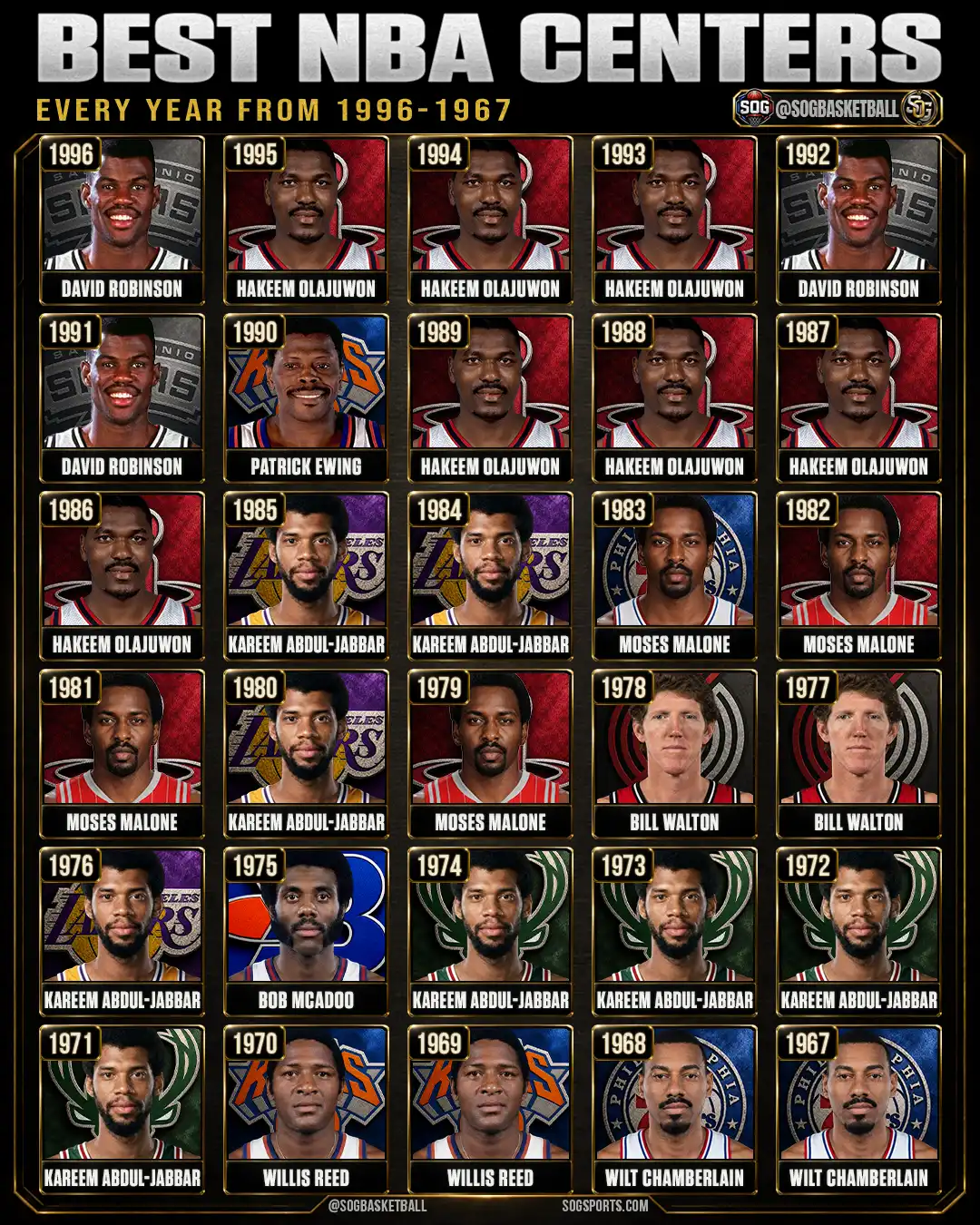
1996 — David Robinson — San Antonio Spurs
David Robinson’s 1996 season was another elite year from one of the most complete centers ever. He could score, rebound, protect the rim, run the floor and defend in space better than almost any big man of his era.
Robinson averaged 25.0 points, 12.2 rebounds and 3.3 blocks. Hakeem Olajuwon was still great, but Robinson’s regular-season two-way dominance gives him the edge here.
1995 — Hakeem Olajuwon — Houston Rockets
Hakeem Olajuwon’s 1995 season is remembered most for the playoff run, and for good reason. Houston entered as a lower seed, but Hakeem played like the best player in the world when it mattered most.
He averaged 27.8 points, 10.8 rebounds and 3.4 blocks in the regular season, then outplayed elite frontcourts on the way to another championship and Finals MVP. This was the Dream at his most surgical.
1994 — Hakeem Olajuwon — Houston Rockets
Hakeem’s 1994 season was the complete package. He won NBA MVP, Defensive Player of the Year and Finals MVP, becoming the clear best player in basketball.
He averaged 27.3 points, 11.9 rebounds and 3.7 blocks. His footwork on offense and timing on defense made him feel like two superstars in one body.
1993 — Hakeem Olajuwon — Houston Rockets
Hakeem’s 1993 season was the year before the championship breakthrough, but he was already playing at an MVP level. Houston’s title foundation was forming around his two-way dominance.
He averaged 26.1 points, 13.0 rebounds and 4.2 blocks, winning Defensive Player of the Year. His combination of footwork, shot blocking and quickness was unmatched.
1992 — David Robinson — San Antonio Spurs
David Robinson’s 1992 season was one of his best. He was an elite scorer, rebounder and defender who gave San Antonio a true franchise center.
Robinson averaged 23.2 points, 12.2 rebounds and 4.5 blocks, winning Defensive Player of the Year. His athleticism at center was rare, even in a decade full of great big men.
1991 — David Robinson — San Antonio Spurs
Robinson’s 1991 season confirmed that he was already one of the league’s premier centers. He had the frame and shot-blocking of a traditional big, but he moved like a forward.
He averaged 25.6 points, 13.0 rebounds and nearly 4 blocks per game. San Antonio’s entire identity changed because of his two-way impact.
1990 — Patrick Ewing — New York Knicks
Patrick Ewing’s 1990 season was the peak of his individual production. He gave the Knicks scoring, rebounding and rim protection at an elite level.
Ewing averaged 28.6 points, 10.9 rebounds and 4.0 blocks. New York’s defensive edge became famous later, but Ewing was already the franchise’s center of gravity.
1989 — Hakeem Olajuwon — Houston Rockets
Hakeem’s 1989 season showed that he was one of the most complete centers in basketball before his championship years. He could dominate with scoring, rebounding and defense every night.
He averaged 24.8 points, 13.5 rebounds, 2.6 steals and 3.4 blocks. Very few centers have ever filled a box score like that while also anchoring a defense.
1988 — Hakeem Olajuwon — Houston Rockets
Olajuwon’s 1988 season kept him near the top of a loaded center era. His footwork was already special, and his defensive range made him one of the league’s most disruptive big men.
He averaged 22.8 points, 12.1 rebounds and 2.7 blocks. The Dream Shake became more famous later, but the foundation was already there.
1987 — Hakeem Olajuwon — Houston Rockets
Hakeem’s 1987 season came after Houston’s Finals run, and he remained one of the league’s most dangerous two-way centers. His quickness made him different from most big men of the time.
He averaged 23.4 points, 11.4 rebounds and more than 3 blocks per game. His defensive activity and post scoring made him one of the hardest matchups in basketball.
1986 — Hakeem Olajuwon — Houston Rockets
Hakeem’s 1986 season was his arrival on the biggest stage. Alongside Ralph Sampson, he helped lead Houston to the NBA Finals and showed that he could dominate playoff basketball.
He averaged 23.5 points, 11.5 rebounds and 3.4 blocks. Even early in his career, his movement and defensive instincts looked unlike anyone else at center.
1985 — Kareem Abdul-Jabbar — Los Angeles Lakers
Kareem Abdul-Jabbar’s 1985 season proved that age had not taken away his greatness. He was deep into his career, but when the Lakers needed him most, he still delivered.
Kareem averaged 22.0 points and 7.9 rebounds in the regular season, then won Finals MVP as Los Angeles beat Boston. The skyhook was still one of the safest shots in basketball.
1984 — Kareem Abdul-Jabbar — Los Angeles Lakers
Kareem was still the league’s best center in 1984 because of his skill, consistency and value to the Lakers. The numbers were no longer from his early prime, but the impact remained elite.
He averaged 21.5 points, 7.3 rebounds and 1.8 blocks. His footwork, touch and ability to score in the half court kept the Lakers’ offense steady.
1983 — Moses Malone — Philadelphia 76ers
Moses Malone’s 1983 season was a championship masterpiece. Philadelphia needed a dominant center to get over the top, and Moses gave the 76ers exactly that.
He averaged 24.5 points and 15.3 rebounds, won NBA MVP and then won Finals MVP as the 76ers captured the title. His offensive rebounding and physicality wore teams down.
1982 — Moses Malone — Houston Rockets
Moses’ 1982 season was pure power and production. He was relentless on the glass, especially on the offensive boards, and he gave Houston a dominant interior scorer.
He averaged 31.1 points and 14.7 rebounds, winning NBA MVP. That combination of scoring and rebounding made him the league’s most imposing center.
1981 — Moses Malone — Houston Rockets
Moses was already in the middle of his prime in 1981. He did not win with polish as much as force, timing and persistence.
He averaged 27.8 points and 14.8 rebounds, leading Houston all the way to the NBA Finals. His rebounding motor gave opponents no rest.
1980 — Kareem Abdul-Jabbar — Los Angeles Lakers
Kareem’s 1980 season was another MVP year and another example of his timeless greatness. Magic Johnson’s arrival changed the Lakers, but Kareem was still the team’s best regular-season player.
He averaged 24.8 points, 10.8 rebounds and 3.4 blocks, winning NBA MVP. His scoring touch and rim protection kept him above the rest of the center field.
1979 — Moses Malone — Houston Rockets
Moses Malone’s 1979 season was his first MVP breakthrough. His rebounding dominance and physical scoring made him one of the toughest players in basketball to handle.
He averaged 24.8 points and 17.6 rebounds, winning NBA MVP. That rebounding number captures the whole point: Moses never stopped attacking the glass.
1978 — Bill Walton — Portland Trail Blazers
Bill Walton’s 1978 season was cut short by injury, but when he played, he was the best center in basketball. Portland’s offense and defense both ran through his intelligence.
Walton averaged 18.9 points, 13.2 rebounds, 5.0 assists and 2.5 blocks, winning NBA MVP. His passing, defense and team control made him a unique center before his body broke down.
1977 — Bill Walton — Portland Trail Blazers
Walton’s 1977 season was the full championship version of his greatness. He was not the highest scorer in the league, but he controlled games with defense, passing, rebounding and decision-making.
He averaged 18.6 points, 14.4 rebounds and 3.2 blocks, then led Portland to the NBA title and won Finals MVP. When healthy, Walton was one of the smartest centers ever.
1976 — Kareem Abdul-Jabbar — Los Angeles Lakers
Kareem’s 1976 season was another MVP-level year, this time in his first season with the Lakers. Los Angeles missed the playoffs, but Kareem’s individual dominance was still undeniable.
He averaged 27.7 points, 16.9 rebounds and 4.1 blocks, winning NBA MVP. The skyhook, rebounding and rim protection made him the best center in the league.
1975 — Bob McAdoo — Buffalo Braves
Bob McAdoo’s 1975 season was a scoring explosion from the center spot. He played with a face-up style that looked ahead of its time, using shooting touch and quickness to punish defenders.
McAdoo averaged 34.5 points, 14.1 rebounds and won NBA MVP. That kind of scoring from a big man was rare, and McAdoo made it look smooth.
1974 — Kareem Abdul-Jabbar — Milwaukee Bucks
Kareem’s 1974 season was another dominant year in Milwaukee. He remained the league’s most reliable interior scorer and one of its best defensive anchors.
He averaged 27.0 points, 14.5 rebounds and 3.5 blocks, winning NBA MVP. Milwaukee reached the NBA Finals, and Kareem was the biggest reason why.
1973 — Kareem Abdul-Jabbar — Milwaukee Bucks
Kareem was already the most dependable superstar center in the league by 1973. His skyhook gave him a shot defenses could not really take away.
He averaged 30.2 points, 16.1 rebounds and 5.0 assists. The scoring was huge, but his passing and defensive presence made the full package even stronger.
1972 — Kareem Abdul-Jabbar — Milwaukee Bucks
Kareem’s 1972 season was one of the great center seasons ever. He dominated as a scorer, rebounder and defensive presence, giving Milwaukee the league’s most reliable superstar.
He averaged 34.8 points, 16.6 rebounds and 4.6 assists, winning NBA MVP. At this point, the skyhook already felt like one of basketball’s most unfair weapons.
1971 — Kareem Abdul-Jabbar — Milwaukee Bucks
Kareem’s 1971 season, still early in his career, was already championship-level dominance. He led Milwaukee to the NBA title and looked like the future of the league had arrived ahead of schedule.
He averaged 31.7 points and 16.0 rebounds, won NBA MVP and captured the championship. Few players have ever reached this level this quickly.
1970 — Willis Reed — New York Knicks
Willis Reed’s 1970 season was a perfect blend of production, leadership and championship impact. The Knicks were built on teamwork and defense, but Reed was their emotional and physical center.
He averaged 21.7 points and 13.9 rebounds, won NBA MVP and then delivered one of the most iconic Finals moments ever. His Game 7 entrance against the Lakers became basketball history.
1969 — Willis Reed — New York Knicks
Reed’s 1969 season showed why he was one of the NBA’s best big men before the 1970 title run made him immortal. He gave New York scoring, rebounding and toughness.
He averaged 21.1 points and 14.5 rebounds. Reed was not the tallest center, but his strength and leadership helped shape the Knicks into a contender.
1968 — Wilt Chamberlain — Philadelphia 76ers
Wilt Chamberlain’s 1968 season was one of his great all-around years. By this stage, Wilt had shifted from pure scoring dominance into a more complete role built around passing, rebounding and defense.
He averaged 24.3 points, 23.8 rebounds and 8.6 assists, winning NBA MVP. Those numbers are still almost impossible to believe, especially from a center.
1967 — Wilt Chamberlain — Philadelphia 76ers
Wilt’s 1967 season was one of the most important center seasons ever. He became the hub of one of the greatest teams in NBA history and proved he could dominate without chasing scoring records.
He averaged 24.1 points, 24.2 rebounds and 7.8 assists, leading Philadelphia to the championship. It was a complete big-man season: scoring, rebounding, passing, defense and winning.
Closest Calls and Playoff Overrides
2026: Victor Wembanyama vs. Nikola Jokić
Jokić remained the league’s most complete offensive center and received unanimous All-NBA First Team support. Wembanyama counters with unanimous Defensive Player of the Year, the Western Conference Finals MVP and a trip to the NBA Finals. The postseason and defensive gap decide the year.
2017: Rudy Gobert vs. Anthony Davis
Davis made the All-NBA First Team and produced the much larger scoring line. Gobert anchored a 51-win team, made the All-Defensive First Team and advanced to the second round while New Orleans missed the playoffs. Team and defensive impact give Gobert the narrow edge.
1995: Hakeem Olajuwon vs. David Robinson
Robinson won regular-season MVP and had the stronger first-team All-NBA case. Olajuwon then outplayed him in the Western Conference Finals and led Houston to the championship as Finals MVP. This is the clearest example of the postseason changing the answer.
1986: Hakeem Olajuwon vs. Kareem Abdul-Jabbar
Kareem made the All-NBA First Team, but Olajuwon defeated the defending champion Lakers and led Houston to the Finals. His playoff dominance overcomes the regular-season voting result.
1985: Kareem Abdul-Jabbar vs. Moses Malone
Moses made the All-NBA First Team and led the league in rebounding. Kareem won the championship and Finals MVP after a decisive series against Boston, earning the selection on the total season.
1981: Moses Malone vs. Kareem Abdul-Jabbar
Kareem earned the All-NBA First Team spot, but Moses led a 40-42 Houston team past the Lakers and all the way to the NBA Finals while averaging 27.8 points and 14.8 rebounds.
1977: Bill Walton vs. Kareem Abdul-Jabbar
Kareem had the stronger scoring profile and won MVP, but Walton controlled the postseason through defense, rebounding and passing while leading Portland to the title and winning Finals MVP.
Centers With the Most Yearly Selections
The repeat leaders show how strongly certain players controlled their eras:
- Kareem Abdul-Jabbar: 8 seasons
- Hakeem Olajuwon: 8 seasons
- Shaquille O’Neal: 8 seasons
- Nikola Jokić: 6 seasons
- Dwight Howard: 5 seasons
- Moses Malone: 4 seasons
- David Robinson: 3 seasons
Full Year-by-Year Table: Best NBA Center Every Season
| Year | Best Center | Team |
|---|---|---|
| 2026 | Victor Wembanyama | San Antonio Spurs |
| 2025 | Nikola Jokić | Denver Nuggets |
| 2024 | Nikola Jokić | Denver Nuggets |
| 2023 | Nikola Jokić | Denver Nuggets |
| 2022 | Nikola Jokić | Denver Nuggets |
| 2021 | Nikola Jokić | Denver Nuggets |
| 2020 | Nikola Jokić | Denver Nuggets |
| 2019 | Nikola Jokić | Denver Nuggets |
| 2018 | Joel Embiid | Philadelphia 76ers |
| 2017 | Rudy Gobert | Utah Jazz |
| 2016 | DeMarcus Cousins | Sacramento Kings |
| 2015 | Marc Gasol | Memphis Grizzlies |
| 2014 | Joakim Noah | Chicago Bulls |
| 2013 | Tim Duncan | San Antonio Spurs |
| 2012 | Dwight Howard | Orlando Magic |
| 2011 | Dwight Howard | Orlando Magic |
| 2010 | Dwight Howard | Orlando Magic |
| 2009 | Dwight Howard | Orlando Magic |
| 2008 | Dwight Howard | Orlando Magic |
| 2007 | Amar’e Stoudemire | Phoenix Suns |
| 2006 | Shaquille O’Neal | Miami Heat |
| 2005 | Shaquille O’Neal | Miami Heat |
| 2004 | Shaquille O’Neal | Los Angeles Lakers |
| 2003 | Shaquille O’Neal | Los Angeles Lakers |
| 2002 | Shaquille O’Neal | Los Angeles Lakers |
| 2001 | Shaquille O’Neal | Los Angeles Lakers |
| 2000 | Shaquille O’Neal | Los Angeles Lakers |
| 1999 | Alonzo Mourning | Miami Heat |
| 1998 | Shaquille O’Neal | Los Angeles Lakers |
| 1997 | Hakeem Olajuwon | Houston Rockets |
| 1996 | David Robinson | San Antonio Spurs |
| 1995 | Hakeem Olajuwon | Houston Rockets |
| 1994 | Hakeem Olajuwon | Houston Rockets |
| 1993 | Hakeem Olajuwon | Houston Rockets |
| 1992 | David Robinson | San Antonio Spurs |
| 1991 | David Robinson | San Antonio Spurs |
| 1990 | Patrick Ewing | New York Knicks |
| 1989 | Hakeem Olajuwon | Houston Rockets |
| 1988 | Hakeem Olajuwon | Houston Rockets |
| 1987 | Hakeem Olajuwon | Houston Rockets |
| 1986 | Hakeem Olajuwon | Houston Rockets |
| 1985 | Kareem Abdul-Jabbar | Los Angeles Lakers |
| 1984 | Kareem Abdul-Jabbar | Los Angeles Lakers |
| 1983 | Moses Malone | Philadelphia 76ers |
| 1982 | Moses Malone | Houston Rockets |
| 1981 | Moses Malone | Houston Rockets |
| 1980 | Kareem Abdul-Jabbar | Los Angeles Lakers |
| 1979 | Moses Malone | Houston Rockets |
| 1978 | Bill Walton | Portland Trail Blazers |
| 1977 | Bill Walton | Portland Trail Blazers |
| 1976 | Kareem Abdul-Jabbar | Los Angeles Lakers |
| 1975 | Bob McAdoo | Buffalo Braves |
| 1974 | Kareem Abdul-Jabbar | Milwaukee Bucks |
| 1973 | Kareem Abdul-Jabbar | Milwaukee Bucks |
| 1972 | Kareem Abdul-Jabbar | Milwaukee Bucks |
| 1971 | Kareem Abdul-Jabbar | Milwaukee Bucks |
| 1970 | Willis Reed | New York Knicks |
| 1969 | Willis Reed | New York Knicks |
| 1968 | Wilt Chamberlain | Philadelphia 76ers |
| 1967 | Wilt Chamberlain | Philadelphia 76ers |
FAQ: Best NBA Center Every Year
Who was the best NBA center in 2026?
Victor Wembanyama was the best center of the 2025–26 season. He won unanimous Defensive Player of the Year, made the All-NBA First Team and led San Antonio to the NBA Finals as Western Conference Finals MVP.
Who was the best NBA center in 2025?
Nikola Jokić was the best center of the 2024–25 season after averaging 29.6 points, 12.7 rebounds and 10.2 assists.
Why are Joel Embiid and Nikola Jokić kept for 2018 and 2020?
The uploaded ranking selects Embiid in 2018 and Jokić in 2020. Anthony Davis has a strong argument in both seasons, but the original rankings are preserved exactly.
Why is DeMarcus Cousins selected in 2016?
Cousins carried a much larger scoring and creation burden, averaging 26.9 points, 11.5 rebounds and 3.3 assists. DeAndre Jordan had the stronger team and All-NBA case, but the supplied ranking keeps Cousins.
Why is Hakeem Olajuwon selected over David Robinson in 1995?
Robinson won regular-season MVP, but Olajuwon outplayed him in the Western Conference Finals and led Houston to the championship and Finals MVP.
Who has the most selections?
Kareem Abdul-Jabbar, Hakeem Olajuwon and Shaquille O’Neal are tied for the most selections with eight each.
What is the greatest center season on the list?
Shaquille O’Neal in 2000, Hakeem Olajuwon in 1994, Wilt Chamberlain in 1967, Kareem Abdul-Jabbar in 1972, Moses Malone in 1983 and Nikola Jokić in 2023 all have credible cases.
Does the ranking value the playoffs more than the regular season?
The playoffs can break a close race, but they do not automatically erase a large regular-season advantage. The weight depends on the quality of the postseason performance and the strength of the regular-season cases.
Sources and Data Notes
Regular-season statistics, award voting, All-NBA teams, All-Defensive teams and current 2025–26 information were checked against official NBA records. Historical playoff results and series statistics were cross-checked against NBA season reviews and Basketball-Reference.
Important definitions: The displayed year is the calendar year in which the season ended. Hybrid big men qualify when they were officially recognised at center or played a substantial center role during that season. The ranking includes both the regular season and playoffs.
Last reviewed: July 25, 2026.
Conclusion: The Center Position Keeps Changing
The list begins with Wilt Chamberlain controlling games as a scorer, rebounder and passer, moves through Kareem Abdul-Jabbar’s skyhook, Moses Malone’s offensive rebounding, Hakeem Olajuwon’s two-way footwork, Shaquille O’Neal’s power and Dwight Howard’s rim protection, and reaches Nikola Jokić’s offensive orchestration.
Victor Wembanyama represents the next shift. His 2026 selection combines Defensive Player of the Year impact with All-NBA offense and a run to the Finals. The job has changed, but the standard remains the same: the best center is the player who controls the season most completely.
More NBA All-Time Rankings
Continue the year-by-year series with the best point guards in the NBA each season.
Compare the modern centers on this list with the most rebounds in the NBA since 2000 and the most assists made in the NBA since 2000.
For historical scoring context, see the NBA’s all-time career scoring leaders and the most points scored in NBA Finals history.
The defensive side of the position is covered in the NBA Defensive Player of the Year winners by season.
Follow @sogbasketball for the most up-to-date basketball rankings!
