J.J. Watt is the SOG Sports pick for the best NFL edge rusher of the 2010s. He won three Defensive Player of the Year awards, recorded 96 regular-season sacks during the decade and affected games as both a pass rusher and run defender. Von Miller ranks second after leading every player with 106 sacks and producing the defining postseason run of the era.
This ranking covers the 2010 through 2019 NFL seasons. It rewards peak dominance, full-decade production, all-around defensive value and postseason performance rather than treating sacks as the only measure.
Table of Contents
How We Ranked the Best Edge Rushers of the 2010s
The ranking uses four connected factors. Peak dominance carries the most weight, followed by sustained value within the decade, complete edge play and postseason performance. Awards, sacks and forced fumbles provide evidence, but placement also accounts for run defense, pressure generation, alignment versatility and how consistently a defender demanded extra blocking attention.
- Peak dominance: The best two-to-four-season stretch, major awards and ability to take over games.
- Decade résumé: Production, availability and consistency from 2010 through 2019 only.
- Complete edge value: Pass rush, run defense, versatility and effectiveness beyond sacks.
- Postseason performance: Playoff production matters most when separating otherwise close cases.
Work before 2010 or after 2019 provides context but does not improve a player’s placement. That limits established veterans such as Julius Peppers, DeMarcus Ware, Jared Allen and Robert Mathis, along with late-decade arrivals such as T.J. Watt, Myles Garrett, Joey Bosa and Danielle Hunter.
The eligibility definition is broader than the modern EDGE label. It includes 4-3 defensive ends, 3-4 outside linebackers and hybrid defensive linemen who regularly created pressure from outside alignments. Watt qualifies because his role moved across the front and included substantial work from defensive end and wider techniques. Interior-first defenders such as Aaron Donald belong in a separate defensive tackle ranking.
Toughest Omissions
James Harrison, Brian Orakpo, Trent Cole, Olivier Vernon and Shaquil Barrett were the hardest players to leave outside the top 30. Harrison and Cole carried more of their peak value from the previous decade, while Orakpo and Vernon fell just short of the final group’s blend of peak and sustained production.
Barrett presents the most interesting peak-versus-longevity argument. His 19.5-sack season in 2019 was better than any single season produced by several players who made the list, but it was his only season as a full-time star inside this window. Garrett and T.J. Watt also had short decade résumés, but each supplied three seasons of high-end production.
Best Edge Rushers of the 2010s: Nos. 30-21
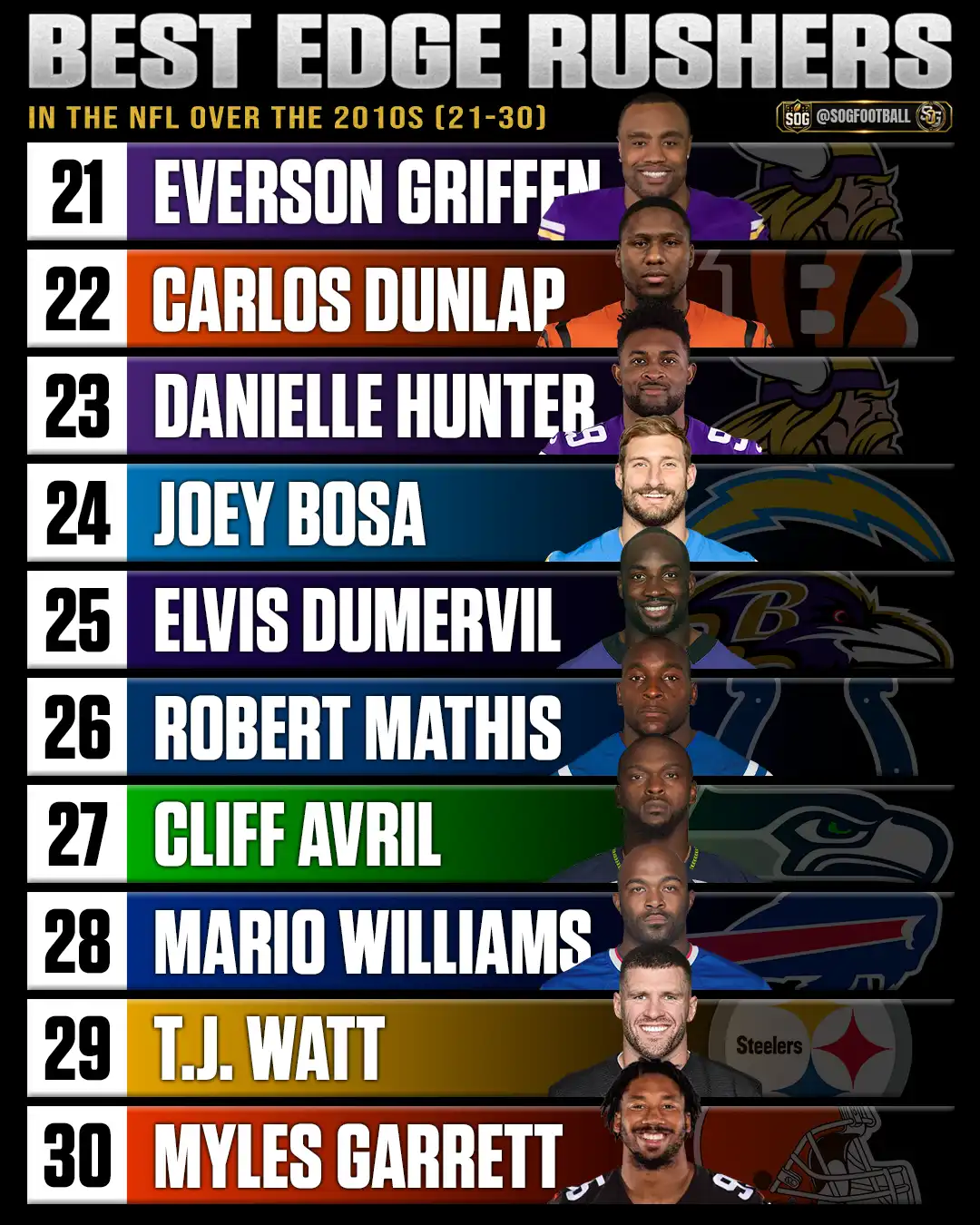
NFL edge rushers ranked 21 through 30 for the 2010s, featuring Everson Griffen, Carlos Dunlap, Danielle Hunter, Joey Bosa, Elvis Dumervil and more.
30. Myles Garrett
Garrett played only three seasons in the decade, so this ranking cannot credit the Defensive Player of the Year-level résumé he later built. His immediate production was still strong enough to earn the final spot.
He recorded 30.5 sacks from 2017 through 2019, including 13.5 in 2018 and 10 in a 10-game 2019 season. Garrett’s power, first step and ability to win through contact were already apparent, but the limited sample keeps him behind players with longer 2010s runs.
29. T.J. Watt
Watt faces the same decade-boundary problem as Garrett. His full career case belongs much higher, but only his first three NFL seasons count here.
He posted 34.5 sacks from 2017 through 2019, progressing from seven as a rookie to 13 in 2018 and 14.5 in 2019. Watt supplied more forced-fumble and coverage value than most young rushers, yet the ranking stops before his best seasons arrived.
28. Mario Williams
Williams entered the 2010s with much of his reputation already established, but his Buffalo peak gives him a legitimate decade case. He followed 13 sacks in 2013 with 14.5 in 2014.
At 6-foot-6 and nearly 300 pounds, Williams could compress the pocket with power without sacrificing the athleticism needed to win outside. His best stretch was shorter than the runs above him, but the two-year peak remained formidable.
27. Cliff Avril
Avril combined steady regular-season production with meaningful playoff value. He recorded 11 sacks for Detroit in 2011 and later reached 11.5 with Seattle in 2016.
His burst and ability to turn the corner gave the Seahawks a reliable closing threat during their championship window. Avril was rarely the biggest name on those defenses, but his speed made the entire front harder to block in obvious passing situations.
26. Robert Mathis
Mathis earns his place largely through one overwhelming season. In 2013, he led the NFL with 19.5 sacks, forced eight fumbles and won the inaugural Deacon Jones Award as the league’s sack leader.
Age, injury and a suspension limited his value across the rest of the decade. That prevents a higher placement, but few players below the top 10 produced a single season as disruptive as Mathis did in 2013.
25. Elvis Dumervil
Dumervil used a low center of gravity, explosive first step and natural bend to create pressure despite being undersized for a traditional defensive end. His best decade season came with Baltimore in 2014.
He finished that year with 17 sacks, giving the Ravens a dangerous outside pairing with Terrell Suggs. Dumervil offered less against the run than the more complete defenders above him, but his pure pass-rush ceiling was undeniable.
24. Joey Bosa
Bosa entered the league in 2016 and immediately played like a veteran technician. He recorded 10.5 sacks in 12 rookie games, then raised the total to 12.5 in 2017.
An injury-shortened 2018 interrupted his rise, but he returned with 11.5 sacks in 2019 and finished the decade with 40. His hand usage and power gave him a more complete early profile than most young edge defenders.
23. Danielle Hunter
Hunter’s decade case is built on a rapid climb from developmental athlete to featured pass rusher. He closed the window with consecutive 14.5-sack seasons in 2018 and 2019.
His length, acceleration and closing power created a difficult matchup once tackles lost leverage. Hunter’s best version was capable of ranking higher, but most of that peak arrived near the end of the decade.
22. Carlos Dunlap
Dunlap delivered dependable pressure for Cincinnati across the entire decade. His best sack season came in 2015, when he finished with 13.5.
He could win with length and power, affect passing lanes and hold up against the run. Dunlap lacked the award-level apex of the names above him, but his long run of useful seasons gives him one of the steadier résumés in this range.
21. Everson Griffen
Griffen became Minnesota’s featured edge threat during the middle of the decade. From 2014 through 2017, he reached double-digit sacks three times and peaked at 13 in 2017.
That final season also helped the Vikings reach the NFC Championship Game. Griffen combined a hot motor with enough speed and power to threaten either shoulder, but the players inside the top 20 produced stronger peaks or longer stretches.
Best Edge Rushers of the 2010s: Nos. 20-11
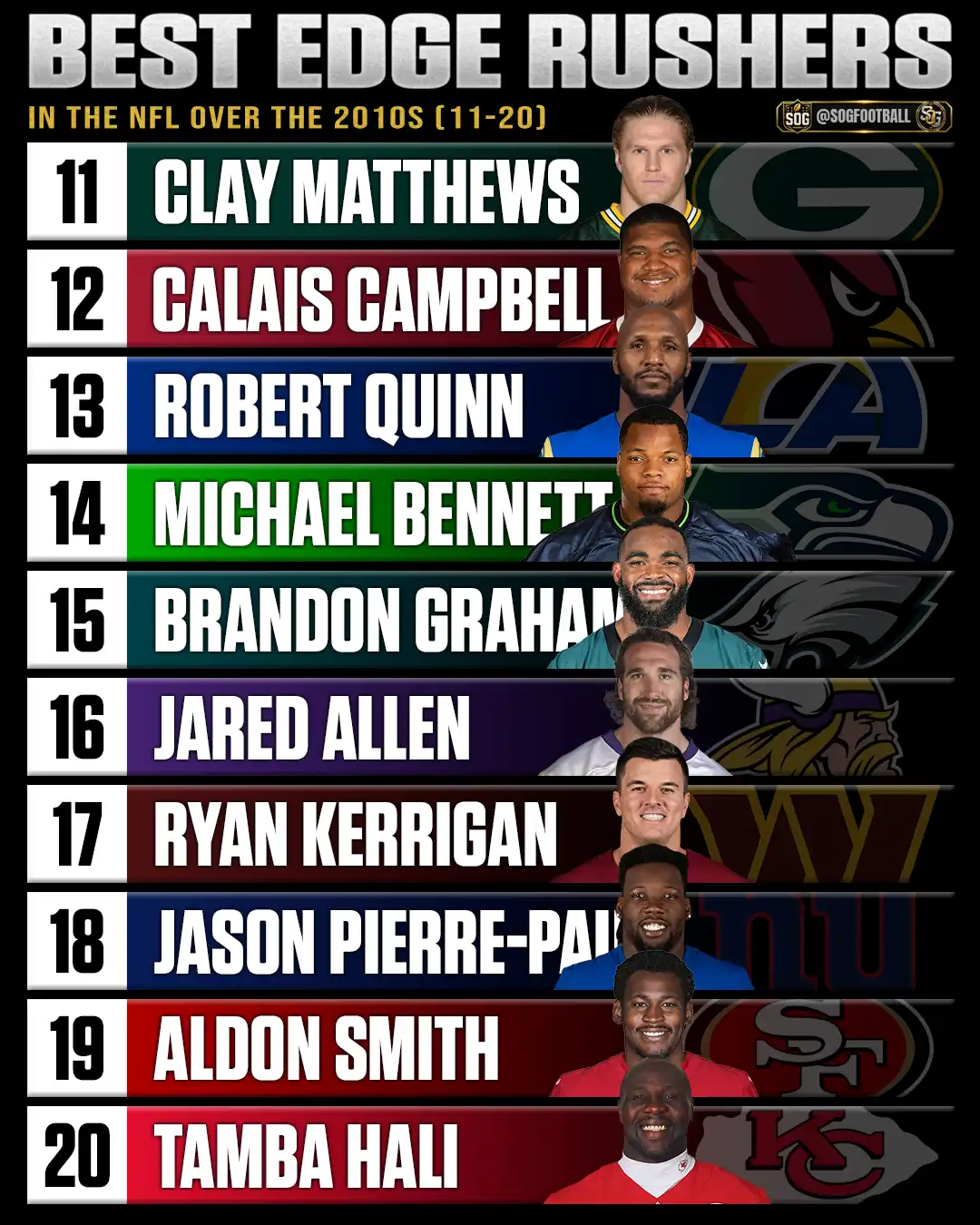
NFL edge rushers ranked 11 through 20 for the 2010s, featuring Clay Matthews, Calais Campbell, Robert Quinn, Michael Bennett, Brandon Graham and more.
20. Tamba Hali
Hali opened the decade as one of the AFC’s most productive edge rushers. He recorded 14.5 sacks in 2010 and followed with 12 in 2011.
His later production declined as age and role changes took hold, but the early peak established the floor for a top-20 case. Before Justin Houston became Kansas City’s primary pass-rush star, Hali drove the pressure plan.
19. Aldon Smith
Smith presents the ranking’s most extreme peak-versus-longevity dilemma. He opened his career with 14 sacks in 2011 and 19.5 in 2012, producing 33.5 across his first two seasons.
His burst, length and closing speed were devastating alongside San Francisco’s loaded front. Off-field problems and a shortened run prevent a top-15 placement, but the first two seasons were far too productive to leave him out.
18. Jason Pierre-Paul
Pierre-Paul’s 2011 season remains the foundation of his decade case. He recorded 16.5 sacks, earned first-team All-Pro honors and helped the New York Giants win Super Bowl XLVI.
He never sustained that exact level, but he remained valuable through injuries and major changes to his game. Pierre-Paul’s length, power and run defense give him an advantage over more specialized pass rushers with similar sack production.
17. Ryan Kerrigan
Kerrigan was one of the decade’s clearest models of consistency. He recorded 90 sacks from 2011 through 2019 and played all 16 games in each of his first eight seasons.
He never reached the single-season heights of Watt, Miller or Houston, but Washington could count on pressure and edge discipline every week. Four seasons with at least 11 sacks give his résumé more peak value than a simple longevity argument suggests.
16. Jared Allen
Allen’s prime began before the decade, but his early-2010s production remained exceptional. He recorded 22 sacks in 2011, finishing only half a sack short of the league record at the time.
Allen also reached 11 sacks in 2010, 12 in 2012 and 11.5 in 2013. His later seasons add less to the case, but that four-year opening gives him both a massive peak and meaningful depth within the window.
15. Brandon Graham
Graham’s placement requires looking beyond sack totals. His pressure generation, run defense and snap-to-snap disruption consistently exceeded what his modest sack counts suggested.
His 9.5 sacks in 2017 marked a career high, and his strip-sack of Tom Brady helped secure Philadelphia’s Super Bowl LII victory. Graham did not have the raw production of several players below him, but his complete value and biggest postseason moment lift him into the top 15.
14. Michael Bennett
Bennett was one of the decade’s most versatile defensive linemen. Seattle could rush him from the edge, move him inside on passing downs or ask him to control the run without changing personnel.
His sack totals never captured the full effect of that flexibility. Bennett created pressure from several alignments and became a central part of a championship front, giving him a stronger all-around case than many higher-volume sack specialists.
13. Robert Quinn
Quinn produced one of the decade’s best pure pass-rushing seasons in 2013. He finished with 19 sacks, forced seven fumbles and earned first-team All-Pro honors.
He also reached double-digit sacks in 2012, 2014 and 2019. Injuries and uneven seasons interrupted the middle of his run, but his best version possessed rare speed and bend around the corner.
12. Calais Campbell
Campbell does not fit a narrow modern EDGE label, but his role as a versatile defensive end belongs within this ranking’s hybrid eligibility rule. He could control the run, rush from wider alignments and move inside to exploit guards.
His clearest peak came with Jacksonville in 2017, when he recorded 14.5 sacks and earned first-team All-Pro honors for the AFC Championship Game-bound defense. Campbell’s versatility and consistent run value separate him from less complete rushers.
11. Clay Matthews
Matthews opened the decade with 13.5 sacks in 2010 and a major role in Green Bay’s Super Bowl championship. His closing speed and ability to rush from different launch points made him one of the league’s most recognizable pressure players.
Later role changes, including snaps at inside linebacker, reduced his pure edge volume. Even so, the early peak, postseason value and flexibility leave him just outside the top 10.
Best Edge Rushers of the 2010s: Nos. 10-1

The top 10 NFL edge rushers of the 2010s, led by J.J. Watt, Von Miller, Khalil Mack, Chandler Jones and Cameron Wake.
10. Terrell Suggs
Suggs enters the top 10 through an excellent early-decade peak and enough later value to remain relevant. He won Defensive Player of the Year in 2011 after recording 14 sacks and forcing seven fumbles.
He also returned from an Achilles injury during Baltimore’s 2012 championship season and continued producing into his 30s. Suggs paired power rushing with disciplined edge setting, giving him a more complete profile than his sack total alone captures.
9. Julius Peppers
Peppers was already on a Hall of Fame trajectory when the decade began, yet he still recorded 78.5 sacks from 2010 through 2018. He remained productive for Chicago, Green Bay and Carolina into his late 30s.
His 2010s case lacks the singular award-level season found elsewhere in the top 10, but few edge defenders matched his combination of longevity, length and positional flexibility. Peppers kept providing pressure long after most players with his mileage decline.
8. DeMarcus Ware
Ware’s best career work began before 2010, but he remained one of football’s premier rushers at the start of the decade. He recorded 15.5 sacks in 2010 and 19.5 in 2011.
His later Denver years added playoff value to the early production. Ware was no longer at his athletic peak during the Super Bowl 50 run, but his pressure, leadership and work opposite Von Miller helped complete a championship front.
7. Cameron Jordan
Jordan combined high-end pass-rush production with some of the strongest run defense in the field. He recorded 87 sacks during the decade, including 13 in 2017 and 15.5 in 2019.
New Orleans could align him across the front without sacrificing edge discipline. Jordan never won Defensive Player of the Year, but his durability and complete skill set produced one of the deepest résumés on the list.
6. Justin Houston
Houston’s 2014 season stands with the greatest pass-rushing peaks of the decade. He recorded 22 sacks, finishing half a sack short of the NFL record at the time.
His speed-to-power conversion and closing ability made him nearly unblockable during that run. Injuries kept Houston from matching the decade-long consistency of the top five, but his best season gives him a legitimate argument against anyone outside that group.
5. Cameron Wake
Wake became one of the NFL’s best speed rushers after beginning his professional career in the CFL. He recorded 95 sacks from 2010 through 2019, the fourth-highest total of the decade.
That production included 14 sacks in 2010 and 15 in 2012. Wake lacked the postseason opportunities and major awards of the four players above him, but his sustained burst, leverage and pressure production make the top-five placement difficult to challenge.
4. Chandler Jones
Jones paired consistency with two enormous late-decade seasons. He recorded 96 sacks from 2012 through 2019, tying Watt for second in the decade and trailing only Miller.
He led the NFL with 17 sacks in 2017 and finished with 19 in 2019. Jones never received the same attention as the three names above him, but his length, finishing ability and year-to-year production give him a clear top-four case.
3. Khalil Mack
Mack’s 2016 Defensive Player of the Year season anchors one of the decade’s strongest all-around peaks. He could dominate offensive tackles as a pass rusher, close running lanes and force offenses to account for him on every down.
He recorded 61.5 sacks from 2014 through 2019 despite entering the league nearly halfway through the decade. Mack’s immediate effect on Chicago’s defense in 2018 reinforced how much his complete edge game could raise an entire unit.
2. Von Miller
Miller owns the strongest pure outside-rusher résumé of the decade. His 106 regular-season sacks from 2011 through 2019 led the NFL, and his blend of first-step quickness, bend and counter moves produced pressure even when offenses knew where he was coming from.
The postseason case is even stronger. Miller dominated the 2015 AFC Championship Game and Super Bowl 50, earning Super Bowl MVP as Denver’s defense carried the team to a title. If the ranking were limited to traditional outside edge rushers, he would be No. 1.
1. J.J. Watt
Watt takes the top spot because no defender matched his 2012 through 2015 peak. He won three Defensive Player of the Year awards in four seasons while producing two 20.5-sack campaigns and another with 17.5.
He still finished the decade with 96 sacks despite losing most of 2016 and 2017 to injuries. Watt’s production matched the best pure rushers, while his run defense, batted passes and ability to attack from several alignments expanded his influence.
Miller was the cleaner outside-rusher prototype and delivered the decade’s greatest postseason edge performance. Watt ranks first because his peak affected more parts of the game and reached a level no other defensive front player sustained for as long.
Closest Calls and Biggest Debates
J.J. Watt vs. Von Miller for No. 1
Miller leads the decade in sacks, owns the stronger traditional EDGE profile and produced the superior postseason moment. Watt counters with three Defensive Player of the Year awards, comparable sack volume and greater influence against the run. The ranking favors Watt’s broader peak by a narrow margin.
Khalil Mack vs. Chandler Jones
Jones leads Mack by 34.5 sacks within the decade, but Mack supplied the stronger all-around peak. His 2016 Defensive Player of the Year season, run defense and ability to dictate protections outweigh Jones’ volume advantage in this specific comparison.
Cameron Wake vs. Justin Houston
Houston owns the better single season with 22 sacks in 2014. Wake recorded 95 sacks across the decade and sustained his pressure production for longer. Wake gets fifth because the consistency advantage narrowly exceeds Houston’s peak advantage.
DeMarcus Ware, Julius Peppers and Terrell Suggs
Ware supplied the strongest early-decade pass-rush peak, Peppers built the deepest 2010s longevity case and Suggs combined a Defensive Player of the Year award with championship value. Their order reflects Ware’s peak first, then Peppers’ sustained production and Suggs’ slightly shorter run at his best.
Aldon Smith and the Short-Peak Problem
Smith’s first two seasons were good enough for a much higher ranking, but the rest of his decade résumé cannot support it. The same principle limits Garrett, T.J. Watt, Bosa and Hunter. Their later careers may reshape all-time rankings, but only their work through 2019 counts here.
The Sack Totals Undervalue Bennett and Graham
Bennett and Graham created more value than their sack totals suggest. Both could win against the run, generate pressure without always finishing the play and contribute to championship fronts. That complete impact places them above several players with more sacks.
Full Ranking Table
| Rank | Edge Rusher | Primary 2010s Team |
|---|---|---|
| 1 | J.J. Watt | Houston Texans |
| 2 | Von Miller | Denver Broncos |
| 3 | Khalil Mack | Oakland Raiders |
| 4 | Chandler Jones | Arizona Cardinals |
| 5 | Cameron Wake | Miami Dolphins |
| 6 | Justin Houston | Kansas City Chiefs |
| 7 | Cameron Jordan | New Orleans Saints |
| 8 | DeMarcus Ware | Dallas Cowboys |
| 9 | Julius Peppers | Chicago Bears |
| 10 | Terrell Suggs | Baltimore Ravens |
| 11 | Clay Matthews | Green Bay Packers |
| 12 | Calais Campbell | Arizona Cardinals |
| 13 | Robert Quinn | St. Louis Rams |
| 14 | Michael Bennett | Seattle Seahawks |
| 15 | Brandon Graham | Philadelphia Eagles |
| 16 | Jared Allen | Minnesota Vikings |
| 17 | Ryan Kerrigan | Washington |
| 18 | Jason Pierre-Paul | New York Giants |
| 19 | Aldon Smith | San Francisco 49ers |
| 20 | Tamba Hali | Kansas City Chiefs |
| 21 | Everson Griffen | Minnesota Vikings |
| 22 | Carlos Dunlap | Cincinnati Bengals |
| 23 | Danielle Hunter | Minnesota Vikings |
| 24 | Joey Bosa | Los Angeles Chargers |
| 25 | Elvis Dumervil | Baltimore Ravens |
| 26 | Robert Mathis | Indianapolis Colts |
| 27 | Cliff Avril | Seattle Seahawks |
| 28 | Mario Williams | Buffalo Bills |
| 29 | T.J. Watt | Pittsburgh Steelers |
| 30 | Myles Garrett | Cleveland Browns |
Frequently Asked Questions
Is J.J. Watt considered an edge rusher?
Watt was a hybrid defensive lineman rather than a full-time modern EDGE. He qualifies under this ranking’s broader definition because he regularly rushed from defensive end and wider alignments while moving across Houston’s front. His versatility is also why his case differs from a traditional outside linebacker such as Miller.
Why is Aaron Donald not ranked?
Donald was primarily an interior defensive lineman. He was one of the greatest defenders of the decade, but including an interior-first tackle in an edge ranking would blur the positional boundary too far. He belongs near the top of a separate defensive tackle or overall defensive player list.
How were partial-decade players ranked?
Only production from the 2010 through 2019 seasons affects placement. Late arrivals such as Garrett and T.J. Watt receive credit for their immediate peaks, but their 2020s accomplishments do not move them higher. The same rule prevents older stars from receiving credit for work before 2010.
Do playoff performances count?
Yes, but regular-season value across the decade carries more weight. Postseason performance is most useful as a separator in close comparisons, particularly Miller’s case against Watt and the championship contributions of Ware, Suggs, Bennett, Graham and Avril.
Conclusion
Miller was the decade’s best traditional outside rusher, but Watt takes the overall No. 1 spot through the most dominant peak and the broadest defensive influence. Three Defensive Player of the Year awards, 96 sacks and game-changing run defense outweigh Miller’s sack lead and postseason advantage by the narrowest margin on the list.
More NFL Rankings
- Best Edge Rushers of All Time
- Best Edge Rushers in the NFL Since 2020
- Best Pass Rushers in NFL History
- Best Cornerbacks in the NFL Over the 2010s
Follow @sogfootball for the most up-to-date NFL content.
