Introduction
The 1st overall NFL Draft pick is meant to change a franchise. It is an organizational statement. Every team in the league had a shot at this player. Every front office ran the tape, filed the reports, and decided to pass. When you turn in that card first, you are telling the league you found the one player who changes everything.
Since 2000, that card has been turned in 26 times. Quarterbacks have dominated the spot. So have busts. Out of those 26 picks, a handful became franchise pillars, a few became generational players, and several became cautionary tales that cost franchises years of competitive football to recover from. The margin between the best and worst first overall picks in this era is enormous, which is exactly what makes ranking them worth doing.
This list ranks every first overall NFL Draft pick since 2000 based on what each player actually delivered: peak performance, longevity, positional value, and how clearly the résumé justified being the first name called. The hits are easy to identify in hindsight. So are the misses. The picks in between are where it gets complicated.
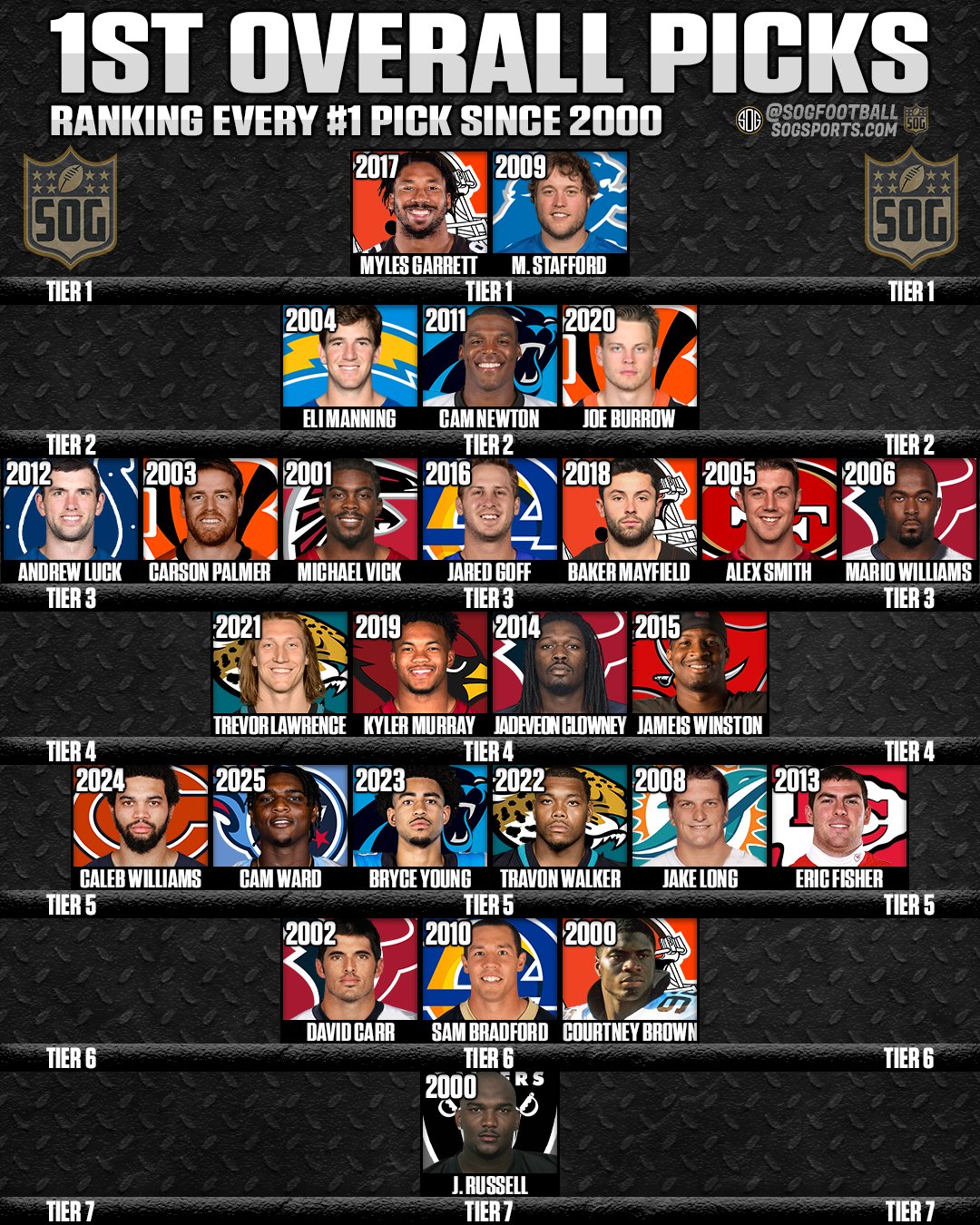
Best to worst 1st overall NFL Draft picks since 2000, ranked by SOG Sports.
Table of Contents
- Introduction to the Best to Worst 1st Overall NFL Draft Picks Since 2000
- How We Ranked the Best to Worst 1st Overall NFL Draft Picks Since 2000
- Tier 1: The Best 1st Overall NFL Draft Picks Since 2000
- Tier 2: Elite No. 1 Overall NFL Draft Picks
- Tier 3: Strong 1st Overall NFL Draft Picks Since 2000
- Tier 4: Good 1st Overall NFL Draft Picks With Mixed Résumés
- Tier 5: Too Early to Judge These 1st Overall Picks
- Tier 6: 1st Overall Picks That Fell Short of Expectations
- Tier 7: The Worst 1st Overall NFL Draft Picks Since 2000
- FAQ About the Best and Worst 1st Overall NFL Draft Picks
- Final Thoughts on the Best and Worst First Overall Picks
How We Ranked the Best to Worst 1st Overall NFL Draft Picks Since 2000
These rankings are built around total NFL value, not just raw talent or pre-draft hype. Peak performance matters. Longevity matters. Awards, production, positional importance, and how clearly each player justified being selected first overall all matter too.
What makes this era worth examining specifically is how badly the hit rate has declined at the position that dominates the spot. Since 2000, quarterbacks have been taken first overall 19 times. Fewer than half of them became genuine long-term franchise answers. The ones who did are easy to identify. The ones who did not cost their franchises years of competitive football they never got back.
Quarterbacks are judged a little differently because the expectations are higher. The question is not just whether they were good, but whether they became the kind of player a franchise could confidently build around. For non-quarterbacks, dominance at their position, consistency, durability, and year-over-year impact carry more weight. Players who are still early in their careers are ranked with that context clearly in mind. This is not a projection of what they might become. It is a ranking of what every first overall NFL Draft pick since 2000 has accomplished so far.
Tier 1: The Best 1st Overall NFL Draft Picks Since 2000
This is the top tier. These are the true home-run outcomes, the players who fully justified being selected first overall and built résumés worthy of the draft slot.
Myles Garrett — Cleveland Browns — 2017
Garrett removed all doubt a long time ago. He has recorded double-digit sacks in every healthy season of his career, won Defensive Player of the Year in 2023, and consistently generates pressure at a rate that makes him one of the most disruptive forces the league has seen at the position in years.
His career sack total is approaching 100, and he has done most of it on a Browns team that has never fully built around him the way a player of his caliber deserves. That is the part that separates him from most of this list. Great pass rushers usually get at least one elite supporting cast. Garrett has largely dominated in isolation. That still counts for something, and it pushes him to the very top of these rankings.
Matthew Stafford — Detroit Lions — 2009
Stafford built one of the quieter and more underrated quarterback careers in modern NFL history. He threw for over 49,000 yards in Detroit alone, posted a 5,038-yard, 41-touchdown season in 2011, and did most of it behind porous lines on teams that were not built to win. He never missed a start due to injury during his Lions run, which is its own kind of remarkable given the punishment he absorbed.
Then he went to Los Angeles and finished the résumé the right way. He threw for 4,886 yards and 41 touchdowns in his first Rams season, got the ball to Cooper Kupp all year, and closed out Super Bowl LVI with the kind of fourth-quarter performance that defines quarterback legacies. Production, durability, and a championship. That is the complete package, and it earns the top tier.
Tier 2: Elite No. 1 Overall NFL Draft Picks
This tier is for players who delivered elite value, whether through postseason greatness, MVP-level peaks, or enough early career dominance to already justify the pick.
Eli Manning — San Diego Chargers — 2004
Manning’s regular season résumé always invited debate, but the postseason piece is what carries him into the elite tier. Two Super Bowl MVPs, two wins over an 18-0 New England team that had no business losing, and some of the best clutch quarterback moments the league has seen in this era. He threw for 377 yards and two touchdowns in Super Bowl XLII and backed it up four years later with another championship run. The biggest stages are where his legacy got built, and that is not nothing.
There were frustrating stretches and years where he was not close to being considered one of the league’s better quarterbacks. That is fair. But total career value, durability across 16 seasons, and a postseason résumé that holds up against almost anyone on this list makes it hard to keep him out of Tier 2.
Cam Newton — Carolina Panthers — 2011
The 2015 MVP season was one of the best individual performances a first overall quarterback has ever produced. Newton threw 35 touchdowns, added 10 more on the ground, finished 15-1, and carried Carolina to Super Bowl 50 on the back of a rushing-and-throwing combination that the league simply had no answer for. The total touchdown output that year was 45. He was the most dangerous player in football, and it was not particularly close.
The reason he stops just short of Tier 1 is that the peak was shorter than the names above him. Injuries compressed the window where he was genuinely unstoppable. Even so, the 2015 version of Newton was the kind of player a franchise uses the first pick to find. He absolutely delivered that.
Joe Burrow — Cincinnati Bengals — 2020
Burrow already has enough on the board to sit in the elite tier. He threw for 4,611 yards and 34 touchdowns in his second NFL season, then went on a postseason run that included three road wins and a Super Bowl appearance, doing it with one of the worst offensive lines in football protecting him. The completion percentage and accuracy numbers have been consistently elite. He ranks among the most efficient passers in the league when healthy.
The one variable is availability. A torn ACL in year one and a wrist injury in 2023 have cost him real time. When he has played, he has looked like a true top-five quarterback. The ceiling is clearly there. The full résumé is still being built, but what he has already done was more than enough to justify the pick.
Tier 3: Strong 1st Overall NFL Draft Picks Since 2000
These are the first overall picks who clearly brought major value. Some had elite peaks. Some built long, productive careers. Some did enough across multiple stops to finish with stronger résumés than the public narrative suggests.
Andrew Luck — Indianapolis Colts — 2012
If this were strictly a peak-value conversation, Luck would have a legitimate argument to rank even higher. He threw for 4,374 yards and 40 touchdowns in just his second NFL season, led the Colts to four playoff appearances in five years, and did it while absorbing punishment that would have broken most quarterbacks. Indianapolis got a legitimate franchise centerpiece — smart, creative, and tough enough to drag bad teams to wins they had no business getting.
The only thing holding him back is the length of the career. The punishment eventually won, and he retired at 29 with more left to give. Even so, 23,671 yards and 171 touchdowns in seven seasons, with that much adversity absorbed along the way, is a strong first overall quarterback résumé. The career just ended before it should have.
Carson Palmer — Cincinnati Bengals — 2003
Palmer gave Cincinnati something it badly needed: real quarterback credibility. His 2005 season was genuinely special before a brutal knee injury cut it short. He threw for 3,836 yards and 32 touchdowns and looked like one of the five best quarterbacks in football. That trajectory, if healthy, pointed somewhere much higher on this list.
Even with the injuries, the full body of work holds up. He threw for over 46,000 career yards, topped 4,000 yards in a season five separate times, and delivered franchise-quarterback production across three different franchises. He never got the postseason recognition the résumé deserved. That does not make the résumé wrong.
Michael Vick — Atlanta Falcons — 2001
Vick changed the visual language of the quarterback position in a way no one before him had. His 2006 season — 2,936 passing yards plus 1,028 rushing yards, making him the first quarterback in NFL history to rush for 1,000 in a season — captures what made him impossible to gameplan for. He was not just fast for a quarterback. He was a legitimate speed threat against any defense in the league, and opposing coordinators had no real answer for it.
The reason he is not higher is that the career never became what it should have. The prison sentence cost him his peak years, and the version of Vick who came back in Philadelphia, though impressive, was never quite the same force. The peak was rare enough and the impact unique enough that he belongs in the strong tier. He just never got to show the full thing.
Jared Goff — Los Angeles Rams — 2016
Goff’s career has aged far better than the public narrative around him. He threw for 4,688 yards and 32 touchdowns in 2018 and led Los Angeles to a Super Bowl appearance, showing he could handle a major offensive system when the structure around him was functioning. That was a real quarterback performance, not a system illusion.
After the trade to Detroit, he did something most quarterbacks do not: he rebuilt his reputation entirely. He threw for 4,575 yards and 29 touchdowns in 2023 and became the centerpiece of one of the best offenses in the NFC. Two franchises, two legitimate starting roles, consistent production across a decade. That is more career value than most first overall picks ever deliver, even if he never quite felt like the obvious answer in either city.
Baker Mayfield — Cleveland Browns — 2018
Mayfield’s career has been louder than it has been linear, but the production is more real than the narrative around him suggests. He threw 27 touchdown passes as a rookie in 2018, breaking Peyton Manning’s first-year record, and helped engineer Cleveland’s 11-5 turnaround in 2020, the franchise’s first playoff win in 26 years. That matters. A Browns team winning playoff football is not something that happens on its own.
After the Cleveland chapter ended messily, he rebuilt his career in Tampa and delivered a 4,044-yard, 28-touchdown season in 2023. Two franchises, two legitimate contributions, more staying power than most people credit him with. He was not the superstar the pick suggested, but he gave more real value than a lot of first overall quarterbacks ever do.
Alex Smith — San Francisco 49ers — 2005
Smith’s career arc was chaotic, but the final résumé is stronger than the early chapters suggested it would be. He worked through constant coordinator changes and brutal early situations in San Francisco before finally finding his footing. By 2017 in Kansas City, he had turned himself into one of the most efficient passers in the league — 4,042 yards, 26 touchdowns, 5 interceptions, and a 104.7 passer rating that ranked among the best in football that season.
Then came the injury that should have ended everything. A compound leg fracture required 17 surgeries and cost him 26 months of football. He came back and started NFL games anyway. He was never the superstar some expected when San Francisco used the top pick on him, but the player he became, and the career he rebuilt twice, was far more than early narratives ever gave him credit for.
Mario Williams — Houston Texans — 2006
Williams got crushed at the time because he was drafted ahead of Reggie Bush, but that criticism never really matched the quality of the player Houston got. He was powerful, productive, and consistently disruptive off the edge. Over time, the actual résumé held up far better than the public reaction to the pick.
He finished with 97.5 career sacks and spent years proving that he was exactly the kind of force a team hopes to find at No. 1 overall. He may not have had the cultural hype of other stars, but he absolutely delivered first overall-caliber value.
Tier 4: Good 1st Overall NFL Draft Picks With Mixed Résumés
These players had real value, and in some cases excellent stretches, but they fall short of the stronger résumé tiers above them.
Trevor Lawrence — Jacksonville Jaguars — 2021
Lawrence still feels like one of the biggest unfinished evaluations on this list because the 2022 version of him looked like the answer. He threw for 4,113 yards and 25 touchdowns that season, led the Jaguars back from a 27-0 deficit to beat the Chargers in the wild card round, and made it feel like Jacksonville had genuinely found its franchise quarterback. That was not a projection. That was a real performance.
Since then, the résumé has become more complicated. Injuries, uneven stretches, and inconsistency have kept him from building on that momentum. The talent is still easy to believe in and the ceiling has not changed. But when you are ranking the best to worst first overall picks since 2000, one good season is not enough by itself. He needs to go do it again.
Kyler Murray — Arizona Cardinals — 2019
Murray’s dual-threat profile is genuinely rare. In 2020, he threw for 3,971 yards and 26 touchdowns while adding 819 rushing yards, a combination almost no quarterback in the league could match. He creates out of structure, stresses defenses with his legs, and generates offense in ways that make him a real problem when healthy and operating in the right system.
The issue is that healthy has been the operative word too often. Injuries have interrupted his momentum at critical points, and Arizona never built a stable enough environment around him to find out what a fully unleashed Kyler Murray looks like over a sustained stretch. The talent has always been obvious. The full franchise-quarterback résumé never materialized around it. That gap is why he lands here instead of higher.
Jadeveon Clowney — Houston Texans — 2014
Clowney entered the league with massive expectations and highlight-reel hype. He looked like he could become one of the defining defenders of his era, and there were stretches where the talent absolutely showed up. He was disruptive, explosive, and physically overwhelming when healthy.
But the full résumé never became what a top pick like this was supposed to become. He never posted a double-digit sack season, never fully established himself as a year-over-year elite pass rusher, and spent too much of his career feeling like a very good player rather than a truly dominant one. That still has real value. It just falls short of the standard attached to the first overall pick.
Jameis Winston — Tampa Bay Buccaneers — 2015
Winston’s career is one of the most entertaining and chaotic evaluations on the board. The arm talent was undeniable. The production, at times, was massive. He even delivered one of the strangest high-volume quarterback seasons in recent memory with 5,109 passing yards and 33 touchdowns in 2019.
He also threw 30 interceptions that same season, which perfectly sums up the problem. Winston could move the ball, create explosive plays, and keep an offense alive, but he never became the trustworthy long-term quarterback Tampa Bay needed. Productive? Yes. Talented? Absolutely. Reliable enough to be called a true No. 1 overall success? Not quite.
Tier 5: Too Early to Judge These 1st Overall Picks
This tier is for active players whose stories are still being written. The talent is obvious in different ways, but the completed NFL résumé is not strong enough yet to rank them with the proven names above.
Caleb Williams — Chicago Bears — 2024
Williams is here because it is still too early to put him anywhere else with confidence. The rookie flashes were real, and the arm talent that made him the top pick was obvious. He showed creativity, off-platform ability, and enough pure playmaking to keep belief alive even when the team environment around him was shaky.
The early résumé is not strong enough yet to push him into the proven tiers, but it is also far too early to call him a disappointment. He belongs in the too-early-to-judge bucket because the long-term verdict is still being written. For now, he is a wait-and-see first overall pick with obvious upside.
Cam Ward — Tennessee Titans — 2025
Ward is the easiest placement on the board because there is barely any NFL résumé to judge yet. This is not a criticism of the player or the pick itself. It is simply a reality check. Ranking him aggressively in either direction right now would be pure projection.
He could climb fast if he becomes the answer in Tennessee, especially at quarterback, where true franchise hits carry enormous value. But for now, he belongs in the too-early-to-judge tier because there just is not enough completed NFL work to say anything stronger.
Bryce Young — Carolina Panthers — 2023
Young’s career got off to a messy start, and a lot of that had to do with the situation around him. Carolina asked him to survive in an unstable environment, and the results reflected it. The early production was underwhelming, and the trajectory looked shaky enough to create real doubt about whether the Panthers had made the right call.
At the same time, it still feels too early to close the book. Young still has time to develop, and quarterbacks especially can take a while to settle into the league if the supporting cast is weak. He lands here because the first return was not strong enough to rank him with the proven names, but the story is not finished.
Travon Walker — Jacksonville Jaguars — 2022
Walker was always more projection than polish. Jacksonville drafted the traits, the frame, and the upside, betting that elite athletic tools would eventually turn into elite NFL production. That kind of gamble can pay off, but it also creates a tricky evaluation window early in a player’s career.
He has not been a bust, but he also has not yet built the kind of résumé most teams want from a first overall pass rusher. The talent is clearly there. The full payoff is still pending. That makes him one of the toughest 1st overall NFL Draft picks to rank right now.
Tier 6: 1st Overall Picks That Fell Short of Expectations
These players had moments, some even had stretches of real value, but the finished résumé lands short of what teams hope to get from the first pick in the draft.
David Carr — Houston Texans — 2002
Carr’s career is one of the toughest evaluations on the entire list because the context was brutal from the beginning. He entered the league as the first quarterback in Houston Texans history and got dropped into an expansion-team setup that could not protect him. He was sacked 76 times as a rookie, and that kind of damage clearly changed the trajectory of his career.
Even with all of that context, the first overall pick still has to deliver more than Carr ultimately did. He flashed talent, but he never became the long-term franchise quarterback Houston hoped it was getting. You can blame the environment and still admit the pick did not work out the way a first overall quarterback pick is supposed to.
Sam Bradford — St. Louis Rams — 2010
Bradford arrived with enough polish to look like the real thing immediately. He won Offensive Rookie of the Year after throwing for 3,512 yards and 18 touchdowns, and early on he had the accuracy, pocket calm, and football intelligence teams want from a franchise quarterback. The Rams had genuine reason to believe they had found their answer.
The problem was that healthy never lasted long enough to build anything real. Two torn ACLs wrecked his momentum at the worst possible times, and he never fully escaped the cycle of recovery and reset. Bradford had a respectable career by normal NFL standards, but first overall picks are not judged by normal standards. The Rams needed a franchise-changing quarterback. What they got was a talented passer whose body never let the career fully take off.
Courtney Brown — Cleveland Browns — 2000
Brown was drafted to become a long-term edge presence and a foundational defensive piece for Cleveland. Instead, his career became a constant battle with injuries. He finished with 16.5 career sacks across parts of six seasons, never played a full year, and never topped 4.5 sacks in any single season. Those are numbers that would be underwhelming for a mid-round pick. For the first overall selection, they represent one of the more complete misses of the modern era.
This is not a case where the player lacked effort or talent. His body simply never held up. The expectations were massive, and the actual NFL return was minimal.
Jake Long — Miami Dolphins — 2008
Long’s peak was undeniably real. He made four Pro Bowls in his first four seasons and looked like one of the better left tackles in football during that stretch. Miami got genuine value in those early years, which separates him from the true busts lower on this list.
But the back half of the career tells a different story. He played fewer than 16 games in four of his final five seasons, appeared in only six games total across his last two years in the league, and was effectively done as a starter before turning 30. The finished résumé is a short peak followed by a long fade. Long was good. He just was not good long enough for the first overall pick to be considered a real success.
Eric Fisher — Kansas City Chiefs — 2013
Fisher became a solid long-term starter and helped stabilize Kansas City’s offensive line for years. That matters. Teams do not regret landing quality starters, especially at left tackle. He also made Pro Bowls and played meaningful football on winning teams, which separates him from the true misses lower on the list.
Still, his career is complete, and the overall result lands closer to fell short than true success. Fisher never felt like one of the defining players from his class, and he never reached the type of dominance teams dream about when they draft first overall. Useful pick. Respectable career. Just not a special one by No. 1 standards.
Tier 7: The Worst 1st Overall NFL Draft Picks Since 2000
This is the bottom of the board. These are the picks that missed badly enough to define the downside of investing the first selection in the draft.
JaMarcus Russell — Oakland Raiders — 2007
When people talk about the worst 1st overall NFL Draft picks of the modern era, this is where the conversation usually starts. Russell had elite arm strength and rare physical gifts, which is why Oakland talked itself into the pick in the first place. The NFL return was a disaster. The Raiders gave him massive money and got almost nothing close to franchise-quarterback value back.
Russell finished with just 18 touchdown passes, 23 interceptions, and a 65.2 passer rating across 25 career starts. He was out of the league before turning 26. There have been other disappointments at No. 1 overall, but few collapsed this quickly or this completely. For a top pick at the most important position in sports, this was about as bad as it gets.
FAQ About the Best and Worst 1st Overall NFL Draft Picks
Who is the best 1st overall NFL Draft pick since 2000?
Matthew Stafford and Myles Garrett have the strongest cases. Stafford brings quarterback value, long-term production, and a Super Bowl title. Garrett brings year-over-year dominance as one of the most dangerous defenders in football.
Who is the worst 1st overall NFL Draft pick since 2000?
JaMarcus Russell is widely viewed as the biggest bust among 1st overall NFL Draft picks since 2000. The talent was obvious, but the NFL production and long-term return were nowhere near what teams expect from the top pick.
Which 1st overall NFL Draft picks since 2000 actually lived up to the hype?
Matthew Stafford, Myles Garrett, Cam Newton, Joe Burrow, and Eli Manning all clearly justified the value of being selected first overall, even if they did it in different ways.
Why are newer 1st overall picks like Caleb Williams and Cam Ward ranked this low?
This ranking is based on completed NFL résumé, not projection. Younger players can rise quickly, but they have not built the same body of work as the veterans higher on the list.
What makes a great first overall NFL Draft pick?
A great first overall pick combines high-end performance, strong positional value, durability, long-term production, and a résumé that clearly separates him from the rest of his draft class.
Are first overall NFL Draft picks usually quarterbacks?
Quarterbacks are the most common position taken first overall because teams value franchise quarterback play above everything else. That is a big reason why quarterbacks dominate so much of the conversation around the No. 1 pick.
Final Thoughts on the Best and Worst First Overall Picks
Twenty-six first overall picks since 2000. Roughly a third of them became players their franchises could genuinely build around. Another third fell somewhere between useful and disappointing. The rest became cautionary tales about how badly a single pick can go wrong even with every resource in the league pointed at getting it right.
Myles Garrett and Matthew Stafford sit alone at the top because they cleared the highest bar on this list, not just being good, but becoming defining players at their positions with résumés that hold up against any era. Garrett did it without ever playing for a real contender. Stafford did it in two cities and finished with a championship. Below them, the list is a reminder that the first overall pick is supposed to be the safest investment in football. Since 2000, it has been anything but.
More NFL Draft Pick Rankings Since 2000
If you liked this breakdown of the best and worst No. 1 overall picks since 2000, check out the rest of our NFL Draft rankings series below. We broke down every pick from No. 1 through No. 5 overall to compare the biggest hits, biggest misses, and the careers that aged the best over time.
- Ranking Every No. 2 Overall Pick Since 2000
- Ranking Every No. 3 Overall Pick Since 2000
- Ranking Every No. 4 Overall Pick Since 2000
- Ranking Every No. 5 Overall Pick Since 2000
For more NFL rankings, graphics, and draft content, also check out SOGFootball on Instagram.
