All 10th Overall NFL Draft Picks in NFL History
Pick No. 10 is where draft rooms start telling the truth about themselves. Teams picking here usually have a real problem to solve, but they are often just outside the clean blue-chip tier, which is how this slot turns into both franchise-changing hits and front-office scars. The history of the 10th pick includes Patrick Mahomes — who arrived via trade-up — along with Rod Woodson, Marcus Allen, and Jerome Bettis, but it also includes quarterback misses, overdrafted need picks, and players teams never got full value from. That tension is why this spot keeps mattering.
Table of Contents
- Featured Graphic
- Year-by-Year: Every 10th Overall Pick
- Why the 10th Overall Pick Matters
- Trends Among 10th Overall NFL Draft Picks
- FAQ
- Final Thoughts
Featured Graphic
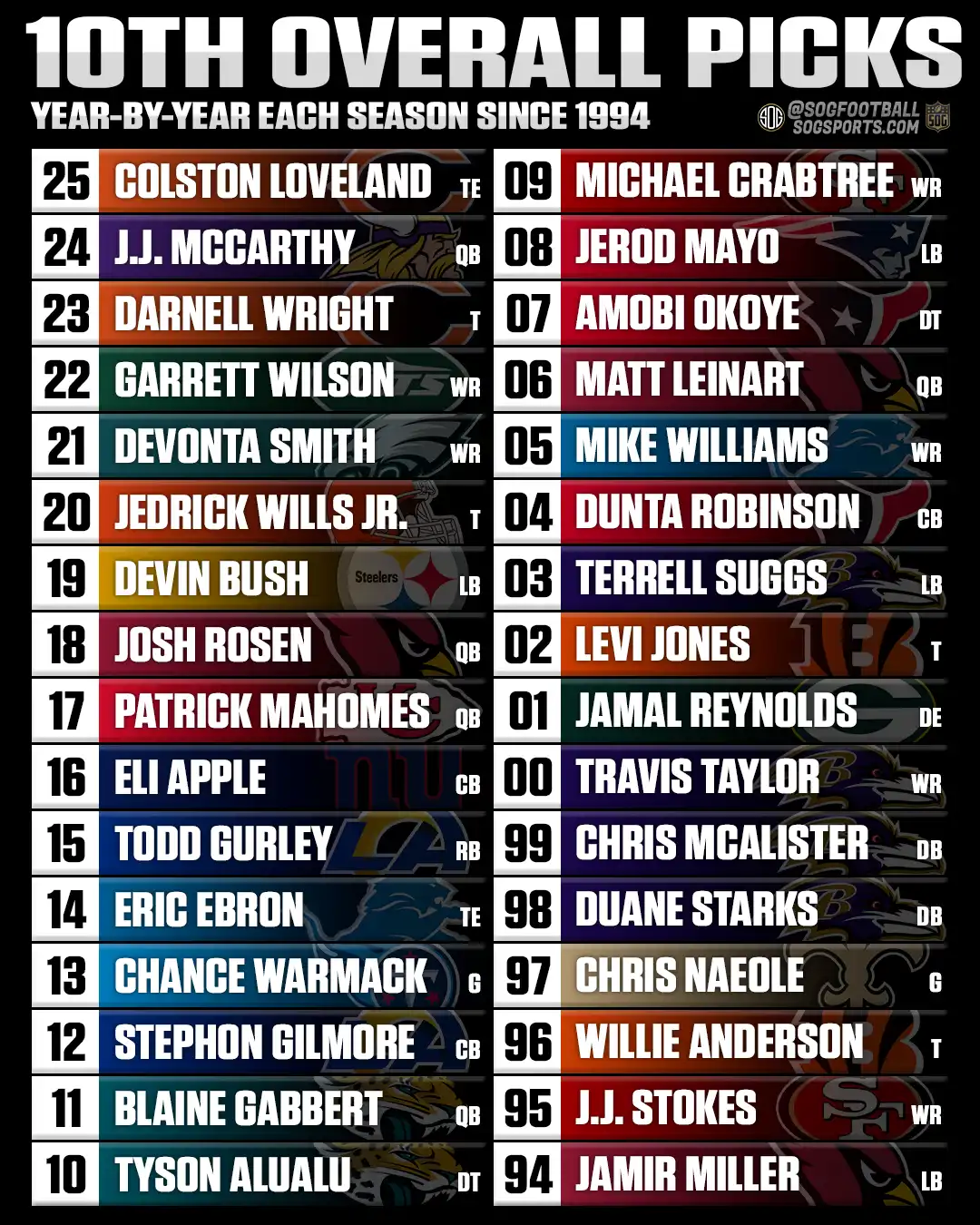
Year-by-year graphic showing every 10th overall NFL Draft pick from 1994 through 2025
The graphic highlights the modern era from Jamir Miller in 1994 through Colston Loveland in 2025. The full list below goes back to 1937, the first year a 10th overall pick existed.
Year-by-Year: Every 10th Overall Pick
2025 — Colston Loveland, Chicago Bears, TE
Chicago used the pick on a middle-of-the-field target for Caleb Williams instead of another long-term project. Loveland caught 56 passes for 582 yards and five touchdowns at Michigan in 2024, and the Bears drafted him expecting early-down value, not a redshirt year.
2024 — J.J. McCarthy, Minnesota Vikings, QB
Minnesota drafted McCarthy to run Kevin O’Connell’s offense, then watched a torn meniscus in August wipe out his rookie season. He entered the league after going 27-1 as a starter at Michigan and throwing for 2,991 yards with 22 touchdowns during the Wolverines’ 2023 national-title run.
2023 — Darnell Wright, Chicago Bears, OT
Wright stepped right into the lineup and started all 17 games at right tackle as a rookie. That matters because the Bears drafted him to fix protection immediately, first for Justin Fields and then for Caleb Williams.
2022 — Garrett Wilson, New York Jets, WR
Wilson won Offensive Rookie of the Year with 83 catches for 1,103 yards, then followed it with another 1,000-yard season in difficult quarterback conditions. This is what a clean hit on a top-10 receiver looks like.
2021 — DeVonta Smith, Philadelphia Eagles, WR
Smith gave Philadelphia a real answer on the perimeter fast. He posted 95 catches for 1,196 yards in 2022 and became a major part of an offense that reached Super Bowl LVII.
2020 — Jedrick Wills Jr., Cleveland Browns, OT
Cleveland drafted Wills to protect Baker Mayfield’s blind side and got a full-time rookie starter on a playoff team. Knee trouble later wrecked the long-term value, but a top-10 tackle is supposed to give you more than a short window of stability.
2019 — Devin Bush, Pittsburgh Steelers, LB
Pittsburgh traded up for Bush because it wanted range and speed in the middle of the defense. He delivered 109 tackles as a rookie, then tore his ACL in Week 6 of the 2020 season and never recovered that trajectory.
2018 — Josh Rosen, Arizona Cardinals, QB
Arizona spent a top-10 pick on Rosen, got 2,278 passing yards with 11 touchdowns and 14 interceptions as a rookie, then replaced him one year later. It was a miss.
2017 — Patrick Mahomes, Kansas City Chiefs, QB
Kansas City traded up from No. 27 to take Mahomes, and that move changed the league. He threw for 5,097 yards and 50 touchdowns in his first year as a starter and has already turned the pick into three Super Bowl titles.
2016 — Eli Apple, New York Giants, CB
Apple started 11 games as a rookie and hung around the league as a playable corner, but the Giants did not get shutdown value from a top-10 defensive back. The gap between usable and worth-the-pick is the whole story here.
2015 — Todd Gurley, St. Louis Rams, RB
For a while this looked like a home run. Gurley won Offensive Rookie of the Year, led the league with 17 rushing touchdowns in 2017, scored 21 total touchdowns in 2018, and then knee arthritis cut the peak short.
2014 — Eric Ebron, Detroit Lions, TE
Detroit drafted a mismatch tight end and mostly got frustration. Ebron eventually made a Pro Bowl with Indianapolis after catching 13 touchdown passes in 2018, but he never became that kind of player for the Lions.
2013 — Chance Warmack, Tennessee Titans, OG
Tennessee spent premium capital on an interior lineman and got 46 starts in four seasons before the investment went sideways. A guard taken this high has to anchor the front for years, and Warmack did not.
2012 — Stephon Gilmore, Buffalo Bills, CB
Gilmore became exactly what teams hope for when they draft a corner in the top 10. He won Defensive Player of the Year in 2019, made multiple All-Pro teams, and carried 32 career interceptions deep into his 30s.
2011 — Blaine Gabbert, Jacksonville Jaguars, QB
Jacksonville took Gabbert to solve quarterback and got 2,214 passing yards with 12 touchdowns in a losing rookie season. He stayed in the league a long time as a backup, but the Jaguars never got the answer they were buying.
2010 — Tyson Alualu, Jacksonville Jaguars, DT
Alualu was called a reach the night he was drafted, then put together a 13-year career with 193 games and 25.0 sacks. He was never a superstar, but this pick aged better than the instant reaction ever did.
2009 — Michael Crabtree, San Francisco 49ers, WR
Crabtree gave San Francisco a real NFL starter, even if he never became the dominant No. 1 receiver some projected. He finished his career with 637 catches, 7,499 yards, and 54 touchdowns.
2008 — Jerod Mayo, New England Patriots, LB
Mayo won Defensive Rookie of the Year after piling up 128 tackles in 2008, then became the centerpiece of New England’s defense for years. He was a clean organizational hit until injuries shortened the prime.
2007 — Amobi Okoye, Houston Texans, DT
Houston drafted Okoye at 19 years old and got 5.5 sacks from him as a rookie. The bigger breakout never came, and 12.0 career sacks is not enough return for a top-10 interior pick.
2006 — Matt Leinart, Arizona Cardinals, QB
Leinart looked like the face of the rebuild for about five minutes. He threw for 2,547 yards and 11 touchdowns as a rookie, but a fractured collarbone in 2007 and shaky play afterward ended Arizona’s plan.
2005 — Mike Williams, Detroit Lions, WR
Detroit kept chasing first-round receivers and got burned again. Williams managed only 29 catches as a rookie, never addressed the early conditioning issues, and did not justify the investment.
2004 — Dunta Robinson, Houston Texans, CB
Robinson walked in as a starting corner and made the Pro Bowl as a rookie after picking off six passes. That is immediate return from a premium defensive pick, even if the peak did not last forever.
2003 — Terrell Suggs, Baltimore Ravens, LB
Suggs is one of the best non-quarterbacks ever taken in this slot. He won Defensive Rookie of the Year, finished with 139.0 career sacks, and became the tone-setter on a Super Bowl defense.
2002 — Levi Jones, Cincinnati Bengals, OT
The Bengals drafted Jones to stabilize left tackle, and he delivered when the roster finally turned. He made a Pro Bowl in 2005 and was the blind-side protector for Carson Palmer during Cincinnati’s division-title season.
2001 — Jamal Reynolds, Green Bay Packers, DE
Green Bay spent a top-10 pick on edge help and got almost nothing back. Reynolds finished with 3.0 career sacks, which puts him among the clearest misses in the history of this draft slot.
2000 — Travis Taylor, Baltimore Ravens, WR
Baltimore wanted a lead receiver and got a complementary player instead. Taylor opened with 604 receiving yards as a rookie and finished his career with 312 catches, 3,729 yards, and 22 touchdowns.
1999 — Chris McAlister, Baltimore Ravens, DB
McAlister was worth the pick. He made three Pro Bowls, intercepted 26 passes, and gave Baltimore a long, physical cover man on playoff defenses.
1998 — Duane Starks, Baltimore Ravens, DB
Starks produced 25 career interceptions, but his name sticks because of one swing play. His pick-six in Super Bowl XXXV helped bury the Giants and put Baltimore’s defense in history.
1997 — Chris Naeole, New Orleans Saints, OG
Naeole gave the Saints and Jaguars exactly what teams want from a first-round guard: durability and years of starts. He played 154 games with 150 starts before a torn quadriceps tendon in 2007 finally stopped the run.
1996 — Willie Anderson, Cincinnati Bengals, OT
Anderson was a flat-out hit. He made four Pro Bowls and gave Cincinnati a decade of high-level tackle play while blocking for the best years of Corey Dillon and the rise of Carson Palmer.
1995 — J.J. Stokes, San Francisco 49ers, WR
Stokes never became the star wideout San Francisco thought it was drafting, but he lasted. He finished with 342 catches, 4,293 yards, and 30 touchdowns over nine seasons.
1994 — Jamir Miller, Arizona Cardinals, LB
Miller took time to become a real pass-rush problem, but the career turned into something. He finished with 36.0 sacks, including a 13.0-sack season with Cleveland in 2001.
1993 — Jerome Bettis, Los Angeles Rams, RB
The Rams drafted Bettis, but Pittsburgh wound up getting the best of the career. He ran for 13,662 yards, scored 94 rushing touchdowns, reached the Pro Football Hall of Fame, and closed with a Super Bowl title in his hometown.
1992 — Ray Roberts, Seattle Seahawks, OT
Roberts was built for volume and gave teams exactly that. He started 141 games over 11 seasons and made three Pro Bowls, which is strong return for a top-10 tackle.
1991 — Herman Moore, Detroit Lions, WR
Moore became one of the best receivers of the 1990s. He finished with 670 catches, 9,174 yards, and 62 touchdowns, and his 123 receptions in 1995 set an NFL single-season record at the time.
1990 — Ray Agnew, New England Patriots, DE
Agnew never became a star in New England, but he built a real career. He played 157 games, logged 22.5 sacks, and later won Super Bowl XXXIV with the Rams.
1989 — Eric Hill, Phoenix Cardinals, LB
Hill gave the Cardinals a long-term starting linebacker, which says more than a lot of top-10 picks can claim. He started 151 games and posted 1,043 tackles over an 11-year career.
1988 — Eric Moore, New York Giants, T
New York drafted Moore to hold down tackle and instead got a short return. He played 22 games with the Giants before injuries and inconsistency ended the pick.
1987 — Rod Woodson, Pittsburgh Steelers, DB
This is one of the greatest hits the slot has ever produced. Woodson reached the Pro Football Hall of Fame after recording 71 interceptions, scoring 17 defensive touchdowns, and redefining what a corner with return value could be.
1986 — Keith Byars, Philadelphia Eagles, RB
Byars did not become a classic feature back, but he became a productive NFL weapon. He finished with 8,319 yards from scrimmage and 610 catches, which was serious receiving volume for a back in that era.
1985 — Al Toon, New York Jets, WR
Toon stacked three straight Pro Bowls and finished with 517 catches for 6,605 yards. His career ended early because of concussions, which is the main reason the totals stopped short of something much bigger.
1984 — Russell Carter, New York Jets, DB
The Jets drafted Carter for big-play range in the secondary and got only a modest return. He played 64 games, intercepted four passes, and never justified the slot.
1983 — Terry Kinard, New York Giants, DB
Kinard gave New York and Houston a long NFL run with real ball production. He played 164 games and intercepted 22 passes over 11 seasons.
1982 — Marcus Allen, Los Angeles Raiders, RB
Allen is one of the cleanest proofs that this pick can still land an all-time player. He rushed for 12,243 yards, scored 145 total touchdowns, won an MVP, and ended up in the Pro Football Hall of Fame.
1981 — David Verser, Cincinnati Bengals, WR
Cincinnati took Verser for downfield speed and got almost no payoff. He finished with 23 catches for 454 yards and three touchdowns.
1980 — Jacob Green, Seattle Seahawks, DE
Green became one of the best players in franchise history. He posted 116.0 sacks, made two Pro Bowls, and anchored Seattle’s defensive front for a decade.
1979 — Keith Dorney, Detroit Lions, OT
Dorney gave Detroit the kind of consistency teams want when they draft a tackle high. He started 110 games in nine seasons and made the Pro Bowl in 1982 while blocking for Billy Sims.
1978 — Gordon King, New York Giants, OT
King was not a star, but he was not a washout either. He played 97 NFL games and made 60 starts with the Giants and Jets.
1977 — Gary Green, Kansas City Chiefs, DB
Green was one of the better corners of his time and a major win at this slot. He intercepted 33 passes, made four Pro Bowls, and earned five All-Pro selections.
1976 — James Hunter, Detroit Lions, DB
Hunter played 12 NFL seasons and came away with 42 interceptions. That is real top-end ball production for a defensive back taken this high.
1975 — Jimmy Webb, San Francisco 49ers, DT
Webb held out for 43 days before signing, then gave the 49ers and Chargers seven NFL seasons. He played more than 100 games and finished with 28.0 sacks.
1974 — Bill Sandifer, San Francisco 49ers, DT
Sandifer did not turn into a difference-maker, but he did get on the field. He played 46 games with 26 starts across five seasons.
1973 — Joe Ehrmann, Baltimore Colts, DT
Baltimore got a real pro out of this pick. Ehrmann played 121 NFL games with 76 starts and carved out a long run on the Colts’ defensive front.
1972 — Jeff Siemon, Minnesota Vikings, LB
Siemon was the kind of sturdy first-round linebacker teams used to chase. He made three Pro Bowls and captained Minnesota defenses that reached multiple Super Bowls.
1971 — Isiah Robertson, Los Angeles Rams, LB
Robertson was a hit. He made six Pro Bowls, intercepted 25 passes, and became one of the defining linebackers of the 1970s.
1970 — Ken Burrough, New Orleans Saints, WR
New Orleans drafted Burrough, got one season, then watched him become a star in Houston after a trade. He finished with 284 catches, 5,349 yards, and 40 receiving touchdowns, including an NFL-leading 1,063 yards in 1975.
1969 — Jim Seymour, Los Angeles Rams, WR
The Rams drafted Seymour, but his NFL career wound up in Chicago instead. He played 31 games over three seasons, caught 21 passes for five touchdowns, and later died of cancer at 64.
1968 — Mike Taylor, Pittsburgh Steelers, OT
Pittsburgh took Taylor to help up front, but the return was thin. He played 46 NFL games with 15 starts and never became the long-term answer attached to the draft slot.
1967 — Loyd Phillips, Chicago Bears, DE
Phillips was a decorated college player, but the pro career was brief. He played 32 NFL games and finished with 4.0 sacks.
1966 — Francis Peay, New York Giants, OT
Peay started eight games as a rookie before fracturing a bone in his foot, and his early development stalled from there. He still carved out 103 NFL games, but the Giants did not get long-term top-10 tackle value.
1965 — Lawrence Elkins, Green Bay Packers, WR
Green Bay drafted Elkins, but he chose to sign with the AFL’s Houston Oilers instead. He never played for the Packers and became a two-time AFL All-Star in Houston.
1964 — John Hadl, Detroit Lions, QB
Detroit drafted Hadl, but he chose the AFL’s Chargers instead and never played for the Lions. That decision proved to be a major one — Hadl threw for 26,938 yards in pro football and made six AFL All-Star or Pro Bowl teams.
1963 — Rufus Guthrie, Los Angeles Rams, OG
The Rams drafted Guthrie to help the line, but the payoff never came. He appeared in only nine NFL games.
1962 — John Hadl, Detroit Lions, QB
Detroit drafted Hadl, but he chose the AFL’s Chargers and never played for the Lions. He went on to throw for 26,938 yards in pro football and made six AFL All-Star or Pro Bowl teams.
1961 — Bobby Crespino, Cleveland Browns, SE
Crespino never became a volume receiver, but he stayed in the league. He played 107 games and finished with 58 catches for 741 yards and nine touchdowns.
1960 — Ron Mix, Baltimore Colts, OT
The Colts drafted Mix, but he signed with the Chargers after getting a better offer and never played for Baltimore. He went on to start 130 games, reach the Pro Football Hall of Fame, and become one of the best tackles of the AFL era.
1959 — Lee Grosscup, New York Giants, QB
Grosscup did not become the Giants’ answer at quarterback. He played only eight games in two seasons with New York before spending most of his pro career elsewhere.
1958 — Alex Karras, Detroit Lions, DT
Karras gave Detroit a dominant defensive tackle and eventually a Hall of Fame player. He made four Pro Bowls, was suspended for the 1963 season for gambling on NFL games, and still finished with a bust in Canton.
1957 — Jerry Tubbs, Chicago Cardinals, LB
Tubbs lasted a lot longer than a typical miss from this era. He played 119 NFL games, made the Pro Bowl in 1962, and eventually found his best fit with San Francisco and Dallas rather than Chicago.
1956 — Menan Schriewer, Chicago Bears, E
The Bears drafted Schriewer, but he never played a snap for them and chose the CFL instead. He spent seven seasons in Canada and was a CFL All-Star in 1957.
1955 — Dickie Moegle, San Francisco 49ers, HB
Moegle’s NFL career was modest, but it did exist. He played for San Francisco and finished with 301 rushing yards while leading the 1955 49ers with five rushing touchdowns.
1954 — Ed Beatty, Los Angeles Rams, C
Beatty never played for the Rams, but he still built a real NFL career elsewhere. He appeared in 80 games with 53 starts for the 49ers, Steelers, and Washington.
1953 — Tom Stolhandske, San Francisco 49ers, E
Stolhandske chose the Edmonton Eskimos before later joining the 49ers, so San Francisco did not get immediate return on the pick. He played only one NFL season, appearing in all 12 games in 1955.
1952 — Bert Rechichar, Cleveland Browns, DB
Rechichar became far more than a one-position player. He made three Pro Bowls, intercepted 31 passes, and helped the Colts win championships in 1958 and 1959.
1951 — Billy Stone, Chicago Bears, B
The Bears took Stone and at least got a productive back. He finished his AAFC and NFL career with 1,112 rushing yards, 2,319 receiving yards, and 31 total touchdowns.
1950 — Fred Morrison, Chicago Bears, FB
Morrison gave Chicago and later Cleveland a real pro career. He rushed for 2,420 yards, led his team in rushing three different seasons, and made the Pro Bowl in 1955.
1949 — Bill Fischer, Chicago Cardinals, OT
Fischer gave the Cardinals a lot more than a lot of early first-rounders gave their teams. He played 59 games and made three straight Pro Bowls from 1950 through 1952.
1948 — Max Baumgardner, Chicago Bears, DE
The Bears drafted the Texas end, but the pick never turned into a notable NFL run. He is remembered far more as part of old draft records than as a pro contributor.
1947 — Vic Schwall, New York Giants, HB
The Giants drafted Schwall, but his actual NFL carries came with the Cardinals. He played 41 games and rushed for 301 yards with one touchdown.
1946 — Emil Sitko, Los Angeles Rams, HB
Sitko played in the NFL, but not at the level expected from the draft position. He appeared in 30 pro games and never became a major offensive piece.
1945 — Elmer Barbour, New York Giants, BB
Barbour did reach the league, but only briefly. He played three games for the Giants in 1945 and then disappeared from the NFL.
1944 — Johnny Podesto, Pittsburgh Steelers, QB
Podesto never played in the NFL. Military service interrupted the start of his pro career, and even after signing later with Pittsburgh and Chicago, he never appeared in a regular-season game.
1943 — Jack Jenkins, Washington Redskins, FB
Jenkins spent five seasons with Washington and gave the club a real contributor. He finished with 274 rushing yards and one rushing touchdown in a wartime-era career.
1942 — Frankie Albert, Chicago Bears, QB
The Bears drafted Albert, but he never played for them after serving in the Navy and later joining the 49ers. He went on to throw for 10,795 yards and 115 touchdowns in the AAFC and NFL.
1941 — Forest Evashevski, Washington Redskins, B
Evashevski never played professional football. He chose coaching instead and became one of the most important figures in Iowa program history.
1940 — Grenny Lansdell, New York Giants, HB
Lansdell’s pro career barely got started before World War II pulled him away. He played only two games for the Giants and rushed for nine yards before joining the Army Air Corps.
1939 — Walt Neilson, New York Giants, FB
Neilson gave the Giants a much better return than a lot of early first-rounders. He played 73 games, intercepted eight passes, and made two Pro Bowls.
1938 — Joe Gray, Chicago Bears, B
Gray never played in the NFL. He declined Chicago’s offer because of a knee injury and took a job as an agriculture inspector instead.
1937 — Johnny Drake, Cleveland Rams, B
Drake was the Rams’ first-ever draft pick, and he justified it better than most early selections. He rushed for 1,700 yards, scored 24 rushing touchdowns, and led the league in rushing scores in both 1939 and 1940.
1936 — No 10th Overall Pick
The first NFL draft had only nine teams making first-round selections, so there was no 10th overall pick in 1936. The history of this slot starts in 1937.
Why the 10th Overall Pick Matters
No. 10 matters because it is usually where need starts driving the room harder than purity of board. By this point, the cleanest elite tier is often gone, so teams talk themselves into the quarterback they still need, the tackle they must have, or the receiver who is supposed to speed up a rebuild.
When that bet hits, the organizational payoff is huge because the player is usually filling an expensive problem. Kansas City changed its future with Mahomes. Cincinnati got years of tackle stability from Willie Anderson. Buffalo landed a long-term corner with Stephon Gilmore.
When it misses, the consequences drag. Rosen lasted one year in Arizona. Jacksonville never got the quarterback fix it wanted from Gabbert. Green Bay got only 3.0 sacks from Jamal Reynolds. A bad pick here does not just waste a first-rounder — it usually forces the team to spend the next two offseasons repairing the same hole.
Trends Among 10th Overall NFL Draft Picks
- Quarterbacks are not the norm at No. 10. Only 9 of the 89 actual 10th-overall picks have been quarterbacks, which is about 10.1 percent of the slot’s history — lower than most people assume for a top-10 spot.
- The ceiling here is real. Five 10th-overall picks are in the Pro Football Hall of Fame: Ron Mix, Alex Karras, Marcus Allen, Rod Woodson, and Jerome Bettis.
- Teams repeatedly use this pick to fix protection. Willie Anderson, Levi Jones, Ray Roberts, Jedrick Wills Jr., and Darnell Wright were all taken here to stabilize the offensive line, and the position has one of the stronger hit rates at this slot.
- The slot has produced a strong run of defensive back hits, including Rod Woodson, Stephon Gilmore, Chris McAlister, Duane Starks, Gary Green, and James Hunter. When teams draft secondary help here instead of forcing a need pick, the conversion rate is high.
- Wide receiver has been boom-or-bust. Garrett Wilson, DeVonta Smith, and Herman Moore were legitimate hits, while Mike Williams, David Verser, and Travis Taylor were all clear misses. There is almost no middle ground in the receiver history at this slot.
- The AFL draft war cost several teams their return entirely. Ron Mix, John Hadl, Lawrence Elkins, and Frankie Albert were all drafted 10th overall by NFL teams and signed elsewhere, making their entries a clean zero for the selecting franchise regardless of how good the player turned out to be.
FAQ
How many 10th overall picks are in the Pro Football Hall of Fame?
Five of the 89 actual 10th-overall picks are confirmed Pro Football Hall of Famers, which works out to about 5.6 percent. The group is Ron Mix, Alex Karras, Marcus Allen, Rod Woodson, and Jerome Bettis — though Mix and Bettis both had their best years with teams other than the ones that drafted them.
How often has a quarterback been drafted 10th overall?
A quarterback has been taken 10th overall 9 times in 89 actual selections, or about 10.1 percent of the time. The list ranges from Frankie Albert and John Hadl to Blaine Gabbert, Josh Rosen, Patrick Mahomes, and J.J. McCarthy — with results ranging from dynasty-builder to one-year starter.
Did the 1936 NFL Draft have a 10th overall pick?
No. The first NFL draft had only nine first-round selections because the league had nine teams, so the 10th-overall history begins in 1937 with Johnny Drake of the Cleveland Rams.
Which 10th overall pick changed a franchise the most?
Mahomes is the clearest answer. Kansas City traded up from No. 27 to take him in 2017, then got an MVP season with 5,097 yards and 50 touchdowns in his first year as a starter and built a dynasty around him. Rod Woodson and Marcus Allen are the strongest historical cases if you are looking beyond the modern era.
Is No. 10 more of a skill-position pick or a trenches pick?
Historically, the trenches have the edge. There have been 27 linemen taken 10th overall combining offensive and defensive line, compared with 17 pass catchers at wide receiver, tight end, split end, or end. Teams picking here consistently prioritize protection and interior defense over perimeter weapons.
What is the biggest warning sign in the history of the 10th pick?
Teams too often use this slot to force a solution instead of taking the best player left. That is how you wind up with quarterback misses like Rosen and Gabbert, or top-10 investments in players like Jamal Reynolds and Chance Warmack who never gave the drafting team enough back. The best outcomes at this slot — Woodson, Allen, Mahomes, Gilmore — all came when teams took the highest-quality player available rather than papering over a specific roster hole.
Final Thoughts
The history of the 10th overall NFL Draft pick is really a record of what happens when front offices run out of obvious answers and have to reveal what they actually believe about team building. The teams that got it right — Pittsburgh with Rod Woodson, Los Angeles with Marcus Allen, Kansas City with Patrick Mahomes — took high-floor players who solved real problems. The teams that missed were usually chasing ceiling over certainty, or forcing a position they needed over the best player still on the board.
That is what keeps No. 10 worth watching every April. By the time this pick is on the clock, the room has already seen a full wave of the best players come off the board, and the team picking here has to decide whether the player it wants is still worth the cost. It is not the loudest pick of the night, but it is often the one that tells you the most about how a front office thinks under pressure.
Explore More NFL Draft Pick History
Looking for more NFL Draft history by draft slot? Check out the rest of the series below, and follow SOGFootball on Instagram for more NFL content.
- All 1st Overall NFL Draft Picks in NFL History
- All 2nd Overall NFL Draft Picks in NFL History
- All 3rd Overall NFL Draft Picks in NFL History
- All 4th Overall NFL Draft Picks in NFL History
- All 5th Overall NFL Draft Picks in NFL History
- All 6th Overall NFL Draft Picks in NFL History
- All 7th Overall NFL Draft Picks in NFL History
- All 8th Overall NFL Draft Picks in NFL History
- All 9th Overall NFL Draft Picks in NFL History
- Follow @SOGFootball on Instagram
