All 7th Overall NFL Draft Picks in NFL History
The seventh pick is where a front office usually has to prove it actually understands its roster. This is still premium draft territory, but it is also the point where the cleanest blue-chip names are often gone and teams start choosing between need, projection, and long-term value. That has made 7th overall NFL draft picks one of the more revealing slots in draft history. The hit list here includes Hall of Famers, franchise quarterbacks, shutdown corners, and some misses that kept teams stuck in place.
Table of Contents
- Featured Graphic
- Year-by-Year List of 7th Overall NFL Draft Picks
- Why the 7th Overall Pick Matters
- Trends Among 7th Overall NFL Draft Picks
- FAQ About 7th Overall NFL Draft Picks
- Final Thoughts
Featured Graphic
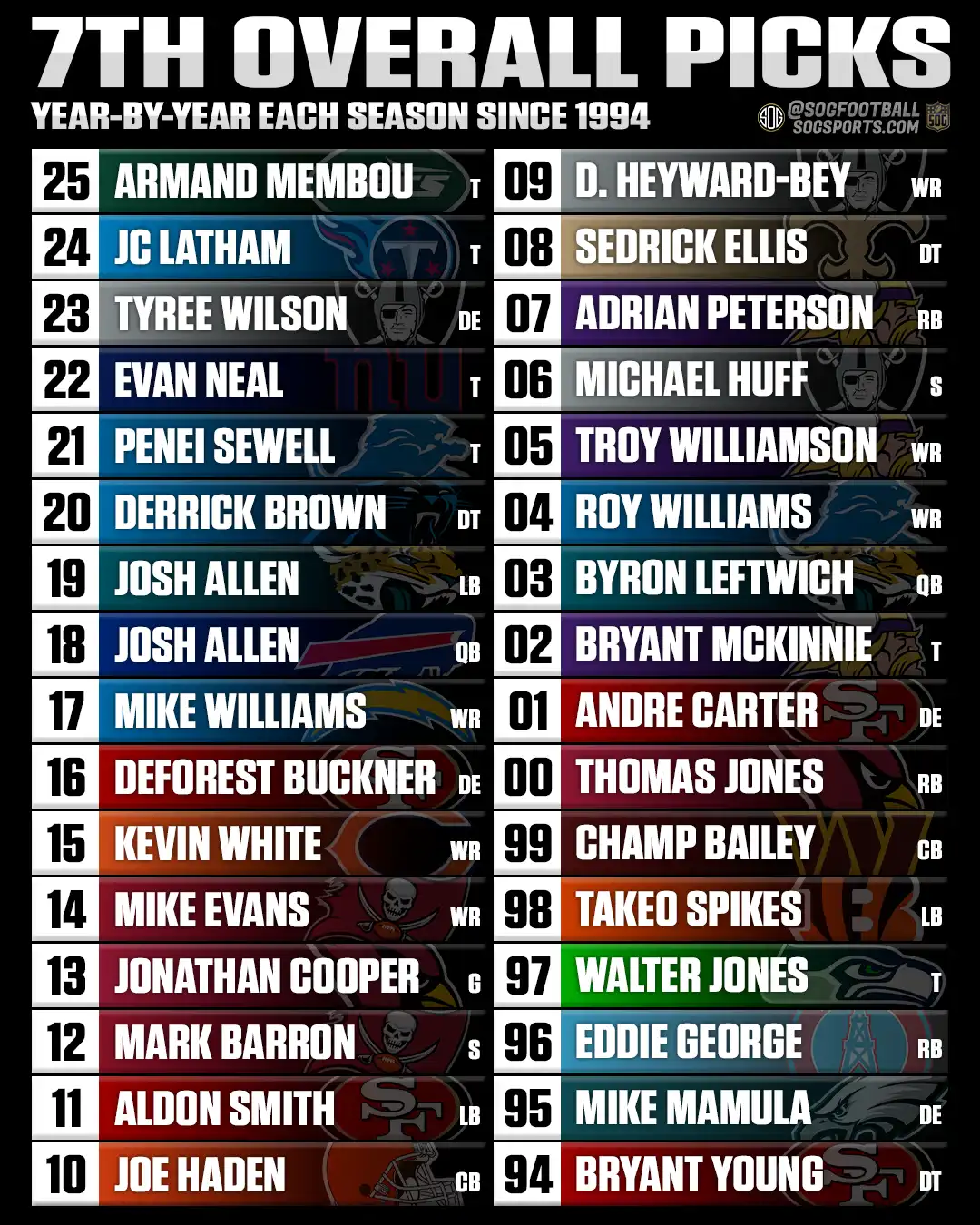
Year-by-year graphic showing every 7th overall NFL Draft pick from 1994 through 2025
The graphic highlights the modern era from Bryant Young in 1994 through Armand Membou in 2025. The full list below goes back to the first NFL Draft in 1936.
Year-by-Year List of 7th Overall NFL Draft Picks
2025 — Armand Membou, New York Jets, Offensive Tackle
Membou went seventh after a strong Missouri career that turned him into one of the cleanest tackle prospects in the class. The Jets drafted him to help stabilize the line and stop treating tackle like a yearly emergency.
2024 — JC Latham, Tennessee Titans, Offensive Tackle
Latham stepped into Tennessee’s lineup right away after starting 27 games at Alabama. The Titans used this pick to protect their quarterback and start rebuilding the offense from the front.
2023 — Tyree Wilson, Las Vegas Raiders, Defensive End
Wilson arrived with 14 career college sacks and top-end length, but he managed only 8 sacks across his first two NFL seasons. That is a slow start for a premium edge pick.
2022 — Evan Neal, New York Giants, Offensive Tackle
Neal started 13 games as a rookie, but injuries and inconsistent play kept the Giants from getting early tackle stability. This is exactly the kind of miss that forces a team to keep patching the same spot.
2021 — Penei Sewell, Detroit Lions, Offensive Tackle
Sewell became an All-Pro and one of the best young tackles in football by his third season. Detroit took him seventh and got a cornerstone for the offense almost immediately.
2020 — Derrick Brown, Carolina Panthers, Defensive Tackle
Brown broke out with 103 tackles in 2023, a huge number for an interior lineman. Carolina drafted him to anchor the front, and he turned into one of the few clear hits from that era.
2019 — Josh Allen, Jacksonville Jaguars, Linebacker
Allen — who later changed his professional name to Josh Hines-Allen — entered the league after a 17-sack season at Kentucky and reached 17.5 sacks in 2023. He gave Jacksonville a real top-end edge threat.
2018 — Josh Allen, Buffalo Bills, Quarterback
Allen went from raw prospect to NFL MVP after throwing for 4,306 yards and 29 touchdowns in 2024. Buffalo found a franchise quarterback at No. 7, which changed the ceiling of the entire organization.
2017 — Mike Williams, Los Angeles Chargers, Wide Receiver
Williams topped 1,000 receiving yards twice and scored 31 touchdowns for the Chargers. He was not a volume monster, but he gave the offense a real vertical and red-zone target.
2016 — DeForest Buckner, San Francisco 49ers, Defensive End
Buckner had 7 sacks as a rookie, later made first-team All-Pro, and became one of the best interior disruptors in football. San Francisco drafted a long-term difference-maker up front.
2015 — Kevin White, Chicago Bears, Wide Receiver
White played only 14 games for the Bears because shin and shoulder injuries wrecked the start of his career. Chicago spent a top-10 pick on a receiver and got 397 yards out of him.
2014 — Mike Evans, Tampa Bay Buccaneers, Wide Receiver
Evans opened his career with 11 straight 1,000-yard seasons and became the best receiver in Buccaneers history. Tampa Bay got a true WR1 without needing a top-five pick.
2013 — Jonathan Cooper, Arizona Cardinals, Guard
Cooper broke his left fibula in the 2013 preseason and never recovered enough to justify the draft slot. Arizona drafted him to fix the interior line and got almost nothing back.
2012 — Mark Barron, Tampa Bay Buccaneers, Safety
Barron never became the elite safety Tampa Bay hoped for, but he later remade himself as a linebacker-type defender with the Rams. The Buccaneers still missed on the role they drafted him to fill.
2011 — Aldon Smith, San Francisco 49ers, Linebacker
Smith had 33.5 sacks in his first two NFL seasons, which made the upside obvious immediately. He was suspended multiple times under the NFL’s substance-abuse and personal conduct policies, and San Francisco never got the full long-term payoff.
2010 — Joe Haden, Cleveland Browns, Cornerback
Haden made three Pro Bowls in Cleveland and gave the Browns a legitimate No. 1 corner. For a franchise that was missing on a lot of premium picks, this one actually landed.
2009 — Darrius Heyward-Bey, Oakland Raiders, Wide Receiver
Heyward-Bey ran a blazing 4.30 forty and became one of the draft’s big speed bets. Oakland got only one season over 1,000 yards, which made this a reach that never paid off.
2008 — Sedrick Ellis, New Orleans Saints, Defensive Tackle
Ellis started on the Saints team that won Super Bowl XLIV, but he finished with only 12.5 career sacks. New Orleans got a starter, not a top-of-the-board difference-maker.
2007 — Adrian Peterson, Minnesota Vikings, Running Back
Peterson ran for 14,918 yards, won the 2012 MVP, and nearly broke the single-season rushing record with 2,097 yards that year. In 2014 he pleaded no contest to misdemeanor reckless assault in a child-abuse case, which caused him to miss most of that season.
2006 — Michael Huff, Oakland Raiders, Safety
Huff started 96 games and later won Super Bowl XLVII with the Ravens. Oakland expected more splash from a seventh-overall defensive back, but it at least got years of starting play.
2005 — Troy Williamson, Minnesota Vikings, Wide Receiver
Williamson finished his Vikings career with 79 catches and 7 touchdown receptions. Minnesota drafted him to replace Randy Moss, and that is a comparison the pick never survived.
2004 — Roy Williams, Detroit Lions, Wide Receiver
Williams made a Pro Bowl and posted a 1,310-yard season in 2006. Detroit got a productive receiver, but not the franchise-changing one it wanted in that stretch of first-round wideout picks.
2003 — Byron Leftwich, Jacksonville Jaguars, Quarterback
Leftwich threw for 10,532 career yards and helped Jacksonville reach the playoffs in the 2005 season. The Jaguars got a functional starter, though not a long-term answer.
2002 — Bryant McKinnie, Minnesota Vikings, Offensive Tackle
McKinnie made one Pro Bowl and later started at left tackle for the Ravens on their Super Bowl XLVII championship team. Minnesota drafted a massive tackle and got years of starting value.
2001 — Andre Carter, San Francisco 49ers, Defensive End
Carter finished with 80.5 career sacks and had a 10-sack season in both San Francisco and Washington. This was a strong edge pick even if his best year came after he left the 49ers.
2000 — Thomas Jones, Arizona Cardinals, Running Back
Jones ran for 10,591 career yards and made one Pro Bowl. Arizona drafted a very good back and moved on before getting the best version of him.
1999 — Champ Bailey, Washington Commanders, Cornerback
Bailey reached the Pro Football Hall of Fame after 12 Pro Bowls and 52 interceptions. Washington drafted one of the best corners ever and then traded him away in his prime.
1998 — Takeo Spikes, Cincinnati Bengals, Linebacker
Spikes finished his NFL career with 1,431 tackles, 19 sacks, and two Pro Bowl selections. Cincinnati drafted a high-energy linebacker and got a long-time starter with real production.
1997 — Dwayne Rudd, Minnesota Vikings, Linebacker
Rudd played nine NFL seasons and recorded 25.5 career sacks as an off-ball linebacker. Minnesota got a long-term starter from this slot, even if Rudd never became a marquee name.
1996 — Terry Glenn, New England Patriots, Wide Receiver
Glenn caught 593 passes for 8,823 yards and 44 touchdowns in his career, including 90 catches for 1,132 yards as a rookie in 1996. He was suspended four games in 2001 under the NFL’s substance-abuse policy. Glenn died in a single-car accident in November 2017 at age 43.
1995 — Mike Mamula, Philadelphia Eagles, Defensive End
Mamula rode a huge combine workout to the seventh pick and finished with 31.5 career sacks. That is not enough return for how much hype was tied to the selection.
1994 — Bryant Young, San Francisco 49ers, Defensive Tackle
Young reached the Pro Football Hall of Fame after 89.5 career sacks and helped San Francisco win Super Bowl XXIX as a rookie. This is one of the best seventh-overall picks ever made.
1993 — Curtis Conway, Chicago Bears, Wide Receiver
Conway finished with 8,230 career receiving yards and produced back-to-back 1,000-yard seasons later in his career. Chicago drafted a good pro, not a franchise receiver.
1992 — Troy Vincent, Miami Dolphins, Cornerback
Vincent made five Pro Bowls and picked off 47 passes in his career. Miami got a high-end corner out of this slot.
1991 — Charles McRae, Tampa Bay Buccaneers, Offensive Tackle
McRae started 102 career games and later became a Pro Bowl tackle for the Raiders. Tampa Bay drafted a solid lineman, but not a long-term franchise answer.
1990 — Andre Ware, Detroit Lions, Quarterback
Ware won the Heisman at Houston but threw for only 1,112 career NFL passing yards. Detroit missed badly on a quarterback who never got close to translating the college production.
1989 — Tim Worley, Pittsburgh Steelers, Running Back
Worley ran for 2,954 career yards and never topped 800 in a season. He was arrested multiple times on drug-related charges after his NFL career ended.
1988 — Sterling Sharpe, Green Bay Packers, Wide Receiver
Sharpe led the league in catches three times and finished with 595 receptions and 65 touchdowns despite a neck injury ending his career after seven seasons. Green Bay got a star, just not enough years of him.
1987 — Reggie Rogers, Detroit Lions, Defensive End
Rogers had clear pass-rush talent, but his NFL career collapsed after legal trouble. In 1988 he was convicted in a drunk-driving crash that killed three teenagers.
1986 — Brian Jozwiak, Kansas City Chiefs, Guard
Jozwiak played only 13 NFL games before injuries ended the run quickly. Kansas City got almost nothing out of a top-10 lineman.
1985 — Ken Ruettgers, Green Bay Packers, Offensive Tackle
Ruettgers played 12 seasons and made one Pro Bowl while starting for years at left tackle. That is good value, even if it never turned into stardom.
1984 — Ricky Hunley, Cincinnati Bengals, Linebacker
Hunley never became the impact linebacker Cincinnati wanted and finished with only 3 career sacks. This was a miss in the middle of a huge draft for better players elsewhere.
1983 — Todd Blackledge, Kansas City Chiefs, Quarterback
Blackledge threw for 5,286 career yards and 29 touchdowns. Kansas City took him in the famous 1983 quarterback class and got one of the roughest outcomes from that group.
1982 — Darrin Nelson, Minnesota Vikings, Running Back
Nelson piled up 8,363 yards from scrimmage and caught 549 passes in his career. Minnesota got a productive offensive piece, even if not a workhorse back.
1981 — Hugh Green, Tampa Bay Buccaneers, Linebacker
Green made two Pro Bowls and posted 66 career sacks. Tampa Bay drafted a front-seven playmaker and got a good one.
1980 — Junior Miller, Atlanta Falcons, Tight End
Miller made the Pro Bowl in 1980 and caught 174 passes in his career. Atlanta got a useful receiving tight end, not a major star.
1979 — Phil Simms, New York Giants, Quarterback
Simms threw for 33,462 yards, won Super Bowl XXI MVP, and became one of the defining quarterbacks in Giants history. New York took heat for the pick at the time and was right in the end.
1978 — Ken MacAfee, San Francisco 49ers, Tight End
MacAfee played only six NFL seasons and caught 54 career passes. San Francisco drafted a premium tight end and got a bust.
1977 — Joe Campbell, New Orleans Saints, Defensive End
Campbell posted 45 career sacks and made the Pro Bowl in 1979. That is a respectable return for a Saints team that needed front-line help.
1976 — Mike Pruitt, Cleveland Browns, Running Back
Pruitt rushed for 6,540 yards and posted two 1,000-yard seasons in Cleveland. The Browns got real production out of this slot.
1975 — Larry Burton, New Orleans Saints, Wide Receiver
Burton caught just 44 passes in four NFL seasons. That is a clear miss for a top-10 receiver.
1974 — J.V. Cain, St. Louis Rams, Tight End
Cain made the Pro Bowl in 1980 and looked like a real receiving tight end before dying of a heart attack in training camp in 1981 at age 28. The Rams lost a good player far too soon.
1973 — Paul Seymour, Buffalo Bills, Tight End
Seymour played 11 seasons and later made two Pro Bowls with the Bears. Buffalo drafted a long-term pro, even if most of the recognition came elsewhere.
1972 — Willie Buchanon, Green Bay Packers, Defensive Back
Buchanon won Defensive Rookie of the Year and finished with 28 interceptions. Green Bay found a high-end cover man at No. 7.
1971 — Joe Profit, Atlanta Falcons, Running Back
Profit rushed for 1,761 career yards in four seasons. Atlanta drafted a running back high and did not get enough out of the investment.
1970 — Mike Reid, Cincinnati Bengals, Defensive Tackle
Reid made two Pro Bowls and was later a first-team All-Pro. Cincinnati got a real interior defender out of the early years of the franchise.
1969 — Ron Sellers, Boston Patriots, Wide Receiver
Sellers finished with 265 catches and 4,340 receiving yards in pro football. Boston got a productive receiver, though not a dominant one.
1968 — Ken Hardy, New Orleans Saints, Defensive Tackle
Hardy played seven NFL seasons after going seventh in the Saints’ first draft. He lasted in the league, but not as a front-line star.
1967 — Mel Farr, Detroit Lions, Running Back
Farr made two Pro Bowls and scored 36 total touchdowns in his career. Detroit got a real offensive contributor.
1966 — Jerry Shay, Minnesota Vikings, Defensive Tackle
Shay played only a few NFL seasons and never became a defining piece of the Vikings’ front. This was a light return for a top-10 tackle.
1965 — Donny Anderson, Green Bay Packers, Running Back
Anderson won two Super Bowls with Green Bay and later made four Pro Bowls across his career. The Packers got a versatile offensive piece, even if the hype outweighed the numbers.
1964 — Bill Munson, Los Angeles Rams, Quarterback
Munson threw for 16,495 career yards and spent 15 seasons in the league. The Rams drafted a quarterback who turned into a real pro, just not their franchise changer.
1963 — Pat Richter, Washington Commanders, Tight End
Richter caught 141 passes in nine seasons and later became more famous as an athletic director. Washington got a useful tight end, not a star.
1962 — Ronnie Bull, Chicago Bears, Running Back
Bull made the Pro Bowl as a rookie after posting 1,073 yards from scrimmage. He gave Chicago immediate value before injuries cut down the long-term return.
1961 — Tom Matte, Baltimore Colts, Running Back
Matte made two Pro Bowls and later became famous for filling in at quarterback during the 1965 season. Baltimore got one of the more versatile backs of his era.
1960 — Rogers Davis, Chicago Bears, Guard
Davis played eight NFL seasons and later started on the Packers’ Super Bowl II team. Chicago drafted a good lineman, but not its own long-term answer.
1959 — Don Clark, Chicago Bears, Back
Clark never became the offensive force his college résumé suggested and lasted only a few pro seasons. Chicago got a miss at a premium spot.
1958 — Chuck Howley, Chicago Bears, Linebacker
Howley reached the Pro Football Hall of Fame and remains the only Super Bowl MVP from a losing team, earning the award with Dallas after Super Bowl V. Chicago drafted a great player and traded him away.
1957 — Clarence Peaks, Philadelphia Eagles, Fullback
Peaks rushed for 1,900 career yards and scored 21 touchdowns while helping Philadelphia win the 1960 NFL title. This was a useful pick for a winning team.
1956 — Joe Childress, Chicago Cardinals, Halfback
Childress played only one NFL season before moving on to other pursuits. The Cardinals got almost no return from the seventh pick.
1955 — Larry Morris, Los Angeles Rams, Linebacker
Morris later became a Pro Bowl linebacker and won an NFL title with the Bears. The Rams drafted a strong player, but another team enjoyed the payoff.
1954 — Johnny Lattner, Pittsburgh Steelers, Halfback
Lattner won the Heisman and later rushed for 1,667 yards in the NFL. Pittsburgh got some production, but not a franchise back.
1953 — Al Carmichael, Green Bay Packers, Defensive Back
Carmichael played eight NFL seasons and made the Pro Bowl in 1954. Green Bay got a legit secondary player here.
1952 — Larry Isbell, Washington Commanders, Back
Isbell never played in the NFL after Washington drafted him seventh overall, choosing baseball and then the CFL instead. That made this a total miss for the franchise.
1951 — Ebert Van Buren, Philadelphia Eagles, Defensive Back
Van Buren played eight NFL seasons and intercepted 20 passes. Philadelphia got a solid defensive back, though not a famous one.
1950 — Travis Tidwell, New York Giants, Quarterback
Tidwell threw for 3,563 career yards and 31 touchdowns. The Giants drafted a quarterback high and got only short-run value.
1949 — Bobby Thomason, Los Angeles Rams, Quarterback
Thomason never became the Rams’ answer and later spent time in the CFL and military service. That is a weak outcome for a premium quarterback pick.
1948 — Jug Girard, Green Bay Packers, End
Girard played 10 NFL seasons, scored 18 total touchdowns, and won two NFL titles with the Lions. Green Bay drafted a versatile player who turned into a real pro.
1947 — Tex Coulter, Chicago Cardinals, Offensive Tackle
Coulter played only a couple of NFL seasons before leaving football. The Cardinals did not get long-term line value from this pick.
1946 — Leo Riggs, Philadelphia Eagles, Back
Riggs later made the Pro Bowl and scored 23 career touchdowns. Philadelphia got a useful backfield piece in the postwar years.
1945 — Don Lund, Chicago Bears, Back
Lund never played in the NFL after being drafted seventh overall, choosing professional baseball instead and spending parts of six seasons in Major League Baseball.
1944 — Merv Pregulman, Green Bay Packers, Center
Pregulman served in the Navy during World War II before starting his pro career and later played four NFL seasons. Green Bay had to wait on the return, but it eventually got a real lineman.
1943 — Bill Daley, Phil-Pitt Combine, Fullback
Daley became a three-time NFL champion and one of the better backs of the wartime era. This was a strong pick for the Steagles season.
1942 — Bobby Robertson, Brooklyn Dodgers, Center
Robertson played only a few pro seasons and never became a standout NFL lineman. Brooklyn got limited value from the pick.
1941 — George Paskvan, Green Bay Packers, Fullback
Paskvan rushed for 817 career yards and won an NFL title with Green Bay. The Packers got some value, even if not a featured back.
1940 — Bulldog Turner, Chicago Bears, Center
Turner reached the Pro Football Hall of Fame and became one of the great centers of the 1940s. Chicago landed a franchise cornerstone here.
1939 — Johnny Pingel, Detroit Lions, Tailback
Pingel played one NFL season, rushed for 301 yards, and later built a major advertising career. Detroit drafted a big college name and got a quick pro exit.
1938 — Cecil Isbell, Green Bay Packers, Tailback
Isbell threw for 5,945 yards and led the NFL in passing yards twice before retiring after only five seasons. Green Bay still got a title-era quarterback-level player out of this pick.
1937 — Lloyd Cardwell, Detroit Lions, Wingback
Cardwell played seven seasons, made the 1938 NFL All-Star Game, and was a two-time first-team All-Pro. Detroit did well here.
1936 — Russ Letlow, Green Bay Packers, Guard
Letlow made the NFL 1930s All-Decade Team, won two NFL titles, and became one of the earliest standout linemen in league history. Green Bay got an excellent opening-round pick in the first draft.
Why the 7th Overall Pick Matters
The seventh pick matters because it often tells you whether a front office is building with a plan or just reacting to what happened in the first six picks. This is the point where the obvious names are usually gone, so the team on the clock has to know exactly what kind of roster it wants to build.
Hit on a player like Josh Allen, Penei Sewell, Champ Bailey, or Bryant Young, and the franchise gets a pillar. Miss on a player like Kevin White, Troy Williamson, or Andre Ware, and the same weakness is still hanging around a couple of years later. That is what makes No. 7 such an organizational pressure point.
It also sits in a tricky range for quarterbacks. Teams picking here are often deciding between taking the last passer they really believe in or skipping the position entirely, and that choice can reshape the next five years of the franchise one way or the other.
Trends Among 7th Overall NFL Draft Picks
- Quarterbacks are rarer here than people assume. Only 8 of the 90 players selected seventh overall through 2025 were quarterbacks, which is 8.9 percent of the slot’s history. Most teams picking seventh already have a quarterback and are building around him.
- This pick has quietly been very good for premium linemen. Penei Sewell, Bryant McKinnie, Ken Ruettgers, Russ Letlow, and Bryant Young all came through No. 7, making the slot one of the better ones in draft history for front-seven and offensive line talent.
- Wide receiver has produced both stars and disasters. Mike Evans, Sterling Sharpe, Terry Glenn, and Roy Williams gave teams real production, while Kevin White, Troy Williamson, and Larry Burton were outright misses. The position history at this slot is genuinely split.
- The slot rewards teams that take the best player over the right position. Champ Bailey, Bryant Young, Sewell, and Joe Haden stand out because their franchises identified high-floor talent instead of drafting for a specific role. The misses at this slot tend to be projection picks that never translated.
FAQ About 7th Overall NFL Draft Picks
Who was the first 7th overall pick in NFL Draft history?
Russ Letlow was the first seventh-overall pick when Green Bay selected him in 1936. He turned into a two-time NFL champion and an All-Decade lineman, which gave the slot a strong start.
How often are quarterbacks taken 7th overall?
Through 2025, 8 of the 90 seventh-overall picks were quarterbacks. That works out to 8.9 percent, which is much lower than most people would guess for a top-10 draft slot.
Who are the best 7th overall NFL draft picks ever?
Champ Bailey, Bryant Young, Mike Evans, Sterling Sharpe, Phil Simms, Joe Haden, and Josh Allen all belong near the top of that list. That is a better all-time group than most people associate with the seventh pick, and it spans every era of the league.
Why has the 7th overall pick worked well for cornerbacks and offensive tackles?
Because this is often the point where desperate quarterback teams have already acted, leaving cleaner value at premium supporting positions. Sewell, McKinnie, Champ Bailey, Haden, and Troy Vincent all fit that pattern — high-floor players at positions where the floor and ceiling are easier to project than a raw quarterback or edge rusher.
What is the biggest bust ever taken 7th overall?
Vernon Gholston belongs near the top of that conversation because he recorded 0 sacks in 45 games after the Jets took him in 2008. Kevin White, Andre Ware, and Troy Williamson are also easy names in that discussion, with White getting 397 career receiving yards as the starkest skill-position miss.
What should teams picking seventh overall in the 2026 NFL Draft be looking for?
The same thing the best teams at this slot have always found — a player who changes how the roster functions, not just the highest-rated survivor on the board. The best seventh-overall picks solve a real structural problem at tackle, corner, quarterback, or pass rush. The worst ones start with a combine number and work backward.
Final Thoughts
The history of the seventh overall NFL Draft pick is really a record of what happens when front offices have to make a decision without a clean answer. The teams that got it right — San Francisco with Bryant Young, Washington with Champ Bailey, Detroit with Penei Sewell, Buffalo with Josh Allen — knew what they needed and trusted their evaluation when the board got uncomfortable. The teams that got it wrong were usually chasing athleticism over fit.
The 2026 NFL Draft will put this slot right back in that same spot. By the time the seventh pick is on the clock, the first wave is over and every team in the building is recalculating. What a franchise does in that moment is often a better indicator of organizational health than any of the louder picks that came before it.
That is what makes No. 7 worth watching every April. It is not the flashiest call of the night, but it is usually one of the most honest ones.
