All 8th Overall NFL Draft Picks in NFL History
The eighth pick is where draft boards usually stop looking clean. The obvious top names are often gone, but the slot is still high enough to land a franchise tackle, a real No. 1 receiver, or a defender a team expects to start changing games right away. That tension is why 8th overall NFL draft picks have such a weird history. This range has produced stars, safe picks that were not safe at all, and a few franchises that got exactly the player they needed.
Table of Contents
- Featured Graphic
- Year-by-Year List of 8th Overall NFL Draft Picks
- Why the 8th Overall Pick Matters
- Trends Among 8th Overall NFL Draft Picks
- FAQ About 8th Overall NFL Draft Picks
- Final Thoughts
Featured Graphic
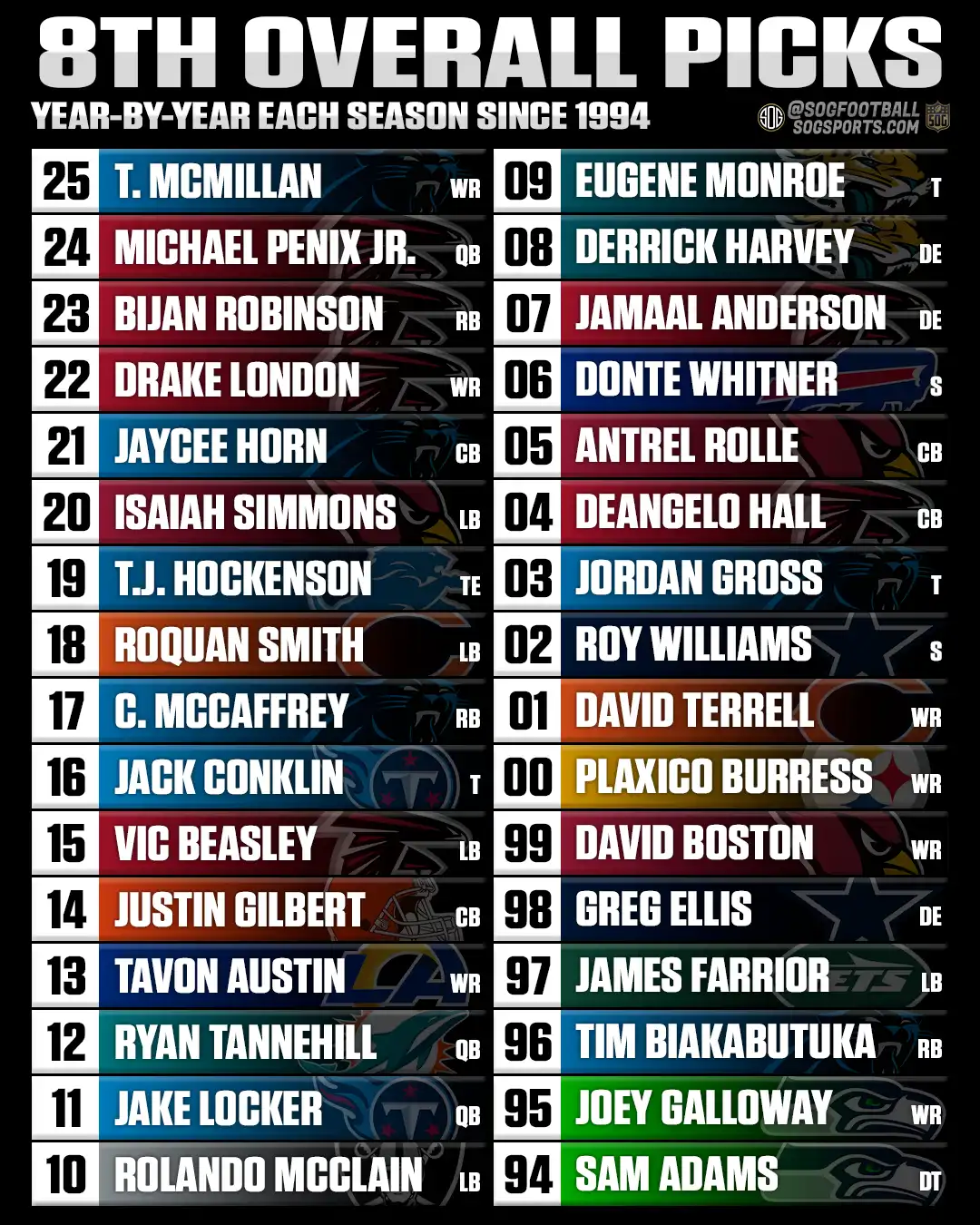
Year-by-year graphic showing every 8th overall NFL Draft pick from 1994 through 2025
The graphic highlights the modern era from Sam Adams in 1994 through Tetairoa McMillan in 2025. The full list below goes back to the first NFL Draft in 1936.
Year-by-Year List of 8th Overall NFL Draft Picks
2025 — Tetairoa McMillan, Carolina Panthers, Wide Receiver
McMillan went eighth after a huge Arizona career that included 1,319 receiving yards in 2024. Carolina drafted him to give Bryce Young a true featured target on the outside.
2024 — Michael Penix Jr., Atlanta Falcons, Quarterback
Penix arrived after throwing for 4,903 yards and 36 touchdowns in his final Washington season. Atlanta made a controversial long-term quarterback bet here, which immediately reshaped the timeline of the franchise.
2023 — Bijan Robinson, Atlanta Falcons, Running Back
Robinson topped 1,400 scrimmage yards as a rookie and looked like the kind of offensive centerpiece Atlanta wanted. The question was never talent — it was whether a running back was the right top-10 investment for that roster.
2022 — Drake London, Atlanta Falcons, Wide Receiver
London opened his career with back-to-back 800-yard seasons, then cleared 1,200 receiving yards in 2024. Atlanta drafted him to become the WR1, and he did.
2021 — Jaycee Horn, Carolina Panthers, Cornerback
Horn’s rookie year ended after three games because of a broken foot, but he later developed into one of Carolina’s better defensive pieces. This pick still comes back to whether the Panthers can keep him on the field.
2020 — Isaiah Simmons, Arizona Cardinals, Linebacker
Simmons brought rare athletic tools, but Arizona never found a stable full-time role for him. That is a problem when a top-10 pick is supposed to solve multiple problems at once.
2019 — T.J. Hockenson, Detroit Lions, Tight End
Hockenson made multiple Pro Bowls and topped 900 receiving yards more than once in his career. Detroit drafted him eighth to add a high-end pass-catching tight end, then traded him inside the division.
2018 — Roquan Smith, Chicago Bears, Linebacker
Smith became an All-Pro linebacker and one of the best tackle producers in football. Chicago got the player right, even if the long-term payoff landed in Baltimore.
2017 — Christian McCaffrey, Carolina Panthers, Running Back
McCaffrey became one of the league’s best all-purpose weapons, highlighted by a 1,000/1,000 rushing and receiving season in 2019. Carolina drafted an offensive engine and got one.
2016 — Jack Conklin, Tennessee Titans, Offensive Tackle
Conklin made first-team All-Pro as a rookie and immediately stabilized Tennessee’s line. That is rare value from a tackle picked outside the top five.
2015 — Vic Beasley, Atlanta Falcons, Linebacker
Beasley led the league with 15.5 sacks in 2016, then never came close to that again. Atlanta drafted him to become a long-term pass-rush answer and got one spike year.
2014 — Justin Gilbert, Cleveland Browns, Cornerback
Gilbert started only three games for Cleveland and was gone after two seasons. This was a hard miss for a team that badly needed secondary help.
2013 — Tavon Austin, St. Louis Rams, Wide Receiver
Austin never topped 510 receiving yards in a season with the Rams despite all the draft-night excitement. St. Louis drafted a space player eighth overall and got gadget production, not a real WR1.
2012 — Ryan Tannehill, Miami Dolphins, Quarterback
Tannehill threw for 34,881 career yards and later had a 33-touchdown season in Tennessee in 2019. Miami drafted a developmental quarterback and got mixed results before the best efficiency stretch happened elsewhere.
2011 — Jake Locker, Tennessee Titans, Quarterback
Locker started only 23 games in his career, and shoulder, hip, and foot injuries buried the pick fast. Tennessee spent a top-10 pick on a quarterback and got almost nothing back.
2010 — Rolando McClain, Oakland Raiders, Linebacker
McClain never became the leader Oakland expected at linebacker and was out of the league with the Raiders after three seasons. He was arrested multiple times during his career on assault and weapons-related charges.
2009 — Eugene Monroe, Jacksonville Jaguars, Offensive Tackle
Monroe started 83 career games and gave Jacksonville years of competent tackle play. That is useful, but not franchise-changing, which is what teams want from the eighth pick.
2008 — Derrick Harvey, Jacksonville Jaguars, Defensive End
Harvey had 8 career sacks in four seasons. Jacksonville traded up for him and got a bust.
2007 — Jamaal Anderson, Atlanta Falcons, Defensive End
Anderson finished with 7.5 career sacks after going eighth overall. Atlanta drafted him for edge production and got almost none.
2006 — Donte Whitner, Buffalo Bills, Safety
Whitner made three Pro Bowls and played 14 NFL seasons. Buffalo drafted a defensive back high and at least got a long-run starter with real durability.
2005 — Antrel Rolle, Arizona Cardinals, Cornerback
Rolle made three Pro Bowls and later won a Super Bowl with the Giants. Arizona drafted a versatile secondary piece and got a strong NFL player.
2004 — DeAngelo Hall, Atlanta Falcons, Cornerback
Hall finished with 43 interceptions and made three Pro Bowls. Atlanta got a playmaker in the secondary, even if the career became more itinerant later on.
2003 — Jordan Gross, Carolina Panthers, Offensive Tackle
Gross made three Pro Bowls and became one of the better tackles in Panthers history. Carolina drafted him eighth and got long-term left tackle stability.
2002 — Roy Williams, Dallas Cowboys, Safety
Williams made five Pro Bowls and became one of the more recognizable Cowboys defenders of the 2000s. Dallas drafted him for impact, and for a while it got it.
2001 — David Terrell, Chicago Bears, Wide Receiver
Terrell never had a 700-yard season and finished with 1,602 career receiving yards. Chicago swung at receiver in the top 10 and missed badly.
2000 — Plaxico Burress, Pittsburgh Steelers, Wide Receiver
Burress finished with 8,499 receiving yards and caught the winning touchdown in Super Bowl XLII. He later pleaded guilty to criminal possession of a weapon after accidentally shooting himself at a New York nightclub in 2008 and served approximately 20 months in prison.
1999 — David Boston, Arizona Cardinals, Wide Receiver
Boston led the NFL with 1,598 receiving yards in 2001 and made a couple of Pro Bowls. He was later suspended for violating the NFL’s substance-abuse policy.
1998 — Greg Ellis, Dallas Cowboys, Defensive End
Ellis recorded 84 career sacks and made a Pro Bowl. Dallas got a productive front-line defender from this slot.
1997 — James Farrior, New York Jets, Linebacker
Farrior became a two-time first-team All-Pro and a key defender on two Steelers Super Bowl teams. The Jets drafted a very good linebacker and did not keep the best years.
1996 — Tim Biakabutuka, Carolina Panthers, Running Back
Biakabutuka’s best season was 1999, when he rushed for 718 yards and 6 touchdowns. Carolina drafted a first-round back and got only one decent season out of him because injuries kept getting in the way.
1995 — Joey Galloway, Seattle Seahawks, Wide Receiver
Galloway finished with 10,950 receiving yards and made a Pro Bowl. Seattle drafted a legit field-stretcher and got a long NFL career out of the pick.
1994 — Sam Adams, Seattle Seahawks, Defensive Tackle
Adams made three Pro Bowls, won Super Bowl XXXV with Baltimore, and became one of the more reliable interior defenders of his era. Seattle got a good player, even if the peak came elsewhere.
1993 — Willie Roaf, New Orleans Saints, Offensive Tackle
Roaf made 11 Pro Bowls and reached the Pro Football Hall of Fame. This was a franchise tackle pick that fully hit.
1992 — Bob Whitfield, Atlanta Falcons, Offensive Tackle
Whitfield made three Pro Bowls and started for teams that reached Super Bowls in Atlanta and New York. That is strong return for a top-10 tackle.
1991 — Antone Davis, Philadelphia Eagles, Offensive Tackle
Davis started 121 NFL games and gave Philadelphia a long-run tackle starter. He was not a star, but he was real top-lineup value.
1990 — Chris Singleton, New England Patriots, Linebacker
Singleton finished with 341 tackles and 7 sacks in his NFL career. New England got a useful linebacker, though not the defensive centerpiece usually expected at No. 8.
1989 — Burt Grossman, San Diego Chargers, Defensive End
Grossman recorded 45 career sacks and posted double-digit sacks in 1990. A neck injury cut the career short before the full return could come in.
1988 — Dave Cadigan, New York Jets, Offensive Tackle
Cadigan played 82 NFL games and made 64 starts. The Jets got a starter for a while, not a franchise line anchor.
1987 — Shane Conlan, Buffalo Bills, Linebacker
Conlan won Defensive Rookie of the Year in 1987 and made three straight Pro Bowls. Buffalo got an immediate difference-maker on a defense that soon reached four straight Super Bowls.
1986 — Leslie O’Neal, San Diego Chargers, Defensive End
O’Neal finished with 132.5 career sacks and made six Pro Bowls. A knee injury late in his rookie year cost him most of the next two seasons, and he still turned into one of the best pass rushers of his era.
1985 — Ron Holmes, Tampa Bay Buccaneers, Defensive End
Holmes finished with 36.5 career sacks across eight NFL seasons. Tampa Bay got some production, but not the top-tier pass rusher it needed from this slot.
1984 — Leonard Coleman, Indianapolis Colts, Defensive Back
Coleman sat out the 1984 NFL season because of a contract dispute and signed with the USFL instead. That immediately cut into the value of the pick for Indianapolis.
1983 — Michael Haddix, Philadelphia Eagles, Running Back
Haddix rushed for 3,722 career yards but averaged just 3.0 yards per carry across his NFL career. Philadelphia spent the eighth pick on a running back and got a disappointment.
1982 — Mike Munchak, Houston Oilers, Guard
Munchak made nine Pro Bowls and reached the Pro Football Hall of Fame. This was a massive hit on the interior offensive line.
1981 — Ronnie Lott, San Francisco 49ers, Defensive Back
Lott reached the Pro Football Hall of Fame after 63 career interceptions, 10 Pro Bowls, and four Super Bowl titles. San Francisco drafted one of the best defensive backs the sport has ever seen.
1980 — Mark Haynes, New York Giants, Defensive Back
Haynes made three Pro Bowls, earned multiple All-Pro honors, and finished with 17 career interceptions. The Giants got a very good corner at No. 8.
1979 — Ottis Anderson, St. Louis Cardinals, Running Back
Anderson rushed for 10,273 career yards and later won Super Bowl XXV MVP with the Giants. The Cardinals drafted a great back and did not keep the peak years.
1978 — Ross Browner, Cincinnati Bengals, Defensive End
Browner made multiple Pro Bowls and started for years on Cincinnati’s front. The Bengals got a productive defensive end out of this spot.
1977 — Wilson Whitley, Cincinnati Bengals, Defensive Tackle
Whitley played only five NFL seasons and never became the interior force Cincinnati expected. For a top-10 defensive tackle, this was a miss.
1976 — Dennis Lick, Chicago Bears, Offensive Tackle
Lick started on the Bears’ line for years and later helped the 49ers win Super Bowl XVI. Chicago got a legitimate NFL tackle, even if the best team success came later.
1975 — Gary Johnson, San Diego Chargers, Defensive Tackle
Johnson finished with 67.5 career sacks and became part of the Chargers’ “Bruise Brothers” front. This was a strong defensive line pick.
1974 — Ed O’Neil, Detroit Lions, Linebacker
O’Neil played six seasons in Detroit before finishing in Green Bay. The Lions got a starter, not a star.
1973 — Wally Chambers, Chicago Bears, Defensive Tackle
Chambers won Defensive Rookie of the Year and made three Pro Bowls. Chicago got an immediate impact lineman at No. 8.
1972 — Royce Smith, New Orleans Saints, Guard
Smith was an All-American coming out of Georgia, but he never became a long-term answer for New Orleans. This was a miss on the interior line.
1971 — Frank Lewis, Pittsburgh Steelers, Wide Receiver
Lewis finished with 397 catches, 6,724 receiving yards, and 40 touchdowns. Pittsburgh drafted a productive receiver who later became a key part of two Super Bowl teams.
1970 — Larry Stegent, St. Louis Cardinals, Running Back
Stegent had useful stretches early in his Cardinals career before injuries got in the way. St. Louis got some production, but not enough for the eighth pick.
1969 — Larry Smith, Los Angeles Rams, Running Back
Smith became a productive NFL back and was part of the Rams’ offense through the early 1970s. This was a solid pick, even if not a franchise-defining one.
1968 — Larry Csonka, Miami Dolphins, Fullback
Csonka reached the Pro Football Hall of Fame, won an MVP, and helped lead Miami to two Super Bowl titles. The Dolphins landed an all-time great at No. 8.
1967 — Gene Washington, Minnesota Vikings, Wide Receiver
Washington finished with 6,954 receiving yards and 60 touchdowns. Minnesota got a real big-play receiver out of this slot.
1966 — Carl McAdams, St. Louis Cardinals, Linebacker
McAdams was drafted by St. Louis but signed with the AFL’s New York Jets instead. That made the pick a loss for the Cardinals before the NFL career even started.
1965 — Jack Snow, Minnesota Vikings, Wide Receiver
Snow was drafted by Minnesota, then quickly landed with the Rams and finished with 6,012 receiving yards and 45 touchdowns. The Vikings used the pick, but Los Angeles got the payoff.
1964 — Marv Woodson, Baltimore Colts, Defensive Back
Woodson was drafted by Baltimore but traded before he ever played for the Colts. He still went on to have a long NFL career as a defensive back.
1963 — Kermit Alexander, San Francisco 49ers, Defensive Back
Alexander played 12 NFL seasons and became a respected veteran corner. San Francisco got a real long-term pro out of the eighth pick.
1962 — Lance Alworth, San Francisco 49ers, Wide Receiver
Alworth was drafted by the 49ers but signed in the AFL and became a Pro Football Hall of Famer with the Chargers after 10,266 receiving yards and 85 touchdowns. San Francisco identified a great player and got none of the benefit.
1961 — Ken Rice, St. Louis Cardinals, Offensive Tackle
Rice was drafted by St. Louis but signed with the AFL’s Buffalo Bills instead and later made an AFL All-Star team. The Cardinals lost this pick to the AFL war.
1960 — Jim Houston, Cleveland Browns, Linebacker
Houston played 13 seasons, made four Pro Bowls, and helped Cleveland win the 1964 NFL title. This was a very good pick.
1959 — Dan James, San Francisco 49ers, Offensive Tackle
James never played for the 49ers and spent his NFL career with Pittsburgh. San Francisco used the pick and missed the real return.
1958 — Jim Pace, San Francisco 49ers, Halfback
Pace played only one NFL season after being drafted eighth overall. The 49ers got almost nothing from a premium backfield pick.
1957 — Jim Parker, Baltimore Colts, Guard
Parker reached the Pro Football Hall of Fame and became one of the best linemen of his era. Baltimore nailed this pick.
1956 — Jack Losch, Green Bay Packers, Halfback
Losch played only one NFL season. Green Bay got almost no return from the eighth pick.
1955 — Joe Heap, New York Giants, Halfback
Heap played only one season with the Giants before Air Force service took over the rest of his football story. New York got very little out of a first-round halfback.
1954 — Steve Meilinger, Washington Redskins, End
Meilinger played six NFL seasons and later won a title with the Packers. Washington got a useful player, not a star.
1953 — Bobby Marlow, New York Giants, Halfback
Marlow never played in the NFL after being drafted eighth overall, choosing the CFL instead. That is the main fact attached to this pick.
1952 — Jim Dooley, Chicago Bears, Back
Dooley spent his entire 10-year NFL career with the Bears and later became the team’s head coach. Chicago got a real long-term player out of this slot.
1951 — Chet Mutryn, Philadelphia Eagles, Back
Mutryn played in the NFL, but he did not become a major offensive star for Philadelphia. This was a modest return for a top-10 pick.
1950 — Lynn Chandnois, Pittsburgh Steelers, Back
Chandnois made the Pro Bowl and became one of Pittsburgh’s better backs of the early 1950s. This was a good pick for the Steelers.
1949 — Rob Goode, Washington Redskins, Back
Goode made two Pro Bowls and led the NFL in rushing touchdowns in 1951. Washington got real production from the eighth pick.
1948 — Clyde Scott, Philadelphia Eagles, Halfback
Scott made the Pro Bowl and later helped Philadelphia win NFL titles. This was a useful early-era pick for the Eagles.
1947 — Neill Armstrong, Philadelphia Eagles, End
Armstrong played on two championship Eagles teams and later became an NFL head coach. Philadelphia got a legitimate contributor here.
1946 — Bill Dellastatious, Detroit Lions, Back
Dellastatious never became a major NFL back after Detroit took him eighth overall. This was a light return from the first round.
1945 — Jim Hardy, Washington Redskins, Quarterback
Hardy threw for 5,690 career yards and later made the Pro Bowl. Washington drafted a real NFL quarterback, even if not a franchise one.
1944 — Mike Micka, Washington Redskins, Fullback
Micka played in the NFL after wartime interruptions and later spent time with Boston as well. Washington got some value, but not top-pick value.
1943 — Dick Wildung, Green Bay Packers, Offensive Tackle
Wildung became a long-time Packers lineman and later reached the Pro Football Hall of Fame. Green Bay got a cornerstone blocker.
1942 — Merle Hapes, New York Giants, Back
Hapes was drafted eighth overall but World War II and later a league suspension for failing to report a bribe attempt limited the NFL story significantly. The Giants did not get a normal return on the pick.
1941 — Dean McAdams, Brooklyn Dodgers, Tailback
McAdams played for the Dodgers and led the NFL in punting yards in 1942. Brooklyn got a player with some all-around value, even if not star-level impact.
1940 — Ed Boell, Washington Redskins, Back
Boell played in the NFL and later made the All-Pro team. Washington got a better result here than many teams did in the early draft years.
1939 — I.B. Hale, Washington Redskins, Offensive Tackle
Hale was a standout college lineman, but the NFL career was brief. Washington did not get long-run line value from the pick.
1938 — George Karamatic, New York Giants, Fullback
Karamatic was drafted by the Giants but ended up playing for Washington. That meant New York spent the pick and got none of the actual NFL return.
1937 — Les McDonald, Chicago Bears, End
McDonald never became a major NFL figure after going eighth overall. This was one of the early-draft picks that did not deliver much pro value.
1936 — Sid Wagner, Detroit Lions, Guard
Wagner was one of the first first-round picks in NFL draft history and became a starter for Detroit. For the inaugural draft, that counted as a respectable outcome.
Why the 8th Overall Pick Matters
The eighth pick matters because it usually forces a front office to stop pretending the board made the decision for it. By this point, the obvious top names are gone, and the team on the clock has to decide whether it is fixing the quarterback’s life, betting on a defender with real starting urgency, or forcing a skill player into a roster that is not ready for him.
The consequences are obvious in the history of this slot. Hit on a player like Christian McCaffrey, Roquan Smith, Jordan Gross, or Jack Conklin, and the roster gets a major piece. Miss on a player like Justin Gilbert, Derrick Harvey, Jamaal Anderson, or David Terrell, and the same problem stays on the roster for years.
This slot is also where teams get in trouble chasing traits over clean football value. That is why the eighth pick has produced both stars and some of the uglier top-10 misses of the modern era.
Trends Among 8th Overall NFL Draft Picks
- Defense has dominated this slot in the modern era. From 2004 through 2021, 13 of the 18 players drafted eighth overall were defenders, including corners, linebackers, safeties, and edge players. The position mix reflects how often teams at this slot have already addressed the offense earlier in the top 10.
- Wide receiver has been boom-or-bust. Joey Galloway, Plaxico Burress, and David Boston produced real seasons, while David Terrell and Tavon Austin were clear misses for where they were drafted. The receiver history here has almost no middle ground.
- The slot has been friendly to offensive tackles when teams stay disciplined. Jordan Gross, Jack Conklin, Willie Roaf, and Eugene Monroe all gave their teams real starting value, and Roaf is a Hall of Famer. The position has one of the better hit rates at No. 8.
- Quarterbacks here are rare, and that tells its own story. From 2000 through 2025, only four quarterbacks went eighth overall: Ryan Tannehill, Jake Locker, Michael Penix Jr., and none between 2012 and 2024. Teams at No. 8 usually pivot to roster support instead of forcing the position.
FAQ About 8th Overall NFL Draft Picks
Who was the best 8th overall NFL draft pick of the modern era?
Christian McCaffrey has a strong case because of the 1,000/1,000 season, multiple All-Pro-level years, and the way he can function as an entire offense by himself. Roquan Smith and Jordan Gross are also right in that conversation depending on how much value you place on position.
How often are quarterbacks taken 8th overall?
From 2000 through 2025, only 4 of the 26 eighth-overall picks were quarterbacks. That is 15.4 percent, which shows how often teams at this slot pivot to other premium positions instead of forcing a passer.
Why do so many defensive players get drafted eighth overall?
Because this is often where the quarterback run is over and teams start trying to fix specific defensive problems fast. Corners, linebackers, and pass-rush projections tend to get pushed into this range when front offices feel pressure to add speed and impact after the early offense-heavy picks.
What is the biggest bust taken 8th overall in the modern era?
Justin Gilbert belongs high on that list because Cleveland got only 3 starts out of him before moving on. Derrick Harvey, Jamaal Anderson, and Jake Locker — who started just 23 games despite being a top-10 pick — are the other names that come up immediately in that conversation.
Which teams used the 8th pick well in the 2000s?
Carolina did well with Jordan Gross and Christian McCaffrey. Buffalo got a long-run starter in Donte Whitner, and Arizona got a quality NFL defensive back in Antrel Rolle even if he later peaked elsewhere. San Francisco’s Ronnie Lott pick in 1981 remains the best single outcome in the slot’s history.
What should teams picking eighth in the 2026 NFL Draft be looking for?
They should be looking for a player who fixes a real structural issue, not just the most explosive name still sitting there. The best eighth-overall picks usually make the quarterback’s job easier, stabilize the line, or immediately upgrade a defense that cannot get off the field. The worst ones start with a combine number and work backward.
Final Thoughts
The history of the eighth overall NFL Draft pick is really a record of what happens when front offices run out of obvious answers and have to reveal what they actually believe. The teams that got it right — San Francisco with Ronnie Lott, Carolina with Jordan Gross and Christian McCaffrey, Buffalo with Shane Conlan — took high-floor players who solved real problems. The teams that missed were usually chasing ceiling over certainty.
The 2026 NFL Draft will put this slot right back in the same position. By the time the eighth pick is on the clock, the room has already seen a full wave of the best players come off the board, and the team picking here has to decide whether the player it wants is still worth the cost.
That is what keeps No. 8 worth watching. It is not the loudest pick of the night, but it is often the one that tells you the most about how a front office thinks under pressure.
