All 9th Overall NFL Draft Picks in NFL History
Top-10 picks are supposed to change something, and No. 9 sits right where the draft board stops handing teams an easy answer. This is the spot where front offices either trust their evaluation or talk themselves into a mistake that hangs around for years. The history of the ninth pick includes Hall of Famers, franchise left tackles, major defensive pieces, and some ugly first-round whiffs. That range is exactly why this slot matters.
Table of Contents
- Featured Graphic
- Year-by-Year List of 9th Overall NFL Draft Picks
- Why the 9th Overall Pick Matters
- Trends Among 9th Overall NFL Draft Picks
- FAQ About 9th Overall NFL Draft Picks
- Final Thoughts
Featured Graphic
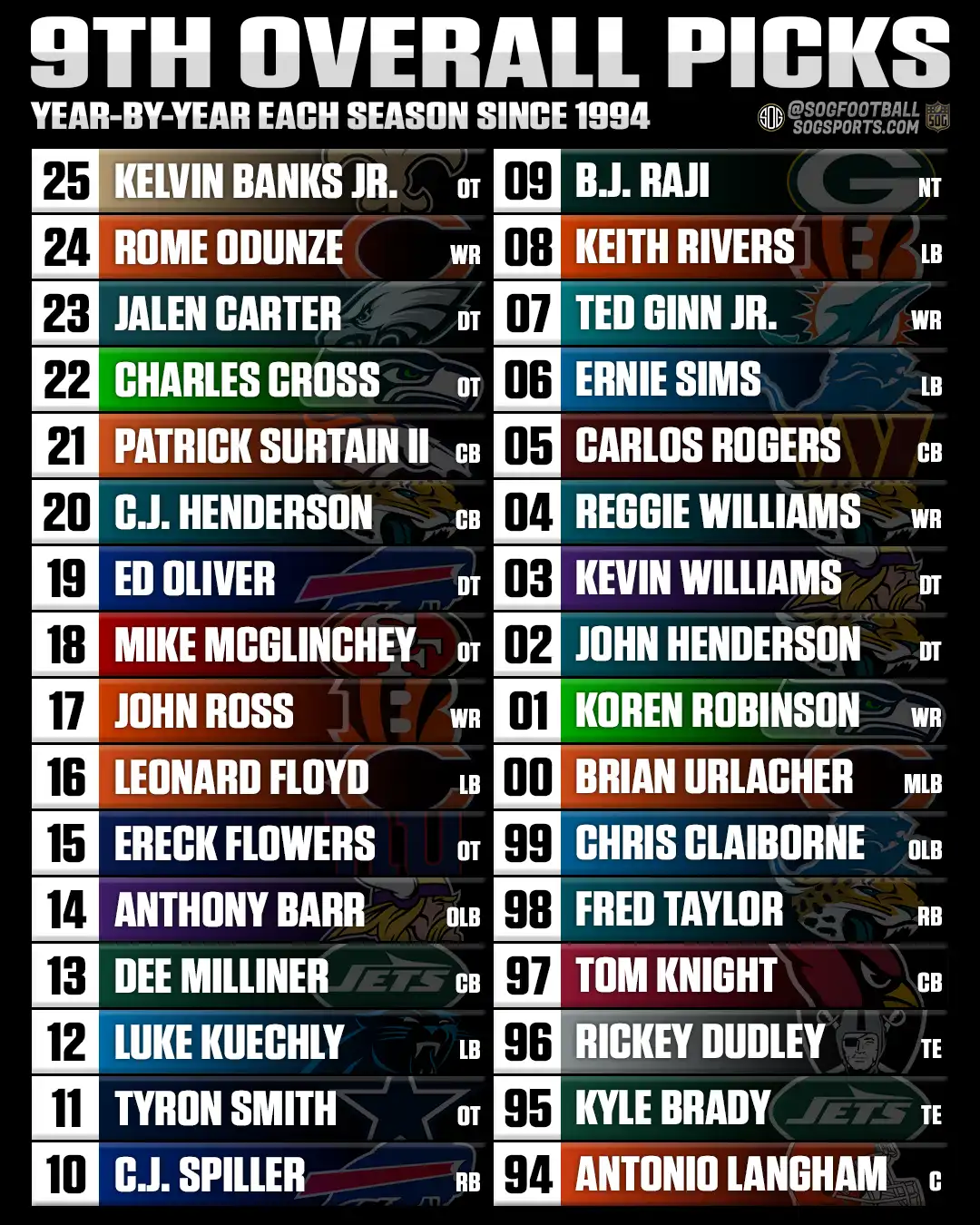
Year-by-year graphic showing every 9th overall NFL Draft pick from 1994 through 2025
The graphic highlights the modern era from Antonio Langham in 1994 through Kelvin Banks Jr. in 2025. The full list below goes back to the first NFL Draft in 1936.
Year-by-Year List of 9th Overall NFL Draft Picks
2025 — Kelvin Banks Jr., New Orleans Saints, Offensive Tackle
New Orleans used the pick on line help, not a luxury piece. Banks started 42 games at Texas, won the 2024 Lombardi and Outland trophies, and reportedly allowed only four sacks in 1,477 career pass-blocking snaps, so the Saints are betting on a plug-and-play tackle instead of another long rebuild project up front.
2024 — Rome Odunze, Chicago Bears, Wide Receiver
Odunze walked into a crowded receiver room and still finished his rookie year with 54 catches for 734 yards and three touchdowns in 17 games. That is not star production yet, but it is real Year 1 volume for a team trying to build around Caleb Williams.
2023 — Jalen Carter, Philadelphia Eagles, Defensive Tackle
Carter already looks like the kind of interior disruptor who changes playoff games. Through his first two seasons he posted 10.5 sacks, made a Pro Bowl, earned second-team All-Pro honors in 2024, and helped power Philadelphia to a Super Bowl LIX title. Before the draft, he pleaded no contest to misdemeanor reckless driving and racing charges stemming from the fatal January 2023 crash in Athens.
2022 — Charles Cross, Seattle Seahawks, Offensive Tackle
Seattle drafted a left tackle and got a full-time starter fast. Cross started 48 games across his first three seasons, including every game in both 2022 and 2024, which is exactly the kind of stability teams chase in the top 10.
2021 — Patrick Surtain II, Denver Broncos, Cornerback
Denver ignored quarterback noise and took the best defender on the board. Surtain had 11 interceptions through his first four seasons, made three Pro Bowls, and won NFL Defensive Player of the Year for 2024, which is about as strong a return as this slot can produce.
2020 — C.J. Henderson, Jacksonville Jaguars, Cornerback
Jacksonville wanted a top-flight outside corner and missed. Henderson bounced through four organizations and entered 2025 with 172 tackles, three interceptions, and 16 pass breakups in 49 career games, which is thin production for a top-10 corner.
2019 — Ed Oliver, Buffalo Bills, Defensive Tackle
Oliver has not become the dominant interior star some expected, but he has been a real NFL starter on winning teams. He entered 2025 with 27.0 career sacks and 231 solo tackles, giving Buffalo steady disruption from the middle of the line.
2018 — Mike McGlinchey, San Francisco 49ers, Offensive Tackle
McGlinchey was drafted to solidify the edge of the line, and that is what he did. He reached 98 career games in his first seven seasons and started throughout San Francisco’s run to Super Bowl LIV before later moving on to Denver.
2017 — John Ross, Cincinnati Bengals, Wide Receiver
Ross brought a 4.22-second combine 40 and not much NFL production behind it. He finished with 63 catches for 963 yards and 11 touchdowns, which makes him one of the clearer misses at this slot in the last decade.
2016 — Leonard Floyd, Chicago Bears, Outside Linebacker
Chicago drafted edge speed and got a long career, even if the best years came elsewhere. Floyd had 66.5 career sacks through the 2025 season and picked up a Super Bowl ring with the Rams, so this was not a bust even if it was not a Bears cornerstone.
2015 — Ereck Flowers, New York Giants, Offensive Tackle
The Giants took Flowers to fix tackle and never got that answer. He lasted 105 NFL games and salvaged his career after moving inside to guard, but the original plan at left tackle failed.
2014 — Anthony Barr, Minnesota Vikings, Outside Linebacker
Minnesota took Barr for range and pass-rush upside and got a useful front-seven piece for years. He opened his career with 70 tackles and 4.0 sacks as a rookie, then made four Pro Bowls and became a core defender on playoff teams.
2013 — Dee Milliner, New York Jets, Cornerback
This is one of the harsher injury busts in the modern history of the slot. Milliner showed flashes with three interceptions as a rookie, but an Achilles tear in 2014 and lingering wrist problems wrecked his career almost immediately.
2012 — Luke Kuechly, Carolina Panthers, Linebacker
Kuechly gave Carolina an instant defensive centerpiece. He posted 164 tackles as a rookie, won Defensive Rookie of the Year, later won Defensive Player of the Year, and became the nerve center of a defense that reached Super Bowl 50.
2011 — Tyron Smith, Dallas Cowboys, Offensive Tackle
Dallas took a tackle and wound up with one of the best linemen of his generation. Smith made multiple All-Pro teams, stacked eight Pro Bowls by the end of the 2023 season, and spent years protecting Tony Romo and then Dak Prescott.
2010 — C.J. Spiller, Buffalo Bills, Running Back
Buffalo used a top-10 pick on a running back and got one great season instead of a franchise changer. Spiller made the 2012 Pro Bowl after producing 1,703 yards from scrimmage, but his career ended with 3,321 rushing yards and only one 1,000-yard rushing season.
2009 — B.J. Raji, Green Bay Packers, Nose Tackle
Raji was not around forever, but Green Bay got impact at the right time. He earned first-team All-Pro honors in 2010, made the Pro Bowl in 2011, and his pick-six in the NFC title game helped launch the Packers toward a Super Bowl XLV win.
2008 — Keith Rivers, Cincinnati Bengals, Linebacker
The Bengals drafted a linebacker and got a player whose career never found lift. Rivers played 74 games with 50 starts, and his rookie year was derailed when Hines Ward broke his jaw on a crackback block.
2007 — Ted Ginn Jr., Miami Dolphins, Wide Receiver
Ginn was mocked as a reach because of where he was taken, but he still carved out a long career. He played 14 NFL seasons, finished with more than 5,700 receiving yards, and remained a serious vertical threat and return weapon long after Miami moved on.
2006 — Ernie Sims, Detroit Lions, Linebacker
Detroit wanted a difference-making linebacker and got a starter, not a star. Sims started 87 games across 109 appearances, which is serviceable NFL value but not enough lift for a top-10 defender.
2005 — Carlos Rogers, Washington Commanders, Cornerback
Rogers took time, but he eventually became a high-end NFL corner. He finished with 17 interceptions, earned second-team All-Pro honors in 2011, and was a major piece of San Francisco’s defense during its Super Bowl XLVII run.
2004 — Reggie Williams, Jacksonville Jaguars, Wide Receiver
Jacksonville drafted Williams to be a big-bodied No. 1 target and never got that player. He closed his career with 189 catches, 2,322 yards, and 18 touchdowns, with 2007 standing as the only season that really looked like first-round value.
2003 — Kevin Williams, Minnesota Vikings, Defensive Tackle
This was a clean hit. Williams made five first-team All-Pro teams, piled up 63.0 sacks from the interior, and gave Minnesota one of the best defensive tackles in football for more than a decade.
2002 — John Henderson, Jacksonville Jaguars, Defensive Tackle
Jacksonville drafted size and violence and got both. Henderson played 146 games, recorded 29.0 sacks, made two Pro Bowls, and formed one of the league’s better interior tandems with Marcus Stroud.
2001 — Koren Robinson, Seattle Seahawks, Wide Receiver
Robinson was talented enough to make a Pro Bowl and finish with 4,244 receiving yards, but Seattle never got a stable No. 1 receiver out of the pick. He was suspended for the 2006 season for violating the NFL’s substance-abuse policy.
2000 — Brian Urlacher, Chicago Bears, Linebacker
Urlacher is one of the best outcomes this slot has ever produced. He finished with 1,361 tackles, 41.5 sacks, 22 interceptions, eight Pro Bowls, a 2005 Defensive Player of the Year award, and a bust in Canton.
1999 — Chris Claiborne, Detroit Lions, Linebacker
Claiborne was a solid pro, just not a franchise-changer. He topped 100 tackles in both 2000 and 2001, then added 4.5 sacks and three interceptions in 2002, but Detroit needed more than a steady linebacker from a top-10 pick.
1998 — Fred Taylor, Jacksonville Jaguars, Running Back
Taylor gave Jacksonville exactly what a top-10 running back is supposed to give when the pick works. He ran for 11,695 yards, averaged 4.6 per carry, and became one of the best players in Jaguars history.
1997 — Tom Knight, Arizona Cardinals, Cornerback
Knight never gave Arizona a clean return on the draft slot. He played 61 NFL games, started 27, and finished with six interceptions before injuries and inconsistency cut the career short.
1996 — Rickey Dudley, Oakland Raiders, Tight End
Dudley was inconsistent, but he was not a zero. He caught 221 passes for 3,024 yards and 33 touchdowns, including a 1999 season with nine scores, then later won Super Bowl XXXVII with Tampa Bay.
1995 — Kyle Brady, New York Jets, Tight End
The pick became infamous because Warren Sapp was still on the board, and Brady could never outrun that context. He still lasted 13 seasons, played 197 games, and finished with 343 catches for 3,519 yards as a sturdy in-line tight end.
1994 — Antonio Langham, Cleveland Browns, Cornerback
Langham was a workable NFL starter, but not a big first-round win. He played 102 games and intercepted 14 passes, with his best season coming in 1996 when he picked off five balls for Baltimore.
1993 — Lincoln Kennedy, Atlanta Falcons, Offensive Tackle
Atlanta missed on the first stop of Kennedy’s career, but the player himself was real. He went on to make three straight Pro Bowls with the Raiders and started on Oakland’s Super Bowl XXXVII offensive line.
1992 — Tommy Vardell, Cleveland Browns, Fullback
Taking a fullback ninth overall was always going to need special production, and Cleveland did not get it. Vardell finished with 1,427 rushing yards and 21 total touchdowns, and knee injuries knocked his Browns career off course early.
1991 — Stanley Richard, San Diego Chargers, Safety
Richard was a good pro and a better pick than people remember. He started 124 games, posted 682 tackles and 21 interceptions, and helped the Chargers reach Super Bowl XXIX.
1990 — Richmond Webb, Miami Dolphins, Offensive Tackle
Miami got one of the best blind-side protectors of his era. Webb made seven Pro Bowls, spent years protecting Dan Marino, and gave the Dolphins a true left tackle instead of a revolving problem.
1989 — Sammie Smith, Miami Dolphins, Running Back
Smith never justified going in the top 10, and the career ended fast. He rushed for 2,126 yards and 11 touchdowns in four seasons. In 1996 he was convicted on cocaine possession and distribution charges and later served prison time.
1988 — Terry McDaniel, Los Angeles Raiders, Cornerback
McDaniel was a flat-out hit. He made five Pro Bowls, recorded 34 interceptions, and gave the Raiders a long-term answer at corner through the late 1980s and 1990s.
1987 — Jerome Brown, Philadelphia Eagles, Defensive Tackle
Brown looked like a future all-timer for Philadelphia’s defensive front. He made two Pro Bowls, earned first-team All-Pro honors in 1990, and then died in a car crash in June 1992 at age 27.
1986 — John Rienstra, Pittsburgh Steelers, Guard
Pittsburgh spent No. 9 on guard help and got only a partial return. Rienstra played 65 games with 48 starts over seven seasons, which is light output for a top-10 interior lineman.
1985 — Kevin Allen, Philadelphia Eagles, Offensive Tackle
Allen played only 16 NFL games with four starts, and later he was convicted of rape and sentenced to prison before his NFL career could develop.
1984 — Rick Bryan, Atlanta Falcons, Defensive Tackle
Bryan was not flashy, but he did become a durable pro. He played 109 games and recorded 29 sacks, which is solid work for an interior lineman even if it never turned into stardom.
1983 — Bruce Matthews, Houston Oilers, Guard
Houston took one of the safest great players of the era and got exactly that. Matthews played 19 seasons, made 14 Pro Bowls, earned Hall of Fame induction, and started basically everywhere on the offensive line.
1982 — Gerald Riggs, Atlanta Falcons, Running Back
Riggs gave Atlanta a power back who produced real volume. He ran for 8,188 career yards, made three Pro Bowls, and exploded for 1,719 rushing yards in 1985.
1981 — Mel Owens, Los Angeles Rams, Linebacker
Owens did not become a household name, but he held the job for years. He finished with 453 tackles and 26.5 sacks, which made him a useful every-down player on some strong Rams defenses.
1980 — Doug Martin, Minnesota Vikings, Defensive End
Martin developed into a quality edge player for a decade. He played 10 seasons, led the NFL in sacks in 1982, and finished with 50.5 career sacks for Minnesota.
1979 — Al Harris, Chicago Bears, Defensive End
Harris did not become a franchise centerpiece, but he lasted much longer than many people remember. He played 149 games and finished with 23.5 sacks, though a 1985 contract dispute cost him a shot to be part of Chicago’s Super Bowl XX run.
1978 — Keith Simpson, Seattle Seahawks, Safety
Seattle found a productive safety at No. 9. Simpson played 108 games, intercepted 19 passes, and scored three defensive touchdowns during his eight-year run with the Seahawks.
1977 — Mike Butler, Green Bay Packers, Defensive End
Butler gave Green Bay real pass-rush production for years. He finished with 41.5 career sacks and made a Pro Bowl in 1980, which is strong value for a first-round edge player in that era.
1976 — Bubba Bean, Atlanta Falcons, Running Back
Bean flashed as a runner, then the injuries hit. He tore his ACL in 1977, still managed a 707-yard season in 1978, and closed his career with 1,528 rushing yards.
1975 — Mike Fanning, Los Angeles Rams, Defensive Tackle
The Rams took a defensive tackle and got a long-tenured starter. Fanning played 137 games, finished with 42.5 sacks, and started on Los Angeles’ Super Bowl XIV team.
1974 — Wilbur Jackson, San Francisco 49ers, Running Back
Jackson was a productive back even if he never became a national star. He ran for 3,852 yards, caught 183 passes, and later picked up a Super Bowl ring with Washington.
1973 — Otis Armstrong, Denver Broncos, Running Back
Armstrong was one of the better backs this slot ever produced. He rushed for 4,453 yards, led the NFL with 1,407 in 1974, and helped Denver reach Super Bowl XII.
1972 — Jerome Barkum, New York Jets, Wide Receiver
Barkum turned into a real weapon for the Jets. He caught 326 passes for 4,789 yards and 40 touchdowns, made the Pro Bowl in 1973, and later shifted from wide receiver into a productive tight end role.
1971 — John Brockington, Green Bay Packers, Running Back
Brockington was immediate production. He won Offensive Rookie of the Year, opened his career with three straight 1,000-yard seasons, and finished with 5,185 rushing yards.
1970 — Cedrick Hardman, San Francisco 49ers, Defensive End
Hardman became one of the best pass rushers San Francisco had before sacks were official. His career total is generally listed at 112.5 unofficial sacks, and he made two Pro Bowls.
1969 — Marty Domres, San Diego Chargers, Quarterback
Quarterbacks almost never go ninth, which makes Domres a strange little checkpoint in the slot’s history. He threw for 4,904 career yards and 27 touchdowns, but he never became the long-term answer the Chargers wanted.
1968 — Haven Moses, Buffalo Bills, Wide Receiver
Moses did not peak in Buffalo, but the player was real. He finished with 448 catches, 8,091 yards, and 56 touchdowns, and later became a key piece of Denver’s attack in both the AFL and NFL.
1967 — Bob Hyland, Green Bay Packers, Center
Hyland joined the defending champions and wound up with a long career instead of instant stardom. He played 136 games, started 60, and was on Green Bay’s Super Bowl II winner.
1966 — Jim Grabowski, Green Bay Packers, Running Back
Grabowski arrived with hype and never became the featured back people expected. He still made useful contributions on title teams, including Green Bay’s wins in Super Bowls I and II, but he finished with only 1,731 career rushing yards.
1965 — Clancy Williams, Los Angeles Rams, Cornerback
The Rams drafted a defensive back and got one. Williams played eight seasons and intercepted 28 passes, which is strong production for a first-round secondary pick in the 1960s.
1964 — Ken Kortas, St. Louis Cardinals, Defensive Tackle
Kortas had a real NFL run even if it never turned into much star power. He played 73 games over six seasons and later spent four years in Pittsburgh before finishing in Chicago.
1963 — Tom Hutchinson, Cleveland Browns, End
Hutchinson was a role player more than a top-10 difference-maker. He played 47 games, caught 19 passes for 409 yards and two touchdowns, and won a title with Cleveland in 1964.
1962 — Wendell Harris, Baltimore Colts, Defensive Back
Baltimore took Harris as a defensive back and return man and got six NFL seasons. He picked off eight passes, handled kick-return work, and later spent time with the Giants.
1961 — Bernie Casey, San Francisco 49ers, Wide Receiver
Casey turned into one of the better players ever taken in this slot even though he is better remembered by younger fans as an actor. He caught 359 passes for 5,444 yards and 40 touchdowns, with an 871-yard season for the Rams in 1967.
1960 — Ron Burton, Philadelphia Eagles, Halfback
Philadelphia drafted Burton ninth, but he chose the AFL’s Boston Patriots instead and never played for the Eagles. He still had a good pro career, putting up 1,536 rushing yards, 1,205 receiving yards, and 19 total touchdowns in six AFL seasons.
1959 — Paul Dickson, Los Angeles Rams, Offensive Tackle
Dickson began as an offensive tackle and lasted a long time in pro football even after shifting around the line. He played 152 games, won an NFL title with Minnesota in 1969, and logged time on both sides of the ball during his career.
1958 — Charlie Krueger, San Francisco 49ers, Defensive Tackle
Krueger is one of the best long-term values this slot ever produced even if he is not in the Pro Football Hall of Fame. He appeared in 198 games with 193 starts for San Francisco, made two Pro Bowls, and became a franchise fixture for more than a decade.
1957 — Don Bosseler, Washington Redskins, Fullback
Bosseler was a real back for Washington. He rushed for 3,112 yards and 22 touchdowns, made the Pro Bowl in 1959, and spent his entire NFL career with the franchise.
1956 — Lenny Moore, Baltimore Colts, Halfback
Moore gave the Colts an explosive multipurpose star and eventually a Hall of Famer. He scored 111 total touchdowns, made seven Pro Bowls, and remains one of the few players in history with 40-plus rushing touchdowns and 40-plus receiving touchdowns.
1955 — Dick Bielski, Philadelphia Eagles, Fullback
Bielski did not justify the draft slot as a runner, but he hung around by doing more than one job. He played nine seasons, made a Pro Bowl with Dallas in 1961, and finished with 107 catches for 1,305 yards.
1954 — Neil Worden, Philadelphia Eagles, Fullback
Worden never became the power back Philadelphia hoped for. He played 24 NFL games and finished with 261 rushing yards, which makes him one of the smaller returns from this slot.
1953 — Donn Moomaw, Los Angeles Rams, Center
Moomaw never gave the Rams a snap. He declined professional football because he did not want to play on Sundays, spent only two seasons in the Canadian league, and later became a prominent minister. Moomaw died in 2025 at age 93.
1952 — Hugh McElhenny, San Francisco 49ers, Halfback
San Francisco landed a Hall of Fame back at No. 9. McElhenny ran for 5,281 yards, added 3,247 receiving yards, made six Pro Bowls, and was one of the league’s most dangerous open-field players of the 1950s. He died in 2022 at age 93.
1951 — Clarence “Butch” Avinger, Pittsburgh Steelers, Fullback
Pittsburgh drafted Avinger ninth, but he never played for the Steelers because of his Army commitment and later spent only one NFL season with the Giants as a punter. That is a brutal outcome for a top-10 pick even in that era.
1950 — Ralph Pasquariello, Los Angeles Rams, Fullback
Pasquariello had a short NFL career and modest production. He played three seasons, rushed for 411 yards, and scored two total touchdowns before the pick faded out fast.
1949 — Frank Tripucka, Philadelphia Eagles, Quarterback
Tripucka never became an Eagles quarterback, but he built a notable pro career anyway. He threw for 10,282 yards and 69 touchdowns across multiple stops, and his 3,038-yard season in 1960 helped launch the AFL version of the Denver Broncos.
1948 — Dan Edwards, Pittsburgh Steelers, End
Pittsburgh drafted Edwards ninth, but he signed with the AAFC’s Brooklyn Dodgers instead of the Steelers. He still put together a real pro résumé, catching 234 passes for 2,898 yards and 16 touchdowns and making the 1950 Pro Bowl.
1947 — Herman Wedemeyer, Los Angeles Rams, Back
The Rams drafted Wedemeyer in the first round, but he never played in the NFL. That makes his entry a clean draft miss regardless of how famous he became in Hawaii sports and entertainment circles later.
1946 — Cal Rossi, Washington Redskins, Back
Rossi is one of the weirdest draft stories ever. Washington used a first-round pick on him in 1946 even though he was not yet eligible, drafted him again the following year, and still never got a professional game out of him.
1945 — John Yonakor, Philadelphia Eagles, End
Philadelphia drafted Yonakor ninth, but he signed with the AAFC’s Cleveland Browns instead of the Eagles. He later played in the NFL after the Browns joined the league, but the drafting team never got the benefit.
1944 — Ray Evans, Chicago Bears, Halfback
Evans was drafted while serving in the military during World War II and chose to return to school before later beginning his pro career with Pittsburgh. He eventually threw for 924 yards and five touchdowns in the NFL.
1943 — Bob Steuber, Chicago Bears, Halfback
Steuber played one game for the Bears in 1943 and then entered the Navy the next day. His combined NFL and AAFC career produced 461 rushing yards and a championship with both the Bears and Browns.
1942 — Urban Odson, Green Bay Packers, Offensive Tackle
Green Bay got four seasons out of Odson before his football life was interrupted by war service. He played 39 games for the Packers, which is solid tenure for a first-round lineman of the 1940s.
1941 — Don Scott, Chicago Bears, Back
Scott never played in the NFL because World War II changed everything. He became a bomber pilot and died in a plane crash during a training exercise in England in October 1943 at age 23.
1940 — Hal Van Every, Green Bay Packers, Back
Van Every played only two seasons but did a little of everything. He appeared in 20 games, rushed for 281 yards, threw for 394 yards and four touchdowns, and then left for military service during the war.
1939 — Larry Buhler, Green Bay Packers, Back
Buhler made the league quickly and helped Green Bay right away. He played 21 games over three seasons, made the 1939 Pro Bowl, and was part of a championship roster as a rookie.
1938 — Andy Farkas, Washington Redskins, Fullback
Farkas became one of the strongest early hits this slot ever produced. He rushed for 2,103 yards, added 1,086 receiving yards, scored 34 offensive touchdowns, and helped Washington win the 1942 NFL title.
1937 — Eddie Jankowski, Green Bay Packers, Back
Jankowski gave the Packers five useful seasons. He ran for 1,002 yards, scored 10 total touchdowns, and was on Green Bay’s 1939 championship team.
1936 — Art Lewis, New York Giants, Offensive Tackle
Lewis played 28 NFL games and later became the NFL’s youngest head coach when he took over the Rams on an interim basis in 1938 at age 27. That is not a Hall of Fame playing career, but it is still a memorable football life tied to this slot.
Why the 9th Overall Pick Matters
No. 9 is where organizations usually have to decide whether they are fixing a real problem or chasing a ceiling. The obvious superstar is often gone by then, but the player taken here still carries top-10 expectations, fifth-year-option money, and the pressure of being tied to the front office that made the call. That is why misses at this spot sting harder than mid-first-round mistakes — teams are usually bad enough to need help now, but not bad enough to have the whole board available.
This slot also has a strong history of changing roster construction. Hit on a tackle here and the quarterback breathes easier for the next decade. Hit on a linebacker, corner, or defensive tackle and the whole identity of the defense can tilt. Miss badly, and the team usually has to spend the next two offseasons patching the same hole it thought it solved on draft night.
Trends Among 9th Overall NFL Draft Picks
- Defense has dominated this slot in the modern era. Fifteen of the 26 No. 9 picks from 2000 through 2025 were defenders, which comes out to 57.7 percent. Corners, linebackers, defensive tackles, and safeties have been the consistent profile at this part of the board.
- The ninth pick has repeatedly landed on premium spine-of-the-roster positions. Offensive tackle, defensive tackle, linebacker, cornerback, and safety show up over and over in the modern era — positions where teams expect immediate starting snaps and real defensive identity.
- Hall of Fame conversion is low but the names are big. The confirmed Pro Football Hall of Famers from this slot are Hugh McElhenny, Lenny Moore, Bruce Matthews, and Brian Urlacher — four players across 90 drafts, which is 4.4 percent. What they share is that every single one was a clean football player taken without reach justification.
- The boom-or-bust profile is sharper than people assume. The same slot that produced Tyron Smith, Fred Taylor, and Patrick Surtain II also produced John Ross, Dee Milliner, and Kevin Allen. This is not a safe pick just because it is in the top 10.
FAQ About 9th Overall NFL Draft Picks
How many 9th overall picks have made the Pro Football Hall of Fame?
Four of the 90 ninth-overall picks from 1936 through 2025 have produced confirmed Pro Football Hall of Famers: Hugh McElhenny, Lenny Moore, Bruce Matthews, and Brian Urlacher. That is 4.4 percent, which is a useful reminder that even a top-10 pick is far from a guaranteed all-time hit.
Who is the best player ever taken ninth overall?
Bruce Matthews has the strongest case because 19 seasons, 14 Pro Bowls, and Hall of Fame status is a remarkable career for any pick. Urlacher is right there if you prefer peak defensive impact, but Matthews gave Houston nearly two decades of elite line play that is nearly impossible to match.
Have quarterbacks been common at No. 9?
No. Frank Tripucka in 1949 and Marty Domres in 1969 are the clear quarterback examples in the full history of the slot, and neither became a franchise answer for the team that drafted them. Teams almost universally fill other needs before using a ninth pick on a passer.
Why has the ninth pick leaned so heavily toward defense in the modern era?
Because teams drafting ninth are often trying to become respectable fast, and defenders at premium spots can change that quicker than developmental skill players. Corners, linebackers, edge types, and defensive tackles have been the cleanest path to immediate snaps and visible return at this part of the board.
Which offensive linemen gave teams the best return at No. 9?
Bruce Matthews is the all-time answer, but Richmond Webb, Tyron Smith, and Lincoln Kennedy were also major wins. Webb protected Dan Marino for years, Smith became an elite blind-side tackle in Dallas, and Kennedy grew into a Pro Bowl right tackle with the Raiders.
Has No. 9 produced more stars or more disappointments?
It has produced enough stars to matter, but the miss rate is still uncomfortable for a top-10 slot. The best version of No. 9 gives you a franchise anchor like Matthews, Urlacher, Taylor, or Surtain. The bad version leaves you chasing the same roster hole two years later with a blown fifth-year option attached.
Final Thoughts
The history of the ninth overall NFL Draft pick has a habit of exposing what a front office really believes about team building. When clubs stay disciplined and take the adult pro on the board, this slot can return a cornerstone. When they start drafting the workout, the projection, or the panic need, the miss can sit on the books for years.
The 2026 NFL Draft will add another name to this list in April, and the same test applies. The team drafting ninth will not just be picking a player — it will be showing whether it understands what this slot rewards, which is almost always clarity over creativity.
That is what makes No. 9 worth watching every year. It is not the loudest pick of the night, but it is often one of the most honest ones.
Explore More NFL Draft Pick History
Looking for more NFL Draft history by draft slot? Check out the rest of the series below, and follow SOGFootball on Instagram for more NFL content.
- All 1st Overall NFL Draft Picks in NFL History
- All 2nd Overall NFL Draft Picks in NFL History
- All 3rd Overall NFL Draft Picks in NFL History
- All 4th Overall NFL Draft Picks in NFL History
- All 5th Overall NFL Draft Picks in NFL History
- All 6th Overall NFL Draft Picks in NFL History
- All 7th Overall NFL Draft Picks in NFL History
- All 8th Overall NFL Draft Picks in NFL History
- All 10th Overall NFL Draft Picks in NFL History
- Follow @SOGFootball on Instagram
