All 6th Overall NFL Draft Picks in NFL History
The sixth pick is where front offices usually have to show what they really believe about their roster. This is the part of the board where a team can still land a franchise quarterback, a true WR1, a bookend tackle, or a defender it expects to start changing games right away. That mix has made 6th overall NFL draft picks one of the draft’s most interesting slots. The history here includes Hall of Famers, instant stars, ugly busts, and a few picks that changed the direction of an entire franchise.
Table of Contents
- Featured Graphic
- Year-by-Year List of 6th Overall NFL Draft Picks
- Why the 6th Overall Pick Matters
- Trends Among 6th Overall NFL Draft Picks
- FAQ About 6th Overall NFL Draft Picks
- Final Thoughts
Featured Graphic
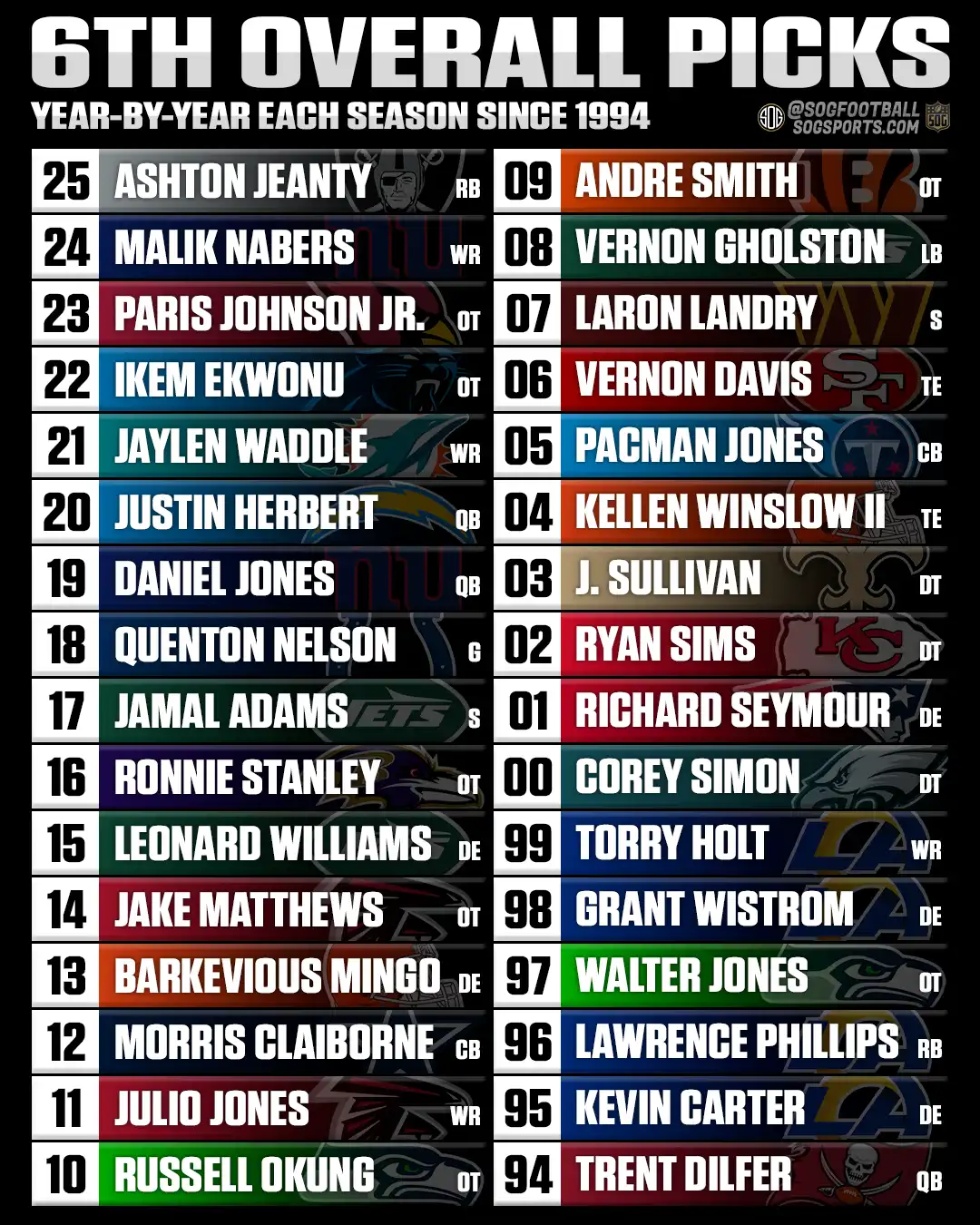
Year-by-year graphic showing every 6th overall NFL Draft pick from 1994 through 2025
The graphic highlights the modern era from Trent Dilfer in 1994 through Ashton Jeanty in 2025. The full list below goes back to the first NFL Draft in 1936.
Year-by-Year List of 6th Overall NFL Draft Picks
2025 — Ashton Jeanty, Las Vegas Raiders, Running Back
Jeanty went sixth after piling up 4,769 rushing yards and 50 rushing touchdowns at Boise State. The Raiders used this pick to put a featured back in Pete Carroll’s offense right away.
2024 — Malik Nabers, New York Giants, Wide Receiver
Nabers caught 109 passes for 1,204 yards and 7 touchdowns as a rookie and made the Pro Bowl. The Giants drafted him to give their offense a real No. 1 target, and he looked like one immediately.
2023 — Paris Johnson Jr., Arizona Cardinals, Offensive Tackle
Johnson started all 17 games as a rookie and earned PFWA All-Rookie Team honors at left tackle. The Cardinals drafted him to protect Kyler Murray, and he held the blindside job from day one.
2022 — Ikem Ekwonu, Carolina Panthers, Offensive Tackle
Ekwonu started 17 games as a rookie and gave Carolina immediate left tackle snaps. The Panthers were trying to fix the front before fixing everything else.
2021 — Jaylen Waddle, Miami Dolphins, Wide Receiver
Waddle opened with 104 catches as a rookie, then topped 1,300 receiving yards in 2022. Miami drafted speed and separation, and the offense got both.
2020 — Justin Herbert, Los Angeles Chargers, Quarterback
Herbert won Offensive Rookie of the Year, then threw for 5,014 yards and 38 touchdowns in 2021. The Chargers landed a franchise quarterback without needing the first pick.
2019 — Daniel Jones, New York Giants, Quarterback
Jones threw 24 touchdown passes as a rookie and later helped the Giants win a playoff game in the 2022 season. He also became one of the clearest examples of how hard it is to justify a top-10 quarterback pick without sustained high-end play.
2018 — Quenton Nelson, Indianapolis Colts, Guard
Nelson made the Pro Bowl in each of his first six seasons and gave Indianapolis the kind of interior line presence teams usually dream about in the top 10. He changed the tone of that offense fast.
2017 — Jamal Adams, New York Jets, Safety
Adams made three straight Pro Bowls from 2018 through 2020 and posted 9.5 sacks in 2020. The Jets drafted a tone-setter on defense and got one.
2016 — Ronnie Stanley, Baltimore Ravens, Offensive Tackle
Stanley became a first-team All-Pro in 2019 and has been central to Baltimore’s protection plan for Lamar Jackson when healthy. That is top-10 tackle value.
2015 — Leonard Williams, New York Jets, Defensive End
Williams made the Pro Bowl in 2016 and later posted 11.5 sacks in 2020 after leaving the Jets. New York got a good player, but not the long-term defensive centerpiece it wanted.
2014 — Jake Matthews, Atlanta Falcons, Offensive Tackle
Matthews became a long-term starter, made multiple Pro Bowls, and protected Matt Ryan through Atlanta’s Super Bowl LI run. This was a stabilizing pick for the Falcons’ offense.
2013 — Barkevious Mingo, Cleveland Browns, Defensive End
Mingo finished his NFL career with 12 sacks, which is a bust line for a sixth-overall front-seven player. Cleveland drafted traits and got very little disruption back.
2012 — Morris Claiborne, Dallas Cowboys, Cornerback
Claiborne started 47 games for Dallas, but injuries kept the pick from ever becoming a shutdown-corner success story. The Cowboys paid a premium price to move up and never got premium return.
2011 — Julio Jones, Atlanta Falcons, Wide Receiver
Jones finished with 13,703 receiving yards, made seven Pro Bowls, and was one of the best receivers of the 2010s. Atlanta traded up for him and got an elite player.
2010 — Russell Okung, Seattle Seahawks, Offensive Tackle
Okung made two Pro Bowls and started at left tackle on Seattle’s Super Bowl XLVIII team. He gave the Seahawks a real foundation piece up front.
2009 — Andre Smith, Cincinnati Bengals, Offensive Tackle
Smith started 96 games in his career and made the Pro Bowl in 2012. Cincinnati did not get a dominant tackle, but it did get years of starting-caliber play.
2008 — Vernon Gholston, New York Jets, Linebacker
Gholston recorded 0 sacks in 45 games with the Jets. For a sixth-overall edge projection, that is one of the worst outcomes this slot has ever produced.
2007 — LaRon Landry, Washington Commanders, Safety
Landry made the Pro Bowl in 2012 and finished with 615 tackles in his career. He was suspended indefinitely in 2015 for violating the NFL’s policy on performance-enhancing substances.
2006 — Vernon Davis, San Francisco 49ers, Tight End
Davis caught 63 career touchdown passes and was a major playoff weapon for San Francisco, including his famous 2011 game-winning score against the Saints. The 49ers drafted a matchup problem and got one.
2005 — Adam “Pacman” Jones, Tennessee Titans, Cornerback
Jones made an All-Pro team as a returner and played 12 NFL seasons, but the Titans did not get clean value from the pick. He was suspended for the entire 2007 season under the NFL’s personal conduct policy.
2004 — Kellen Winslow II, Cleveland Browns, Tight End
Winslow caught 89 passes for 875 yards in 2007 and made the Pro Bowl. In 2019 he was convicted of rape and lewd conduct following a trial in California, and in 2021 pleaded no contest to additional charges.
2003 — Johnathan Sullivan, New Orleans Saints, Defensive Tackle
Sullivan produced 5.5 sacks in three seasons with the Saints. That is nowhere near enough from a sixth-overall defensive tackle.
2002 — Ryan Sims, Kansas City Chiefs, Defensive Tackle
Sims played eight NFL seasons but finished with only 5 career sacks. Kansas City drafted him to move the line and got very little pass-rush impact.
2001 — Richard Seymour, New England Patriots, Defensive End
Seymour made the Pro Football Hall of Fame, won three Super Bowls, and finished with 57.5 career sacks. This was a franchise-shaping pick for New England.
2000 — Corey Simon, Philadelphia Eagles, Defensive Tackle
Simon made the Pro Bowl in 2003 and was a key part of the Eagles team that reached Super Bowl XXXIX. Philadelphia got a legit interior starter out of this slot.
1999 — Torry Holt, St. Louis Rams, Wide Receiver
Holt reached the Pro Football Hall of Fame after posting 13,382 receiving yards and helping power the “Greatest Show on Turf.” The Rams got a perfect fit for a title offense.
1998 — Grant Wistrom, St. Louis Rams, Defensive End
Wistrom finished with 53 career sacks and started on the Rams team that won Super Bowl XXXIV. He gave St. Louis real edge production.
1997 — Walter Jones, Seattle Seahawks, Offensive Tackle
Jones made the Pro Football Hall of Fame, earned nine Pro Bowls, and became one of the best left tackles ever. Seattle absolutely nailed this pick.
1996 — Lawrence Phillips, St. Louis Rams, Running Back
Phillips rushed for 1,453 yards in the NFL and never justified the draft slot. He had multiple serious legal issues after his career and died by suicide in prison in 2016 at age 40.
1995 — Kevin Carter, St. Louis Rams, Defensive End
Carter posted 104.5 career sacks and made four Pro Bowls. This was a major hit for a Rams team that needed pass-rush juice.
1994 — Trent Dilfer, Tampa Bay Buccaneers, Quarterback
Dilfer threw for 20,518 yards in his career and later won Super Bowl XXXV with Baltimore. Tampa Bay did not get a franchise quarterback, but it did draft a long-time NFL starter.
1993 — Eric Curry, Tampa Bay Buccaneers, Defensive End
Curry’s NFL career lasted only 36 games because knee injuries wrecked the pick early. Tampa got almost nothing from a premium edge selection.
1992 — David Klingler, Cincinnati Bengals, Quarterback
Klingler started only 19 games for Cincinnati and threw 16 touchdown passes in his NFL career. That is a miss at the position that hurts the most when you get it wrong.
1991 — Eric Swann, Phoenix Cardinals, Defensive Tackle
Swann made three Pro Bowls and finished with 52.5 career sacks from the interior. Arizona got a real player even if the team around him stayed shaky.
1990 — Mark Carrier, Chicago Bears, Safety
Carrier won Defensive Rookie of the Year with 10 interceptions in 1990 and made three Pro Bowls. Chicago got immediate production from the sixth pick.
1989 — Broderick Thomas, Tampa Bay Buccaneers, Linebacker
Thomas played eight NFL seasons and finished with 29.5 sacks. Tampa Bay drafted a linebacker high and got a decent pro, not a star.
1988 — Tim Brown, Los Angeles Raiders, Wide Receiver
Brown reached the Pro Football Hall of Fame after posting 1,094 catches, 14,934 receiving yards, and 100 touchdowns. The Raiders took a receiver and got an all-timer.
1987 — Kelly Stouffer, St. Louis Cardinals, Quarterback
Stouffer did not sign with the Cardinals and was later traded to Seattle. He threw only 2,762 career passing yards, which made the whole situation a loss for Arizona.
1986 — Jim Dombrowski, New Orleans Saints, Guard
Dombrowski made six Pro Bowls and gave the Saints a long-term answer at guard. That is exactly the kind of line return teams want from the top 10.
1985 — Lomas Brown, Detroit Lions, Offensive Tackle
Brown made seven Pro Bowls and blocked for Barry Sanders during Detroit’s best offensive years of that era. This was a strong tackle pick.
1984 — Mossy Cade, San Diego Chargers, Defensive Back
Cade played six NFL seasons and intercepted 12 passes. San Diego got a starter, but not a difference-making top-six defender.
1983 — Jim Covert, Chicago Bears, Offensive Tackle
Covert made two Pro Bowls, anchored the line for the 1985 Bears, and later reached the Pro Football Hall of Fame. Chicago got premium tackle value here.
1982 — Jeff Bryant, Seattle Seahawks, Defensive End
Bryant posted 63 career sacks and played 12 seasons. Seattle got a long-term edge presence from this slot.
1981 — Rich Campbell, Green Bay Packers, Quarterback
Campbell started only seven NFL games and threw six touchdown passes. Green Bay missed badly on a first-round quarterback.
1980 — Curtis Greer, St. Louis Cardinals, Defensive End
Greer finished with 57 career sacks and became one of the better pass rushers in Cardinals history. This was a very good pick.
1979 — Barry Krauss, Baltimore Colts, Linebacker
Krauss played 13 NFL seasons and made the Pro Bowl in 1981. Baltimore got a long-run linebacker, even if he never became a national star.
1978 — James Lofton, Green Bay Packers, Wide Receiver
Lofton reached the Pro Football Hall of Fame after 14,004 receiving yards and eight Pro Bowls. Green Bay got a true deep-threat legend.
1977 — Warren Bryant, Atlanta Falcons, Offensive Tackle
Bryant started for years in Atlanta and later helped the Rams reach Super Bowl XIV. That is solid tackle value from the sixth pick.
1976 — Richard Todd, New York Jets, Quarterback
Todd threw for 20,610 yards in his career and led the Jets to the AFC title game in the 1982 season. He gave New York a starting quarterback, though not a franchise changer.
1975 — Robert Brazile, Houston Oilers, Linebacker
Brazile reached the Pro Football Hall of Fame and made seven straight Pro Bowls. Houston found one of the best linebackers of the decade.
1974 — Carl Barzilauskas, New York Jets, Defensive Tackle
Barzilauskas played only five NFL seasons. The Jets spent the sixth pick on a defensive tackle and got a bust.
1973 — Charlie Young, Philadelphia Eagles, Tight End
Young caught 418 passes in his career and made two Pro Bowls. Philadelphia got a productive receiving tight end from a spot that usually carries more pressure.
1972 — Greg Sampson, Houston Oilers, Offensive Tackle
Sampson played 10 NFL seasons and started for years in Houston. That is useful line value, even without Pro Bowl shine.
1971 — John Riggins, New York Jets, Running Back
Riggins reached the Pro Football Hall of Fame, rushed for 11,352 yards, and won Super Bowl XVII MVP later in Washington. The Jets drafted a great back and did not keep his peak.
1970 — Steve Zabel, Philadelphia Eagles, Linebacker
Zabel played 11 seasons and became a steady front-seven player in Philadelphia. The Eagles got longevity, not top-tier star power.
1969 — Ron Sellers, Boston Patriots, Wide Receiver
Sellers played eight pro seasons and finished with more than 4,800 receiving yards. That gave Boston a real receiver, though not a superstar.
1968 — Dennis Byrd, Boston Patriots, Defensive End
Byrd made four AFL All-Star teams and became one of the league’s better defensive ends of that era. This was a very good pick.
1967 — Floyd Little, Denver Broncos, Running Back
Little reached the Pro Football Hall of Fame after 6,323 rushing yards and five AFL All-Star selections. Denver built early credibility around him.
1966 — Charlie Gogolak, Washington Commanders, Kicker
Gogolak is remembered as the first soccer-style kicker drafted in the first round of the NFL Draft. That alone made him a historically notable selection regardless of the on-field production.
1965 — Steve DeLong, Chicago Bears, Defensive Tackle
DeLong was drafted by Chicago but eventually became a five-time AFL All-Star with the San Diego Chargers. The Bears drafted him and did not get the lasting value.
1964 — Carl Eller, Minnesota Vikings, Defensive End
Eller reached the Pro Football Hall of Fame and became one of the anchors of the Purple People Eaters. Minnesota got a franchise defensive end.
1963 — Lee Roy Jordan, Dallas Cowboys, Linebacker
Jordan made five Pro Bowls and became one of the foundational defenders of Tom Landry’s Cowboys. This was a major culture-building pick.
1962 — Fate Echols, St. Louis Cardinals, Defensive Tackle
Echols played seven NFL seasons and became a regular starter on the line. That was respectable value from this slot.
1961 — Jimmy Johnson, San Francisco 49ers, Defensive Back
Johnson reached the Pro Football Hall of Fame and intercepted 47 passes in his NFL career. San Francisco landed an all-time defensive back.
1960 — Jack Spikes, Pittsburgh Steelers, Running Back
Spikes never became a featured back in Pittsburgh and later did his best rushing work in the AFL. The Steelers drafted him high and missed on the payoff.
1959 — Nick Pietrosante, Detroit Lions, Running Back
Pietrosante made three Pro Bowls and gave Detroit a productive backfield piece in the early 1960s. That was strong return from No. 6.
1958 — Walt Kowalczyk, Philadelphia Eagles, Running Back
Kowalczyk played only one NFL season. Philadelphia got almost nothing from a premium running back pick.
1957 — Jim Brown, Cleveland Browns, Running Back
Brown reached the Pro Football Hall of Fame after 12,312 rushing yards, eight rushing titles, and three MVP awards. Cleveland hit the jackpot at No. 6.
1956 — Joe Marconi, Los Angeles Rams, Running Back
Marconi played four NFL seasons and scored 15 total touchdowns. That is not enough from a sixth-overall back.
1955 — Frank Varrichione, Pittsburgh Steelers, Offensive Tackle
Varrichione later became an AFL All-Star and played 11 pro seasons. Pittsburgh drafted a good lineman, even if the best recognition came outside the NFL.
1954 — Stan Wallace, Chicago Bears, Defensive Back
Wallace played 10 NFL seasons and made multiple Pro Bowls. Chicago got a long-term secondary piece out of this slot.
1953 — Billy Anderson, Chicago Bears, Running Back
Anderson’s NFL career was brief and he never became a featured back. This was a light return for a high backfield pick.
1952 — Ed Modzelewski, Pittsburgh Steelers, Fullback
Modzelewski never became a major NFL back and later found more notice as a coach. Pittsburgh did not get sixth-pick production from him as a player.
1951 — Jerry Groom, Chicago Cardinals, Center
Groom played three NFL seasons before his career ended early. Chicago drafted a center high and got limited return.
1950 — George Thomas, Washington Commanders, Halfback
Thomas played six NFL seasons and contributed on both sides of the ball in a very old-school roster era. That versatility gave Washington some value, though not top-six value.
1949 — Bob Gage, Pittsburgh Steelers, Running Back
Gage played four NFL seasons and made the Pro Bowl in 1951. Pittsburgh got a useful back, not a franchise centerpiece.
1948 — Y.A. Tittle, Detroit Lions, Quarterback
Tittle never played for Detroit, began his pro career in the AAFC with Baltimore, and later reached the Pro Football Hall of Fame after throwing for 33,070 yards. The Lions drafted a great quarterback and got none of the real return.
1947 — Ernie Case, Green Bay Packers, Quarterback
Case played seven NFL seasons and later made the Pro Bowl in 1950. Green Bay got a real pro quarterback, even if not a star.
1946 — Johnny Strzykalski, Green Bay Packers, Running Back
Strzykalski played six NFL seasons and later made the Pro Bowl with Pittsburgh. The Packers drafted a good player, but not their long-term answer in the backfield.
1945 — Frank Szymanski, Detroit Lions, Center
Szymanski became a two-time Pro Bowler and gave Detroit real line value in the late 1940s. This pick worked.
1944 — Billy Hillenbrand, New York Giants, Halfback
Hillenbrand never played in the NFL after the draft. That is the main fact attached to this pick.
1943 — Steve Filipowicz, New York Giants, Back
Filipowicz’s NFL career was short, though he later played in the AAFC. The Giants did not get much out of the sixth pick.
1942 — Spec Sanders, Washington Commanders, Back
Sanders never played for Washington and later became an AAFC star with the New York Yankees. The franchise drafted him high and never got the payoff.
1941 — George Franck, New York Giants, Back
Franck never played in the NFL after being drafted. That makes the sixth pick another early-era miss.
1940 — Doyle Nave, Detroit Lions, Quarterback
Nave played only one NFL season and threw 11 touchdown passes in his pro career. Detroit got a quick miss at quarterback.
1939 — Bill Osmanski, Chicago Bears, Back
Osmanski helped the Bears win the 1940 NFL title and later reached the Pro Football Hall of Fame. Chicago got a championship player out of this slot.
1938 — Alex Wojciechowicz, Detroit Lions, Center
Wojciechowicz reached the Pro Football Hall of Fame and anchored Detroit’s line in the 1940s. This was a major hit.
1937 — Sammy Baugh, Washington Commanders, Quarterback
Baugh reached the Pro Football Hall of Fame, threw for 21,886 yards, and changed pro football’s passing game. Washington landed one of the most important quarterbacks in league history.
1936 — Joe Stydahar, Chicago Bears, Offensive Tackle
Stydahar reached the Pro Football Hall of Fame and became one of the best tackles of the early NFL. The Bears got an all-time lineman in the first draft.
Why the 6th Overall Pick Matters
The sixth pick matters because it is usually where a franchise stops being able to hide behind the board. By this point, the obvious top names are gone, and the team on the clock has to show whether it actually knows what it is building. Is it trying to protect the quarterback, give him a true target, replace him, or fix a defense that keeps losing games late?
The consequences show up fast. Hit on a player like Justin Herbert, Quenton Nelson, Walter Jones, Richard Seymour, Julio Jones, or Jim Brown, and the roster gets a pillar. Miss on a player like Vernon Gholston, David Klingler, Johnathan Sullivan, or Barkevious Mingo, and the same weakness is still sitting there two offseasons later.
This slot also has a long history of value swings. Teams at No. 6 can still land Hall of Fame talent, but they are just far enough down the board to talk themselves into the wrong projection if they are chasing need instead of the right player.
Trends Among 6th Overall NFL Draft Picks
- Offensive line has been the dominant theme in the modern era. From 2010 through 2025, Russell Okung, Jake Matthews, Ronnie Stanley, Quenton Nelson, Ikem Ekwonu, and Paris Johnson Jr. all went sixth overall — six of sixteen picks in that window going to the trenches.
- This slot has produced a lot of Pro Bowl value. Through 2025, 45 players drafted sixth overall have made at least one Pro Bowl, which is exactly 50 percent of the history of the slot. That hit rate is stronger than most top-10 positions produce.
- Wide receiver has delivered some of the biggest hits. Julio Jones, Torry Holt, Tim Brown, James Lofton, and Malik Nabers all went sixth, giving the slot a deep track record of premium perimeter talent across six decades.
- The busts here tend to be obvious and expensive. Vernon Gholston, Johnathan Sullivan, David Klingler, and Barkevious Mingo are reminders that when teams miss at No. 6, they usually miss on a premium position — and the next front office inherits the same problem.
FAQ About 6th Overall NFL Draft Picks
Who was the first 6th overall pick in NFL Draft history?
Joe Stydahar was the first sixth-overall pick when the Chicago Bears selected him in 1936. He later reached the Pro Football Hall of Fame, which gave the slot an excellent opening chapter.
How many 6th overall NFL draft picks have made the Pro Bowl?
Through 2025, 45 of the 90 sixth-overall picks have made at least one Pro Bowl. That puts the Pro Bowl hit rate for the slot at exactly 50.0 percent — meaning the sixth pick has produced a Pro Bowl player in half of all drafts.
Which positions are most common at No. 6 overall?
Offensive linemen, wide receivers, and front-seven defenders dominate the history of the sixth pick. The modern trend has leaned especially hard toward tackles and interior offensive linemen, with six of the last sixteen sixth-overall picks going to the offensive line.
Who are the best 6th overall NFL draft picks ever?
Jim Brown, Walter Jones, Julio Jones, Richard Seymour, Tim Brown, Sammy Baugh, Torry Holt, Floyd Little, James Lofton, and Robert Brazile all belong in that conversation. That is a serious list for a pick outside the top five.
Why has the 6th overall pick worked so well for offensive linemen in the modern era?
Because this is often the point where quarterback-needy teams have already taken a passer and the next teams start fixing the infrastructure around one. Tackle and guard have been clean answers here because the value is obvious and the projection is often safer than forcing a quarterback or a coverage player who needs a specific scheme.
What should teams picking sixth overall be looking for in the 2026 NFL Draft?
The same thing the best teams at this slot have always looked for — a player who solves a real structural problem, not just the highest-rated name still available. The difference between the hits and the misses at No. 6 is almost always whether a team took the right player or reacted to what the board handed them.
Final Thoughts
The history of the sixth overall NFL Draft pick is really a record of how well front offices perform under moderate pressure. The teams that got it right — Seattle with Walter Jones, New England with Richard Seymour, Cleveland with Jim Brown, Green Bay with James Lofton — were not lucky. They identified the best player available and took him without second-guessing what the first five picks said about their needs.
The 2026 NFL Draft will put this slot right back where it usually lives: in the middle of the night’s first real argument. Sixth overall is high enough to land a cornerstone player, but low enough that a front office has to separate conviction from panic once the first wave is gone.
That is why this pick stays interesting every year. It is often the spot where smart teams steal a franchise piece after the early noise clears, and where underprepared teams convince themselves the wrong projection is close enough to elite talent to be worth it.
