
Myles Garrett is SOG Sports’ choice as the NFL’s best defensive player for 2025 after setting the official single-season sack record with 23 and becoming the unanimous AP Defensive Player of the Year. The 2026 selection remains open because the season has not begun.
This opinion-based year-by-year list covers the 59 completed NFL seasons from 1967 through 2025. Regular-season performance carries the most weight, but postseason play can break a close race. That matters in 2010 and 2015, the only completed seasons in which this list intentionally differs from the Associated Press winner.
For the career-level version of the debate, see our ranking of the best defensive players in NFL history.
Methodology and Eligibility
Each season receives one selection. The player is evaluated for what he did in that NFL season, not for career reputation, and the team listed is the team he represented during that year.
- Regular-season dominance: disruption, coverage value, run defense, turnovers and consistency.
- Game-plan pressure: how often an offense had to avoid, double-team, chip or specifically locate the defender.
- Positional context: edge rushers, interior linemen, linebackers and defensive backs are judged by different responsibilities.
- Postseason value: playoff performance is a meaningful tiebreaker, but it does not erase a weak regular season.
- Era context: older players are judged with the statistics and award evidence available in their period.
Sacks became an official NFL statistic in 1982. Any earlier sack figure mentioned here comes from retroactive research and is identified as unofficial. The list includes the 2026 placeholder because it appears on the supplied graphic, but 2026 is not counted among the 59 completed seasons.
How This List Compares With Defensive Player of the Year Voting
The graphic closely follows major defensive player of the year results. From 1971 through 2025, 53 of the 55 selections match the AP winner. The four pre-AP seasons from 1967 through 1970 match the NEA George Halas Trophy winners, an award selected through player voting.
That means 57 of the 59 completed selections align with a major contemporary award. The two deliberate exceptions are Clay Matthews over Troy Polamalu in 2010 and Von Miller over J.J. Watt in 2015. Both changes are based on full-season evaluation, with postseason performance breaking an already strong regular-season case.
Best Defensive Players Each Year, 2026–1997
2026: TBD
The 2026 selection remains open because the season has not begun. Preseason reputation is not enough for a year-by-year list; the choice will be made after the full regular season and postseason provide evidence on production, consistency and game-changing value.
2025: Myles Garrett
Myles Garrett set the official NFL single-season record with 23 sacks and received all 50 first-place votes for AP Defensive Player of the Year. The record, the unanimous vote and the constant protection help required to slow him make 2025 one of the clearest choices on the entire list.
2024: Patrick Surtain II
Patrick Surtain II delivered the rare cornerback season that stood above every pass rusher. His disciplined man coverage let Denver challenge receivers elsewhere, and he became the first corner since Stephon Gilmore in 2019 to win AP Defensive Player of the Year.
2023: Myles Garrett
Garrett finished with 14 sacks, but the case was never limited to the final total. His speed-to-power rushes, inside counters and ability to defeat protection built specifically for him made him the engine of Cleveland’s defense and the AP Defensive Player of the Year.
2022: Nick Bosa
Nick Bosa led the NFL with 18.5 sacks and consistently closed drives for one of the league’s strongest defenses. His hand use and balance made him more than a speed threat, allowing him to win through tackles even when they knew where he was coming from.
2021: T.J. Watt
T.J. Watt tied the official single-season sack record with 22.5 sacks despite playing only 15 games. His strip-sack timing and late-game production turned pressure into wins, giving him the strongest defensive season of 2021.
2020: Aaron Donald
Aaron Donald produced 13.5 sacks from the interior while absorbing the protection attention normally reserved for an entire front. His first step and leverage collapsed pockets before quarterbacks could climb, which is why his value exceeded the raw box score.
2019: Stephon Gilmore
Stephon Gilmore paired shutdown assignments with 6 interceptions and two pick-sixes. New England could isolate him against top receivers without constantly tilting coverage his way, a level of trust that made his cornerback value unusually visible.
2018: Aaron Donald
Donald’s 20.5 sacks remain one of the most extreme interior pass-rush totals ever recorded. Guards could not match his quickness, tackles could not consistently handle him when he widened, and double teams still failed to keep the pocket clean.
2017: Aaron Donald
Donald recorded 11 sacks in 14 games and won from nearly every interior alignment. The missed time did not weaken his case because his snap-to-snap disruption was so far beyond the normal standard for a defensive tackle.
2016: Khalil Mack
Khalil Mack combined 11 sacks, five forced fumbles and an interception return for a touchdown with strong edge-setting work. He could win outside with burst or drive directly through a blocker, giving Oakland a complete defender rather than a one-dimensional sack specialist.
2015: Von Miller
This is one of the two deliberate departures from the AP award result. J.J. Watt owned the stronger regular-season résumé, but Miller added 5 postseason sacks, an AFC Championship Game interception and a Super Bowl performance with 2.5 sacks and two forced fumbles. Because this list allows postseason play to break a close race, Miller gets the full-season choice.
2014: J.J. Watt
J.J. Watt finished with 20.5 sacks, 29 tackles for loss and five total touchdowns, including three as a receiver. He was a weekly defensive mismatch and a legitimate league MVP candidate, not merely the best defender.
2013: Luke Kuechly
Luke Kuechly controlled the middle with anticipation, range and clean tackling while Carolina rose into the league’s top defensive tier. His value came from solving plays before they developed and keeping the entire unit aligned, not from chasing one headline statistic.
2012: J.J. Watt
Watt’s breakout season produced 20.5 sacks, 39 tackles for loss and 16 passes defended. That combination of backfield disruption and throwing-lane control is why 2012 still belongs in any discussion of the greatest defensive seasons ever.
2011: Terrell Suggs
Terrell Suggs delivered 14 sacks and seven forced fumbles without giving away the edge against the run. Baltimore could move him around the front and trust him to finish the high-leverage plays that decided close games.
2010: Clay Matthews
This is the other intentional break from the AP winner. Troy Polamalu edged Matthews 17 votes to 15 after the regular season, but Matthews added 3.5 postseason sacks and forced the pivotal fourth-quarter fumble in Green Bay’s Super Bowl win. The complete-season edge goes narrowly to Matthews.
2009: Charles Woodson
Charles Woodson combined 9 interceptions with slot work, blitzing, run support and three defensive touchdowns. Darrelle Revis had the cleaner pure-coverage argument, but Woodson affected more areas of the defense and created more scoring plays.
2008: James Harrison
James Harrison recorded 16 sacks and seven forced fumbles as the pressure source for the NFL’s best scoring defense. His 100-yard interception return in the Super Bowl did not create the season-long case, but it gave the year an unforgettable finish.
2007: Bob Sanders
Bob Sanders changed Indianapolis by closing run lanes that had been weaknesses and still covering enough ground to play from depth. His physicality was obvious, but his real value was how many structural problems the Colts could solve when he was healthy.
2006: Jason Taylor
Jason Taylor paired 13.5 sacks with forced turnovers and two interception-return touchdowns. His length disrupted passing lanes, while his awareness turned routine pressure opportunities into points.
2005: Brian Urlacher
Brian Urlacher was the central communicator and range defender for a Chicago unit that carried the team. He could run the deep middle in coverage, beat blocks inside and erase perimeter plays, making the Bears’ scheme work at every level.
2004: Ed Reed
Ed Reed intercepted 9 passes and turned quarterback mistakes into 358 return yards. His range mattered before the ball was thrown because quarterbacks had to account for a safety who could disguise one responsibility and arrive in another.
2003: Ray Lewis
Ray Lewis paired his usual run-game command with 6 interceptions, showing how complete his 2003 season was. Baltimore trusted him to diagnose formations, carry routes and still arrive as the most forceful tackler in the box.
2002: Derrick Brooks
Derrick Brooks scored four defensive touchdowns during the regular season and added a pick-six in the Super Bowl. His speed in Tampa Bay’s coverage structure turned underneath throws into danger, while his consistency helped anchor one of the best championship defenses ever.
2001: Michael Strahan
Michael Strahan set the official single-season record at the time with 22.5 sacks. He also remained a strong edge defender against the run, which kept the season from being reduced to one famous final sack.
2000: Ray Lewis
Ray Lewis was the organizer and emotional center of a defense that allowed only 165 regular-season points before winning the Super Bowl. His range, tackling and postseason command made him the defining defender of the season.
1999: Warren Sapp
Warren Sapp recorded 12.5 sacks from defensive tackle and made Tampa Bay’s one-gap front difficult to block honestly. His interior burst forced quarterbacks off their spot before the edge rush had to finish.
1998: Reggie White
Reggie White produced 16 sacks in his age-37 season, an extraordinary late-career peak. His power rush remained the foundation, but his hand technique let him win after the athletic margin had narrowed.
1997: Dana Stubblefield
Dana Stubblefield’s 15 sacks gave San Francisco rare finishing production from the interior. His penetration prevented quarterbacks from simply stepping away from the edge rush and made the entire front more effective.
Best Defensive Players Each Year, 1996–1967
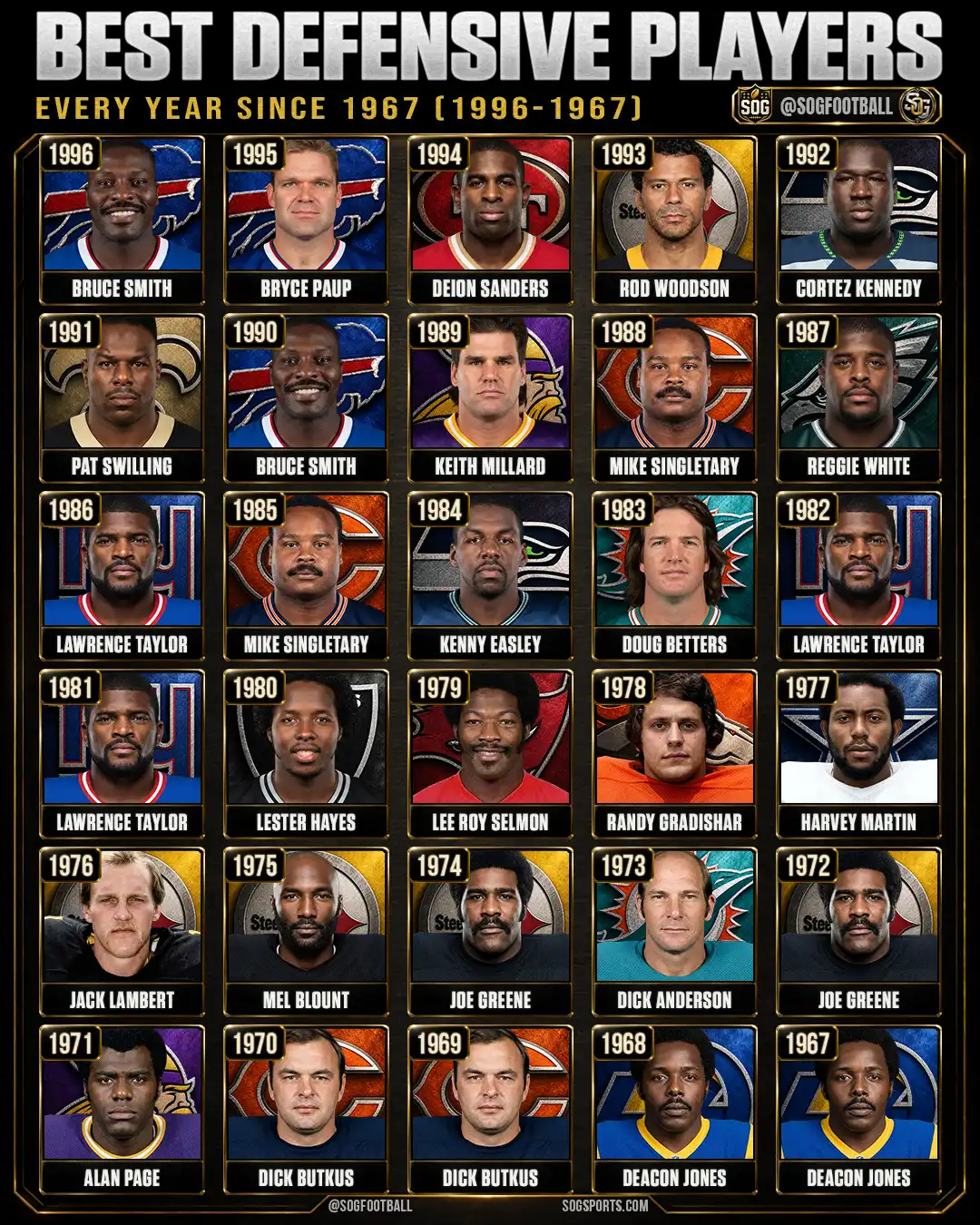
Best defensive players for every NFL season from 1996 through 1967, including Bruce Smith, Lawrence Taylor, Reggie White, Joe Greene, Dick Butkus and Deacon Jones.
1996: Bruce Smith
Bruce Smith remained the league’s most complete defensive end, winning with first-step quickness, power and a deep counter-rush plan. His 13.5 sacks were only part of a season in which offenses still had to build protection around him.
1995: Bryce Paup
Bryce Paup led the NFL with 17.5 sacks in his first season with Buffalo. The sudden jump was not empty volume; his speed off the edge gave the Bills the disruptive outside presence their front needed.
1994: Deion Sanders
Deion Sanders intercepted 6 passes and returned three for touchdowns while taking away the routes San Francisco least wanted to defend. His coverage value and scoring threat helped push a loaded team over its final championship obstacle.
1993: Rod Woodson
Rod Woodson could cover outside, tackle like a safety, blitz and create field position as a returner. That versatility gave Pittsburgh answers against nearly every offensive personnel package and made him the season’s most complete defensive back.
1992: Cortez Kennedy
Cortez Kennedy posted 14 sacks from the interior on a 2-14 team, which makes the award recognition even more revealing. He dominated without the benefit of leads, favorable game scripts or a deep supporting cast.
1991: Pat Swilling
Pat Swilling’s 17 sacks supplied the finishing rush for the Dome Patrol. New Orleans could pressure with several linebackers, but Swilling was the player most consistently turning disruption into lost downs.
1990: Bruce Smith
Bruce Smith recorded 19 sacks and gave Buffalo a defender who could control both the passing and running games from the same alignment. His power forced tackles to anchor early, which opened his speed and inside counters.
1989: Keith Millard
Keith Millard’s 18 sacks set a new standard for interior pass-rush production. He attacked gaps too quickly for guards to settle and had enough power to finish when centers slid toward him.
1988: Mike Singletary
Mike Singletary remained the diagnostic center of Chicago’s defense. His season was built on alignment, anticipation and tackling reliability, the work that allowed the Bears’ front and secondary to play aggressively around him.
1987: Reggie White
Reggie White recorded 21 sacks in only 12 games, one of the greatest pressure rates in league history. His hump move and raw power could erase an offensive tackle’s leverage before the play had time to develop.
1986: Lawrence Taylor
Lawrence Taylor finished with 20.5 sacks, won AP Defensive Player of the Year and became the second defensive player to win league MVP. His edge speed changed protection rules and powered the Giants to a championship.
1985: Mike Singletary
The 1985 Bears had stars at every level, but Singletary was the unit’s traffic controller. His reads and communication kept Buddy Ryan’s aggressive front organized, while his tackling closed the escape routes created by the pressure.
1984: Kenny Easley
Kenny Easley intercepted 10 passes while still delivering the physical box play that defined him. Few safeties have combined deep-range production and contact strength so cleanly in one season.
1983: Doug Betters
Doug Betters recorded 16 sacks and became the primary finisher for Miami’s Killer B’s defense. His season stands out because the production was matched by consistent pressure rather than a short run of favorable matchups.
1982: Lawrence Taylor
The strike-shortened schedule could not hide Taylor’s separation from the league. His burst and closing speed made conventional blocking plans feel outdated, and a second straight AP Defensive Player of the Year award confirmed the rookie season was not a fluke.
1981: Lawrence Taylor
Taylor transformed the Giants immediately as a rookie, winning both Defensive Rookie of the Year and Defensive Player of the Year. He attacked from wider alignments with a speed that tackles and backs were not prepared to handle.
1980: Lester Hayes
Lester Hayes intercepted 13 passes during the regular season and added five more in the playoffs. His ball production, physical coverage and championship run make 1980 one of the strongest cornerback seasons ever.
1979: Lee Roy Selmon
Lee Roy Selmon was the foundational star of Tampa Bay’s breakthrough from expansion struggles to the NFC Championship Game. His quickness and strength let him create pressure without sacrificing his responsibility against the run.
1978: Randy Gradishar
Randy Gradishar controlled the middle of Denver’s Orange Crush defense with fast reads and unusually secure tackling. He was not a specialist; he handled interior runs, underneath coverage and the communication burden of the entire front seven.
1977: Harvey Martin
Harvey Martin was the lead pass rusher for a championship defense and later shared Super Bowl MVP honors with Randy White. Retroactive sources disagree on his exact pre-1982 sack total, so the safest case is the consensus dominance, AP Defensive Player of the Year award and postseason finish.
1976: Jack Lambert
Jack Lambert led a Pittsburgh defense that nearly carried an injury-damaged offense back to the Super Bowl. His range and edge gave the Steel Curtain its identity, while his communication kept the front aligned through a season with almost no margin for error.
1975: Mel Blount
Mel Blount led the league with 11 interceptions while overwhelming receivers with size and contact. The later five-yard contact rule is closely associated with the type of coverage he mastered, which shows how unusual his physical advantage was.
1974: Joe Greene
Joe Greene was the interior force behind Pittsburgh’s first Super Bowl championship. He could split blocks to destroy runs or collapse the pocket through the middle, making every part of the Steel Curtain more difficult to attack.
1973: Dick Anderson
Dick Anderson intercepted 8 passes and returned two for touchdowns for the defending champions. His anticipation turned Miami’s disciplined coverage structure into scoring opportunities rather than merely preventing completions.
1972: Joe Greene
Greene’s 1972 season established Pittsburgh’s defense as a championship-level force before the titles arrived. His interior penetration and strength changed the line of scrimmage, giving the Steelers a player around whom the rest of the dynasty could be built.
1971: Alan Page
Alan Page won both AP Defensive Player of the Year and league MVP, a combination achieved by only one other defender since. His quickness from defensive tackle created pressure before blocking schemes could account for him.
1970: Dick Butkus
Dick Butkus won the NEA George Halas Trophy as the league’s top defender for a second straight season. Even as knee problems began to accumulate, his diagnosis, takeaways and physical control of the middle remained the standard for linebacker play.
1969: Dick Butkus
Chicago finished 1-13, yet Butkus still received the NEA’s player-voted defensive honor. That separation from team success is the strongest evidence for the pick: opponents and peers saw a defender controlling games even when the Bears rarely won them.
1968: Deacon Jones
Deacon Jones repeated as the NEA defensive player of the year and is retroactively credited with more than 20 sacks. Because sacks were not official until 1982, the exact total must be labeled unofficial, but the season’s pass-rush dominance is not in doubt.
1967: Deacon Jones
Deacon Jones opens the list with the first of two straight NEA defensive player of the year honors. Retroactive charting credits him with more than 20 sacks in a 14-game season, while his speed and head-slap technique made him the era’s defining edge rusher.
What the Full List Shows
Pass rushers control nearly half of the completed seasons
Using the position groups in the recap table, edge defenders account for 27 of the 59 completed selections. The pattern stretches from Deacon Jones to Myles Garrett, which reflects how directly pressure can destroy a passing offense. For a deeper career comparison, see the best edge rushers of all-time and the NFL’s all-time sack leaders.
Lawrence Taylor and Aaron Donald have the most selections
Taylor owns 1981, 1982 and 1986, while Donald owns 2017, 2018 and 2020. Both reached three selections by creating pass-rush value from positions that offenses historically handled in different ways: Taylor changed protection from the edge, while Donald forced the same level of fear from defensive tackle.
Defensive backs need exceptional ball production or shutdown value
Only seven cornerbacks and four safeties make the 59 completed selections. The defensive backs who broke through usually combined coverage suppression with turnovers or scoring plays, which is also why the list’s cornerback seasons connect naturally to our ranking of the best cornerback seasons in NFL history.
Closest Calls
2015: Von Miller over J.J. Watt and Aaron Donald
Watt won AP Defensive Player of the Year with 17.5 sacks, and Donald had an outstanding interior season. Miller’s regular season alone would not win the comparison, but five postseason sacks, an AFC title-game interception and a Super Bowl MVP performance gave him the strongest complete-season case.
2010: Clay Matthews over Troy Polamalu
Polamalu won the AP vote 17-15 and had the stronger turnover résumé. Matthews finished with 13.5 regular-season sacks, added 3.5 in the playoffs and forced the Super Bowl fumble that Green Bay converted into the decisive fourth-quarter touchdown. This remains the narrowest choice on the list.
2009: Charles Woodson over Darrelle Revis
Revis may have played the best pure man-coverage season of the era. Woodson’s nine interceptions, three defensive touchdowns and ability to play outside, in the slot, near the box and as a blitzer created the broader defensive case.
1994: Deion Sanders over Rod Woodson
Rod Woodson offered more ways to affect a game, but Sanders’ six interceptions, three pick-sixes and championship-level coverage tilted this specific season. His scoring threat made throwing at him as dangerous as avoiding him was limiting.
1969: Dick Butkus over Deacon Jones
Jones remained the superior pass rusher, but Butkus won the NEA player vote while playing for a one-win team. The lack of team success actually strengthens the individual case because the recognition could not be explained by a championship defense or favorable game scripts.
Full Year-by-Year Table: Best Defensive Player Every Season
| Year | Player | Team | Position |
|---|---|---|---|
| 2026 | TBD | TBD | TBD |
| 2025 | Myles Garrett | Cleveland Browns | DE |
| 2024 | Patrick Surtain II | Denver Broncos | CB |
| 2023 | Myles Garrett | Cleveland Browns | DE |
| 2022 | Nick Bosa | San Francisco 49ers | DE |
| 2021 | T.J. Watt | Pittsburgh Steelers | OLB |
| 2020 | Aaron Donald | Los Angeles Rams | DT |
| 2019 | Stephon Gilmore | New England Patriots | CB |
| 2018 | Aaron Donald | Los Angeles Rams | DT |
| 2017 | Aaron Donald | Los Angeles Rams | DT |
| 2016 | Khalil Mack | Oakland Raiders | OLB |
| 2015 | Von Miller | Denver Broncos | OLB |
| 2014 | J.J. Watt | Houston Texans | DE |
| 2013 | Luke Kuechly | Carolina Panthers | ILB |
| 2012 | J.J. Watt | Houston Texans | DE |
| 2011 | Terrell Suggs | Baltimore Ravens | OLB |
| 2010 | Clay Matthews | Green Bay Packers | OLB |
| 2009 | Charles Woodson | Green Bay Packers | CB |
| 2008 | James Harrison | Pittsburgh Steelers | OLB |
| 2007 | Bob Sanders | Indianapolis Colts | S |
| 2006 | Jason Taylor | Miami Dolphins | DE |
| 2005 | Brian Urlacher | Chicago Bears | MLB |
| 2004 | Ed Reed | Baltimore Ravens | S |
| 2003 | Ray Lewis | Baltimore Ravens | MLB |
| 2002 | Derrick Brooks | Tampa Bay Buccaneers | OLB |
| 2001 | Michael Strahan | New York Giants | DE |
| 2000 | Ray Lewis | Baltimore Ravens | MLB |
| 1999 | Warren Sapp | Tampa Bay Buccaneers | DT |
| 1998 | Reggie White | Green Bay Packers | DE |
| 1997 | Dana Stubblefield | San Francisco 49ers | DT |
| 1996 | Bruce Smith | Buffalo Bills | DE |
| 1995 | Bryce Paup | Buffalo Bills | OLB |
| 1994 | Deion Sanders | San Francisco 49ers | CB |
| 1993 | Rod Woodson | Pittsburgh Steelers | CB |
| 1992 | Cortez Kennedy | Seattle Seahawks | DT |
| 1991 | Pat Swilling | New Orleans Saints | OLB |
| 1990 | Bruce Smith | Buffalo Bills | DE |
| 1989 | Keith Millard | Minnesota Vikings | DT |
| 1988 | Mike Singletary | Chicago Bears | MLB |
| 1987 | Reggie White | Philadelphia Eagles | DE |
| 1986 | Lawrence Taylor | New York Giants | OLB |
| 1985 | Mike Singletary | Chicago Bears | MLB |
| 1984 | Kenny Easley | Seattle Seahawks | S |
| 1983 | Doug Betters | Miami Dolphins | DE |
| 1982 | Lawrence Taylor | New York Giants | OLB |
| 1981 | Lawrence Taylor | New York Giants | OLB |
| 1980 | Lester Hayes | Oakland Raiders | CB |
| 1979 | Lee Roy Selmon | Tampa Bay Buccaneers | DE |
| 1978 | Randy Gradishar | Denver Broncos | ILB |
| 1977 | Harvey Martin | Dallas Cowboys | DE |
| 1976 | Jack Lambert | Pittsburgh Steelers | MLB |
| 1975 | Mel Blount | Pittsburgh Steelers | CB |
| 1974 | Joe Greene | Pittsburgh Steelers | DT |
| 1973 | Dick Anderson | Miami Dolphins | S |
| 1972 | Joe Greene | Pittsburgh Steelers | DT |
| 1971 | Alan Page | Minnesota Vikings | DT |
| 1970 | Dick Butkus | Chicago Bears | MLB |
| 1969 | Dick Butkus | Chicago Bears | MLB |
| 1968 | Deacon Jones | Los Angeles Rams | DE |
| 1967 | Deacon Jones | Los Angeles Rams | DE |
FAQ: Best Defensive Players Every Year Since 1967
Who is the best defensive player for the 2026 NFL season?
The 2026 spot is still TBD because the season has not begun. The selection will be made after actual regular-season and postseason performance can be evaluated.
Who was the best defensive player in 2025?
Myles Garrett is the 2025 choice after setting the official single-season sack record with 23 and winning AP Defensive Player of the Year unanimously.
Is this the same as a list of AP Defensive Player of the Year winners?
No. Fifty-three of the 55 selections from 1971 through 2025 match the AP winner, but SOG Sports selects Clay Matthews in 2010 and Von Miller in 2015 because postseason performance breaks those close races.
Who appears most often on the list?
Lawrence Taylor and Aaron Donald lead with three selections each. Ten other players appear twice.
Are sack totals before 1982 official?
No. The NFL did not make sacks an official individual statistic until 1982, so earlier figures are retroactive research totals and can differ slightly by source.
Statistical scope: One SOG Sports selection per NFL season. Regular-season performance is primary, with postseason play used as a tiebreaker. The final completed season included is 2025; 2026 remains a placeholder.
Important limitation: Sacks before 1982 are unofficial retroactive totals. Harvey Martin’s exact 1977 total varies by source, so this article does not present one disputed number as settled fact.
Last reviewed: August 4, 2026.
Conclusion
Myles Garrett closes the completed portion of the list with a record-setting 2025 season, while the 2026 spot remains open. Across the full timeline, Lawrence Taylor and Aaron Donald lead with three selections each, and edge defenders account for 27 of the 59 completed years.
The list also shows why defensive comparisons require more than one statistic. Pass rush dominates most seasons, but players such as Mel Blount, Lester Hayes, Ed Reed, Charles Woodson, Stephon Gilmore and Patrick Surtain II earned their years by changing where quarterbacks were willing to throw.
More NFL Defensive Rankings
Continue with our all-time rankings of the best NFL linebackers, best defensive tackles, best cornerbacks and best safeties.
For the statistical side of pass-rush history, compare the career leaderboard with the most sacks in a single NFL season.
