Introduction
5th overall picks are supposed to give franchises something real: a cornerstone, a difference-maker, or at the very least a player who clearly justifies the weight of a top-five investment. That does not always happen. Sometimes teams nail it and land a future Hall of Fame-level star. Sometimes they get a very good player who never quite becomes elite. And sometimes the pick ages horribly.
That is what makes this draft slot so interesting. Ranking every No. 5 overall pick since 2000 gives you a little bit of everything: dominant defenders, franchise running backs, elite receivers, dependable linemen, impact defensive backs, and a few names that still sting if you were on the wrong side of draft night.
This is a graphic-first evergreen ranking, but the goal goes beyond just stacking names. This list ranks the best 5th overall picks in NFL draft history since 2000 by peak performance, career value, longevity, positional impact, accolades, and how convincingly each player justified being selected that high.
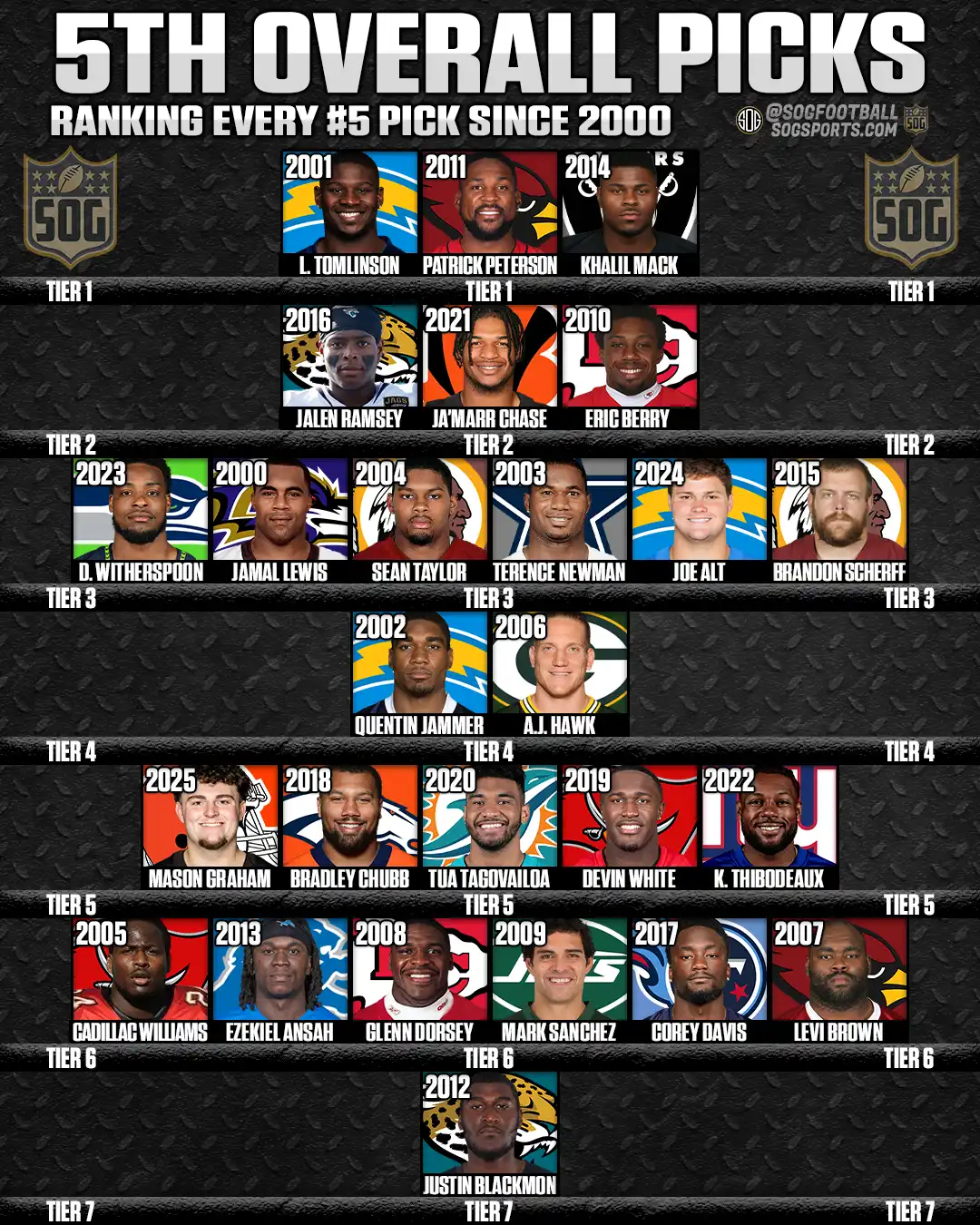
SOG Sports tier list ranking every NFL No. 5 overall pick since 2000.
Table of Contents
- Introduction
- How These Rankings Were Made
- Tier 7: Biggest NFL Draft Busts
- Tier 6: NFL Draft Disappointments
- Tier 5: Useful Careers, Wrong Slot
- Tier 4: Good Players With Limits
- Tier 3: Strong NFL Draft Successes
- Tier 2: Elite 5th Overall Picks
- Tier 1: Best 5th Overall NFL Draft Picks Since 2000
- FAQ
- Final Thoughts
How These Rankings Were Made
This ranking weighs peak performance, consistency, longevity, accolades, positional value, and total return on a top-five draft investment. A corner, linebacker, wide receiver, tackle, quarterback, safety, and running back do not create value in the same way, but the standard stays the same: did this player actually deliver like a premium pick?
Context matters too. Injuries shaped several of these careers. Some players landed in stronger situations than others. Younger players are judged more carefully because their careers are still taking shape. This is not a projection of where every active player will finish. It is a ranking of what each No. 5 overall pick has accomplished so far.
One rule stays constant throughout the list. Every player is listed with the team that originally drafted him, not the team he later became most associated with.
Tier 7: Biggest NFL Draft Busts — 5th Overall Picks That Barely Returned Anything
This is the bottom tier. These are the players who gave their teams the least return relative to where they were drafted.
Justin Blackmon — Jacksonville Jaguars — 2012
Blackmon had real first-round talent and looked like someone who could become a true No. 1 receiver. In just 20 career games, he still managed 93 catches for 1,280 yards and showed enough flashes to make the unrealized upside obvious. That is part of what makes the outcome so rough. For a fifth overall pick, the gap between promise and actual return was enormous.
Tier 6: NFL Draft Disappointments — Some Flashes, Not Enough Value
These players had moments, and a few had stretches where they looked useful or even exciting, but the full résumé never justified the draft slot.
Cadillac Williams — Tampa Bay Buccaneers — 2005
Williams burst onto the scene with over 1,100 rushing yards as a rookie and gave Tampa Bay immediate energy. That early impact matters. The problem is that injuries kept the long-term return from holding up, and the full body of work never matched what teams want from a top-five running back.
Ezekiel Ansah — Detroit Lions — 2013
Ansah had raw tools, real flashes, and one stretch where it looked like Detroit had found a defensive star. His 14.5-sack season in 2015 was the kind of peak that gets your attention fast. Injuries and inconsistency kept that from lasting long enough to push him higher.
Glenn Dorsey — Kansas City Chiefs — 2008
Dorsey was a major college name and one of the most respected prospects in his class. He became a decent NFL player and carved out a real career, but he never became the kind of interior force teams hope to land with the fifth pick.
Mark Sanchez — New York Jets — 2009
Sanchez is one of the stranger cases on the board. The playoff runs were real, the team success was real, and he had moments on big stages. But the individual résumé never came close to matching the expectations attached to a top-five quarterback, and that keeps him down here.
Corey Davis — Tennessee Titans — 2017
Davis had useful seasons, topped 980 receiving yards in 2020, and produced enough to avoid true bust status. Still, the fifth overall pick at wide receiver usually comes with expectations of becoming a true offensive centerpiece. He never fully got there.
Levi Brown — Arizona Cardinals — 2007
Brown had staying power in the league, which counts. He started games, played a premium position, and gave Arizona some useful years. He just never felt like a franchise left tackle who fully changed the trajectory of the offense.
Tier 5: Useful Careers, Wrong Slot — Good Enough to Matter, Not Enough to Win Big
This tier is made up of players who had real value, or still might, but have not yet built the kind of résumé that clearly beats the weight of the slot.
Mason Graham — Cleveland Browns — 2025
Graham is only here because he is just getting started. The Browns made him the fifth overall pick in 2025, and the early profile already looks promising. He has since earned PFWA All-Rookie recognition, which is a strong first signal, but he is still too early in his career to rank aggressively against finished résumés. This is a placeholder more than a verdict.
Bradley Chubb — Denver Broncos — 2018
Chubb has been productive, disruptive, and clearly talented. He posted 12 sacks as a rookie and has had stretches where he looked exactly like the kind of edge defender teams want from a top-five pick. He has also dealt with injuries, and that matters in a ranking built around total value.
Tua Tagovailoa — Miami Dolphins — 2020
Tua has had stretches of strong quarterback play, efficient production, and obvious command within Miami’s offense. He led the league in passing yards in 2023, which is not nothing. But durability concerns, system-dependence arguments, and the still-unfinished nature of his résumé keep him in a complicated middle tier for now.
Devin White — Tampa Bay Buccaneers — 2019
White’s peak was impactful and violent, especially in big moments. His playoff run during Tampa Bay’s Super Bowl season remains the loudest stretch of his career, and he showed the kind of range and closing burst that made him such a premium prospect. The total career picture has still been uneven enough to keep him here.
Kayvon Thibodeaux — New York Giants — 2022
Thibodeaux is still young, still dangerous, and still capable of climbing. Double-digit sacks in 2023 showed there is real pass-rush value here. For now, though, the flashes are still a little stronger than the full résumé.
Tier 4: Good Players With Limits — Strong Careers That Fell Short of the Top Tiers
These players were good pros, and in some cases very good ones, but they land a step below the stronger long-term wins on this board.
Quentin Jammer — San Diego Chargers — 2002
Jammer had a long, useful career and gave the Chargers real value at corner for more than a decade. He was physical, durable, and dependable. He just did not become the kind of dominant defensive back who forces his way into the higher tiers.
A.J. Hawk — Green Bay Packers — 2006
Hawk became a dependable, productive linebacker for a winning organization and started for a long time. That matters. He may not have been a star in the loudest sense, but he gave Green Bay real NFL value over multiple playoff-caliber seasons.
Tier 3: Strong NFL Draft Successes — Real Value, Real Résumés
Now we are into the players who clearly justified the pick to a meaningful degree, even if they stopped short of the very top shelf.
Devon Witherspoon — Seattle Seahawks — 2023
Witherspoon already looks like the kind of defensive back offenses have to account for. As a rookie, he posted 79 total tackles, 3 sacks, 16 passes defensed, and an interception in just 14 games, which is a ridiculous kind of all-over-the-field impact for a young corner. The start has been strong enough to put him here already, and he still has room to climb.
Jamal Lewis — Baltimore Ravens — 2000
Lewis brought real power and major production to Baltimore’s offense. He rushed for over 2,000 yards in 2003, helped the Ravens control games with physicality, and had a peak that was absolutely strong enough to make him an easy Tier 3 placement.
Sean Taylor — Washington Redskins — 2004
Taylor’s career was tragically short, which makes ranking him one of the hardest calls on the board. The talent and impact were obvious, and the trajectory looked massive. This placement reflects both how special he was and how incomplete the total résumé became.
Terence Newman — Dallas Cowboys — 2003
Newman carved out a long, credible, high-level NFL career. He made multiple Pro Bowls, remained useful well into his 30s, and gave teams exactly the kind of stable cornerback play that holds up over time. He was not always discussed like the league’s loudest stars, but the consistency and longevity were real.
Joe Alt — Los Angeles Chargers — 2024
Alt is early in his career, but the start has already been encouraging. He started 16 games as a rookie, which is exactly the kind of immediate stability teams hope for when they draft a tackle this high. The reason he lands here already is simple: premium position, strong early floor, and obvious long-term upside.
Brandon Scherff — Washington Redskins — 2015
Scherff became one of the better interior linemen in football and gave Washington strong value for years. Multiple Pro Bowls, premium-level guard play, and long-term credibility make this a quality top-five return, even if it falls short of the elite names above.
Tier 2: Elite 5th Overall Picks — High-End Careers That Clearly Justified the Slot
This tier is reserved for players who clearly justified the fifth pick and spent long stretches looking like top-end talent.
Jalen Ramsey — Jacksonville Jaguars — 2016
Ramsey was a tone-setter almost immediately. He played with attitude, range, shutdown ability, and the kind of edge that changed how offenses attacked his defense. At his peak, he looked like one of the most dangerous corners in football, and the résumé easily supports this tier.
Ja’Marr Chase — Cincinnati Bengals — 2021
Chase hit the league like a star and has looked like one ever since. He posted 1,455 receiving yards as a rookie, won Offensive Rookie of the Year, and immediately became one of the most explosive receivers in football. He already feels like one of the cleaner offensive wins in this draft range.
Eric Berry — Kansas City Chiefs — 2010
Berry was one of the most respected safeties of his era. His career included elite play, leadership, multiple Pro Bowls, and one of the most inspiring comeback stories the league has seen. The total value easily supports this tier, even if the career was interrupted by serious adversity.
Tier 1: Best 5th Overall NFL Draft Picks Since 2000 — The True Home Runs
This is the top shelf. These are the fifth-overall picks whose careers feel like clear, undeniable wins.
LaDainian Tomlinson — San Diego Chargers — 2001
Tomlinson was one of the best running backs of his generation and one of the easiest Tier 1 placements anywhere on this board. He won league MVP in 2006, finished with 13,684 rushing yards and 145 rushing touchdowns, and built a Hall of Fame résumé that fully justified the pick and then some.
Patrick Peterson — Arizona Cardinals — 2011
Peterson gave Arizona elite corner play and major all-around impact for years. He was smooth, explosive, and consistently one of the best players at his position. Eight Pro Bowls, multiple All-Pro honors, and instant-impact value make this an easy Tier 1 call.
Khalil Mack — Oakland Raiders — 2014
Mack was exactly what a team wants from a premium defensive pick. He was violent, versatile, disruptive, and game-changing. A Defensive Player of the Year award, multiple All-Pro seasons, and high-end edge impact put his peak among the very best on this list.
FAQ
Who is the best No. 5 overall pick since 2000?
LaDainian Tomlinson has the cleanest case because of the production, scoring dominance, and Hall of Fame résumé. Patrick Peterson and Khalil Mack are right there too, which is why all three land in Tier 1.
Why is Sean Taylor only in Tier 3?
Because this ranking has to balance peak talent with total career value. Taylor looked like a future all-time great, but the career was tragically cut short, which makes a true Tier 1 or Tier 2 placement difficult to justify in a résumé-based ranking.
Why are Joe Alt and Mason Graham ranked so early already?
Because both are unfinished evaluations. Alt already looks like a legitimate long-term tackle piece, while Graham has only just begun building his NFL résumé. Their placements reflect what is known right now, not where they are guaranteed to finish.
Who is the biggest bust among 5th overall picks since 2000?
Justin Blackmon is the clearest answer because the total return was so limited relative to the slot and the expectation. Cadillac Williams, Glenn Dorsey, and Levi Brown also land on the disappointing side of the board.
What makes a great 5th overall pick in the NFL draft?
A great fifth overall pick usually combines high-end peak play, strong positional value, multiple impact seasons, and a résumé that clearly beats the expectation of a top-five investment. The best names on this list became franchise pillars, matchup problems, or long-term stars.
Why are some productive players still outside Tier 1?
Because productivity alone is not always enough. Shorter peaks, injuries, lower positional leverage, or good-not-great total impact can keep a strong player from reaching the true home-run tier.
Final Thoughts
The fifth pick in the draft is close enough to the top that teams still expect to land a franchise-shaping player. Sometimes they did. This board has Hall of Fame talent, elite defenders, and major offensive weapons at the top. It also has a middle class full of good players who just never became quite as valuable as the slot suggests they should have.
That is what makes this draft position so interesting. It is high enough for huge expectations, but just low enough for teams to talk themselves into upside, projection, and scheme fit. When they nailed it, they got names like LaDainian Tomlinson, Patrick Peterson, and Khalil Mack. When they missed, the gap between hype and reality got ugly fast.
The best names here are a reminder of what top-five success is supposed to look like. The worst names are the reminder that even premium draft capital does not come with guarantees.
More NFL Draft Rankings Since 2000
This article is part of our full NFL Draft history series breaking down the best and worst top-five picks since 2000. Keep going below.
