Introduction
The 4th overall NFL Draft pick sits in one of the most fascinating spots on the board. It is still premium territory, still a range where teams expect franchise players, but it comes with a little less noise than the first three picks. That is part of what makes the slot so interesting. Over the last 25 years, it has produced elite offensive linemen, franchise quarterbacks, star receivers, dominant defenders, and a few outright misses that aged badly almost immediately.
Ranking every No. 4 overall pick since 2000 tells a bigger story than just hits and busts. It shows how much positional value matters. It shows how quickly expectations can shift. And it proves that being drafted high guarantees attention, not long-term success.
This list ranks every 4th overall NFL Draft pick since 2000 by peak performance, career value, longevity, positional importance, accolades, and how convincingly each player justified being selected that high. The top of this list is full of premium hits. The bottom is a reminder that top-five capital still gets wasted more often than teams want to admit.
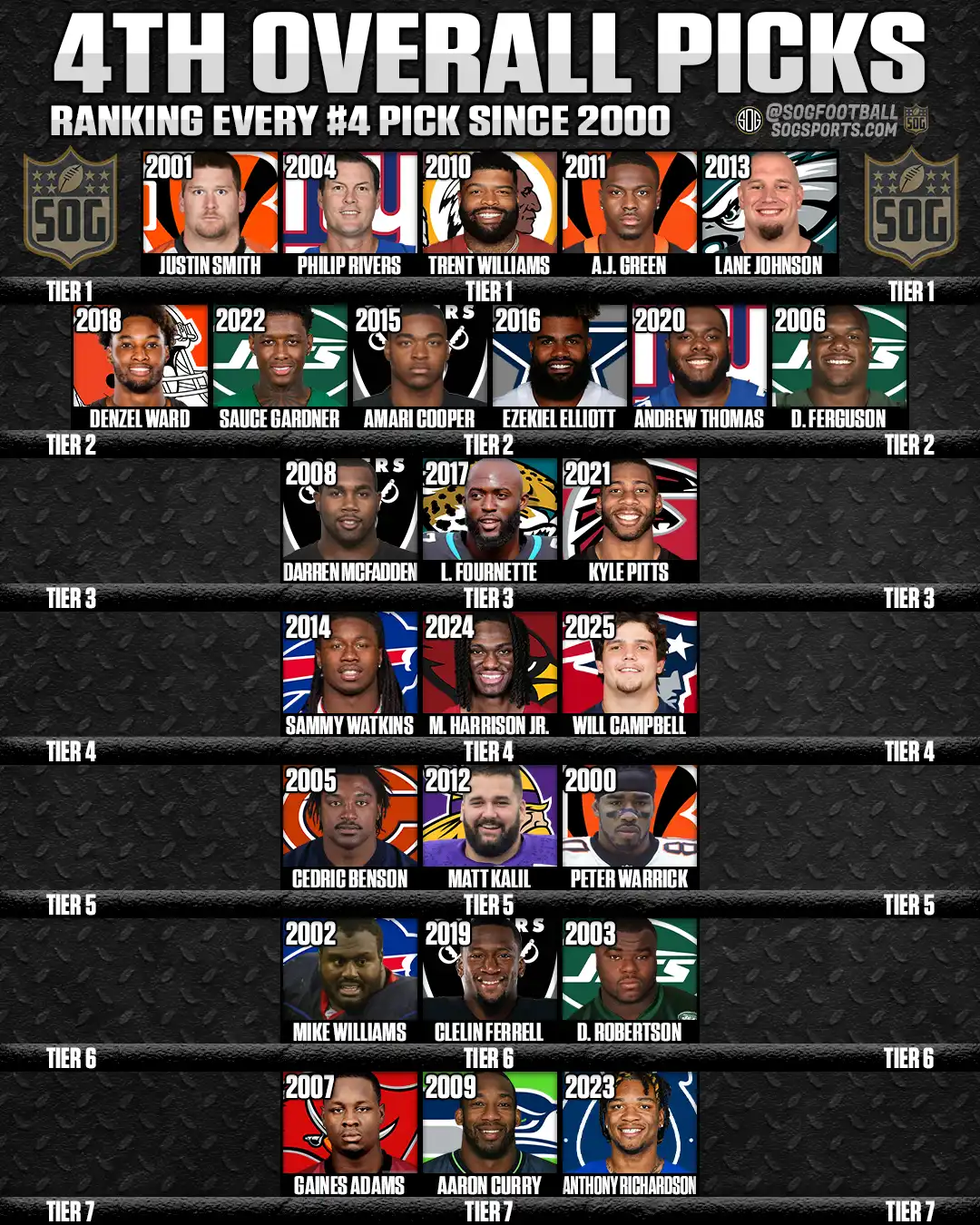
Best to worst 4th overall NFL Draft picks since 2000, ranked by SOG Sports.
Table of Contents
- Introduction to the Best to Worst 4th Overall NFL Draft Picks
- How We Ranked the Best to Worst 4th Overall NFL Draft Picks
- Tier 1: The Best 4th Overall NFL Draft Picks
- Tier 2: Elite 4th Overall NFL Draft Picks
- Tier 3: Strong 4th Overall NFL Draft Picks
- Tier 4: Good but Flawed 4th Overall NFL Draft Picks
- Tier 5: Incomplete or Uneven 4th Overall NFL Draft Picks
- Tier 6: Bad 4th Overall NFL Draft Picks That Fell Well Short
- Tier 7: The Worst 4th Overall NFL Draft Picks
- FAQ About the Best and Worst 4th Overall NFL Draft Picks
- Final Thoughts on the Best and Worst No. 4 Overall Picks
How We Ranked the Best to Worst 4th Overall NFL Draft Picks
This ranking weighs peak performance, consistency, longevity, accolades, positional value, and total return on a top-four draft investment. A left tackle, wide receiver, running back, pass rusher, corner, and quarterback all create value differently, but the core question stays the same: did this player actually perform like a premium draft pick?
Context matters too. Injuries shaped several of these careers. Some players landed in better situations than others. Younger players are judged more carefully because their stories are still being written. This is not a prediction of how every active player will finish. It is a ranking of what each No. 4 overall NFL Draft pick has accomplished so far.
One more rule matters here. Every player is listed with the team that originally drafted him, not the team he later became most associated with.
Tier 1: The Best 4th Overall NFL Draft Picks
This is the top shelf. These are the fourth-overall picks whose careers feel like clear, premium wins, the players who fully matched or exceeded the slot.
Justin Smith — Cincinnati Bengals — 2001
Smith became one of the most respected and reliable defensive linemen of his era. He made five Pro Bowls, earned multiple All-Pro honors, and brought toughness, versatility, and winning football to two different franchises. He was the kind of player coaches love because he fit almost anywhere and still played at a high level.
What pushes him into Tier 1 is the combination of quality and staying power. He was not just good for a few years. He built the kind of career that validates a premium pick from almost any angle.
Philip Rivers — New York Giants — 2004
Rivers never played for the Giants, but that is the team that originally drafted him, and that is what counts here. He gave the league years of high-level quarterback play, eight Pro Bowls, over 63,000 passing yards, and one of the clearest examples of long-term top-five value at the position.
The lack of a ring always colors part of the conversation, but that should not erase the quality of the career. Landing that much quarterback value at No. 4 overall is still a major win, and Rivers gave his drafting slot exactly that kind of return.
Trent Williams — Washington Redskins — 2010
Williams has a real argument as the best player on this entire board. Elite left tackles with his movement skills, power, recovery ability, and staying power do not come around often. He became a perennial All-Pro talent and one of the defining offensive linemen of his era.
This is a franchise-changing hit. When a team finds a tackle this dominant and this durable at a premium position, the debate is not whether the pick worked. It is how high he belongs among the best outcomes of the era.
A.J. Green — Cincinnati Bengals — 2011
Green stepped into the league as a true No. 1 receiver and played like it immediately. He opened his career with seven straight Pro Bowls, gave Cincinnati elite perimeter production, and was one of the smoothest and most dangerous wideouts in football during his prime. At his best, he looked like a matchup problem every week.
He was not just a good receiver drafted high. He was the kind of clean offensive hit teams dream about when they take a wideout in the top five. That makes him an easy Tier 1 name.
Lane Johnson — Philadelphia Eagles — 2013
Johnson became one of the best right tackles in football and a foundational piece for a winning organization. Multiple All-Pro honors, long-term premium play, and a central role on championship-caliber teams make this exactly what Tier 1 is supposed to look like. He brought athleticism, edge control, and consistency to one of the toughest positions on the field.
The position label may keep him from getting the same mainstream shine as some left tackles, but the value is real. Johnson became one of the anchor pieces of a winning franchise, and that is elite draft return.
Tier 2: Elite 4th Overall NFL Draft Picks
This tier is for players who clearly justified being taken fourth overall and gave their teams high-level value over a meaningful stretch.
Denzel Ward — Cleveland Browns — 2018
Ward has been one of the better cover corners in football when healthy. His speed, instincts, and movement skills translated quickly, and Cleveland got exactly the kind of premium defensive back it hoped for. When he is right, he looks like a true No. 1 corner.
He belongs here because the résumé already includes multiple Pro Bowl-level seasons and real high-end play at a premium position. The only reason he stops short of Tier 1 is that the very top names either lasted longer or built even more complete career packages.
Sauce Gardner — New York Jets — 2022
Gardner entered the league and instantly looked like a difference-maker. He won Defensive Rookie of the Year, earned first-team All-Pro honors as a rookie, and immediately showed the kind of field-shrinking coverage presence elite corners bring. Very few young defensive backs announce themselves that quickly.
He is this high already because the start has been that strong. If he keeps stacking seasons, he has a real shot to push into the top tier. The early return already looks like a premium hit.
Amari Cooper — Oakland Raiders — 2015
Cooper might not always get discussed with the loudest language, but the production has been real for a long time. He posted multiple 1,000-yard seasons, developed into one of the more dependable route-runners of his era, and gave teams exactly the kind of polished receiving value a top-five wideout is supposed to bring.
He stops here rather than Tier 1 because the very best names on this board brought either more dominance, more longevity, or more franchise-defining weight. Still, this was clearly a strong pick.
Ezekiel Elliott — Dallas Cowboys — 2016
Elliott’s prime hit hard and fast. He led the league in rushing twice, made an immediate impact in Dallas, and became central to the Cowboys’ offensive identity during his best years. For a few seasons, he looked exactly like the kind of back who could tilt an entire offense.
Running back value always complicates these conversations, but the early return was absolutely strong enough to earn this placement. Dallas got major production, major visibility, and a player defenses had to account for right away.
Andrew Thomas — New York Giants — 2020
Thomas developed into one of the steadier tackles in football after a rocky rookie start. That matters. Premium-position hits are exactly what teams chase this high, and he has become one of the cleaner examples on this list of a player growing into the investment.
What helps him here is not just that he improved. It is that he improved into the kind of answer teams genuinely need. Reliable top-end tackle play is hard to find, and the Giants eventually got it.
D’Brickashaw Ferguson — New York Jets — 2006
Ferguson was steady, durable, and exactly the kind of line anchor teams hope to find early in the first round. He started every game of his 10-year career, gave the Jets years of high-level stability at left tackle, and delivered the sort of dependable value franchises love.
He may not be the flashiest name on this page, but top-five picks do not all need to be flashy. Sometimes the win is landing a player who solves an important position for a decade. That is what Ferguson did.
Tier 3: Strong 4th Overall NFL Draft Picks
Now we get into the players who clearly brought real value, even if they stopped short of elite top-four status.
Darren McFadden — Oakland Raiders — 2008
McFadden was explosive, entertaining, and at his best looked like one of the most dangerous backs in football. He led the league with 5.4 yards per carry in 2010 and later rushed for over 1,000 yards in 2015. When healthy, the burst and big-play ability were obvious.
The issue was durability. The talent was obvious. The sustained production just never fully matched it. That keeps him out of the higher tiers, but not out of the success side of the board.
Leonard Fournette — Jacksonville Jaguars — 2017
Fournette helped power Jacksonville’s run to the AFC Championship Game and later became a major part of Tampa Bay’s Super Bowl offense. He had a meaningful NFL career, multiple productive seasons, and real playoff moments. He was a good player with legitimate power and finishing ability.
He just never felt like a truly dominant, era-shaping one. That is the line between strong value and top-tier value here.
Kyle Pitts — Atlanta Falcons — 2021
Pitts remains one of the tougher players on this board to pin down. The talent is still obvious, and a 1,000-yard rookie season at tight end was no joke. That kind of start usually signals a player who is about to explode into a centerpiece role.
He lands here because the résumé still has more promise than payoff, but the story is far from over and he still has time to climb. For now, he fits as a strong but unfinished evaluation.
Tier 4: Good but Flawed 4th Overall NFL Draft Picks
These players had value and, in some cases, still have time to climb. They just sit a level below the cleaner, stronger No. 4 overall success stories.
Sammy Watkins — Buffalo Bills — 2014
Watkins had real ability, real explosiveness, and enough flashes to remind people why he was drafted so high. He posted over 1,000 receiving yards in 2015 and later played a role on a Super Bowl-winning Kansas City team. The talent was never the problem.
But injuries and inconsistency kept him from becoming the offensive centerpiece Buffalo hoped it was getting. That leaves him in the good-not-great range rather than the stronger tiers above.
Marvin Harrison Jr. — Arizona Cardinals — 2024
It is way too early to lock Harrison into any permanent tier, and that matters here. The talent is obvious, the route-running profile is clean, and the long-term outlook still feels strong. This placement is more about incomplete work than criticism, because the career is still just beginning.
If he quickly becomes a true No. 1 receiver, this spot will not hold very long. For now, the résumé is simply too young for a more aggressive ranking.
Will Campbell — New England Patriots — 2025
Campbell is here only because he is just getting started. Being drafted fourth overall by New England immediately put major pressure on him to become a franchise tackle, and that is still the expectation. The profile makes sense. The NFL résumé just does not exist yet.
For now, this is simply a placeholder tier for a player whose career is too young to rank with conviction.
Tier 5: Incomplete or Uneven 4th Overall NFL Draft Picks
This tier is filled with players who had some value, some moments, or some decent stretches, but still fell short of what teams hope for from a top-four selection. It also includes players whose careers are too early or too unstable to push higher yet.
Cedric Benson — Chicago Bears — 2005
Benson eventually became a productive NFL back and later posted three straight 1,000-yard rushing seasons with Cincinnati. That matters. He was not a total miss as a pro, and the back half of the career was more useful than people sometimes remember.
But Chicago drafted him fourth overall to become more than just a respectable starter. The career was solid enough to avoid the bottom tiers, but it never felt like great value for the slot.
Matt Kalil — Minnesota Vikings — 2012
Kalil looked like a future star early, made the Pro Bowl as a rookie, and for a moment seemed like a long-term answer at left tackle. That early promise is what keeps the conversation around him alive, because the start suggested Minnesota may have landed a premium line piece.
The problem is that the rest of the career never matched the start, and the long-term return fell short. He fits better as an uneven outcome than a clear win.
Peter Warrick — Cincinnati Bengals — 2000
Warrick had talent, hype, and real college fame, but the NFL production never rose to the level Cincinnati needed. He never posted a 1,000-yard receiving season and is remembered more for the idea of what he could become than for the actual career he built.
That kind of gap between expectation and result is exactly what puts a player in this range. The talent was there. The payoff never fully arrived.
Anthony Richardson — Indianapolis Colts — 2023
Richardson is still far too early in his career for any final verdict, but this ranking is about actual NFL return so far. The athletic upside is rare and the ceiling is still obvious. The flashes are exciting enough that writing him off would be premature.
Right now, though, the résumé is incomplete, the availability has been shaky, and the body of work is still too unstable to justify a higher ranking. This is a placeholder, not a final judgment.
Tier 6: Bad 4th Overall NFL Draft Picks That Fell Well Short
These players were disappointments for the slot, even if they had moments where they looked useful. The full résumé never got where it needed to go.
Mike Williams — Buffalo Bills — 2002
This is the offensive tackle Mike Williams, not the later wide receiver with the same name. Buffalo drafted him to anchor the offensive line for years, and that never really happened at the level expected from a fourth overall pick. He started games and had moments, but the pick aged poorly because he never became the foundational tackle Buffalo thought it was getting.
Clelin Ferrell — Oakland Raiders — 2019
Ferrell became one of the defining examples of a team reaching too high for fit and need. He was a solid college player, but the fourth overall pick comes with a much different standard. He never looked like that level of pass-rush talent, and the pick felt questionable almost from the moment it happened.
Dewayne Robertson — New York Jets — 2003
Robertson had some useful seasons, but the total impact was too modest for the slot. For a defensive tackle selected fourth overall, teams want a player who changes the line of scrimmage consistently. The Jets never got that kind of difference-making return.
Tier 7: The Worst 4th Overall NFL Draft Picks
This is the bottom tier. These are the players who fell the furthest short of what teams expect from the fourth pick.
Gaines Adams — Tampa Bay Buccaneers — 2007
Adams had traits, flashes, and a few productive stretches, but the total return never came close to what Tampa Bay needed from a top-five edge rusher. He finished with 13.5 sacks across three seasons before his career and life were tragically cut short. The story is sad, but from a pure draft-value standpoint, the return was still very limited.
Aaron Curry — Seattle Seahawks — 2009
Curry was sold as one of the safest players in his class, which is part of what makes the outcome feel so rough. Seattle drafted him expecting a clean, reliable defensive cornerstone. Instead, he never became more than a disappointing return for the slot and quickly turned into one of the bigger top-five misses of that era.
FAQ About the Best and Worst 4th Overall NFL Draft Picks
Who is the best No. 4 overall pick since 2000?
There are a few strong cases, but Trent Williams probably gets the most support because of how dominant he has been at one of the most valuable positions in football. Justin Smith, Philip Rivers, A.J. Green, and Lane Johnson all have real arguments too depending on whether you value quarterback longevity, trench dominance, or receiving peak.
Why is Philip Rivers listed with the New York Giants?
Because this ranking uses each player’s original drafted team only. Rivers was selected by the Giants before the draft-day trade that sent him to the Chargers, so he stays attached to New York for the purposes of this list.
Why are Marvin Harrison Jr., Will Campbell, and Anthony Richardson ranked so cautiously?
Because they are still early in their careers. This list is based on what each player has done so far, not a final projection of where each career will end. Talent matters, but résumé matters more in a ranking like this.
Who is the biggest bust among 4th overall picks since 2000?
Aaron Curry has one of the strongest cases because he was viewed as such a safe prospect and still fell well short. Gaines Adams, Mike Williams, and Clelin Ferrell belong in that conversation too depending on how much weight you place on expectations versus total career value.
What makes a great 4th overall pick in the NFL Draft?
A great fourth overall pick usually combines premium positional value, multiple impact seasons, high-end peak play, and a résumé that clearly justifies top-five investment. The best names on this list became franchise pillars, matchup problems, or long-term answers at critical positions.
Why are some productive players still outside Tier 1?
Because being productive is not always the same thing as fully cashing out a top-four pick. Shorter peaks, injuries, lower positional leverage, or good-not-great overall impact can keep a player out of the true home-run tier.
Final Thoughts on the Best and Worst No. 4 Overall Picks
The fourth pick in the draft is where teams still expect stars, and a lot of them actually got one. The top of this board is loaded with players who became cornerstones at premium positions. The middle tiers are filled with players who were useful, talented, and at times exciting, but not quite transformational. The bottom is the reminder that even high picks can go sideways fast.
What stands out most is how strong the best names really are. Trent Williams, Justin Smith, Philip Rivers, A.J. Green, and Lane Johnson were not just solid picks. They were the kinds of players who validate an entire draft strategy. That is the standard for a top-four selection, and they cleared it.
At the same time, the misses matter too. They are what make this kind of ranking interesting, because they show how thin the line can be between a premium hit and a front-office regret. Draft slot creates pressure, not guarantees. The best names here proved exactly why teams chase elite talent at the top. The worst names are the reminder that even premium evaluations can still go sideways.
More NFL Draft Pick Rankings Since 2000
If you liked this breakdown of the best and worst No. 4 overall picks since 2000, check out the rest of our NFL Draft rankings series below. We broke down every pick from No. 1 through No. 5 overall to compare the biggest hits, biggest misses, and the careers that aged the best over time.
- Ranking Every No. 1 Overall Pick Since 2000
- Ranking Every No. 2 Overall Pick Since 2000
- Ranking Every No. 3 Overall Pick Since 2000
- Ranking Every No. 5 Overall Pick Since 2000
For more NFL rankings, graphics, and draft content, also check out SOGFootball on Instagram.
