Introduction
2nd overall picks are supposed to be as close to a sure thing as the NFL draft gets. These are blue-chip prospects, premium athletes, and franchise-shaping talents teams expect to become stars early. Sometimes that is exactly how it plays out. Other times, the gap between draft-night hype and actual NFL value becomes impossible to ignore.
That is what makes ranking every No. 2 overall pick since 2000 so interesting. This group includes Hall of Fame-level defenders, elite pass rushers, franchise quarterbacks, explosive offensive weapons, dependable long-term starters, and a handful of painful misses that still look brutal in hindsight.
This is a graphic-first evergreen ranking, but the goal goes beyond just stacking names. This list ranks the best 2nd overall picks in NFL draft history since 2000 based on peak performance, career value, longevity, positional impact, accolades, and how convincingly each player justified being selected that high.
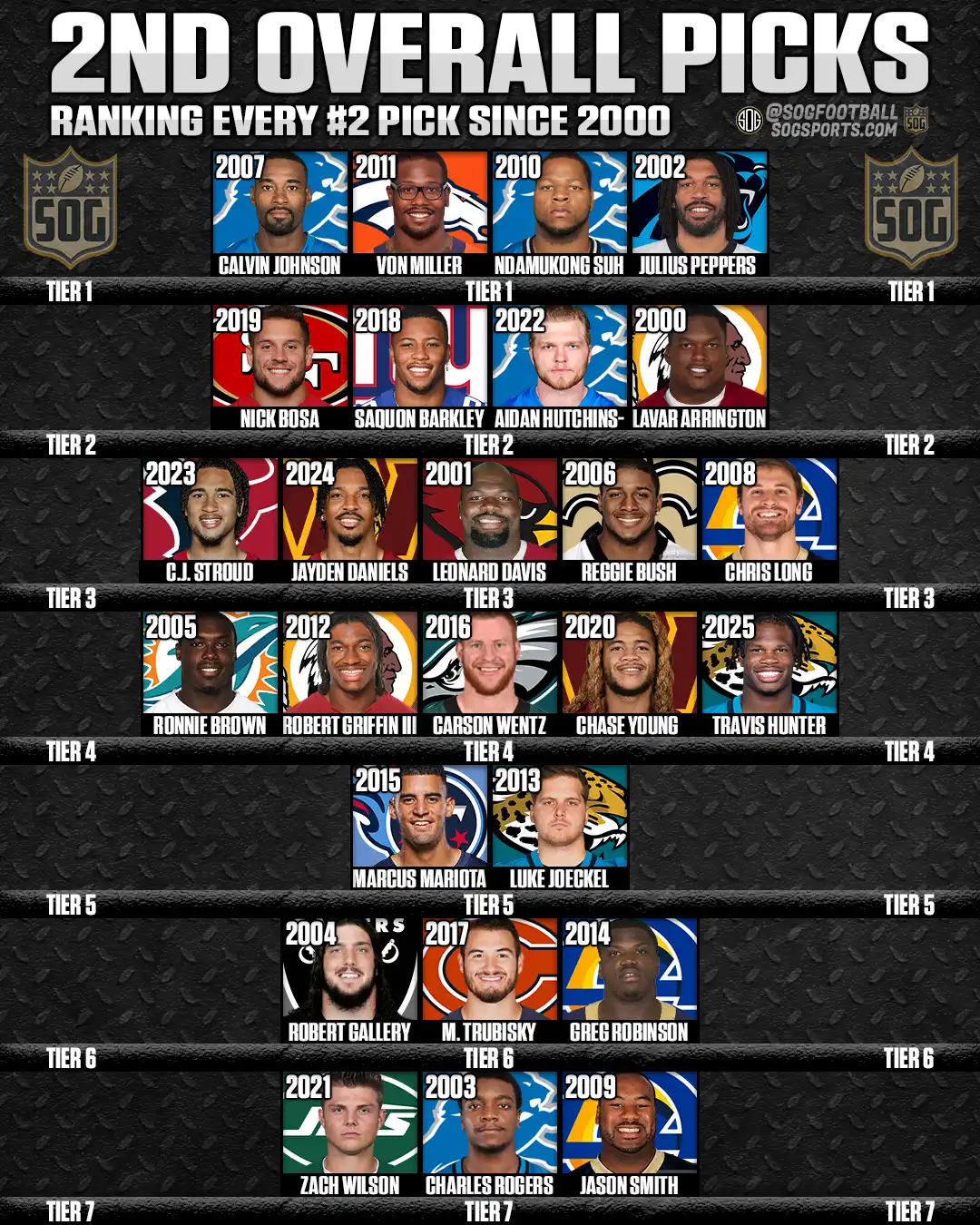
SOG Sports tier list ranking every NFL No. 2 overall pick since 2000.
Table of Contents
- Introduction
- How These Rankings Were Made
- Tier 7: Biggest NFL Draft Busts
- Tier 6: NFL Draft Disappointments
- Tier 5: 2nd Overall Picks That Didn’t Pan Out
- Tier 4: Solid With Caveats
- Tier 3: Successful NFL Draft Picks
- Tier 2: Elite NFL Draft Picks
- Tier 1: Best 2nd Overall NFL Draft Picks Since 2000
- FAQ
- Final Thoughts
How These Rankings Were Made
This ranking weighs peak performance, consistency, longevity, accolades, positional value, and total return on a top-two draft investment. A quarterback, pass rusher, running back, and offensive tackle do not create value in the same way, but the central question stays the same: how much did this player justify being drafted second overall?
Context matters too. Injuries changed some careers. Team situation helped or hurt others. Older players have the advantage of a finished résumé, while active players are judged more carefully because their careers are still unfolding. This is not a projection of where every active No. 2 pick will finish. It is a ranking of what each 2nd overall NFL draft pick has accomplished so far.
Tier 7: Biggest NFL Draft Busts — 2nd Overall Picks That Completely Missed
This is the bottom tier. These are the picks that missed badly enough that there is no clean way to spin the outcome.
Zach Wilson — New York Jets — 2021
Wilson entered the league with rare arm talent, creativity outside structure, and all the traits that usually tempt teams into betting big on quarterback upside. The problem is that very little of it translated consistently on Sundays. He threw 26 touchdowns against 25 interceptions across four seasons with the Jets and never stabilized his accuracy or pocket command. For a quarterback taken second overall, that is about the worst outcome possible.
Charles Rogers — Detroit Lions — 2003
Rogers had real talent, but the NFL career never had time to become anything meaningful. He played just 15 games across two seasons before injuries and off-field problems ended any real chance at recovery. For Detroit, this was supposed to be a foundational playmaker. Instead, it became one of the least productive returns any team got from a premium draft slot in the modern era.
Jason Smith — St. Louis Rams — 2009
Franchise left tackles are exactly the kind of players teams hope to lock in with the second pick, and Smith never came close to becoming that. He started only 26 games across four seasons and never developed into a reliable long-term answer up front. When a tackle goes that high and contributes that little, there is no other way to read the pick.
Tier 6: NFL Draft Disappointments — High Picks That Fell Well Short
These players were disappointments for the slot, even if they had moments or stretches where they looked usable. The full body of work never got where it needed to go.
Robert Gallery — Oakland Raiders — 2004
Gallery lasted in the league and eventually reinvented himself as a guard, which keeps him from true bust status. He started 72 games over seven seasons, but he was drafted to be a franchise left tackle and one of the safest offensive line prospects in years. That version never showed up. Starting games matters, but a position switch is not what teams dream about when they spend the second overall pick.
Mitchell Trubisky — Chicago Bears — 2017
Trubisky made a Pro Bowl, helped Chicago to a playoff appearance, and had stretches where he looked functional in the right setup. That keeps him above the true disaster tier. But quarterbacks taken second overall are judged differently, and being picked ahead of Patrick Mahomes and Deshaun Watson permanently shapes the evaluation. The résumé is not empty, but it falls far short of what the slot demands.
Greg Robinson — St. Louis Rams — 2014
Robinson arrived with the physical profile teams pay for at offensive tackle, but the technique and consistency never came. He started 56 games across five seasons without ever making a Pro Bowl or establishing himself as a reliable anchor. For that draft position, flashes and traits are not enough.
Tier 5: 2nd Overall Picks That Didn’t Pan Out — Useful Careers, Wrong Slot
This is the middle ground between outright miss and clear success. These players had useful careers or meaningful seasons, but they still fell short of what teams hope to get from the second pick in the draft.
Marcus Mariota — Tennessee Titans — 2015
Mariota gave Tennessee a winning stretch, a playoff moment people still remember, and real dual-threat value early in his career. He threw 76 touchdown passes against 44 interceptions with the Titans and added value as a runner. That is not nothing. But he never became the long-term high-end answer at quarterback, and that is ultimately what keeps this from feeling like a true win for a No. 2 overall pick.
Luke Joeckel — Jacksonville Jaguars — 2013
Joeckel was drafted to become the anchor of Jacksonville’s offensive line for years, and that never happened. He never looked like a premium difference-maker in the trenches, and injuries helped shorten the runway. When you take an offensive lineman this high, a short and underwhelming run is not enough return on the investment.
Tier 4: Solid With Caveats — Value That Didn’t Quite Match the Price
These players had value and, in some cases, delivered strong peaks. They just sit a tier below the cleanest second-overall success stories.
Ronnie Brown — Miami Dolphins — 2005
Brown was a good back and a versatile piece of Miami’s offense during his best years. He had three straight seasons with at least 900 rushing yards from 2006 through 2008 and brought receiving value on top of that. The issue is simple: he was productive, not transformative. For a second overall pick at running back, teams want a star. Brown was more solid than special.
Robert Griffin III — Washington Redskins — 2012
RGIII’s rookie season was electric. He won Offensive Rookie of the Year, threw 20 touchdown passes to just 5 interceptions, and changed the feel of Washington’s offense overnight. That peak matters a lot. But the injuries hit fast, the long-term development stalled, and the career never recovered enough to match the beginning. One dominant season followed by decline is a difficult outcome to rank anywhere higher.
Carson Wentz — Philadelphia Eagles — 2016
Wentz is one of the more complicated cases on this list because the high point was legitimately elite. In 2017, he threw 33 touchdown passes in 13 games and looked like an MVP frontrunner before getting hurt. That kind of season carries real weight. The problem is that his post-peak decline was sharp and fast, and he never rebuilt the stability expected from a quarterback taken second overall.
Chase Young — Washington Commanders — 2020
Young won Defensive Rookie of the Year with 7.5 sacks and flashed exactly the kind of burst and pass-rush upside that made him such a coveted prospect. But injuries interrupted his momentum almost immediately, and the sustained production has not come. The tools are obvious. The career return, at least so far, is still more tease than takeover.
Travis Hunter — Jacksonville Jaguars — 2025
Hunter is too early in his career to judge the way older players on this list can be judged. The talent is rare, the two-way intrigue is real, and the ceiling is enormous. This placement is purely about incomplete work. If he becomes the kind of impact defender, receiver, or true hybrid weapon many expect, he will fly up these rankings in a hurry.
Tier 3: Successful NFL Draft Picks — Real Stars Who Fell Just Short of the Top
Now we are into the players who clearly brought real value. Some were stars. Some had long productive runs. Some younger names already look strong enough to demand respect.
C.J. Stroud — Houston Texans — 2023
Stroud looked like a franchise quarterback almost immediately. As a rookie, he threw for over 4,100 yards with 23 touchdown passes and just 5 interceptions, then helped turn Houston from a bottom-tier team into a playoff winner. That kind of early command matters. He is still building the résumé, but the opening chapter was strong enough to put him ahead of several older names already.
Jayden Daniels — Washington Commanders — 2024
Daniels put together one of the better rookie quarterback seasons in recent memory, throwing for over 3,500 yards with 25 touchdowns and leading Washington to the NFC Championship Game in year one. The dual-threat element adds another layer. This spot is intentionally cautious because it is still one season, but the early evidence is hard to dismiss.
Leonard Davis — Arizona Cardinals — 2001
Davis may not get talked about like some of the flashier names here, but he carved out a long, credible NFL career and made three Pro Bowls across 13 seasons. He never became a transcendent superstar, but he gave Arizona and Dallas quality trench play over a long stretch. Staying power matters more than people sometimes admit when evaluating top draft picks.
Reggie Bush — New Orleans Saints — 2006
Bush came into the NFL with almost impossible expectations after his college career, so anything less than instant superstardom was always going to feel underwhelming. Even so, he was a dynamic weapon, topped 1,300 yards from scrimmage as a rookie, caught 88 passes in 2007, and played a real role on a Super Bowl-winning team. He did not fully become the player the hype promised, but he brought real value.
Chris Long — St. Louis Rams — 2008
Long posted back-to-back double-digit sack seasons in 2011 and 2012, later added two Super Bowl rings as a veteran contributor, and gave teams over a decade of reliable edge production. He was never in the Peppers or Von Miller tier as a pass rusher, but the career return was solid and the body of work holds up better than most people remember.
Tier 2: Elite NFL Draft Picks — Dominant Peaks, Strong Cases for the Top
This tier is for players who were either elite for long stretches or have already built an extremely strong case. They sit just a step below the very best second-overall outcomes.
Nick Bosa — San Francisco 49ers — 2019
When healthy, Bosa looks exactly like what teams hope a premium defensive pick becomes. He has already won Defensive Rookie of the Year and Defensive Player of the Year, and he has been one of the most complete edge defenders in football at his best. The reason he is not Tier 1 yet is career volume. The peak and the talent absolutely belong near the top.
Saquon Barkley — New York Giants — 2018
Barkley’s career has been shaped by injuries, but the talent has never been in doubt. He exploded for over 2,000 yards from scrimmage as a rookie, brought elite home-run ability, and at his best has looked like one of the most dangerous backs in football. The only things keeping him out of Tier 1 are positional value and the missed time that cut into his long-term résumé.
Aidan Hutchinson — Detroit Lions — 2022
Hutchinson already feels like one of the cornerstones of Detroit’s rise. He impacts the game with effort, power, and relentless activity, and he has looked like a tone-setter for the entire defense. The production is already strong and the eye test backs it up. If he keeps stacking healthy seasons, the Tier 1 path is very real.
LaVar Arrington — Washington Redskins — 2000
Arrington’s peak was as disruptive as any linebacker of his era. He made three Pro Bowls, earned two First-Team All-Pro selections, and at his best played with a motor and instinct that made offensive coordinators game-plan around him specifically. Injuries cut short what could have been an even bigger legacy, but the top-end play was real enough to keep him near the top.
Tier 1: Best 2nd Overall NFL Draft Picks Since 2000 — The True Home Runs
This is the top shelf. These are the second-overall picks that feel like clean home runs, the players who either dominated their era or built résumés that fully match the draft slot.
Calvin Johnson — Detroit Lions — 2007
There is no mystery here. Calvin Johnson was one of the most dominant wide receivers the NFL has ever seen. He made six Pro Bowls, earned three First-Team All-Pro selections, led the league in receiving yards twice, and set the single-season receiving yards record with 1,964 in 2012. Even with a career that ended earlier than many expected, the peak was so overwhelming that he lands comfortably at the top.
Von Miller — Denver Broncos — 2011
Miller was everything Denver could have hoped for when it made him the second pick. He became one of the defining edge rushers of his era, made multiple All-Pro teams, won Super Bowl 50 MVP, and consistently changed games with his ability to finish. This is what a premium defensive hit looks like when it fully cashes out.
Ndamukong Suh — Detroit Lions — 2010
Suh was a force almost from day one. He won Defensive Rookie of the Year, made five Pro Bowls, and built a long career as one of the most dominant interior defenders in football. Interior linemen rarely get the same attention as edge rushers, but Suh was one of the exceptions because his presence genuinely shifted blocking schemes week to week.
Julius Peppers — Carolina Panthers — 2002
Peppers is one of the cleanest success stories anywhere on this list. He posted 159.5 career sacks, made nine Pro Bowls, earned multiple All-Pro honors, and combined rare athleticism with elite finishing ability for nearly two decades. He was not just a great No. 2 overall pick. He was one of the best defensive players of the entire era.
FAQ
Who is the best No. 2 overall pick since 2000?
Calvin Johnson, Von Miller, Ndamukong Suh, and Julius Peppers all have strong arguments. Johnson has the most dominant peak. Miller has the Super Bowl MVP and the sustained pass-rush résumé. Peppers has the longevity and one of the best sack totals of the era. Any of the four is defensible depending on what you weigh most.
Who is the biggest bust among 2nd overall picks since 2000?
Zach Wilson, Charles Rogers, and Jason Smith are the three worst outcomes. Rogers and Smith gave their teams almost no return at all. Wilson gets extra attention because he played quarterback and never once looked like a long-term answer at the position.
Why is C.J. Stroud already ranked above older players?
Quarterback value is the most important variable in the NFL, and Stroud’s early production already changed the direction of a franchise. Over 4,000 yards, near-perfect ball security, and a postseason win as a rookie earns real placement, not just potential credit.
Why are active players like Jayden Daniels, Aidan Hutchinson, and Travis Hunter ranked cautiously?
Because this list is based on what players have already done. Hutchinson has already built a strong case. Daniels had a strong rookie year. Hunter has played one season. Ranking draft careers fairly means respecting the difference between a résumé and a projection.
What makes a great 2nd overall pick in the NFL draft?
Elite peak play, strong positional value, multiple sustained impact seasons, and a career that clearly justifies the investment. The best names on this list were foundational pieces, major matchup problems, or franchise-level building blocks — not just solid contributors.
Why are some productive players still ranked outside Tier 1?
Because this ranking is about return relative to draft position. A productive player who never reached a dominant peak, dealt with major injuries, or plays a position with lower leverage can still fall short of what the second overall pick demands.
Final Thoughts
Looking back at every 2nd overall pick since 2000, a few things stand out immediately. The top of this list — Calvin Johnson, Von Miller, Ndamukong Suh, Julius Peppers — is loaded with players who fully justified the pick and then some. These were not just good outcomes. They were era-defining players who changed games and altered how defenses or offenses had to be built.
The middle of the list tells a different story. Several picks here had real value without ever becoming the difference-makers teams paid for. That gap between “useful” and “worth the second pick” is wider than most people realize, and it is where a lot of premium selections quietly disappear.
At the bottom, the misses are genuinely difficult to defend regardless of context. Injuries, team situation, and development time are all real factors — but Rogers, Smith, and Wilson had more than enough runway to show something. They just never did.
Draft position creates expectation, not guarantee. The names at the top of this list are proof of what the slot can produce when it works. The names at the bottom are the reminder of what happens when it does not.
More NFL Draft Rankings Since 2000
This article is part of our full NFL Draft history series breaking down the best and worst top-five picks since 2000. Keep going below.
