Best Running Back Drafted Each Year Since 1966
Few positions can define an NFL era the way a great running back can. The league has changed, offenses have changed, and roster-building has changed, but elite backs still leave a mark that is impossible to miss. Some become the engine of dominant offenses. Others carry entire franchises before the rest of the roster catches up.
That is what makes a year-by-year draft exercise so interesting at running back. The best player from each class is not always the first back off the board, not always the most hyped prospect, and definitely not always the one teams expected to become a star. Terrell Davis went #196. Frank Gore lasted until #65. Brian Westbrook slipped to #91. Running back history is full of teams overthinking obvious talent and missing badly on what matters most.
Some draft classes gave us obvious all-time answers. Others were thinner and forced a much less glamorous choice. A few years produced easy winners like Walter Payton, Barry Sanders, Emmitt Smith, Marshall Faulk, LaDainian Tomlinson, Adrian Peterson, and Derrick Henry. Other years were more about finding the back who built the strongest overall NFL career in a weaker field.
We went through every draft since 1966 and made the call anyway. Where the answer is obvious, it is treated that way. Where the class was weak, the write-up reflects it. And for the most recent years, the framing stays cautious because those careers are still unfolding.
Table of Contents
- How We Chose the Best Running Back From Each Draft Class
- Best Running Backs Drafted Each Year From 1966–1995
- Best Running Backs Drafted Each Year From 1996–2025
- Full List of the Best Running Back Drafted Each Year
- Final Thoughts on the Best Running Backs Drafted Each Year
- FAQ About the Best Running Backs Drafted by Year
How We Chose the Best Running Back From Each Draft Class
This list is based on career value first. Peak matters, but full body of work matters more.
Longevity, production, awards, playoff impact, and overall place in NFL history all factored into the final call. In some classes, one brilliant peak was enough to separate a player from the field. In others, the better answer came down to who stayed good the longest.
For recent classes, the picks are naturally more fluid. One or two NFL seasons can tell you a lot, but they do not tell you everything. Those years should be read as current snapshots, not final historical verdicts.
A specific note on 2024 and 2025: both entries are explicitly provisional. Those careers are just getting started, and those spots should be viewed as informed early calls rather than settled answers.
Best Running Backs Drafted Each Year From 1966–1995
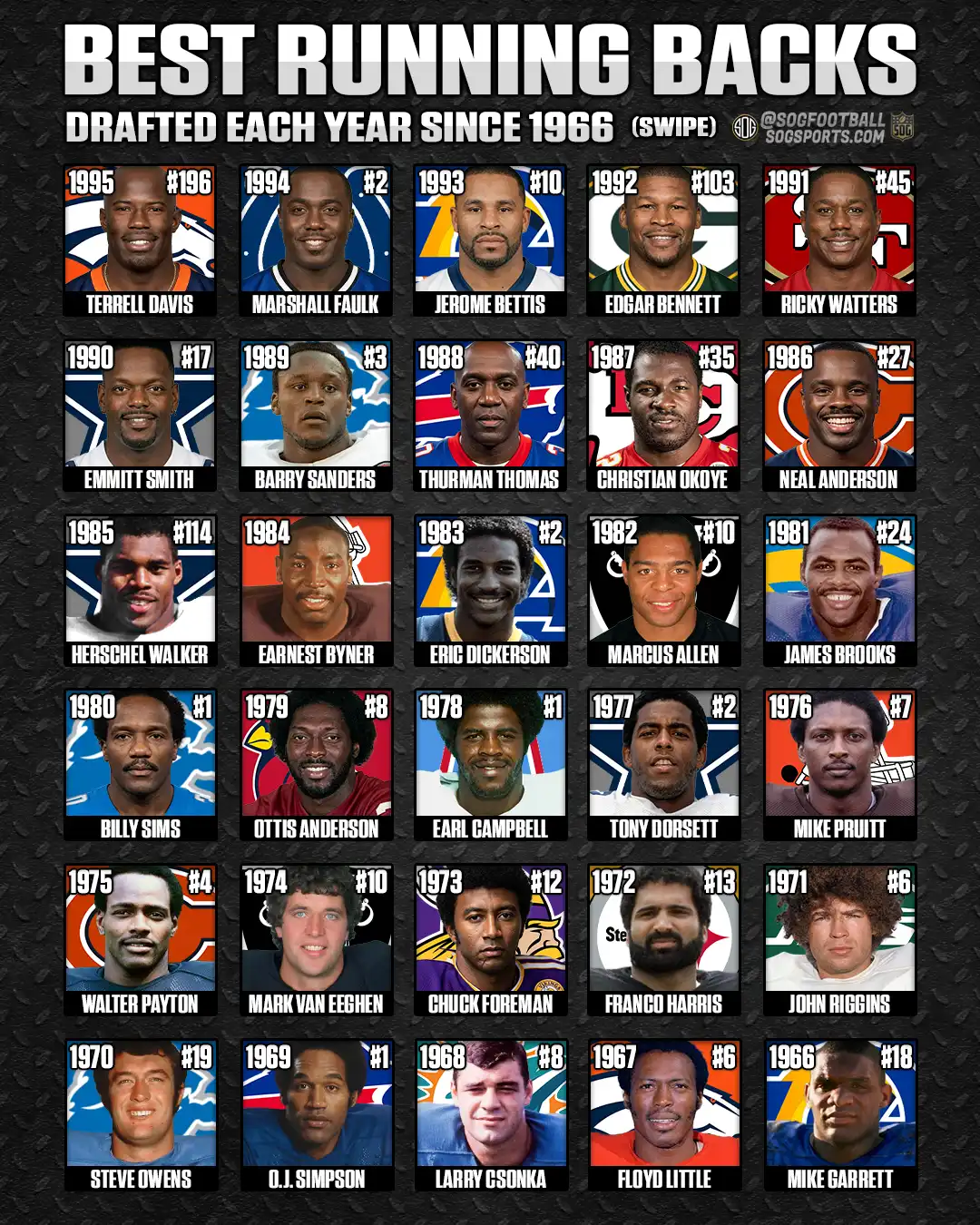
The best running back drafted in every NFL Draft class from 1966 through 1995.
1966 — Mike Garrett, Los Angeles Rams, #18
The 1966 class was thin at running back, so this is more about having the best actual NFL career than owning the loudest résumé. Garrett was a useful, winning player and part of a championship run in Kansas City. In a weak year, the bar is modest and he clears it.
1967 — Floyd Little, Denver Broncos, #6
Little was one of the first true stars in Broncos history and did most of his damage on teams that did not give him much help. He carried a young franchise, made three Pro Bowls, rushed for over 6,300 yards, and left such a mark on Denver that the team retired his number. The Hall of Fame came in 2010, decades later than it should have.
1968 — Larry Csonka, Miami Dolphins, #8
Csonka ran like Miami wanted to play: violent, disciplined, and relentlessly physical. He was a central piece of the Dolphins dynasty, won Super Bowl VIII MVP, and helped define one of the best rushing identities any team has ever built.
1969 — O.J. Simpson, Buffalo Bills, #1
Purely as a football player, Simpson was one of the most explosive runners the sport has ever seen. The 2,003-yard season in 14 games still looks absurd. Whatever else surrounds the name, the on-field peak was undeniable.
1970 — Steve Owens, Detroit Lions, #19
This is one of the thinner years on the board, and Owens is the honest answer rather than the exciting one. He had real talent, gave Detroit a few productive seasons, and did enough before injuries took over. Some years simply do not produce a star at the position.
1971 — John Riggins, New York Jets, #6
Riggins had one of the strangest great careers a running back has ever had. He was good early, disappeared for a while, then returned to Washington and became a postseason hammer, capping it with a 43-yard touchdown against Miami in Super Bowl XVII that earned him MVP honors. Not many backs peak that late and that loudly.
1972 — Franco Harris, Pittsburgh Steelers, #13
Harris was the steady force behind a dynasty. Four Super Bowl rings, over 12,000 rushing yards, and the Immaculate Reception to announce his arrival as a rookie — he delivered exactly what championship teams need from the position across his entire career.
1973 — Chuck Foreman, Minnesota Vikings, #12
Foreman was ahead of his time. He was not just a productive runner, he was a complete offensive weapon who could catch, create mismatches, and stress defenses in ways the league had not fully embraced yet. Five Pro Bowls and three NFC Championship appearances give him a stronger historical profile than he typically gets credit for.
1974 — Mark van Eeghen, Oakland Raiders, #10
The 1974 class was not loaded, which is why van Eeghen’s career carries more weight than his name value typically gets. He gave Oakland quality rushing production, won two Super Bowls as a key contributor, and led the AFC in rushing in 1977. In a weak field, that is a real résumé.
1975 — Walter Payton, Chicago Bears, #4
Payton rushed for 16,726 yards, held the all-time rushing record for nearly two decades, and did it while playing for Bears offenses that frequently gave him very little help. He missed one game in 13 seasons. He blocked as hard as he ran, returned kicks, and was considered the best-conditioned player in football throughout his prime. One of the two or three greatest backs who ever played.
1976 — Mike Pruitt, Cleveland Browns, #7
Pruitt is easy to overlook because he does not carry the historical weight of some other winners on this list, but he was a real feature back for years. He rushed for over 6,500 yards, made two Pro Bowls, and gave Cleveland consistent production in a class without a better answer.
1977 — Tony Dorsett, Dallas Cowboys, #2
Dorsett brought home-run speed to a team that already knew how to win. He rushed for over 12,000 yards, won a Super Bowl as a rookie, and still owns the longest run in NFL history, a 99-yard touchdown in 1983. The 1977 class belongs to him.
1978 — Earl Campbell, Houston Oilers, #1
Campbell won three straight rushing titles, took home league MVP in 1979, and ran with such violence that defenders visibly braced themselves before contact. The prime burned hot and short, but it was one of the most physically dominant stretches any back has ever produced.
1979 — Ottis Anderson, St. Louis Cardinals, #8
Anderson’s career had staying power and a memorable second act. He came into the league with over 1,600 rushing yards as a rookie, then years later won Super Bowl XXV MVP with the Giants at 34 years old. That kind of beginning-to-end résumé is hard to beat in a year like 1979.
1980 — Billy Sims, Detroit Lions, #1
Sims won Offensive Rookie of the Year and made three Pro Bowls before a knee injury ended the career after only five seasons. He was electric, physical, and dynamic in space, the kind of player who made you wonder what the full story could have been.
1981 — James Brooks, San Diego Chargers, #24
Brooks became one of the most efficient all-purpose backs of his era, especially once he reached Cincinnati. He ran it, caught it, and averaged over five yards per carry across multiple seasons. For a second-round pick, the career value is excellent.
1982 — Marcus Allen, Los Angeles Raiders, #10
Allen won Rookie of the Year, then won Super Bowl XVIII MVP on a 74-yard touchdown run that finished the game. He was a star as a runner, a receiving threat, and a big-game player who extended his career well past what most people expected when his Raiders relationship deteriorated. Longevity, versatility, and championship production make this a comfortable pick.
1983 — Eric Dickerson, Los Angeles Rams, #2
Dickerson ran for 2,105 yards in his second NFL season, setting the single-season rushing record that stood for 18 years. The long-striding style, the effortless explosion, the instant production — he made greatness look smooth at a level very few backs ever have.
1984 — Earnest Byner, Cleveland Browns, #280
This is one of the more debatable years, but Byner gets the nod on full career value. Roger Craig has a legitimate argument, three Super Bowl rings and real offensive versatility in San Francisco, but Byner’s longer body of work across different teams and systems is enough to carry it here.
1985 — Herschel Walker, Dallas Cowboys, #114
Walker never fully became the NFL version of the myth that followed him out of college and the USFL, but the career was still more substantial than people remember. He rushed for over 8,000 yards, added real receiving value, and remained productive long enough to take a weak class. This is not a glamorous winner, but it is the right one.
1986 — Neal Anderson, Chicago Bears, #27
Anderson had the difficult job of following Walter Payton and built a strong career of his own anyway. He made four Pro Bowls, gave Chicago real two-way value out of the backfield, and quietly became one of the more complete backs of the late 1980s.
1987 — Christian Okoye, Kansas City Chiefs, #35
Okoye came to football late — he was a Nigerian track and field athlete before the Chiefs drafted him — and turned the position into something purely physical. He led the league in rushing in 1989 at 260 pounds and was nearly impossible to bring down at the point of attack. The prime was short, but there was nobody else in this class doing anything close to it.
1988 — Thurman Thomas, Buffalo Bills, #40
Buffalo got one of the great second-round steals of the era. Thomas was the engine of a four-Super Bowl team, led the NFL in yards from scrimmage four consecutive years, won Offensive Player of the Year in 1991, and could beat defenses in every phase of the offense. Outstanding player, outstanding value.
1989 — Barry Sanders, Detroit Lions, #3
Sanders retired at 30 sitting 1,457 yards behind Walter Payton’s all-time rushing record and walked away anyway. What he left behind was still one of the most electrically watchable careers in NFL history: ten Pro Bowls, a rushing title in nine of his ten seasons, and a style of play that defenses never figured out how to stop. This is a no-notes pick.
1990 — Emmitt Smith, Dallas Cowboys, #17
Smith owns the all-time rushing record at 18,355 yards and won three Super Bowls while anchoring one of the great dynasties of the modern era. He was not the flashiest back of his time, but the vision, patience, consistency, and longevity are impossible to argue with.
1991 — Ricky Watters, San Francisco 49ers, #45
Watters was one of the better all-around backs of the 1990s. He ran it well, caught it well, scored a lot, and produced across multiple teams. Five straight 1,000-yard rushing seasons and a three-touchdown Super Bowl XXIX performance give his résumé real substance.
1992 — Edgar Bennett, Green Bay Packers, #103
This is a weak class, and Bennett is the honest answer. He was a steady, productive back for good Green Bay teams and ended up delivering more real NFL value than most fourth-round backs ever do. Not a star, but the right winner for the year.
1993 — Jerome Bettis, Los Angeles Rams, #10
Bettis turned power football into a long-term career. Over 13,000 rushing yards, six Pro Bowls, and a memorable Super Bowl ring in his hometown to close it out — he was never subtle, just durable and productive for a very long time.
1994 — Marshall Faulk, Indianapolis Colts, #2
Faulk changed the way the league thought about the position. Runner, receiver, mismatch problem, offensive centerpiece — he was all of it. Three consecutive seasons with at least 1,000 rushing and 1,000 receiving yards at various points of his prime remains one of the most ridiculous stretches the position has produced.
1995 — Terrell Davis, Denver Broncos, #196
Sixth-round pick. League MVP. Super Bowl XXXII MVP. 2,008 rushing yards in 1998. Davis had one of the most compressed and brilliant peaks in running back history before knee injuries ended the career early. The draft value and the height of the peak make him one of the best stories on this entire list.
Best Running Backs Drafted Each Year From 1996–2025
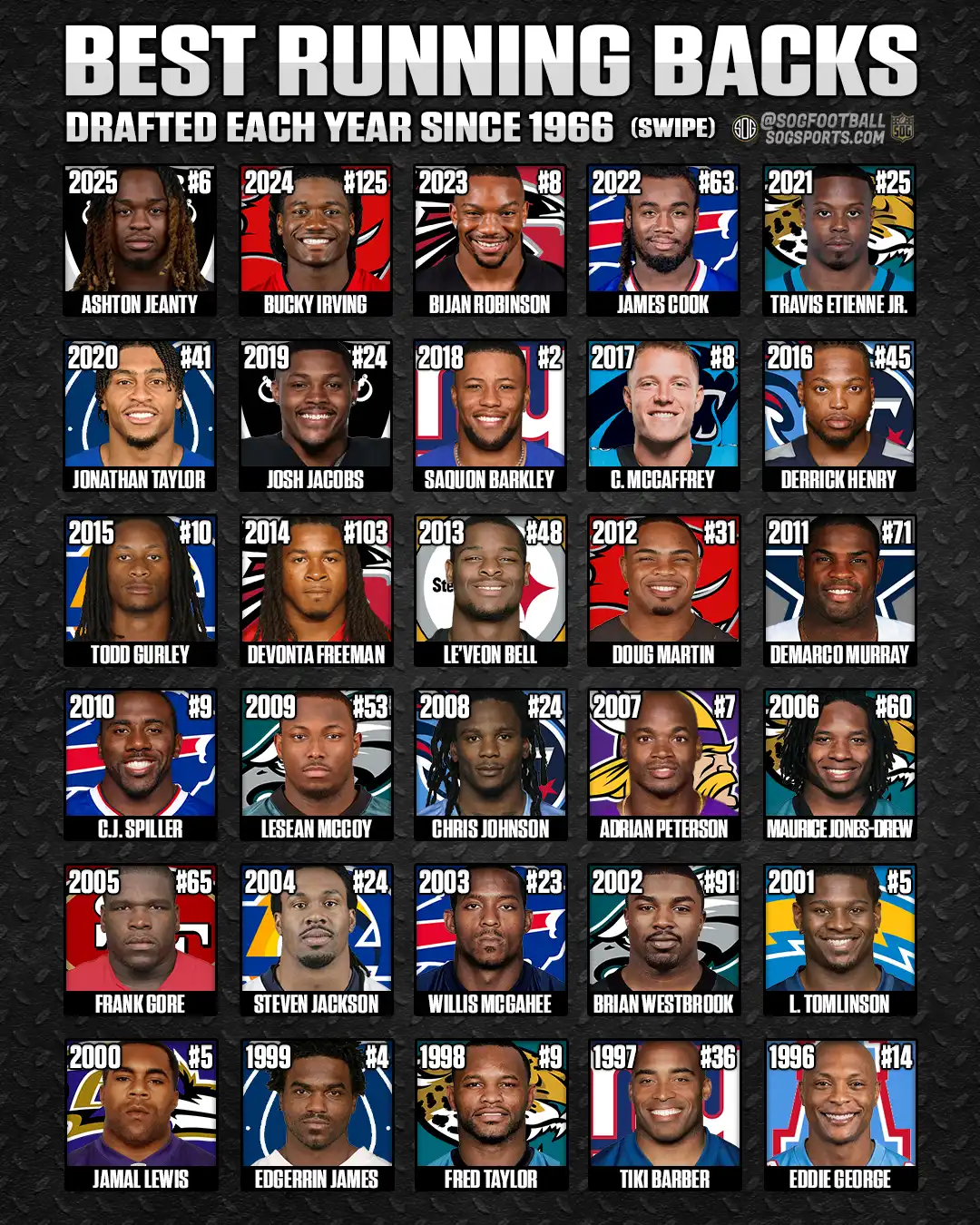
The best running back drafted in every NFL Draft class from 1996 through 2025.
1996 — Eddie George, Houston Oilers, #14
George gave his teams massive volume, toughness, and consistency. Eight straight 1,000-yard seasons, real playoff relevance in Tennessee, and the kind of physical reliability coaches build around make him the clear winner from 1996.
1997 — Tiki Barber, New York Giants, #36
Barber’s late-career jump matters here. He went from a good player to an elite producer with three consecutive monster seasons between 2004 and 2006, including a 1,860-yard rushing year, and finished with a much stronger résumé than most people acknowledge. The 1997 class belongs to him.
1998 — Fred Taylor, Jacksonville Jaguars, #9
Taylor was one of the most underrated pure runners of his era, which had everything to do with availability and nothing to do with talent. When healthy, he averaged over five yards per carry for his career and was as explosive in the open field as anyone of his generation.
1999 — Edgerrin James, Indianapolis Colts, #4
James won four rushing titles, ran for over 12,000 yards, and built a Hall of Fame résumé while helping power the early Peyton Manning Colts into a contender. He lived in a loaded era for backs and still stood out clearly from the competition.
2000 — Jamal Lewis, Baltimore Ravens, #5
Lewis rushed for 2,066 yards in 2003, the second-highest single-season total in NFL history at the time, and did it with the kind of straight-line power that made defenses look overmatched. The overall career is strong enough to back up that peak, and in this class the combination wins comfortably.
2001 — LaDainian Tomlinson, San Diego Chargers, #5
In 2006, Tomlinson scored 28 rushing touchdowns and 31 total touchdowns, breaking the single-season TD record in one of the most individually dominant seasons any back has ever had. He made five Pro Bowls, won Offensive Player of the Year three times, and retired with over 13,000 rushing yards. Nobody from 2001 is in the conversation.
2002 — Brian Westbrook, Philadelphia Eagles, #91
Westbrook was a modern offensive weapon before the league fully started talking that way. He could run, catch, create after the catch, and tilt the geometry of an offense from the backfield. Getting that production out of the third round is one of the better value stories the position has.
2003 — Willis McGahee, Buffalo Bills, #23
McGahee deserves credit for building the career he did after the devastating knee injury he suffered in college. He was never a true superstar, but he produced multiple 1,000-yard seasons, stayed relevant for a long time, and gave several teams credible starting value. In a class without a stronger résumé, that is enough.
2004 — Steven Jackson, St. Louis Rams, #24
Jackson spent too much of his prime on bad Rams teams, which is the main reason his name does not come up more often historically. He still cleared 10,000 rushing yards, made three Pro Bowls, and was one of the toughest feature backs of his era. Great player, bad context.
2005 — Frank Gore, San Francisco 49ers, #65
Gore retired as the third-leading rusher in NFL history at over 16,000 career yards, played 16 seasons, and was taken in the third round after two torn ACLs in college pushed him out of the first round entirely. One of the best value picks the position has ever produced.
2006 — Maurice Jones-Drew, Jacksonville Jaguars, #60
At 5-foot-7, Jones-Drew was not built the way scouts wanted their feature backs to look, which is how he lasted until the second round. What he did once he got on the field was lead the NFL in rushing in 2011 and make three Pro Bowls from a player profile that most teams passed on in round one. The 2006 class is his.
2007 — Adrian Peterson, Minnesota Vikings, #7
Peterson came back from a torn ACL in 2011 and rushed for 2,097 yards in 2012, breaking Eric Dickerson’s single-season record that had stood for 28 years. He was a nine-time Pro Bowler and one of the most naturally gifted runners the league has ever seen. The 2007 class is not close behind him.
2008 — Chris Johnson, Tennessee Titans, #24
Johnson’s 2,006-yard season in 2009 gives him the edge, and the speed that produced it was genuinely special — he was the most dangerous open-field runner in football for a two- or three-year stretch. The career faded earlier than the peak suggested, but what he hit was real.
2009 — LeSean McCoy, Philadelphia Eagles, #53
McCoy’s vision and make-you-miss ability in tight spaces was elite. He led the NFL in rushing in 2013 with 1,607 yards, made the Pro Bowl in six of his first seven seasons, and was productive enough in Philadelphia that trading him was a genuinely controversial decision at the time.
2010 — C.J. Spiller, Buffalo Bills, #9
This is one of the weakest recent classes at the position, which puts more weight on peak than longevity. Spiller’s 2012 season — 6.0 yards per carry on 207 carries — was one of the most efficient by a feature back in recent history. The career never fully delivered on that ceiling, but in a class without a stronger long-term answer, the peak carries the argument.
2011 — DeMarco Murray, Dallas Cowboys, #71
Murray’s 2014 season did a lot of the heavy lifting here: 1,845 yards, 13 touchdowns, first-team All-Pro, and the best single-season performance any back in this class produced. In a year without a stronger overall résumé, that peak is enough to hold the spot.
2012 — Doug Martin, Tampa Bay Buccaneers, #31
Martin is not a clean answer, but he is the right one. The career had valleys, but the high-end seasons were strong enough to beat a class that never gave us a better long-term outcome at running back.
2013 — Le’Veon Bell, Pittsburgh Steelers, #48
Bell’s running style was so patient it almost looked wrong until the hole opened and he accelerated through it. He was also one of the best receiving backs of his era and a genuine offensive centerpiece at his peak. The 2013 class is his without a real challenge.
2014 — Devonta Freeman, Atlanta Falcons, #103
Freeman was a fifth-round pick who became a major piece of one of the highest-scoring offenses in recent NFL history. Back-to-back 1,000-yard seasons, two Pro Bowls, and real dual-threat value in a weak class give him the spot.
2015 — Todd Gurley, St. Louis Rams, #10
For two seasons, Gurley looked like the best back in football. He won Offensive Player of the Year in 2017, followed it with another first-team All-Pro year, and carried the Rams to a Super Bowl. The knee condition that quietly limited him throughout that run and shortened his career makes the arc feel incomplete, but the peak was high enough to take the class.
2016 — Derrick Henry, Tennessee Titans, #45
Henry is modern rushing dominance. Over 1,000 yards in six seasons, a 2,027-yard year in 2020, and a size-speed combination at 247 pounds that offensive linemen enjoy blocking for and defenders dread meeting. Getting that in the second round only strengthens a case that was already obvious.
2017 — Christian McCaffrey, Carolina Panthers, #8
McCaffrey’s 2019 season — 1,387 rushing yards, 1,005 receiving yards, 19 touchdowns — made him one of only three players in NFL history to rush for 1,000 and receive for 1,000 yards in the same season. He is not just a great runner, he is one of the best all-purpose offensive weapons of his era, and the 2017 class is not close behind him.
2018 — Saquon Barkley, New York Giants, #2
The career has taken longer to settle than people expected, but the talent was never in question. When healthy, Barkley has looked like the most dangerous player from this class, including a remarkable comeback after major injury. He holds the lead here.
2019 — Josh Jacobs, Oakland Raiders, #24
Jacobs came in and immediately looked like a real feature back. The rushing title in 2022 with 1,653 yards, the multiple Pro Bowl appearances, and the durability across a class that did not produce a stronger answer make this a straightforward pick.
2020 — Jonathan Taylor, Indianapolis Colts, #41
Taylor’s 2021 season — 1,811 rushing yards, 18 touchdowns, first-team All-Pro — was as good as any back produced in recent years. Getting that level of performance at #41 only makes the selection stronger.
2021 — Travis Etienne Jr., Jacksonville Jaguars, #25
This class is still developing, but Etienne has built the strongest early case so far. He has shown big-play ability, receiving value, and enough overall production to hold the edge for now. That can still change, but he is the right name at this point.
2022 — James Cook, Buffalo Bills, #63
Cook has the best early résumé from the 2022 class. He is not a classic volume back, but the burst, receiving value, and overall production have been better than anyone else in the group so far. In a still-forming class, that is enough to put him on top.
2023 — Bijan Robinson, Atlanta Falcons, #8
Robinson was the consensus best back in the draft and has done nothing to undermine that evaluation. The talent is obvious, the production has been strong, and in a class without another back demanding the conversation, this one is not close.
2024 — Bucky Irving, Tampa Bay Buccaneers, #125
Irving made a quick and genuine impression after falling to the fourth round, showing burst, efficiency, and an immediate role in Tampa Bay’s offense. This is a provisional pick on a short sample and should be read that way, but the early returns and the draft value are both worth noting.
2025 — Ashton Jeanty, Las Vegas Raiders, #6
There is no serious long-term football case to make here yet. Jeanty is simply the placeholder based on projection, draft capital, and expectation. That is all a 2025 entry can honestly be.
Full List of the Best Running Back Drafted Each Year
1966 — Mike Garrett, Los Angeles Rams, #18
1967 — Floyd Little, Denver Broncos, #6
1968 — Larry Csonka, Miami Dolphins, #8
1969 — O.J. Simpson, Buffalo Bills, #1
1970 — Steve Owens, Detroit Lions, #19
1971 — John Riggins, New York Jets, #6
1972 — Franco Harris, Pittsburgh Steelers, #13
1973 — Chuck Foreman, Minnesota Vikings, #12
1974 — Mark van Eeghen, Oakland Raiders, #10
1975 — Walter Payton, Chicago Bears, #4
1976 — Mike Pruitt, Cleveland Browns, #7
1977 — Tony Dorsett, Dallas Cowboys, #2
1978 — Earl Campbell, Houston Oilers, #1
1979 — Ottis Anderson, St. Louis Cardinals, #8
1980 — Billy Sims, Detroit Lions, #1
1981 — James Brooks, San Diego Chargers, #24
1982 — Marcus Allen, Los Angeles Raiders, #10
1983 — Eric Dickerson, Los Angeles Rams, #2
1984 — Earnest Byner, Cleveland Browns, #280
1985 — Herschel Walker, Dallas Cowboys, #114
1986 — Neal Anderson, Chicago Bears, #27
1987 — Christian Okoye, Kansas City Chiefs, #35
1988 — Thurman Thomas, Buffalo Bills, #40
1989 — Barry Sanders, Detroit Lions, #3
1990 — Emmitt Smith, Dallas Cowboys, #17
1991 — Ricky Watters, San Francisco 49ers, #45
1992 — Edgar Bennett, Green Bay Packers, #103
1993 — Jerome Bettis, Los Angeles Rams, #10
1994 — Marshall Faulk, Indianapolis Colts, #2
1995 — Terrell Davis, Denver Broncos, #196
1996 — Eddie George, Houston Oilers, #14
1997 — Tiki Barber, New York Giants, #36
1998 — Fred Taylor, Jacksonville Jaguars, #9
1999 — Edgerrin James, Indianapolis Colts, #4
2000 — Jamal Lewis, Baltimore Ravens, #5
2001 — LaDainian Tomlinson, San Diego Chargers, #5
2002 — Brian Westbrook, Philadelphia Eagles, #91
2003 — Willis McGahee, Buffalo Bills, #23
2004 — Steven Jackson, St. Louis Rams, #24
2005 — Frank Gore, San Francisco 49ers, #65
2006 — Maurice Jones-Drew, Jacksonville Jaguars, #60
2007 — Adrian Peterson, Minnesota Vikings, #7
2008 — Chris Johnson, Tennessee Titans, #24
2009 — LeSean McCoy, Philadelphia Eagles, #53
2010 — C.J. Spiller, Buffalo Bills, #9
2011 — DeMarco Murray, Dallas Cowboys, #71
2012 — Doug Martin, Tampa Bay Buccaneers, #31
2013 — Le’Veon Bell, Pittsburgh Steelers, #48
2014 — Devonta Freeman, Atlanta Falcons, #103
2015 — Todd Gurley, St. Louis Rams, #10
2016 — Derrick Henry, Tennessee Titans, #45
2017 — Christian McCaffrey, Carolina Panthers, #8
2018 — Saquon Barkley, New York Giants, #2
2019 — Josh Jacobs, Oakland Raiders, #24
2020 — Jonathan Taylor, Indianapolis Colts, #41
2021 — Travis Etienne Jr., Jacksonville Jaguars, #25
2022 — James Cook, Buffalo Bills, #63
2023 — Bijan Robinson, Atlanta Falcons, #8
2024 — Bucky Irving, Tampa Bay Buccaneers, #125
2025 — Ashton Jeanty, Las Vegas Raiders, #6
Final Thoughts on the Best Running Backs Drafted Each Year
Looking back at the best running back drafted each year since 1966 is a reminder that the position has changed without ever really changing. The style may shift, the schemes may evolve, and the workload may look different, but elite backs still separate themselves with the same core traits: vision, burst, balance, toughness, and the ability to turn routine touches into game-changing plays.
It also shows how little draft slot guarantees anything. Some of these backs were premium picks who became exactly what their teams hoped for. Others lasted into the second round, third round, or much later before turning into stars. Terrell Davis at #196, Frank Gore at #65, Brian Westbrook at #91, and LeSean McCoy at #53 are all reminders that real value at running back does not always show up where teams expect it to.
That is what makes this kind of year-by-year draft history exercise so satisfying. You get the obvious legends, the forgotten value picks, the stacked classes, and the weak ones that force a less glamorous answer. More than anything, you get a clean look at how one great running back can shape an offense, rescue a draft class, and leave a lasting mark on NFL history.
FAQ About the Best Running Backs Drafted by Year
What is the best running back draft class in NFL history?
1990 is the best answer. ESPN ranked it first among all running back draft classes because it starts with Emmitt Smith, the NFL’s all-time rushing leader, and then backs it up with real depth. Eleven different running backs from the 1990 class made at least one Pro Bowl, and eight different backs posted a 1,000-yard rushing season.
Who is the best running back ever drafted in the NFL?
That debate usually runs through Walter Payton, Barry Sanders, Jim Brown, and Emmitt Smith.
Why are recent running back draft classes harder to rank?
Because running back careers can swing quickly. Early production matters, but injuries, workload, and team fit can change the long-term picture fast, which is why recent classes should be treated as snapshots, not final verdicts.
Does draft position matter when judging the best running back from each class?
It matters for context, but not for the final answer. Draft slot tells you how a player was valued coming into the league. It does not decide what kind of NFL career he ends up having.
Want more records and rankings like this?
📲 Follow @sogfootball on Instagram for daily debates and stat drops.
🔗 Browse all NFL records and tier lists on the site here.
