Best Quarterbacks Drafted Each Year Since 1966
There is no position in sports that swings a franchise quite like quarterback. Get that pick right and you can change the next decade of a team’s history. Get it wrong and you are back in the same cycle every fan knows by heart: new coordinator, new coach, new prospect, same problem.
That is what makes a year-by-year quarterback draft exercise so interesting. The best quarterback from each class is not always the first one taken, not always the biggest name coming out of college, and definitely not always the player most evaluators thought would become a star. Tom Brady went #199. Joe Montana lasted until the third round. Brock Purdy was the final pick in his draft. Few positions embarrass scouting consensus the way quarterback does.
Some classes gave the league all-time greats. Others barely produced a long-term starter. That range is part of the appeal. The 1983 class changed NFL history. The 2007 class is remembered mostly because it was such a mess. Some years, the answer is obvious. Other years, it feels more like identifying the least disappointing outcome.
We went through every draft since 1966 and made the call anyway. Where the answer is clear, we treated it that way. Where the class was weak, we said so. And for the most recent years, the framing stays cautious because those careers are still being written.
Table of Contents
- How We Chose the Best Quarterback From Each Draft Class
- Best Quarterbacks Drafted Each Year, 1966–1995
- Best Quarterbacks Drafted Each Year, 1996–2025
- Full List of the Best Quarterback Drafted Each Year
- Final Thoughts on the Best Quarterbacks Drafted Each Year
- FAQ About the Best Quarterbacks Drafted by Year
- Related NFL Draft History Articles
How We Chose the Best Quarterback From Each Draft Class
This list is based on career value first. Peak matters, but full body of work matters more.
Longevity, production, awards, playoff success, and overall impact all factored into the final call. A brilliant short run can beat a longer but forgettable career in some cases, but usually the quarterback who sustained real value over time got the edge.
For recent classes, the picks are naturally more fluid. Two strong seasons do not settle a quarterback debate forever, and one rough stretch does not always close the book either. Those years should be read as current snapshots, not final verdicts.
A specific note on 2024 and 2025: both entries are explicitly provisional. Those careers are just getting started, and those spots should be viewed as informed early calls rather than settled answers.
Best Quarterbacks Drafted Each Year, 1966–1995
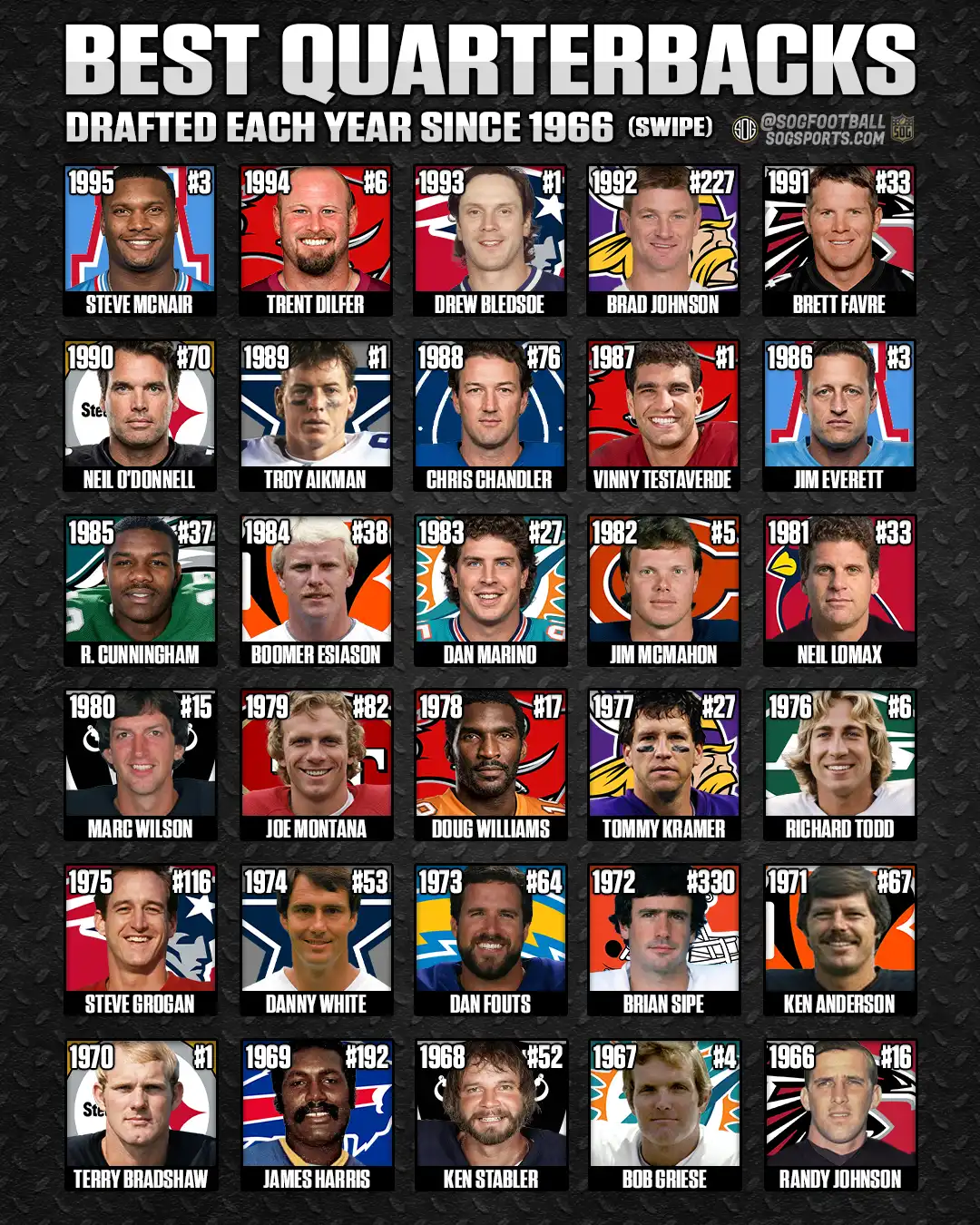
The best quarterback drafted in every NFL Draft class from 1966 through 1995.
1966 — Randy Johnson, Atlanta Falcons, #16
The 1966 quarterback class is not going to make anyone’s shortlist of memorable drafts. Johnson played eight seasons, started games for the Falcons and later the Giants, and was a functional if forgettable presence in a year that did not produce much quarterback talent. In a thin class, longevity carries the pick.
1967 — Bob Griese, Miami Dolphins, #4
Griese was the ideal quarterback for what Don Shula was building in Miami: methodical, poised, and rarely making the kind of mistake that costs you a game. He led the Dolphins to back-to-back Super Bowl titles, including the only perfect season in NFL history, and did it by making the offense work exactly the way it was supposed to. Easy winner.
1968 — Ken Stabler, Oakland Raiders, #52
Stabler slipping to the second round was the kind of draft mistake teams spend years trying to explain away. He won an MVP, won a Super Bowl, and played with the kind of creativity and edge that fit the Raiders perfectly. The 1968 class belongs to him without much debate.
1969 — James Harris, Buffalo Bills, #192
Harris was an eighth-round pick who became one of the first Black quarterbacks to establish himself as a legitimate NFL starter, which alone gives him real historical weight. His best years came with the Rams, where he made the Pro Bowl and helped lead Los Angeles deep into the postseason. In a weak class, he stands apart.
1970 — Terry Bradshaw, Pittsburgh Steelers, #1
Four Super Bowls. Two Super Bowl MVPs. The face of the Steelers dynasty. Bradshaw took some time to settle in, but once he did, he became exactly what a franchise hopes the first overall pick can become. No real argument needed.
1971 — Ken Anderson, Cincinnati Bengals, #67
Anderson remains one of the most underappreciated quarterbacks in NFL history. He won league MVP in 1981, made four Pro Bowls, and led Cincinnati to a Super Bowl. For a third-round pick, the Bengals got a franchise quarterback and then some.
1972 — Brian Sipe, Cleveland Browns, #330
The final round of the 1972 draft produced an NFL MVP. Sipe spent years developing before exploding in 1980 with the Kardiac Kids, throwing for over 4,100 yards and 30 touchdowns on his way to the league’s top individual award. The career was not spotless, but the peak was too strong to ignore.
1973 — Dan Fouts, San Diego Chargers, #64
Fouts did not just thrive in Air Coryell. He helped define what a high-level passing offense could look like. Three straight 4,000-yard seasons at a time when that number felt unreachable, six Pro Bowls, and a Hall of Fame résumé make him the easy choice from 1973.
1974 — Danny White, Dallas Cowboys, #53
White spent years in Roger Staubach’s shadow before finally getting his turn, and once he did, he helped lead Dallas to three straight NFC Championship Games. He never reached a Super Bowl, which has probably hurt how he is remembered, but in a weak quarterback year, his overall body of work holds up well.
1975 — Steve Grogan, New England Patriots, #116
Grogan was a fifth-round pick who gave New England 16 seasons and helped lead the Patriots to Super Bowl XX. He was never elite, but toughness, durability, and long-term value matter, especially in a class that did not produce a stronger answer.
1976 — Richard Todd, New York Jets, #6
Todd made the Pro Bowl in 1981 and helped lead the Jets on a real playoff run. He could be erratic and the turnovers never fully went away, but in a draft year that produced no truly high-level quarterback, he still ends up as the best option available.
1977 — Tommy Kramer, Minnesota Vikings, #27
Kramer spent 13 seasons with the Vikings, made two Pro Bowls, and had a long stretch as a credible NFL starter. He was never a superstar, but he did enough over time to separate himself in a class that did not offer much.
1978 — Doug Williams, Tampa Bay Buccaneers, #17
Williams played for Tampa Bay before eventually making history with Washington, where he became the first Black quarterback to start and win a Super Bowl. His explosion in Super Bowl XXII remains one of the greatest single-game performances a quarterback has ever had on that stage. That carries the class.
1979 — Joe Montana, San Francisco 49ers, #82
Third round. Four Super Bowl titles. Three Super Bowl MVPs. Two league MVPs. Montana has a legitimate case as the greatest quarterback ever, and San Francisco got him with the 82nd pick. One of the easiest selections in the article.
1980 — Marc Wilson, Oakland Raiders, #15
There is no great answer in the 1980 class, and Wilson is where the search ends more than where it confidently lands. He was mostly a backup and never became the type of quarterback teams want from a first-round investment. In a genuinely weak year, that still ends up being enough.
1981 — Neil Lomax, St. Louis Cardinals, #33
Lomax looked like he had a chance to become a long-term star, putting up big numbers for the era and making two Pro Bowls before a degenerative hip condition cut the career short. Even with the shortened run, his peak was the best the class produced.
1982 — Jim McMahon, Chicago Bears, #5
McMahon was the perfect quarterback for the 1985 Bears: tough, brash, and completely unfazed by the stage. Injuries kept him from building a stronger long-term résumé, but the ring and the role he played on one of the most famous teams in NFL history give him the nod.
1983 — Dan Marino, Miami Dolphins, #27
The 1983 class is the gold standard for quarterback drafts, and Marino still gets the pick even with John Elway and Jim Kelly in the same class. He was the most gifted pure passer of the bunch, shattered records, and changed what teams thought was possible through the air. The missing Super Bowl ring does not move him down here.
1984 — Boomer Esiason, Cincinnati Bengals, #38
Esiason won MVP, made four Pro Bowls, and led Cincinnati to a Super Bowl. He was one of the better quarterbacks of his era and the clear headliner of the 1984 class.
1985 — Randall Cunningham, Philadelphia Eagles, #37
Before the modern mobile quarterback became normal, Cunningham was doing things that looked unfair. He could launch it, improvise, escape, and create outside structure in a way almost nobody at the position was doing at the time. He was electric, and nobody else from this class is close.
1986 — Jim Everett, Houston Oilers, #3
Everett was drafted by Houston and quickly moved to the Rams, where he put together several strong seasons and looked like a real franchise piece for a while. The back half of the career fell off, but the peak was still good enough to top this class.
1987 — Vinny Testaverde, Tampa Bay Buccaneers, #1
Testaverde’s career was long, strange, and often uneven, but 21 seasons at quarterback is still an achievement. He bounced around, had better years later than people remember, and ultimately did more than anyone else in this class at the position.
1988 — Chris Chandler, Indianapolis Colts, #76
Chandler bounced around before finally finding his best stretch in Atlanta, where he helped lead the Falcons to a Super Bowl. In a thin class, the longevity and late-career payoff make him the strongest answer.
1989 — Troy Aikman, Dallas Cowboys, #1
Three Super Bowls in four years and a Hall of Fame career put Aikman on easy ground here. He was efficient, poised, and perfectly suited to run one of the great dynasties in league history.
1990 — Neil O’Donnell, Pittsburgh Steelers, #70
O’Donnell was not flashy, but he gave Pittsburgh credible starting play and helped lead the Steelers to a Super Bowl appearance. In one of the weaker quarterback classes of the era, that is enough.
1991 — Brett Favre, Atlanta Falcons, #33
Favre barely played in Atlanta, got traded to Green Bay, and then became one of the defining quarterbacks of his generation. Three straight MVPs, a Super Bowl ring, and one of the most durable careers ever make this one obvious.
1992 — Brad Johnson, Minnesota Vikings, #227
Johnson was a ninth-round pick who eventually won a Super Bowl as Tampa Bay’s starter. In a class this thin, that is more than enough to carry the argument. Not glamorous, but correct.
1993 — Drew Bledsoe, New England Patriots, #1
Bledsoe did what you want from a first overall pick for most of the 1990s. He made four Pro Bowls, threw for a ton of yards, and helped lead New England to a Super Bowl. The Brady ending changed how he is remembered, but the full career still holds up.
1994 — Trent Dilfer, Tampa Bay Buccaneers, #6
The 1994 class did not produce a real star at quarterback, and Dilfer reflects that. He won a Super Bowl with Baltimore and had a long career, even if the overall résumé was defined more by inconsistency than sustained high-level play. Weak class, honest answer.
1995 — Steve McNair, Houston Oilers, #3
McNair played the position with a level of toughness that still stands out. He shared an MVP, led the Titans to a Super Bowl, and came within one yard of forcing overtime in one of the most famous finishes ever. He was a genuinely great quarterback and one of the stronger winners on this list.
Best Quarterbacks Drafted Each Year, 1996–2025
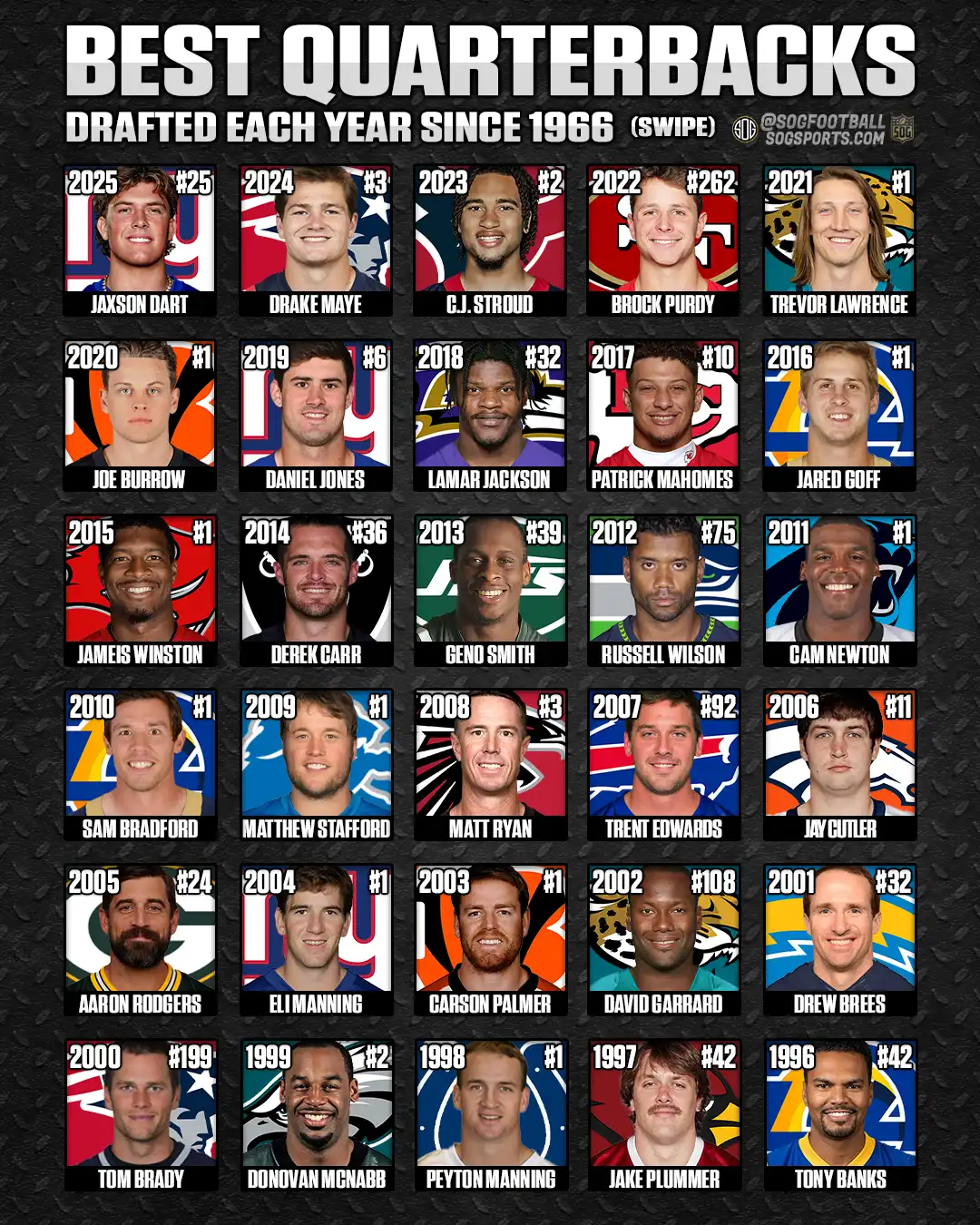
Our picks for the best quarterbacks drafted each year, featuring the modern era from 1996 to 2025.
1996 — Tony Banks, St. Louis Rams, #42
This is one of those years where the honest answer is not a satisfying one. Banks started games, had a few reasonable stretches, and ultimately did more than anyone else in a weak group. That is enough for 1996.
1997 — Jake Plummer, Arizona Cardinals, #42
Plummer never became a star, but he gave Arizona and later Denver legitimate starting quarterback play for a long time. Put the full career together, and he ends up as the best answer from this class.
1998 — Peyton Manning, Indianapolis Colts, #1
Five MVPs, two Super Bowl rings, and one of the sharpest football minds the position has ever seen. Manning changed the Colts, revived his career in Denver, and set the standard for what hitting on a first overall quarterback can look like. Easy winner.
1999 — Donovan McNabb, Philadelphia Eagles, #2
McNabb led the Eagles to four straight NFC Championship Games and a Super Bowl appearance while playing in one of the toughest media markets in sports. Six Pro Bowls and a long run of high-level play make him the clear choice from 1999.
2000 — Tom Brady, New England Patriots, #199
This is the easiest pick on the list. Seven Super Bowl rings, five Super Bowl MVPs, three league MVPs, and the most accomplished résumé in football history. Getting that player at #199 remains one of the wildest draft outcomes ever.
2001 — Drew Brees, San Diego Chargers, #32
Brees was passed over in the first round, suffered a major shoulder injury, and still went on to become one of the most prolific passers the game has seen. The New Orleans run alone makes this an easy call, and the full résumé only widens the gap.
2002 — David Garrard, Jacksonville Jaguars, #108
The 2002 class was bad at quarterback, and there is no point pretending otherwise. Garrard at least became a real starter, had a good run in Jacksonville, and won a playoff game. That is enough to take the year.
2003 — Carson Palmer, Cincinnati Bengals, #1
Palmer looked like a true franchise quarterback before a devastating knee injury changed the arc of his career. Even with that setback, he still gave the Bengals and later the Cardinals plenty of strong football over a long career. He is the best outcome from 2003.
2004 — Eli Manning, New York Giants, #1
Two Super Bowl MVPs against the dynasty that owned the era settle this one. Whatever debates exist around Eli’s regular-season consistency, the biggest moments are too strong to ignore.
2005 — Aaron Rodgers, Green Bay Packers, #24
Rodgers slid to #24, sat behind Favre, then turned into one of the best passers in league history. Four MVPs, a Super Bowl ring, and one of the highest peaks the position has seen make him the obvious answer.
2006 — Jay Cutler, Denver Broncos, #11
The 2006 class underdelivered badly, and Cutler ends up on top mostly because he had the longest stretch of meaningful starting play. He was talented, productive at times, and frustrating all at once, which fits the class perfectly.
2007 — Trent Edwards, Buffalo Bills, #92
The 2007 quarterback class was a train wreck, so this is less about crowning a real winner and more about identifying the least disappointing outcome. Edwards started games in Buffalo, flashed some competence early, and at least looked functional for stretches, which is more than can be said for most of the names around him. When the alternatives are JaMarcus Russell, Brady Quinn, Kevin Kolb, and John Beck, this is not exactly glowing praise, but Edwards is still the pick.
2008 — Matt Ryan, Atlanta Falcons, #3
Ryan was the model of the steady franchise quarterback for more than a decade. He won MVP, reached a Super Bowl, and gave Atlanta the kind of consistency most teams spend years chasing.
2009 — Matthew Stafford, Detroit Lions, #1
Stafford spent years carrying Detroit with little help, then finally got a real team around him in Los Angeles and immediately won a Super Bowl. The arm talent was always obvious. The ring just confirmed what a lot of people already believed.
2010 — Sam Bradford, St. Louis Rams, #1
Sam Bradford never became the franchise quarterback people imagined when he went first overall, but the 2010 class gives you very little to work with. He won Offensive Rookie of the Year, had real arm talent, and for a while looked like he might settle in as a long-term answer before injuries kept wrecking the arc of his career. This is one of those years where the best quarterback drafted is still a disappointing answer, and that says as much about the class as it does about Bradford.
2011 — Cam Newton, Carolina Panthers, #1
Newton was unlike anything the league had really seen at quarterback to that point. He won Rookie of the Year, won MVP, and carried Carolina to a Super Bowl while redefining what the position could look like physically. This is his class by a mile.
2012 — Russell Wilson, Seattle Seahawks, #75
Andrew Luck’s peak keeps this one interesting, but Wilson’s full career wins the argument. A Super Bowl ring, another Super Bowl appearance, and a long run of high-level play make him the better overall outcome from 2012.
2013 — Geno Smith, New York Jets, #39
The 2013 quarterback class was weak right out of the gate, and for a long time it looked like nobody from that group was going to build a meaningful career as a starter. Geno Smith changed that late. After struggling early with the Jets and spending years as a backup, he rebuilt his career in Seattle and turned himself into a legitimate starting quarterback well into his 30s. That second act gives him the edge in a class that never produced a true franchise centerpiece.
2014 — Derek Carr, Oakland Raiders, #36
Carr gave the Raiders something they badly needed: stability. He was never a true superstar, but he was a multiple-time Pro Bowler and long-term starter in a class that did not produce anything better.
2015 — Jameis Winston, Tampa Bay Buccaneers, #1
This is not a pretty quarterback class, and Winston gets the spot mostly because he flashed more upside than anyone else in it. He threw for over 5,000 yards in 2019, which at least gives him a statistical peak the rest of the class cannot match. The turnovers always came with it, which is why this class still feels underwhelming.
2016 — Jared Goff, Los Angeles Rams, #1
Goff has had one of the stranger arcs of any recent top pick. He reached a Super Bowl with the Rams, got discarded, then rebuilt his standing in Detroit and became a major part of the Lions’ resurgence. In the end, that full arc is enough to beat the rest of the class.
2017 — Patrick Mahomes, Kansas City Chiefs, #10
No debate. Mahomes is already one of the defining quarterbacks in NFL history, and he is still in the middle of his prime. Multiple MVPs, multiple Super Bowl titles, and a completely different standard for what the position looks like in the modern game make him the easy pick.
2018 — Lamar Jackson, Baltimore Ravens, #32
Jackson was the final pick of the first round and turned into one of the most dynamic players the position has ever seen. Two MVP awards and a completely unique style of play put him on clear ground here.
2019 — Daniel Jones, New York Giants, #6
The 2019 quarterback class never really gave us the star-level payoff people expected, which is what makes this one messy. Jones was inconsistent in New York and never fully locked down the Giants’ future, but his rebound in Indianapolis at least gave his résumé more weight than it had before. This is not a victory-lap pick so much as an acknowledgment that 2019 turned into a disappointing quarterback class, and Jones is the choice from a group that never truly delivered.
2020 — Joe Burrow, Cincinnati Bengals, #1
Burrow changed the Bengals almost overnight. He came back from a torn ACL, took Cincinnati to the Super Bowl in his second season, and quickly established himself as one of the best pure passers in football. This class is his.
2021 — Trevor Lawrence, Jacksonville Jaguars, #1
The 2021 group looked loaded at the time, but most of it underdelivered. Lawrence took a little time, but he still ended up as the best long-term quarterback bet from the class and the clearest franchise answer.
2022 — Brock Purdy, San Francisco 49ers, #262
Mr. Irrelevant becoming the best quarterback in his class is exactly why this kind of exercise is fun. Purdy stepped in, won, played well, and outperformed every quarterback drafted ahead of him. For now, 2022 belongs to him.
2023 — C.J. Stroud, Houston Texans, #2
Stroud hit the ground running, won Offensive Rookie of the Year, and led Houston to a playoff win almost immediately. Based on early returns, this is one of the cleaner recent-year selections.
2024 — Drake Maye, New England Patriots, #3
This is an early projection, not a settled historical call. Maye showed enough flashes to make the long-term case believable, especially when you factor in the tools that made him such a highly regarded prospect. The résumé is nowhere close to written yet, but for now he holds the strongest long-term case in the class.
2025 — Jaxson Dart, New York Giants, #25
There is no serious career argument to make here yet. Dart is simply the early placeholder based on current projection and expectation. That is all a 2025 entry can honestly be.
Full List of the Best Quarterback Drafted Each Year
1966 — Randy Johnson, Atlanta Falcons, #16
1967 — Bob Griese, Miami Dolphins, #4
1968 — Ken Stabler, Oakland Raiders, #52
1969 — James Harris, Buffalo Bills, #192
1970 — Terry Bradshaw, Pittsburgh Steelers, #1
1971 — Ken Anderson, Cincinnati Bengals, #67
1972 — Brian Sipe, Cleveland Browns, #330
1973 — Dan Fouts, San Diego Chargers, #64
1974 — Danny White, Dallas Cowboys, #53
1975 — Steve Grogan, New England Patriots, #116
1976 — Richard Todd, New York Jets, #6
1977 — Tommy Kramer, Minnesota Vikings, #27
1978 — Doug Williams, Tampa Bay Buccaneers, #17
1979 — Joe Montana, San Francisco 49ers, #82
1980 — Marc Wilson, Oakland Raiders, #15
1981 — Neil Lomax, St. Louis Cardinals, #33
1982 — Jim McMahon, Chicago Bears, #5
1983 — Dan Marino, Miami Dolphins, #27
1984 — Boomer Esiason, Cincinnati Bengals, #38
1985 — Randall Cunningham, Philadelphia Eagles, #37
1986 — Jim Everett, Houston Oilers, #3
1987 — Vinny Testaverde, Tampa Bay Buccaneers, #1
1988 — Chris Chandler, Indianapolis Colts, #76
1989 — Troy Aikman, Dallas Cowboys, #1
1990 — Neil O’Donnell, Pittsburgh Steelers, #70
1991 — Brett Favre, Atlanta Falcons, #33
1992 — Brad Johnson, Minnesota Vikings, #227
1993 — Drew Bledsoe, New England Patriots, #1
1994 — Trent Dilfer, Tampa Bay Buccaneers, #6
1995 — Steve McNair, Houston Oilers, #3
1996 — Tony Banks, St. Louis Rams, #42
1997 — Jake Plummer, Arizona Cardinals, #42
1998 — Peyton Manning, Indianapolis Colts, #1
1999 — Donovan McNabb, Philadelphia Eagles, #2
2000 — Tom Brady, New England Patriots, #199
2001 — Drew Brees, San Diego Chargers, #32
2002 — David Garrard, Jacksonville Jaguars, #108
2003 — Carson Palmer, Cincinnati Bengals, #1
2004 — Eli Manning, New York Giants, #1
2005 — Aaron Rodgers, Green Bay Packers, #24
2006 — Jay Cutler, Denver Broncos, #11
2007 — Trent Edwards, Buffalo Bills, #92
2008 — Matt Ryan, Atlanta Falcons, #3
2009 — Matthew Stafford, Detroit Lions, #1
2010 — Sam Bradford, St. Louis Rams, #1
2011 — Cam Newton, Carolina Panthers, #1
2012 — Russell Wilson, Seattle Seahawks, #75
2013 — Geno Smith, New York Jets, #39
2014 — Derek Carr, Oakland Raiders, #36
2015 — Jameis Winston, Tampa Bay Buccaneers, #1
2016 — Jared Goff, Los Angeles Rams, #1
2017 — Patrick Mahomes, Kansas City Chiefs, #10
2018 — Lamar Jackson, Baltimore Ravens, #32
2019 — Daniel Jones, New York Giants, #6
2020 — Joe Burrow, Cincinnati Bengals, #1
2021 — Trevor Lawrence, Jacksonville Jaguars, #1
2022 — Brock Purdy, San Francisco 49ers, #262
2023 — C.J. Stroud, Houston Texans, #2
2024 — Drake Maye, New England Patriots, #3
2025 — Jaxson Dart, New York Giants, #25
Final Thoughts on the Best Quarterbacks Drafted Each Year
Looking back at the best quarterback drafted each year since 1966 is a reminder of how uneven this process has always been. Some classes gave us no-doubt legends. Others barely produced a steady starter. That is part of what makes quarterback evaluation so fascinating in the first place.
What stands out most is how little draft slot guarantees anything. Some franchises got exactly what they hoped for from premium picks. Others found the right answer deep in the draft after the league passed on him multiple times. Montana at #82, Brady at #199, Wilson at #75, and Purdy at #262 all tell the same story: the right quarterback is worth everything, and teams do not always know where he is coming from.
That is why this exercise works so well year by year. It shows the swings, the misses, the rare all-time classes, and the thin ones that leave you with an unsatisfying answer. More than anything, it shows how one quarterback can change the direction of an entire franchise, which is why every new draft class still carries that kind of weight.
FAQ About the Best Quarterbacks Drafted by Year
What is the best NFL quarterback draft class in history?
The 1983 NFL Draft class is the easy answer. It produced Dan Marino, John Elway, and Jim Kelly, which is absurd quarterback talent from one class. Marino gets the nod here for this article, but the class as a whole is still the standard.
Who is the best quarterback ever drafted in the NFL?
Tom Brady is the most accomplished quarterback ever drafted. Seven Super Bowl rings, five Super Bowl MVPs, three league MVPs, and he did it after being taken #199 in the sixth round. Nobody else matches the résumé.
Why are recent quarterback draft classes harder to evaluate?
Because those careers are still unfolding. Early returns matter, but quarterbacks can break out late, decline quickly, or completely change their trajectory once they land in a better system. Recent classes should be treated as snapshots, not final verdicts.
Does draft position matter when judging the best quarterback from each class?
It matters for context, but not for the final answer. Draft slot tells you how a player was valued coming out of college. It does not determine what he becomes in the NFL, and quarterback history is full of examples that prove it.
Related NFL Draft History Articles
- Best Running Back Drafted Each Year Since 1966
- Best Wide Receiver Drafted Each Year Since 1966
- Best Tight End Drafted Each Year Since 1966
- Best Defensive Back Drafted Each Year Since 1966
Want more records and rankings like this?
📲 Follow @sogfootball on Instagram — daily debates and stat drops.
🔗 Browse all NFL Records and Tier Lists on the site here.
