The second pick is where the draft usually gets real. Once the first card is in, the team at No. 2 has to decide whether it is taking the next quarterback, the cleanest blue-chip player on the board, or the best fit for a roster that cannot afford another miss. That is why 2nd overall NFL draft picks have such a strange history: Hall of Famers, franchise changers, immediate busts, and a few careers that were derailed by injury or life off the field. The slot has never been safe, and that is exactly what makes it interesting.
Table of Contents
- Featured Graphic
- Year-by-Year List of 2nd Overall NFL Draft Picks
- Why the 2nd Overall Pick Matters
- Trends Among 2nd Overall NFL Draft Picks
- FAQ About 2nd Overall NFL Draft Picks
- Final Thoughts
Featured Graphic
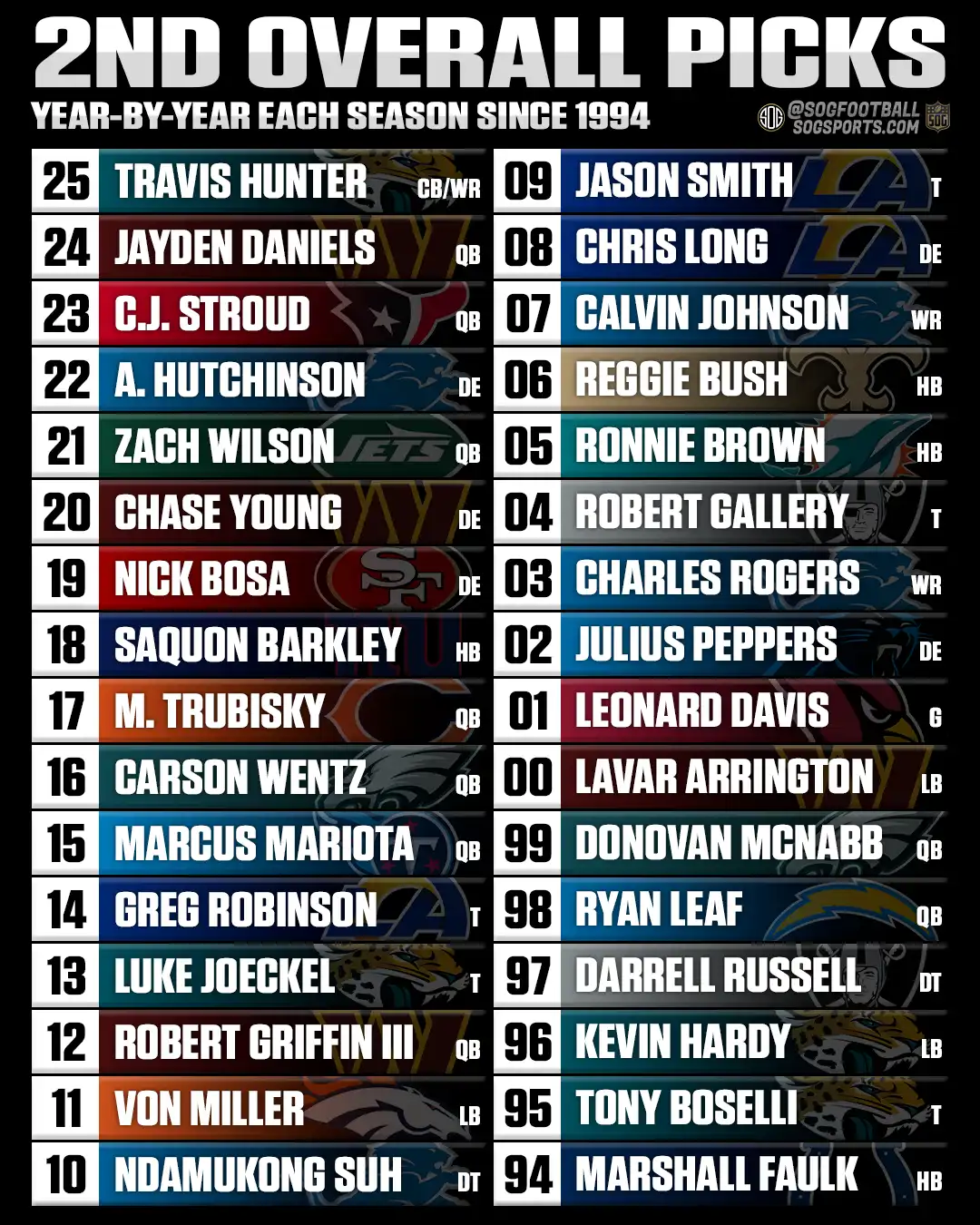
Year-by-year graphic showing every 2nd overall NFL Draft pick from 1994 through 2025
Year-by-Year List of 2nd Overall NFL Draft Picks
2025 — Travis Hunter, Jacksonville Jaguars, Cornerback/Wide Receiver
Hunter arrived as a genuine two-way outlier after winning the 2024 Heisman Trophy. Jacksonville traded up to No. 2 to get him, so this pick is already tied to a major organizational bet on a player expected to contribute on both offense and defense.
2024 — Jayden Daniels, Washington Commanders, Quarterback
Daniels won Offensive Rookie of the Year after throwing for 3,568 yards and 25 touchdowns while adding 891 rushing yards and six rushing scores. That kind of dual-threat rookie season is why Washington suddenly looks like it has a real answer at quarterback.
2023 — C.J. Stroud, Houston Texans, Quarterback
Stroud threw for 4,108 yards with a 23-5 TD-INT line as a rookie and won Offensive Rookie of the Year. Houston went from bottom-feeder to playoff winner fast, which is about the cleanest outcome possible for a No. 2 quarterback.
2022 — Aidan Hutchinson, Detroit Lions, Defensive End
Hutchinson followed a 9.5-sack rookie year with 11.5 sacks in 2023, then opened 2024 with 7.5 sacks in five games before suffering a broken tibia and fibula. Detroit took him to change the tone of its defense, and he already has.
2021 — Zach Wilson, New York Jets, Quarterback
Wilson never stabilized the job in New York, finishing his Jets run with 6,293 passing yards, 23 touchdown passes, and 25 interceptions. That pick left the franchise right back in the quarterback market a few years later.
2020 — Chase Young, Washington Commanders, Defensive End
Young won Defensive Rookie of the Year with 7.5 sacks and helped Washington reach the playoffs in his first season. A torn ACL in 2021 changed the trajectory, and the long-term payoff never matched the early excitement.
2019 — Nick Bosa, San Francisco 49ers, Defensive End
Bosa won Defensive Rookie of the Year, then led the league with 18.5 sacks in 2022 on the way to Defensive Player of the Year. San Francisco used the second pick on a pass rusher and got one of the league’s best.
2018 — Saquon Barkley, New York Giants, Running Back
Barkley won Offensive Rookie of the Year, then exploded for 2,005 rushing yards and the 2024 Offensive Player of the Year award later in his career. He has been productive enough to justify the talent argument, even if team-building debates around drafting a running back that high never fully went away.
2017 — Mitchell Trubisky, Chicago Bears, Quarterback
Trubisky made a Pro Bowl in 2018 after throwing 24 touchdown passes for a 12-4 Bears team. He also became one of the defining examples of how badly a team can damage itself by missing on a top-two quarterback, especially after Patrick Mahomes and Deshaun Watson went later in the same draft.
2016 — Carson Wentz, Philadelphia Eagles, Quarterback
Wentz threw 33 touchdown passes in 2017 before tearing his left ACL, and that season still sits at the center of his career story. Philadelphia eventually won the Super Bowl that year, but the post-injury version of Wentz never held the same level.
2015 — Marcus Mariota, Tennessee Titans, Quarterback
Mariota won the Heisman, then gave Tennessee stretches of real hope, including a 26-touchdown, 9-interception season in 2016. He also caught his own touchdown pass in a playoff win over Kansas City, which remains one of the weirdest and best moments of his career.
2014 — Greg Robinson, St. Louis Rams, Offensive Tackle
Robinson was drafted to become a franchise left tackle and did not come close to that standard. In 2020, he was arrested after authorities said they found 157 pounds of marijuana in a rented vehicle he was in.
2013 — Luke Joeckel, Jacksonville Jaguars, Offensive Tackle
Joeckel entered the league as the Outland Trophy winner, but Jacksonville never got long-term tackle play out of the pick. He started games at both tackle and guard, and the Jaguars still had the same offensive line problem when he left.
2012 — Robert Griffin III, Washington Commanders, Quarterback
Griffin’s rookie year was electric: 3,203 passing yards, 815 rushing yards, an NFC East title, and Offensive Rookie of the Year. The torn ACL and LCL he suffered in the playoff loss to Seattle changed the entire conversation around his career.
2011 — Von Miller, Denver Broncos, Linebacker
Miller became exactly what Denver hoped for: 138.5 career sacks, eight Pro Bowls, two Super Bowl rings, and Super Bowl 50 MVP. The second pick rarely turns into a cleaner franchise hit than this.
2010 — Ndamukong Suh, Detroit Lions, Defensive Tackle
Suh won Defensive Rookie of the Year and finished his career with 71.5 sacks, which is an enormous number for an interior lineman. Detroit got a dominant force, even if some of his biggest postseason moments came later with other teams.
2009 — Jason Smith, St. Louis Rams, Offensive Tackle
Smith played only 45 NFL games, which is nowhere near enough for a tackle taken second overall. The Rams needed a foundation piece and got a bust instead.
2008 — Chris Long, St. Louis Rams, Defensive End
Long posted 70 career sacks and later won Super Bowls with the Patriots and Eagles. He did not become a franchise savior for the Rams, but he had a real NFL career and stayed useful for a long time.
2007 — Calvin Johnson, Detroit Lions, Wide Receiver
Johnson finished with 11,619 receiving yards, set the single-season record with 1,964 in 2012, and went straight to the Hall of Fame. Detroit drafted a monster receiver and got exactly that.
2006 — Reggie Bush, New Orleans Saints, Running Back
Bush finished with 9,088 yards from scrimmage and was a key piece of the Saints team that won Super Bowl XLIV. He never became the every-down superstar some expected at No. 2, but he was far from a throwaway pick.
2005 — Ronnie Brown, Miami Dolphins, Running Back
Brown ran for 5,391 yards in his career and made one Pro Bowl, but he is remembered most for being a central part of Miami’s Wildcat package in 2008. That season helped the Dolphins win the AFC East after a 1-15 year.
2004 — Robert Gallery, Oakland Raiders, Offensive Tackle
Gallery was supposed to lock down left tackle for a decade, but he eventually moved inside to guard to salvage the career. He became a solid NFL lineman, just not the blind-side cornerstone the Raiders paid for.
2003 — Charles Rogers, Detroit Lions, Wide Receiver
Rogers finished with just 36 catches for 440 yards after breaking a collarbone in each of his first two seasons. He died of liver failure in 2019 at age 38.
2002 — Julius Peppers, Carolina Panthers, Defensive End
Peppers piled up 159.5 sacks and sailed into the Hall of Fame. Carolina used the second pick on a defensive end and got one of the best edge rushers the league has seen.
2001 — Leonard Davis, Arizona Cardinals, Guard
Davis never solved Arizona’s tackle problem, but the move inside extended his value and led to three Pro Bowls. That made him a better player than his early years suggested, though the pick still fell short of the original plan.
2000 — LaVar Arrington, Washington Commanders, Linebacker
Arrington made three Pro Bowls and posted 23.5 sacks in an off-ball linebacker role. Washington got splash plays and star power, but not the long-term defensive anchor it wanted from No. 2.
1999 — Donovan McNabb, Philadelphia Eagles, Quarterback
McNabb threw for 37,276 yards, made six Pro Bowls, and led Philadelphia to five NFC title game appearances and one Super Bowl. Andy Reid and the Eagles built a contender around this pick.
1998 — Ryan Leaf, San Diego Chargers, Quarterback
Leaf threw for 3,666 yards with 14 touchdown passes in a career that collapsed almost immediately, making him one of the most famous busts in draft history. In 2012, he pleaded guilty to burglary and drug possession charges in Montana.
1997 — Darrell Russell, Oakland Raiders, Defensive Tackle
Russell made two Pro Bowls and was a first-team All-Pro, but repeated substance-abuse suspensions wrecked the middle of his career. He died in a car crash in 2005 at age 29.
1996 — Kevin Hardy, Jacksonville Jaguars, Linebacker
Hardy made the Pro Bowl in 1999 and gave Jacksonville a useful front-seven player during the franchise’s early competitive years. That is a respectable return for an expansion team trying to build a defense fast.
1995 — Tony Boselli, Jacksonville Jaguars, Offensive Tackle
Boselli was the Jaguars’ first-ever draft pick, then turned into five Pro Bowls, three first-team All-Pro selections, and a Hall of Fame career. That is how an expansion franchise gets serious in a hurry.
1994 — Marshall Faulk, Indianapolis Colts, Running Back
Faulk finished with 12,279 rushing yards and 19,154 yards from scrimmage, won an MVP, and made the Hall of Fame. The Colts drafted a star, even if his peak came later with the Rams.
1993 — Rick Mirer, Seattle Seahawks, Quarterback
Mirer set rookie records for attempts, completions, and passing yards in 1993, throwing for 2,833 yards that season. Seattle still did not find its quarterback answer, which is why the pick is remembered more for the drop-off than the start.
1992 — Quentin Coryatt, Indianapolis Colts, Linebacker
Coryatt made the PFWA All-Rookie Team and finished his career with 442 tackles and 8.5 sacks. He was a solid linebacker, but not the kind of difference-maker teams expect that high.
1991 — Eric Turner, Cleveland Browns, Defensive Back
Turner made two Pro Bowls and developed into one of the better safeties of the 1990s. He died of complications from abdominal cancer in 2000 at age 31.
1990 — Blair Thomas, New York Jets, Running Back
Injury problems buried this one early, and Thomas left the Jets with just 2,009 rushing yards and five rushing touchdowns. For a team picking second overall, that is a brutal result.
1989 — Tony Mandarich, Green Bay Packers, Offensive Tackle
Mandarich is one of the loudest busts the draft has ever produced, especially because he was taken in front of Barry Sanders, Derrick Thomas, and Deion Sanders. He later admitted steroid use in college and eventually rebuilt part of his career with Indianapolis.
1988 — Neil Smith, Kansas City Chiefs, Defensive End
Smith made six Pro Bowls and became one of the anchors of Kansas City’s best defenses of the 1990s. The Chiefs hit on a true franchise pass rusher here.
1987 — Cornelius Bennett, Indianapolis Colts, Linebacker
Bennett made five Pro Bowls and became one of the best linebackers of his era after a draft-day trade sent him to Buffalo. The Colts made the pick, but the Bills got the better part of the story.
1986 — Tony Casillas, Atlanta Falcons, Defensive Tackle
Casillas never turned into a star in Atlanta, but he later won Super Bowls with Dallas. That makes him a decent NFL player and a bad use of the second pick for the team that actually drafted him.
1985 — Bill Fralic, Atlanta Falcons, Guard
Fralic made four Pro Bowls and gave Atlanta a real front-line lineman. Guards do not usually go this high unless a team thinks it is getting a tone-setter, and Fralic at least delivered that part.
1984 — Dean Steinkuhler, Houston Oilers, Offensive Tackle
Steinkuhler played eight seasons with the Oilers and worked at both guard and tackle. That made him useful, but not the offensive line star expected from the second pick.
1983 — Eric Dickerson, Los Angeles Rams, Running Back
Dickerson ran for 2,105 yards in 1984, a record that still stands, and he is in the Hall of Fame. The Rams got one of the greatest backs ever at No. 2.
1982 — Johnie Cooks, Baltimore Colts, Linebacker
Cooks played 10 NFL seasons and finished with 32 sacks, which is strong production for an off-ball linebacker from that era. He never became a household name, but he absolutely had a real career.
1981 — Lawrence Taylor, New York Giants, Linebacker
Taylor changed defensive football, won league MVP in 1986, took two Super Bowls, and landed in the Hall of Fame. If you are ranking the best second overall picks ever, he is right at the top.
1980 — Lam Jones, New York Jets, Wide Receiver
Jones brought Olympic speed and finished his NFL career with 138 catches for 2,322 yards and 13 touchdowns. That was nowhere near enough for a receiver taken second overall.
1979 — Mike Bell, Kansas City Chiefs, Defensive End
Bell spent 12 seasons with Kansas City and finished with 52 sacks. That is much better than people remember when they talk about old top-five picks.
1978 — Art Still, Kansas City Chiefs, Defensive End
Still made four Pro Bowls and became one of the best defenders in franchise history. Kansas City went defensive line in back-to-back years and hit hard with this one.
1977 — Tony Dorsett, Dallas Cowboys, Running Back
Dorsett won a Super Bowl as a rookie and rushed for 12,739 yards on his way to the Hall of Fame. Dallas got instant offense and a long-term star.
1976 — Steve Niehaus, Seattle Seahawks, Defensive Tackle
Niehaus won NFC Defensive Rookie of the Year, so the start looked promising. He recorded 11 career sacks in five seasons before injuries ended his career at 26 — never building from that early promise into something sustained.
1975 — Randy White, Dallas Cowboys, Defensive Tackle
White became a Hall of Famer, a Super Bowl MVP, and a central piece of the Doomsday defense. This was a dynasty-level pick.
1974 — Bo Matthews, San Diego Chargers, Running Back
Matthews rushed for 1,566 yards and 11 touchdowns across six NFL seasons. That is roster-level production, not second-overall production, from a slot that demanded much more from a back.
1973 — Bert Jones, Baltimore Colts, Quarterback
Jones won the 1976 NFL MVP and made the Pro Bowl that same year, throwing for 3,104 yards and 24 touchdowns at his peak. Injuries shortened his window, but for a stretch he was one of the best quarterbacks in football.
1972 — Sherman White, Cincinnati Bengals, Defensive End
White played 12 seasons and finished with 63 sacks, which is serious production for that era. Cincinnati drafted a good player, even if his best years were spread across two franchises.
1971 — Archie Manning, New Orleans Saints, Quarterback
Manning made two Pro Bowls and threw for 23,911 career yards while spending most of his prime trying to carry weak Saints rosters. The talent was real, but the franchise around him was not.
1970 — Mike McCoy, Green Bay Packers, Defensive Tackle
McCoy played 132 NFL games over 11 seasons and recorded 34.5 sacks during an era when the stat was not officially tracked league-wide. He was a dependable starter, not the impact lineman that usually justifies the second pick.
1969 — George Kunz, Atlanta Falcons, Offensive Tackle
Kunz made eight Pro Bowls and was one of the best tackles of his generation. That is elite value from the second slot.
1968 — Bob Johnson, Cincinnati Bengals, Center
Johnson was the first draft pick in Bengals history, made the AFL All-Star team as a rookie, and had his number retired by the franchise. That is a foundational pick in every sense.
1967 — Clint Jones, Minnesota Vikings, Halfback
Jones rushed for 2,009 yards and 18 touchdowns over six seasons with Minnesota before finishing with San Diego. He was a useful piece on a contending team, but never close to a top-of-the-draft star.
1966 — Tom Mack, Los Angeles Rams, Guard
Mack made the Hall of Fame and gave the Rams 13 years of high-level line play. For a guard taken second overall, that is exactly what the pick needs to look like.
1965 — Ken Willard, San Francisco 49ers, Fullback
Willard made four Pro Bowls and became one of the better power backs of his time. San Francisco got a dependable offensive centerpiece out of this pick.
1964 — Bob Brown, Philadelphia Eagles, Offensive Tackle
Brown became a Hall of Fame tackle and one of the best linemen of the 1960s. This was a hit the minute you stack him against the rest of the decade.
1963 — Jerry Stovall, St. Louis Cardinals, Defensive Back
Stovall made three Pro Bowls and later became the Cardinals’ head coach. The franchise got a high-level player and a long-term football figure out of one selection.
1962 — Roman Gabriel, Los Angeles Rams, Quarterback
Gabriel won the 1969 NFL MVP, made four Pro Bowls, and threw for 29,444 career yards. For years, he was the Rams’ offense.
1961 — Norm Snead, Washington Commanders, Quarterback
Snead made four Pro Bowls and threw for 30,797 yards in a long NFL career. Washington did not build a winner around him, but the player himself was good enough.
1960 — George Izo, St. Louis Cardinals, Quarterback
Izo threw for 1,791 yards with 12 touchdowns and 32 interceptions in his NFL career. That is nowhere near what a team wants from the second pick at quarterback.
1959 — Dick Bass, Los Angeles Rams, Fullback
Bass made three Pro Bowls and gave the Rams a productive backfield piece. He also later became well known off the field as an actor, which made his name last longer than most players from that era.
1958 — John David Crow, Chicago Cardinals, Halfback
Crow entered the league as the 1957 Heisman Trophy winner and eventually became a three-time Pro Bowler. That made him one of the better second-overall backs of the pre-merger era.
1957 — Jon Arnett, Los Angeles Rams, Halfback
Arnett made five Pro Bowls and was one of the Rams’ best offensive players of the late 1950s and early 1960s. This was a major win for Los Angeles.
1956 — Earl Morrall, San Francisco 49ers, Quarterback
Morrall later won the 1968 NFL MVP and was part of three Super Bowl-winning teams. San Francisco did not get the best stretch of his career, but this was still a strong player.
1955 — Max Boydston, Chicago Cardinals, End
Boydston finished with 97 catches, 1,328 receiving yards, and eight touchdowns across the NFL and AFL. That is a respectable pro career, though not a game-changing one.
1954 — Lamar McHan, Chicago Cardinals, Quarterback
McHan lasted 10 pro seasons and threw for 9,449 yards, which gave this pick more staying power than a lot of quarterbacks from the 1950s. It still was not top-of-the-draft quarterback play.
1953 — Billy Vessels, Baltimore Colts, Halfback
Vessels came in with a Heisman Trophy and real hype after Oklahoma. His NFL career was fine, but it never reached the level of the college résumé.
1952 — Les Richter, New York Yanks, Linebacker
Richter became a Hall of Fame linebacker and one of the best two-way players of his era. The Yanks folded before he played for them, but the player absolutely justified the slot.
1951 — Bob Williams, Chicago Bears, Quarterback
Williams played 25 NFL games with the Bears before leaving professional football to pursue a medical career, eventually becoming a physician. That is one of the more unusual exits for a second overall quarterback.
1950 — Adrian Burk, Baltimore Colts, Quarterback
Burk made two Pro Bowls and later threw seven touchdown passes in a single game, which was an NFL record at the time. He gave Baltimore real value under center.
1949 — John Rauch, Detroit Lions, Quarterback
Rauch threw for 959 yards as an NFL player, then later coached the Raiders to an AFL championship and a Super Bowl appearance. His post-playing career ended up being the bigger story.
1948 — Skip Minisi, New York Giants, Halfback
Minisi played one NFL season, then retired to attend law school and became a successful attorney. That made him one of the shortest-lived second overall careers in league history.
1947 — Glenn Davis, Detroit Lions, Halfback
Davis had to complete his Army service before turning pro and never played a game for Detroit. He eventually joined the Rams in 1950 and made the Pro Bowl that year, so the football ability was real — the Lions just never saw it.
1946 — Dub Jones, Chicago Cardinals, Halfback
Jones won two AAFC titles and three NFL championships, which is a huge team résumé for any back from that era. He turned into a better pro than many people realize.
1945 — Paul Duhart, Pittsburgh Steelers, Quarterback/Halfback
Duhart appeared in only 13 NFL games, with seven starts, before injuries ended the run early. That is another reminder of how unstable draft outcomes were in the 1940s.
1944 — Pat Harder, Chicago Cardinals, Fullback
Harder became a three-time first-team All-Pro, which is exactly the kind of return a top-two pick is supposed to deliver. Chicago got a real star.
1943 — Joe Muha, Philadelphia Eagles, Fullback
Muha became a two-time All-Pro and gave Philadelphia strong two-way value in the 1940s. For a wartime-era draft pick, that is substantial production.
1942 — Jack Wilson, Cleveland Rams, Halfback
Wilson appeared in only 10 NFL games and made just three starts. Cleveland spent the second pick on a back who never became part of a long-term core.
1941 — John Kimbrough, Chicago Cardinals, Fullback
Kimbrough entered the league as a College Football Hall of Famer, but his NFL career lasted only four seasons. The name carried more weight than the pro production.
1940 — George McAfee, Philadelphia Eagles, Halfback
McAfee became a Hall of Famer and one of the great multipurpose backs of his time. Philadelphia picked a star, even though his best years came after a military-service interruption.
1939 — Sid Luckman, Chicago Bears, Quarterback
Luckman became a Hall of Famer, won four NFL titles, and changed the quarterback position in the T formation. This is one of the best second-overall picks ever made.
1938 — Jim McDonald, Philadelphia Eagles, Halfback
McDonald never played for the Eagles and managed only 80 career rushing yards over two seasons with Detroit. This one went sideways almost immediately.
1937 — Ed Goddard, Brooklyn Dodgers, Quarterback/Halfback
Goddard made the 1938 Pro Bowl and at least gave Brooklyn a real NFL contributor. That alone mattered in an era when top picks were far less predictable than they are now.
1936 — Riley Smith, Boston Redskins, Quarterback
Smith became the first player from the inaugural NFL draft to actually play in the league after No. 1 pick Jay Berwanger never signed. He later started for the Redskins in the 1936 NFL Championship Game.
Why the 2nd Overall Pick Matters
The second pick matters because it usually forces a franchise to reveal what it really thinks it is missing. If No. 1 is a quarterback, No. 2 often becomes a test of whether the next team reaches for the second passer or stays patient and takes the best non-quarterback in the class.
That decision has real consequences. Miss on a quarterback here and a front office can lose years. Hit on a pass rusher, tackle, or skill player and the roster starts making sense fast because the second pick is still premium territory with a cheaper contract path than veteran star shopping.
It also creates pressure in a different way than No. 1. Teams at No. 2 do not get to say the board fell strangely — they usually have multiple clean options and get judged for the one they choose to ignore.
Trends Among 2nd Overall NFL Draft Picks
- Quarterbacks lead the board. Through 2025, 24 of the 90 second overall picks have been quarterbacks. That is 26.7 percent of the slot’s entire history, and the concentration is even higher in the modern era.
- The Hall of Fame hit rate is lower than people think. Thirteen second overall picks have reached Canton, which works out to 14.4 percent through 2025. The No. 1 pick gets more attention, but the gap in elite outcomes between the two slots is not as wide as the spotlight suggests.
- The slot used to belong to backs. Nineteen running backs or halfbacks have gone second overall, but none have gone there since Saquon Barkley in 2018. The position’s declining draft value has effectively closed off the top two picks to traditional runners.
- True wide receivers are rare here. Calvin Johnson, Charles Rogers, and Lam Jones are the only pure wide receivers taken second overall. Travis Hunter landed there as a two-way cornerback and wide receiver, which makes the position grouping genuinely one of a kind.
FAQ About 2nd Overall NFL Draft Picks
Who was the first 2nd overall pick in NFL Draft history?
Riley Smith was the first second overall pick in 1936. He also became the first player from that inaugural NFL draft to actually play in the league after No. 1 pick Jay Berwanger never signed.
How many 2nd overall NFL draft picks have made the Hall of Fame?
Thirteen of the 90 second overall picks through 2025 have reached the Pro Football Hall of Fame. That puts the Hall of Fame rate for the slot at about 14.4 percent — meaning roughly six out of every seven teams that pick second overall do not get a Canton-level player out of it.
Which position is selected 2nd overall most often?
Quarterback leads the way with 24 selections through 2025. That is 26.7 percent of the entire history of the No. 2 slot, which tells you how often teams use this pick trying to solve the biggest problem in sports.
Which franchises have held the 2nd overall pick the most?
The Rams and Cardinals franchises are tied for the most second overall picks with nine each. That count includes their full city history, so it folds together Cleveland, St. Louis, and Los Angeles for the Rams, and Chicago, St. Louis, and Arizona for the Cardinals.
Has the 2nd overall pick been better for quarterbacks or non-quarterbacks?
Non-quarterbacks have produced the stronger top-end outcomes. Lawrence Taylor, Eric Dickerson, Marshall Faulk, Tony Boselli, Julius Peppers, Calvin Johnson, and Von Miller all became franchise-shaping players. The quarterback history at No. 2 is far more uneven, with Sid Luckman, Donovan McNabb, C.J. Stroud, and Jayden Daniels as the clearest hits against a much longer list of misses.
Who are the best 2nd overall NFL draft picks ever?
Lawrence Taylor belongs on the short list immediately, and so do Marshall Faulk, Eric Dickerson, Julius Peppers, Calvin Johnson, Tony Dorsett, Randy White, and Sid Luckman. That group gives the slot real star power, even if the miss rate across the full 90-pick history is still high.
Final Thoughts
The history of the second overall NFL Draft pick is really a record of organizational honesty. The teams that got it right — Dallas with Lawrence Taylor one pick away, Denver with Von Miller, Carolina with Julius Peppers — knew what they needed and took it. The teams that got it wrong often talked themselves into a quarterback or a position that fit a narrative more than a roster.
The 2026 NFL Draft will add a new name to this list in April, and the same questions will apply. Who does the team at No. 2 think they are? Do they trust the board or do they reach? The slot has produced Hall of Famers and all-time busts in roughly equal proportion, and nothing about that pattern suggests it is changing anytime soon.
That tension is what keeps the second pick almost as interesting as the first. No. 1 gets the press conference. No. 2 is usually where the real argument starts.
