All 1st Overall NFL Draft Picks in NFL History
The first overall pick is the most scrutinized decision in professional football. It defines front offices, ends coaching careers, and either rescues struggling franchises or deepens their rebuilds. The featured graphic below covers the modern era from 1994 to 2025. The full list below goes year by year through every No. 1 overall pick since the first NFL Draft in 1936 — the hits, the Hall of Famers, and the ones that still sting.
Table of Contents
- Featured Graphic
- Year-by-Year List of 1st Overall NFL Draft Picks
- Why the 1st Overall Pick Matters
- Trends Among 1st Overall NFL Draft Picks
- FAQ About 1st Overall NFL Draft Picks
- Final Thoughts
Featured Graphic
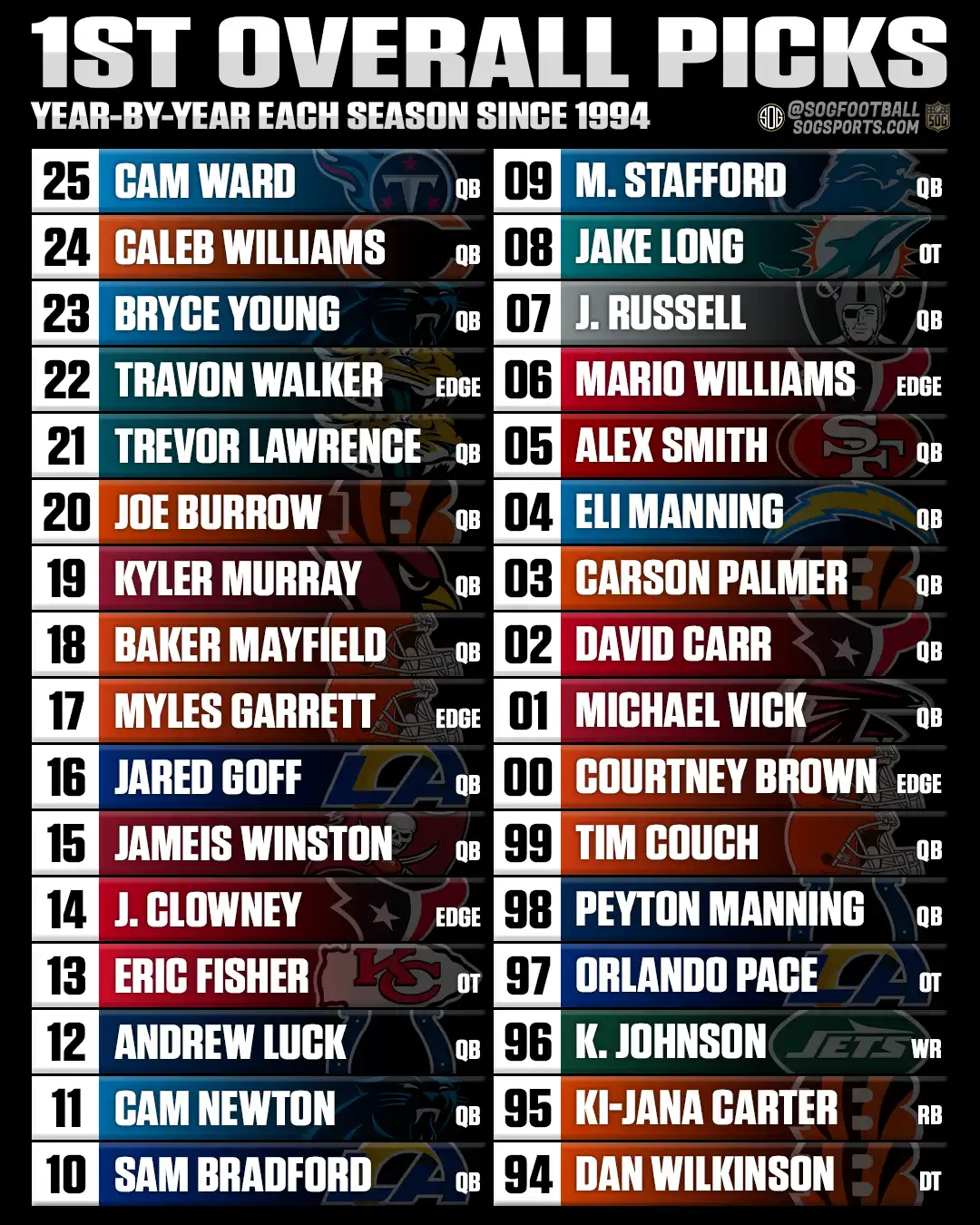
Year-by-year graphic showing every 1st overall NFL Draft pick from 1994 through 2025
The graphic highlights the modern era from Dan Wilkinson in 1994 through Cam Ward in 2025. The full list below goes back to the first NFL Draft in 1936.
Year-by-Year List of 1st Overall NFL Draft Picks
2025 — Cam Ward, Tennessee Titans, Quarterback
Ward became the latest quarterback to go first overall, giving Tennessee a franchise reset at the position. His arm talent and playmaking ability outside of structure made him the consensus top pick in the class.
2024 — Caleb Williams, Chicago Bears, Quarterback
Williams arrived in Chicago with a Heisman Trophy and one of the most complete quarterback skill sets of the decade. The tools that made him the No. 1 pick are obvious — the rest of the evaluation is still playing out.
2023 — Bryce Young, Carolina Panthers, Quarterback
Young threw for 2,877 yards with 11 touchdowns as a rookie in an offense that gave him almost nothing to work with. His early NFL story has been shaped as much by Carolina’s supporting cast failures as by anything he did wrong.
2022 — Travon Walker, Jacksonville Jaguars, Edge Rusher
Walker posted just 9.5 sacks in his first three NFL seasons, which is the main reason he remains one of the more debated recent top picks. Jacksonville bet on his size and athleticism ceiling at 6-foot-5, 272 pounds rather than his college production, and that bet has yet to pay off.
2021 — Trevor Lawrence, Jacksonville Jaguars, Quarterback
Lawrence was viewed as a generational quarterback prospect long before he entered the draft, and he backed it up. His breakout 2022 season — 4,113 yards, 25 touchdowns — helped Jacksonville win the AFC South and a playoff game.
2020 — Joe Burrow, Cincinnati Bengals, Quarterback
Burrow changed Cincinnati’s direction faster than almost anyone expected, taking the Bengals from rebuild mode to Super Bowl LVI in just his second healthy season. He threw for 4,611 yards in 2021 and has looked like exactly the kind of quarterback franchises hope to find at No. 1.
2019 — Kyler Murray, Arizona Cardinals, Quarterback
Murray won Offensive Rookie of the Year and gave Arizona immediate explosiveness at quarterback, throwing for 3,722 yards with 20 touchdowns as a rookie. His selection also marked back-to-back No. 1 picks out of Oklahoma following Baker Mayfield in 2018.
2018 — Baker Mayfield, Cleveland Browns, Quarterback
Mayfield helped snap Cleveland’s long playoff drought and brought real momentum to a franchise that badly needed it. His career has taken several turns since, but he will always be connected to the moment the Browns stopped being a punchline.
2017 — Myles Garrett, Cleveland Browns, Edge Rusher
Garrett became one of the cleanest hits any team has made with the first pick in recent memory. He has recorded 100-plus career sacks, made multiple All-Pro teams, and is the face of Cleveland’s defense.
2016 — Jared Goff, Los Angeles Rams, Quarterback
Goff’s career arc has defied the usual narratives. He went from rocky rookie to Super Bowl starter to trade chip, then rebuilt himself into one of Detroit’s most productive passers. Few No. 1 picks have outlasted as many early write-offs.
2015 — Jameis Winston, Tampa Bay Buccaneers, Quarterback
Winston threw for over 19,000 yards in five seasons with Tampa Bay and made the Pro Bowl in 2019. The talent was always real; the consistency and off-field issues were what kept the career from matching the billing.
2014 — Jadeveon Clowney, Houston Texans, Edge Rusher
Clowney recorded 59 career sacks and made three Pro Bowls, which is a reasonable return on a first overall pick. A torn meniscus in his rookie year cost him most of his first season and changed the early trajectory of what looked like a dominant career.
2013 — Eric Fisher, Kansas City Chiefs, Offensive Tackle
Fisher was not a flashy first overall pick, but he became a long-term starter and was on the offensive line that helped protect Patrick Mahomes on a Super Bowl-winning team. That is what teams actually need from that position.
2012 — Andrew Luck, Indianapolis Colts, Quarterback
Luck threw for 23,671 yards and 171 touchdowns in seven seasons and led Indianapolis to the playoffs in three of his first four years. His early retirement at 29 is still one of the biggest what-ifs attached to any pick on this list.
2011 — Cam Newton, Carolina Panthers, Quarterback
Newton won Offensive Rookie of the Year, the league MVP in 2015, and took Carolina to Super Bowl 50 with a 15-1 regular season record. At his peak, he was one of the most unique quarterback problems defenses had ever faced.
2010 — Sam Bradford, St. Louis Rams, Quarterback
Bradford won Offensive Rookie of the Year and showed the accuracy that made him a coveted prospect. A torn ACL in 2013 and another in 2014 effectively ended any chance of the career that looked possible early on.
2009 — Matthew Stafford, Detroit Lions, Quarterback
Stafford spent twelve years in Detroit, throwing for 45,109 yards — the most ever by any quarterback for a single franchise — before eventually winning Super Bowl LVI with the Rams. His arm talent was never the question.
2008 — Jake Long, Miami Dolphins, Offensive Tackle
Long made four straight Pro Bowls to open his career, which is exactly the kind of immediate payoff a team wants from a first overall offensive lineman. Injuries limited him after that, but the early return was real.
2007 — JaMarcus Russell, Oakland Raiders, Quarterback
Russell is still the first name that comes up in draft bust conversations, and for good reason. He threw 23 touchdowns against 23 interceptions in three seasons and was out of the league by age 24. The size and arm were there; the rest was not.
2006 — Mario Williams, Houston Texans, Edge Rusher
Williams was the surprise choice over Reggie Bush, which made the pick divisive on draft night. He answered with 100 career sacks, multiple Pro Bowls, and a production record that made Houston look right over time.
2005 — Alex Smith, San Francisco 49ers, Quarterback
Smith took years to find stability behind poor coaching and a revolving offensive door in San Francisco. He eventually rebuilt himself into a winning quarterback and respected leader, finishing with 35,650 career passing yards.
2004 — Eli Manning, San Diego Chargers, Quarterback
Manning was drafted by San Diego before the famous trade to New York, which is how the pick is officially recorded. He won two Super Bowls and two Super Bowl MVP awards with the Giants and is a Hall of Famer.
2003 — Carson Palmer, Cincinnati Bengals, Quarterback
Palmer threw for 46,247 career yards and made three Pro Bowls in a career that had genuine star stretches. A brutal knee injury on a playoff run in January 2006 changed the direction of what had been a fast ascent in Cincinnati.
2002 — David Carr, Houston Texans, Quarterback
Carr was sacked 76 times as a rookie — still the single-season NFL record — behind an expansion offensive line that gave him no chance. He is one of the clearest examples of how a bad environment can permanently damage a talented quarterback.
2001 — Michael Vick, Atlanta Falcons, Quarterback
Vick redefined what a quarterback could do with his legs, rushing for 6,109 career yards and making four Pro Bowls. His career was interrupted by a federal conviction for dogfighting and an 18-month prison sentence, and it never reached the peak it looked capable of before that point.
2000 — Courtney Brown, Cleveland Browns, Edge Rusher
Brown recorded just 17.5 sacks in six NFL seasons, well short of what a first overall pick needs to produce. Injuries were a major factor, but the career never came close to what Cleveland hoped it was getting.
1999 — Tim Couch, Cleveland Browns, Quarterback
Couch became the face of the Browns’ reboot and was sacked 166 times in five seasons behind one of the league’s worst offensive lines. Constant pressure and a thin roster made it nearly impossible to know what he could have become.
1998 — Peyton Manning, Indianapolis Colts, Quarterback
Manning is the gold standard for No. 1 picks. Five MVPs, two Super Bowl titles, 71,940 career passing yards, and a Hall of Fame career make him one of the best draft decisions any franchise has ever made.
1997 — Orlando Pace, St. Louis Rams, Offensive Tackle
Pace became a cornerstone left tackle, a Hall of Famer, and a key piece of the Rams’ Super Bowl-winning “Greatest Show on Turf” era. He is the best offensive lineman ever taken first overall.
1996 — Keyshawn Johnson, New York Jets, Wide Receiver
Johnson caught 814 passes for 10,571 yards and made three Pro Bowls. He also won a Super Bowl with Tampa Bay, giving him a career that delivered on a premium draft slot at a premium position.
1995 — Ki-Jana Carter, Cincinnati Bengals, Running Back
Carter tore his ACL in his first preseason carry as a professional and never recovered his pre-draft level. He is one of the starkest reminders on this list of how quickly a projection can collapse.
1994 — Dan Wilkinson, Cincinnati Bengals, Defensive Tackle
Wilkinson had a long 13-year NFL career and was a legitimate interior presence. He never became the franchise-altering force usually expected from a first overall defensive tackle, but he was a productive starter for a long time.
1993 — Drew Bledsoe, New England Patriots, Quarterback
Bledsoe threw for 29,657 yards in New England, made the Pro Bowl four times, and took the franchise to a Super Bowl. He was a genuine success story, even if history remembers what happened after Tom Brady took his spot.
1992 — Steve Emtman, Indianapolis Colts, Edge Rusher
Emtman had the tape and the physical profile to be a dominant pro defender coming out of Washington. Serious knee injuries in his first two seasons ended that possibility before it could develop.
1991 — Russell Maryland, Dallas Cowboys, Defensive Tackle
Maryland was not a headline-grabbing first pick, but he became a useful starter on a Dallas team that won three Super Bowls in four years. A good player on the right roster still matters.
1990 — Jeff George, Indianapolis Colts, Quarterback
George had one of the strongest arms of his generation and stayed in the league for 12 seasons. He never became the franchise quarterback his draft position demanded, but teams kept finding uses for that arm.
1989 — Troy Aikman, Dallas Cowboys, Quarterback
Aikman became a Hall of Famer, a three-time Super Bowl champion, and the face of the Cowboys dynasty. Few No. 1 picks have ever produced a cleaner outcome than this one.
1988 — Aundray Bruce, Atlanta Falcons, Linebacker
Bruce recorded just 16 sacks over nine seasons, which falls well short of what a first overall edge pick usually needs to deliver. Atlanta hoped it was getting a franchise defender and did not get one.
1987 — Vinny Testaverde, Tampa Bay Buccaneers, Quarterback
Testaverde threw for 46,233 career yards and made two Pro Bowls, which is a better career than his early reputation suggested. He was not the franchise savior Tampa Bay needed, but he lasted 21 seasons and found success elsewhere.
1986 — Bo Jackson, Tampa Bay Buccaneers, Running Back
Jackson refused to play for Tampa Bay and played baseball instead, which makes this one of the strangest picks in draft history. He eventually became a sports icon on his own terms in Oakland — just never as anyone’s franchise running back.
1985 — Bruce Smith, Buffalo Bills, Edge Rusher
Smith is the NFL’s all-time leader with 200 career sacks and a Hall of Famer. He is the best defensive first overall pick in league history and belongs in any conversation about the best picks overall.
1984 — Irving Fryar, New England Patriots, Wide Receiver
Fryar caught 851 passes for 12,785 yards and made five Pro Bowls in a career that aged much better than the early criticism around him. He was the first wide receiver ever taken first overall.
1983 — John Elway, Baltimore Colts, Quarterback
Like Eli Manning two decades later, Elway’s story included a franchise he refused to play for. Once he reached Denver, he became a league MVP, a two-time Super Bowl champion, and a Hall of Famer.
1982 — Kenneth Sims, New England Patriots, Edge Rusher
Sims had the profile of a dominant interior pass rusher coming out of Texas but recorded only 22 sacks in seven seasons. Injuries were a consistent factor and kept him from becoming the force New England expected.
1981 — George Rogers, New Orleans Saints, Running Back
Rogers won Offensive Rookie of the Year and rushed for 1,674 yards in his first season, immediately justifying his draft position. His prime was shorter than expected, but that first season was as good as advertised.
1980 — Billy Sims, Detroit Lions, Running Back
Sims won Offensive Rookie of the Year and rushed for 5,106 yards before a 1984 knee injury ended his career at 27. The four seasons he played were electric; the what-if is a real one.
1979 — Tom Cousineau, Buffalo Bills, Linebacker
Cousineau chose to play in Canada rather than sign with Buffalo, then spent most of his NFL career elsewhere. He never became the impact player the first overall slot implied.
1978 — Earl Campbell, Houston Oilers, Running Back
Campbell won Offensive Rookie of the Year, three rushing titles, and an MVP award, rushing for 9,407 career yards. He was one of the most punishing runners the league has ever seen and a first-ballot Hall of Famer.
1977 — Ricky Bell, Tampa Bay Buccaneers, Running Back
Bell brought real talent to an expansion Tampa Bay team and became one of the better stories of that era. He died in 1984 at age 29 from a rare heart disease, cutting short both his football career and his life.
1976 — Lee Roy Selmon, Tampa Bay Buccaneers, Edge Rusher
Selmon became the ideal foundation piece for an expansion franchise — a Hall of Famer, a dominant defender, and the first true star in Buccaneers history. Tampa Bay got this one exactly right.
1975 — Steve Bartkowski, Atlanta Falcons, Quarterback
Bartkowski made two Pro Bowls and gave Atlanta a legitimate starting quarterback for the better part of a decade. That is a reasonable return at the position, even without a deep playoff run attached to it.
1974 — Ed Jones, Dallas Cowboys, Edge Rusher
“Too Tall” Jones played 15 seasons for Dallas, made three Pro Bowls, and won a Super Bowl. The Cowboys got longevity and production from a pick that paid off well into the next decade.
1973 — John Matuszak, Houston Oilers, Edge Rusher
Matuszak never justified being the top pick but carved out a lengthy career. He later became part of two Raiders Super Bowl teams before his death in 1989 at age 38.
1972 — Walt Patulski, Buffalo Bills, Edge Rusher
Patulski recorded just 9 career sacks over five seasons and is one of the tougher outcomes in Bills history at the top of the draft. The physical profile was there; the production never was.
1971 — Jim Plunkett, New England Patriots, Quarterback
Plunkett’s career looked finished more than once before he found a second life in Oakland. He won two Super Bowls with the Raiders, including a Super Bowl MVP in Super Bowl XV, and is one of the more unusual comeback stories connected to a first overall pick.
1970 — Terry Bradshaw, Pittsburgh Steelers, Quarterback
Bradshaw won four Super Bowls, threw for 27,989 career yards, and was named Super Bowl MVP twice. He became the face of one of the greatest dynasties in NFL history and is a Hall of Famer.
1969 — O.J. Simpson, Buffalo Bills, Running Back
On the field, Simpson was an all-time great — 11,236 career rushing yards, two rushing titles, and a 2,003-yard season in just 14 games in 1973 that remains one of the most famous single-season rushing performances in league history. His football legacy is permanently overshadowed by his 1995 murder trial acquittal and the subsequent civil judgment finding him liable for wrongful death.
1968 — Ron Yary, Minnesota Vikings, Offensive Tackle
Yary became a Hall of Fame tackle and one of the anchors of Minnesota’s dominant teams through the late 1960s and 1970s. He is among the best offensive linemen ever taken first overall.
1967 — Bubba Smith, Baltimore Colts, Edge Rusher
Smith was a legitimate defensive force and later won a Super Bowl with the Colts. He gave real substance to a first overall pick that came with enormous expectations.
1966 — Tommy Nobis, Atlanta Falcons, Linebacker
Nobis was the first draft pick in Falcons franchise history and immediately became the face of the team. He is still one of the foundational players in Atlanta’s history.
1965 — Tucker Frederickson, New York Giants, Running Back
Frederickson made a Pro Bowl in his second season and showed why the Giants believed in him early. Knee injuries cut into his career before it could develop into something sustained.
1964 — Dave Parks, San Francisco 49ers, Wide Receiver
Parks made three straight Pro Bowls to open his career, which is exactly the kind of immediate return a team wants from a premium draft slot. He delivered early.
1963 — Terry Baker, Los Angeles Rams, Quarterback
Baker won the Heisman Trophy at Oregon State, but his pro career never came close to translating that college reputation. He is one of the older examples of elite college production failing to cross over to the pro level.
1962 — Ernie Davis, Washington Commanders, Running Back
Davis made history as the first Black Heisman Trophy winner, but his football story turned tragic before it could begin in the NFL. He died of leukemia in 1963 at age 23 before ever playing a professional game.
1961 — Tommy Mason, Minnesota Vikings, Running Back
Mason became the first player ever selected by the Vikings and produced immediately. He made three Pro Bowls and gave an expansion franchise an early offensive identity to build around.
1960 — Billy Cannon, Los Angeles Rams, Running Back
Cannon was a Heisman winner whose draft story reflected the NFL-AFL war for talent. He was selected first by the Rams but became an AFL standout with Houston, and his pro career ultimately played out far from where the draft placed him.
1959 — Randy Duncan, Green Bay Packers, Quarterback
Duncan chose to play in Canada rather than sign with Green Bay and never became the answer at quarterback. His name mostly survives as a footnote from a very different era of the sport.
1958 — King Hill, Chicago Cardinals, Quarterback
Hill had a long pro career built on versatility and durability, though not as the franchise centerpiece usually tied to the first pick. He is remembered more for longevity than for stardom.
1957 — Paul Hornung, Green Bay Packers, Running Back
Hornung became a Hall of Famer, league MVP in 1961, and one of the defining stars of Vince Lombardi’s championship Packers. That is about as strong a return as any team could want from the first pick.
1956 — Gary Glick, Pittsburgh Steelers, Defensive Back
Glick’s selection stood out because top picks from the secondary were rare even then. His career never turned him into a star, but the pick itself remains historically notable as an early outlier at the position.
1955 — George Shaw, Baltimore Colts, Quarterback
Shaw looked like the Colts’ quarterback answer before history moved quickly once Johnny Unitas arrived. That twist is a big part of why his draft slot is still remembered at all.
1954 — Bobby Garrett, Cleveland Browns, Quarterback
Garrett barely got a chance in Cleveland and was moved almost immediately. It is one of the more abrupt exits any first overall pick has had from the team that drafted him.
1953 — Harry Babcock, San Francisco 49ers, End
Babcock never became a pro star, which makes him one of the quieter names on a list full of loud ones. His draft status now feels much larger than anything he did on the field.
1952 — Bill Wade, Los Angeles Rams, Quarterback
Wade made multiple Pro Bowls and later led the Bears to an NFL championship in 1963. That gives him a much stronger overall career than most early first overall quarterbacks on this list.
1951 — Kyle Rote, New York Giants, Running Back
Rote became one of the Giants’ standout postwar players and made four Pro Bowls. He returned real value from a premium draft position.
1950 — Leon Hart, Detroit Lions, End
Hart won the Heisman in college and later contributed to Detroit’s championship teams. He was not a long-term megastar, but he helped a winning franchise during a successful era.
1949 — Chuck Bednarik, Philadelphia Eagles, Center/Linebacker
Bednarik became a Hall of Famer and one of the last true 60-minute players in NFL history. Few first overall picks left behind a more iconic old-school reputation in the game.
1948 — Harry Gilmer, Washington Commanders, Halfback/Wide Receiver
Gilmer’s versatility made him one of the more interesting early draft stars and earned him multiple Pro Bowl honors. He justified his billing better than most players from that era.
1947 — Bob Fenimore, Chicago Bears, Halfback
Fenimore was a massive college name whose NFL career lasted only two seasons. That gap between amateur reputation and pro reality is one of the most consistent themes across the league’s earliest drafts.
1946 — Frank Dancewicz, Boston Yanks, Quarterback
Dancewicz never developed into the long-term answer Boston was looking for and played just two seasons professionally. He is one of several early top picks whose college fame did not survive contact with the pro level.
1945 — Charley Trippi, Chicago Cardinals, Halfback
Trippi became a Hall of Famer and a key piece of the Cardinals’ 1947 championship team. His versatility made him one of the most complete stars of his generation.
1944 — Angelo Bertelli, Boston Yanks, Quarterback
Bertelli won the Heisman but was called into military service before he could establish himself in the NFL. His professional career never reached the level his college reputation suggested.
1943 — Frank Sinkwich, Detroit Lions, Halfback
Sinkwich brought a Heisman Trophy into the league and won the NFL MVP award in 1944, giving Detroit genuine return on the pick. He delivered when it mattered.
1942 — Bill Dudley, Pittsburgh Steelers, Halfback
Dudley became a Hall of Famer and NFL MVP, making him one of the most successful first overall picks of the pre-Super Bowl era. He was a true all-around star in every sense.
1941 — Tom Harmon, Chicago Bears, Halfback
Harmon was already one of the biggest names in American sports when Chicago drafted him. Military service during World War II interrupted his NFL career before it could fully develop.
1940 — George Cafego, Chicago Cardinals, Halfback
Cafego was a prominent college back whose professional career was also shaped by World War II service. Like several picks from this era, his résumé was defined by more than just football.
1939 — Ki Aldrich, Chicago Cardinals, Center
Aldrich earned all-star recognition multiple times and is one of the more successful first picks from the pre-war era. For a 1930s top pick, that counts as a meaningful outcome.
1938 — Corbett Davis, Cleveland Rams, Fullback
Davis holds the distinction of being one of the NFL’s earliest first overall picks. His pro career was brief, which makes him more historically notable than statistically famous.
1937 — Sam Francis, Philadelphia Eagles, Fullback
Francis was a celebrated college name whose NFL run was short. Brief careers were not uncommon in that era, but his name still stands out as an early marker in the draft’s history.
1936 — Jay Berwanger, Philadelphia Eagles, Halfback
Berwanger holds the unique place of being the first No. 1 pick in NFL Draft history — and he never played a single professional game. The very first top selection in league history remains one of the strangest stories on the list.
Why the 1st Overall Pick Matters
The first pick is not just about the player. It is about the franchise making it. Teams that land the No. 1 pick are almost always in a bad spot, and the selection is often their best available shot at resetting the entire organization. Get it right and the pick can define a decade. Miss and the conversation never ends.
That weight is what separates this slot from everything else in the draft. No other pick carries the same front office consequences. A wrong call in the second round is forgotten quickly. A wrong call at No. 1 can cost a general manager their job within two years and leave the team further behind than when the pick was made.
The pick also carries public pressure that no other position in the draft does. Wherever the team goes with the selection, the entire sports world watches and evaluates. That scrutiny does not go away once the pick is made — it follows the player into every training camp, every preseason game, and every early career stumble.
Trends Among 1st Overall NFL Draft Picks
Quarterbacks dominate the modern era. From 1998 through 2025, teams chose a quarterback with the first pick in 18 of 28 drafts. Once the league became fully quarterback-driven, franchises stopped treating any other position as a viable long-term answer at No. 1.
Elite college résumés still show up at the top. Heisman winners appear throughout this list from Paul Hornung and O.J. Simpson through Joe Burrow, Bryce Young, Caleb Williams, and Cam Ward. The award does not guarantee success, but the players winning it tend to keep landing at the top of draft boards.
Non-quarterbacks still shape the list. Bruce Smith, Orlando Pace, Lee Roy Selmon, Earl Campbell, and Myles Garrett are all reminders that a dominant edge rusher, left tackle, or running back can still return franchise value at the first pick. They just have to be special.
The miss rate is higher than anyone admits on draft night. For every Peyton Manning or Terry Bradshaw, the list includes a JaMarcus Russell, Tim Couch, or Travon Walker who never became what the moment demanded. Certainty at No. 1 is an illusion every front office buys into for at least one night a year.
FAQ About 1st Overall NFL Draft Picks
Who was the first No. 1 pick in NFL Draft history?
Jay Berwanger was the first No. 1 overall pick when the Philadelphia Eagles selected him in 1936. He never signed with the team and never played a professional game.
Who is the most recent first overall NFL Draft pick?
Cam Ward is the most recent No. 1 overall pick after the Tennessee Titans selected him in the 2025 NFL Draft.
Which position is picked first overall most often?
Quarterback is the most common position taken first overall and it is not particularly close in the modern era. Since 1998, more than half of all first overall picks have been quarterbacks.
What percentage of first overall picks become successful NFL starters?
Roughly half of first overall picks become at least quality long-term starters, but truly elite outcomes — Hall of Famers and multiple Pro Bowl players — represent a much smaller share. The full list makes clear there is no such thing as a safe bet at any pick, including No. 1.
Has a wide receiver or running back ever gone first overall in recent drafts?
Not since 1996, when the Jets selected Keyshawn Johnson. The quarterback-driven nature of the modern NFL has made it nearly impossible for a skill position player to justify the first pick over a franchise quarterback prospect.
Which 1st overall NFL draft picks are considered the greatest of all time?
Peyton Manning, John Elway, Terry Bradshaw, Bruce Smith, Orlando Pace, and Chuck Bednarik all belong near the top of that conversation. Manning is the clear benchmark for the quarterback version of that question — five MVPs, two Super Bowls, and one of the cleanest franchise-to-Hall-of-Fame arcs in league history.
Final Thoughts
The history of the first overall NFL Draft pick is ultimately a record of what franchises believed in any given moment — which positions mattered most, which college stars looked like sure things, and how often those bets landed the way everyone expected. The list keeps growing every April, and the 2026 NFL Draft will add another name to it.
What makes the slot fascinating going forward is how quarterback-locked it has become. The next team that uses the first pick on a non-quarterback will face immediate scrutiny in a way that would not have been true 40 years ago. The list from 1936 to now is a snapshot of how the game changed. The picks from here forward will tell us where it is still going.
