All 5th Overall NFL Draft Picks in NFL History
The fifth pick is where teams usually stop talking about the draft board in theory and start making a real organizational choice. This is the range where clubs decide whether they are fixing the quarterback’s protection, adding a true difference-maker on defense, or gambling on a skill player who has to justify top-five value fast. That is why 5th overall NFL draft picks have such a wide history. This slot has produced Hall of Famers, franchise anchors, explosive stars, and some ugly misses that left teams chasing the same problem a year later.
Table of Contents
- Featured Graphic
- Year-by-Year List of 5th Overall NFL Draft Picks
- Why the 5th Overall Pick Matters
- Trends Among 5th Overall NFL Draft Picks
- FAQ About 5th Overall NFL Draft Picks
- Final Thoughts
Featured Graphic
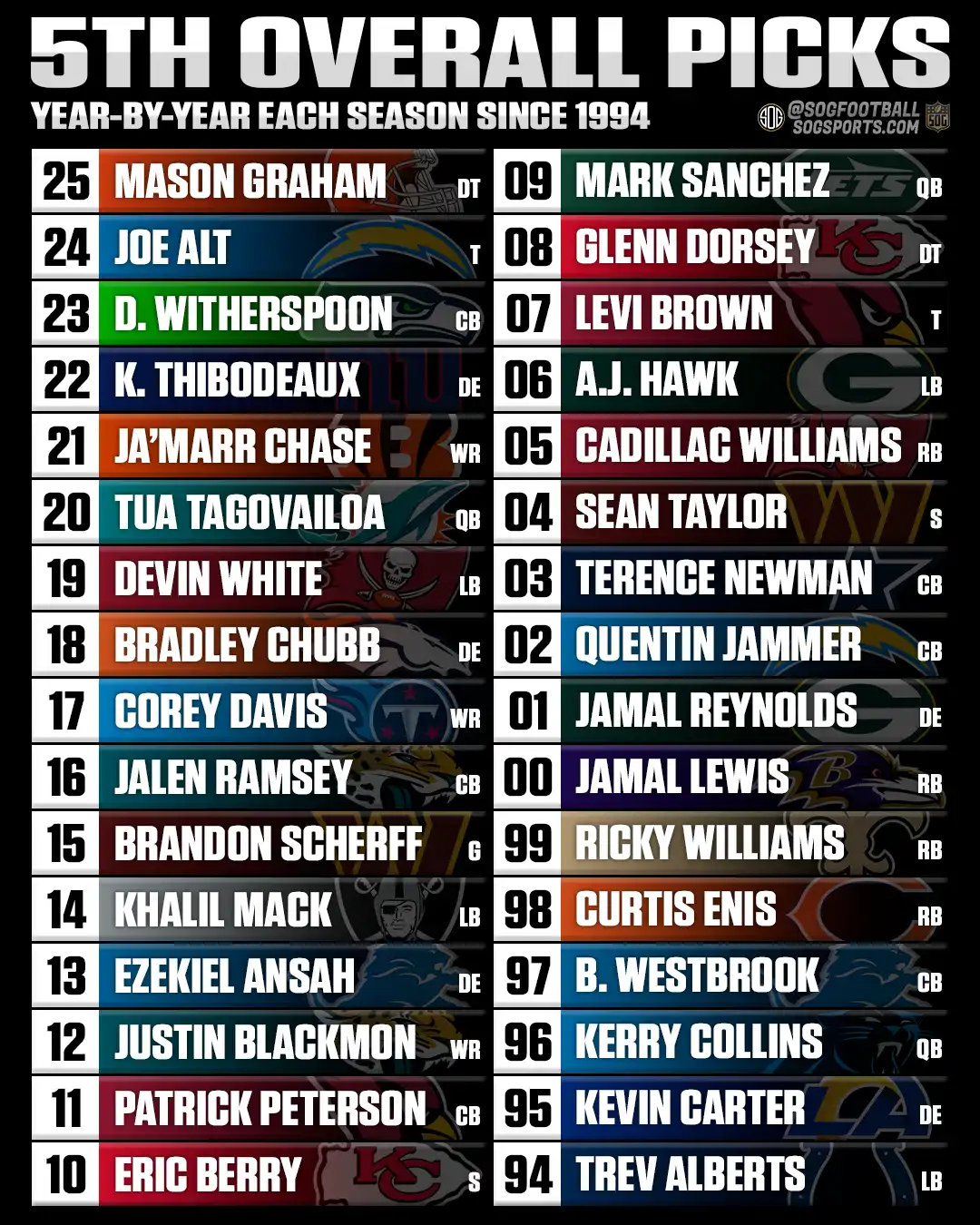
Year-by-year graphic showing every 5th overall NFL Draft pick from 1994 through 2025
The graphic highlights the modern era from Trev Alberts in 1994 through Mason Graham in 2025. The full list below goes back to the first NFL Draft in 1936.
Year-by-Year List of 5th Overall NFL Draft Picks
2025 — Mason Graham, Cleveland Browns, Defensive Tackle
Graham went fifth after becoming a first-team All-American at Michigan. Cleveland drafted him to add interior disruption to a front that already had Myles Garrett on the edge.
2024 — Joe Alt, Los Angeles Chargers, Offensive Tackle
Alt arrived as one of the cleanest tackle prospects in the class after an All-American career at Notre Dame. The Chargers used this pick to make Justin Herbert’s life easier for the next decade.
2023 — Devon Witherspoon, Seattle Seahawks, Cornerback
Witherspoon made an impact right away, posting a pick-six and three sacks as a rookie. Seattle took him fifth to get nastier on defense, and that showed up immediately.
2022 — Kayvon Thibodeaux, New York Giants, Linebacker/Edge Rusher
Thibodeaux broke out with 11.5 sacks in 2023 and finally looked like the edge threat the Giants thought they were getting. That matters when a team spends a top-five pick trying to fix a pass rush.
2021 — Ja’Marr Chase, Cincinnati Bengals, Wide Receiver
Chase already has a 1,455-yard rookie season and a receiving Triple Crown on his résumé after leading the league in catches, yards, and touchdowns in 2024. Cincinnati took him to pair with Joe Burrow, and the move helped produce a Super Bowl run almost immediately.
2020 — Tua Tagovailoa, Miami Dolphins, Quarterback
Tagovailoa led the NFL with 4,624 passing yards in 2023 and looked like the answer Miami wanted at quarterback. Multiple concussions, including episodes that raised serious league-wide safety concerns, have stayed attached to the evaluation of this pick.
2019 — Devin White, Tampa Bay Buccaneers, Linebacker
White was a major piece of Tampa Bay’s Super Bowl LV defense and posted 140 tackles with 9 sacks in 2020. The Buccaneers drafted speed and range in the middle of the field and got exactly that.
2018 — Bradley Chubb, Denver Broncos, Defensive End
Chubb opened with 12 sacks as a rookie, which looked like a top-five hit. A torn ACL in 2019 changed the trajectory and the career never got back to that early level for long.
2017 — Corey Davis, Tennessee Titans, Wide Receiver
Davis posted 984 receiving yards in 2020 but never became a true No. 1 target over a full career. Tennessee needed more than one strong season from a fifth-overall receiver.
2016 — Jalen Ramsey, Jacksonville Jaguars, Cornerback
Ramsey became a multi-time first-team All-Pro and later won Super Bowl LVI with the Rams. Jacksonville spent the fifth pick on a shutdown corner and got a great player, even if the best team success came later elsewhere.
2015 — Brandon Scherff, Washington Commanders, Guard
Scherff became a five-time Pro Bowler and gave Washington a legitimate tone-setter inside. Guards rarely go this high unless the team thinks it is getting a long-term difference-maker up front.
2014 — Khalil Mack, Oakland Raiders, Linebacker
Mack won Defensive Player of the Year in 2016 and quickly justified the draft slot as a premier edge threat. This is the kind of defensive hit that changes an entire roster plan.
2013 — Ezekiel Ansah, Detroit Lions, Defensive End
Ansah peaked with 14.5 sacks in 2015 and made a Pro Bowl. Detroit got a strong season or two, but not enough healthy years from a top-five pass rusher.
2012 — Justin Blackmon, Jacksonville Jaguars, Wide Receiver
Blackmon flashed real talent with 93 catches for 1,280 yards in 20 NFL games. He was suspended multiple times for violating the league’s substance-abuse policy and never returned after 2013.
2011 — Patrick Peterson, Arizona Cardinals, Cornerback
Peterson made eight Pro Bowls and gave Arizona a true No. 1 corner from the start. He served a six-game suspension in 2019 for violating the NFL’s performance-enhancing drug policy.
2010 — Eric Berry, Kansas City Chiefs, Safety
Berry made five Pro Bowls and won Comeback Player of the Year in 2015 after returning from Hodgkin lymphoma. Kansas City drafted a cornerstone safety and got one when he was healthy.
2009 — Mark Sanchez, New York Jets, Quarterback
Sanchez led the Jets to back-to-back AFC Championship Games in his first two seasons. He never turned into a franchise quarterback, but those early playoff runs gave the pick real short-term value.
2008 — Glenn Dorsey, Kansas City Chiefs, Defensive Tackle
Dorsey played 10 NFL seasons and later started for a 49ers team that reached Super Bowl XLVII. Kansas City expected more than “solid pro” from a fifth-overall defensive tackle.
2007 — Levi Brown, Arizona Cardinals, Offensive Tackle
Brown started 77 games in Arizona and was on the roster during the club’s Super Bowl XLIII run. That is serviceable value, but not franchise-left-tackle value.
2006 — A.J. Hawk, Green Bay Packers, Linebacker
Hawk became Green Bay’s all-time leading tackler and started on the Super Bowl XLV team. The Packers drafted him to stabilize the middle of the defense, and he did that for years.
2005 — Carnell “Cadillac” Williams, Tampa Bay Buccaneers, Running Back
Williams rushed for 1,178 yards and won Offensive Rookie of the Year in 2005. Foot and knee injuries kept the career from becoming what that first season suggested.
2004 — Sean Taylor, Washington Commanders, Safety
Taylor made two Pro Bowls and looked like one of the league’s most gifted safeties before he was shot during a home invasion in 2007 and died at age 24. Washington drafted a star and lost him far too early.
2003 — Terence Newman, Dallas Cowboys, Cornerback
Newman played 15 NFL seasons, made two Pro Bowls, and finished with 42 interceptions. That is excellent return from a top-five corner.
2002 — Quentin Jammer, San Diego Chargers, Cornerback
Jammer started 172 games over 12 seasons and gave San Diego long-term stability at corner. That is the kind of durability teams want when they draft defense this high.
2001 — LaDainian Tomlinson, San Diego Chargers, Running Back
Tomlinson ran for 13,684 yards, scored 162 rushing touchdowns, won the 2006 MVP, and reached the Hall of Fame. This was one of the best fifth-overall picks ever made.
2000 — Jamal Lewis, Baltimore Ravens, Running Back
Lewis ran for 10,607 yards, posted a 2,066-yard season in 2003, and helped Baltimore win Super Bowl XXXV. The Ravens drafted a workhorse and got a great one.
1999 — Ricky Williams, New Orleans Saints, Running Back
Williams finished with 10,009 rushing yards and produced multiple 1,000-yard seasons. He was suspended multiple times under the NFL’s substance-abuse policy, which interrupted what could have been an even bigger career.
1998 — Curtis Enis, Chicago Bears, Running Back
Enis never reached 500 rushing yards in a season, and knee injuries wrecked the pick early. Chicago got only 1,497 career rushing yards from a fifth-overall back.
1997 — Bryant Westbrook, Detroit Lions, Cornerback
Westbrook spent six seasons in Detroit and finished with nine career interceptions. That is not enough impact for a top-five corner.
1996 — Cedric Jones, New York Giants, Defensive End
Jones produced only 15 sacks in five seasons. The Giants drafted a pass rusher at No. 5 and got a bust.
1995 — Kerry Collins, Carolina Panthers, Quarterback
Collins threw for 40,922 yards, made two Pro Bowls, and later took the Giants to Super Bowl XXXV. Carolina’s expansion-era pick turned into a long NFL career, even if the best years came elsewhere.
1994 — Trev Alberts, Indianapolis Colts, Linebacker
Alberts retired after three seasons because of knee injuries. That is a brutal outcome for a player taken fifth overall.
1993 — John Copeland, Cincinnati Bengals, Defensive End
Copeland played 11 seasons and finished with 78.5 sacks. Cincinnati got a real NFL starter, even if he never became a headline star.
1992 — Terrell Buckley, Green Bay Packers, Cornerback
Buckley lasted 14 seasons and picked off 50 passes. He bounced around, but that career interception total says the talent was absolutely real.
1991 — Todd Lyght, Los Angeles Rams, Cornerback
Lyght finished with 37 career interceptions and made a Pro Bowl. That is strong value for a fifth-overall defensive back.
1990 — Junior Seau, San Diego Chargers, Linebacker
Seau made 12 Pro Bowls, reached the Hall of Fame, and became the face of Chargers defense for a decade. He died by suicide in 2012 at age 43, and posthumous examination confirmed he had CTE.
1989 — Deion Sanders, Atlanta Falcons, Cornerback
Sanders finished with 53 interceptions, won two Super Bowls, and reached the Hall of Fame. Atlanta drafted one of the greatest playmakers in football history.
1988 — Rickey Dixon, Cincinnati Bengals, Defensive Back
Dixon played in Super Bowl XXIII as a rookie, but his NFL career produced only six interceptions. Cincinnati expected a much bigger payoff from the fifth pick.
1987 — Mike Junkin, Cleveland Browns, Linebacker
Junkin lasted one season in Cleveland before being traded and never stuck anywhere else. That tells the story of the pick better than anything else.
1986 — Anthony Bell, St. Louis Cardinals, Linebacker
Bell played seven NFL seasons and finished with 11 sacks. That is respectable career length, but not top-five impact.
1985 — Duane Bickett, Indianapolis Colts, Linebacker
Bickett piled up 53 career sacks and gave the Colts years of solid front-seven play. This was a better pick than it gets credit for now.
1984 — Bill Maas, Kansas City Chiefs, Defensive Tackle
Maas won Defensive Rookie of the Year and finished with 40 career sacks. Kansas City got a real interior disruptor out of the pick.
1983 — Billy Ray Smith Jr., San Diego Chargers, Linebacker
Smith started more than 100 games and spent his entire career with the Chargers. He was a long-term starter, even if he never became a true defensive star.
1982 — Jim McMahon, Chicago Bears, Quarterback
McMahon threw for 18,148 yards and quarterbacked the 1985 Bears to a Super Bowl XX title. Chicago did not get huge volume numbers, but it got the quarterback for a championship team.
1981 — E.J. Junior, St. Louis Cardinals, Linebacker
Junior made two Pro Bowls and later earned a first-team All-Pro selection. The Cardinals got a strong linebacker out of this slot.
1980 — Curtis Dickey, Baltimore Colts, Running Back
Dickey rushed for 4,289 yards and scored 32 rushing touchdowns in his career. That is real production, even if the pick never became a franchise-changing one.
1979 — Jerry Butler, Buffalo Bills, Wide Receiver
Butler finished with 5,198 receiving yards and made two Pro Bowls. Buffalo got a legitimate NFL receiver at No. 5.
1978 — Terry Miller, Buffalo Bills, Running Back
Miller rushed for 1,060 yards as a rookie, which was a strong start. He never sustained that level long enough to make the pick a big win.
1977 — Gary Jeter, New York Giants, Defensive End
Jeter posted 55 career sacks and later won a Super Bowl with the Raiders. The Giants drafted a good pro, even if the peak came elsewhere.
1976 — Mike Haynes, New England Patriots, Cornerback
Haynes made nine Pro Bowls, finished with 46 interceptions, and reached the Hall of Fame. That is elite value from any draft slot.
1975 — Mack Mitchell, Cleveland Browns, Defensive End
Mitchell’s NFL career was short, which made this a miss for Cleveland. The Browns needed much more from a top-five edge pick.
1974 — John Dutton, Baltimore Colts, Defensive Tackle
Dutton made four Pro Bowls and finished with 40.5 sacks. He was one of the better interior defenders of his era.
1973 — Dave Butz, St. Louis Cardinals, Defensive Tackle
Butz later became a two-time Super Bowl champion in Washington and finished with 64 career sacks. The Cardinals drafted a high-level player and did not get the best years of him.
1972 — Riley Odoms, Denver Broncos, Tight End
Odoms made four Pro Bowls and gave Denver 5,755 receiving yards. That is outstanding value for a tight end taken fifth overall.
1971 — Richard Harris, Philadelphia Eagles, Defensive End
Harris played seven NFL seasons after going fifth overall. He lasted in the league, but not as a difference-maker.
1970 — Al Cowlings, Buffalo Bills, Defensive End
Cowlings played 10 NFL seasons and won a Super Bowl with Dallas in Super Bowl XII. Buffalo drafted a long-term pro, but not a franchise-changing one.
1969 — Greg Cook, Cincinnati Bengals, Quarterback
Cook threw 15 touchdown passes as a rookie and looked special right away. A torn rotator cuff wrecked the career almost immediately, leaving one of the bigger what-ifs in this draft slot’s history.
1968 — Fred Carr, Green Bay Packers, Linebacker
Carr made three Pro Bowls and gave Green Bay a productive linebacker in the post-Lombardi years. The pick aged pretty well.
1967 — George Webster, Houston Oilers, Linebacker
Webster won AFL Rookie of the Year and made four AFL All-Star teams. Houston got immediate impact from the pick.
1966 — John Niland, Dallas Cowboys, Guard
Niland made six Pro Bowls and started on two Dallas Super Bowl teams. That is exactly how a top-five interior line pick is supposed to work out.
1965 — Craig Morton, Dallas Cowboys, Quarterback
Morton threw for 27,908 yards and later started Super Bowls for both Dallas and Denver. That made him one of the better quarterbacks ever taken fifth overall.
1964 — Pete Beathard, Detroit Lions, Quarterback
Beathard never became Detroit’s answer and was later traded before doing his best work in Kansas City. The Lions missed at quarterback here.
1963 — Bob Vogel, Baltimore Colts, Offensive Tackle
Vogel made five Pro Bowls and anchored the Colts’ offensive line for years. Baltimore got a true long-term tackle at No. 5.
1962 — Bob Ferguson, Pittsburgh Steelers, Running Back
Ferguson made the Pro Bowl and later led the NFL in rushing touchdowns in 1965. Pittsburgh got a useful backfield piece out of the pick.
1961 — Mike Ditka, Chicago Bears, Tight End
Ditka posted 1,076 receiving yards as a rookie, made the Hall of Fame, and changed the way teams viewed the tight end position. This was a massive hit.
1960 — Tom Moore, Green Bay Packers, Running Back
Moore later made two Pro Bowls and had a 1,216-yard rushing season in St. Louis. Green Bay drafted a good player but did not keep the best version.
1959 — Dave Baker, San Francisco 49ers, Defensive Back
Baker spent 10 seasons in pro football and made the 1960 Pro Bowl. The 49ers got a real secondary player, not a star.
1958 — Jim Phillips, Los Angeles Rams, Wide Receiver
Phillips made three Pro Bowls and led the NFL with 78 catches in 1961. The Rams got a very good receiver at No. 5.
1957 — Len Dawson, Pittsburgh Steelers, Quarterback
Dawson did not become Pittsburgh’s quarterback, but he later won a Super Bowl and reached the Hall of Fame with Kansas City. The Steelers drafted a great player and got none of the prime years.
1956 — Art Davis, Pittsburgh Steelers, Defensive Back
Davis had a short NFL career and never became a major secondary piece for Pittsburgh. That made this a light return from the fifth pick.
1955 — Tom Bettis, Green Bay Packers, Linebacker
Bettis became a Pro Bowl linebacker and later won an NFL title with the Lions. Green Bay drafted a strong pro, but again did not enjoy the best stretch of the career.
1954 — Cotton Davidson, Baltimore Colts, Quarterback
Davidson never became Baltimore’s long-term quarterback, but he later made four AFL All-Star teams in Dallas. The player had value; the drafting team did not cash in on it.
1953 — Ted Marchibroda, Pittsburgh Steelers, Quarterback
Marchibroda’s NFL playing career was modest, but he later became a successful NFL head coach. Pittsburgh did not get top-five quarterback production from the player himself.
1952 — Johnny Bright, Philadelphia Eagles, Running Back
Bright never played in the NFL after being drafted fifth overall, choosing instead to play in Canada where he became one of the CFL’s all-time rushing leaders. That is the main fact attached to this pick.
1951 — Bob Gain, Green Bay Packers, Defensive Tackle
Gain reached the Pro Bowl and later won an NFL title with Cleveland. Green Bay drafted a very good lineman and lost the best years.
1950 — Joe Watson, Detroit Lions, Center
Watson became a two-time Pro Bowl center and played on Detroit championship teams. That is strong value from a fifth-overall interior lineman.
1949 — Stan Heath, Green Bay Packers, Quarterback
Heath threw only 12 career touchdown passes and was done in the NFL quickly. Green Bay got almost nothing out of a premium quarterback pick.
1948 — Vaughn Mancha, Boston Yanks, Center
Mancha later became a Pro Bowl center and won championships with the Bears and Colts. The Yanks drafted a good player and did not keep him long enough to matter.
1947 — Hub Bechtol, Pittsburgh Steelers, End
Bechtol made the Pro Bowl and became a productive end in the late 1940s. Pittsburgh got a legitimate player here.
1946 — George Connor, New York Giants, Offensive Tackle
Connor did not stay with the Giants and became a Hall of Famer with the Bears after his rights were moved. New York drafted a great player and got none of the benefit.
1945 — Elroy Hirsch, Cleveland Rams, Wide Receiver
Hirsch later reached the Hall of Fame and became one of the league’s great deep threats. Cleveland drafted a star, but much of his biggest success came after time in the AAFC and then Los Angeles.
1944 — Steve Van Buren, Philadelphia Eagles, Halfback
Van Buren reached the Hall of Fame, led the league in rushing four times, and became one of the key players in Eagles history. This was a franchise-level hit.
1943 — Mike Holovak, Cleveland Rams, Halfback
Holovak had a modest NFL playing career and later became far more notable as a coach and executive. Cleveland did not get top-five player value from the field production.
1942 — Bob Westfall, Detroit Lions, Halfback
Westfall later made three Pro Bowls and was one of the Lions’ better offensive players of the 1940s. That made this a strong early-era pick.
1941 — Jim Thomason, Detroit Lions, Halfback
Thomason had a short NFL career and never developed into a featured back. Detroit got limited value from the fifth pick.
1940 — Olie Cordill, Cleveland Rams, Halfback
Cordill’s pro career was brief. Cleveland drafted him high and did not get a long-run contributor.
1939 — Bob MacLeod, Brooklyn Dodgers, Halfback
MacLeod scored four touchdowns in his only NFL season after being traded to the Bears. The Dodgers used the fifth pick and barely saw any return.
1938 — Jack Robbins, Chicago Cardinals, Halfback
Robbins played 17 NFL games over two seasons and rushed for 310 yards. That is not enough from a fifth-overall pick.
1937 — Mike Basrak, Pittsburgh Pirates, Center
Basrak had a short NFL career but did make the 1937 Pro Bowl. Pittsburgh at least got an immediate contributor.
1936 — Jimmy Lawrence, Chicago Cardinals, Halfback
Lawrence played 34 NFL games and was part of Green Bay’s 1939 championship team after a trade. For the first-ever draft, that counted as a decent outcome.
Why the 5th Overall Pick Matters
The fifth pick matters because it is often where a front office commits to the actual shape of its rebuild. By this point, the obvious quarterback or premium pass rusher may already be gone, so teams at No. 5 have to decide whether they are building around their current quarterback, replacing him, or trying to fix the defense with a player who needs to hit fast.
The consequences are easy to see in the history of this slot. Hit on a player like LaDainian Tomlinson, Junior Seau, Jalen Ramsey, Brandon Scherff, or Ja’Marr Chase, and the roster gets a centerpiece. Miss on a player like Justin Blackmon, Cedric Jones, Curtis Enis, or Mike Junkin, and the organization keeps spending future offseasons trying to patch the same hole.
This pick also tempts teams into forcing the board. No. 5 still feels close enough to blue-chip territory that front offices talk themselves into the wrong running back, the wrong tackle, or the wrong defender because they are afraid of leaving the top five without a foundation piece.
Trends Among 5th Overall NFL Draft Picks
- Running backs owned this slot for a long time. Through 2025, 18 of the 90 fifth-overall picks were backs, which is exactly 20 percent of the history of the slot. The position has almost entirely disappeared from this range in the modern era.
- Quarterbacks are rarer here than people assume. Only 11 quarterbacks have gone fifth overall through 2025, and just two of them were selected from 2000 through 2025. This is not a quarterback slot in the modern draft.
- Defensive backs have thrived here in the modern era. Jalen Ramsey, Patrick Peterson, Devon Witherspoon, Sean Taylor, Eric Berry, Quentin Jammer, Mike Haynes, and Deion Sanders all came through No. 5, making it one of the better recent slots for secondary talent.
- The Hall of Fame hit rate is stronger than the slot gets credit for. LaDainian Tomlinson, Junior Seau, Deion Sanders, Mike Haynes, Mike Ditka, Len Dawson, Elroy Hirsch, Steve Van Buren, and George Connor give the fifth pick more star power than most casual draft conversations acknowledge.
FAQ About 5th Overall NFL Draft Picks
Who was the first 5th overall pick in NFL Draft history?
Jimmy Lawrence was the first player taken fifth overall in 1936 by the Chicago Cardinals. Unlike some early picks who never signed, Lawrence actually played in the NFL and appeared in 34 games before being traded to Green Bay.
How often are running backs taken 5th overall?
Running backs and halfbacks account for 18 of the 90 fifth-overall picks through 2025, which works out to 20 percent. That is a huge share, even if the position has mostly disappeared from this slot in the modern passing era.
Which 5th overall pick turned into the best NFL player?
LaDainian Tomlinson has a strong case — he won an MVP, made the Hall of Fame, and scored 162 rushing touchdowns. Deion Sanders, Junior Seau, Mike Haynes, and Steve Van Buren also belong in that conversation, which tells you how deep the star power at this slot actually goes.
Has the 5th overall pick been better for defense or offense?
Defense probably has the edge at the top because of Seau, Sanders, Haynes, Ramsey, Berry, and Mack. Offensively, Tomlinson, Chase, Mike Ditka, Len Dawson, Steve Van Buren, and Brandon Scherff keep the other side of the debate very alive. The split is genuinely close.
Why has the 5th overall pick produced so many running backs historically?
For decades, teams were far more willing to build an offense around a feature back, so No. 5 became a natural landing spot for that kind of player. Names like Tomlinson, Jamal Lewis, Ricky Williams, Curtis Enis, and Curtis Dickey all reflect the old roster-building model where a dominant runner at the top of the draft made organizational sense.
What makes the 5th overall pick dangerous for front offices?
It is close enough to the top of the board that teams convince themselves they are still getting a can’t-miss player, even when the class has already thinned out. That is how franchises end up with a bust at a premium price instead of a long-term starter at a less glamorous position. The history of this slot has plenty of both.
Final Thoughts
The history of the fifth overall NFL Draft pick is really a record of how well franchises handle pressure when the obvious choices are already gone. The teams that got it right — San Diego with LaDainian Tomlinson, Atlanta with Deion Sanders, San Diego again with Junior Seau — trusted the board and took the best player available. The teams that got it wrong usually convinced themselves the slot still guaranteed something it did not.
The 2026 NFL Draft will add another name to this list in April, and the same dynamic will be in play. By the time the fifth pick is on the clock, the room already knows which quarterbacks and top pass rushers are off the board. What happens next tells you everything about how a front office thinks.
That tension is what keeps No. 5 worth watching every year. It is not the loudest pick of the night, but it is often the most revealing one.
