The fourth pick sits in a strange spot. It is high enough to land a franchise tackle, a true WR1, or a quarterback a team believes it can build around, but it is also the range where front offices start overthinking what is left after the first three names come off the board. That tension shows up all over the history of 4th overall NFL draft picks. This slot has produced Hall of Famers, immediate foundational players, and some misses that set organizations back years.
Table of Contents
- Featured Graphic
- Year-by-Year List of 4th Overall NFL Draft Picks
- Why the 4th Overall Pick Matters
- Trends Among 4th Overall NFL Draft Picks
- FAQ About 4th Overall NFL Draft Picks
- Final Thoughts
Featured Graphic
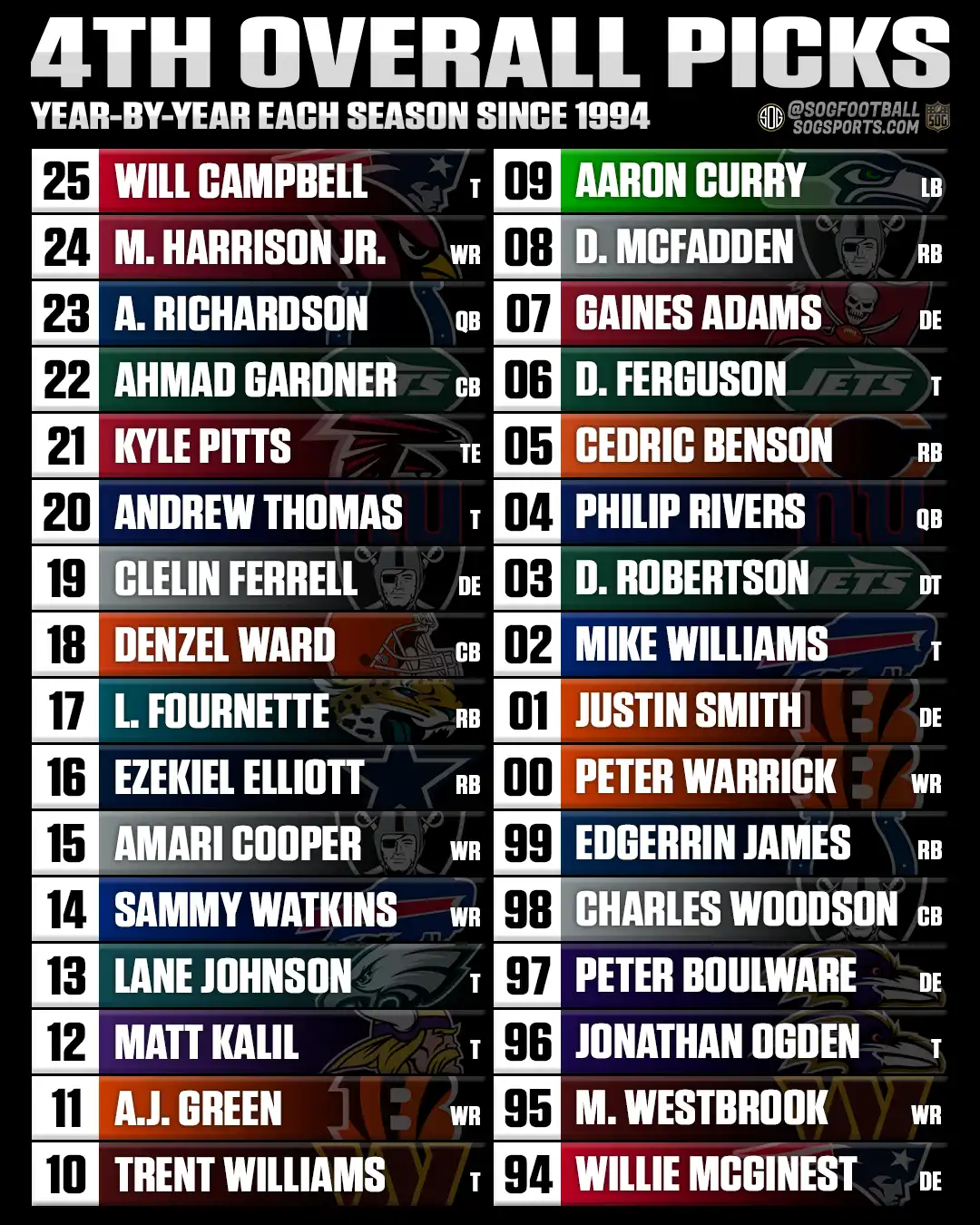
Year-by-year graphic showing every 4th overall NFL Draft pick from 1994 through 2025
The graphic highlights the modern era from Willie McGinest in 1994 through Will Campbell in 2025. The full list below goes back to the first NFL Draft in 1936.
Year-by-Year List of 4th Overall NFL Draft Picks
2025 — Will Campbell, New England Patriots, Offensive Tackle
Campbell went fourth after winning the Jacobs Blocking Trophy at LSU. New England drafted him to protect Drake Maye and finally stop the revolving-door problem at tackle.
2024 — Marvin Harrison Jr., Arizona Cardinals, Wide Receiver
Harrison entered the draft after a 14-touchdown season at Ohio State in 2023. Arizona took him to give Kyler Murray the kind of true No. 1 receiver the offense had been missing.
2023 — Anthony Richardson, Indianapolis Colts, Quarterback
Richardson flashed immediately with four rushing touchdowns in his first four NFL games before a season-ending shoulder injury. The pick still hinges on whether Indianapolis can keep him healthy enough to develop as a passer.
2022 — Ahmad Gardner, New York Jets, Cornerback
Gardner made first-team All-Pro as a rookie and again in his second season. The Jets took a corner at No. 4 and got one of the league’s best almost instantly.
2021 — Kyle Pitts, Atlanta Falcons, Tight End
Pitts broke 1,000 receiving yards as a rookie, which almost never happens at tight end. Atlanta spent the fourth pick on a matchup weapon, even if the production has not climbed from there the way people expected.
2020 — Andrew Thomas, New York Giants, Offensive Tackle
Thomas grew into the Giants’ best lineman and earned second-team All-Pro honors in 2022. That pick mattered because New York badly needed a left tackle it could stop worrying about.
2019 — Clelin Ferrell, Oakland Raiders, Defensive End
Ferrell had 10 sacks in four seasons with the Raiders, which is not enough for a fourth-overall edge rusher. This was one of the reach picks of that draft, and it looked like one.
2018 — Denzel Ward, Cleveland Browns, Cornerback
Ward made multiple Pro Bowls and gave Cleveland a legitimate No. 1 corner. For a Browns team trying to build a real defense, this was one of the cleaner hits of that era.
2017 — Leonard Fournette, Jacksonville Jaguars, Running Back
Fournette rushed for 1,040 yards as a rookie and helped power Jacksonville to the 2017 AFC title game. He later became a major piece of Tampa Bay’s Super Bowl LV run.
2016 — Ezekiel Elliott, Dallas Cowboys, Running Back
Elliott led the league in rushing twice and ran for 1,631 yards as a rookie. Dallas drafted him fourth and got immediate production behind a loaded offensive line.
2015 — Amari Cooper, Oakland Raiders, Wide Receiver
Cooper topped 1,000 receiving yards in each of his first two seasons and finished with multiple Pro Bowls. He gave the Raiders a real WR1 at a time when the offense needed one badly.
2014 — Sammy Watkins, Buffalo Bills, Wide Receiver
Watkins posted a 1,047-yard season in 2015, but the Bills did not get enough long-term value from a receiver they traded up for. The cost of the move became part of the story.
2013 — Lane Johnson, Philadelphia Eagles, Offensive Tackle
Johnson became a multiple-time first-team All-Pro and a central piece of Philadelphia’s Super Bowl LII team. This is exactly why teams draft tackles in the top five.
2012 — Matt Kalil, Minnesota Vikings, Offensive Tackle
Kalil made the Pro Bowl as a rookie, then injuries got in the way of the long run. Minnesota thought it had landed a franchise left tackle and never got that full return.
2011 — A.J. Green, Cincinnati Bengals, Wide Receiver
Green opened his career with seven straight Pro Bowls and finished with 10,514 receiving yards. Cincinnati used the fourth pick on a star wideout and hit immediately.
2010 — Trent Williams, Washington Commanders, Offensive Tackle
Williams became an 11-time Pro Bowler and one of the best left tackles of his generation. Washington found the right player and still never built enough around him.
2009 — Aaron Curry, Seattle Seahawks, Linebacker
Curry was called one of the safest players in the class and turned into a bust almost right away. Seattle got only 5.5 sacks from him before moving on.
2008 — Darren McFadden, Oakland Raiders, Running Back
McFadden rushed for 1,157 yards in 2010, but injuries kept the career from ever fully taking off. Oakland drafted a featured back and got only one 1,000-yard season out of a top-four pick.
2007 — Gaines Adams, Tampa Bay Buccaneers, Defensive End
Adams finished with 13.5 career sacks before dying of an enlarged heart in 2010 at age 26. Tampa Bay never got the full career it expected from the pick.
2006 — D’Brickashaw Ferguson, New York Jets, Offensive Tackle
Ferguson started 160 straight games and made three Pro Bowls. The Jets drafted him to lock down left tackle, and that is exactly what happened.
2005 — Cedric Benson, Chicago Bears, Running Back
Benson rushed for 6,017 career yards and later had back-to-back 1,000-yard seasons in Cincinnati. He was arrested multiple times on alcohol-related charges during his career.
2004 — Philip Rivers, New York Giants, Quarterback
Rivers was drafted by the Giants, then immediately traded to the Chargers as part of the Eli Manning deal. He went on to throw for 63,440 yards and 421 touchdown passes — one of the most productive passing careers in league history.
2003 — Dewayne Robertson, New York Jets, Defensive Tackle
Robertson started 75 games for the Jets but never became a difference-making interior player. For a fourth-overall defensive tackle, that is a miss.
2002 — Mike Williams, Buffalo Bills, Offensive Tackle
Williams started 48 games for Buffalo, but the Bills drafted him to become a franchise tackle and never got that level. Top-five linemen are not supposed to fade that fast.
2001 — Justin Smith, Cincinnati Bengals, Defensive End
Smith finished with 87 career sacks, made five Pro Bowls, and was a first-team All-Pro twice. Cincinnati drafted a high-floor lineman and got a great one.
2000 — Peter Warrick, Cincinnati Bengals, Wide Receiver
Warrick never reached 800 receiving yards in a season and finished with 18 career touchdown catches. That is nowhere near enough from a fourth-overall receiver.
1999 — Edgerrin James, Indianapolis Colts, Running Back
James ran for 12,246 yards, made the Hall of Fame, and gave Peyton Manning a backfield star from day one. Indianapolis ignored the Ricky Williams noise and made the right call.
1998 — Charles Woodson, Oakland Raiders, Cornerback
Woodson won Defensive Rookie of the Year, later took Defensive Player of the Year, and finished with 65 interceptions. This was a Hall of Fame pick.
1997 — Peter Boulware, Baltimore Ravens, Defensive End
Boulware posted 70 sacks and made four Pro Bowls. Baltimore found a pass rusher before its defense turned into a championship unit.
1996 — Jonathan Ogden, Baltimore Ravens, Offensive Tackle
Ogden made 11 Pro Bowls and walked into the Hall of Fame. For an expansion franchise, landing a left tackle like this at No. 4 is how you accelerate the whole build.
1995 — Michael Westbrook, Washington Commanders, Wide Receiver
Westbrook’s best year was 1999, when he put up 1,191 receiving yards and nine touchdowns. Washington needed more than one big season from a fourth-overall wideout.
1994 — Willie McGinest, New England Patriots, Defensive End
McGinest finished with 86 sacks and won three Super Bowls. He became one of the most important defensive players of the Patriots’ first dynasty.
1993 — Marvin Jones, New York Jets, Linebacker
Jones made two Pro Bowls and was part of the Jets’ best defenses of the late 1990s. This was a solid top-five hit even without national star power.
1992 — Desmond Howard, Washington Commanders, Wide Receiver
Howard never became the offensive star Washington wanted, but he later won Super Bowl XXXI MVP as a returner in Green Bay. The value showed up, just not where his drafting team expected.
1991 — Mike Croel, Denver Broncos, Linebacker
Croel had 10 sacks as a rookie and never matched that again. Denver drafted a top-five linebacker and got one good season out front.
1990 — Keith McCants, Tampa Bay Buccaneers, Linebacker
McCants produced 13 sacks in six NFL seasons, which is a bust line for this slot. Tampa Bay swung for a front-seven playmaker and came up short.
1989 — Derrick Thomas, Kansas City Chiefs, Linebacker
Thomas stacked 126.5 career sacks and made the Hall of Fame. He died from injuries suffered in a car crash in 2000 at age 33.
1988 — Paul Gruber, Tampa Bay Buccaneers, Offensive Tackle
Gruber started 183 games and made the Pro Bowl. Tampa Bay got a long-term left tackle out of the fourth pick, which is real value.
1987 — Brent Fullwood, Green Bay Packers, Running Back
Fullwood topped 500 rushing yards only once and finished with 1,392 career rushing yards. That is a bust for a fourth-overall running back.
1986 — Jon Hand, Indianapolis Colts, Defensive End
Hand had only 5 career sacks and never justified his draft slot. The Colts used the fourth pick on a defensive end and got almost nothing back.
1985 — Chris Doleman, Minnesota Vikings, Defensive End
Doleman finished with 150.5 sacks and reached the Hall of Fame. Minnesota landed an all-timer at one of the premium positions in football.
1984 — Kenny Jackson, Philadelphia Eagles, Wide Receiver
Jackson caught 144 passes in five seasons and never became the receiver Philadelphia needed. This was a miss in a draft famous for better players taken behind him.
1983 — Chris Hinton, Denver Broncos, Offensive Tackle
Hinton was sent to the Colts as part of the John Elway trade and ended up making seven Pro Bowls. The player was excellent, but the pick is inseparable from one of the biggest draft standoffs ever.
1982 — Art Schlichter, Baltimore Colts, Quarterback
Schlichter threw only seven NFL touchdown passes and became one of the era’s most notorious quarterback busts. His career was derailed by a gambling addiction that later led to prison time on fraud charges.
1981 — Kenny Easley, Seattle Seahawks, Defensive Back
Easley won Defensive Player of the Year in 1984 and made five Pro Bowls before kidney disease ended his career early. Seattle still got a Hall of Fame safety out of the pick.
1980 — Bruce Clark, Green Bay Packers, Defensive Tackle
Clark refused to sign with Green Bay and played in the CFL before eventually joining the Saints. That made this a major organizational loss for the Packers before it ever got started.
1979 — Dan Hampton, Chicago Bears, Defensive Tackle
Hampton became a Hall of Famer and one of the core defenders on the 1985 Bears. Chicago nailed this pick.
1978 — Chris Ward, New York Jets, Offensive Tackle
Ward started 91 games over eight seasons. That was useful line play, though not the franchise tackle profile teams want from No. 4.
1977 — Marvin Powell, New York Jets, Offensive Tackle
Powell made five straight Pro Bowls from 1979 through 1983. The Jets spent the fourth pick on a tackle and got a very good one.
1976 — Joe Washington, San Diego Chargers, Running Back
Washington produced 6,462 yards from scrimmage and scored 50 touchdowns in his career. He gave the Chargers real big-play offense.
1975 — Walter Payton, Chicago Bears, Running Back
Payton ran for 16,726 yards, won an MVP, and became one of the greatest players in NFL history. Chicago landed a Hall of Famer at No. 4.
1974 — Waymond Bryant, Chicago Bears, Linebacker
Bryant started for years in Chicago but never became the type of impact defender expected from a top-five pick. This was more starter than star.
1973 — John Hannah, New England Patriots, Guard
Hannah made nine first-team All-Pro teams and belongs in any short list of the best guards ever. This was a franchise-defining line pick.
1972 — Ahmad Rashad, St. Louis Cardinals, Wide Receiver
Rashad finished with 495 catches, 6,831 receiving yards, and 44 touchdowns. He became a far better pro than many top-five receivers do.
1971 — J.D. Hill, Buffalo Bills, Wide Receiver
Hill averaged 20.2 yards per catch as a rookie and later made the Pro Bowl. Buffalo got a vertical threat, even if the career never became huge.
1970 — Phil Olsen, New England Patriots, Defensive Tackle
Olsen played six NFL seasons and was done by age 28. New England drafted a top-five interior lineman and did not get long-run return.
1969 — Joe Greene, Pittsburgh Steelers, Defensive Tackle
Greene changed the Steelers’ franchise, won two Defensive Player of the Year awards, and reached the Hall of Fame. Few fourth-overall picks have meant more to a team’s entire history.
1968 — Russ Washington, San Diego Chargers, Offensive Tackle
Washington made four Pro Bowls and started 200 career games. That is elite longevity from a tackle taken fourth.
1967 — Bob Griese, Miami Dolphins, Quarterback
Griese won two Super Bowls, made eight Pro Bowls, and threw for 25,092 yards. Miami got a Hall of Fame quarterback at No. 4.
1966 — Randy Beisler, Philadelphia Eagles, Defensive End
Beisler played 69 NFL games and never became a front-line edge player. That was light return for this part of the board.
1965 — Gale Sayers, Chicago Bears, Running Back
Sayers made the Hall of Fame despite playing only 68 games, which tells you how electric he was at his peak. Chicago got one of the greatest open-field runners the league has seen.
1964 — Scott Appleton, Dallas Cowboys, Defensive Tackle
Appleton refused to sign with the Cowboys and chose the AFL’s Houston Oilers instead. Dallas used the fourth pick on a defensive tackle and never got the player.
1963 — Ed Budde, Philadelphia Eagles, Guard
Budde never played for Philadelphia and signed with the AFL’s Kansas City Chiefs, where he became a five-time AFL All-Star and a Super Bowl champion. The Eagles drafted a great interior lineman and lost him.
1962 — Gary Collins, Cleveland Browns, Wide Receiver
Collins made two Pro Bowls and scored three touchdowns in the 1964 NFL Championship Game. Cleveland got a big-play receiver with a signature moment.
1961 — Marlin McKeever, Los Angeles Rams, Linebacker
McKeever made five Pro Bowls and gave the Rams a long-term defensive starter. That is a strong result from the fourth pick.
1960 — Richie Lucas, Washington Commanders, Quarterback
Lucas never became Washington’s answer at quarterback and played only 13 NFL games. This was a quick miss at the most expensive position.
1959 — Don Allard, Washington Commanders, Quarterback
Allard never played a regular-season NFL game. That made the fourth pick a complete whiff for Washington.
1958 — Lou Michaels, Los Angeles Rams, Offensive Tackle
Michaels became a Pro Bowl kicker later in his career and was a useful NFL player, just not as the cornerstone tackle this pick suggested. The Rams drafted one role and got value somewhere else.
1957 — Ron Kramer, Green Bay Packers, End
Kramer made four Pro Bowls and helped the Packers win championships under Vince Lombardi. Green Bay got a real offensive weapon here.
1956 — Bob Pellegrini, Philadelphia Eagles, Center
Pellegrini never played in the NFL because Army service prevented his pro career from starting. For Philadelphia, that meant no return on the fourth pick.
1955 — Ralph Guglielmi, Washington Commanders, Quarterback
Guglielmi threw for 5,830 yards in the NFL but never became a franchise quarterback. Washington missed again at the premium spot.
1954 — Veryl Switzer, Green Bay Packers, Back
Switzer played only 18 NFL games. That is another top-five pick from the 1950s that barely got off the ground.
1953 — Johnny Olszewski, Chicago Cardinals, Back
Olszewski lasted nine NFL seasons and made the 1955 Pro Bowl. That gave the Cardinals a better return than many high picks from that era.
1952 — Vito “Babe” Parilli, Green Bay Packers, Quarterback
Parilli never became Green Bay’s answer, but he later starred in the AFL and made four AFL All-Star teams with Boston. The Packers drafted a notable quarterback and got little from him.
1951 — Leon Heath, Washington Commanders, Back
Heath played four seasons and never made a Pro Bowl. Washington took him fourth and got a short career out of it.
1950 — Clayton Tonnemaker, Green Bay Packers, Center
Tonnemaker made two Pro Bowls and won an NFL title with the Lions after leaving Green Bay. The player was good; the Packers just did not enjoy the best stretch.
1949 — Paul Page, New York Giants, Back
Page played only 26 NFL games and made limited impact. The Giants got almost no return from the fourth pick.
1948 — Lowell Tew, Washington Commanders, Back
Tew never played in the NFL after the draft. That made the fourth pick a total loss.
1947 — Cal Rossi, Washington Commanders, Back
Rossi never played in the NFL either, which gave Washington back-to-back no-plays from the fourth slot. Early draft history could get weird fast.
1946 — Johnny Lujack, Chicago Bears, Quarterback
Lujack won the 1947 Heisman, then later became a two-time NFL champion and the 1950 league scoring leader. Chicago got a real quarterback out of this one.
1945 — Eddie Prokop, Boston Yanks, Back
Prokop played 21 NFL games and rushed for 149 yards. That is a bust line for a fourth-overall back.
1944 — Otto Graham, Detroit Lions, Quarterback
Graham never played for Detroit and instead became a Hall of Fame quarterback for Cleveland in the AAFC and NFL, winning seven championships in ten seasons. The Lions drafted a legend and got none of it.
1943 — Paul Governali, Brooklyn Dodgers, Back
Governali threw only 12 career touchdown passes and never became the offensive star expected from his college résumé. The draft slot was much bigger than the NFL production.
1942 — Steve Lach, Chicago Cardinals, Back
Lach helped the Cardinals win the 1947 NFL title and made the 1948 Pro Bowl. Chicago got a winning backfield piece out of the pick.
1941 — Rudy Mucha, Cleveland Rams, Center
Mucha played 42 NFL games and made one Pro Bowl. That is respectable value from an early-draft lineman.
1940 — Banks McFadden, Brooklyn Dodgers, Back
McFadden played only one NFL season before military service interrupted the career. Brooklyn never got sustained value from the pick.
1939 — Davey O’Brien, Philadelphia Eagles, Quarterback
O’Brien played only two NFL seasons and retired to join the FBI after throwing just 11 career touchdown passes. The Heisman winner’s pro career was over before it could develop.
1938 — Byron “Whizzer” White, Pittsburgh Steelers, Back
White played just one season before leaving football for Oxford and eventually a legal career that ended at the U.S. Supreme Court, where he served as an Associate Justice for 31 years. Pittsburgh drafted a star name and got almost no football return.
1937 — Ed Widseth, New York Giants, Offensive Tackle
Widseth played seven seasons and made the 1939 Pro Bowl. That was strong value from a time when plenty of top picks barely lasted.
1936 — Dick Crayne, Brooklyn Dodgers, Back
Crayne never played in the NFL. That made the fourth pick in the first draft another early reminder that signing players was not guaranteed in that era.
Why the 4th Overall Pick Matters
The fourth pick matters because it is often where a team decides what kind of rebuild it is actually running. If the first three picks knock the obvious quarterback or pass rusher off the board, the front office at No. 4 has to decide whether it is fixing the trenches, adding a true No. 1 target, or taking the next quarterback anyway.
That choice carries real organizational consequences. Hit on a tackle like Jonathan Ogden, Lane Johnson, Trent Williams, or Andrew Thomas and the offense gets structure for a decade. Hit on a receiver like A.J. Green or Amari Cooper and the quarterback has a chance. Miss on a top-five defender like Aaron Curry or Clelin Ferrell, and the roster still has the same holes two years later.
This slot also produces tough value decisions because teams here are close enough to elite talent to get impatient. That is how front offices talk themselves into a need pick when the better long-term answer is still sitting there.
Trends Among 4th Overall NFL Draft Picks
- The modern slot leans heavily offensive. From 2010 through 2025, 12 of the 16 fourth-overall picks were offensive players, including five tackles and five pass catchers. The position mix reflects how much the league has shifted toward protecting and arming quarterbacks.
- Quarterbacks are rarer here than people think. Only two quarterbacks were taken fourth overall from 2000 through 2025: Philip Rivers in 2004 and Anthony Richardson in 2023. Teams picking fourth in the modern era usually have a quarterback and are fixing everything around him.
- This spot has produced elite Hall of Fame linemen. Jonathan Ogden, John Hannah, Joe Greene, Chris Doleman, Dan Hampton, Trent Williams, and Lane Johnson make the fourth pick look very good in the trenches across every era of the game.
- Refusal and league-jump stories show up more than once. Scott Appleton, Ed Budde, Otto Graham, and Bruce Clark are all reminders that the fourth pick has a weird history beyond just wins and losses — several of the best players drafted here never took a snap for the teams that selected them.
FAQ About 4th Overall NFL Draft Picks
Who was the first 4th overall pick in NFL Draft history?
Dick Crayne was the first fourth-overall pick in 1936 when Brooklyn selected him out of Iowa. He never played in the NFL, which tells you how different the draft worked in its earliest years.
How often are quarterbacks taken 4th overall?
Quarterbacks account for 10 of the 90 fourth-overall picks from 1936 through 2025, which works out to 11.1 percent. That is a much lower rate than most top-five slots and reflects how often teams picking fourth already have their quarterback answer.
Which 4th overall picks became Hall of Famers?
The list is strong: Jonathan Ogden, Charles Woodson, Derrick Thomas, Chris Doleman, Kenny Easley, Walter Payton, John Hannah, Joe Greene, Dan Hampton, Bob Griese, Gale Sayers, and Otto Graham all have Hall of Fame careers tied to this slot. That is one of the deeper star pools of any top-five pick position.
Has the 4th overall pick been better for offense or defense?
Historically it is close, but the offensive line and skill-position side has delivered more clean franchise-building value. Ogden, Hannah, Payton, Sayers, A.J. Green, Trent Williams, Lane Johnson, and Edgerrin James are hard to beat as a group.
What is the biggest bust taken 4th overall?
Aaron Curry belongs high on that list — Seattle drafted him as a supposed safe pick and got only 5.5 sacks before moving on. Jon Hand, Clelin Ferrell, Peter Warrick, and Brent Fullwood are also in that conversation. Art Schlichter is the most damaging individual story because the off-field situation ended a career that never had a real chance to develop.
Why do so many teams use the 4th pick on tackles and receivers?
Because it is the sweet spot for fixing an offense without forcing a quarterback. Teams picking fourth are often one major piece away from making their quarterback evaluation fair, and left tackles plus true WR1 types are the fastest way to do that without spending the top pick on a position that may already be filled.
Final Thoughts
The history of the fourth overall NFL Draft pick is really a record of how well front offices know themselves. The teams that got it right — Baltimore with Jonathan Ogden, Oakland with Charles Woodson, Kansas City with Derrick Thomas, Chicago with Walter Payton — trusted the board and took the best player regardless of position. The teams that got it wrong usually tried to solve a specific problem and ended up with a player who was neither the solution nor a long-term asset.
The 2026 NFL Draft will add another name to this list in April. By the time the fourth pick is on the clock, the room will have a read on which quarterbacks and top defenders are gone, and the team at No. 4 will have to decide in real time whether the player it wants is still there or whether it is about to force something.
That is what makes this slot worth watching every year. No. 4 does not get the same attention as the top three, but it is often where the draft’s first real organizational reveal happens.
