All 3rd Overall NFL Draft Picks in NFL History
The third pick has a different kind of pressure than No. 1 or No. 2. By the time a team gets on the clock here, the board has already forced a reaction, and that usually means choosing between the last premium quarterback, the cleanest non-quarterback star, or a roster fix that has to work. That is why 3rd overall NFL draft picks have produced such a strange mix of Hall of Famers, franchise tackles, MVPs, busted quarterbacks, and misses that front offices never live down. It is one of the most revealing spots in the entire draft.
Table of Contents
- Featured Graphic
- Year-by-Year List of 3rd Overall NFL Draft Picks
- Why the 3rd Overall Pick Matters
- Trends Among 3rd Overall NFL Draft Picks
- FAQ About 3rd Overall NFL Draft Picks
- Final Thoughts
Featured Graphic
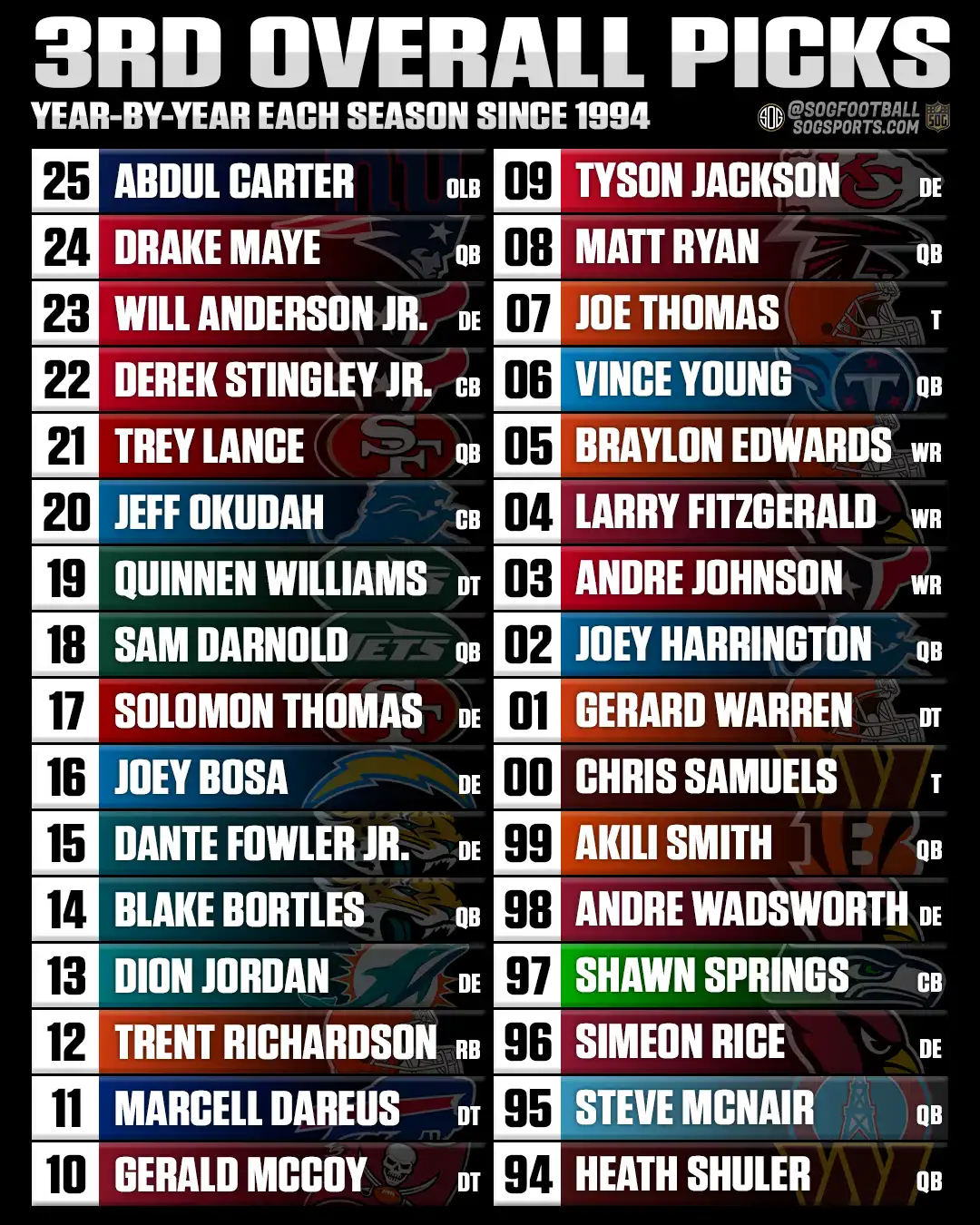
Year-by-year graphic showing every 3rd overall NFL Draft pick from 1994 through 2025
The graphic highlights the modern era from Heath Shuler in 1994 through Abdul Carter in 2025. The full list below goes back to the first NFL Draft in 1936.
Year-by-Year List of 3rd Overall NFL Draft Picks
2025 — Abdul Carter, New York Giants, Outside Linebacker
The Giants took Carter after a Penn State season that included 12 sacks and 23.5 tackles for loss. This was a straight bet on edge speed and backfield chaos.
2024 — Drake Maye, New England Patriots, Quarterback
Maye followed a promising rookie year with a 2025 breakout that produced 4,394 passing yards and 31 touchdown passes. That is the kind of jump that changes how a franchise plans the next three offseasons.
2023 — Will Anderson Jr., Houston Texans, Defensive End
Houston traded up for Anderson and got a real payoff fast. Through 2025 he had 30 sacks, a Defensive Rookie of the Year award, and a first-team All-Pro season.
2022 — Derek Stingley Jr., Houston Texans, Cornerback
Stingley looked like a gamble early because of the injury history, then turned into a top-end cover corner. His 2024 season, when he picked off five passes and earned first-team All-Pro honors, was the turning point.
2021 — Trey Lance, San Francisco 49ers, Quarterback
San Francisco paid a massive trade-up price for Lance and got only four starts before moving him. That pick is tied as much to the cost as the player.
2020 — Jeff Okudah, Detroit Lions, Cornerback
Okudah’s Detroit run never stabilized, and a torn Achilles in Week 1 of the 2021 season crushed whatever early momentum he had. For a rebuilding team, this was a miss it could not afford.
2019 — Quinnen Williams, New York Jets, Defensive Tackle
Williams eventually became the exact type of interior force the Jets thought they were drafting. He developed into a multi-time Pro Bowler and one of the league’s best big men on passing downs.
2018 — Sam Darnold, New York Jets, Quarterback
Darnold was supposed to end New York’s quarterback search and instead became part of the same cycle. He started 38 games for the Jets before the franchise was right back looking for the answer.
2017 — Solomon Thomas, San Francisco 49ers, Defensive End
Thomas never gave San Francisco the impact expected from a top-three defensive lineman. The 49ers got just six sacks from him in four seasons before moving on.
2016 — Joey Bosa, San Diego Chargers, Defensive End
Bosa opened with 10.5 sacks in only 12 rookie games and immediately looked like a hit. When healthy, he has been the Chargers’ most consistent pass rusher of his era.
2015 — Dante Fowler Jr., Jacksonville Jaguars, Defensive End
Fowler tore his ACL in rookie minicamp before he played a snap, and that injury changed the whole arc of the pick. He later rebuilt value as a rotational pass rusher, but Jacksonville never got a true franchise edge out of him.
2014 — Blake Bortles, Jacksonville Jaguars, Quarterback
Bortles never became a high-end passer, but his 2015 line of 4,428 yards and 35 touchdown passes was real production. Jacksonville still spent years trying to fix the same quarterback problem afterward.
2013 — Dion Jordan, Miami Dolphins, Defensive End
Jordan finished his career with 13.5 sacks, which is nowhere near enough for this slot. He was also suspended multiple times for violating the NFL’s substance-abuse policy, including the entire 2015 season.
2012 — Trent Richardson, Cleveland Browns, Running Back
Richardson scored 12 touchdowns as a rookie, then Cleveland dealt him to Indianapolis after Week 2 of his second season. Teams do not trade away third-overall running backs that quickly unless the pick has already gone bad.
2011 — Marcell Dareus, Buffalo Bills, Defensive Tackle
Dareus made four Pro Bowls and gave Buffalo 35 career sacks from the interior. He was suspended four games in 2015 for violating the league’s substance-abuse policy.
2010 — Gerald McCoy, Tampa Bay Buccaneers, Defensive Tackle
McCoy made six straight Pro Bowls from 2012 through 2017 and finished with 59.5 sacks. Tampa took him for interior disruption and got a decade of it.
2009 — Tyson Jackson, Kansas City Chiefs, Defensive End
Kansas City drafted Jackson to anchor a front and got just 9.0 career sacks. That is a top-three miss, even if he lasted eight NFL seasons.
2008 — Matt Ryan, Atlanta Falcons, Quarterback
Ryan threw for 62,792 yards, won the 2016 MVP, and took Atlanta to a Super Bowl. This was the clean franchise-quarterback hit every team picking in the top three is chasing.
2007 — Joe Thomas, Cleveland Browns, Offensive Tackle
Thomas made 10 straight Pro Bowls, never missed a snap for more than 10 seasons, and walked into the Hall of Fame. Cleveland absolutely nailed the player, even if the franchise around him wasted too much of it.
2006 — Vince Young, Tennessee Titans, Quarterback
Young won Offensive Rookie of the Year and went 30-17 as a starter. Tennessee got a real early jolt, even if the long-term answer never stuck.
2005 — Braylon Edwards, Cleveland Browns, Wide Receiver
Edwards led the league with 16 touchdown catches in 2007 and posted 1,289 receiving yards that season. Cleveland still never got a dependable long-run No. 1 receiver out of the pick.
2004 — Larry Fitzgerald, Arizona Cardinals, Wide Receiver
Fitzgerald finished with 1,432 catches, 17,492 receiving yards, and 121 touchdowns. This was one of the best wide receiver picks any team has ever made.
2003 — Andre Johnson, Houston Texans, Wide Receiver
Johnson gave Houston 14,185 receiving yards, seven Pro Bowls, and a long stretch where he was the franchise’s most reliable offensive player. The expansion Texans needed a tone-setter and got one.
2002 — Joey Harrington, Detroit Lions, Quarterback
Harrington threw for 14,693 yards in the NFL, but Detroit never got winning quarterback play out of the pick. He became another reminder that top-three quarterback swings can set a team back years.
2001 — Gerard Warren, Cleveland Browns, Defensive Tackle
Warren lasted 11 seasons and started more than 100 games, but Cleveland did not draft him third overall to get a solid pro. The Browns wanted a wrecking ball and did not get one.
2000 — Chris Samuels, Washington Commanders, Offensive Tackle
Samuels made six Pro Bowls and gave Washington a legitimate franchise tackle. He was one of the few picks from that era that actually stabilized something up front.
1999 — Akili Smith, Cincinnati Bengals, Quarterback
Smith threw just five touchdown passes in four NFL seasons. This was a flat-out bust at the position that hurts the most when you miss.
1998 — Andre Wadsworth, Arizona Cardinals, Defensive End
Wadsworth had 8 sacks as a rookie, then a torn ACL in training camp before the 1999 season wrecked the rest of the career. Arizona got one good year and not much else.
1997 — Shawn Springs, Seattle Seahawks, Cornerback
Springs played 13 seasons, made a Pro Bowl, and finished with 27 interceptions. That is real value from a premium corner spot.
1996 — Simeon Rice, Arizona Cardinals, Defensive End
Rice piled up 122 sacks and later won a Super Bowl with Tampa Bay. Arizona drafted a pass rusher with top-three talent and that part was exactly right.
1995 — Steve McNair, Houston Oilers, Quarterback
McNair threw for 31,304 yards, shared the 2003 MVP, and took Tennessee to a Super Bowl. The franchise bet big on a small-school quarterback and hit hard.
1994 — Heath Shuler, Washington Commanders, Quarterback
Shuler finished with 3,691 passing yards and a 15-33 TD-INT line. Washington spent the third pick on a quarterback and was back in the market almost immediately.
1993 — Garrison Hearst, Phoenix Cardinals, Running Back
Hearst’s best work came later in San Francisco, where he rushed for 1,570 yards in 1998 and won Comeback Player of the Year after a severe ankle injury. Arizona drafted a good player and barely saw the payoff.
1992 — Sean Gilbert, Los Angeles Rams, Defensive Tackle
Gilbert made the Pro Bowl in his second season and finished with 42.5 sacks. He had a real career, but the Rams never turned the pick into a long-term defensive foundation.
1991 — Bruce Pickens, Atlanta Falcons, Cornerback
Atlanta traded Pickens after two seasons, which says a lot about how fast the pick went sideways. He later made a Pro Bowl, just not for the team that drafted him.
1990 — Cortez Kennedy, Seattle Seahawks, Defensive Tackle
Kennedy won Defensive Player of the Year in 1992, made eight Pro Bowls, and reached the Hall of Fame. This is one of the best defensive picks ever made at No. 3.
1989 — Barry Sanders, Detroit Lions, Running Back
Sanders ran for 15,269 yards, won an MVP, and made the Hall of Fame after only 10 seasons. Detroit got one of the greatest runners the league has ever seen.
1988 — Bennie Blades, Detroit Lions, Safety
Blades finished with 35 interceptions and made the 1991 first-team All-Pro team. That is strong return from a third-overall defensive back.
1987 — Alonzo Highsmith, Houston Oilers, Running Back
Knee injuries wrecked this pick early, and Highsmith never rushed for 350 yards in a season. Houston used a premium pick on a back who barely got rolling.
1986 — Jim Everett, Houston Oilers, Quarterback
Everett refused to play for Houston and was traded to the Rams before his rookie season. He later threw for 34,837 yards and had five 3,000-yard seasons, just not for the team that drafted him.
1985 — Ray Childress, Houston Oilers, Defensive Tackle
Childress made five Pro Bowls and finished with 75.5 sacks. Houston got the kind of interior disruptor teams spend top-three picks trying to find.
1984 — Carl Banks, New York Giants, Linebacker
Banks became a two-time Super Bowl champion and one of the pillars of the Giants’ great defenses of the 1980s. This was a roster-shaping pick for a franchise on the rise.
1983 — Curt Warner, Seattle Seahawks, Running Back
Warner tore his ACL in his first NFL game, which changed the immediate outlook of the pick. He still came back to make three Pro Bowls and rush for 6,705 yards.
1982 — Chip Banks, Cleveland Browns, Linebacker
Banks made four Pro Bowls and gave Cleveland a real playmaker at linebacker. That was more than enough to justify the slot.
1981 — Freeman McNeil, New York Jets, Running Back
McNeil rushed for 8,074 yards and led the league in rushing average during the strike-shortened 1982 season. The Jets got a long-run starter and a genuine weapon.
1980 — Anthony Muñoz, Cincinnati Bengals, Offensive Tackle
Muñoz made 11 Pro Bowls, reached the Hall of Fame, and became one of the best tackles in NFL history. The third pick rarely looks better than this.
1979 — Jack Thompson, Cincinnati Bengals, Quarterback
Thompson threw for 7,818 yards in the NFL and never became the answer Cincinnati needed. The “Throwin’ Samoan” label outlasted the production.
1978 — Wes Chandler, New Orleans Saints, Wide Receiver
Chandler finished with 559 catches, 8,966 yards, and four Pro Bowls. New Orleans got a real player, even if his best production came after a trade to San Diego.
1977 — Eddie Edwards, Cincinnati Bengals, Defensive Tackle
Edwards made three Pro Bowls and gave Cincinnati years of steady work up front. This was a much better pick than people remember.
1976 — Chuck Muncie, New Orleans Saints, Running Back
Muncie produced 6,702 yards from scrimmage and 44 rushing touchdowns, but repeated drug violations led to a league suspension in 1984 that ended the career prematurely. The talent was obvious; the full value never stayed intact.
1975 — Ken Huff, Baltimore Colts, Guard
Huff became a long-term starter on the Colts’ offensive line, which mattered, but not at the franchise-defining level interior linemen need to reach from the third pick.
1974 — John Hicks, New York Giants, Guard
Hicks made the Pro Bowl as a rookie and gave the Giants stability inside. Guards do not go this high unless a team thinks the player can start immediately, and he did.
1973 — Jerry Sisemore, Philadelphia Eagles, Offensive Tackle
Sisemore started for years and later made two Pro Bowls. Philadelphia got a dependable tackle, which is never nothing at this spot.
1972 — Lionel Antoine, Chicago Bears, Offensive Tackle
Antoine played 11 NFL seasons and started more than 100 games. That is real value even if he never became a headline name.
1971 — Dan Pastorini, Houston Oilers, Quarterback
Pastorini threw for 18,515 yards and helped lead Houston into the playoffs late in the decade. He was not a star, but he gave the Oilers a functioning starter for years.
1970 — Mike Phipps, Cleveland Browns, Quarterback
Phipps threw for 10,506 yards and made one Pro Bowl. Cleveland expected more than a stopgap from a third-overall quarterback.
1969 — Leroy Keyes, Philadelphia Eagles, Running Back
Keyes finished runner-up in the 1968 Heisman race, but his NFL career never took off. He never reached 300 rushing yards in a season.
1968 — Claude Humphrey, Atlanta Falcons, Defensive End
Humphrey reached the Hall of Fame and became one of the best pass rushers of his time. Atlanta got a franchise defender at No. 3.
1967 — Steve Spurrier, San Francisco 49ers, Quarterback
Spurrier’s NFL career produced just 6,878 passing yards before he became far more famous as a college coach. This was not the quarterback payoff San Francisco wanted.
1966 — Dick Leftridge, Pittsburgh Steelers, Running Back
Leftridge played only four NFL games and rushed for 17 yards. That is one of the roughest top-three outcomes in Steelers history.
1965 — Dick Butkus, Chicago Bears, Linebacker
Butkus became a Hall of Famer and one of the most feared defenders the sport has produced. Chicago did not just hit here — it landed an icon.
1964 — Charley Taylor, Washington Commanders, Wide Receiver
Taylor scored 90 touchdowns and made the Hall of Fame after converting from running back to wide receiver. Washington got a star and then found his best position.
1963 — Jim Dunaway, Minnesota Vikings, Defensive Tackle
Dunaway never developed into the anchor Minnesota wanted this high. He became a useful player, just not a franchise one.
1962 — Merlin Olsen, Los Angeles Rams, Defensive Tackle
Olsen made 14 straight Pro Bowls and reached the Hall of Fame. The Rams took a defensive tackle and got one of the greatest ever.
1961 — Joe Rutgens, Washington Commanders, Defensive Tackle
Rutgens played 110 games and made two Pro Bowls. Washington got a strong pro, even if the name is largely forgotten now.
1960 — Johnny Robinson, Detroit Lions, Defensive Back
Robinson became a Hall of Famer later in Kansas City and one of the best ballhawks of his era. Detroit drafted a great player and did not keep the best years.
1959 — Billy Stacy, Chicago Cardinals, Defensive Back
Stacy gave the Cardinals a starter in the secondary, but not a difference-maker worthy of the third pick. This was more functional than special.
1958 — Dan Currie, Green Bay Packers, Linebacker
Currie made two first-team All-Pro teams and helped the Lombardi-era Packers build a dominant defense. Green Bay got a real piece here.
1957 — John Brodie, San Francisco 49ers, Quarterback
Brodie threw for 31,548 yards, won the 1970 MVP, and spent 17 seasons with the 49ers. That is elite longevity for a third-overall quarterback.
1956 — Hopalong Cassady, Detroit Lions, Running Back
Cassady won the 1955 Heisman and later made three Pro Bowls with Detroit. He gave the Lions legitimate return right away.
1955 — Alan Ameche, Baltimore Colts, Running Back
Ameche won Rookie of the Year and scored the championship-winning touchdown in the 1958 NFL title game. Baltimore got a huge early payoff from the pick.
1954 — Art Hunter, Green Bay Packers, Center
Hunter played 119 NFL games and later made a Pro Bowl with the Rams. The Packers drafted him, but much of the best work came elsewhere.
1953 — Jack Scarbath, Washington Commanders, Quarterback
Scarbath threw for 3,090 yards over six seasons and never became a franchise answer. Washington missed at the premium position again.
1952 — Ollie Matson, Chicago Cardinals, Running Back
Matson reached the Hall of Fame and became one of the league’s best open-field runners. This was a major hit.
1951 — Y.A. Tittle, San Francisco 49ers, Quarterback
Tittle came to San Francisco through the dispersal of the original Baltimore Colts after the franchise folded following the 1950 season, then went on to throw for 33,070 yards and reach the Hall of Fame. San Francisco got one of the best quarterbacks of his generation.
1950 — Chuck Hunsinger, Chicago Bears, Running Back
Hunsinger produced 834 rushing yards and 249 receiving yards in three seasons. That was useful depth, not top-three value.
1949 — Doak Walker, New York Bulldogs, Running Back
Walker became a Hall of Famer and one of the biggest stars of early pro football. The Bulldogs drafted him, but Detroit enjoyed most of the payoff.
1948 — Bobby Layne, Chicago Bears, Quarterback
Layne became a Hall of Famer and later won three NFL titles with Detroit. Chicago picked a great quarterback and did not get the prime years.
1947 — Fritz Barzilauskas, Boston Yanks, Guard
Barzilauskas made the All-Pro team twice in a short career. That is strong return from an era where draft outcomes were all over the place.
1946 — Doc Blanchard, Pittsburgh Steelers, Fullback
Blanchard never played professional football, choosing a military career after winning the Heisman at Army. That is the main fact attached to this pick.
1945 — Joe Renfroe, Boston/Brooklyn Yanks, Halfback
Renfroe never played in the NFL and chose coaching instead. For a third-overall pick, that is the whole story.
1944 — Creighton Miller, Brooklyn Tigers, Halfback
Miller never played professionally because a heart condition ended that path before it started. He later became a major figure in the formation of the NFL Players Association.
1943 — Glenn Dobbs, Chicago Cardinals, Running Back
Dobbs was a huge college name at Tulsa, but wartime football made the transition messy. His playing résumé never matched the draft slot.
1942 — Pete Kmetovic, Philadelphia Eagles, Running Back
Kmetovic was already famous for a late touchdown that snapped Minnesota’s long winning streak. His NFL career was much quieter.
1941 — Norm Standlee, Chicago Bears, Running Back
Standlee helped Chicago win titles and became one of the better power backs of the decade. That made this a strong early-era pick.
1940 — Kay Eakin, Pittsburgh Steelers, Quarterback
Eakin threw for 601 pro passing yards and three touchdowns across NFL and AAFC time. Pittsburgh did not get a real quarterback answer out of the pick.
1939 — Parker Hall, Cleveland Rams, Running Back
Hall won the Joe F. Carr Trophy as league MVP in his rookie season. That is immediate top-three value in any era.
1938 — Boyd Brumbaugh, Brooklyn Dodgers, Running Back
Brumbaugh spent four seasons in pro football and scored six total touchdowns. That is a decent career, but light for a pick this high.
1937 — Ray Buivid, Chicago Cardinals, Quarterback
Buivid’s NFL career was brief and the Cardinals got little from the investment. Early draft history is full of picks like this.
1936 — Bill Shakespeare, Pittsburgh Pirates, Halfback
Shakespeare never played in the NFL. That makes the third pick in the first draft one of the earliest examples of how uncertain this process used to be.
Why the 3rd Overall Pick Matters
The third pick matters because it is often where a front office gets exposed. By No. 3, the first two selections have already taken away at least one clean answer, so the team on the clock has to decide whether it trusts the next quarterback, the best player left, or its own roster priorities.
That choice reshapes organizations. Hit on a quarterback like Matt Ryan or Steve McNair and the franchise gets stability for years. Hit on a tackle like Joe Thomas or Anthony Muñoz and the offense has a backbone. Miss on a quarterback like Akili Smith or Heath Shuler, or on a premium athlete like Dion Jordan, and the damage carries into the next coaching staff and sometimes the next general manager too.
No. 3 is also where trade pressure shows up. Teams that cannot get to No. 1 sometimes move up here for the last top quarterback, and that raises the cost of a miss even more because the bad pick usually comes with surrendered draft capital attached.
Trends Among 3rd Overall NFL Draft Picks
- Quarterbacks show up often, but not overwhelmingly. Through 2025, 21 of the 90 third-overall picks have been quarterbacks, which comes out to 23.3 percent of the slot’s history. That is a meaningful share without being the dominant story of the position.
- This spot has been great for Hall of Fame trench players. Anthony Muñoz, Merlin Olsen, Cortez Kennedy, Dick Butkus, Claude Humphrey, and Joe Thomas all came through No. 3, making it one of the richest slots in draft history for dominant interior and edge defenders.
- The slot has produced elite pass catchers repeatedly. Larry Fitzgerald, Andre Johnson, Charley Taylor, and Wes Chandler all went third overall. That concentration of Hall of Fame and Pro Bowl receiver talent makes No. 3 one of the better historical slots for skill position hits.
- The bust history is real and damaging. Akili Smith, Heath Shuler, Joey Harrington, Trent Richardson, Dion Jordan, and Solomon Thomas are all reminders that the third pick can sink a rebuild as fast as it can accelerate one, and the cost is always paid in years, not just dollars.
FAQ About 3rd Overall NFL Draft Picks
Who was the first 3rd overall pick in NFL Draft history?
Bill Shakespeare was the first third-overall pick when the Pittsburgh Pirates selected him in 1936. He never played in the NFL, which makes the first No. 3 pick one of the stranger entries in draft history.
How often are quarterbacks taken 3rd overall?
Quarterbacks account for 21 of the 90 third-overall picks through 2025, or 23.3 percent. That is a meaningful share, but it also shows this slot has never been exclusively about quarterback desperation — some of the best picks here have been defenders and skill players.
Which 3rd overall picks turned into the best NFL players?
Anthony Muñoz, Barry Sanders, Joe Thomas, Dick Butkus, Merlin Olsen, Larry Fitzgerald, Andre Johnson, Cortez Kennedy, and Steve McNair all belong near the top of that list. That group covers Hall of Fame linemen, legendary backs, franchise quarterbacks, and all-time receivers — as deep a star pool as any pick slot in the draft.
Has the 3rd overall pick been better for offense or defense?
The slot has produced huge names on both sides, but defense may have the slight edge at the top because of Butkus, Olsen, Kennedy, Humphrey, and Carl Banks. Offensively, Muñoz, Barry Sanders, Fitzgerald, Andre Johnson, McNair, and Matt Ryan keep the argument close.
What makes the 3rd overall pick riskier than people think?
The team at No. 3 usually feels pressure to react to what happened with the first two picks. That is how franchises talk themselves into the wrong quarterback or convince themselves a traits bet is safer than it really is. The bust list at this slot — Smith, Shuler, Harrington, Richardson, Jordan — reflects exactly that pattern.
Which recent 3rd overall picks have had the fastest franchise impact?
Will Anderson Jr. and Drake Maye are the clearest recent answers. Anderson already had 30 sacks through 2025 and a first-team All-Pro season in Houston. Maye’s 4,394-yard, 31-touchdown breakout in 2025 gave New England something it has not had in years — real quarterback momentum going forward.
Final Thoughts
The history of the third overall NFL Draft pick is ultimately a record of how well front offices handle pressure when the board has already taken its first two swings. The teams that got it right — Seattle with Cortez Kennedy, Detroit with Barry Sanders, Cincinnati with Anthony Muñoz, Atlanta with Matt Ryan — trusted their evaluation instead of reacting to the picks ahead of them. The teams that got it wrong usually let the board dictate the decision rather than the roster.
The 2026 NFL Draft will add another name to this list in April, and the same dynamic will be in play. By the time the third pick is on the clock, at least one or two of the obvious answers are already gone. What a team does with that pressure is the whole story.
That is what keeps No. 3 worth watching every year — not because it is the loudest pick on the board, but because it is often the most honest one.
