2020 NFL Redraft: Re-Picking the Entire First Round With Hindsight
The 2020 NFL Draft is one of the easiest classes to redraft because the original board aged all over the place. Some teams nailed premium picks. Some watched stars fall right past them. And once enough real NFL football got played, the gap between draft-night projection and actual long-term value got pretty hard to ignore.
This 2020 NFL redraft throws out the original order and rebuilds the first round based on what these players actually became. Quarterback value still matters. Premium positions still matter. But this is not about who looked the cleanest coming out of college. It is about who you would want if every team got to do this class over again.
That is why the board changes fast. Justin Jefferson does not last until No. 22. Jalen Hurts is nowhere near the second round. Several original first-rounders slide hard. And a few names taken outside Round 1 force their way onto the board entirely.
Table of Contents
- How This 2020 NFL Redraft Was Built
- 2020 NFL Redraft Order
- Biggest Risers in the 2020 NFL Redraft
- Biggest Fallers From the Original 2020 NFL Draft
- Biggest Takeaways From the 2020 NFL Redraft
- FAQ: 2020 NFL Redraft
How This 2020 NFL Redraft Was Built
This redraft weighs positional value, peak level, consistency, and real NFL impact. Quarterbacks get pushed up because that is the most valuable position in the sport. Elite offensive tackles matter a ton too. So do true No. 1 receivers, high-end corners, and defenders who actually changed games instead of just flashing for a stretch.
The goal was not to reward prospect hype or draft slot. The goal was to answer a much simpler question: if every team in the first round got a full do-over with hindsight, who would be gone first?
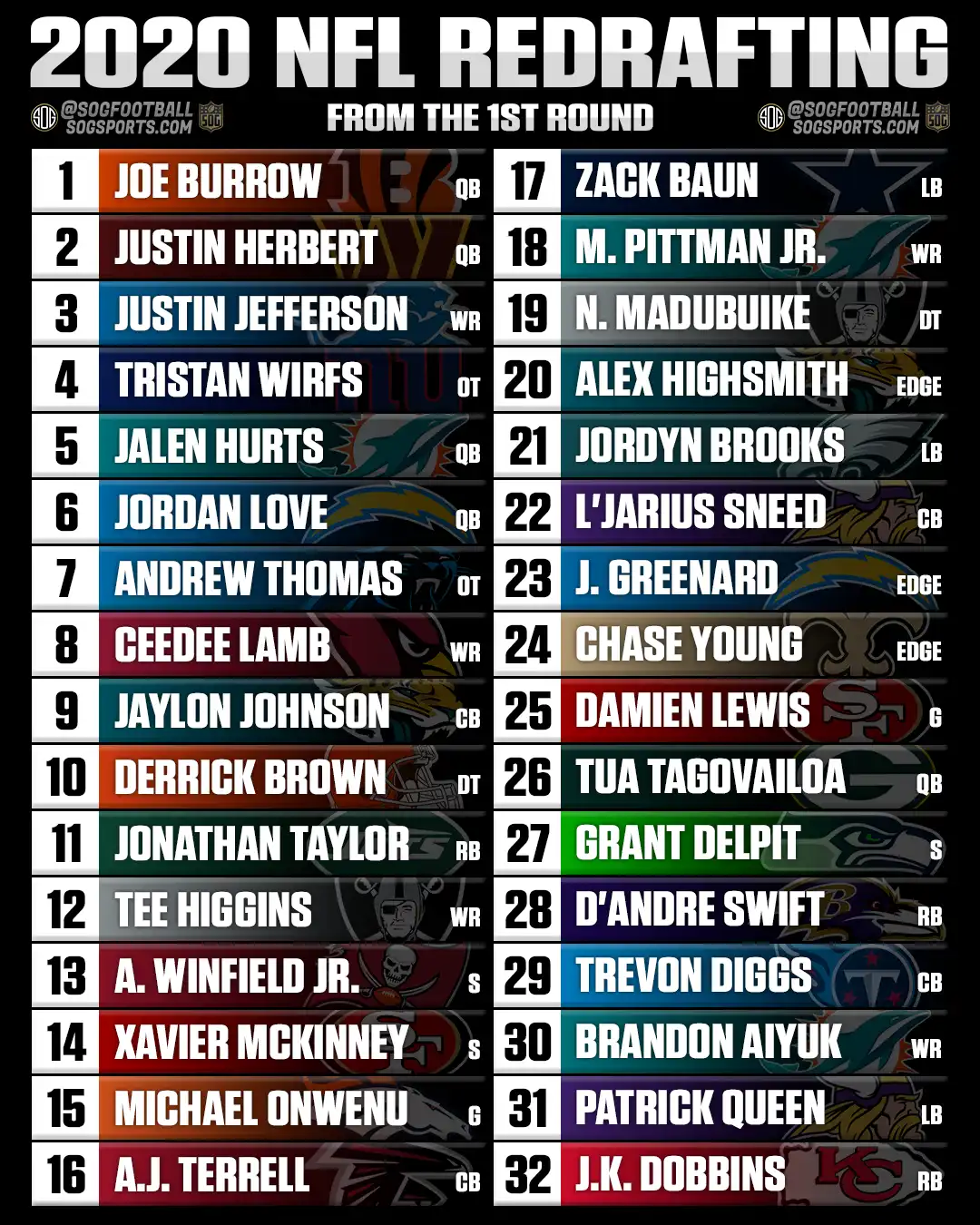
SOGSports re-drafts the entire first round of the 2020 NFL Draft using hindsight.
2020 NFL Redraft Order
1. Joe Burrow (Cincinnati Bengals)
Originally drafted: 1st round, 1st overall
Burrow still stays at the top. That tells you how strong of a pick this was even after all the redraft chaos behind him. When a team drafts a quarterback who changes the ceiling of the entire franchise, there is not much reason to get cute and move off that.
2. Justin Herbert (Los Angeles Chargers)
Originally drafted: 1st round, 6th overall
Herbert climbs four spots and has a real case to be the first pick in a version of this exercise that leans even harder on raw quarterback traits. The arm talent is absurd, the production has been huge, and his 2025 stats again showed how much offense the Chargers keep putting on his shoulders. The Burrow vs. Herbert debate is the hardest call at the very top.
3. Justin Jefferson (Minnesota Vikings)
Originally drafted: 1st round, 22nd overall
This is where the original board really starts getting exposed. Jefferson making a 19-spot jump is the easiest move in the whole redraft. He turned into one of the best receivers in football, and no team would willingly let that profile get anywhere near the 20s if they had the full story in front of them.
4. Tristan Wirfs (Tampa Bay Buccaneers)
Originally drafted: 1st round, 13th overall
Premium tackles are hard to find and even harder to find at this level. Tampa Bay got one of the cleanest non-quarterback wins from the class. Even with the 2025 knee and oblique issues, nothing about the bigger evaluation changed.
5. Jalen Hurts (Philadelphia Eagles)
Originally drafted: 2nd round, 53rd overall
Hurts jumping from the middle of the second round into the top five says plenty about how this class aged. A franchise-level quarterback on Day 2 is the kind of outcome that blows up the original board. Once you know what he became, there is no world where he lasts to pick 53 again.
6. Jordan Love (Green Bay Packers)
Originally drafted: 1st round, 26th overall
Love is one of the bolder climbs, but that comes with quarterback value. When a team finds a real starting quarterback with franchise-level upside, that player is going to jump in any hindsight exercise. He took longer than some of the other passers in the class, but once Green Bay handed him the offense, the value became obvious.
7. Andrew Thomas (New York Giants)
Originally drafted: 1st round, 4th overall
Thomas does not rise much, but that is not a criticism. It is actually a compliment. The Giants got a real long-term answer at left tackle, and those picks age well even if the draft-night reactions were too noisy.
8. CeeDee Lamb (Dallas Cowboys)
Originally drafted: 1st round, 17th overall
Lamb jumps into the top 10 because true No. 1 receivers matter and because he actually became one. He is not Jefferson, but he is still one of the best offensive outcomes from the whole class. A redraft would not let him hang around the teens again.
9. Jaylon Johnson (Chicago Bears)
Originally drafted: 2nd round, 50th overall
Johnson is one of the quieter hindsight wins from 2020. He never needed huge hype to prove he was a great pick. Teams are always searching for corners they can actually trust, and Chicago found one without even using a first-rounder.
10. Derrick Brown (Carolina Panthers)
Originally drafted: 1st round, 7th overall
Brown stays near the top because impact interior defenders still carry real weight, even in a class with a lot of offensive firepower. He gave Carolina what a high pick at that position is supposed to buy: force, disruption, and long-term value.
11. Jonathan Taylor (Indianapolis Colts)
Originally drafted: 2nd round, 41st overall
Running backs get squeezed a bit in redrafts because the position just does not carry quarterback or tackle value. But Taylor’s peak was so strong that he still forces his way near the top third of the round. At his best, he looked like one of the most dangerous backs in football.
12. Tee Higgins (Cincinnati Bengals)
Originally drafted: 2nd round, 33rd overall
Higgins is exactly the type of receiver teams would love to re-draft earlier with hindsight. He became a real weapon, gave Cincinnati a huge boost opposite Burrow, and has continued to be productive enough that he would never last until Round 2 again.
13. Antoine Winfield Jr. (Tampa Bay Buccaneers)
Originally drafted: 2nd round, 45th overall
Winfield was one of the smartest all-around picks in the class. He is the kind of defender who fits good football from the start and keeps mattering in big moments. Tampa Bay did not just land a starter here. It landed a player who helped winning happen.
14. Xavier McKinney (New York Giants)
Originally drafted: 2nd round, 36th overall
McKinney’s rise makes sense the second you stop thinking about prospect shine and start thinking about what teams actually want from a safety. Reliability, range, intelligence, and real back-end value travel. That plays in any era and in any redraft.
15. Michael Onwenu (New England Patriots)
Originally drafted: 6th round, 182nd overall
This is one of the biggest hindsight wins anywhere in the class. Onwenu making a 167-spot leap is not even hard to justify. Late-round offensive linemen are not supposed to become this useful, this flexible, and this dependable.
16. A.J. Terrell (Atlanta Falcons)
Originally drafted: 1st round, 16th overall
Terrell ends up in almost the same slot, which says Atlanta got this right even if people were too loud about it at the time. The Falcons found a quality starting corner and got a much better outcome than several teams drafting around them.
17. Zack Baun (New Orleans Saints)
Originally drafted: 3rd round, 74th overall
Baun forcing his way into the middle of a redrafted first round is exactly why people love looking back at classes like this. He was not sold as a foundational name when he entered the league. Years later, he looks like one of the best values on the board.
18. Michael Pittman Jr. (Indianapolis Colts)
Originally drafted: 2nd round, 34th overall
Pittman became the kind of Day 2 receiver teams would happily take much earlier with hindsight. He is not the flashiest player from the class, but he has been physical, dependable, and clearly worth the investment. That is winning draft value.
19. Nnamdi Madubuike (Baltimore Ravens)
Originally drafted: 3rd round, 71st overall
Madubuike feels like one of those picks that looked solid on draft weekend and then just kept aging better. Baltimore found real defensive line value without needing premium capital, and that kind of outcome absolutely plays in a redraft.
20. Alex Highsmith (Pittsburgh Steelers)
Originally drafted: 3rd round, 102nd overall
Highsmith is one of the cleanest arguments for why a redraft board should look nothing like the original one. He was not one of the stars of the weekend, then turned into a player the Steelers could legitimately lean on. That is exactly the kind of overdelivery that forces a player into Round 1 with hindsight.
21. Jordyn Brooks (Seattle Seahawks)
Originally drafted: 1st round, 27th overall
Brooks is not going to wow people on a graphic like some of the higher names, but he became a good player and a much better first-round outcome than several more famous 2020 picks. There is value in just getting a player right.
22. L’Jarius Sneed (Kansas City Chiefs)
Originally drafted: 4th round, 138th overall
Sneed is another big mover because winning teams love uncovering this type of player. Kansas City got toughness, versatility, and real value without spending anything close to premium draft capital. In hindsight, he is nowhere near a fourth-rounder.
23. Jonathan Greenard (Houston Texans)
Originally drafted: 3rd round, 90th overall
Pass-rush value always ages well, and Greenard gave Houston more of it than his original slot ever suggested. He is not one of the headline stars from 2020, but he is exactly the kind of player who gets pulled up in a first-round redraft.
24. Chase Young (Washington Commanders)
Originally drafted: 1st round, 2nd overall
This is the part people will argue about most, and fairly. Young won Defensive Rookie of the Year, so the start was real. But a redraft is about the full career arc, not just the opening chapter, and the long-term result never came close to matching what teams expect from the No. 2 pick. His 2025 bounce-back with the Saints helped, but it did not put him back near the top of the board. :contentReference[oaicite:3]{index=3}
25. Damien Lewis (Seattle Seahawks)
Originally drafted: 3rd round, 69th overall
Lewis is not flashy, but teams absolutely care about outcomes like this. Seattle found real stability without spending a premium pick, and that matters more in hindsight than draft-night buzz ever does.
26. Tua Tagovailoa (Miami Dolphins)
Originally drafted: 1st round, 5th overall
Tua is still one of the strangest evaluations from the class because there were enough good stretches to see the argument, but not enough long-term clarity to make the original slot feel right. Quarterback value keeps him in the round. The fact he falls this far tells the rest of the story.
27. Grant Delpit (Cleveland Browns)
Originally drafted: 2nd round, 44th overall
Delpit never became one of the defining safeties from the class, but he carved out a legitimate NFL role and stayed relevant. That is enough to sneak into the back part of a redrafted first round in a class with some big misses up top.
28. D’Andre Swift (Detroit Lions)
Originally drafted: 2nd round, 35th overall
Swift has always been a frustrating evaluation because the talent keeps making you think there should be more. Even so, the explosiveness and versatility were real enough that he still belongs in a redrafted Round 1 conversation.
29. Trevon Diggs (Dallas Cowboys)
Originally drafted: 2nd round, 51st overall
Diggs is one of the hardest players to place because the splash plays are real and the full weekly picture is more complicated. He still gets in because impact plays matter, ball production matters, and there were plenty of original first-rounders who aged far worse.
30. Brandon Aiyuk (San Francisco 49ers)
Originally drafted: 1st round, 25th overall
Aiyuk at his best looked like he should go much higher than this. The problem is that the current reality is a mess. The knee injury and the ugly San Francisco situation dragged the value down enough that he ends up sneaking into the back of the round instead of sitting comfortably near the top half.
31. Patrick Queen (Baltimore Ravens)
Originally drafted: 1st round, 28th overall
Queen never had the cleanest path, but there is still enough real NFL value here to keep him in the first-round mix. He did not become a star, but he also did not wash out, and that matters in a redraft this messy.
32. J.K. Dobbins (Denver Broncos)
Originally drafted: 2nd round, 55th overall
Dobbins is one of the biggest what-if players from the class because the explosiveness has never really been the issue. He gave Denver real juice in 2025 before another injury shut him down, and the Broncos brought him back in March 2026, which tells you how much talent teams still see there. The durability concern is the only thing keeping him from climbing higher. :contentReference[oaicite:4]{index=4}
Biggest Risers in the 2020 NFL Redraft
Justin Jefferson is the obvious headliner because he jumps from 22nd to third and turns into one of the easiest hindsight calls in the entire class. Jalen Hurts goes from the second round to the top five, which is the type of move that changes how people remember the whole board. Michael Onwenu, Zack Baun, Alex Highsmith, and L’Jarius Sneed all make the original order look pretty shaky too.
Biggest Fallers From the Original 2020 NFL Draft
The top of the original board took some real damage once hindsight kicked in. Tua Tagovailoa slides from fifth to the back third of the round. Chase Young falls from second all the way to the 20s. And several notable original first-round names do not even survive the redraft at all, which is where the real pain kicks in.
That includes players like Jeff Okudah, Isaiah Simmons, C.J. Henderson, Mekhi Becton, Henry Ruggs III, Damon Arnette, Jeff Gladney, Noah Igbinoghene, K’Lavon Chaisson, Jalen Reagor, Cesar Ruiz, Javon Kinlaw, Austin Jackson, and Clyde Edwards-Helaire. Some of those misses were about performance. Some were about injuries. Some were about off-field collapse. Either way, they are out.
Biggest Takeaways From the 2020 NFL Redraft
The biggest takeaway is that the 2020 class was much stronger at quarterback and receiver than the original order fully reflected. Burrow, Herbert, Hurts, Jefferson, Lamb, Higgins, and Love gave the group a huge amount of offensive value, and that pushes skill and quarterback talent all over this board.
The second takeaway is how much the class rewarded teams that found value outside the obvious premium spots. Onwenu, Baun, Highsmith, Madubuike, Greenard, Curl, and Sneed all made cases that they were underdrafted by at least a round or two. That is a big reason this redraft looks so different from the real thing.
The last takeaway is that the original first round had more dead spots than people probably want to remember. This was not a bad class. It was actually a strong one. But the teams that missed near the top really missed.
Conclusion
If the 2020 NFL Draft happened again with perfect hindsight, the board would get wrecked almost immediately. Justin Jefferson would never sniff the 20s. Jalen Hurts would be a top-five pick. Michael Onwenu would not last anywhere near the sixth round. And several names that once looked safe in Round 1 would be watching from the outside.
That is what makes this class so fun to revisit. It had enough stars to matter, enough misses to create real movement, and enough mid-round and late-round wins to make the full redraft feel dramatically different from the original thing.
For a broader look at the class, check out the 2020 NFL Draft hub. You can also read the full 2020 NFL Draft rankings, the 2020 NFL Draft grades, the biggest steals, and the biggest busts.
FAQ: 2020 NFL Redraft
Who goes No. 1 in a 2020 NFL redraft?
Joe Burrow still gets the nod because franchise quarterbacks carry the most value and he still has the strongest overall case from the class.
Who was the biggest steal in the original 2020 NFL Draft?
Justin Jefferson is the easiest answer because he went 22nd and became a superstar, but Jalen Hurts, Michael Onwenu, Zack Baun, Alex Highsmith, and L’Jarius Sneed all deserve serious mention too.
Why does Justin Jefferson go so high in the 2020 NFL redraft?
Because he became one of the best receivers in football, and teams would never let that level of talent get anywhere near the 20s if they knew the full outcome.
Why does Chase Young fall so far in the 2020 NFL redraft?
Because the rookie-year start was strong, but the full career arc never turned into the superstar outcome people expected from the second overall pick. The 2025 bounce-back helped, but it did not fully undo the slide.
Which original first-round picks would fall out of the redrafted first round entirely?
Quite a few. Jeff Okudah, Isaiah Simmons, C.J. Henderson, Mekhi Becton, Henry Ruggs III, Damon Arnette, Jeff Gladney, Noah Igbinoghene, K’Lavon Chaisson, Jalen Reagor, Cesar Ruiz, Javon Kinlaw, Austin Jackson, and Clyde Edwards-Helaire all miss the cut here.
Was the 2020 NFL Draft still a strong class overall?
Yes. Even with the misses, the class produced franchise quarterbacks, elite receivers, premium tackles, quality defensive starters, and a lot of value outside the top of the board.
Want more NFL draft content?
Browse more NFL rankings and tier lists on SOGSports here and follow @sogfootball for daily debates and graphics.
