2020 NFL Draft Rankings: Best Players From the 2020 Class
The 2020 NFL Draft turned into the kind of class that makes hindsight way more interesting than draft night ever was. A few stars landed exactly where they belonged. A few others made teams look foolish for passing on them. And once enough time passed, the original order started feeling less like a blueprint and more like a rough first guess.
That is why this class still holds up so well for rankings content. It gave the league franchise quarterbacks, elite weapons, premium tackles, late-round wins, and just enough first-round disappointment to keep the debate alive. Some names climbed. Some fell. Some are still hard to place because the talent and the résumé do not line up as cleanly as people want them to.
These 2020 NFL Draft rankings are built around what these players actually became in the NFL, not what they were supposed to become when they were picked. Draft slot still matters for context, but this page is about talent, impact, value, and where the class really stands now.
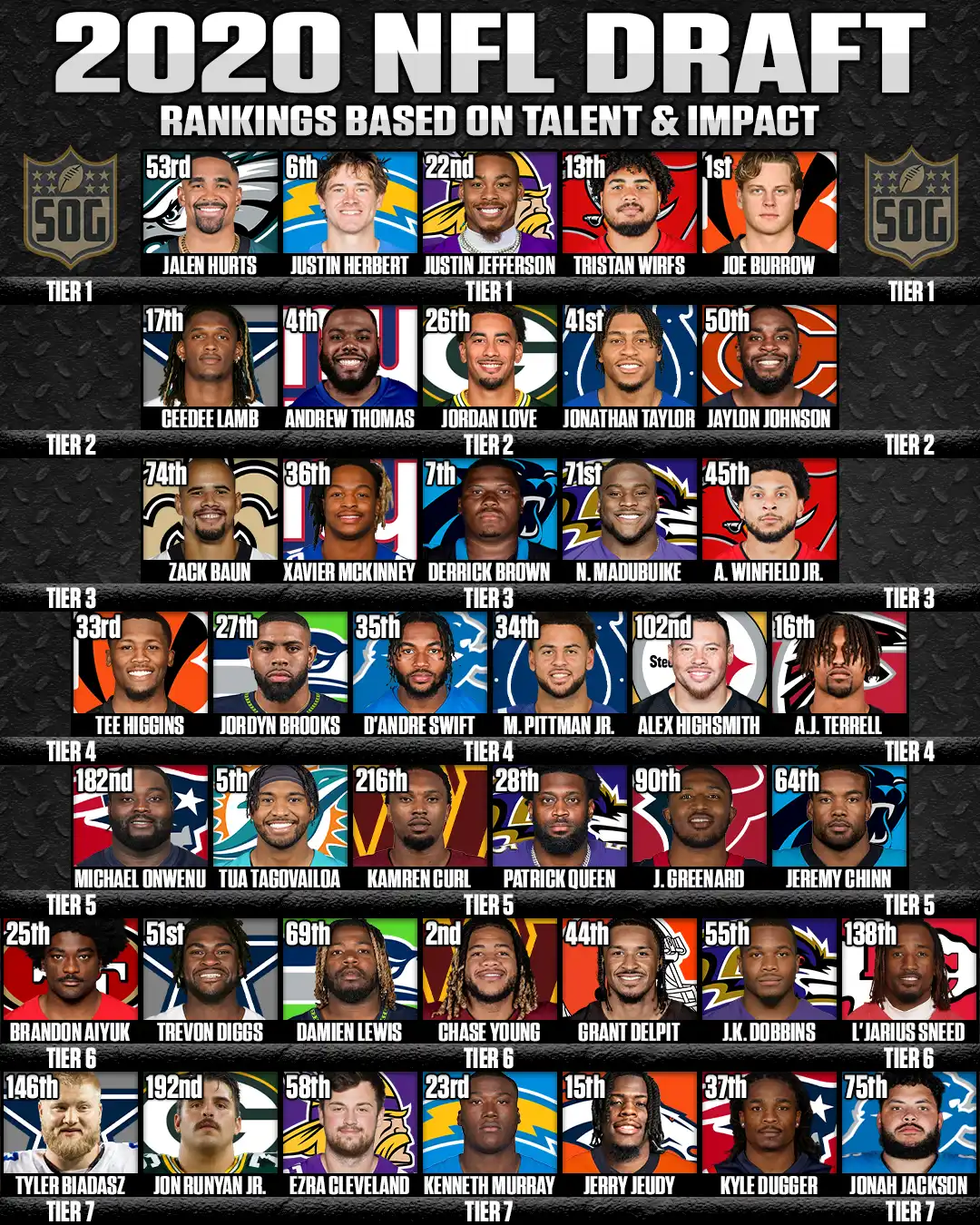
SOGSports ranks the best players from the 2020 NFL Draft class based on talent and long-term NFL impact.
Table of Contents
- How These 2020 NFL Draft Rankings Were Built
- Tier 1
- Tier 2
- Tier 3
- Tier 4
- Tier 5
- Tier 6
- Tier 7
- Biggest Takeaways From the 2020 NFL Draft Class
- FAQ: Best Players From the 2020 NFL Draft
How These 2020 NFL Draft Rankings Were Built
This ranking leans on four things: pure talent, peak level, positional value, and real NFL impact. That is why quarterbacks with franchise-level outcomes get pushed up, why dominant tackles carry more weight than solid players at lighter-value positions, and why a guy’s original draft slot is not doing much heavy lifting here.
The other goal was to keep the write-ups current. A lot of 2020 class content still reads like it is frozen two years ago. This does not. If a player’s stock changed because of a 2025 breakout, another injury, a messy team situation, or a more complete résumé, that matters here.
Tier 1
Joe Burrow (Cincinnati Bengals)
Drafted: 1st round, 1st overall
Burrow still has the strongest overall case at the top because this is what teams are actually trying to find when they pick early: a quarterback who changes the temperature of the entire building. Cincinnati stopped feeling like a team hoping to get lucky once he got there. Even with a less dominant 2025 than some expected, the full picture still looks like a franchise quarterback who justified being the face of the class.
Justin Herbert (Los Angeles Chargers)
Drafted: 1st round, 6th overall
If someone wanted Herbert at No. 1 based on raw quarterback talent, it would be a defensible take. The arm is ridiculous, the numbers have stayed strong, and the Chargers have spent years asking him to carry more than most quarterbacks should. Burrow has the edge for me because of the full résumé and team-level impact, but Herbert is absolutely in the same neighborhood.
Justin Jefferson (Minnesota Vikings)
Drafted: 1st round, 22nd overall
Jefferson is the cleanest non-quarterback superstar in the class. It is not just that he was a steal at No. 22. It is that he became the kind of receiver defensive coordinators build the entire week around. Even when the touchdown total in 2025 looked unusually low by his standards, he was still the same problem for everybody who had to cover him.
Tristan Wirfs (Tampa Bay Buccaneers)
Drafted: 1st round, 13th overall
There are not many easier hindsight wins in this draft than Wirfs. Tampa Bay got a premium tackle and ended up with one of the best offensive linemen in football. The 2025 injury issues were frustrating, but they did not really change the larger takeaway. Healthy Wirfs is still a massive value piece in a class like this.
Jalen Hurts (Philadelphia Eagles)
Drafted: 2nd round, 53rd overall
Hurts belongs here because second-round quarterbacks are not supposed to pay off like this. He became a franchise answer, not a decent gamble. There are still debates about how high he should rank among current NFL quarterbacks, but that is almost missing the point. Philadelphia got a legitimate centerpiece on Day 2, and that is one of the biggest wins anywhere in this class.
Tier 2
CeeDee Lamb (Dallas Cowboys)
Drafted: 1st round, 17th overall
Lamb never quite reached Jefferson territory, but that is a brutal standard to judge anyone by. He still turned into a true No. 1 receiver and one of the best offensive outcomes from the entire class. In a weaker draft, he would be banging on the Tier 1 door a lot harder than he is here.
Andrew Thomas (New York Giants)
Drafted: 1st round, 4th overall
Thomas is a good reminder that people rush to grade offensive tackles way too early. The Giants got their long-term left tackle, which is a massive win no matter how ugly the early discourse looked. That position is too valuable and too hard to fill to do anything other than respect this outcome.
Jordan Love (Green Bay Packers)
Drafted: 1st round, 26th overall
Love is still one of the hardest names to place because his path took longer and the résumé is not as thick as the guys above him. But once Green Bay handed him the offense, the talent was obvious and the ceiling stopped feeling theoretical. He is not being ranked on projection anymore. He has shown enough to belong in this range.
Jonathan Taylor (Indianapolis Colts)
Drafted: 2nd round, 41st overall
Running backs usually need a real peak to climb this high, and Taylor had one. When he is right, he still looks like one of the few backs from this class who can completely change a game script. The position naturally pulls him down a little compared to quarterbacks and premium linemen, but the best version of Taylor was too good to shrug off.
Jaylon Johnson (Chicago Bears)
Drafted: 2nd round, 50th overall
Johnson is one of the quieter great picks from this class. He never needed a huge media campaign to prove he belonged. He just kept turning into a high-level corner, which is exactly the kind of player teams spend years trying to find.
Tier 3
Zack Baun (New Orleans Saints)
Drafted: 3rd round, 74th overall
Baun is one of the best reminders that draft classes do not settle the way people think they will. He was not treated like one of the defining names from 2020 when he came into the league. Years later, he looks like one of the better values anywhere on the board. That kind of rise deserves more than a casual mention.
Xavier McKinney (New York Giants)
Drafted: 2nd round, 36th overall
McKinney is not the flashiest player on this page, but he became the kind of safety teams trust without having to think twice about it. That matters. He brought stability, range, and real value to the back end, which makes him one of the stronger defensive outcomes from the class.
Derrick Brown (Carolina Panthers)
Drafted: 1st round, 7th overall
Brown gave Carolina exactly what a premium defensive tackle is supposed to give you: size, force, disruption, and real value in the middle. He may not get talked about like the skill guys from this class, but players like this are a huge part of why teams win up front.
Nnamdi Madubuike (Baltimore Ravens)
Drafted: 3rd round, 71st overall
Madubuike feels like one of those Baltimore picks that looked solid at the time and then kept aging better. He turned into one of the better non-first-round defenders from the class and became a pretty easy hindsight riser once the full body of work stacked up.
Antoine Winfield Jr. (Tampa Bay Buccaneers)
Drafted: 2nd round, 45th overall
Winfield has always felt bigger than a normal safety evaluation. He makes plays, he fits winning football, and he shows up in moments that matter. Tampa Bay did not just get a starter here. It got one of the smartest all-around defensive picks from the class.
Tier 4
Tee Higgins (Cincinnati Bengals)
Drafted: 2nd round, 33rd overall
Higgins is the kind of receiver who would look even better in a less loaded class. He became a real weapon, stayed productive, and was still finding the end zone in 2025 even without the kind of weekly volume some top receivers get. For a second-round pick, that is a hell of a return.
Jordyn Brooks (Seattle Seahawks)
Drafted: 1st round, 27th overall
Brooks is not going to win the style points battle on a page like this, but he became a productive linebacker and a much better first-round outcome than a lot of louder names from 2020. There is real value in just being a good player for a long time.
D’Andre Swift (Detroit Lions)
Drafted: 2nd round, 35th overall
Swift has always had the talent to tease you into thinking there should be even more here. That is probably what makes him frustrating. Still, the explosiveness was real, the versatility was real, and there is enough actual production on the board to keep him comfortably in this range.
Michael Pittman Jr. (Indianapolis Colts)
Drafted: 2nd round, 34th overall
Pittman became the kind of sturdy Day 2 hit teams should be thrilled to get. He is not the most electric receiver in this class, but he has been physical, dependable, and clearly worth where he went. That is not flashy value. It is winning value.
Alex Highsmith (Pittsburgh Steelers)
Drafted: 3rd round, 102nd overall
Highsmith is one of the easiest players to point to when explaining why redrafts never look like the original board. He was not one of the stars of draft weekend, then turned into a player Pittsburgh could actually lean on. That is a serious overdelivery for where he was picked.
A.J. Terrell (Atlanta Falcons)
Drafted: 1st round, 16th overall
Terrell ended up being a really good answer to a pick that got too much heat at the time. Atlanta found a quality starting corner and got a far better first-round outcome than plenty of teams drafting around them. That ages well.
Tier 5
Michael Onwenu (New England Patriots)
Drafted: 6th round, 182nd overall
Onwenu is one of the best bargain picks in the whole class. Late-round linemen are not supposed to become this useful, this flexible, or this steady. New England got a real starter long after most teams were already swinging at depth pieces.
Tua Tagovailoa (Miami Dolphins)
Drafted: 1st round, 5th overall
Tua is still one of the strangest evaluations from the class because there are enough good stretches on tape to see why people believed, but the full story never settled into something cleaner. He belongs here because starting-caliber quarterback play still matters a lot. He just never fully escaped the feeling that there should have been more.
Kamren Curl (Washington Commanders)
Drafted: 7th round, 216th overall
Curl is exactly the type of Day 3 hit teams fantasize about. Washington got way more than it paid for, and he pretty quickly showed he was not just some depth flyer who happened to stick. Picks like this are a huge part of what makes the 2020 class feel deeper than the surface version.
Patrick Queen (Baltimore Ravens)
Drafted: 1st round, 28th overall
Queen never had the smoothest career arc, but there is enough real production here to keep him in a respectable spot. He did not become a star, but he also did not wash out or leave Baltimore with nothing. In a class this volatile, that matters.
Jonathan Greenard (Houston Texans)
Drafted: 3rd round, 90th overall
Greenard turned into another really nice hit outside the glamorous range of the draft. Pass-rush value always ages well, and he delivered more of it than his draft slot suggested he would. That is one of the cleaner arguments for keeping him in this part of the ranking.
Jeremy Chinn (Carolina Panthers)
Drafted: 2nd round, 64th overall
Chinn always had a different kind of appeal because the size and versatility were part of the pitch from the start. He never fully became a star, but he absolutely became a useful NFL player with real value. That is enough to keep him firmly on the page.
Tier 6
Brandon Aiyuk (San Francisco 49ers)
Drafted: 1st round, 25th overall
Aiyuk is one of the hardest players in the whole class to rank right now because the talent is obvious and the current situation is a mess. He looked like a much higher-tier guy at his best, then the 2024 knee injury changed everything and the 2025 reserve/left team situation made it feel even shakier. Pure ability says he could be placed higher. The reality surrounding him makes that a lot tougher.
Trevon Diggs (Dallas Cowboys)
Drafted: 2nd round, 51st overall
Diggs has always been one of those players who creates a different argument depending on what you value. The ball production is real. The splash plays are real. The full picture is just a little more complicated than the highlights make it seem, which is why he settles here instead of climbing into the upper groups.
Damien Lewis (Seattle Seahawks)
Drafted: 3rd round, 69th overall
Lewis is another good example of a team getting a lot of stability without spending premium capital. He is not going to dominate the conversation on a rankings page like this, but teams absolutely value outcomes like this when they look back at a class.
Chase Young (Washington Commanders)
Drafted: 1st round, 2nd overall
Young is one of the most important names to get right in this class because the easy take is usually the lazy one. He won Defensive Rookie of the Year right away, so the start was real. The bigger problem is that the career never launched into the superstar track people expected from the No. 2 pick. The 2025 bounce-back with New Orleans helped and mattered. It just did not fully erase the gap between the prospect hype and the long-term result.
Grant Delpit (Cleveland Browns)
Drafted: 2nd round, 44th overall
Delpit never became one of the defining safeties from the class, but he carved out a real role and stayed relevant. That might not sound glamorous, but it is meaningful in a group with as many misses and half-hits as this one had.
J.K. Dobbins (Denver Broncos)
Drafted: 2nd round, 55th overall
Dobbins is one of the most frustrating what-if players from the whole class because the burst has never really been the issue. He gave Denver real juice in 2025, then got clipped again by injury and ended up back on the shelf after foot surgery. The Broncos bringing him back in 2026 says a lot about how much talent is still there. It also says the durability question is not going away.
L’Jarius Sneed (Kansas City Chiefs)
Drafted: 4th round, 138th overall
Sneed is one of those players winning teams always seem to uncover. Kansas City got toughness, versatility, and real value without paying premium draft capital for it. He may not get pushed to the front of every conversation about this class, but he absolutely made it stronger.
Tier 7
Tyler Biadasz (Dallas Cowboys)
Drafted: 4th round, 146th overall
Biadasz gave Dallas a real player, which already makes him a solid outcome relative to where he was picked. Not every good draft result needs to become a star.
Jon Runyan Jr. (Green Bay Packers)
Drafted: 6th round, 192nd overall
Runyan turned into exactly the sort of lineman coaches appreciate more than fans usually do. He could give you playable snaps, hold up in a group, and keep an offensive line from becoming a weekly problem.
Ezra Cleveland (Minnesota Vikings)
Drafted: 2nd round, 58th overall
Cleveland never made a real jump into the higher tiers, but he stayed in the league and stayed usable. In a class with some legitimate flameouts, that is still worth something.
Kenneth Murray (Los Angeles Chargers)
Drafted: 1st round, 23rd overall
Murray is a good example of why draft pedigree does not carry much weight in a hindsight ranking. He got the opportunity. The final payoff just never matched the billing that came with where he was picked.
Jerry Jeudy (Denver Broncos)
Drafted: 1st round, 15th overall
Jeudy always felt like a player people wanted to rank on flashes and route-running rather than the full résumé. The talent was obvious. The complete payoff just never consistently matched the imagination.
Kyle Dugger (New England Patriots)
Drafted: 2nd round, 37th overall
Dugger deserves credit because he came from a less conventional background and still became a real NFL player. He may not have climbed into the upper defensive group from this class, but he gave New England a legit return.
Jonah Jackson (Detroit Lions)
Drafted: 3rd round, 75th overall
Jackson turned into a useful pick and a solid piece up front. He was never going to carry a ranking page like this, but he gave Detroit real value, which is more than a lot of players from this class can say.
Biggest Takeaways From the 2020 NFL Draft Class
The biggest takeaway is how much the original order cracked once the actual careers started settling in. Some early picks absolutely justified the investment. Others got jumped hard by players taken later, especially at receiver, safety, edge, and along the offensive line.
The other big thing is how much offensive firepower came out of this class. Burrow, Herbert, Hurts, Jefferson, Lamb, Higgins, and Taylor gave 2020 real star power, and Wirfs plus Thomas made sure it was not just a skill-position-heavy group.
There is enough defensive substance here too to keep the class from feeling top-heavy. Winfield, Jaylon Johnson, McKinney, Madubuike, Brown, Baun, Highsmith, and Terrell all helped balance it out. It was not a perfect class, but it ended up being a much deeper and more interesting one than people sometimes remember.
Conclusion
Years later, the 2020 NFL Draft still stands out because it gives you everything a good hindsight class should. It gave the league franchise quarterbacks, star receivers, premium linemen, late-round wins, and enough misses near the top to keep the debates alive. That is why the board looks so different now than it did the night it happened.
Some classes are remembered for one or two stars. This one is better than that. It has enough top-end talent to matter and enough movement throughout the board to stay interesting. That mix is what makes the 2020 class one of the best ones to rerank honestly.
For a broader look at the class, check out the 2020 NFL Draft hub. You can also jump into the 2020 NFL redraft, the 2020 NFL Draft grades, the biggest steals, and the biggest busts.
FAQ: Best Players From the 2020 NFL Draft
Who was the best player in the 2020 NFL Draft?
Joe Burrow has the strongest overall case because franchise quarterbacks carry the most value, but Justin Herbert is right there too. If you are talking strictly non-quarterbacks, Justin Jefferson has the clearest argument.
Who was the biggest steal in the 2020 NFL Draft?
Justin Jefferson at No. 22 is the easy mainstream answer, but he is not the only one. Michael Onwenu, Zack Baun, Alex Highsmith, and Kamren Curl all badly outplayed where they were drafted.
Was the 2020 NFL Draft a strong class?
Yes. It produced franchise quarterbacks, elite wide receiver talent, premium offensive line play, and enough useful depth to stay interesting well beyond the first round.
Why is Justin Jefferson ranked so high in the 2020 NFL Draft class?
Because he became one of the best receivers in football and one of the clearest examples in the class of a team getting way more than the draft slot suggested.
Why is Tristan Wirfs ranked near the top?
Because dominant offensive tackles are incredibly valuable and incredibly hard to find. Tampa Bay got one.
Why is Chase Young lower than people expected?
Because the start of the career was strong, including a Defensive Rookie of the Year season, but the long-term arc never fully became the superstar story people expected from the No. 2 pick. The 2025 bounce-back helped, but it did not completely reset the full evaluation.
Which players from the 2020 NFL Draft climbed the most in hindsight?
Justin Jefferson is the obvious headliner, but Jalen Hurts, Michael Onwenu, Zack Baun, Alex Highsmith, and Kamren Curl all look much better now than they did when the draft happened.
Want more NFL draft content?
Browse more NFL rankings and tier lists on SOGSports here and follow @sogfootball for daily debates and graphics.
