Twenty-six teams have held 1st overall picks since 2000. Only two of those selections landed in a tier of their own. The rest of this list shows just how many different ways a franchise can miss on the player it was most certain about.
Some of these picks became true franchise pillars. Some were very good without fully changing the league. Some flashed, stalled, or never came close to justifying the weight of the spot. This ranking is not just about talent. It is about career value, peak performance, longevity, and how much each player actually delivered relative to the pressure that comes with going first overall.
Table of Contents
How These Rankings Were Made
Peak performance matters. Longevity matters. Individual production, awards, positional value, and how clearly a player justified being the first name called all factor in. Team success is part of the discussion, but it is not the ceiling or the floor for anyone here.
Quarterbacks carry higher expectations than any other position, so they are judged on a slightly different curve. The question is not just whether they were good, but whether they became the kind of player a franchise could trust with its identity for a decade. Non-quarterbacks are evaluated primarily on individual dominance, durability, and impact at their position.
Players still early in their careers are placed with that context stated clearly. This is not a final verdict on anyone still building the résumé.
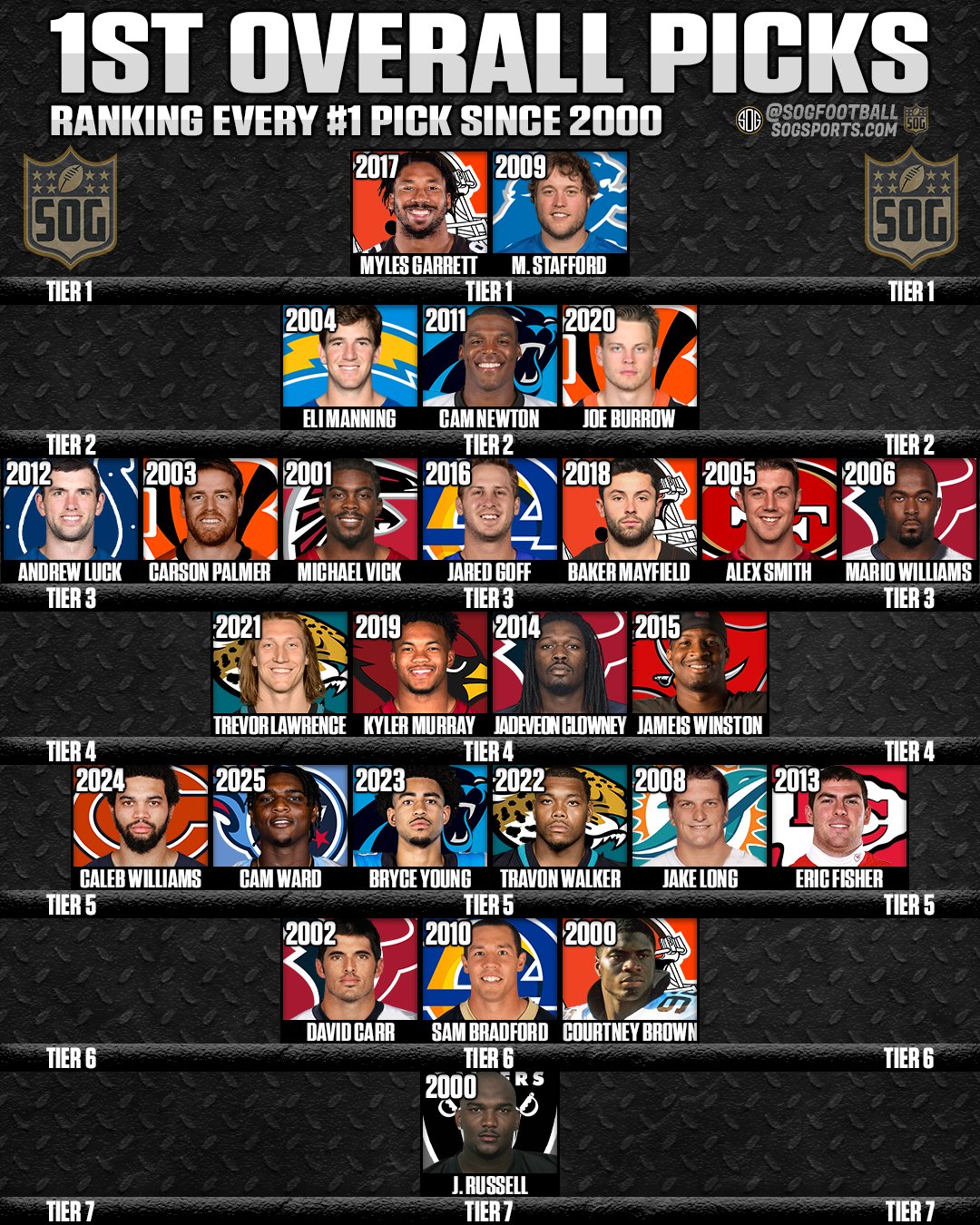
SOG Sports tier list ranking every NFL No. 1 overall pick since 2000.
TIER 7
JaMarcus Russell — Oakland Raiders — 2007
Oakland gave Russell $68 million guaranteed and got 7 touchdowns, 23 interceptions, and a 65.2 passer rating across 25 starts. He was out of the league before turning 26. The arm talent was real, which is why the pick happened in the first place, but almost everything else fell apart fast. Work ethic, conditioning, and preparation all became issues almost immediately. When people debate the biggest bust in modern draft history, this is where the conversation starts and usually ends.
TIER 6
David Carr — Houston Texans — 2002
Carr was sacked 76 times as a rookie, an NFL record that still stands and probably explains everything that came after. The expansion-team setup was brutal, and it clearly damaged him in ways he never fully recovered from. He finished 23-37 as a starter before Houston moved on. You can understand the context and still admit the pick did not deliver what a No. 1 quarterback is supposed to deliver.
Sam Bradford — St. Louis Rams — 2010
Bradford looked the part when healthy and finished his career completing 65.8 percent of his passes. The problem was that healthy never lasted. Two torn ACLs before age 27, plus additional knee and shoulder problems, kept him from building any real momentum. He started more than 14 games in a season exactly once. A respectable career is not what a team wants from the first pick in the draft.
Courtney Brown — Cleveland Browns — 2000
Brown finished with 17 sacks in five seasons and never had more than 4.5 in a year. Cleveland drafted him expecting a long-term cornerstone off the edge. Injuries wrecked the plan almost immediately. He was not a character issue or a lack-of-effort case — his body just never held up. The gap between what he was supposed to be and what he actually became is why he lands here.
TIER 5
Caleb Williams — Chicago Bears — 2024
Williams threw for 3,541 yards with 20 touchdowns and 6 interceptions as a rookie on a Bears team that finished 5-12. The numbers were decent. The environment was not. It is still too early to make a hard judgment on where his career is headed, which is why he lands in the incomplete tier instead of somewhere more definitive.
Cam Ward — Tennessee Titans — 2025
Ward is further from a verdict than anyone on this list. This placement is not an insult — it is simply the reality that there is almost nothing to evaluate yet. He could climb quickly if he becomes the answer in Tennessee, but anything stronger than that right now would be manufactured certainty.
Bryce Young — Carolina Panthers — 2023
Young threw for 2,877 yards with 11 touchdowns and 10 interceptions in 2023, then got benched midway through 2024 before reclaiming the job in a carousel that said as much about Carolina’s front office as it did about Young. There is still talent here and still time to climb. The early return was not strong enough to place him anywhere else for now.
Travon Walker — Jacksonville Jaguars — 2022
Walker was always a projection pick, drafted more for traits and upside than for a polished college résumé. He has not been a bust, but he also has not produced the pass-rush numbers you want from a first overall edge defender. The athleticism is obvious. The full payoff is still pending.
Jake Long — Miami Dolphins — 2008
Long made four Pro Bowls in his first four seasons and was one of the better left tackles in football during that stretch. Then the injuries hit and never really stopped — shoulder, knee, Achilles, all of it piling up. He retired at 30. The peak was real. It just was not long enough to push him higher.
Eric Fisher — Kansas City Chiefs — 2013
Fisher gave Kansas City a solid long-term starter at left tackle, made two Pro Bowls, and helped anchor an offense that eventually became one of the most dangerous in football. There is genuine value in that. He just never felt like a dominant No. 1 overall pick or a player who defined his draft class.
TIER 4
Trevor Lawrence — Jacksonville Jaguars — 2021
Lawrence’s 2022 season — 4,113 yards, 25 touchdowns, 8 interceptions, and a playoff win over the Chargers — looked like the arrival of a true franchise quarterback. His 2023 was even better: 4,016 yards and 40 touchdowns. Then 2024 brought injuries and enough regression to create real doubt. The talent is obvious and the flashes are more than enough to keep belief alive. He is here because he has not yet turned that promise into consistent dominance.
Kyler Murray — Arizona Cardinals — 2019
Murray has three seasons of 3,700-plus passing yards, threw 26 touchdowns in 2020, and can make plays that few quarterbacks in the league can make. He has also missed significant time with injuries and has never fully taken control of the direction of the franchise. The talent was never the issue. Durability and full command of the role still are.
Jadeveon Clowney — Houston Texans — 2014
Clowney was supposed to become one of the defining defensive players of his era. He never posted a double-digit sack season and spent much of his career bouncing from team to team on short deals. Useful, disruptive, and talented — but not the type of sustained force this pick was meant to produce.
Jameis Winston — Tampa Bay Buccaneers — 2015
Winston threw for 5,109 yards and 33 touchdowns in 2019. He also threw 30 interceptions that same season — the most by any quarterback since 2002. That tension defined him in Tampa Bay. He was productive, reckless, entertaining, and impossible to fully trust. The arm talent was real. The full quarterback package never quite got there.
TIER 3
Andrew Luck — Indianapolis Colts — 2012
If this were only a peak discussion, Luck would have a real argument to rank even higher. He posted a 99.1 passer rating in 2014, carried Indianapolis to multiple playoff runs, and absorbed punishment behind an offensive line that was never good enough for what they were asking him to do. He retired at 29 because his body was broken and he no longer wanted to play through it. The early exit is the only thing keeping him out of a higher tier. The talent itself was elite.
Carson Palmer — Cincinnati Bengals — 2003
Palmer finished with 46,247 career passing yards and 294 touchdowns, and gave Cincinnati a real answer at quarterback after years of instability at the position. His 2005 season showed what his ceiling looked like before a knee injury changed the trajectory. The injuries slowed the momentum, but the overall body of work holds up well here.
Michael Vick — Atlanta Falcons — 2001
Vick became the first quarterback in NFL history to rush for 1,000 yards in a season and changed what the position could look like in the open field. His 2010 comeback in Philadelphia — 21 touchdowns, 6 interceptions, 100.2 passer rating — reminded everyone how high the ceiling really was. The career was interrupted by a federal prison sentence from 2007 to 2009 and never fully recovered its trajectory. The peak was still special enough to land here.
Jared Goff — Los Angeles Rams — 2016
Goff threw for 4,688 yards in 2018 and reached the Super Bowl with the Rams. After being traded to Detroit, he rebuilt his reputation and put up 4,575 yards with 29 touchdowns in 2023 while taking the Lions to the NFC Championship. Public perception on Goff has never caught up with what he has actually produced. He belongs in this tier.
Baker Mayfield — Cleveland Browns — 2018
Mayfield went 11-5 in Cleveland in 2020 and helped end one of the ugliest stretches in franchise history. After getting bounced around, he landed in Tampa and threw for 4,044 yards with 28 touchdowns and 10 interceptions in 2023 to win the NFC South. The career arc has been noisier than most. The total case is better than people remember.
Alex Smith — San Francisco 49ers — 2005
Smith suffered a catastrophic leg injury in 2018 that required 17 surgeries and came close to requiring amputation. He returned to play in 2020 and won Comeback Player of the Year. He finished with 35,650 career passing yards. He was never the flashy top pick San Francisco imagined, but he survived chaos, reinvented himself multiple times, and delivered far more value than the early chapters of his career suggested he would.
Mario Williams — Houston Texans — 2006
Williams caught immediate heat for being drafted ahead of Reggie Bush, then spent years proving he was a legitimate force. He put up 53 sacks in his first six Houston seasons and finished his career with 97.5 total. He was not a cultural event the way some pass rushers become. He was just consistently dominant, which is exactly what a franchise is supposed to get when it takes a defensive end first overall.
TIER 2
Eli Manning — San Diego Chargers — 2004
Manning finished with 57,023 career passing yards and 366 touchdowns. The regular season was inconsistent enough to keep the debate alive for his entire career. The playoff résumé — two Super Bowl MVPs, both against New England, both as the underdog, both requiring him to be the best player on the field — is not debatable. Those two runs will always give him a legitimate argument in this discussion.
Cam Newton — Carolina Panthers — 2011
Newton’s 2015 MVP season: 3,837 passing yards, 35 touchdowns, 10 interceptions, 10 rushing touchdowns, a 15-1 regular-season record, and a Super Bowl appearance. He finished his career with 75 rushing touchdowns, the most by a quarterback in NFL history. At his peak he was doing things no quarterback had done before at that size and speed. The durability issues that cut the peak short are why he is not in Tier 1. That peak alone is why he is not lower.
Joe Burrow — Cincinnati Bengals — 2020
Burrow led Cincinnati to the Super Bowl in just his second season. In 2023, before a wrist injury ended his year, he threw for 4,918 yards with 41 touchdowns and 12 interceptions and was the best quarterback in football for the stretch he was healthy. The accuracy, command, and poise under pressure are as clean as any quarterback on this list. There is still more career to build, but the foundation already justifies this placement.
TIER 1
Myles Garrett — Cleveland Browns — 2017
Garrett has more than 105 career sacks, won Defensive Player of the Year in 2023, and led the league with 14 sacks that season. He has been one of the two or three most feared pass rushers in football for the better part of six years. When a franchise drafts an edge rusher first overall, this is the version they are hoping for and almost never get.
The reasonable counter is that quarterback value should always win the top spot on a list like this. That argument holds in the abstract. This ranking is about what players actually became. Garrett has delivered elite production, elite durability, and elite impact year after year. That is enough to share the top tier with the one quarterback on this list who earned it outright.
Matthew Stafford — Detroit Lions — 2009
Stafford is one of five quarterbacks in NFL history to throw for more than 50,000 career yards, finishing with over 57,000 — among the top five all-time. He spent the first twelve seasons of his career in Detroit, never had a winning record, and showed up every week behind offensive lines that ranged from mediocre to genuinely poor. Then he went to Los Angeles, threw for 4,886 yards in 2021, and won Super Bowl LVI.
Volume, toughness, longevity, peak performance, and a ring. That is the full profile of a first overall pick who actually lived up to what the spot demands.
FAQ
Who is the best No. 1 overall pick since 2000?
Myles Garrett and Matthew Stafford are the only two players in Tier 1. Garrett has the cleaner dominance at his position. Stafford has the quarterback value, the 57,000-plus career passing yards, and the Super Bowl. Both have a legitimate claim.
Who is the biggest bust among No. 1 overall picks since 2000?
JaMarcus Russell. Oakland gave him $68 million guaranteed and he threw 7 touchdowns against 23 interceptions before washing out before his 26th birthday. The arm talent was real. Everything else required to be an NFL quarterback was not.
Why is Eli Manning listed with the San Diego Chargers?
Because this ranking uses each player’s original drafted team only. Manning was selected first overall by San Diego in 2004 and immediately traded to the Giants.
Why are Caleb Williams and Cam Ward ranked this low already?
Because this list is based on what players have done so far, not what they might become. Both could rise significantly with time. Right now, there is not enough completed résumé to place them higher.
Was Andrew Luck good enough to rank higher?
At his peak, absolutely. The reason he does not rank higher is straightforward: the career ended too early. The talent was top-tier. The total body of work ended up shorter than the players above him.
Final Thoughts
Twenty-six first overall picks since 2000. Only two in Tier 1. That ratio is not an accident — it reflects how hard it actually is to identify a 21-year-old who will carry a franchise for the next decade and then actually do it.
Myles Garrett and Matthew Stafford stand alone because they removed all doubt. Garrett became one of the most dominant defenders in football. Stafford built the full quarterback résumé and finished it with a ring. Everyone else on this list falls somewhere between a good bet that did not fully peak and a brutal reminder of how wrong a franchise can be when it thinks it has the safest answer on the board.
